-
新人教版高中英语选修2Unit 2 Using langauge-Listening教学设计
? B: Absolutely! Getting involved with Chinese cultural activities there definitely helped a lot. I got to practice my Chinese on a daily basis, and I could learn how native Chinese speakers spoke.? A: What do you feel is your biggest achievement?? B: Learning Chinese characters! I have learnt about 1,500 so far. When I first started, I didn't think it was even going to be possible to learn so many, but now I find that I can read signs, menus, and even some easy newspaper articles.? A: What are you most keen on?? B: I've really become keen on learning more about the Chinese culture, in particular Chinese calligraphy. As I have learnt Chinese characters, I have developed a great appreciation for their meaning. I want to explore Chinese characters by learning how to write them in a more beautiful way. ? A: Finally, what do you want to say to anyone interested in learning Chinese?? I have really become keen on learning more about the Chinese culture, in particular Chinese Calligraphy. As I have learnt Chinese character, I have developed a great appreciation for their meaning. I want to explore Chinese characters by learning how to write them in a more beautiful way.? A: Finally, what do you want to say to anyone interested in learning Chinese?? B: I'd say, give it a shot! While some aspects may be difficult, it is quite rewarding and you will be happy that you tried.? A: Thanks for your time. ? B:You're welcome.
新人教版高中英语选修2Unit 4 Learning about Language教学设计
This section guides students to pay attention to the typical context of vocabulary use, helps students accumulate vocabulary around the key vocabulary of this unit, and uses the learned words and word chunks in different contexts to deeply understand their meaning and usage, so as to achieve the purpose of review and consolidation.The teaching design activities aim to guide students to pay attention to the typical context in which the target vocabulary is used, as well as the common vocabulary used in collocation, so that students can complete the sentence with correct words. In terms of vocabulary learning strategies, this unit focuses on cultivating students' ability to pay attention to collocation of words and to use word blocks to express meaning.For vocabulary learning, it is not enough just to know the meaning of a single word, but the most important thing is to master the common collocations of words, namely word blocks.Teachers should timely guide students to summarize common vocabulary collocation, such as verb and noun collocation, verb and preposition collocation, preposition and noun collocation, and so on.1. Guide students to understand and consolidate the meaning and usage of the vocabulary in the context, 2. Guide the students to use the unit topic vocabulary in a richer context3. Let the students sort out and accumulate the accumulated vocabulary, establishes the semantic connection between the vocabulary,4. Enable students to understand and master the vocabulary more effectivelyGuiding the Ss to use unit topic words and the sentence patterns in a richer context.
新人教版高中英语选修2Unit 4 Reading for writing教学设计
假定你是英国的Jack,打算来中国旅行,请你给你的中国笔友李华写一封信,要点如下:1.你的旅行计划:北京→泰山→杭州;2.征求建议并询问他是否愿意充当你的导游。注意:1.词数80左右(开头和结尾已给出,不计入总词数);2.可以适当增加细节,以使行文连贯。参考词汇:故宫 the Forbidden City;泰山 Mount TaiDear Li Hua,I'm glad to tell you that 'm going to visit China.First,I am planning to visit Beijing,the capitalof China,where I am looking forward to enjoying the Great Wall,the Forbidden City and somebeautiful parks.Then I intend to go to visit Mount Tai in Shandong Province.I've heard that it is one ofthe most famous mountains in China and I can't wait to enjoy the amazing sunrise there.After that,I amalso going to Hangzhou.It is said that it is a beautiful modern city with breathtaking natural sights,among which the West Lake is a well- known tourist attraction.What do you think of my travel plan? Will you act as my guide? Hope to hear from you soon.
新人教版高中英语选修2Unit 4 Using langauge-Listening教学设计
The theme of the listening section is " talking about scenery and culture along a journey."The part is designed to further lead the students to understand Canadian natural geography and social environment, and integrated into the cultural contrast by mentioning the long train journey from Beijing to Moscow routes. On this basis, the part activates students related travel experience, lets the student serial dialogue, guides the student to explore further the pleasure and meaning of the long journey, and Chinese and foreign cultural comparison.The part also provides a framework for the continuation of the dialogue, which is designed to provide a framework for students to successfully complete their oral expressions, and to incorporate an important trading strategy to end the dialogue naturally.1. Help students to understand and master some common English idioms in the context, and experience the expression effect of English idioms.2. Guide the students to understand the identity of different people in the listening context, and finish the dialogue according to their own experience.3. Instruct the students to use appropriate language to express surprise and curiosity about space and place in the dialogue, and master the oral strategy of ending the dialogue naturally.1. Instruct students to grasp the key information and important details of the dialogue.2. Instruct students to conduct a similar talk on the relevant topic.
新人教版高中英语必修3Unit 1 Festivals and Celebrations教学设计二
1. Ss look at the picture and scan the passage to understand the main idea while teacher is giving the following questions to inspire Ss to think.*Where are those people?*What are they doing?*Why are they so excited?2. Ss complete the passage with the appropriate -ing form. Then discuss and check the answers with class.Answers: boring, interesting, taking, exciting, amazing3. The teacher raises questions for the students to discuss and encourages them to express their opinions.*Do you like La Tomatina? Why or why not?4. Each group representative reports the discussion result, the teacher gives feedback and the evaluation.Step 6 PracticeActivity 41. Ss complete the Ex 2 in Using structures.2. Check the answers after finishing the exercises.①The dragon boat races are the most exciting part of the Dragon Boat Festival.② The children were excited to go Easter egg hunting.③What an amazing performance! This is the best music festival I have ever been to.④We were amazed by her funny-looking hat.⑤His inspiring speech at the conference won the admiration/ favour of the audience.⑥This is a challenging game to test your memory and observation capabilities. 3. T asks Ss to finish Ex 3 and 4 in Using structures by themselves, then check the answers with class.Step 6 Homework1. Understand and master the functions and usage of the -ing form;2. Finish the other exercises in Using structures.1、通过本节内容学习,学生是否理解和掌握动词-ing形式作定语和表语的功能和意义;2、通过本节内容学习,学生能否在理解文段内容的基础上,根据上下文语境和表达逻辑,能正确运用动词-ing形式描述节日庆典。3、通过本节内容学习,学生是否归纳和积累用于表达情绪的相关词汇。
新人教版高中英语必修3Unit 2 Morals and Virtues教学设计二
Activity 41. Students complete the task of activity 4, then teachers and students check the answers. 2. The teacher organized the students to work together and asked them to use the tables and mind maps sorted out before to retold the important choices in Lin Qiaozhi's life and their resultsStep 5 Language points1. The teacher asks the students to read the text carefully, find out the core words and long and difficult sentences in the text and draw lines, understand the use of vocabulary, and analyze the structure of long and difficult sentences. 2. The teacher explains and summarizes the usage of core vocabulary and asks the students to take notes. 3. The teacher analyzes and explains the long and difficult sentences that the students don't understand, so that the students can understand them better. Step 6 Homework1. Read the text again, in-depth understanding of the text; 2. Master the use of core vocabulary and understand the long and difficult sentences. 3. Complete relevant exercises in the guide plan. 1、通过本节内容学习,学生是否理解和掌握阅读文本中的新词汇的意义与用法;2、通过本节内容学习,学生能否结合文本特点总结林巧稚的人生原则和人格品质特征;3、通过本节内容学习,学生能否针对人生抉择发表自己的看法;能否全面地、客观地、理性地看待问题,进而对道德和人性有更加深入的思考和理解。
新人教版高中英语必修3Unit 2 Morals and Virtues教学设计四
3.Teachers ask different groups to report the answers to the questions and ask them to try different sentence patterns.The teacher added some sentence patterns for students to refer to when writing.Step 4 Writing taskActivity 51.Write the first draft.Students first review the evaluation criteria in activity 5, and then independently complete the draft according to the outline of activity 4, the answers to the questions listed in the group discussion and report, and the reference sentence pattern.2.Change partners.The teacher guides the students to evaluate their partner's composition according to the checklist of activity 5 and proposes Suggestions for modification.3.Finalize the draft.Based on the peer evaluation, students revise their own compositions and determine the final draft.Finally, through group recommendation, the teacher selects excellent compositions for projection display or reading aloud in class, and gives comments and Suggestions.Step 5 Showing writingActivity 5T call some Ss to share their writing.Step 6 Homework1. Read the passage in this section to better understand the passage.2. Carefully understand the hierarchical structure of the article, and deeply understand the plot of the story according to the causes, process and results;3. Independently complete the relevant exercises in the guide plan.1、通过本节内容学习,学生是否理解和掌握阅读文本中的新词汇的意义与用法;2、通过本节内容学习,学生能否通过人物言行的对比分析道德故事的深层内涵;3、通过本节内容学习,学生能否根据故事的起因、经过和结果来深入理解故事的情节,从而了解文章的层次结构;4、结合现实生活案例发表自己的见解和看法,写一篇观点明确、层次分明的故事评论。
新人教版高中英语必修3Unit 3 Diverse Cultures教学设计二
(2)Consolidate key vocabulary.Ask the students to complete the exercises of activity 6 by themselves. Then ask them to check the answers with their partners.(The first language:Damage of the 1906 San Francisco earthquake and fire.A second language: Yunnan - one of the most diverse provinces in China).Step 5 Language points1. The teacher asks the students to read the text carefully, find out the more words and long and difficult sentences in the text and draw lines, understand the use of vocabulary, and analyze the structure of long and difficult sentences.2. The teacher explains and summarizes the usage of core vocabulary and asks the students to take notes.3. The teacher analyzes and explains the long and difficult sentences that the students don't understand, so that the students can understand them better.Step 6 Homework1. Read the text again, in-depth understanding of the text;2. Master the use of core vocabulary and understand the long and difficult sentences.3. Complete relevant exercises in the guide plan.1、通过本节内容学习,学生是否理解和掌握阅读文本中的新词汇的意义与用法;2、通过本节内容学习,学生能否结合文本特点了解文章的结构和作者的写作逻辑;3、通过本节内容学习,学生能否了解旧金山的城市风貌、文化特色,以及加利福尼亚州的历史,体会多元文化对美国的影响。
新人教版高中英语选修2Unit 5 Reading and thinking教学设计
The theme of this activity is to learn the first aid knowledge of burns. Burns is common in life, but there are some misunderstandings in manual treatment. This activity provides students with correct first aid methods, so as not to take them for granted in an emergency. This section guides students to analyze the causes of scald and help students avoid such things. From the perspective of text structure and collaborative features, the text is expository. Expository, with explanation as the main way of expression, transmits knowledge and information to readers by analyzing concepts and elaborating examples. This text arranges the information in logical order, clearly presents three parts of the content through the subtitle, accurately describes the causes, types, characteristics and first aid measures of burns, and some paragraphs use topic sentences to summarize the main idea, and the level is very clear.1. Guide students to understand the causes, types, characteristics and first aid methods of burns, through reading2. Enhance students’ ability to deal withburnss and their awareness of burns prevention3. Enable students to improve the ability to judge the types of texts accurately and to master the characteristics and writing techniques of expository texts.Guide students to understand the causes, types, characteristics and first aid methods of burns, through readingStep1: Lead in by discussing the related topic:1. What first-aid techniques do you know of ?CPR; mouth to mouth artificial respiration; the Heimlich Manoeuvre
人教版新课标小学数学四年级上册数学广角教案
教学目标:知识与技能:1、使学生初步体会对策论方法在解决实际问题中的应用。2使学生认识到解决问题策略的多样性,形成寻找解决问题最优方案的意识。3、培养学生的应用意识和解决实际问题的能力。过程与方法:使学生理解优化的思想,形成从多种方案中寻找最优方案的意识,提高学生解决问题的能力。情感、态度和价值观:使学生感受到数学在日常生活中的广泛应用,尝试用数学的方法解决生活中的简单问题。重点:体会优化的思想难点:寻找解决问题最优方案,提高学生解决问题的能力。教具:图片教学过程:一、情境导入:1、你们听过“田忌赛马“的故事吗?田忌是怎样赢了齐王的?谁能给大家讲一讲这个故事?2、问:田忌的马都不如齐王的马,但他却赢了?这是为什么呢?3、这节课我们就来研究研究。板书课题:数学广角
人教版新课标小学数学二年级上册数学广角教案2篇
方法三:我先把数字1放在个位,然后把数字2和3分别放在十位组成21和31;我再把数字2放在个位,然后把数字1和3分别放在十位组成12和32;我再把数字3放在个位,然后把数字1和2分别放在十位组成13和23,一共摆出了6个两位数。(21、31、12、32、13、23)每种方法说完后师问:还能摆吗?(再摆就要重复了!提示:不能遗漏也不能重复)师小结:排数的时候按照一定的顺序既不会重复也不会遗漏。我们用3个不同的一位数拼成了几个不同的两位数?(板书:6个)可拓展:三只动物抽到卡片后最多能组成21、31、32那谁可以和聪聪一起坐呀?小猫很幸运,他抽到了2和3,那么他一定会摆出一个……(三)握手小动物们谢谢我们帮他们一起解决了这些数学问题,一定要让老师表示谢意,好谢谢你们。(老师过去和学生握手。分别找几个人握手,让学生观察,每两个人握一次手。)
人教版新课标小学数学五年级上册数学广角教案2篇
虽然在此之前已经听过多节有关的研讨课,但临到自己教学时才真正体会到本课教学的艰难。一是信息化时代对邮政编码的冲突。其实我在教学前也仅仅只知道学校和家庭住址的邮编,至于邮政编码的结构含义等是完全陌生。在课堂前测中了解到,全班仅3人有写信寄信的经历(这三名学生的老家都远离湖北省),他们知道老家的邮编,全班有半数左右的家庭收集不到已经邮寄过的旧信封。可以说在学习本课前师生对邮政编码都是知之甚少,教师本身都只“半勺水”,何以给学生“一杯水”?虽然在课前布置学生收集了一些有关邮政编码的知识,自己也进行了大量的查询,但在实际教学中仍旧倍感吃力。如有学生质疑“为什么书上北京人民出版社的邮编是100008,它的第三、四位都是0呢”;“为什么我们学校的邮编4300XX第三、四位也是0呢”;“邮区是不是指什么市?”“邮区与市、区、县有什么关系?”一个接一个问题“炮轰”过来,着实招架不住。
人教部编版道德与法制六年级上册公民意味着什么说课稿
居住在中华人民共和国境内的年满十六周岁的中国公民,应当依照本法的规定申请领取居民身份证:未满十六周岁的中国公民,可以依照本法的规定申请领取居民身份证。居民身份证登记的项目包括:姓名、性别、民族、出生年月、常住户口所在地住址、公民身份号码、本人相片、证件的有效期和签发机关。公民身份证号码是每个公民唯一的、终身不变的身份代码,有公安机关按照公民身份号码国家标准编制。身份证是我国目前唯一的法定个人身份证件,将来要注意妥善保管好自己的身份证,不要随意借给他人使用。【设计意图:给学生渗透法制教育,让他们意识到身份证的重要性,要妥善保管好身份证,不能轻易的借给别人。】5、教师提问:在生活中哪些地方会用到居民身份证?学生回答。【设计意图:让学生体会数学与生活的紧密联系。】
人教部编版道德与法制六年级上册感受生活中的法律说课稿
学生阅读教材第4页正文的文本,结合课前搜集到的纪律、道德与法律关系的相关资料,先在小组内讨论:你认为违反法律的后果和违反学校纪律的后果是一样的吗?再小组之间进行辩论,教师相机引导。板书:法律与纪律、道德等社会规范不同。设计意图:引导学生理解法律与纪律、道德等社会规范不同。环节三:课堂小结,内化提升学生谈一谈学习本节课的收获,教师相机引导。设计意图:梳理总结本节课的主要内容,体验收获与成功的喜悦,内化提升认识与情感。环节四:布置作业,课外延伸生活中,在行使权利的同时,履行好我们的义务。设计意图:将课堂所学延伸到学生的日常生活中,有利于落实行为实践。六、板书设计为了突出重点,让学生整体上感知本节课的主要内容,我将以思维导图的形式设计板书:在黑板中上方的中间位置是课题《感受生活中的法律》,下面是:法律是什么;学生说到的权利和义务;法律与纪律、道德等社会规范不同。
部编人教版六年级上册《我的伯父鲁迅先生》说课稿(一)
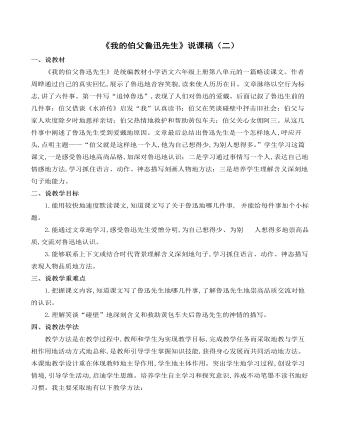
(二)过程与方法:1、通过拼读、练习、组词等方法达到正确读写本课生字、新词的目的;2、通过默读、指导感情朗读等多种形式的朗读训练,质疑、讨论、小组合作学习等形式的学习,达到理解含义深刻的句子,体会文章的思想感情的目的;3、通过教师指导、学生独立思考完成填空练习的方法,学习掌握作者抓住人物语言、动作、神态描写表现人物品质的方法。(三)情感、态度与价值观:通过本课的学习,让学生感受鲁迅先生爱憎分明,为自己想得少,为别人想得多的崇高品质,从而激发学生对鲁迅先生的崇敬之情。(四)教学重点:引导学生学习作者抓住人物语言、动作、神态描写表现人物品质的方法。(五)教学难点:理解4句含义深刻的句子,感受鲁迅先生的崇高品质。
部编人教版六年级上册《有的人——纪念鲁迅有感》说课稿(一)
四、说教学环节1、复习旧知,揭题导入教师用课件展示毛泽东同志对鲁迅先生的评价语,导入:毛泽东同志一连用了5个“最”字,论定了鲁迅先生在中国现代文化史上的无可替代的地位。1936年10月16日,鲁迅先生因病逝世,临终他说,“赶快收殓,埋掉,拉倒”,“忘记我,管自己的生活”。然而,人们真的那么容易忘掉他吗?事隔十三年后,诗人臧克家在北京参观了鲁迅故居,有感而发,写下了诗歌《有的人》。今天,我们就来学习这首诗歌。看到题目,你们对这首诗歌会有什么问题?理解题目的意思吗?你想从中知道什么呢?(设计意图:引用伟人对鲁迅先生的评价,为学生理解本课的内容和思想定下基调,为下面的学习铺垫。同时让学生对学习内容发出疑问,产生学习的兴趣和动力。)
部编人教版六年级上册《我的伯父鲁迅先生》说课稿(二)
情景教学法。根据课文描述地情景,适时创设情境,引导学生思考、想象,为激发学生对鲁迅高尚人品地崇敬之情,奠定情感基调。 讲解法。在学生探究理解地过程中,教师适当补充背景资料、人物介绍、方法指导等,实现教师地主导作用。 朗读体会法。通过自由读、默读、表演读、感情朗读等,让学生走进人物,体会作者地写作方法,学习文章描写人物地方法。感受文章地思想感情,与作者产生情感共鸣,提高学生地语言感悟能力。 自主探究与交流延伸相结合学习法。在阅读故事地过程中,学生自主探究学习,感知故事内容,通过与同学、老师交流,不断深化对鲁迅地认识,感受鲁迅地高尚品格。
部编人教版六年级上册《有的人——纪念鲁迅有感》说课稿(二)
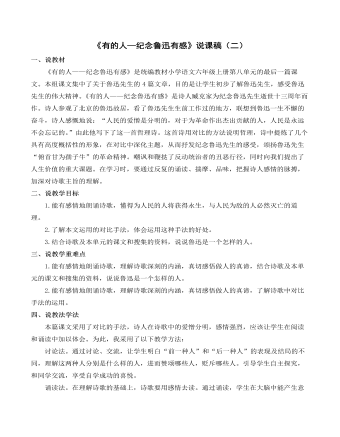
五、说教学过程 (一)创设情境,揭示课题。 以前面学习的课文《我的伯父鲁迅先生》进行回顾导入,将学生再次带入到鲁迅逝世的场景中,感受人们对他的爱戴。适时补充本诗的写作背景,奠定理解诗歌的感情基调,为学生理解内容做好铺垫。 (二)诵读全诗,整体感知。 给学生充足的时间让学生自主探究,读准字音,把诗句读流畅。 播放朗读音频,学生倾听,练习朗读。指七名学生分节读,教师随机点拨。本首诗学生读通顺是没问题的,但这首诗歌感情色彩强烈,爱憎分明,重点是要读出感情。因此播放音频朗读,一是让学生在倾听中感受诗人的强烈感情,二是仿照练习,读好节奏、声调等,帮助在理解诗歌后更好地感情朗读。 默读并思考:这首诗在内容和写法上你发现了有什么特别之处吗? 引导学生感受诗歌对比和反复的特点,找出具体的对比内容,为后面的理解学习做好准备。
人教部编版道德与法制六年级上册公民的基本权利和义务说课稿
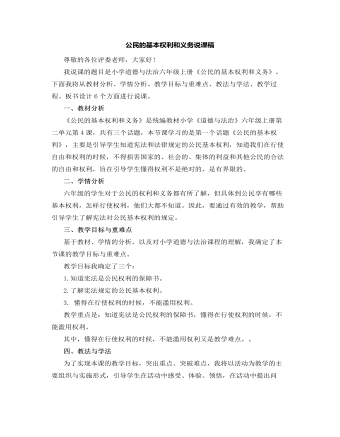
三是:装修不应该打扰邻居的正常休息。如果你是事件中的受害方,你会如何处理这件事情?全班汇报交流,教师相机引导,板书:权利不是绝对的,是有界限的。设计意图:引导学生体会权利行使的界限。环节三:课堂小结,内化提升学生谈一谈学习本节课的收获,教师相机引导。设计意图:梳理总结,体验收获与成功的喜悦,内化提升学生的认识与情感。环节四:布置作业,课外延伸课后,以古老而优美的汉字为主题办一期手抄报。设计意图:将课堂所学延伸到学生的日常生活中,有利于落实行为实践。六、板书设计为了突出重点,让学生整体上感知本节课的主要内容,我将以思维导图的形式设计板书:在黑板中上方的中间位置是课题《公民的基本权利》,下面是:宪法是公民权利的保障书;法律保障公民基本权利的落实;权利不是绝对的,是有界限的。
人教部编版道德与法制六年级上册国家机构有哪些说课稿
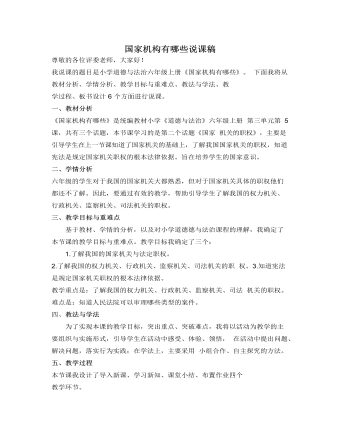
活动三:政府机关、监察机关和司法机关的职权 首先,学生阅读教材第46 页的图文资料,结合课前搜集到的有关人民政府的资料, 教师引导学生说一说行政机关有哪些?其职权是 什么?板书:行政管理职权,提供公共服务。然后,学生从教材第 47 页中找出监察机关和司法机关职权的相 关信息,并了解司法机关徽章的含义。板书:监察权,审判权,监督 权。最后,结合活动园中三名同学对法院可以审理哪些类型案件的争 议,先小组内讨论交流, 你认为法院可以审理哪些类型的案件?再全 班汇报交流,教师相机引导。设计意图:引导学生了解政府机关、 监察机关和司法机关的职权,知道人民法院可以审理哪些类型的案件。环节三:课堂小结,内化提升 学生谈一谈学习本节课的收获,教师相机引导。 设计意图:梳理总结,体验收获与成功的喜悦,内化提升学生的认识与情感。环节四:布置作业,课外延伸课后,以国家机关的职权为主题办一期手抄报。