-
人教A版高中数学必修二直线与平面垂直教学设计
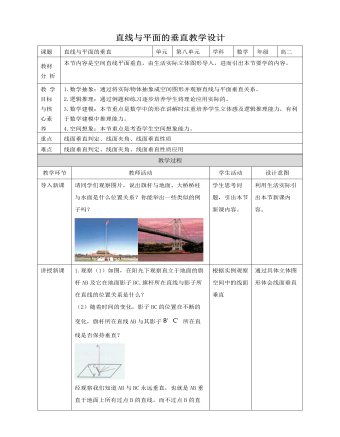
1.观察(1)如图,在阳光下观察直立于地面的旗杆AB及它在地面影子BC,旗杆所在直线与影子所在直线的位置关系是什么?(2)随着时间的变化,影子BC的位置在不断的变化,旗杆所在直线AB与其影子B’C’所在直线是否保持垂直?经观察我们知道AB与BC永远垂直,也就是AB垂直于地面上所有过点B的直线。而不过点B的直线在地面内总是能找到过点B的直线与之平行。因此AB与地面上所有直线均垂直。一般地,如果一条直线与一个平面α内所有直线均垂直,我们就说l垂直α,记作l⊥α。2.定义:①文字叙述:如果直线l与平面α内的所有 直线都垂直,就说直线l与平面α互相垂直,记作l⊥α.直线l叫做平面α的垂线,平面α叫做直线l的垂面.直线与平面垂直时,它们唯一的公共点P叫做交点.②图形语言:如图.画直线l与平面α垂直时,通常把直线画成与表示平面的平行四边形的一边垂直.
人教A版高中数学必修二直线与直线垂直教学设计
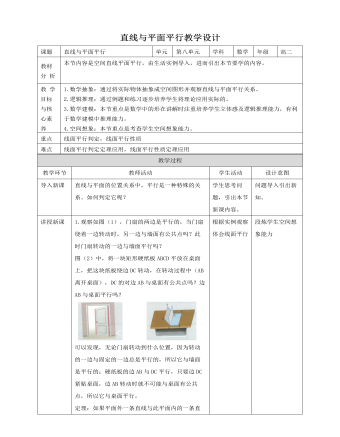
6.例二:如图在正方体ABCD-A’B’C’D’中,O’为底面A’B’C’D’的中心,求证:AO’⊥BD 证明:如图,连接B’D’,∵ABCD-A’B’C’D’是正方体∴BB’//DD’,BB’=DD’∴四边形BB’DD’是平行四边形∴B’D’//BD∴直线AO’与B’D’所成角即为直线AO’与BD所成角连接AB’,AD’易证AB’=AD’又O’为底面A’B’C’D’的中心∴O’为B’D’的中点∴AO’⊥B’D’,AO’⊥BD7.例三如图所示,四面体A-BCD中,E,F分别是AB,CD的中点.若BD,AC所成的角为60°,且BD=AC=2.求EF的长度.解:取BC中点O,连接OE,OF,如图。∵E,F分别是AB,CD的中点,∴OE//AC且OE=1/2AC,OF//AC且OF=1/2BD,∴OE与OF所成的锐角就是AC与BD所成的角∵BD,AC所成角为60°,∴∠EOF=60°或120°∵BD=AC=2,∴OE=OF=1当∠EOF=60°时,EF=OE=OF=1,当∠EOF=120°时,取EF的中点M,连接OM,则OM⊥EF,且∠EOM=60°∴EM= ,∴EF=2EM=
新人教版高中英语必修3Unit 1 Festivals and Celebrations-Reading for writing教学设计二
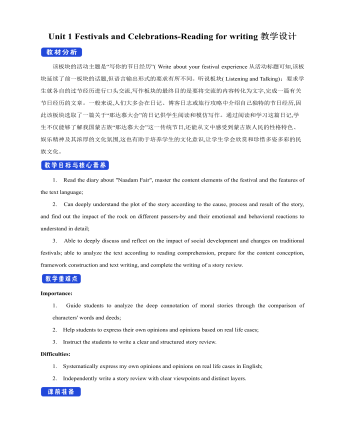
Step 3 Analyzing article structureActivity 31. Teachers raise questions to guide students to analyze the chapter structure of this diary and think about how to describe the festival experience. (1)What should be included in the opening/body/closing paragraph(s)?(2)How did the writer arrange his/her ideas?(3)What kind of interesting details did the writer describe?(4)How did the writer describe his/her feelings/emotions during the event?2. Students read and compare the three sentence patterns in activity 2. Try to rewrite the first paragraph of the diary with these three sentence patterns. After that, students exchange corrections with their partners. Such as:●This was my first time spending three days experiencing the Naadam Festival in China’s Inner Mongolia Autonomous Region and it was an enjoyable and exciting experience. ●I'll never forget my experience at the Naadam Festival because it was my first time to watch the exciting Mongolian games of horse racing, wrestling, and archery so closely. ●I'll always remember my first experience at the Naadam Festival in China’s Inner Mongolia Autonomous Region because it was so amazing to spend three days witnessing a grand Mongolian ceremony. Step 4 Accumulation of statementsActivity 41. Ask the students to read the diary again. Look for sentences that express feelings and emotions, especially those with the -ing form and the past participle. Such as:● …horse racing, wrestling, and archery, which are all so exciting to watch. ● some amazing performances● I was surprised to see…● I was a little worried about. . . ● feeling really tiredOther emotional statements:●I absolutely enjoyed the archery, too, but the horse races were my favourite part. ●I'm finally back home now, feeling really tired, but celebrating Naadam with my friend was totally worth it. ●He invited me back for the winter to stay in a traditional Mongolian tent and cat hot pot. I can’t wait!2. In addition to the use of the -ing form and the past participle, the teacher should guide the students in the appreciation of these statements, ask them to memorize them, and encourage them to use them reasonably in writing practice.
新人教版高中英语必修3Unit 2 Morals and Virtues-Reading for Writing教学设计
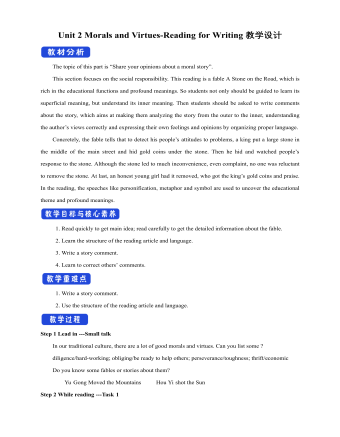
1. 这个寓言是一个关于一位国王古寓言。 The fable is an old fable about a king.2.作者用这个故事让读者对于社区的问题负有个人责任的必要印象深刻。The author used the story to impress upon readers with the need to take personal responsibility for problems in the community.3. 这个故事十分成功的实现了它的目的。The story was quite successful in achieving its purpose.Step 7 WritingPlease write a review of the story according the outline above.The fable is an old fable about a king who thought his people are lazy, so he put a large stone in the middle of the road and hides and waited to see if anyone will try to move it.The author used this story to impress upon readers with the need to take personal responsibility for problems in the community. The story was quite successful in achieving its purpose, and I liked it because it had a clear moral.However, while the moral of the story is clear, the actions of the king seemed pointless to me, because none of the characters in the story learnt anything. For this reason, I think there are better stories that can be used to impress upon people with the need for personal responsibility.Step 8 Pair workExchange drafts with a partner. Use this checklist to help your partner revise his/her draft.1. Does the writer give a short description of the story ?2. Does the description include the most important details of the story ?3. Does the writer give his or her opinion about the character or their actions ?4. Is the review well-organised ? 5. Does the writer use the -ing form as the adverbial correctly in the writing ?6. Are there any grammar, spelling, or punctuation errors ?Step 9 HomeworkPut up your revised draft in the classroom or read it to your class.
新人教版高中英语必修3Unit 3 Diverse Cultures-Discovering Useful Structure教学设计
Step 4 PracticeRead the conversation. Find out which words have been left out.Justin: Linlin, I’m going to Guizhou Province next month. I’m super excited! Any recommendations for places to visit?Linlin: Wow, cool! Guizhou is a province with a lot of cultural diversity. Places to visit...well, definitely the Huangguoshu Waterfall first.Justin: What’s special about the waterfall?Linlin: Well, have you ever heard of the Chinese novel Journey to the West ?Justin: Yes, I have. Why ?Linlin: In the back of the waterfall, you will find a cave, which is the home of the Monkey King.Justin: Really? Cool! I’ll definitely check it out.Linlin:And I strongly recommend the ethnic minority villages. You’ll find Chinese culture is much more diverse than you thought.Justin:Sounds great, thanks.Answers:Justin: Linlin, I’m going to Guizhou Province next month. I’m super excited! Do you have any recommendations for places to visit?Linlin: Wow, that’s cool! Guizhou is a province with a lot of cultural diversity. What are some places to visit in Guizhou ? Well, definitely the Huangguoshu Waterfall is the first place to visit in Guizhou Province.Justin: What’s special about the waterfall?Linlin: Well, have you ever heard of the Chinese novel Journey to the West ?Justin: Yes, I have heard of the Chinese novel Journey to the West . Why do you ask if I have heard of the Chinese novel Journey to the West?Linlin: In the back of the waterfall, you will find a cave, which is the home of the Monkey King from Journey to the West.Justin: That’s really true? It’s Cool! I’ll definitely check it out.Linlin:And I strongly recommend the ethnic minority villages on your trip to Guizhou Province. You’ll find Chinese culture is much more diverse than you thought it was.Justin:This all sounds great, thanks.
新人教版高中英语必修3Unit 4 Space Exploration-Listening&Speaking&Talking教学设计二
The themes of this part are “Talk about how to become an astronaut” and “Talk about life in space”. As Neil Armstrong said “Mystery creates wonder and wonder is the basis of man’s desire to understand. Space is difficult for human to reach, therefore, humans are full of wonders about it. However, if wanting to achieve the dream of reaching the Moon, some of our human should work hard to be an astronaut at first. Part A(Talk about how to become an astronaut) is a radio interview in a radio studio, where the host asked the Chinese astronauts about his story how to become an astronaut. Yang Liwei told his dreamed to be an astronaut since childhood. Then he worked hard to get into college at 22. The next 10 years, he gradually became an experienced pilot. At the same time, to be an astronaut, he had to study hard English, science and astronomy and trained hard to keep in good physical and mental health and to practise using space equipment. Part B (Talk about life in space) is also an interview with the astronaut Brown, who is back on the earth. The host Max asked about his space life, such as his emotion about going back the earth, the eating, shower, brushing, hobbies and his work. Part A and Part B are interviews. So expressing curiosity about the guests’ past life is a communicative skill, which students should be guided to learn.1. Students can get detailed information about how Yang Liwei became an astronaut and Max’s space life.2. Students learn to proper listening strategy to get detailed information---listening for numbers and taking notes.3. Students can learn related sentences or phrases to express their curiosity like “ I wish to know...” “I’d love to know...”4. Students can learn more about the space and astronauts, even be interested in working hard to be an astronaut
新人教版高中英语必修3Unit 4 Space Exploration-Reading for Writing教学设计二
⑦在我看来, 探索太空是值得的。As far as I am concerned, it is worthwhile to explore the space.Step 10 Writing---draftRecently, students in our class have had heated a discussion on whether space is worth exploring. Students hold different ideas about it.30% of us think space exploration is not worthwhile. They think space is too far away from us and our daily life and is a waste of money. And the money spent on space exploration can be used to solve the earth’s problems such as starvation and pollution.On the other hand,70% think space is worth exploring because we have benefited a lot from it,such as using satellites for communication and weather forecast. What’s more,with further space research,we may solve the population problem by moving to other planets one day. Also,space research will enable us to find new sources to solve the problem of energy shortages on the earth.As far as I am concerned, it is worthwhile to explore the space. Not only can it promote the development of society but also enrich our life. Step 11 Pair workExchange drafts with a partner. Use this checklist to help your partner revise his/her draft.1.Does the writer explain why he/she changed/wanted to change?2.Does the writer tell how the changes have improved or will improve his/her life?3.Is the text well-organised?4.Does the writer use words and expressions to show similarities and differences?5.Are there any grammar or spelling errors?6.Does the writer use correct punctuation?
新人教版高中英语必修3Unit 4 Space Exploration-Reading For Writing教学设计一
另一方面,其余的人反对这个计划,因为它可能会导致一些不好的影响。7.I hold the belief that space exploration not only enable us to understand how the universe began but also help us survived well into the future.我坚信探索太空不仅能够使我们了解宇宙的起源而且能够帮助我们更好地走进未来。8.I think we should spend more time and money exploring space so as to provide new and better solutions to people's shortterm and longterm problems.为了给人类的短期和长期问题提供更新和更好的解决方法,我认为我们应该花更多的时间和金钱来探索太空。9.From my point of view,it is wrong of young people to depend on their telephones too much,which may do harm to both their physical and mental health.在我看来,年轻人过度依赖手机是不对的,因为它们可能会对他们的身心健康都有害。最近你班同学就“人类是否应该进行宇宙探索”这个问题进行了激烈的讨论。有人认为,探索宇宙不仅让人类更好地了解宇宙的发展,还可以用来指导农业生产,以及把一些探索太空的高新技术用于现实生活;也有一些人认为探索太空花掉了大量的人力物力;影响了人们的生活水平。请你根据以下情况写一篇报告并发表自己的观点。注意:1.写作内容应包括以上全部要点,可适当发挥,使上下文连贯;
新人教版高中英语必修3Unit 5 The Value of Money-Listening &Speaking&Talking教学设计
4. A:We’d like to have someone to say a word at the beginning to welcome the group.B:↙Who?A:We thought that you or Dr.Johnson might do it.B用降调说Who,其意思是问,对方想让谁在开场时致欢迎词。Step 6 Pronunciation---Practice1. Listen to the short conversation and mark the intonation with ↗, ↙ or ↙, ↗. Then discuss with a partner what they intend to convey by using different intonation.Owner: You know what ?↗ It’s a million-pound bank note↙.Waiter 1: Really ?↗(question)Waiter 2: Really !↙(unbelievable and surprised)Waiter 3: Really ?!↙↗(first question then surprised)2. Listen to the conversations. Underline the parts that are stressed and mark the intonation. Then talk about the implied meanings of the responses with different intonations. Listen again and repeat.1) Henry: It’s a nice suit.Owner: Oh, it’s perfect!↙(The intonation means it is very suitable for Henry.)2) Henry: Well, that’s very kind of you.Owner: Kind, sir ?↗(what you said is not right) No, it’s kind of you. You must come whenever you want and have whatever you like. Just having you sit here is a great honour !!↙(welcome you to come again)3)Henry:Well, to be honest, I have none. Oliver:(happily) What luck!(excited) Brother↗, what luck!↙(It means “Didn’t you hear it?”)Henry: Well, it may seem lucky to you but not to me!↗(angry) If this is your idea of some kind of joke, I don’t think it’s very funny. Now if you’ll excuse me, I ought to be on my way.↙(If so, I would leave.)Roderick: Please don’t go↙...(hope Henry can wait for a moment)Part B Viewing and Talking---Describe people’s changing attitudes in a film clipStep 1 Before-listening---Tell the filmYou are going to watch part of the film The Million Pound Bank Note. Look at these photos and guess what happens in the film.
新人教版高中英语选修2Unit 1 Science and Scientists-Discovering useful structures教学设计
The grammatical structure of this unit is predicative clause. Like object clause and subject clause, predicative clause is one of Nominal Clauses. The leading words of predicative clauses are that, what, how, what, where, as if, because, etc.The design of teaching activities aims to guide students to perceive the structural features of predicative clauses and think about their ideographic functions. Beyond that, students should be guided to use this grammar in the context apporpriately and flexibly.1. Enable the Ss to master the usage of the predicative clauses in this unit.2. Enable the Ss to use the predicative patterns flexibly.3. Train the Ss to apply some skills by doing the relevant exercises.1.Guide students to perceive the structural features of predicative clauses and think about their ideographic functions.2.Strengthen students' ability of using predicative clauses in context, but also cultivate their ability of text analysis and logical reasoning competence.Step1: Underline all the examples in the reading passage, where noun clauses are used as the predicative. Then state their meaning and functions.1) One theory was that bad air caused the disease.2) Another theory was that cholera was caused by an infection from germs in food or water.3) The truth was that the water from the Broad Street had been infected by waste.Sum up the rules of grammar:1. 以上黑体部分在句中作表语。2. 句1、2、3中的that在从句中不作成分,只起连接作用。 Step2: Review the basic components of predicative clauses1.Definition
新人教版高中英语选修2Unit 2 Bridging Cultures-Discovering useful structures教学设计
The grammar of this unit is designed to review noun clauses. Sentences that use nouns in a sentence are called noun clauses. Nominal clauses can act as subject, object, predicate, appositive and other components in compound sentences. According to the above-mentioned different grammatical functions, nominal clauses are divided into subject clause, object clause, predicate clause and appositive clause. In this unit, we will review the three kinds of nominal clauses. Appositive clauses are not required to be mastered in the optional compulsory stage, so they are not involved.1. Guide the students to judge the compound sentences and determine the composition of the clauses in the sentence.2. Instruct students to try to learn grammar by generalizing grammar rules, controlling written practice, and semi-open oral output.3. Inspire the students to systematize the function and usage of noun clause1.Instruct students to try to learn grammar by generalizing grammar rules, controlling written practice, and semi-open oral output.2.Inspire the students to systematize the function and usage of noun clauseStep1: The teacher ask studetns to find out more nominal clauses from the reading passage and udnerline the nominal clauses.
新人教版高中英语选修2Unit 3 Food and Culture-Reading and thinking教学设计
The discourse explores the link between food and culture from a foreign’s perspective and it records some authentic Chinese food and illustrates the cultural meaning, gerography features and historic tradition that the food reflects. It is aimed to lead students to understand and think about the connection between food and culture. While teaching, the teacher should instruct students to find out the writing order and the writer’s experieces and feelings towards Chinese food and culture.1.Guide the students to read the text, sort out the information and dig out the topic.2.Understand the cultural connotation, regional characteristics and historical tradition of Chinese cuisine3.Understand and explore the relationship between food and people's personality4.Guide the students to use the cohesive words in the text5.Lead students to accurately grasp the real meaning of the information and improve the overall understanding ability by understanding the implied meaning behind the text.1. Enable the Ss to understand the structure and the writing style of the passage well.2. Lead the Ss to understand and think further about the connection between food and geography and local character traits.Step1: Prediction before reading. Before you read, look at the title, and the picture. What do you think this article is about?keys:It is about various culture and cuisine about a place or some countries.
新人教版高中英语必修3Unit 1 Festivals and celebrations-Discovering Useful Structure教学设计
4.That was an experience that frightened everyone. →That was _____________________. 答案:1. taking 2. being discussed 3. in the reading room 4. a frightening experienceStep 6 The meaning and function of V-ing as the predicative动词-ing形式作表语,它通常位于系动词后面,用以说明主语“是什么”或“怎么样”一种表示主语的特质、特征和状态, 其作用相当于形容词; 另一种具体说明主语的内容, 即主语等同于表语, 两者可互换。The music they are playing sounds so exciting. 他们演奏的音乐听起来令人激动。The result is disappointing. 结果令人失望。Our job is playing all kinds of music. 我们的工作就是演奏各种音乐。Seeing is believing. 眼见为实。Step 7 Practice1. It is ________(amaze) that the boy is able to solve the problem so quickly.2. Buying a car is simply _______(waste) money. 3. Please stop making the noise—it’s getting ________(annoy). 4. complete the passage with the appropriate -ing form.La Tomatina is a festival that takes place in the Spanish town Bunol every August. I think many food festivals are __________ because people are just eating. however, this festival is _________ because people don't actually eat the tomatoes. Instead, they throw them at each other! the number of people ________ part in this tomato fight, can reach up to 20,000, and it is a very __________ fight that lasts for a whole hour. The _______ thing is how clean Bunol is after the tomatoes are washed away after the fight. this is because the juice form tomatoes is really good for making surfaces clean!答案:1. amazing 2. wasting 3. annoying4. boring interesting taking exciting amazing
新人教版高中英语必修3Unit 1 Festivals and Celebrations-Reading and Thinking教学设计
The topic of this part is “Discover the reasons for festivals and celebrations.The Listening & Speaking & Talking part aims at talking about the experiences and feelings or emotions about the festivals and celebrations. This section aims at detecting the reason why the people celebrate the festivals, the time, the places, the types and the way of celebrations. It also explains why some traditions in the old celebrations are disappearing, like the firecrackers in the big cities and some new things are appearing like the prosperity of business or commerce. 1. Students can talk about what festivals they know and the reasons and the way of celebrating them.2. Students should learn the reading skills such as the headline and get the topic sentences, the structures of articles.3. Students can understand the past, the present situation of some festival around the world and why there are some changes about them. 4. Students can have the international awareness about the festivals.1. Students should learn the reading skills such as the headline and get the topic sentences, the structures of articles.2. Students can understand the past, the present situation of some festival around the world and why there are some changes about them.Step 1 Lead in---Small talkWhat festival do you like best ? Why ?I like the Spring Festivals because I can set off the fireworks, receive the lucky money and enjoy the Gala with my families.Step 2 Before reading---Pair workWhy do people celebrate different festivals ?The Spring Festivals is to celebrate the end of winter and the coming of spring and new life.The Mid-autumn Day is to celebrate the harvest and admire the moon.
新人教版高中英语必修3Unit 1 Festivals and Celebrations-Listening &Speaking&Talking教学设计
The theme of this section is “Talk about festival activities and festival experiences”.Festival and holiday is a relaxing and interesting topic for students. This part talks about the topic from the daily life of students’. In the part A ---Listening and Speaking, there are three conversations among different speakers from three countries(Japan, Rio and China), where the speakers are participating in or going to participate in the festivals and celebrations. So listening for the relationship among them is a fundamental task. Actually, with the globalization and more international communication, it is normal for Chinese or foreigners to witness different festivals and celebrations in or out of China. In the Conversation 1, a foreign reporter is interviewing a Japanese young girl who just had participated in the ceremony of the Coming-of-Age Day on the street and asking her feeling about the ceremony and the afterwards activities. Conversation 2, Chinese girl Li Mei is witnessing the Rio Carnival for the first time, and her friend Carla gives her some advice on the costumes which enables her to match with the carnival to have a good time. Conversation 3, a Chinese guide is showing a group of foreign visitors around the Lantern Festival and introducing the customs of the festival to them. The three conversations have a strong vitality and insert the festival and cultural elements from different countries. So perceiving the festivals and cultures from different countries is the second task. At the same time, the scripts also insert the targeted grammar --- v-ing as attributive and predicative, which students can perceive and experience in a real context and make a road for the further study. That is the third task. In the Part B--- Listening and Talking, the theme is “Talk about festival experience”, which is the common topic in our daily conversations. During the conversation, Song Lin, a Chinese student, asked Canadian friend Max about how to spend Christmas. In the conversation, Song Lin talked about experience and the feelings during the Chinese Spring Festival, during which there are not only some enjoyable things but some unpleasant things. After the listening, perhaps students find there are some similarities between Christmas and the Chinese Spring Festival as there are some differences in the origins and celebrations. For example, people always visit friends and relatives, decorate their houses, have a big dinner together, chat and give presents to each other.
新人教版高中英语必修3Unit 1 Festivals and Celebrations-Reading for Writing教学设计一
The topic of this part is “Write about your festival experience”.During the Listening and Speaking and Talking, students are just asked to say out their festival experiences such as the Spring Festival, Mid-autumn Day, but this part students will be asked to write down their own festival experiences. During the reading part, it introduces the Naadam Festival in Inner Mongolia Autonomous Region, which can give students a good example to imitate. Students not only learn the festival, but touch and feel the Inner Mongolian’s character, the spirit and cultural atmosphere, which can help students form the cultural awareness and learn to enjoy and value the diversity of Chinese culture.Concretely, the dairy tells the experience that the author spent the Naadam Festival in Inner Mongolia Autonomous Region with his/her friend. The structure is clear. In the opening paragraph, it introduces the topic of the Naadam Festival and the whole feeling. Then it introduces the items of the festival like the ceremony, wrestling and horse racing. Finally, it summarizes this experience. Because this part is a travel journal, we must guide students pay more attention to these details: 1. use the first person. 2. use the past tense to tell the past thing and use the present or future tense to describe the scenery. 3. use the timeline to tell the development. 4. be careful for the author’s psychology, emotion and feeling, etc.1. Read quickly to get main idea; read carefully to get the detailed information about Naadam Festival.2. Learn the structure of the reading article and language.3. Write an article about a festival experience4. Learn to use the psychology, emotions and feeling in the writing.1. Write an article about a festival experience.2. Use the structure of the reading article and language.
新人教版高中英语必修3Unit 2 Morals and Virtues-Discovering Useful Structure教学设计
1. 表示时间。Hearing these stories, I’m skeptical about the place. = When I heard these stories. . . 2. 表示原因。Not knowing his address, I can’t send this book to him. = Because/Since/As I don’t know his address. . . 3. 表示结果。His father died, leaving him a lot of money. =. . . and left him a lot of money4. 表示条件。Going straight down the road, you will find the department store. = If you go straight down the road. . . 5. 表示让步。Being tired, they went on working. =Although they were tired. . . 6. 表示行为方式、伴随情况或补充说明。He lay on the grass, staring at the sky for a long time. =. . . and stared at the sky for a long time注意:非谓语动词作状语时, 如所提供的动词不能和句子中的主语保持一致, 动词-ing形式必须有自己的逻辑主语, 通常由名词或代词来担任, 这就是独立主格结构。The last bus having gone, we had to walk home. (having gone的逻辑主语是the last bus, 而不是we)Weather permitting, the football match will be played on Friday. (permitting的逻辑主语是time, 而不是the football match)Step 7 Practice1. ________(study) hard, you are sure to get first prize. 2. People use plastic in their daily life, _______(leave) large amounts of waste. 3. ________(work) hard at your lessons, you are to succeed. 4. The old man, ____________(work) abroad for twenty years, is on the way back to his motherland. 5. ______________(finish) his homework, he was playing on the playground. Answers: 1. Studying 2. leaving 3. Working 4.having worked 5. Having finishedStep 8 HomeworkFinish the homework on Page 22.
新人教版高中英语必修3Unit 2 Morals and Virtues-Reading and Thinking教学设计
The topic of this part is “Learn to make choices in life”.The Listening & Speaking & Talking part aims at the moral dilemmas, and this part is about making choices in life. The heroin is Lin Qiaozhi, a famous medical scientist, made a great contribution to our country’s medical care. Most importantly, her life experience can inspire our students whether in studying or the development of career. she had moral dilemmas and life choices, which are similar to the students who will step into society. Besides, Lin has quite good virtues like kindness, self-improvement, insistence, job-loving , generosity and responsibility, which is worth being learned.Concretely, this article is a biography about Lin Qiaozhi. The article tells her whole life according the timeline, among which the life choices is emphasized. For example, whether married or chased her dream, returned home or stayed abroad, family or public, her choices all reflected her faith, spirit, responsibility and devotion.1. Fast reading to get the detailed information about Lin Qiaozhi; careful reading to do the deductive information.2. Learn the reading skills--deductive judgement according the context.3. Study the structure features and language features. 4. Communicate about Lin’s life choices and reflect their own life choices.1. Learn the reading skills--deductive judgement according the context.2. Study the structure features and language features.3. Communicate about Lin’s life choices and reflect their own life choices.Step 1 Lead in---Small talkWhat are some important life choices?Importance choices: university study, jobs and marriage partners. Because they can determine our future.
新人教版高中英语必修3Unit 3 Diverse Cultures-Reading for Writing教学设计
The topic of this part is “Describe a place with distinctive cultural identity”.This section focuses on Chinese culture by introducing Chinatown, whose purpose is to show the relationship between the Chinese culture and American culture. The Chinese culture in Chinatown is an important part of American culture. Chinatown is an important window of spreading Chinese culture and the spirit homeland of oversea Chinese, where foreigners can experience Chinese culture by themselves.Concretely, the title is “Welcome to Chinatown!”, from which we can know that the article aims at introducing Chinatown. The author used the “Introduction--Body Paragraph--Conclusion” to describe the people, language, architecture, business, famous food and drinks and people’s activities, which can be a centre for Chinese culture and shows its unique charm.1. Read quickly to get main idea; read carefully to get the detailed information.2. Learn the characteristics of writing and language.3. Learn to introduce your own town according to the text.4. Learn to correct others’ writing.1. Learn the characteristics of writing and language.2. Learn to introduce your own town according to the text.Step 1 Lead in ---Small talkIn the reading part, we mentioned the Chinatown of San Francisco. How much do you know about Chinatown of San Francisco ?Chinatown is a main living place for Chinese immigrants, where you can see many Chinese-style buildings, costumes, operas, restaurants, music and even hear Chinese.Step 2 Before reading ---Predict the contentWhat is the writer’s purpose of writing this text ? How do you know ?From the title(Welcome to Chinatown) and some key words from the text(tourist, visit, visitors, experience), we can know the purpose of the text is to introduce Chinatown and show the relationship between Chinese culture and American culture.
新人教版高中英语必修3Unit 3 Diverse Cultures-Listening &Speaking&Talking教学设计
1. In Picture 1 and Picture 2, where do you think they are from? How do you know?From their wearings, we can know they are from ethnic minority of China--- Miao and Dong.Picture 1, they are playing their traditional instrument lusheng in their traditional costumes.Picture 2. the girls are Miao because they wear their traditional costumes and silver accessory.2. In Picture 3, can you find which village it is? What time is it in the picture?It is Dong village. It is at night. Step 2 While-listeningJustin met a new friend while traveling in Guizhou. Listen to their conversation and complete the summaries below.Part 1Justin and Wu Yue watched some Miao people play the lusheng. The instrument has a history of over 3,000 years and it is even mentioned in the oldest collection of Chinese poetry. Then they watched the lusheng dance. Justin wanted to buy some hand-made silver/traditional accessories as souvenirs. He was told that the price will depend on the percentage of silver. Part 2They will go to a pretty Dong minority village called Zhaoxing. they will see the drum towers and the wind and rain bridges. They may also see a performance of the Grand Song of the Dong people.Step 3 Post-listening---TalkingWork in groups. Imagine Justin is telling some friends about his trip to Guizhou. One of you is Justin and the rest of you are his friends. Ask Justin questions about his trip and experience. The following expressions may help you.