-
新人教版高中英语必修2Unit 3 The Internet-Listening &Speaking&Talking教案一
Listening and Speaking introduces the topic of “ask about online habits”. Many middle school students have been surfing the Internet for many years, but what they do with the Internet and how much time they spend every day may not be very clear to themselves, nor to other students. This section allows students to investigate their peers' Internet use, which is conducive to their mutual understanding and understanding of the Internet. It can also help them reflect on their own online behavior, learn from other people's good online habits, and get rid of their bad online behavior.The listening text of this section is an investigation interview. The investigators interview specific groups with the same questions to obtain information, so as to understand their views, practices or attitudes on this issue. There are two specific questions: “how much time do you spend online every day? What do you usually do online?”. The answers of the three respondents provide rich and different information, and achieve the purpose of the investigators. The oral discourse structure of survey interviews generally includes greeting and explaining the purpose of the interview, presenting the interview questions and the respondents' answers. Listening and Talking introduces the theme of “choosing the right application ". Listening text is a conversation between Laura and Xiao Bo. In this part of listening, “oink”; “piggy bank” may cause the students' hearing comprehension limitation. Oink refers to sound word and pig's sound. So, add some oink to my piggy bank is often used to describe "making a little money".1. Guide students to understand the content of listening texts in terms of listening for definitions.2. Cultivate students' ability to define words and understand an investigation interview.
新人教版高中英语必修2Unit 3 The Internet-Reading and Thinking教案二
Q5:What's Jan's next goal?Her next goal is to start a charity website to raise money for children in poor countries.Q6:What can we learn from her experiences?We learn that when we go through tough times, we can find help and support from other people online. We learn that we can feel less lonelyStep 5: While reading---rethinkingQ1: What is Jan’s attitude to the Internet ?Thankful/Grateful, because it has changed her and her life.Q2: What writing skills is used in the article ?Examples(Jan’s example, the 59-year-old man’s and the 61-year-old woman’s example)Q3: Can you get the main idea of the article ?The Internet has changed Jan’s life/Jan’s life has been changed by the Internet.Step 6 Post reading---Retell the storyMuch has been written about the wonders of the World Wide Web. There are countless articles (1)telling(tell) us how the Internet has made our lives more convenient. But the Internet has done a lot (2)more(much) for people than simply make life more convenient. People’s lives (3) have been changed(change) by online communities and social networks so far. Take Jan for example, who developed a serious illness that made her (4)stuck(stick) at home with only her computer to keep (5)her(she) company. She joined an online group (6)where she could share problems, support and advice with others. She considered the ability to remove the distance between people as one of the greatest (7)benefits(benefit). She was so inspired (8)that she started an IT club in which many people have been helped. She has started to learn more about how to use the Internet to make society better. Her next goal is to start a charity website to raise money (9)for children in poor countries. Jan’s life has been (10)greatly(great) improved by the Internet.
新人教版高中英语必修2Unit 3 The Internet-Reading and Thinking教案一
Paragraph 3. Jan decided to start an IT club to teach old people how to use computers and the Internet. Paragraph 4. Jan has started taking online classes to learn more about how to use the Internet to make society better. Paragraph 5. Jan’s life has been greatly improved by the Internet. Step 5: Critical thinking:(1)How do you arrange your time spent on study and the Internet? Is it reasonable? I usually surf the Internet using my mobile phone for only an hour after class, and it is reasonable for me.(2)What are your online activities? Are they safe? I chat with my friends, read news and play games. I never give away my private information so I think they are safe.Step 4: summary Much has been written about the wonders of the World Wide Web. There are countless articles (1)______(tell) us how the Internet has made our lives more convenient. But the Internet has done a lot (2)_____(much) for people than simply make life more convenient. People’s lives (3) _________________(change) by online communities and social networks so far. Take Jan for example, who developed a serious illness that made her (4)_____(stick) at home with only her computer to keep (5)___(she) company. She joined an online group (6)______ she could share problems, support and advice with others. She considered the ability to remove the distance between people as one of the greatest (7)_______(benefit). She was so inspired (8)____ she started an IT club in which many people have been helped. She has started to learn more about how to use the Internet to make society better. Her next goal is to start a charity website to raise money (9)___ children in poor countries. Jan’s life has been (10)______(great) improved by the Internet. Step 5 Homework:Review what we have learned and find out the key language points in the text.
新人教版高中英语必修2Unit 3 The Internet-Reading for Writing教案二
8. However, the more polite you are, the less likely it is you will be attacked. 然而, 你越有礼貌, 你被攻击的可能性就越小。 Step 8 Writing---the articleHow to stay safe in the online chat roomToday I thought I’d blog about a question that has been asked many times--- how do you stay safe online and avoid bad experiences in the online chat room ? I’m not an expert, but many years as a blogger have taught me a thing or two.First of all, there’s the golden rule of the Internet: keep out of what makes you uneasy. Don’t post comments or click on anything. Second, protect your privacy. Don’t give out too much private information like your address, phone numbers, the ID numbers, etc. Third, be polite. If you are polite to others on the Internet, you won’t be attacked in normal situation. Finally, don’t believe in others easily and never meet someone you met online alone. It is very dangerous.Have you had any bad experiences online, or do you have some good advice for staying safe? Post your comments below!Step 9 Pair workExchange drafts with a partner. Use this checklist to help your partner revise his/her draft.1. Does the writer tell the reader what he/she know about the topic ?2. Are the tips and suggestions well organised ?3. Has the writer defined the new words ?4. Does the author include examples, comparison, or explanations ?5. Does the writer end by asking readers to leave comments and/or suggestions ?6. Can you find any grammar or spelling mistakes.Step 6 HomeworkPut up your revised draft in the classroom or read it to your class.
新人教版高中英语必修2Unit 3 The Internet-Reading For Writing教案一
⑦identity theft 身份盗窃⑧chat room 聊天室⑨draft your blog post 起草博客帖子⑩post embarrassing photos 张贴尴尬照片 【话题句式】 1. How do you stay safe online and avoid bad experiences on the Internet? 你如何在网上保持安全, 避免在网上的不良经历? 2. I’m not an expert, but many years as a blogger have taught me a thing or two. 我不是专家, 但作为一个博主, 我已经学了好几年了。 3. If you see or read something that makes you feel uncomfortable, leave the site immediately. 如果你看到或读到一些让你觉得不舒服的东西, 立即离开这个网站。4. Don’t give out your address or phone number. 别告诉别人你的地址或电话号码。 5. Identity theft is a common and serious problem. 身份盗窃是一个常见而严重的问题。6. Being online is no excuse for being rude, and you don’t want to become a target for a troll or cyberbully. 上网并不是无礼的借口, 你也不想成为发挑衅帖子的人或网络恶霸的目标。 7. Trolls often use several false names so that they can stay on a site. 发挑衅帖子的人经常使用几个假名, 这样他们就可以留在一个网站上。8. However, the more polite you are, the less likely it is you will be attacked. 然而, 你越有礼貌, 你被攻击的可能性就越小。
新人教版高中英语必修3Unit 1 Festivals and Celebrations教学设计二
1. Ss look at the picture and scan the passage to understand the main idea while teacher is giving the following questions to inspire Ss to think.*Where are those people?*What are they doing?*Why are they so excited?2. Ss complete the passage with the appropriate -ing form. Then discuss and check the answers with class.Answers: boring, interesting, taking, exciting, amazing3. The teacher raises questions for the students to discuss and encourages them to express their opinions.*Do you like La Tomatina? Why or why not?4. Each group representative reports the discussion result, the teacher gives feedback and the evaluation.Step 6 PracticeActivity 41. Ss complete the Ex 2 in Using structures.2. Check the answers after finishing the exercises.①The dragon boat races are the most exciting part of the Dragon Boat Festival.② The children were excited to go Easter egg hunting.③What an amazing performance! This is the best music festival I have ever been to.④We were amazed by her funny-looking hat.⑤His inspiring speech at the conference won the admiration/ favour of the audience.⑥This is a challenging game to test your memory and observation capabilities. 3. T asks Ss to finish Ex 3 and 4 in Using structures by themselves, then check the answers with class.Step 6 Homework1. Understand and master the functions and usage of the -ing form;2. Finish the other exercises in Using structures.1、通过本节内容学习,学生是否理解和掌握动词-ing形式作定语和表语的功能和意义;2、通过本节内容学习,学生能否在理解文段内容的基础上,根据上下文语境和表达逻辑,能正确运用动词-ing形式描述节日庆典。3、通过本节内容学习,学生是否归纳和积累用于表达情绪的相关词汇。
新人教版高中英语必修3Unit 1 Festivals and Celebrations教学设计一
本板块的活动主题是“谈论节日活动”(Talk about festival activities),主要是从贴近学生日常生活的角度来切入“节日”主题。学生会听到发生在三个国家不同节日场景下的简短对话,对话中的人们正在参与或将要亲历不同的庆祝活动。随着全球化的进程加速,国际交流日益频繁,无论是国人走出国门还是外国友人访问中国,都已成为司空见惯的事情。因此,该板块所选取的三个典型节日场景都是属于跨文化交际语境,不仅每组对话中的人物来自不同的文化背景,对话者的身份和关系也不尽相同。1. Master the new words related to holiday: the lantern, Carnival, costume, dress(sb)up, march, congratulation, congratulate, riddle, ceremony, samba, make - up, after all. 2. To understand the origin of major world festivals and the activities held to celebrate them and the significance of these activities;3. Improve listening comprehension and oral expression of the topic by listening and talking about traditional festivals around the world;4. Improve my understanding of the topic by watching pictures and videos about different traditional festivals around the world;5. Review the common assimilation phenomenon in English phonetics, can distinguish the assimilated phonemes in the natural language flow, and consciously use the assimilation skill in oral expression. Importance:1. Guide students to pay attention to the attitude of the speaker in the process of listening, and identify the relationship between the characters;2. Inspire students to use topic words to describe the festival activities based on their background knowledge. Difficulties:In the process of listening to the correct understanding of the speaker's attitude, accurately identify the relationship between the characters.
新人教版高中英语必修3Unit 2 Morals and Virtues教学设计二
Activity 41. Students complete the task of activity 4, then teachers and students check the answers. 2. The teacher organized the students to work together and asked them to use the tables and mind maps sorted out before to retold the important choices in Lin Qiaozhi's life and their resultsStep 5 Language points1. The teacher asks the students to read the text carefully, find out the core words and long and difficult sentences in the text and draw lines, understand the use of vocabulary, and analyze the structure of long and difficult sentences. 2. The teacher explains and summarizes the usage of core vocabulary and asks the students to take notes. 3. The teacher analyzes and explains the long and difficult sentences that the students don't understand, so that the students can understand them better. Step 6 Homework1. Read the text again, in-depth understanding of the text; 2. Master the use of core vocabulary and understand the long and difficult sentences. 3. Complete relevant exercises in the guide plan. 1、通过本节内容学习,学生是否理解和掌握阅读文本中的新词汇的意义与用法;2、通过本节内容学习,学生能否结合文本特点总结林巧稚的人生原则和人格品质特征;3、通过本节内容学习,学生能否针对人生抉择发表自己的看法;能否全面地、客观地、理性地看待问题,进而对道德和人性有更加深入的思考和理解。
新人教版高中英语必修3Unit 2 Morals and Virtues教学设计四
3.Teachers ask different groups to report the answers to the questions and ask them to try different sentence patterns.The teacher added some sentence patterns for students to refer to when writing.Step 4 Writing taskActivity 51.Write the first draft.Students first review the evaluation criteria in activity 5, and then independently complete the draft according to the outline of activity 4, the answers to the questions listed in the group discussion and report, and the reference sentence pattern.2.Change partners.The teacher guides the students to evaluate their partner's composition according to the checklist of activity 5 and proposes Suggestions for modification.3.Finalize the draft.Based on the peer evaluation, students revise their own compositions and determine the final draft.Finally, through group recommendation, the teacher selects excellent compositions for projection display or reading aloud in class, and gives comments and Suggestions.Step 5 Showing writingActivity 5T call some Ss to share their writing.Step 6 Homework1. Read the passage in this section to better understand the passage.2. Carefully understand the hierarchical structure of the article, and deeply understand the plot of the story according to the causes, process and results;3. Independently complete the relevant exercises in the guide plan.1、通过本节内容学习,学生是否理解和掌握阅读文本中的新词汇的意义与用法;2、通过本节内容学习,学生能否通过人物言行的对比分析道德故事的深层内涵;3、通过本节内容学习,学生能否根据故事的起因、经过和结果来深入理解故事的情节,从而了解文章的层次结构;4、结合现实生活案例发表自己的见解和看法,写一篇观点明确、层次分明的故事评论。
新人教版高中英语必修3Unit 2 Morals and virtues教学设计一
(2) students are divided into groups according to the requirements of activity 3. Each student shares a story of personal experience or hearing-witnessing kindness, and then selects the most touching story in the group and shares it with the whole class. Before the students share the story, the teacher can instruct them to use the words and sentence patterns in the box to express. For example, the words in the box can be classified:Time order: first of all, then, after that, later, finally logical relationship :so, however, although, butTeachers can also appropriately add some transitional language to enrich students' expression:Afterwards, afterwards, at last, in the end, eventuallySpatial order: next to, far from, on the left, in front ofOtherwise, nevertheless, as a result, therefore, furthermore, in addition, as well asSummary: in a word, in short, on the whole, to sum up, in briefStep 8 Homework1. Understand the definition of "moral dilemma" and establish a correct moral view;2. Accumulate vocabulary about attitudes and emotions in listening texts and use them to express your own views;3. Complete relevant exercises in the guide plan.1、通过本节内容学习,学生能否理解理解“道德困境”的定义;2、通过本节内容学习,学生能否通过说话人所表达的内容、说话的语气、语调等来判断其态度和情绪;3、通过本节内容学习,学生能否针对具体的道德困境发表自己的看法和见解,能否掌握听力理训练中的听力策略。
人教版高中历史必修3从蒸汽机到互联网教案
(2)根据材料二与所学知识,从经济、政治、思想文化三个方面,分析欧洲近代科技迅速发展的原因。答:资本主义工商业的成长刺激了对技术的需求,为近代科技的发展提供了工具和手段;资产阶级革命为资本主义发展、科技进步开辟了道路;人文主义和理性精神解放了思想,推动近代科技迅速发展。(如答出其它原因,言之有理,可酌情加分,但不得超过该问总分)(3)根据材料二三与所学知识,分析清代(鸦片战争前)中国科技发展停滞的原因。答:君主专制维系腐朽制度;重农抑商、闭关政策阻碍资本主义萌芽发展;自然经济不能提供近代科技发展的物质基础;文化专制政策(或崇尚理学、八股取士、文字狱等)禁锢思想,摧残人才,阻碍科技发展。(如答出其它原因,言之有理,可酌情加分,但不得超过该问总分。)(4)简述从中西方科技发展变化的历史中得到的启示。答:评分说明:围绕生产力发展,政治经济变革、思想解放与科技发展的关系等任一角度回答,言之有理,均可酌情赋分
新人教版高中英语必修3Unit 4 Space Exploration-Discovering Useful Structures导学案
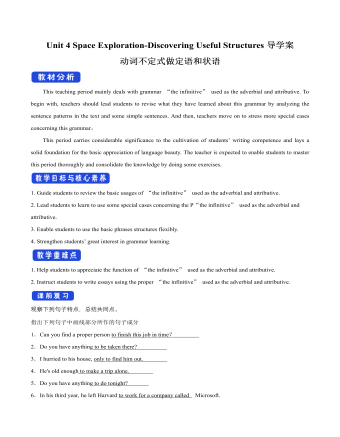
【点津】 1.不定式的复合结构作目的状语 ,当不定式或不定式短语有自己的执行者时,要用不定式的复合结构?即在不定式或不定式短语之前加 for +名词或宾格代词?作状语。He opened the door for the children to come in. 他开门让孩子们进来。目的状语从句与不定式的转换 英语中的目的状语从句,还可以变为不定式或不定式短语作状语,从而使句子在结构上得以简化。可分为两种情况: 1?当目的状语从句中的主语与主句中的主语相同时,可以直接简化为不定式或不定式短语作状语。We'll start early in order that/so that we may arrive in time. →We'll start early in order to/so as to arrive in time. 2?当目的状语从句中的主语与主句中的主语不相同时,要用动词不定式的复合结构作状语。I came early in order that you might read my report before the meeting. →I came early in order for you to read my report before the meeting.
人教版高中语文必修4《短文三篇》教案
③于是,大自然出现了惊人的奇迹,不毛的石缝间丛生出倔强的生命。④或者就只是一簇一簇无名的野草,春绿秋黄。岁岁枯荣。它们只有三两片长长的细瘦的薄叶,那细微的叶脉,告知你生存该是多么艰难;更有的。它们就在一簇一簇瘦叶下自己生长出根须,只为了少向母体吮吸一点乳汁,便自去寻找那不易被觉察到的石缝。这就是生命,如果这是一种本能,那么它正说明生命的本能是多么尊贵,生命有权自认为辉煌壮丽,生机竟是这样地不可扼制。⑤或者就是一团一团小小的山花,大多又都是那苦苦的蒲公英。它们不似田野上的同宗长得那样茁壮,它们的茎显得坚韧而苍老。它们的叶因枯萎而失却光泽。它们已经不能再去为人们作佐餐的鲜嫩的野菜,却默默地为攀登山路的人准备了一个可靠的抓手。生命就这样地被环境规定着,又被环境改变着,适者生存的规律尽管无情。但一切适者就是战胜环境的强者。生命现象告诉你,生命就是拼搏。
人教版高中政治必修1社会主义市场经济教案
教师总结:社会主义市场经济是使市场在国家宏观调控下起基础性配置作用的经济,充分发挥市场基础性调节作用,就必须主要靠经济手段、法律手段,而不是行政手段。(三)课堂总结、点评这节课我们重点学习了社会主义市场经济的有关知识,知道了社会主义市场经济的基本特征,以及国家宏观调控的含义、目标和主要手段。这对于我们在经济生活中正确地认识我国市场经济的性质和作用,理解国家宏观调控的措施及意义,增强社会主义优越感和民族自强意识,自觉投身现代化建设等将有重大指导作用。★课余作业 讨论:联系经济生活中国家宏观调控的实例,讨论应如何认识和理解国家各种宏观调控手段的综合运用,对国民经济发展的意义。★教学体会 本节内容与学生生活实际联系密切,在学习中应该多引入日常生产、生活中常见的一些宏观调控实例,让学生去深刻理解、把握宏观调控手段及其作用。
人教版高中政治必修1市场配置资源教案
教师点拨:这则材料说明,市场调节有其局限性,单纯的市场调节具有自发性、盲目性、滞后性等缺点。市场调节不是万能的。社会生活中有很多领域和产品不能用市场来调节,如国防、治安、消防等产品的供给问题,枪支弹药、麻醉品等都不能让市场来调节。市场调节具有自发性、盲目性、滞后性。自发性:由于市场调节是在价值规律自发作用下进行的,在利益驱动下会产生一些违反市场原则的行为,如制造、销售假冒伪劣商品,大量排放废水、废气破坏环境,窃取他人智力成果等等。盲目性:由于人们不可能完全掌握生产各方面信息及其变化趋势,致使决策带有一定的盲目性。如某种商品有利可图则一哄而上,反之则一哄而退,从而造成资源浪费和消费得不到充分满足。滞后性:由于市场价格的形成和传递有一个过程,一旦传递到生产经营者手中进行生产调整,就有一个时间差,致使市场调节带有滞后性,成为一种事后调节。
人教版高中政治必修1信用工具和外汇教案
(3)人民币外汇牌价:我国通常采用100单位外币作为标准,折算为一定数量的人民币。如果用100单位外币可以兑换更多的人民币,说明外汇汇率升高;反之,则说明外汇汇率跌落。教师活动:大家知道汇率是经常变动的,为什么汇率经常变动?我国在美国、日本等国再三施加压力的情况下,为什么保持汇率稳定,人民币不升值?学生活动:学生就老师提出的问题去阅读教材;然后展开讨论,并回答(4)保持人民币币值稳定的意义教师点评:影响汇率变动的因素主要有:外汇的供求关系、通货膨胀(或紧缩)率的差异、经济增长率、利率水平、国家货币当局的干预与管制、市场预期、外汇投机活动等。外汇在国家经济发展和国际贸易中具有重要的作用:通过汇率的升降调节进出口贸易;可以影响国际资本的流动方向和数量;可以影响国内物价水平;影响外汇储备的实际价值等。
人教版高中语文必修5《谈中国诗》教案
教师提示:1.这句话的本体不是一般意义上的“中国诗”,即不是指中国诗歌中的某一类作品或某位诗人的作品,而是指中国诗的发展特点。早熟,是指“纯粹的抒情诗的精髓和峰极,在中国诗里出现得异常之早”;早衰,是指“中国诗一蹴而至崇高的境界,以后就缺乏变化,而且逐渐腐化”(腐化,是对诗的思想内容和艺术价值而言的)。这句话,借助比喻和比喻中的对比(“早熟”与“早衰”),从诗歌发展的角度,简要地说明了中国诗的艺术特征和由此产生的负面影响。2.这句话有两层意思:一是借梵文的《百喻经》阐释中国的艺术和思想体构上的缺欠,旨在批评;二是点明造成这种缺欠的根本原因。“一个印度愚人要住三层楼而不许匠人造底下两层”这样的建筑物就是“飘飘凌云的空中楼阁”,作者以此作喻,批评中国的艺术和思想体构缺乏严密的逻辑性,往往脱离客观实际,没有坚实的基础,其结果必定影响艺术的健康、稳定地发展。
人教版高中政治必修1第二课多变的价格教案
(四)反思总结,当堂检测。本节内容讲述了价格变动对人们生活、生产的影响作用,主要知识框架如下:(1)、价格变动会影响人们的消费需求,商品价格上涨,人需求就减少,反之,则增大。价格变动对不同商品需求影响程度是不一样的,对生活必需品的需求量影响较小,对高档耐用品的需求量影响较大。相关商品价格变动对消费需求的影响不同,某种商品价格上涨,就会减少需求量,其替代品需求量增加,其互补品需求量则减少。(2)、价格变化也会影响生产经营,价格变动会调节生产,刺激生产者改进技术,提高劳动生产率,促使生产者生产适销对路的高 质量产品。(五)发导学案、布置预习。预习第三课第一框《消费及其类型》,完成预习导学案练习题九、板书设计《价格变动的影响》1、对人们生活的影响(1)商品价格变动与消费需求量之间的关系(2)不同商品的需求量对价格变动的反应程度不同
人教版高中政治必修1第一课神奇的货币教案
1、外汇与外币的关系:(1)外汇包括外币,但外汇不等于就是外币。外币是指外国的货币,包括外国的纸币、铸币;外汇通常是以外国货币表示的用于国际间结算的支付手段,具体包括外币、外币有价证券、外币支付凭证等。(2)外币属于外汇的范围,但不能把二者等同起来。通常情况下,只有可以自由兑换的外币才是外汇,因为外汇的实质是国际支付手段,如果某种货币不能自由兑换,它就不能成为国际支付手段。外汇执行的 主要是货币的支付手段的职能。(3)持有外汇意味着对外汇发行国拥有债权。持有外汇过多,一方面意味着国际支付能力强和有可能对外汇发行国施加影响;另一方面则意味着大量该由本国享受的资源,被借给外国利用,并要承担外汇贬值的风险。2、关于币值变化的分析:(1)对货币升值的具体分析:一个国家的货币升值(上浮)后,同量的这种货币能比以前换 取更多的他国货币,买到更多的他国商品。
《媒介信息的辨识与表达》说课稿-2021-2022学年统编版高中语文必修下册
②癌症患者在治疗过程中,会有很大的身体损耗,而黄鳝有很好的滋补作用,适当吃一点黄鳝,既能够为患者补充营养,也能够提高患者的身体免疫力。 (来源于报纸)经过讨论交流,每一组一名同学自主发言,老师点拨,最后形成小结。看来源 要权威发布,不要道听途说看内容 要事实清晰,不要模糊遗漏看立场 要客观公允,不要情绪煽动看逻辑 要严谨准确,不要简单断言情感判断 理性判断 理性表达(四)活动三,重实践新课标提到,语文课程应引导学生在真实的语言运用情境中,通过自主的语言实践活动,积累经验,把握规律,培养能力。据此,我设计了以下贴近学生生活、可参与性强的活动。多媒体展示案例,仍然是先讨论交流,再自主发言,说出案例有哪些问题。这是某校园论坛上的一则寻物启示。