-
新人教版高中英语必修3Unit 1 Festivals and Celebrations-Reading and Thinking教学设计
The topic of this part is “Discover the reasons for festivals and celebrations.The Listening & Speaking & Talking part aims at talking about the experiences and feelings or emotions about the festivals and celebrations. This section aims at detecting the reason why the people celebrate the festivals, the time, the places, the types and the way of celebrations. It also explains why some traditions in the old celebrations are disappearing, like the firecrackers in the big cities and some new things are appearing like the prosperity of business or commerce. 1. Students can talk about what festivals they know and the reasons and the way of celebrating them.2. Students should learn the reading skills such as the headline and get the topic sentences, the structures of articles.3. Students can understand the past, the present situation of some festival around the world and why there are some changes about them. 4. Students can have the international awareness about the festivals.1. Students should learn the reading skills such as the headline and get the topic sentences, the structures of articles.2. Students can understand the past, the present situation of some festival around the world and why there are some changes about them.Step 1 Lead in---Small talkWhat festival do you like best ? Why ?I like the Spring Festivals because I can set off the fireworks, receive the lucky money and enjoy the Gala with my families.Step 2 Before reading---Pair workWhy do people celebrate different festivals ?The Spring Festivals is to celebrate the end of winter and the coming of spring and new life.The Mid-autumn Day is to celebrate the harvest and admire the moon.
新人教版高中英语必修3Unit 1 Festivals and Celebrations-Listening &Speaking&Talking教学设计
The theme of this section is “Talk about festival activities and festival experiences”.Festival and holiday is a relaxing and interesting topic for students. This part talks about the topic from the daily life of students’. In the part A ---Listening and Speaking, there are three conversations among different speakers from three countries(Japan, Rio and China), where the speakers are participating in or going to participate in the festivals and celebrations. So listening for the relationship among them is a fundamental task. Actually, with the globalization and more international communication, it is normal for Chinese or foreigners to witness different festivals and celebrations in or out of China. In the Conversation 1, a foreign reporter is interviewing a Japanese young girl who just had participated in the ceremony of the Coming-of-Age Day on the street and asking her feeling about the ceremony and the afterwards activities. Conversation 2, Chinese girl Li Mei is witnessing the Rio Carnival for the first time, and her friend Carla gives her some advice on the costumes which enables her to match with the carnival to have a good time. Conversation 3, a Chinese guide is showing a group of foreign visitors around the Lantern Festival and introducing the customs of the festival to them. The three conversations have a strong vitality and insert the festival and cultural elements from different countries. So perceiving the festivals and cultures from different countries is the second task. At the same time, the scripts also insert the targeted grammar --- v-ing as attributive and predicative, which students can perceive and experience in a real context and make a road for the further study. That is the third task. In the Part B--- Listening and Talking, the theme is “Talk about festival experience”, which is the common topic in our daily conversations. During the conversation, Song Lin, a Chinese student, asked Canadian friend Max about how to spend Christmas. In the conversation, Song Lin talked about experience and the feelings during the Chinese Spring Festival, during which there are not only some enjoyable things but some unpleasant things. After the listening, perhaps students find there are some similarities between Christmas and the Chinese Spring Festival as there are some differences in the origins and celebrations. For example, people always visit friends and relatives, decorate their houses, have a big dinner together, chat and give presents to each other.
新人教版高中英语必修3Unit 3 Diverse Cultures-Listening &Speaking&Talking教学设计
1. In Picture 1 and Picture 2, where do you think they are from? How do you know?From their wearings, we can know they are from ethnic minority of China--- Miao and Dong.Picture 1, they are playing their traditional instrument lusheng in their traditional costumes.Picture 2. the girls are Miao because they wear their traditional costumes and silver accessory.2. In Picture 3, can you find which village it is? What time is it in the picture?It is Dong village. It is at night. Step 2 While-listeningJustin met a new friend while traveling in Guizhou. Listen to their conversation and complete the summaries below.Part 1Justin and Wu Yue watched some Miao people play the lusheng. The instrument has a history of over 3,000 years and it is even mentioned in the oldest collection of Chinese poetry. Then they watched the lusheng dance. Justin wanted to buy some hand-made silver/traditional accessories as souvenirs. He was told that the price will depend on the percentage of silver. Part 2They will go to a pretty Dong minority village called Zhaoxing. they will see the drum towers and the wind and rain bridges. They may also see a performance of the Grand Song of the Dong people.Step 3 Post-listening---TalkingWork in groups. Imagine Justin is telling some friends about his trip to Guizhou. One of you is Justin and the rest of you are his friends. Ask Justin questions about his trip and experience. The following expressions may help you.
新人教版高中英语必修3Unit 4 Space Exploration-Reading and Thinking教学设计二
The theme of this unit focuses on “space exploration.” Students will learn about the training and experience needed to become an astronaut. The text is mainly about the development of space exploration. On the one hand, the text helps students to have a good understanding about the great feats humans have achieved, on the other hand, they will further understand the contributions that we Chinese have achieved, and feel confident and proud about our homeland and strengthen their love for our country. The teacher should instruct students to aim high and study harder to make great progress in the space career if possible.1. Read about the development and value of space exploration.2. Explore the mysteries of the universe and the achievements in space exploration.3. Skillfully use the vocabulary of this text to cultivate self-study ability 4. Develop cooperative learning ability through discussion.1. Enable the Ss to talk about the development and value of space exploration.2. Guide the Ss to summarize the main idea of each paragraph as well as the main idea of the text.3. Help Ss comprehend the main reasons for space exploration. Multi-media, textbook, notebooks.Step 1: Warming up and predictionLook at the title and the pictures of the text and predict what the text will be about?2. What are the main reasons for space exploration?
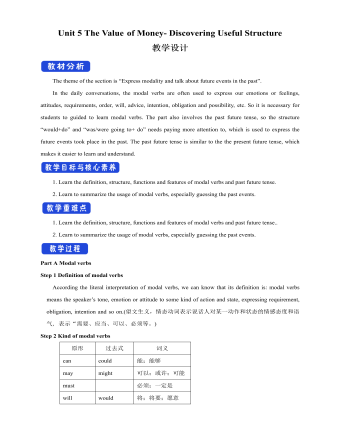
新人教版高中英语必修3Unit 5 The Value of Money- Discovering Useful Structure教学设计
Step 3 Meaning1. 过去将来时表示从过去某一时间来看将要发生的动作或存在的状态, 常用在宾语从句中。一般由“would/should +动词原形”构成。She hoped that they would meet again someday. 她希望将来有一天他们能再见面。2. was/were going to+动词原形: 表示过去将要发生或很有可能发生的动作, 常用于口语中, 表示预言、意图或者打算等。He was going to start work the following week. 他打算下星期开始工作。3. was/were about to do: 常用来表示即将发生的动作, “刚要/正要做……”。注意该结构不与任何时间状语连用。I felt that something terrible was about to happen. 我感到某种可怕的事情即将发生。4.was/were to do: 表示“曾计划做某事”, 如果表示“本来计划做某事, 动作没实现”, 则需用 “was/were to have done”。She said she was to have told me about the accident. 她说她本来想告诉我关于事故的事。5.Start, go, come, leave, see, meet等动词的过去进行时: 表示就过去某一时刻而言即将发生的动作。She was coming later. 她随后就来。I had just put on my overcoat and was leaving to visit a friend of mine. 我刚穿上外套要去看我的一个朋友。
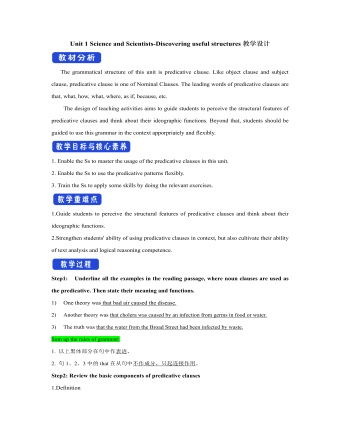
新人教版高中英语选修2Unit 1 Science and Scientists-Discovering useful structures教学设计
The grammatical structure of this unit is predicative clause. Like object clause and subject clause, predicative clause is one of Nominal Clauses. The leading words of predicative clauses are that, what, how, what, where, as if, because, etc.The design of teaching activities aims to guide students to perceive the structural features of predicative clauses and think about their ideographic functions. Beyond that, students should be guided to use this grammar in the context apporpriately and flexibly.1. Enable the Ss to master the usage of the predicative clauses in this unit.2. Enable the Ss to use the predicative patterns flexibly.3. Train the Ss to apply some skills by doing the relevant exercises.1.Guide students to perceive the structural features of predicative clauses and think about their ideographic functions.2.Strengthen students' ability of using predicative clauses in context, but also cultivate their ability of text analysis and logical reasoning competence.Step1: Underline all the examples in the reading passage, where noun clauses are used as the predicative. Then state their meaning and functions.1) One theory was that bad air caused the disease.2) Another theory was that cholera was caused by an infection from germs in food or water.3) The truth was that the water from the Broad Street had been infected by waste.Sum up the rules of grammar:1. 以上黑体部分在句中作表语。2. 句1、2、3中的that在从句中不作成分,只起连接作用。 Step2: Review the basic components of predicative clauses1.Definition
分式方程的解法及应用教学设计与学案
内容:分式方程的解法及应用——初三中考数学第一轮复习学习目标:1、熟练利用去分母化分式方程为整式方程2、熟练利用分式方程的解法解决含参数的分式方程的问题重点:分式方程的解法(尤其要理解“验”的重要性)难点:含参数的分式方程问题预习内容:1、观看《分式方程的解法》《含参数分式方程增根问题》《解含参分式方程》视频2、完成预习检测
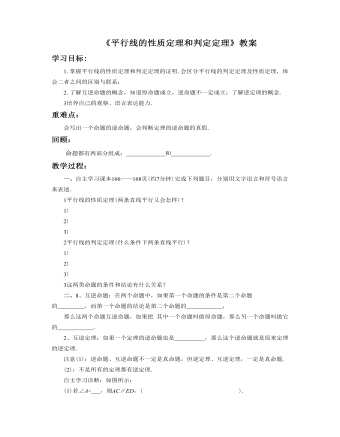
平行线的性质定理和判定定理教案教学设计
1、互逆命题:在两个命题中,如果第一个命题的条件是第二个命题的 ,而第一个命题的结论是第二个命题的 ,那么这两个命题互逆命题,如果把其中一个命题叫做原命题,那么另一个命题叫做它的 .2、互逆定理:如果一个定理的逆命题也是 ,那么这个逆命题就是原来定理的逆定理.注意(1):逆命题、互逆命题不一定是真命题,但逆定理、互逆定理,一定是真命题.(2):不是所有的定理都有逆定理.自主学习诊断:如图所示:(1)若∠A= ,则AC∥ED,( ).(2)若∠EDB= ,则AC∥ED,( ).(3)若∠A+ =1800,则AB∥FD,( ).(4)若∠A+ =1800,则AC∥ED,( ).
初中语文常考常见的别词、别字教案教学设计
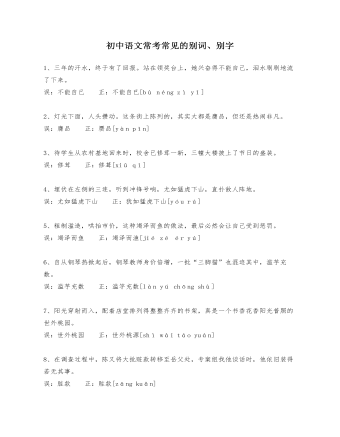
1、三年的汗水,终于有了回报。站在领奖台上,她兴奋得不能自己,泪水刷刷地流了下来。误:不能自己 正:不能自已[bù néng zì yǐ] 2、灯光下面,人头攒动。这条街上陈列的,其实大都是膺品,但还是热闹非凡。误:膺品 正:赝品[yàn pǐn]3、待学生从农村基地回来时,校舍已修茸一新,三幢大楼披上了节日的盛装。误:修茸 正:修葺[xiū qì] 4、埋伏在左侧的三连,听到冲锋号响,尤如猛虎下山,直扑敌人阵地。误:尤如猛虎下山 正:犹如猛虎下山[yóu rú] 5、粗制滥造,哄抬市价,这种竭泽而鱼的做法,最后必然会让自己受到惩罚。误:竭泽而鱼 正:竭泽而渔[jié zé ér yú] 6、自从钢琴热掀起后,钢琴教师身价倍增,一批“三脚猫”也混迹其中,滥芋充数。误:滥芋充数 正:滥竽充数[làn yú chōng shù] 7、阳光穿射而入,配着店堂排列得整整齐齐的书架,真是一个书香花香阳光普照的世外桃园。误:世外桃园 正:世外桃源[shì wài táo yuán]8、在调查过程中,陈又将大批赃款转移至岳父处,专案组找他谈话时,他依旧装得若无其事。误:脏款 正:赃款[zāng kuǎn]
丰富的图形世界 展开与折叠教案教学设计
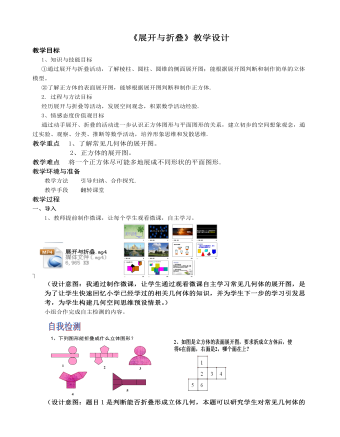
设计意图:题目1是判断能否折叠形成立体几何,本题可以研究学生对常见几何体的把握是否成熟。题目2是考察正方体的展开图,一方面可以研究学生对几何体的把握,另一方面可以引导学生思考,引出下面要学习的内容。)学生预设回答:题目一:学生应该很容易的说出折叠后形成的立体图形。题目二:①运用动手操作的方法,剪出题目中的图形,折叠后对题目做出判断。 ②利用空间观念,复原展开图,发现6的对面是1,2的对面是4,5的对面是3,进而做出判断。教师引导语预设:① 当学生运用动手操作的方法,可以让学生动手实践一下,下一步再引导学生观察正方体,发现规律。② 当学生运用空间观念,教师要放慢语调,和学生一起想象,锻炼学生空间想象能力。
《珍爱生命远离毒品》教学设计教案
教学目标:1、使学生了解什么是毒品,毒品的种类,认识吸毒行为,认清毒品的危害性。2、通过图文、吸毒而造成的悲惨事件,教育学生自觉远离毒品,提高拒毒防毒意识和能力。3、让学生认识吸毒成瘾的途径;认识吸毒成瘾的原因,如何预防。懂得“珍爱生命,拒绝毒品”,培养禁毒意识,遵纪守法,抵制毒品,增强与毒品违法犯罪作斗争的自觉性。教学重点:知道什么是毒品,吸毒的危害,如何提高抵制毒品的能力。
《珍爱生命远离毒品》教学设计教案
教学目标:1、使学生了解什么是毒品,毒品的种类,认识吸毒行为,认清毒品的危害性。2、通过图文、吸毒而造成的悲惨事件,教育学生自觉远离毒品,提高拒毒防毒意识和能力。3、让学生认识吸毒成瘾的途径;认识吸毒成瘾的原因,如何预防。懂得“珍爱生命,拒绝毒品”,培养禁毒意识,遵纪守法,抵制毒品,增强与毒品违法犯罪作斗争的自觉性。教学重点:知道什么是毒品,吸毒的危害,如何提高抵制毒品的能力。
数据的收集与整理 3 数据的表示教案教学设计
创设情境,导入新课:你对母亲知多少师问1:我们5月份刚过了一个重要的节日,你知道是什么吗?----母亲节。师问2:那你知道妈妈的生日吗?(举手示意),每个妈妈都知道自己孩子的生日,请不知道的同学回家了解一下,多关心一下自己的父母。师问3:那你知道妈妈最爱吃的菜吗?你可以选择知道、不知道或者是没有爱吃的(拖动白板上相对应的表情符号)。请大家用不同的手势表示出来。我找3名同学统计各组的数据,写在黑板上(随机找3名学生数人数)。下面我来随机采访一下:你妈妈最喜欢吃的菜是什么?(教师随机采访,结合营养搭配和感恩教育)
20以内的不退位减法教案教学设计
教学目标:1.引导幼儿参与学习活动,经历十几减几计算方法的探索与算理的建构过程。2.根据 11 至 20 各数的组成,掌握 20 以内不进位加法和不进位减法的计算方法。教学重点:十几减几(不退位)的计算。教学过程:一、复习导入复习10以内的数的组合,11~20各数的组成。1.碰球游戏导入,复习10的分解组合2.老师分别出示数字卡片:14、17、12、11。幼儿说数的组成。
三角形的有关证明 3 直角三角形教案教学设计
从课程内容来看,本节课属于“图形与几何”中“图形的性质”部分。依据课标的要求,我从以下四个方面设定了课程目标,分别是:1。知识技能:(1)掌握判定直角三角形全等的“斜边、直角边”定理。(2)已知一直角边和斜边,能用尺规作出直角三角形。2。数学思考:(1)经历探索、猜想、证明的过程,进一步体会证明的必要性,发展推理能力和有条理的表达能力。(2)在探究过程中,渗透由特殊到一般的数学思想方法。3。问题解决:能利用直角三角形的全等解决有关问题。4。情感态度:通过学习,让学生感受数学证明的严谨性,发展勇于质疑、严谨求实的科学态度。
九年级上册道德与法治富强与创新5作业设计
(2) 厦门经济特区成立40年来,在各项事业上都实现历史性跨越和突破, 为国家建设做出重要贡献。 厦门的发展表明当代中国最鲜明的特色是( )A.创新发展 B.经济建设 C.可持续发展 D.改革开放(3) 下列选择中,有利于解决我国当前社会主要矛盾的是( )①以经济建设为中心,解放发展生产力②坚持全面深化改革,实施创新驱动发展③推进城乡一体化发展,实现区域同步发展④兜住民生底线、补齐民生短板、办好民生实事A.①②③ B.①②④ C.①③④ D.②③④(4) 2021是 “十四五” 的开局之年。这一年,我国的战略科技力量发展加 快,改革开放推向纵深,民生得到有力和有效的保障,生态文明建设持续推进,┉┉ 。下列时事与此描述相符合的有 ( )①举行第四届中国国际进口博览会②退休人员的基本养老金实现17连涨③正式提出2030碳达峰和2060碳中和战略目标④成功举办24届北京冬奥会和13届北京冬残奥会A.①②③ B.①②④ C.①③④ D.②③④A.治国有常,而利民为本 B.民相亲在于心相通C.君远相知,不道云海深 D.人而无信,不知其可也
道德与法治八年级上册进社会作业设计
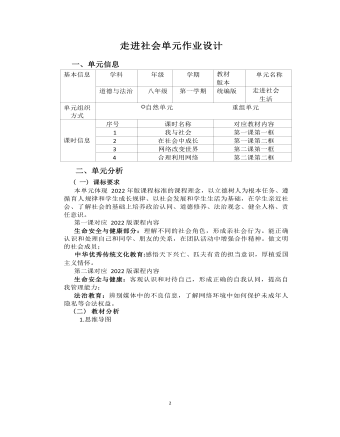
二、单元分析( 一) 课标要求本单元体现 2022 年版课程标准的课程理念,以立德树人为根本任务、遵 循育人规律和学生成长规律、以社会发展和学生生活为基础,在学生亲近社 会、了解社会的基础上培养政治认同、道德修养、法治观念、健全人格、责 任意识。第一课对应 2022 版课程内容生命安全与健康部分:理解不同的社会角色,形成亲社会行为。能正确 认识和处理自己和同学、朋友的关系,在团队活动中增强合作精神。做文明 的社会成员;中华优秀传统文化教育:感悟天下兴亡、匹夫有责的担当意识,厚植爱国 主义情怀。第二课对应 2022 版课程内容生命安全与健康:客观认识和对待自己,形成正确的自我认同,提高自 我管理能力;法治教育:辨别媒体中的不良信息,了解网络环境中如何保护未成年人 隐私等合法权益。
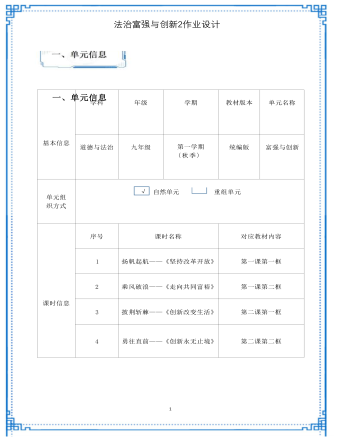
九年级上册道德与法治富强与创新2作业设计
【作业分析】本题考查创新改变生活。防雨神器自动收晾衣服的灵感来源是下 雨忘记收衣服被批评,体现创新是来源于生活、来源于实践。“智能晴雨棚”打 破了传统的只能晾衣服的常规。而由教材内容可知,创新是改革开放的生命, 改革在不断创新中提升发展品质,所以②错误;故本题选 C2. (改编) 利用“安康码”自动定位,即可监测附近新冠肺炎感染病例发病点; 通过输入自己的手机号码,即可通过“通信大数据卡”判断自己是否到访过高 危地区;通过皖事通 APP“密接人员自查”即可查询自己是否曾与新冠肺炎感染 患者接触……疫情发生以来,大数据、健康码、无人机、机器人、测温仪等众 多科技创新成果纷纷登场,助力疫情防控,提高了抗击疫情的精准化水平。这 表明 ( )①标志着我国已经成为科技强国②实施创新驱动发展战略成效显著③创新应成为国家发展进步的中心工作④创新的目的是增进人类福祉,让生活更美好A.①② B.②③ C.①④ D.②④【评价实施主体】教师【评价标准】D【作业分析】本题考查科技创新改变生活中创新的重要性。我国现在还不是科 技强国,但科技自主创新能力不断增强,所以①说法错误。
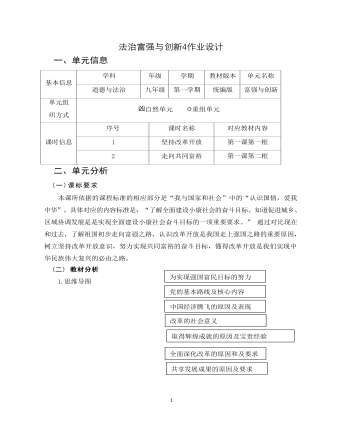
九年级上册道德与法治富强与创新4作业设计
4.2021 年是我国航天事业创建 65 周年,也是收获满满的一年,从“两弹一星”到“神舟” 载人,从“北斗”指路到“嫦娥”奔月、“天问”探火,从无人飞行到载人飞行,从舱内 实验到太空行走,从太空短期停留到中长期驻留……这说明 ( )①我国科技发展水平总体较高②我国综合国力和自主创新能力不断增强③我国实行科教兴国战略取得了显著成效④我国科技在某些尖端领域居于世界领先地位A.①②③ B.①②④ C.①③④ D.②③④5.中国工程院院士张伯礼在讲述他赴武汉抗疫故事时这样感慨:“科学研究是一个养兵千日、 用兵一时的创新事业。”围绕疫苗研发,各攻关团队日夜奋战,在尊重科学、保障安全的 前提下,最大限度缩短研发时间,为本国和全球应对新冠肺炎疫情提供有力支撑。我们在防疫科研人员身上看到 ( )①造福人类的济世情怀 ②律己宽人的处事原则③沟通合作的团队精神 ④见利思义的高尚情操A.①② B.①③ C.②④ D.③④
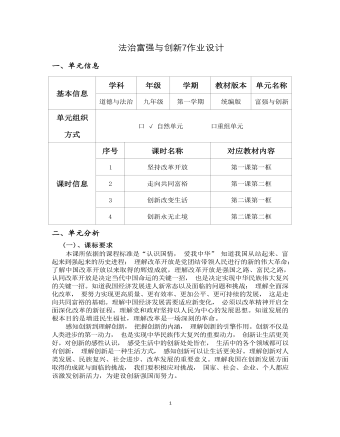
九年级上册道德与法治富强与创新7作业设计
作业 2 观看视频设计分析:学生通过观看 2022 年中国冬奥会厨房机器人感 受到祖国充满创新的高科技风格, 感受祖国的强大, 激发学生的民族自豪感, 自 信心。作业 2 观看视频设计意图:激发学生的学习的热情, 培养创新精神, 提高创 新能力,树立远大的理想。(五) 作业实施与反思作业 1:通过新闻点评, 感受祖国的航天事业的蓬勃发展, 激发学生的爱国 情怀, 考查学生对于创新价值的理解, 对于国家创新文化的自豪感以及对于国家 创新发展的自信。考查学生辩证看待问题的能力和自觉践行创新的能力, 激励学 生有意识地在日常生活中培养自己的创新能力。作业 2:通过观看视频, 2022 年中国冬奥会厨房机器人,智能化运用到生 活中, 机器人学生更关注, 更有兴趣, 从而激发学生学习的热情, 培养学生创新 的热情, 提高创新的能力。感受中国创新成就中培养民族自豪感,形成国家观、 世界观,培养民族担当意识,树立远大理想。