-
人教版新课标小学数学五年级上册数学广角教案2篇
虽然在此之前已经听过多节有关的研讨课,但临到自己教学时才真正体会到本课教学的艰难。一是信息化时代对邮政编码的冲突。其实我在教学前也仅仅只知道学校和家庭住址的邮编,至于邮政编码的结构含义等是完全陌生。在课堂前测中了解到,全班仅3人有写信寄信的经历(这三名学生的老家都远离湖北省),他们知道老家的邮编,全班有半数左右的家庭收集不到已经邮寄过的旧信封。可以说在学习本课前师生对邮政编码都是知之甚少,教师本身都只“半勺水”,何以给学生“一杯水”?虽然在课前布置学生收集了一些有关邮政编码的知识,自己也进行了大量的查询,但在实际教学中仍旧倍感吃力。如有学生质疑“为什么书上北京人民出版社的邮编是100008,它的第三、四位都是0呢”;“为什么我们学校的邮编4300XX第三、四位也是0呢”;“邮区是不是指什么市?”“邮区与市、区、县有什么关系?”一个接一个问题“炮轰”过来,着实招架不住。
人教版新课标小学数学六年级下册数学广角教案2篇
一、创设情境,猜想验证1.猜一猜,摸一摸。一盒粉笔若干支,5种不同的颜色。至少摸几支能保证:(1)2支同色的。(2)3支同色的。(3)4支同色的。2.想一想,摸一摸。请学生独立思考后,先在小组内交流自己的想法,再动手操作试一试,验证各自的猜想。在这个过程中,教师要加强巡视,要注意引导学生思考本题与前面所讲的抽屉原理有没有联系,如果有联系,有什么样的联系,应该把什么看成抽屉,要分放的东西是什么。二、观察比较,分析推理1.说一说,在比较中初步感知。2.想一想,在反思中学习推理。三、深入探究,沟通联系四、对比练习,感悟新知1.说一说。把红、黄、蓝、白四种颜色的球各10个放到一个袋子里。至少取多少个球,可以保证取到两个颜色相同的球?2.算一算。向东小学六年级共有370名学生,其中六(2)班有49名学生。请问下面两人说的对吗?为什么?五、总结评价六、布置作业
人教版新课标PEP小学英语三年级下册Recycle 1教案2篇
1.猜袋中东西数 将全班分成若干小组,每组抽一人到前面,背对着班级。教师拿一个袋子,并向学生们借一些书本,铅笔,钢笔,橡皮等,放入袋中,然后让各组学生轮流猜袋子里东西的数目,猜对的给该组记10分。 2.学生一起有节奏地说唱Let’s chant部分的歌谣,并请学生分角色表演。 (二)呈现新课 (Presentation) 1.抢读单词 教师将全班分成若干小组,然后逐个出示一些图片,学生们举手抢答,教师让最先举手的学生将图片的单词说出来,说对的给该组记10分,得分最多的组为优胜。 2.看单词卡读出单词并说出中文,复习1-3单元要求四会的单词。 3.教师用实物投影出示1-3单元课文中的某一幅图片,让学生根据图片内容进行对话练习。 4.让学生填写Assessment部分的内容,自己对1-3单元所学内容的掌握情况进行自我评价。 5.教师向学生出示已制作好的window card:This si a window card.并教读window card教师问学生:Do you like it? Can you make it? Do you want to learn how to make a window card?
人教版新课标PEP小学英语三年级下册Where is my ruler教案2篇
1.Let’s say学习字母Uu, Vv, Ww,以及以这些字母开头的单词。2.Let’s do本部分通过有韵律的歌谣,来复习巩固A-W的字母。【教学重点】学习字母Uu, Vv, Ww及以其为首字母的单词【教学难点】单词umbrella, violin, wind和字母Uu, Vv, Ww的发音.【教具准备】1 教师准备教材配套的录音带。2 教师准备 umbrella, vest, violin, window, wind 的图片和词卡。3 教师准备字母卡 Aa----Ww 。【教学过程】1 热身、复习 (Warm-up/Revision)(1)Oral practice学生口语会话展示。教师可根据学生情况提示他们增加对内容。(2)游戏:“猜猜看”。教师用简笔画的方法在黑板上画某种交通工具的某个部位,边画边问:What is it? 学生随意想象,猜图说:A panda? A jeep? A pear? … 教师再继续画一两笔,让学生接着猜,并以小组为单位讨论,最后由一名学生代表说出一个答案。教师将图画完,带领学生一起说: Look! It’s a … 猜对的小组赢得一分。(以交通工具、玩具和文具词为主) 还可让学生代替教师进行此项活动。
人教版新课标PEP小学英语六年级下册Recycle2 A Farewell Party教案
3. 新课呈现(Presentation) Let’s make (1)教师说:Miss White is making a book about her students. So she can remember them well.Who are the students? 请学生独立或分小组朗读四段短文,解释学生不理解的句子,然后说:There are four pictures below. Would you like to help Miss/White glue the pictures? 教师知道学生完成图文搭配的练习。 (2)教师发给每名学生一张铅画纸,说:Now please draw a picture of your best classmate. Then describe him or her.学生画一副最要好的同学的肖像,并在傍边配上对该同学的英语介绍。 学生上讲台介绍自己最要好的同学,请其他学生猜是谁,看谁说的生动又贴切,教师给予评价时注意强调第三人称单数形式的使用。 Story time 教师向学生展示Story time部分的教学挂图,指着最后一副图中的Zoom 和 Zip说 Look at the picture. Zoom and Zip are sad. They are saying goodbye to each other. Now let’s see What happened. 学生同桌之间合作阅读或是,然后教师提出问题Where is Zip going? Is this good news for zoom ? What grade is Zip going to be in? 教师放录音,学生录音跟读故事,然后再分角色朗读.
人教版高中语文必修1《纪念刘和珍君》说课稿3篇
1.说教材《记念刘和珍君》是鲁迅先生用饱醮着热泪,用悲愤的笔调写下的一篇感人至深的散文,既有对爱国青年沉痛的悼念,又有对反动派愤怒的控诉,也有对觉醒的国民的呐喊。《记念刘和珍君》是高中语文必修1第三单元第一课的讲读课文。文中描摹人物的音容笑貌,叙述人物的行为事迹,都融入了作者真挚的情感和深刻的感悟。对学生明辨是非,领悟时代精神和人生意义,有着重要的作用。新课标强调了要全面提升高中学生的语文素养,初步形成正确的世界观、人生观、价值观,并学会收集、判断、处理信息,具有人文素养、创新精神与实践能力。同时,《记念刘和珍君》感情真挚,感悟深刻,具有典型人文性。结合本单元教学目标,确立教学目标如下。
人教版高中语文必修1《雨巷》说课稿3篇
一.教材理解教材地位与作用:本单元“阅读与鉴赏”部分,本单元要求学生能在了解诗歌创作的时代背景的情况下通过反复诵读诗歌,把握其中丰富的意象,领悟诗歌独特的意境和诗人所要表达的情感。《雨巷》是现代派大师戴望舒的成名作和前期的代表作,他曾因此而赢得了“雨巷诗人”的雅号。本单元以《雨巷》为例子给学生展示了象征主义诗歌的特点,《雨巷》运用了象征性的抒情手法。诗中那狭窄阴沉的雨巷,在雨巷中徘徊的独行者,以及那个像丁香一样结着愁怨的姑娘,都是象征性的意象。这些意象又共同构成了一种象征性的意境,含蓄地暗示出作者即迷惘感伤又有期待的情怀,并给人一种朦胧而又幽深的美感。富于音乐性是《雨巷》的另一个突出的艺术特色。诗中运用了复沓、叠句、重唱等手法,造成了回环往复的旋律和宛转悦耳的乐感。因此我把本课的教学重点和难点确定为:教学重点:通过反复诵读,领略诗歌的音乐美以及分析其成因教学难点:分析意象以及其象征意义初步掌握鉴赏诗歌的方法
人教版高中语文必修3《杜甫诗三首》说课稿
我以以《登高》为例,引导学生进行意象分析,感悟意境美。古人云“立象以尽意”“古诗之妙,专求意象”意象是诗人情感的载体,是诗歌的灵魂。引导学生张开联想和想象的翅膀去感受,去体验是意象,诗歌鉴赏的关键。科林伍德说“真正艺术的作品,不是看见的,也不是听到的,而是想象中的某种东西。”诗人通过想象创造出诗的形象,我们读者通过想象丰富地再现诗人创造的形象。而感受体验则是以全部身心投入作品,心灵与心灵相沟通,感情与感情相交流,对诗人的想象活动进行再经历和再体验。因此,在引导意象解读中,我先让学生点击这一个,就是通过抓修饰词、依据感情基调、展开想象具体分析本诗中每个意象的情感意蕴和审美意蕴,使学生明白意象在每首诗中的独特性。
人教版高中历史必修3启蒙运动说课稿
教材地位本课具有承上启下的作用,前承文艺复兴,后启资产阶级革命时代的到来,启蒙运动为资本主义社会构建了一套政治蓝图,具有前瞻性,是近代第二次思想解放运动。因此,本节内容在整个教材中有着很重要的地位。教学目标1、知识目标:(1)帮助学生了解启蒙运动的性质、内容和主要启蒙 思想家及其主张。(2)理解启蒙运动兴起的背景、影响。2、能力目标:(1)在讨论和探究过程中训练学生的科学思维方法和自主学习的能力和掌握解题的方法。(2)通过指导学生阅读启蒙思想家的言论资料,培养学生对历史资料的理解和归纳能力。3、情感价值目标:(1)培养人文意识,强化法治观念。(2)培养学生的团结协作精神和竞争意识。教学重点、难点(1)教学重点:启蒙思想家的主张及启蒙运动的影响。
人教版高中生物必修1细胞增殖说课稿
f.有丝分裂的意义(讨论分析教学),首先引导学生结合所学知识讨论有丝分裂的的作用,最后有教师归纳总结,并要求学生在理解的基础上记忆。g.无丝分裂(图形直观教学、简介),本部分内容不是教学的重点,内容也相对简单,所以我的教学方法是直接给学生展示挂图,再进行简短介绍,让学生了解即可。h.引出减数分裂的概念,为第五章学习打下基础。小结:新课讲完以后由教师对本节内容进行总结巩固和反馈:进行一些课堂练习达到巩固和反馈的作用。最后布置作业,各种难度的作业题目均设置一些,其中简单题比重大,难题要求学生选作,这样提高学生学习积极性。2教学媒体程序设计: 细胞周期的概念(多媒体课件演示周期动画)植物细胞有丝分裂(多媒体课件演示分裂各期动画)动植物细胞有丝分裂异同点(多媒体课件演示分裂各期动画)有丝分裂过程中DNA和染色体数量的变化规律(挂图演示,包括表格和函数图象)
人教版高中生物必修1细胞分化说课稿
在讲述细胞分化的意义时,也可以用实例来解决,工厂的生产车间里不同的工人干着不同的工作,一件产品的产出需要这些工人才能创造出来,一个生物体就像一个车间一样,不同的细胞各司其职,相互合作。工人的分工是主管调解出来的,而不同细胞的出现就是细胞分化的结果,所以说,细胞的分化是生物体发育的基础。在讲到细胞全能性的时候,要多给学生举些关于细胞全能性的例子,如植物组织培养、克隆技术等等,让学生从实际的例子中真正的悟出细胞全能性的含义。此外,还要重视教材中的疑问,适当对题目进行引申,使它的作用更加突出,有利于学生对知识的串联、积累、加工,从而达到举一反三的效果。怎样来解释细胞的全能性呢?这主要以讲授法来解释了,细胞全能性的体现需要在组织或器官离体后才能体现出来,每个细胞都包含着生物体的全套遗传基因,通过基因选择性的表达,使离体的组织或器官通过分裂和分化逐渐发育成完整的植株。
人教版高中政治必修1市场配置资源说课稿
(2)、市场调节存在固有的弊端:自发性:由于市场调节是在价值规律自发作用下进行的,在利益驱动下会产生一些违反市场原则的行为,如制造、销售假冒伪劣商品,大量排放废水、废气破坏环境,窃取他人智力成果等等。盲目性:由于人们不可能完全掌握生产各方面信息及其变化趋势,致使决策带有一定的盲目性。如某种商品有利可图则一哄而上,反之则一哄而退,从而造成资源浪费和消费得不到充分满足。滞后性:由于市场价格的形成和传递有一个过程,一旦传递到生产经营者手中进行生产调整,就有一个时间差,致使市场调节带有滞后性,成为一种事后调节。教师活动:请同学们想一想,市场的这些弊端和不足,会导致什么后果?(3)、危害教师总结:资源浪费,经济波动与混乱,分配不公两极分化等。设计意图:通过创设情景,加深对市场调节局限性的理解;要求学生结合生活实例探讨其弊端有助于加强对其产生原因和表现的记忆和理解。
人教版高中政治必修1税收及其种类说课稿
在学生明确了税收的含义之后,我将分别对税收的三个基本特征进行解析。在讲解了之后,并分别用实例对其进行说明,加深学生对知识点的印象。最重要的是,总结出关键的字眼,使得学生能够清晰的区分出税收的三个基本特征。将强制性概括为依法征税、依法纳税;无偿性概括为不具有偿还性和返还型;固定性概括为规定应不应纳税、纳什么税、纳多少税。并跟学生指出,强制性是基本前提,无偿性是核心。由此根据书上的内容,推导出税收的三个基本特征相互之间的关系,即:三者缺一不可,统一于税法。而且,无偿性要求强制性,强制性保障无偿性;而无偿性与强制性又共同决定固定性。从而结束新课讲授。3、课堂总结根据板书内容重新回顾本课学习的主要内容,包括税收的含义,以及税收的三个基本特征和它们之间的相互关系。4、作业布置让学生预习税收的种类的内容,尤其是增值税和个人所得税。同时了解父母每月所缴纳的个人所得税和怎么计算的。
人教版高中政治必修3感受文化影响说课稿
(2)世界观,人生观,价值观是人们文化素养的核心和标志。一旦形成就会对人产生深远持久的影响。(但随着生活阅历的变化,人们文化素养的提高,人们的“三观”会发生变化。)总之“潜移默化”指每时每刻,不知不觉;是从文化对人影响的过程来看的。“深远持久”指经年累月,难以抹去;是从文化对人影响的结果上说的。3.课堂总结:首先启动学生思维,教会学生把握知识主线,建构知识体系,先由学生进行总结,然后教师进行必要的补充4、布置作业:布置作业。运用文化对人的影响的知识分析“近朱者赤,近墨者黑”,并且应该如何处理朋友之间的关系。设计这个作业的意图是既让学生灵活运用所学知识,同时又让学生回归生活,如何处理朋友之间的关系。5、板书设计遵循板书设计的实用性、直观性的原则,根据本课的教材特点,我采用结构式板书,这样设计比较直观、系统,以便于学生能够系统把握和理解知识。
人教版高中政治必修3建设学习型社会说课稿
解析:材料是讲学习型社会所产生的影响,A项观点错误,在当前和今后相当长的时间里,学校教育仍然是人们获得知识的最重要的途径。B项观点错误,终身学习只是成就人生目的的手段、途径,而不是目的本身。D项说法错误,当前我国社会的中心工作是经济建设。二、问答题5.材料一:日本是公认的漫画大国,日本的动漫产业产值每年230万亿日元,成为日本的第二大支柱产业。在日本,漫画比电影、小说有时甚至比电视或音乐更受欢迎。日本漫画的热潮还席卷了世界:日本每年出口到美国的卡通片价值就达5 000亿日元,是日本对美国钢铁出口金额的4倍;漫画中的人物被迅速复制成电子游戏、卡通片及真人演出的节目。原来只是闲暇时候消遣的漫画,正飞速渗透到人们的生活中。值得警惕的是,除了催人奋进的精华之外,日本漫画中也存在暴力、色情、扭曲历史等诸多糟粕,对缺乏辨别能力的青少年产生了许多不良影响,更引发了一系列深刻的社会问题。
人教版高中政治必修3聚焦文化竞争力说课稿
(1)文化与经济、政治在经济基础上相互影响。①经济、政治和文化是社会生活的三个基本领域。其中,经济是基础,政治是经济的集中表现,文化是经济和政治的反映。一定的文化由一定的经济、政治所决定,又反作用于一定的政治、经济,给予政治、经济以重大影响。②经济发展是文化发展的基础。但这并不意味着文化的发展始终与经济的发展亦步亦趋。如同不能简单地把精神文明看作是物质文明的派生物和附属品一样,也不能简单地认为文化是经济、政治的派生物和附属品。文化有其自身的传承性和相对的独立性。那种认为只要物质条件好了,精神文化自然而然地就会好起来,物质条件差一点,精神文化就不可能搞好的观点,不符合历史发展的事实,是不正确的。③掀开历史的画卷,文化既有古今和地域之别,又有先进与落后、腐朽之分。不同的文化,对经济、政治的影响不同,对社会发展的作用也不同。不同民族的文化,影响不同民族和国家各具特色的发展道路。
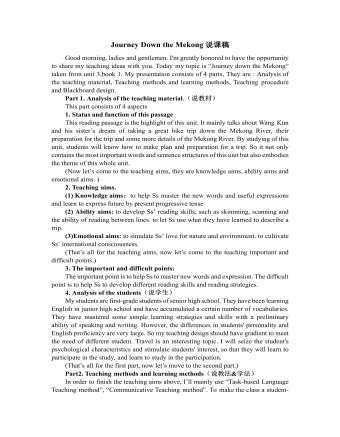
人教版高中英语必修1Journey Down the Mekong说课稿
2. let the Ss complete the forms paragraph by paragraph. Purpose here is to help Ss to get the habit of reading a passage as a whole, and pay attention to the organization of the text, as a result the Ss will fully understand the whole passage.3. ask Ss to retell the passage with the help of the key words in the form.Since the Ss in the class are in different levels, so I let them to fill in the blank to understand the meaning of the words and phrases better. ( That’s all for the while-reading. Now let’s move to the fifth step.)Step V: Post-reading (10mins) ---DiscussionIn this part students are asked to discuss in groups and list Wang Kun’s and Wang Wei’s attitudes about the trip. After that, Ss are encouraged to express their attitudes with the whole class. Collect their answers and don’t forget to praise them even if their answers may not be perfect.In this activity, discussion provides a vivid and active learning environment for Ss to communicate in English with newly learned language items. (Finally it comes to the homework.)StepⅥ: Homework (1min)1. Ss are required to read the text again after class and figure out the meaning of some complex sentences.2. Do the exercises on P19; This can help Ss to consolidate what they’ve learnt and make preparation for the next lessonPart4. Blackboard design.(说板书设计)On the top, there is the title of this lesson. On the left, there are main ideas for each paragraph. On the right, there are some new words and expressions.Unit 3 Travel journalJourney down the MekongMain idea of each para.:Para1: deciding to take a great bike trip along the Mekong river.Para2: Different attitudes between Wang kun and Wang wei.
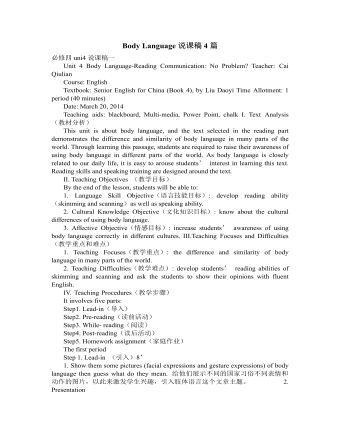
人教版高中英语必修4Body Language说课稿4篇
Textbook: Senior English for China (Book 4), by Liu Daoyi Time Allotment: 1 period (40 minutes)Date: March 20, 2014Teaching aids: blackboard, Multi-media, Power Point, chalk I. Text Analysis (教材分析)This unit is about body language, and the text selected in the reading part demonstrates the difference and similarity of body language in many parts of the world. Through learning this passage, students are required to raise their awareness of using body language in different parts of the world. As body language is closely related to our daily life, it is easy to arouse students’ interest in learning this text. Reading skills and speaking training are designed around the text.II. Teaching Objectives (教学目标)By the end of the lesson, students will be able to:1. Language Skill Objective(语言技能目标): develop reading ability (skimming and scanning)as well as speaking ability.2. Cultural Knowledge Objective(文化知识目标): know about the cultural differences of using body language.3. Affective Objective(情感目标): increase students’ awareness of using body language correctly in different cultures. III.Teaching Focuses and Difficulties(教学重点和难点)1. Teaching Focuses(教学重点): the difference and similarity of body language in many parts of the world.2. Teaching Difficulties(教学难点): develop students’ reading abilities of skimming and scanning and ask the students to show their opinions with fluent English.
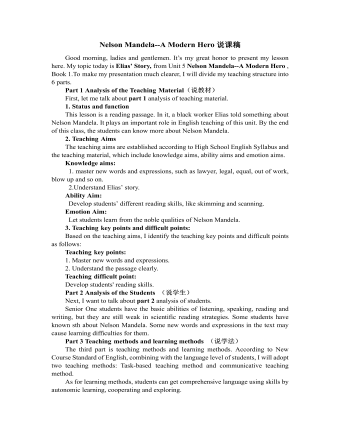
人教版高中英语必修1Nelson Mandela--A Modern Hero说课稿
In this step, give students a few minutes to read the passage . While they are reading, I will write some key words of the text on the blackboard. Then ask students to retell the passage according to the key words.By retelling, students can improve their ability of language organization and have an overall understanding of the article.Step 4 Group discussionIn this step, students will be divided into groups of 4 to discussion the following question: What qualities make a great person?After their discussion, invite a few groups to make a report to the class.This group discussion can practice students’ oral English and cultivate their abilities of cooperation and communication.Step 5. HomeworkLet students write a short passage to introduce a great person he or she admires.The homework can consolidate the knowledge the students have learned and cultivate their writing ability. Part 6 Blackboard Design(板书设计)That’s all my teaching procedures. Finally, I’d like to say sth about part 6 blackboard design. On the top is the title. On the left, there will be some new words and expressions. In the middle of the blackboard, I will write some useful sentence structures so that the students can know clearly what they’ve learned and then try to master the knowledge.OK. That’s all for my presentation. Thank you for your attention.
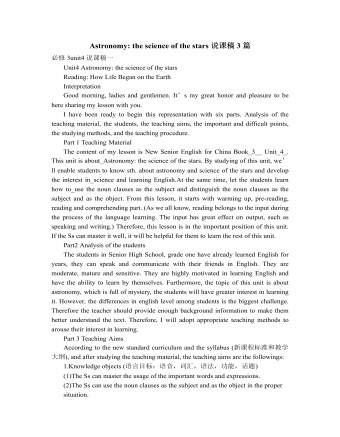
人教版高中英语必修3Astronomy the science of the stars说课稿3篇
Step 2 Pre-listeningAfter students finish their discussion, I will show a picture of Newton and ask them: Who is him? What is he famous for? Could you find out some words to describe him? Maybe students will answer that he is genius for his finding of theGravitation, making a great contribution to the progress of human being. At that time I will show another two pictures of Einstein and Hawking, letting students guess who they are and write down their idea about the Gravitation. For I have arranged them to search more information about the gravity before this class, Students have beenfamiliar with the topic and will not be afraid about this abstract conception, which is helpful for their listening.Step 3 While-listeningIn this step, students will be required to listen the material for three times. The first and listening is extensive listening and the second and third listening is intensive listening. In the first time, They are required to listen a material including Part 1 and Part 2 and choose the best summary of the listening text. After they choose the right answer, They also need work in group to explain what is wrong with the others. Then I will make a conclusion that we should pay attention to the first paragraph and last paragraph and some keys to get the main idea. By doing this, their capacity of generalization will have a great improvement.Before the second listening, I will ask students to scan the blank on the power point quickly and ask them to note down some key words .Then ask them to listen to the Part 1again and fill the first column of the chart. Maybe some students just show the ideas of these three scientists an still can’t catch their development of gravity. Therefore, I will ask them to listen to Part 2 again and fill in the rest. After finish the listening, I will give them ten minutes to discuss with their partner. I will also guidethem to improve their answers when they discuss with others.