-
人教A版高中数学必修二空间点、直线、平面之间的位置关系教学设计
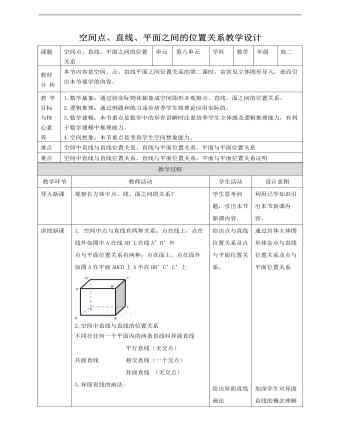
9.例二:如图,AB∩α=B,A?α, ?a.直线AB与a具有怎样的位置关系?为什么?解:直线AB与a是异面直线。理由如下:若直线AB与a不是异面直线,则它们相交或平行,设它们确定的平面为β,则B∈β, 由于经过点B与直线a有且仅有一个平面α,因此平面平面α与β重合,从而 , 进而A∈α,这与A?α矛盾。所以直线AB与a是异面直线。补充说明:例二告诉我们一种判断异面直线的方法:与一个平面相交的直线和这个平面内不经过交点的直线是异面直线。10. 例3 已知a,b,c是三条直线,如果a与b是异面直线,b与c是异面直线,那么a与c有怎样的位置关系?并画图说明.解: 直线a与直线c的位置关系可以是平行、相交、异面.如图(1)(2)(3).总结:判定两条直线是异面直线的方法(1)定义法:由定义判断两条直线不可能在同一平面内.
人教A版高中数学必修一指数函数的概念教学设计(2)
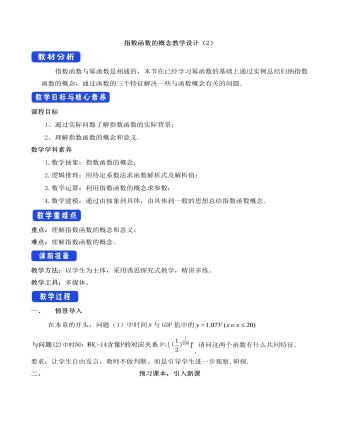
指数函数与幂函数是相通的,本节在已经学习幂函数的基础上通过实例总结归纳指数函数的概念,通过函数的三个特征解决一些与函数概念有关的问题.课程目标1、通过实际问题了解指数函数的实际背景;2、理解指数函数的概念和意义.数学学科素养1.数学抽象:指数函数的概念;2.逻辑推理:用待定系数法求函数解析式及解析值;3.数学运算:利用指数函数的概念求参数;4.数学建模:通过由抽象到具体,由具体到一般的思想总结指数函数概念.重点:理解指数函数的概念和意义;难点:理解指数函数的概念.教学方法:以学生为主体,采用诱思探究式教学,精讲多练。教学工具:多媒体。一、 情景导入在本章的开头,问题(1)中时间 与GDP值中的 ,请问这两个函数有什么共同特征.要求:让学生自由发言,教师不做判断。而是引导学生进一步观察.研探.
人教A版高中数学必修二平面与平面平行教学设计
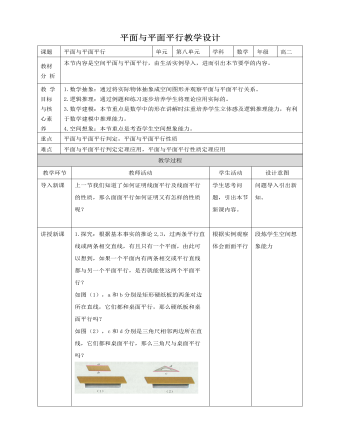
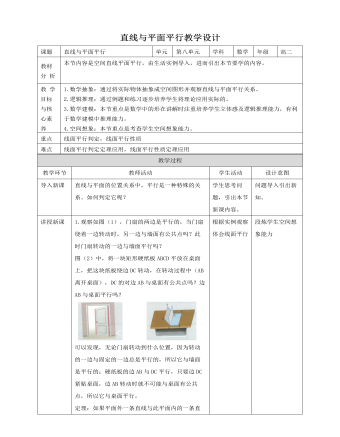
1.探究:根据基本事实的推论2,3,过两条平行直线或两条相交直线,有且只有一个平面,由此可以想到,如果一个平面内有两条相交或平行直线都与另一个平面平行,是否就能使这两个平面平行?如图(1),a和b分别是矩形硬纸板的两条对边所在直线,它们都和桌面平行,那么硬纸板和桌面平行吗?如图(2),c和d分别是三角尺相邻两边所在直线,它们都和桌面平行,那么三角尺与桌面平行吗?2.如果一个平面内有两条平行直线与另一个平面平行,这两个平面不一定平行。我们借助长方体模型来说明。如图,在平面A’ADD’内画一条与AA’平行的直线EF,显然AA’与EF都平行于平面DD’CC’,但这两条平行直线所在平面AA’DD’与平面DD’CC’相交。3.如果一个平面内有两条相交直线与另一个平面平行,这两个平面是平行的,如图,平面ABCD内两条相交直线A’C’,B’D’平行。
人教A版高中数学必修二事件的相互独立性教学设计
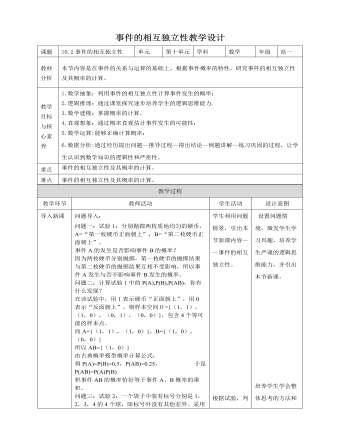
问题导入:问题一:试验1:分别抛掷两枚质地均匀的硬币,A=“第一枚硬币正面朝上”,B=“第二枚硬币正面朝上”。事件A的发生是否影响事件B的概率?因为两枚硬币分别抛掷,第一枚硬币的抛掷结果与第二枚硬币的抛掷结果互相不受影响,所以事件A发生与否不影响事件B发生的概率。问题二:计算试验1中的P(A),P(B),P(AB),你有什么发现?在该试验中,用1表示硬币“正面朝上”,用0表示“反面朝上”,则样本空间Ω={(1,1),(1,0),(0,1),(0,0)},包含4个等可能的样本点。而A={(1,1),(1,0)},B={(1,0),(0,0)}所以AB={(1,0)}由古典概率模型概率计算公式,得P(A)=P(B)=0.5,P(AB)=0.25, 于是 P(AB)=P(A)P(B)积事件AB的概率恰好等于事件A、B概率的乘积。问题三:试验2:一个袋子中装有标号分别是1,2,3,4的4个球,除标号外没有其他差异。
人教A版高中数学必修二向量的减法运算教学设计
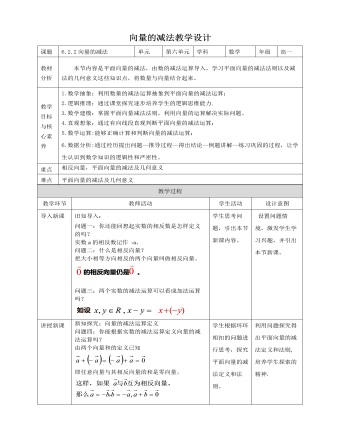
新知探究:向量的减法运算定义问题四:你能根据实数的减法运算定义向量的减法运算吗?由两个向量和的定义已知 即任意向量与其相反向量的和是零向量。求两个向量差的运算叫做向量的减法。我们看到,向量的减法可以转化为向量的加法来进行:减去一个向量相当于加上这个向量的相反向量。即新知探究(二):向量减法的作图方法知识探究(三):向量减法的几何意义问题六:根据问题五,思考一下向量减法的几何意义是什么?问题七:非零共线向量怎样做减法运算? 问题八:非零共线向量怎样做减法运算?1.共线同向2.共线反向小试牛刀判一判(正确的打“√”,错误的打“×”)(1)两个向量的差仍是一个向量。 (√ )(2)向量的减法实质上是向量的加法的逆运算. ( √ )(3)向量a与向量b的差与向量b与向量a的差互为相反向量。 ( √ )(4)相反向量是共线向量。 ( √ )
人教A版高中数学必修二直线与平面垂直教学设计
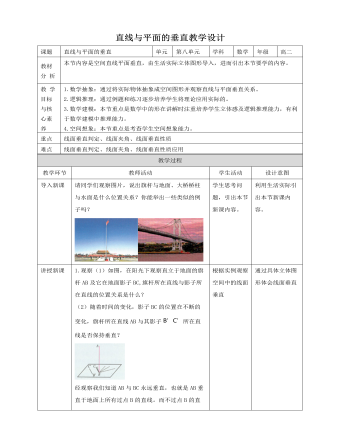
1.观察(1)如图,在阳光下观察直立于地面的旗杆AB及它在地面影子BC,旗杆所在直线与影子所在直线的位置关系是什么?(2)随着时间的变化,影子BC的位置在不断的变化,旗杆所在直线AB与其影子B’C’所在直线是否保持垂直?经观察我们知道AB与BC永远垂直,也就是AB垂直于地面上所有过点B的直线。而不过点B的直线在地面内总是能找到过点B的直线与之平行。因此AB与地面上所有直线均垂直。一般地,如果一条直线与一个平面α内所有直线均垂直,我们就说l垂直α,记作l⊥α。2.定义:①文字叙述:如果直线l与平面α内的所有 直线都垂直,就说直线l与平面α互相垂直,记作l⊥α.直线l叫做平面α的垂线,平面α叫做直线l的垂面.直线与平面垂直时,它们唯一的公共点P叫做交点.②图形语言:如图.画直线l与平面α垂直时,通常把直线画成与表示平面的平行四边形的一边垂直.③符号语言:任意a?α,都有l⊥a?l⊥α.
人教A版高中数学必修二直线与直线垂直教学设计
6.例二:如图在正方体ABCD-A’B’C’D’中,O’为底面A’B’C’D’的中心,求证:AO’⊥BD 证明:如图,连接B’D’,∵ABCD-A’B’C’D’是正方体∴BB’//DD’,BB’=DD’∴四边形BB’DD’是平行四边形∴B’D’//BD∴直线AO’与B’D’所成角即为直线AO’与BD所成角连接AB’,AD’易证AB’=AD’又O’为底面A’B’C’D’的中心∴O’为B’D’的中点∴AO’⊥B’D’,AO’⊥BD7.例三如图所示,四面体A-BCD中,E,F分别是AB,CD的中点.若BD,AC所成的角为60°,且BD=AC=2.求EF的长度.解:取BC中点O,连接OE,OF,如图。∵E,F分别是AB,CD的中点,∴OE//AC且OE=1/2AC,OF//AC且OF=1/2BD,∴OE与OF所成的锐角就是AC与BD所成的角∵BD,AC所成角为60°,∴∠EOF=60°或120°∵BD=AC=2,∴OE=OF=1当∠EOF=60°时,EF=OE=OF=1,当∠EOF=120°时,取EF的中点M,连接OM,则OM⊥EF,且∠EOM=60°∴EM= ,∴EF=2EM=
统编版三年级语文上第17课古诗三首教学设计教案
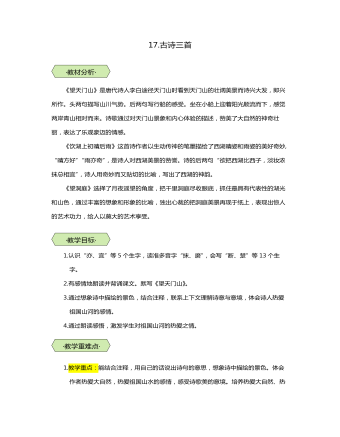
《望天门山》是唐代诗人李白途径天门山时看到天门山的壮阔美景而诗兴大发,即兴所作。头两句描写山川气势。后两句写行船的感受。坐在小船上迎着阳光顺流而下,感觉两岸青山相对而来。诗歌通过对天门山景象和内心体验的描述,赞美了大自然的神奇壮丽,表达了乐观豪迈的情感。《饮湖上初晴后雨》这首诗作者以生动传神的笔墨描绘了西湖晴姿和雨姿的美好奇妙,?“晴方好”“雨亦奇”,是诗人对西湖美景的赞誉。诗的后两句“欲把西湖比西子,淡妆浓抹总相宜”,诗人用奇妙而又贴切的比喻,写出了西湖的神韵。《望洞庭》选择了月夜遥望的角度,把千里洞庭尽收眼底,抓住最具有代表性的湖光和山色,通过丰富的想象和形象的比喻,独出心裁的把洞庭美景再现于纸上,表现出惊人的艺术功力,给人以莫大的艺术享受。 1.认识“亦、宜”等5个生字,读准多音字“抹、磨”,会写“断、楚”等13个生字。2.有感情地朗读并背诵课文。默写《望天门山》。3.通过想象诗中描绘的景色,结合注释,联系上下文理解诗意与意境,体会诗人热爱祖国山河的感情。4.通过朗读感悟,激发学生对祖国山河的热爱之情。 1.教学重点:能结合注释,用自己的话说出诗句的意思,想象诗中描绘的景色。体会作者热爱大自然,热爱祖国山水的感情,感受诗歌美的意境。培养热爱大自然、热爱祖国的情感。2.教学难点:体会诗文的内容,体会诗人的思想感情。 3课时
新人教版高中英语必修3Unit 1 Festivals and Celebrations-Reading and Thinking教学设计
The topic of this part is “Discover the reasons for festivals and celebrations.The Listening & Speaking & Talking part aims at talking about the experiences and feelings or emotions about the festivals and celebrations. This section aims at detecting the reason why the people celebrate the festivals, the time, the places, the types and the way of celebrations. It also explains why some traditions in the old celebrations are disappearing, like the firecrackers in the big cities and some new things are appearing like the prosperity of business or commerce. 1. Students can talk about what festivals they know and the reasons and the way of celebrating them.2. Students should learn the reading skills such as the headline and get the topic sentences, the structures of articles.3. Students can understand the past, the present situation of some festival around the world and why there are some changes about them. 4. Students can have the international awareness about the festivals.1. Students should learn the reading skills such as the headline and get the topic sentences, the structures of articles.2. Students can understand the past, the present situation of some festival around the world and why there are some changes about them.Step 1 Lead in---Small talkWhat festival do you like best ? Why ?I like the Spring Festivals because I can set off the fireworks, receive the lucky money and enjoy the Gala with my families.Step 2 Before reading---Pair workWhy do people celebrate different festivals ?The Spring Festivals is to celebrate the end of winter and the coming of spring and new life.The Mid-autumn Day is to celebrate the harvest and admire the moon.
新人教版高中英语必修3Unit 1 Festivals and Celebrations-Reading for Writing教学设计一
The topic of this part is “Write about your festival experience”.During the Listening and Speaking and Talking, students are just asked to say out their festival experiences such as the Spring Festival, Mid-autumn Day, but this part students will be asked to write down their own festival experiences. During the reading part, it introduces the Naadam Festival in Inner Mongolia Autonomous Region, which can give students a good example to imitate. Students not only learn the festival, but touch and feel the Inner Mongolian’s character, the spirit and cultural atmosphere, which can help students form the cultural awareness and learn to enjoy and value the diversity of Chinese culture.Concretely, the dairy tells the experience that the author spent the Naadam Festival in Inner Mongolia Autonomous Region with his/her friend. The structure is clear. In the opening paragraph, it introduces the topic of the Naadam Festival and the whole feeling. Then it introduces the items of the festival like the ceremony, wrestling and horse racing. Finally, it summarizes this experience. Because this part is a travel journal, we must guide students pay more attention to these details: 1. use the first person. 2. use the past tense to tell the past thing and use the present or future tense to describe the scenery. 3. use the timeline to tell the development. 4. be careful for the author’s psychology, emotion and feeling, etc.1. Read quickly to get main idea; read carefully to get the detailed information about Naadam Festival.2. Learn the structure of the reading article and language.3. Write an article about a festival experience4. Learn to use the psychology, emotions and feeling in the writing.1. Write an article about a festival experience.2. Use the structure of the reading article and language.
新人教版高中英语必修3Unit 2 Morals and Virtues-Listening &Speaking&Talking教学设计
Example:One day, a poor boy who was trying to pay his way through school by sending newspapers door to door found that he only had one dime(一角)left. He was so hungry that he decided to beg for a meal at the next house.However, he lost his nerve when a lovely young woman opened the door. Instead of a meal he asked for a drink of water. She thought he looked hungry so she brought him a large glass of milk. He drank it slowly, and then asked, “How much do I owe you?” “You don’t owe me anything,” she replied, “Mother has taught me never to accept pay for a kindness.” “Then I thank you from the bottom of my heart.” With these words, Howard Kelly left that house.Years later the woman became badly ill and was finally sent to the hospital in a big city. Dr. Howard Kelly, now famous, was called in. When he heard the name of the town she came from, a strange light filled his eyes. Dressed in his doctor’s clothes, Dr. Kelly went into her room and recognized her at once. From that day on, he gave special attention to her, and decided to do his best to save her life.At last the woman was saved. Dr. Kelly asked the business office to pass the final bill to him. He looked at it and then wrote something on the side. The bill was sent to the woman’s room. She was afraid to open it because she was sure that it would take the rest of her life to pay for it off. Finally she looked, and the note on the side of the bill caught her attention. She read these words: “Paid in full with a glass of milk, Dr. Howard Kelly.” Tear of joy flooded her eyes.
新人教版高中英语必修3Unit 4 Space Exploration-Discovering Useful Structure教学设计
The theme of the section is “Describe space facts and efforts to explore space”. Infinitives are one of non-finite verbs, as the subjects, objects, predicative, attributes and adverbials. This unit is about space exploration, which is a significant scientific activity, so every scientific activity has strong planning. Therefore, using the infinitives to show its purpose, explanations or restrictions is the best choice.1. Learn the structure, functions and features of infinitives.2. Learn to summarize some rules about infinitives to show purpose and modify.3. Learn to use infinitives in oral and writing English. 1. Learn the structure, functions and features of infinitives.2. Learn to summarize some rules about infinitives to show purpose and modify.3. Learn to use use infinitives in oral and writing English.Step 1 Lead in---Pair workLook at the following sentences and focus on the italicized infinitives. In pairs, discuss their functions. 1. I trained for a long time to fly airplanes as a fighter pilot..(作目的状语)2. As we all know, an astronaut needs to be healthy and calm in order to work in space..(作目的状语)3. First of all, you must be intelligent enough to get a related college degree..(作目的状语)4. Some scientist were determined to help humans realise their dream to explore space..(作定语)5. On 12 April 1961, Yuri Gagarin became the first person in the world to go into space..(作定语)Summary:1. 不定式的结构:to+do原形。2. 分析上面的句子,我们知道在描述太空探索时,动词不定式不仅可以用来表目的,还可以用来作定语,表修饰。
新人教版高中英语必修3Unit 4 Space Exploration-Reading for Writing教学设计二
⑦在我看来, 探索太空是值得的。As far as I am concerned, it is worthwhile to explore the space.Step 10 Writing---draftRecently, students in our class have had heated a discussion on whether space is worth exploring. Students hold different ideas about it.30% of us think space exploration is not worthwhile. They think space is too far away from us and our daily life and is a waste of money. And the money spent on space exploration can be used to solve the earth’s problems such as starvation and pollution.On the other hand,70% think space is worth exploring because we have benefited a lot from it,such as using satellites for communication and weather forecast. What’s more,with further space research,we may solve the population problem by moving to other planets one day. Also,space research will enable us to find new sources to solve the problem of energy shortages on the earth.As far as I am concerned, it is worthwhile to explore the space. Not only can it promote the development of society but also enrich our life. Step 11 Pair workExchange drafts with a partner. Use this checklist to help your partner revise his/her draft.1.Does the writer explain why he/she changed/wanted to change?2.Does the writer tell how the changes have improved or will improve his/her life?3.Is the text well-organised?4.Does the writer use words and expressions to show similarities and differences?5.Are there any grammar or spelling errors?6.Does the writer use correct punctuation?
新人教版高中英语必修3Unit 5 The value of money-Reading and Thinking教学设计二
? Could you offer me some kind of work here?? I don’t want your charity, I just want an honest job.? Careless: I landed in Britain by accident.Step 7:Consolidation.? Find Henry? Roderick and Oliver were I .making a bet when they saw Henry, a poor young man. ? Know Henry? About a month ago, Henry was sailing and later he found himself carried out to sea by a strong wind. Fortunately, he 2.was spotted by a ship. And it was the ship that brought him to 3.England? Offer money to Henry ? Oliver and Roderick gave Henry a letter and told him that there was money in it. They 4.persuaded him to accept it, and made him 5.promise that it wouldn't be opened until 2 o'clock.Step 8:Language pointsa large amount of: a large quantity of; a great deal ofe.g. They bought a large amount of furniture before they moved their new house.make a bet: make an arrangement to risk money, etc. on an event of which the result is doubtful.e.g. We made a bet on the result of the match.permit sb to do something: allow somebody to do somethinge.g. My mother doesn’t permit me to ride in the street after it rained.by accident: as a result of chancee.g. I only found it by accident.stare at: look at somebody or something with the eyes wide open in a fixed gaze( in astonishment, wonder, fear, etc)to be honest: to tell you the truth; to be franke.g. To be honest, I don’t think we have a chance of winning.Step7 Homework:What do you think will happen to Henry? Will the bank-note help him or get him into trouble?
新人教版高中英语选修2Unit 1 Science and Scientists-Using langauge教学设计
This happens because the dish soap molecules have a strong negative charge, and the milk molecules have a strong positive charge. Like magnets, these molecules are attracted to each other, and so they appear to move around on the plate, taking the food coloring with them, making it look like the colors are quickly moving to escape from the soap.Listening text:? Judy: Oh, I'm so sorry that you were ill and couldn't come with us on our field trip. How are you feeling now? Better?? Bill: Much better, thanks. But how was it?? Judy: Wonderful! I especially liked an area of the museum called Light Games.it was really cool. They had a hall of mirrors where I could see myself reflected thousands of times!? Bill: A hall of mirrors can be a lot of fun. What else did they have?? Judy: Well, they had an experiment where we looked at a blue screen for a while, and then suddenly we could see tiny bright lights moving around on it. You'll never guess what those bright lights were!? Bill: Come on, tell me!? Judy: They were our own blood cells. For some reason, our eyes play tricks on us when we look at a blue screen, and we can see our own blood cells moving around like little lights! But there was another thing I liked better. I stood in front of a white light, and it cast different shadows of me in every color of the rainbow!? Bill: Oh, I wish I had been there. Tell me more!? Judy: Well, they had another area for sound. They had a giant piano keyboard that you could use your feet to play. But then, instead of playing the sounds of a piano, it played the voices of classical singers! Then they had a giant dish, and when you spoke into it, it reflected the sound back and made it louder. You could use it to speak in a whisper to someone 17 meters away.? Bill: It all sounds so cool. I wish I could have gone with you? Judy: I know, but we can go together this weekend. I'd love to go there again!? Bill: That sounds like a great idea!
统编版二年级语文上第2课我是什么教学设计教案
《小蝌蚪找妈妈》是统编版二年级上册第一单元的一篇寓水的知识于趣味故事中的科学童话。课文采用拟人手法,以第一人称“我”的叙述方式,生动形象地介绍了自然界中水的变化及其利与害。课文用词准确、语言优美、想象丰富,把知识性、科学性融于趣味性之中,文中多处运用短长句的方式写出了语言的节奏感,拟人化的词句增强了画面感,充满情趣。比如“有时候……有时候……”“落”“打”“飘”体现了用词准确、严谨的特点。教学时以学生为主体,让每个人有尝试的机会和自主选择的权利。力求采用自主、合作的学习方式探究问题,解决问题,使学生在生生互动、师生互动中,相互启发,拓展思路,分享学习之乐。让学生在开放而有活力的课堂氛围中始终处于积极主动的学习状态,变“被动地学”为“主动地学”。 ·教学目标· 1.认识“晒、极”等15个生字,会写“变、极”等10个生字,读准多音字“没”。掌握“天空、傍晚”等词语。2.能正确、流利、有感情地朗读课文,简单说说水的变化过程。3.了解气候常识,知道汽、云、雨、冰雹和雪都是水的不同形态。知道水的利与害。4.通过学习,让学生知道只有合理地利用水资源才能造福人类的道理,树立环保意识,激发学生探究科学的兴趣。 ·教学重难点· 1.教学重点:能正确、流利地朗读课文。简单说出水的变化过程,体会“落、打、飘”用词的准确,并能仿照说句子。2.教学难点:了解气候常识,知道汽、云、雨、冰雹和雪都是水的不同形态。知道水的利与害。
统编版二年级语文上识字2树之歌教学设计教案
《树之歌》是统编版二年级上册第二单元的一篇识字课文。介绍树木特征的归类识字歌,描写了杨树、榕树、梧桐树……等11种树木,表现了大自然树木种类的丰富。课文安排了一组“木”字旁归类识字。把树木的名称集中在一首诗歌中,让学生在感受美丽景色、感受美好生活的同时,认识事物,认识表示树木的汉字,感知不同树木的名称。教学的过程中可引导学生在诵读文本的同时,体现多样的识字形式,要将识字教学与阅读文本有机融合, 在反复的读书体会中,引导学生发现汉字规律,运用形声字形旁表义、声旁表音的特点归类识字,并鼓励学生运用已经掌握的方法自主识字。 1.认识“梧、桐”等15个生字,会写“杨、壮”等10个生字。学会运用形声字的特点自主识字。2.正确、流利地朗读儿歌,并背诵全文。3.通过看图和读儿歌,初步了解11种树木的基本特点。积累与树木有关的语句。4.引导学生学会观察身边的事物,树立爱护花草树木的意识。 1.教学重点:学会本课生字,利用形声字特点掌握木字旁的8个生字。朗读课文,背诵课文。了解不同树木的特点。2.教学难点:能按掌握形声字的构字特点,了解11种树木的基本特点。积累与树木有关的语句。能背诵课文。 2课时
统编版二年级语文上第3课植物妈妈有办法教学设计教案
《植物妈妈有办法》是统编版二年级上册第一单元的一篇讲述植物传播种子的诗歌,作者运用比喻和拟人的修辞手法,以富有韵律感的语言,生动形象地介绍了蒲公英、苍耳、豌豆传播种子的方法。从植物妈妈的办法中,能感到大自然的奇妙,激发学生了解更多的植物知识的愿望,培养学生留心观察身边事物的习惯。教学过程中,可以将课文插图与诗句相配合,感受三种植物传播种子的方式。课文插图画面鲜活、直观、富有儿童情趣,既能激发学生的学习热情,又能辅助学生认识事物,理解重点词句。 1.认识“植、如”等12个生字,会写“法、如”等10个生字,读准多音字“为”和“得”。2.正确、流利、有感情地朗读课文,背诵课文。3.了解蒲公英、苍耳、豌豆三种植物传播种子的方法。4.激发学生观察植物、了解植物知识、探究植物奥秘的兴趣。 1.教学重点:正确、流利、有感情地朗读课文,背诵课文。了解蒲公英、苍耳、豌豆三种植物传播种子的方法。2.教学难点:激发学生观察植物、了解植物知识、探究植物奥秘的兴趣。 2课时
统编版二年级语文上识字1场景歌教学设计教案
《场景歌》是统编版二年级上册第二单元的一篇识字课文。这是一组数量词归类识字。把数量词分类集中在四幅不同的图画之中,让学生在感受美丽景色、感受美好生活的同时,认识事物,认识表示事物的汉字,初步感知不同事物数量词的表达方式。全文共五节。第一节是一幅大海风景图。第二节是一幅山村田园风光图。第三节是一幅公园景色图。第四幅是少先队员活动的场面。教师要充分调动学生的积极性,采用各种各样的方法,让学生自己认字,朗读。在教学的过程中,通过结合图片和上下文,欣赏美丽景色,感受美好生活,同时认识事物,初步感知不同事物数量词的表达方式。 1.认识“帆、艘”等10个生字,会写“处、园”等10个生字。2.正确朗读课文。初步感受场景展示的美丽景色,了解不同事物数量词的不同的表达。3.选择照片或图画,仿照课文,学习用数量词表达生活中的事物。4.培养学生留心观察周围事物的习惯,培养学生的观察能力和想象能力。 1.教学重点:会认、会写课文相关生字。正确朗读课文。背诵课文。初步感受场景展示的美丽景色,了解不同事物量词的不同表达。2.教学难点:培养学生留心观察周围事物的习惯,培养学生的观察能力和想象能力。学习用数量词表达生活中的事物。 2课时
统编版三年级语文上第12课总也倒不了的老屋教学设计教案
《总也倒不了的老屋》是三年级上册第四单元的第一篇课文。课文主要描写了老屋帮助了很多人,为他们遮风挡雨的故事,赞扬了老屋的爱心和他的善良品质。本课的重点是通过感情朗读,理解课文内容,引导学生联系上下文,体会老屋善良、富有同情心的美好品质。本课的难点是学习预测故事,续编故事。课文用反复的手法推进情节的发展,各部分情节具有相似性,教学过程中可引导学生关注相关内容,这也可以为学生预测故事的发展提供方法上的引领,尤其是对老屋和小动物的语言、动作和心理等细节描写的相似为学生提供预测的依据。 1.会认“暴、凑”等6个生字,会写“准、备”13个生字,理解“准备、偶尔”等词语。2.能试着一边读一边预测故事的情节发展。3.能根据题目、插图和故事内容中的线索,结合生活经验和常识进行故事情节的预测,培养阅读兴趣。4.初步体会预测的好处和乐趣,学习老屋善良的品质。 1.教学重点:培养学生抓住重点词句理解课文内容的能力,能试着一边读一边预测故事的情节发展。2.教学难点:引导学生初步掌握通过故事情节的发展方向,预测故事结局的方法。 2课时