-
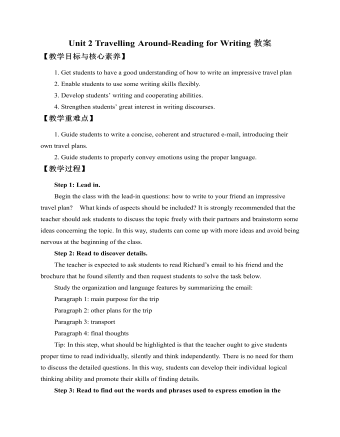
新人教版高中英语必修1Unit 2 Travelling Around-Reading for Writing教案
Is there a clear purpose for the trip? :Does each paragraph have a clear main idea? Does the writer use the present continuous tense for future plans?Does the writer use commas, stops, and question marks correctly? Are all the words spelt correctly?Are all the proper nouns capitalized?Revise your draft according to your partner's comments.Step 5:The summary of how to write a travel plan.旅游计划是一种常见的应用文写作。旅游可分为观光游、文化游、美食游及探险游等不同类型,因此旅游计划也要根据不同的旅游目的进行设计。常规的旅游计划需要明确以下几个方面的问题:Travel planWhen will you leave for? Where is your the destination?How will you get there?What will you do there?How long will you there?Is there a clear purpose for the trip? 为了提升旅行计划的层级,还需注意以下几个方面的问题:1.每段是否有明确清晰的主题;2.用一般现在时代替一般将来时;3.用更高级的形容词词汇。例如:表达“好”时,不要总用“nice”,我们还可以用“smart, clean, excellent, exciting, beautiful, wonderful, clever, famous, grand”等表达更具有指向性的词汇;4.用更高级的动词词汇。比如:我们可以用“seem stand, lie .get stay, remain, look . sound, become . keep, grow”等代替"be";
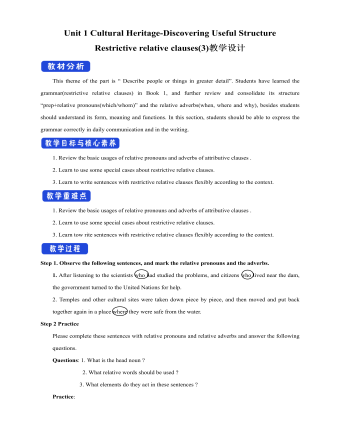
新人教版高中英语必修2Unit 1 Cultural Heritage-Discovering Useful Structure教案二
This theme of the part is “ Describe people or things in greater detail”. Students have learned the grammar(restrictive relative clauses) in Book 1, and further review and consolidate its structure “prep+relative pronouns(which/whom)” and the relative adverbs(when, where and why), besides students should understand its form, meaning and functions. In this section, students should be able to express the grammar correctly in daily communication and in the writing. 1. Review the basic usages of relative pronouns and adverbs of attributive clauses . 2. Learn to use some special cases about restrictive relative clauses.3. Learn to write sentences with restrictive relative clauses flexibly according to the context.1. Review the basic usages of relative pronouns and adverbs of attributive clauses .2. Learn to use some special cases about restrictive relative clauses.3. Learn tow rite sentences with restrictive relative clauses flexibly according to the context.Step 1. Observe the following sentences, and mark the relative pronouns and the adverbs. 1. After listening to the scientists who had studied the problems, and citizens who lived near the dam, the government turned to the United Nations for help.2. Temples and other cultural sites were taken down piece by piece, and then moved and put back together again in a place where they were safe from the water.Step 2 PracticePlease complete these sentences with relative pronouns and relative adverbs and answer the following questions.Questions: 1. What is the head noun ?2. What relative words should be used ?3. What elements do they act in these sentences ?
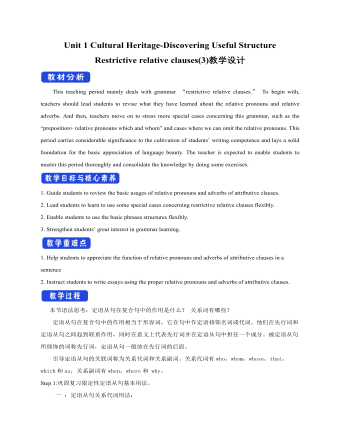
新人教版高中英语必修2Unit 1 Cultural Heritage-Discovering Useful Structure教案一
This teaching period mainly deals with grammar “restrictive relative clauses.” To begin with, teachers should lead students to revise what they have learned about the relative pronouns and relative adverbs. And then, teachers move on to stress more special cases concerning this grammar, such as the “preposition+ relative pronouns which and whom” and cases where we can omit the relative pronouns. This period carries considerable significance to the cultivation of students’ writing competence and lays a solid foundation for the basic appreciation of language beauty. The teacher is expected to enable students to master this period thoroughly and consolidate the knowledge by doing some exercises. 1. Guide students to review the basic usages of relative pronouns and adverbs of attributive clauses.2. Lead students to learn to use some special cases concerning restrictive relative clauses flexibly.2. Enable students to use the basic phrases structures flexibly.3. Strengthen students’ great interest in grammar learning.1. Help students to appreciate the function of relative pronouns and adverbs of attributive clauses in a sentence2. Instruct students to write essays using the proper relative pronouns and adverbs of attributive clauses.本节语法思考:定语从句在复合句中的作用是什么? 关系词有哪些?定语从句在复合句中的作用相当于形容词,它在句中作定语修饰名词或代词。他们在先行词和定语从句之间起到联系作用,同时在意义上代表先行词并在定语从句中担任一个成分。被定语从句所修饰的词称先行词,定语从句一般放在先行词的后面。
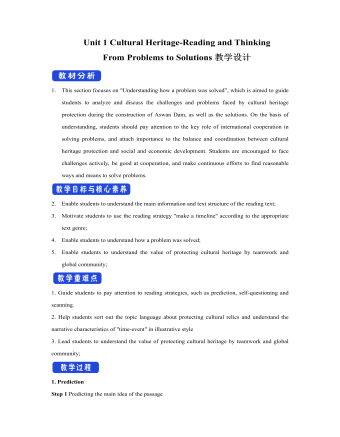
新人教版高中英语必修2Unit 1 Cultural Heritage-Reading and Thinking教案二
1. This section focuses on "Understanding how a problem was solved”, which is aimed to guide students to analyze and discuss the challenges and problems faced by cultural heritage protection during the construction of Aswan Dam, as well as the solutions. On the basis of understanding, students should pay attention to the key role of international cooperation in solving problems, and attach importance to the balance and coordination between cultural heritage protection and social and economic development. Students are encouraged to face challenges actively, be good at cooperation, and make continuous efforts to find reasonable ways and means to solve problems.2. Enable students to understand the main information and text structure of the reading text;3. Motivate students to use the reading strategy "make a timeline" according to the appropriate text genre;4. Enable students to understand how a problem was solved;5. Enable students to understand the value of protecting cultural heritage by teamwork and global community;1. Guide students to pay attention to reading strategies, such as prediction, self-questioning and scanning.2. Help students sort out the topic language about protecting cultural relics and understand the narrative characteristics of "time-event" in illustrative style3. Lead students to understand the value of protecting cultural heritage by teamwork and global community;
新人教版高中英语必修2Unit 1 Cultural Heritage-Reading and Thinking教案一
The theme of the reading and thinking is about “Understanding how a problem was solved”.The Listening & Speaking & Talking is about international co-work to protect the Mount Tai, in which the students from seven countries came up with many solutions even create the Mount Tai App. This section aims at showing how to solve a difficult and even tough problem about protecting the cultural heritage by the international co-work. So in this section, cultivating students’ international awareness is very clear and important. Concretely, with the economic development, how to balance the protection of cultural relics and social development is a big challenge for human. In the 1950s, the Egyptian government wanted to build the Aswan Dam across the Nile to control floods, produce electricity and water farms. But the proposal led to protests because it would destroy a lot of cultural relics. The Egyptian had no choice but ask the UN for help. Therefore, a international cooperation about how to protect the cultural relics began, which involved the time length about 20 years and a large amount of fund. Then, the problems was solved. 1. Read quickly to get the main idea and the structure of the article; read careful to get detailed information.2. Learn to use the reading strategy---making a timeline3. Learn how to solve a tough problem by asking for help and cooperation4. Have the international awareness and understand the great strength of international cooperation.1. Read quickly to get the main idea and the structure of the article; read careful to get detailed information.2. Learn to use the reading strategy---making a timeline.3. Learn how to solve a tough problem by asking for help and cooperation.
新人教版高中英语必修2Unit 1 Cultural Heritage-Reading For Writing教案
This report is short, concise and has typical news content and language features. The title uses the verb phrases, embodying the characteristics of being concise and general. The introduction is the first two sentences in the first paragraph, describing the general situation of the cultural heritage protection project, including time, place, characters, events and other news elements, so that readers can see the main points of the news report at a glance. The main body is the second and third paragraphs, which report the important historical and cultural value of Mogao Grottoes and the production of Mogao Grottoes Material digital photos, which are of great significance to the inheritance of historical culture and the promotion of international cultural understanding, exchange and cooperation. Direct citation is used in the report, as well as background introduction and other news writing techniques.1. Get students to have a good understanding of some features about a news report by reading the text.2. Instruct students to write a summary about a news report properly using some newly acquired writing skills in this period.3. Develop students’ writing and cooperating abilities.4. Strengthen students’ great interest in writing discourses.1. Stimulate students to have a good understanding of how to a summary about a news report 2. Cultivate students to write a news report properly and concisely.Step 1: Lead in Do you think it is necessary for us to circulate our cultural heritage to the world? Why or why not?Do we need to learn more about other countries’ cultural heritage? Why or why not?Step 2: Read to discover details concerning the main body of the news report.
九年级上册道德与法治建设法治中国2作业设计
6.新冠肺炎疫情发生以来,中央强调,在疫情防控工作中,要坚决反对形式主义、 官僚主义, 让基层干部把更多精力投入到疫情防控第一线。这样要求 ( )①有利于政府工作人员依法行政②有利于政府履行职责,维护广大人民群众的根本利益③有利于形成良好的社会风气④警示人类必须坚持走可持续发展的道路A. ①②③ B. ①②④ C. ①③④ D. ②③④ 7.中央纪委监察部网站(现中央纪委国家监委网站)开通纠正“四风”(形式主义、 官僚主义、 享乐主义和奢靡之风) 监督举报直通车,引导网友积极举报各种公款 吃喝、公款旅游等“四风”问题。这一做法 ( )①扩大了我国公民的政治经济权利②有利于政府依法行政,实现国家长治久安③有利于提高我国公民的民主监督意识④有利于国家机关及其工作人员勤政廉洁A. ①②③ B. ①②④ C. ①③④ D. ②③④ 8.《孟子 ·离娄上》有言:“徒善不足以为政, 徒法不能以自行。”
新人教版高中英语必修3Unit 2 Morals and Virtues教学设计三
The joke set her crying.这个玩笑使她哭起来。Step 5 ReadingActivity 31. Students read the small text in activity 3. The teacher provides several small questions to check whether students understand the content of the text and the ideographic function of the -ing form in the text.*Where are those people?*Why did Dr Bethune come to China?*How did he help the Chinese people during the war?*What did Chairman Mao Zedong say about him?2. Ss try to rewrite some sentences using the -ing form. Then check the answers. When checking the answers, the teacher can ask different students to read the rewritten sentences and give comments.Answers:1. he became very interested in medicine, deciding to become a doctor.2. …after hearing that many people were dying in the war.3. Helping to organise hospitals, he taught doctors and nurses, and showed people how to give first aid./ He helped to organise hospitals, teaching doctors and nurses, and showing people how to give first aid.4. …praising Dr Bethune as a hero to be remembered in China.Step 6 PracticeActivity 4Students complete grammar activities 2 and 3 on page 69 of the workbook.Step 6 Homework1. Understand and master the functions and usage of the -ing form;2. Finish the other exercises in Using structures.1、通过本节内容学习,学生是否理解和掌握动词-ing形式作宾语补足语语和状语语的功能和意义;2、通过本节内容学习,学生能否正确使用动词-ing形式描述人物的行为、动作及其经历;3、通过本节内容学习,学生能否独立完成练习册和导学案中的相关练习。
新人教版高中英语必修3Unit 2 Morals and Virtues教学设计四
3.Teachers ask different groups to report the answers to the questions and ask them to try different sentence patterns.The teacher added some sentence patterns for students to refer to when writing.Step 4 Writing taskActivity 51.Write the first draft.Students first review the evaluation criteria in activity 5, and then independently complete the draft according to the outline of activity 4, the answers to the questions listed in the group discussion and report, and the reference sentence pattern.2.Change partners.The teacher guides the students to evaluate their partner's composition according to the checklist of activity 5 and proposes Suggestions for modification.3.Finalize the draft.Based on the peer evaluation, students revise their own compositions and determine the final draft.Finally, through group recommendation, the teacher selects excellent compositions for projection display or reading aloud in class, and gives comments and Suggestions.Step 5 Showing writingActivity 5T call some Ss to share their writing.Step 6 Homework1. Read the passage in this section to better understand the passage.2. Carefully understand the hierarchical structure of the article, and deeply understand the plot of the story according to the causes, process and results;3. Independently complete the relevant exercises in the guide plan.1、通过本节内容学习,学生是否理解和掌握阅读文本中的新词汇的意义与用法;2、通过本节内容学习,学生能否通过人物言行的对比分析道德故事的深层内涵;3、通过本节内容学习,学生能否根据故事的起因、经过和结果来深入理解故事的情节,从而了解文章的层次结构;4、结合现实生活案例发表自己的见解和看法,写一篇观点明确、层次分明的故事评论。
新人教版高中英语必修3Unit 2 Morals and virtues教学设计一
(2) students are divided into groups according to the requirements of activity 3. Each student shares a story of personal experience or hearing-witnessing kindness, and then selects the most touching story in the group and shares it with the whole class. Before the students share the story, the teacher can instruct them to use the words and sentence patterns in the box to express. For example, the words in the box can be classified:Time order: first of all, then, after that, later, finally logical relationship :so, however, although, butTeachers can also appropriately add some transitional language to enrich students' expression:Afterwards, afterwards, at last, in the end, eventuallySpatial order: next to, far from, on the left, in front ofOtherwise, nevertheless, as a result, therefore, furthermore, in addition, as well asSummary: in a word, in short, on the whole, to sum up, in briefStep 8 Homework1. Understand the definition of "moral dilemma" and establish a correct moral view;2. Accumulate vocabulary about attitudes and emotions in listening texts and use them to express your own views;3. Complete relevant exercises in the guide plan.1、通过本节内容学习,学生能否理解理解“道德困境”的定义;2、通过本节内容学习,学生能否通过说话人所表达的内容、说话的语气、语调等来判断其态度和情绪;3、通过本节内容学习,学生能否针对具体的道德困境发表自己的看法和见解,能否掌握听力理训练中的听力策略。
新人教版高中英语必修3Unit 2 Morals and Virtues教学设计二
Activity 41. Students complete the task of activity 4, then teachers and students check the answers. 2. The teacher organized the students to work together and asked them to use the tables and mind maps sorted out before to retold the important choices in Lin Qiaozhi's life and their resultsStep 5 Language points1. The teacher asks the students to read the text carefully, find out the core words and long and difficult sentences in the text and draw lines, understand the use of vocabulary, and analyze the structure of long and difficult sentences. 2. The teacher explains and summarizes the usage of core vocabulary and asks the students to take notes. 3. The teacher analyzes and explains the long and difficult sentences that the students don't understand, so that the students can understand them better. Step 6 Homework1. Read the text again, in-depth understanding of the text; 2. Master the use of core vocabulary and understand the long and difficult sentences. 3. Complete relevant exercises in the guide plan. 1、通过本节内容学习,学生是否理解和掌握阅读文本中的新词汇的意义与用法;2、通过本节内容学习,学生能否结合文本特点总结林巧稚的人生原则和人格品质特征;3、通过本节内容学习,学生能否针对人生抉择发表自己的看法;能否全面地、客观地、理性地看待问题,进而对道德和人性有更加深入的思考和理解。
人教版高中语文必修3《寡人之于国也》教案2篇
一、引入:教师列举以下言论,让学生辨出哪些是孟子的,哪些不是。学生不知道的,由教师说出。学生不理解的,教师作简要解说。1.天将降大任于是人也,必先苦其心志,劳其筋骨,饿其体肤,空乏其身,行拂乱其所为。所以动心忍性,曾益其所不能。(孟子)2.域民不以封疆之界,固国不以山溪之险,威天下不以兵革之利。得道者多助,失道者寡助。(孟子)3.鱼,亦我所欲也,熊掌,亦我所欲也,二者不可得兼,舍鱼而取熊掌者也。生,亦我所欲也,义,亦我所欲也,二者不可得兼,舍生而取义者也。(孟子)4.富贵不能淫,贫贱不能移,威武不能屈。(孟子)5.非礼勿视,非礼勿听,非礼勿言,非礼勿动。(孔子)6.无恻隐之心非人也,无羞恶之心非人也,无辞让之心非人也,无是非之心非人也。(孟子)7.庖有肥肉,厩有肥马,民有饥色,野有饿殍。(孟子)8.人性之善也,犹水之就下也;人无有不善,水无有不下。(孟子)9.民为贵,社稷次之,君为轻。(孟子)10.君子坦荡荡,小人常戚戚。(孔子)
人教版高中政治必修4关于世界观的学说精品教案
一、教材分析《关于世界观的学说》是人教版高中政治必修四第1章第2框的教学内容,主要学习什么是哲学。二、教学目标1.知识目标:(1)哲学的含义;(2)世界观和方法论的含义;(3)哲学与世界观的关系;(4)哲学与方法论的关系;(5)哲学与具体科学知识的关系。2.能力目标:(1)通过世界观知识的学习,提高学生的思维层次,锻炼学生的思维能力;(2)通过对哲学与世界观、方法论、具体知识三对关系的分析,培养辩证思维的能;(3)通过对身边生活事例、哲理故事、哲学家观点的体悟,培养分析问题的能力;3.情感、态度和价值观目标:(1)通过世界观与方法论关系的学习,让学生体会到树立科学世界观的重要性;(2)通过哲学与具体科学知识关系的学习,懂得哲学的指导意义,从而使学生热爱哲学,喜欢哲学,自觉树立科学的世界观。
人教版高中生物必修3第一章第二节《内环境稳态的重要性》说课稿
四、稳态的重要意义 为什么内环境稳态失调后,会对机体造成危害?引导学生从细胞代谢需要的物质和条件进行分析,最后总结出:内环境稳态是机体进行正常生命活动的必要条件。如何预防内环境稳态失调、保持机体健康?引导学生从外界环境和机体自身调节能力两个方面去思考。即通过加强自我保健,减少外界环境变化对机体的不良影响,同时增强机体的调节能力以适应多变的外界环境。具体如何做?学生讨论,总结。1.保护我们的生存环境,防治环境污染。2.加强体育锻炼,增强体质,提高机体适应外界环境的能力。3.加强自我保健,为机体保持健康创造有利条件。尤其是处于比较恶劣的工作环境中的人,更应注意自身保健,如边防战士注意保暖、炼钢工人注意降温、抗洪战士注意补充水盐等。了解这些知识后才能懂得如何关爱自身和他人。
人教版高中生物必修3第六章第二节《保护我们共同的家园》说课稿
1.潜在价值──某种不知名的昆虫。间接价值──每个物种都维系着它们所在的生态系统的结构和功能。直接价值──芦苇是一种重要的造纸原料;蝉蜕是一种动物性药物;鲁班通过观察某种叶片的叶缘得到启示,研制出了木工用的锯;海洋和森林等生态系统能陶冶情操、激发创作的灵感。2.主要的困难是,一些发达国家(如美国、加拿大和欧盟国家等),拒绝核准或迟迟不予核准该议定书。主要争议的问题是,这些国家担心影响本国经济的发展和其他国家可能不承担相应的责任。例如,美国政府在2003年3月以“减少温室气体排放将会影响美国经济发展”和“发展中国家也应该承担减排和限排温室气体的义务”为由,宣布拒绝执行《京都议定书》。建议世界各国特别是发展中国家联合起来,通过联合国大会和各国的政府以及民间组织等多种途径,呼吁每年大量产生温室气体的发达国家率先核准《京都议定书》(我国政府早在2002年9月就核准了《京都议定书》)。
人教版高中生物必修3第一章第一节《细胞生活的内环境》说课稿
1. 该节内容属于人教版高中生物必修三《稳态与环境》第一章第一节的内容:细胞生活的环境。本节内容主要突出的是内环境的概念,为下一节稳态的重要性及下一章动物和人的生命活动的调节做铺垫。2. 教学目标:(1)知识目标:①描述内环境的组成和理化性质。②说明内环境是细胞与外界环境进行物质交换的媒介。(2)能力目标:①通过思考与讨论培养学生语言表达能力②通过相关练习培养学生知识迁移的能力(3)情感目标:关注维持内环境稳态与健康的关系。*目标确定依据:主要根据课标要求及教材内容特点。3.重难点及依据(1)重点:①内环境的组成和理化性质。②内环境是细胞与外界环境进行物质交换的媒介。*依据:根据课标要求,同时是高考考点。(2)难点:①内环境的组成和理化性质。②内环境是细胞与外界环境进行物质交换的媒介。* 依据:学生缺少相关的有机化学的知识基础,且内容相对枯燥抽象。
人教版高中生物必修3第二章第一节《通过神经系统的调节》说课稿
3、总结(这部分要5分钟)学生在教师的提示和问题的引导下,完成对本节课的知识的归纳和小结。利用简炼、清晰的语言,再一次的突出本节课的重点,起到画龙点睛的作用,培养了学生的表达能力。4、巩固练习(这部分要10分钟)用大屏幕投影把题目投影在屏幕上,让学生思考,然后回答。这部分安排10分钟的时间,让学生思考完成具有针对性的练习,进行知识巩固和教学效果反馈,及时纠正错误的理解和片面的认识。5、板书设计在板书中,我根据板书的“规范、工整和美观”的要求,结合所学的内容,设计了如图所示的板书。在其中,注重了重、难点的突出,使学生对知识的结构、层次、重点、难点一目了然,便于记忆和理解。四、效果分析对于反射的判断,学生仍有可能出现错误,如刺激坐骨神经肌肉的收缩,教师应强调没有完整的反射弧结构参与的不是反射。
人教版高中生物必修3第五章第一节《生态系统的结构》说课稿
5、归纳小结,当堂演练(10分钟)1、肉食动物不可能是一条食物链中的第几营养级()A.第五B.第二C.第三D.第四2、对水稻→鼠→蛇→鹰这条食物链的错误描述是()A.水稻是生产者B.鼠是初级消费者C.蛇是次级消费者D.鹰属于第三营养级3、在下列生物中,属于分解的是()A.蓝藻B.草履虫C.蘑菇D.蝗虫4、从生态系统的组成成分看,硝化细菌和蚯蚓属于()A.生产者和分解者B.生产者和消费者C.消费者和分解者D.分解者和消费者5、下列哪组生物可和无机环境组成一个生态系统()A.水藻、鸟B.小鱼、大鱼C.小草、昆虫、细菌D.水藻、虾6、对草→昆虫→食虫鸟→鹰这条食物链的叙述,正确的是()A.有四个营养级,两个次级消费者B.有三个营养级,一个生产者C.食虫鸟是第三营养级、次级消费者D.有三个营养级,三个消费者(设计意图)进行简单扼要的课堂小结与练习,可以把课堂传授的知识尽快地转化为学生的素质;也可使学生更深刻地理解理论在实际生活中的应用。
人教版高中生物必修3第三章第二节《生长素的生理作用》说课稿
强调重力对生长素分布的影响,为下面的内容讲解做铺垫,明确植物出现向光性与生长素分布不均有关。复习旧知识,产生首因效应,巩固和加强记忆。通过植物向光性是生长素分布较多而促进生长,进而提出“对于植物来说,生长素是不是越多越好”这个问题,引发思考,锻炼思维。说明生长素浓度对不同器官产生的影响不同,让学生对这一情况有一个整体印象。结合数学知识逐步分析图上各点和各曲线的含义,引导学生得出不同器官对生长素浓度的敏感性顺序,为解释横放植物“S”型生长做铺垫。通过对曲线的分析,得出低生长素浓度起促进作用,高浓度有抑制作用这种双重性,并得出其双重性表现。通过以上的分析和总结,对横放植物“S”型生长进行解释,达到首尾呼应的效果。采用“蒙太奇”手法,引申到“太空中,横放植物将会如何生长”这个问题,引发学生的联想和思考,以这种提问方式结课为下节课的开课做了铺垫,掌握了主动权。
人教版高中生物必修3第三章第一节《植物生长素的发现》说课稿
(5)根据实验的第五部分——验证性实验结果,证实了达尔文关于植物向光性运动原因的假说――确实存在一种物质致使胚芽尖端产生了向光运动。这样通过多个实验的多媒体演示过程,强化学生的思维,最终在学生的大脑中形成科学研究过程的”条件反射”。为了使学生初步学会”设计对照实验的方法”,首先也利用多媒体的演示实验,并在其中特意设置一些”陷阱”,通过多次”请学生进入‘陷阱’”,来强化设计实验时应该控制的变量问题,从而在学生的认知领域里初步构建出设计对照实验的知识体系。3、归纳总结1934年,荷兰科学家郭葛等人从植物中分离出了这种能使植物产生向光性的物质,并确定它就是吲哚乙酸。这就真正从化学物质的角度证实了达尔文的假设。在能够从植物体中分离提取出生长素之后,要想知道:除了能使植物产生向光运动之外,生长素对于植物的器官还有什么作用?可以采用哪种方法来进行试验?