-
北师大版初中数学九年级下册直线与圆的位置关系说课稿
设计意图这一组习题的设计,让每位学生都参与,通过学生的主动参与,让每一位学生有“用武之地”,深刻体会本节课的重要内容和思想方法,体验学习数学的乐趣,增强学习数学的愿望与信心。4.回顾反思,拓展延伸(教师活动)引导学生进行课堂小结,给出下列提纲,并就学生回答进行点评。(1)通过本节课的学习,你学会了哪些判断直线与圆位置关系的方法?(2)本节课你还有哪些问题?(学生活动)学生发言,互相补充。(教师活动)布置作业(1)书面作业:P70练习8.4.41、2题(2)实践调查:寻找圆与直线的关系在生活中的应用。设计意图通过让学生课本上的作业设置,基于本节课内容和学生的实际,对课后的书面作业分为三个层次,分别安排了基础巩固题、理解题和拓展探究题。使学生完成基本学习任务的同时,在知识拓展时起激学生探究的热情,让每一个不同层次的学生都可以获得成功的喜悦。

北师大版初中数学九年级下册切线长定理说课稿
通过与学生讲解切线长定义,让学生在参与、合作中有一个猜想,再进一步提出更有挑战性的问题,能否用数学的方法加以证明。问题的解决,使学生既能解决新的问题,同时应用到全等、切线的性质等知识,同时三条辅助线中,两条运用切线性质添加、一条构造全等。证明后用较规范的语言归纳并不断完善。(3) 应用新知加深理解通过前面的学习学生们已经对切线长定理有了较深刻的了解。为了加深学生对定理的认识并培养学生的应用意识学习例1、例2。例1让学生自己独立完成,加深对切线长定理的理解,老师进行点评,对于例2,由师生共同分析完成,交进行示范板书。(4) 巩固与提高此训练题分为二个层次,目的在于巩固新学的定理,并将所学的定理应用到旧的知识体系中,使学生的知识体系得到补充和完善。(5) 归纳与小结通过小结,使知识成为系统帮助学生全面理解,掌握所学的知识。
北师大版初中数学九年级下册正多边形和圆说课稿
第一道例题提示学生把地基看成一个几何图形,即正六边形,逐步引导学生完成例题的解答。例题1:有一个亭子它的地基是半径为4米的正六边形,求地基的周长和面积(精确到0.1平方米)。第二道例题,我让学生独立完成,我在下面巡视,个别辅导,同时我将关注不同层次学生对本节知识的理解、掌握程度,及时调整教学。最后,引导学生总结这一类问题的求解方法。这两道例题旨在将实际问题转化成数学问题,将多边形化归成三角形来解决,体现了化归思想的应用。(七)、课堂小结(1)学完这节课你有哪些收获?(八)布置作业:我针对学生素质的差异设计了有层次的训练题,留给学生课后自主探究,这样即使学生掌握基础知识,又使学有佘力的学生有所提高,从而达到拔尖和“减负”的目的。
人教版新目标初中英语八年级上册Can you come to my party教案3篇
Step 3 (3b)First, tell the students when we talk about our future plans, we often use: I’m+verb+ing When we talk about what we must do, we use have to. Ask the students to fill in the blanks in 3b. The answers are: shopping, go to see, a test, I’m going, my family. Step 4 (3c)Let the students write an e-mail message to a friend. Say why you can’t visit next. Before the exercise, ask the students to give some possible answers and write them on the blackboard. So the students will feel easy to finish the writing exercise. After they finish it, Let them to correct it in groups first. Each group chooses theirs best one to read in front of the whole class. Step 5 ( planning a party )First read the conversation in the box together. Then ask the students to turn to page 88.Write down everything you have to do next week. Write in all the things you have to do . Ask the students to look at the list. Ask them “What day are you free?” This is when you can have your party. Step 6 (Self check 1 )Let the students to fill in the blanks with the words given. Change the forms of the words if possible. Then make their own sentences. The answers are: visit, playing, have to, study, comeStep 7 (Self check 2)Imagine you are Marie. Read the information and look at your schedule. Write replies to the invitation.
人教版新目标初中英语八年级上册What are you doing for vacation教案2篇
Teaching goals : 1. Words & phrases: babysit ,get back , fishing , rent , think about , decide(on) , tourist etc. 2. How to talk about future plans . 3. 现在进行时表示将来计划或行动. 4. 特殊疑问句(where , when , how long引导) Important and difficult points : Drills :What are you doing for vacation ? I’m watching TV . When are you going ? I’m going … . How long are you staying ? We’re staying for five days . Teaching aids : cards and a tape ,a large wall calendar . Period 1 Teaching procedures : Step 1Leading in1. Free talk . 2. Put up the wall calendar . T: I’m staying home on Saturday (pointing to next Saturday ).Ss repeat . Ss: I’m staying home on Saturday . T: OK. Today we’ll learn how to talk about future plans. Step 2Pre-task SB Page 13 , 1a . 1. Look at the picture carefully and tell what you see in the picture . 2. Write the activities from the pictures in the box and add some more . 3. Practice reading . Step 3While-task1. Using the activities we write in 1a to make conversations .For example :What are you doing for vacation ? I’m visiting my uncle . 2. Pairwork .Practice in pairs . 3. 用第三人称练习对话.
人教版新目标初中英语八年级上册I’m going to be a basketball player教案3篇
教学目标1.知识目标:(1)学习What are you going to be when you grow up?/How are you going to do that?句式。(2)学会用英语描述有关职业的表达法。2.能力目标:(1)能够谈论为实现理想所做出的打算和安排。(2)能够谈论未来自己与他人理想的职业及原因。(3)能用英语描述课余时间的活动安排,最终具备表达综合信息的能力。3.情感目标:新学期到来之际,让他们在学习、体育、饮食、特长、读书等方面制定计划,教育学生合理安排自己的课外生活,思考自己的理想职业及适合自己的职业。教学重点、难点本单元的重点为“be going to”表将来,want to be, what,where, when,how引导的特殊疑问句。难点是语言目标的实现。教材分析本单元以I am going to be a basketball player为话题,共设计了三部分的内容:一、Section A该部分有4个模块。第一模块围绕Do you think these jobs are interesting?这一话题展开思维(1a)、听力(1b)、口语(1c)训练;
人教版新目标初中英语八年级上册What’s the matter教案2篇
She shouldn’t go to the party tonight.Step7. TaskT: You know, there are lots of problems in our life. If you are a doctor, please tell us how to solve the problem. I will divide you into 9 groups. Please work in groups. And then choose one of you to report your ideas.The following are the problems:I have a toothache.I am hungry. I have a sore throat.I am stressed out. I have a sore back.I am tired. I can’t sleep.I have a cold. I have a headache.Report: If you have a headache, you should go to bed early. You should see the doctor. You should eat some medicine. You shouldn’t wash your face with cold water.You shouldn’t sleep late.You shouldn’t swim.…..T encourages the students to give advice as much as possible.Homework:1. Chose one of the problems, and write down your advice2. Copy the new words这一步是用于热身的,同时也可以让他们复习一部分的表示人体部位的单词,扩充知识.学习语言的过程也是一个不断积累的过程,复习旧知识,增添新知识.通过小游戏,强化学生对Does she/he have…这个句子的运用能力.通过复习,自然的引到下面新知识的学习。充分利用表格,由句子到对话,再到文章,让学生循序渐进. 提高学生的综合语言运用能力,运用以前学过的知识来解决身边的问题.Period 5 (Section B 3a—3c, selfcheck)教学内容与分析:
人教版新目标初中英语八年级上册How do you make a banana milk shake教案2篇
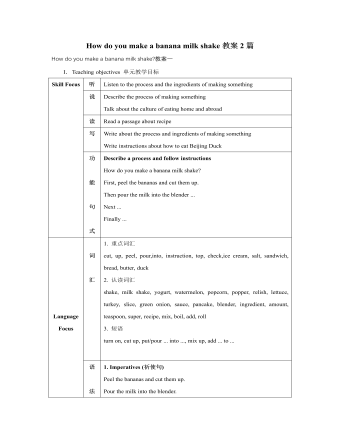
1. First, ... then, ... next, ... finally, ...首先,……然后,……接着,……最后,……这是英语中表达做某事的步骤的一种说法。如果步骤较多,还可以说:first-next-after that-later on-finally/at last通常你会听到说英语国家的人在说 first, next, then, finally 和后面的内容时,他们会做一些停顿。这样就能提前告诉听者接下来讲的是一系列的步骤。这一点在朗读和听力中应特别注意。2. how many, how much均为疑问词,同是“多少”,但用法不同。请看:how many修饰可数名词复数,how much修饰不可数名词。但在用法上,同学们常犯如下错误:1) [误] How many are there bananas on the table?[正] How many bananas are there on the table?[析] how many, how much 中的many,much是形容词,常修饰名词作定语,故后面跟名词。2) [误]How much tea are there on the table?[正]How much tea is there on the table?[析] how much修饰不可数名词时,谓语动词用单数。how many与how much的区别可简记为:前how many:问“多少”,复数名词后面跑;how much问“多少”,不可数名词单数好。前者答语用基数词,后者答语用数量关系。
人教版新目标初中英语八年级上册How was your school trip教案2篇
“Go for it!” is based on “Task-Based Language Teaching”. It adheres to “The authenticity principle”, “The form-function principle”, “The task dependency principle” and “The principle of learning by doing”. These principles all accord with the demands of curriculum focus.In and of Grade Seven (II), “Go for it!”, students have learned “The Simple Past Tense”. And it appears again in of Grade Eight (I). teaches students more about how to talk about events in the past. In addition, it gives affirmative and negative statements in the past tense, such as the sentence patterns “Did you see …?” “Were there …?” “Did you go …?” As the first part of Unit 8, Section A opens with a picture presenting the last school trip in the aquarium and continues with several step-by-step practice activities, which are all good for students to master “The Simple Past Tense”. Doing well in Section A will help students integrate the new target language with that in Section B. Thus, they can describe the events in the past freely and foster their own ability of reflecting and practicing. II. Teaching ObjectivesTeaching objective is the beginning and aim of teaching activities. According to the overall goal of the English elementary course--- improve students' synthetic ability of language application, which should be based on the development of students’ “Language knowledge”, “Language skills”, “Character building”, “Learning strategies” and “Cross-cultural awareness”. The teaching objectives are described as follows(I). Knowledge objectivesi. Master the simple past tense of regular and irregular verbsii. Recite the new words and expressions about the last school trip in the aquarium, including their pronunciation and intonation
人教版新目标初中英语八年级上册Could you please clean your room教案3篇
一、 教学内容Section A 1a----1c二、 教学目标1.学习词汇do the dishes, make the bed, take out the trash, fold the clothes, do the laundry, sweep the floor, clean the living room.2.句型 Could you please clean your room? Yes, sure.三、 教学准备 学生预习本单元所有的词汇多媒体课件 活动表 奖品四、 教学过程Pre-task1. Warming upEnjoy ourselves. Watch cartoon Cinderella. 看动画片段《灰姑娘》导如入本课话题和新词汇“chores”美丽善良的鬼姑娘因继母的嫉妒,每天得做所有的家务。片段的主题使学生联想到本课的话题。2. learn new words and phrasesLook! What is she / he dong? 看图学习动词词组do chores, do the dishes, make the bed, take out the trash, fold the clothes, do the laundry, clean the living room.3. Guessing game.What is she doing ? 4. Pair work. 1a, Do you do these things at home? Write “Y” for “yes” and “N” for “no”.5. Listening . 1b , Peter’s chores or Mom’s chores?理解目标语Could you please clean your room? Yes, sure.Write “M” for Mom’s chores, “P” for Peter’s chores in the chart.6. PairworkLook at the picture,Ask your partner to do the chores that you see. 7. Interview Who is the most able at home? 1) What chores do you do at home? How often do you do the chores? Work in four, interview each of the students in the group, fill in the chart.
人教版新目标初中英语八年级上册I’m more outgoing than my sister教案2篇
1 交通工具的比较此活动为小组活动。学生通过讨论找出到达某一城市可乘坐的各种交通工具,并选择最佳出行方式。Teacher:We’re going to Shanghai. How many ways can we use to get there? Yes, there are four ways: by bus, by plane, by train, by ship. Please discuss how you are going to get there.操作建议:(1)学生以小组为单位展开活动,谈论本组所选择的交通工具。(2)各组选代表向全班汇报,阐述本组所选择的交通工具的利和弊。完成任务所需要的语言结构:We can go there by ship. It’s more comfortable and cheaper than any other transportation.We can go there by bus. It’s cheaper but it takes longer time.2 哪个城市更合适?此活动具有挑战性。假设中国要举行2014年世界杯足球赛,分别从历史,人文,天气等方面对各城市(北京,大连,上海,昆明)进行比较,选择最佳举办城市。T: Imagine China is holding the 2014 FIFA World Cup. Which city do you think is the best for the World Cup, Beijing, Dalian, Shanghai or Kunming? Let’s work in groups. If you choose Beijing, please join the Team Red. If you chose Dalian, please join the Team White. If you choose Shanghai, please join the Team Blue. If you choose Kunming, please join the Team Green. Please show us its advantages. Then let’s see which team will win.
人教版新目标初中英语八年级上册What’s the best radio station教案2篇
教学重点和难点:运用所掌握的语言描述,比较不同地点的特点。在练习中学习掌握英语比较级和最高级的用法。课前准备分配小组,每组五至六人。通过上网或翻阅报刊杂志等方法,确定旅游线路,做出基本的旅游计划。教学设计:本节课流程图 学法指导:1.由于这是一堂新课,在教学中应注意面向全体,发挥学生的主体性,引导学生积极参与,激发学生的求知欲和学习积极性,指导学生积极思维,主动获取知识,养成良好的学习方法。逐步学会独立解决问题。总之要尽可能调动学生的非智力因素促进智力因素的发展。教法选择:1.电化教学法2.课堂讨论法3.任务型教学法采用这些方法的目的是为了充分调动学生的学习积极性,使学生变被动学习为主动学习。通过电脑形象的演示,加强印象,提高兴趣,突破难点,提高教学效率,进而增大教学的容量和信息量。充分体现教师为主导,学生为主体的教学原则。

人教版新目标初中英语八年级上册How do you get to school教案2篇
Step Ⅶ Role play ( Work on 1b)1. First ask two students to read the dialogue to the class.Sa: How do you get to school?Sb: Well, I ride my bike to the subway station. Then I take the subway.2. Now work with a partner.Suppose you use two kinds of transportation to get to school \Hangzhou\Beijing... (bus, train, subway, walking, bike, etc.) Tell how you get there. You may use the phrases in 1a.3. Then ask different pairs of students to present their conversations to the class.Step ⅧListening1. Work on 2a(1) First ask students to read the list of information that Thomas wants to know.…where Nina lives.…how far from school she lives.…how long it takes to get to school.…how she gets to school.…what she thinks of the transportation.(2) Tell students what transportation and bus stop mean.bus stop 汽车站 transportation n. 运送;运输Then tell students we'll hear a recording. Please put a checkmark in front of each thing that Thomas wants to know.(3) Now play the recording for students.( Have students pay attention to the sample answer.) (4) Then correct the answers.
二年级数学下册第三单元数图形的运动教案
一、游戏活动激趣,认识对称物体1、游戏“猜一猜”:课件依次出示“剪刀、扫帚、飞机、梳子”的一部分,分男、女生猜。2、认识对称物体:1)师质疑:为什么女生猜得又快又准呢?2)小结:像这样两边形状、大小都完全相同的物体,我们就说它是对称物体。(板书:对称)二、猜想验证新知,认识轴对称图形(一)初步感知对称图形1、将“剪刀、飞机、扇子”等对称物体抽象出平面图形,让学生观察,这些平面图形还是不是对称的。2、师小结:像这样的图形,叫做对称图形。(板书:图形)(二)猜想验证对称图形1、猜一猜:出示“梯形、平行四边形、圆形、燕尾箭头”等平面图形,让学生观察。师:这些平面图形是不是对称图形?怎样证明它们是不是对称图形?
二年级数学下册第六单元有余数的除法教案
1、教学主题图。(1)让学生独立观察教材情境图。思考问题:[1]这幅画面是什么地方?[2]你发现了画面中有什么活动内容?(按顺序)(2)在小组中互相说一说自己观察到了什么内容。你想到了什么?(3)各组代表汇报。(4)教师板书学生汇报的数据。[1]这是某个校园里的活动情景图。从图中发现了教学大楼前面的两树之间都插着4面不同颜色的旗子,升旗台上也飘着一面国旗。[2]运动场上每4人一组小朋友在跳绳。[3]篮球场上每5人一组准备打篮球比赛。[4]板报下面摆的花是每3盆摆一组,旁边还有很多盆花。(5)根据上面的信息(条件),想一想能提出用除法计算的问题吗?大家在小组议一议。
二年级数学下册第一单元数据收集整理教案
问题情景,导入新课1、多媒体课件出示例1主题图,问:图上的小朋友在干什么?你们测量过体重吗?测量了几次?读一年级刚入学时,你测量的体重是多少?(学生自由汇报各自的体重情况)怎样才能让大家一看就明白我们班所有人的体重情况呢?二、活动体验,探究新知1、电脑出示统计表(1): 体重(千克)15以下16~20 21~25 26~30 31以上人数 师:现在我们就用“正”字记录法来统计一下刚入学时的体重(集体活动)2、活动结束后,师生共同将收集的数据整理后填入表格中。3、二年级时,我们的体重有什么变化呢? 电脑出示统计表(2) 体重(千克)15以下16~20 21~25 26~30 31以上人数 集体进行统计活动,并将结果填入表中。4、讨论:如果想把两年的体重数据填入一个统计表中,该如何表示呢? 学生讨论后,在黑板上出示表格(3):(单位:千克)
二年级数学下册第七单元万以内数的认识教案
一、复习导入1、口答:最大的一位数是几?最小的两位数是多少?这两个数相差多少?2、数数:10个10个地数,从10数到100; 1个1个地数,从91数到99; 问:99加1是多少?3、导入:你会从100开始接着往后数吗?今天开始我们将要学习更大的数,下面请你们观察这幅图。二、讲授新课1、出示主题图。(1)观察这幅图,说一说画面上正在发生什么事情?(2)看着画面你想知道什么问题?引导学生估算画面上的体育馆大约能坐多少人?2、板书课题:1000以内数的认识。3、教学例1。(1)数一数。每人数出10个小方块,说说你是怎么数的?板书:一个一个地数,10个一是十。
人教版新课标小学数学二年级下册总复习教案
教学时间:教学准备:小黑板,挂图。教学过程:一、复习旧知,引入新课。1、请大家想一想到今天为止,我们已经复习了本学期学过的哪些知识?(表内除法。万以内数的认识和加法、减法。克和千克及图形的变换。)2、对这些知识还有没有什么问题?还有没有内容是我们没有复习到或复习了掌握不好的?如果学生有问题,则针对问题,让同学们一起来想办法解决这些问题。学生提出问题,思考解决方法。二、复习整理:1、分别出示教材第122页第13、14题的挂图。(如果没有,就让学生直接看书)(1)看了图后,你明白图中的画是什么意思吗?学生看挂图,小组讨论这两题的意思。叙述两幅图的意思,没有说好的请其他同学来补充完整。在小组内讨论交流。(2)怎样来解决这两个生活中的实际问题?
人教版新课标小学数学五年级下册总复习教案
此图是一个复式折线统计图,考察内容是根据统计图,进行数据的有效分析。(1)因为统计图中蓝色的折线表示学龄儿童,根据对学龄儿童的折线数据分析发现:1980年的学龄儿童最多,2000年的学龄儿童最少。(2)根据题目要求的分析:没上学的学龄儿童实际上是指:学龄儿童的人数与实际入学儿童人数的差。通过仔细观察统计图,可以直观地发现:1980年的学龄儿童和入学人数之间的差值最大,2000年的学龄儿童和入学人数之间的差值最小。所以,1980年没上学的学龄儿童最多,2000年的最少。(3)这一问比较开放,只要合理即可。三、练习二十七第9——14题解答指导:9. 81cm3=81ml 700dm3=0.7m3 560ml=0.56L 2.3dm3=2300cm310. 根据图示可知:把铁皮做成一个长方体,长方体的长为30—5×2=20(cm),宽为25—5×2=15(cm),高也就是切去的正方形的边长5cm。(1)求“这个盒子用了多少铁皮?”也就是求这个铁皮盒子(无盖)的表面积。
冀教版二年级数学下册排列问题教案
1.自学文本出示书中情境图:有21架飞机要参加飞行表演,怎样飞呢?想请同学们帮忙设计编组方案,下面小组同学合作,用学具摆一摆,设计出自己的编组方案,看哪个小组设计的方案最多?学生小组合作,边摆学具边说方案。2.交流研讨哪组想到前面来汇报一下你们制定的飞行方案?(不必强调平均分,如有小组同学说出每组有7(3)架,可以分成3(7)组,或每7(3)架一组,可以分成3(7)组,老师在给予肯定的同时可以问其它小组摆法一样吗?之后板书算式:21÷7=3,21÷3=7。如果学生没说出平均分,老师可引导说:有时表演的每组也可同样多)