-
人教版高中语文必修2《孔雀东南飞并序》教案2篇
让学生仔细聆听美妙的音乐,合作讨论,加深理解。(1)本诗文中的“兰芝被遣”和“兰芝抗婚”的情节,可与乐曲展开部第一阶段“逼嫁抗婚”对比阅读。文中的刘兰芝是在封建礼教的压迫下被遣归及被迫“改嫁”,刘兰芝与祝英台一样都进行了抗争。乐曲中的乐器奏出了具有威胁力的封建势力的主题,代表着封建势力的凶暴残酷,同时叙述了祝英台的悲痛和不安心情,表现了控诉、抗争的感情。(2)本诗文中的“夫妻誓别”的情节,可与乐曲呈示部中的结束部“长亭惜别”对比阅读。文中刘兰芝与焦仲卿的誓别。二人分手之际,依依不舍,“举手长劳劳,二情同依依”。乐曲中梁祝分别时依依不舍又充满悲伤,音调抒情徐缓。让学生在徐缓的音乐中去感受刘兰芝与焦仲卿生离死别的痛苦。
人教版高中语文必修5《宇宙的未来》教案
(2)怎样理解本文的一些相关论述?【明确】这是一篇科学讲演,涉及较为复杂的背景知识。这些知识和讲演的主题是密切相关的,如果不作必要的交待,讲演的内容就会显得抽象和单薄。如,谈到天气预报、大脑工作原理都具有混沌性质,来反衬宇宙在大尺度上是"平滑而非混沌"的;如,谈到恒星的死亡(归宿)引出黑洞,为宇宙中暗物质的存在寻找理论支持;如,谈到现存宇宙对初始密度的极度敏感,引出了"人择原理"等等。这些相关的论述,或从对立面凸显观点,或从纵深面强化观点,使论证丰富多彩。(3)这篇讲演在语言上具有怎样的特点?【明确】讲演是面对面的交流,这种交流又是单向度的,如果不注意讲演的语言艺术,就达不到最佳的表达效果。这篇讲演,除了推理严谨外,语言幽默也是其突出的特点。幽默的语言创造出一种轻松愉快的气氛,更具有亲和力,使所阐发的事理更容易为听众接受。
人教版高中语文必修5《咬文嚼字》教案
【教学过程】第一课时一、导入新课清代唐彪在《读书作文谱》中引用武叔卿的话说:“文章有一笔写成不加点缀而工者,此神到之文,尚矣。其次须精思细改,如文章草创已定,便从头至尾—一标点。”同学们能列举出文学史上的作家哪些属于前者,哪些属于后者吗?前者有李白。后者如贾岛、王安石、欧阳修、曹雪芹等。(贾岛有关于推敲的典故。王安石修改“春风又绿江南岸”句传为佳话。欧阳修《醉翁亭记》的开头便是精心改成的。《红楼梦》更是“披阅十载,增删五次。”)提问:古今的伟大作家为什么像李白式的诗人很少,而大多数人却都要“咬文嚼字”,苦苦修改呢?这节课我们就来研究一下这个问题。二、整体感知1.快速浏览全文,熟悉主要内容。2.根据“学习重点”,确立学习目标。三、课文分析1.理清观点与材料的关系。首先,让学生找出本文在论证中所运用的材料。
人教版高中历史必修1马克思主义的诞生教案
【合作探究】分析说明巴黎公社是无产阶级建立政权的第一次伟大尝试(1)从巴黎公社产生的情况来看,它是在巴黎无产阶级通过暴力革命,推翻反动的资产阶级政府的基础上,通过普选建立起的新型国家。(2)从巴黎公社的政权的领导人和阶级成分来看,通过民主选举产生的公社委员会的成员,大多数是工人,其中有些委员会虽然从事不同的职业,有的不是马克思主义者,但公认是公认阶级的代表。(3)从巴黎公社实行的政策措施来看,这是最能说明公社性质的一个方面。公社在建设新政权的同时,打碎资产阶级国家机器,做出建立无产阶级专政国家机器的伟大尝试。公社的社会经济措施和其他民主措施,都在一定程度上体现了它的无产阶级性质。没收逃亡资本家的工厂,触及资本主义私有制,具有明显的无产阶级性质。
人教版高中政治必修1社会主义市场经济教案
教师总结:社会主义市场经济是使市场在国家宏观调控下起基础性配置作用的经济,充分发挥市场基础性调节作用,就必须主要靠经济手段、法律手段,而不是行政手段。(三)课堂总结、点评这节课我们重点学习了社会主义市场经济的有关知识,知道了社会主义市场经济的基本特征,以及国家宏观调控的含义、目标和主要手段。这对于我们在经济生活中正确地认识我国市场经济的性质和作用,理解国家宏观调控的措施及意义,增强社会主义优越感和民族自强意识,自觉投身现代化建设等将有重大指导作用。★课余作业 讨论:联系经济生活中国家宏观调控的实例,讨论应如何认识和理解国家各种宏观调控手段的综合运用,对国民经济发展的意义。★教学体会 本节内容与学生生活实际联系密切,在学习中应该多引入日常生产、生活中常见的一些宏观调控实例,让学生去深刻理解、把握宏观调控手段及其作用。
人教版高中政治必修1税收及其种类教案
教师总结:近二十多年来,我国个人所得税的征收发展迅速,这也反映了我国经济水平、人民生活收入有了较大提高。与增值税的计税方法不同,个人所得税采用累进税率的计税办法,就是个人所得越高,税率越高,纳税人个人收入越多,缴纳个人所得税越多。这一特点从教材83页个人所得税税率表上可以看出。教师点拨:个人所得税的计算办法是分段计算的,个人收入800元以内不计税,多余800元以上部分,按不同税率分段计税。请同学们计算教材所列题目。学生活动:计算。应税所得额:4000元;不超过500元部分:25元;500――2000元部分:150元;2000――4000元部分:300元;累计所得税:475元教师活动:同学们想一想,这样计算个人所得税有什么意义呢?学生活动:认真思考,回答问题教师点拨:有利于增加财政收入,有利于调节个人收入分配,实现社会公平。(三)课堂总结、点评
人教版高中政治必修1信用工具和外汇教案
(3)人民币外汇牌价:我国通常采用100单位外币作为标准,折算为一定数量的人民币。如果用100单位外币可以兑换更多的人民币,说明外汇汇率升高;反之,则说明外汇汇率跌落。教师活动:大家知道汇率是经常变动的,为什么汇率经常变动?我国在美国、日本等国再三施加压力的情况下,为什么保持汇率稳定,人民币不升值?学生活动:学生就老师提出的问题去阅读教材;然后展开讨论,并回答(4)保持人民币币值稳定的意义教师点评:影响汇率变动的因素主要有:外汇的供求关系、通货膨胀(或紧缩)率的差异、经济增长率、利率水平、国家货币当局的干预与管制、市场预期、外汇投机活动等。外汇在国家经济发展和国际贸易中具有重要的作用:通过汇率的升降调节进出口贸易;可以影响国际资本的流动方向和数量;可以影响国内物价水平;影响外汇储备的实际价值等。
人教版高中政治必修4价值与价值观精品教案
一、教材分析我们使用的是人教版第四册《生活与哲学》教材,本框属于第四单元第十二课第一框题。其内容主要分两目,第一目主要介绍价值的含义、人是社会一切财富的创造者、人的价值在于创造价值和对社会的责任和贡献,以及对一个人的评价主要看他的贡献等内容。第二目主要介绍价值观的导向作用,内容包括价值观的含义、价值观对人们认识世界和改造世界的活动具有导向作用以及对人生道路的选择具有导向作用。二、教学目标知识目标:1、识记价值和价值观的基本含义;价值观的导向作用。2、理解人的价值是什么?如何评价人的价值。3、运用所学知识及相关哲学原理,分析物的价值和人的价值的 不同,从中加深对人的价值的理解评论分析为什么对一个人的评价要看他的贡献,而不是索取了多少。
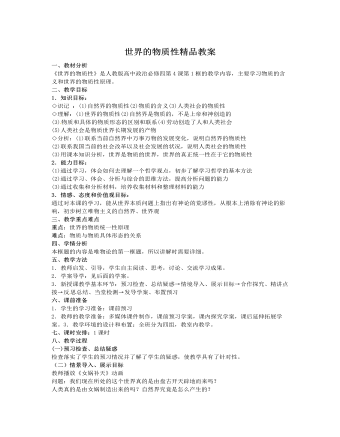
人教版高中政治必修4世界的物质性精品教案
1.知识目标:◇识记 :(1)自然界的物质性(2)物质的含义(3)人类社会的物质性◇理解:(1)世界的物质性(2)自然界是物质的,不是上帝和神创造的(3) 物质和具体的物质形态的区别和联系(4)劳动创造了人和人类社会(5)人类社会是物质世界长期发展的产物◇分析:(1)联系当前自然界中万事万物的发展变化,说明自然界的物质性 (2)联系我国当前的社会改革以及社会发展的状况,说明人类社会的物质性(3)用课本知识分析,世界是物质的世界,世界的真正统一性在于它的物质性2.能力目标:(1)通过学习,体会如何去理解一个哲学观点,初步了解学习哲学的基本方法(2)通过学习、体会、分析与综合的思维方法,提高分析问题的能力(3)通过收集和分析材料,培养收集材料和整理材料的能力3.情感、态度和价值观目标:通过对本课的学习,能从世界本质问题上指出有神论的荒谬性,从根本上消除有神论的影响,初步树立唯物主义的自然界、世界观 三、教学重点难点重点:世界的物质统一性原理
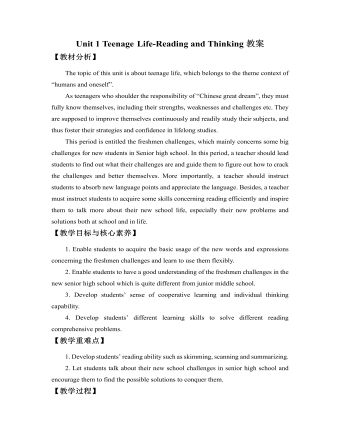
新人教版高中英语必修1Unit 1 Teenage Life-Reading and Thinking教案
【教材分析】The topic of this unit is about teenage life, which belongs to the theme context of “humans and oneself”.As teenagers who shoulder the responsibility of “Chinese great dream”, they must fully know themselves, including their strengths, weaknesses and challenges etc. They are supposed to improve themselves continuously and readily study their subjects, and thus foster their strategies and confidence in lifelong studies.This period is entitled the freshmen challenges, which mainly concerns some big challenges for new students in Senior high school. In this period, a teacher should lead students to find out what their challenges are and guide them to figure out how to crack the challenges and better themselves. More importantly, a teacher should instruct students to absorb new language points and appreciate the language. Besides, a teacher must instruct students to acquire some skills concerning reading efficiently and inspire them to talk more about their new school life, especially their new problems and solutions both at school and in life.【教学目标与核心素养】1. Enable students to acquire the basic usage of the new words and expressions concerning the freshmen challenges and learn to use them flexibly.2. Enable students to have a good understanding of the freshmen challenges in the new senior high school which is quite different from junior middle school.3. Develop students’ sense of cooperative learning and individual thinking capability. 4. Develop students’ different learning skills to solve different reading comprehensive problems.
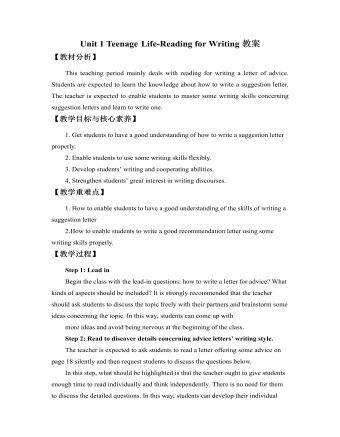
新人教版高中英语必修1Unit 1 Teenage Life-Reading for Writing教案
【教材分析】This teaching period mainly deals with reading for writing a letter of advice. Students are expected to learn the knowledge about how to write a suggestion letter. The teacher is expected to enable students to master some writing skills concerning suggestion letters and learn to write one.【教学目标与核心素养】1. Get students to have a good understanding of how to write a suggestion letter properly.2. Enable students to use some writing skills flexibly.3. Develop students’ writing and cooperating abilities.4. Strengthen students’ great interest in writing discourses.【教学重难点】1. How to enable students to have a good understanding of the skills of writing a suggestion letter2.How to enable students to write a good recommendation letter using some writing skills properly.【教学过程】Step 1: Lead in Begin the class with the lead-in questions: how to write a letter for advice? What kinds of aspects should be included? It is strongly recommended that the teacher should ask students to discuss the topic freely with their partners and brainstorm some ideas concerning the topic. In this way, students can come up with more ideas and avoid being nervous at the beginning of the class.Step 2: Read to discover details concerning advice letters’ writing style.The teacher is expected to ask students to read a letter offering some advice on page 18 silently and then request students to discuss the questions below.
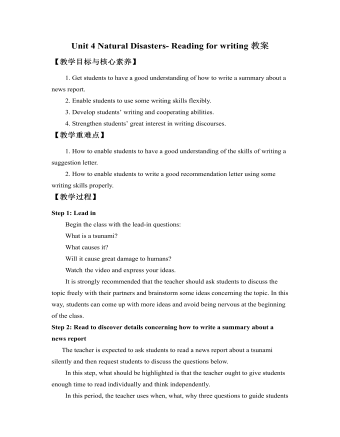
新人教版高中英语必修1Unit 4 Natural Disasters- Reading for writing教案
①标题——标题应当简洁明了。②导语——导语是消息开头的第一段或第一句话,简明扼要地揭示出消息的核心内容。③主体——主体是消息的主要部分,要用充足的事实表现主题,对导语的内容作进一步的展开和阐述。④结束语——通常是对全文内容进行概括性的总结。3. 新闻报道增分句子(1)陈述事实常用的句型:①A terrible storm hit/struck ... , killing ..②It was a cool autumn night when the earthquake happened. A large number of buildings fell down and roads were destroyed, leaving a great many people homeless.地震发生在一个凉爽的秋夜。大量的建筑物倒塌,道路被毁,许多人无家可归。③With the help of the rescue team, people who were the trapped in the flood were saved.在救援队的帮助下,困在洪水中的人们得救了。(2)陈述观点常用的句型:①Clearly/Obviously/In my opinion/It seemed that people were shocked.显然/在我看来/似乎人们震惊了。②The whole city was in ruins after the earthquake.地震后整个城市成了一片废墟。(3)揭示原因常用的句型:Because of/As a result of/Thanks to the help of the army, people who got injured were sent to the hospital immediately.
新人教版高中英语必修1Unit 4 Natural Disasters-Discovering Useful Structures教案
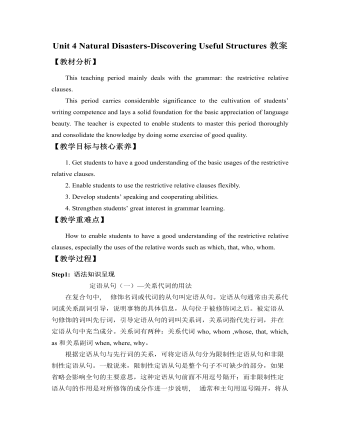
【教材分析】This teaching period mainly deals with the grammar: the restrictive relative clauses.This period carries considerable significance to the cultivation of students’ writing competence and lays a solid foundation for the basic appreciation of language beauty. The teacher is expected to enable students to master this period thoroughly and consolidate the knowledge by doing some exercise of good quality.【教学目标与核心素养】1. Get students to have a good understanding of the basic usages of the restrictive relative clauses.2. Enable students to use the restrictive relative clauses flexibly.3. Develop students’ speaking and cooperating abilities.4. Strengthen students’ great interest in grammar learning.【教学重难点】How to enable students to have a good understanding of the restrictive relative clauses, especially the uses of the relative words such as which, that, who, whom.【教学过程】Step1: 语法知识呈现定语从句(一)—关系代词的用法在复合句中, 修饰名词或代词的从句叫定语从句。定语从句通常由关系代词或关系副词引导,说明事物的具体信息,从句位于被修饰词之后。被定语从句修饰的词叫先行词,引导定语从句的词叫关系词,关系词指代先行词,并在定语从句中充当成分。关系词有两种:关系代词who, whom ,whose, that, which, as和关系副词when, where, why。
新人教版高中英语必修1Welcome Unit-Reading and Thinking教案
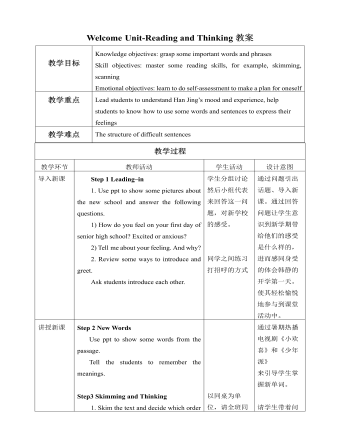
Step 2 New WordsUse ppt to show some words from the passage.Tell the students to remember the meanings.Step3 Skimming and Thinking1. Skim the text and decide which order Han Jing follows to talk about her first day. Time order or place order?Time order2. What is Han Jing worried about before she goes to senior high school?She is worried about whether she will make new friends and if no one talks to her, what she should do.Step 4 Fast Reading1. Match the main ideas with each paragraphParagraph 1:The worries about the new school day Paragraph 2Han Jing’s first maths classParagraph 3Han Jing’s first chemistry classParagraph 4Han Jing’s feelings about her first senior school dayStep 5 Careful Reading1. Fill in the chart with the words and phrases about Han Jing’s day. Answers: Senior high school, a little nervous; Her first maths class, classmates and teachers, friendly and helpful; Chemistry lab; new; great; annoying guy; Confident; a lot to explore2. Read the text again and discuss the questions.1) Why did Han Jing feel anxious before school?Because she was a new senior high student and she was not outgoing. What was more, she was worried about whether she can make friends.2) How was her first maths class?It was difficult but the teacher was kind and friendly. 3) What happened in the chemistry class? What would you do if this happened to you? A guy next to Han Jing tried to talk with her and she couldn’t concentrate on the experiment.
新人教版高中英语必修2Unit 1 Cultural Heritage-Listening&Speaking&Talking教案
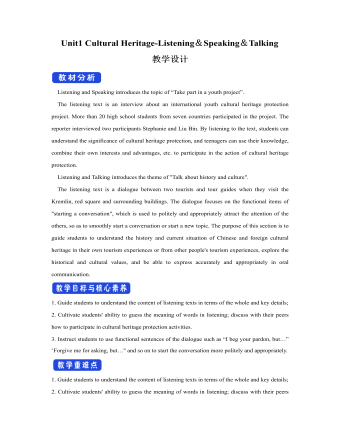
Listening and Speaking introduces the topic of “Take part in a youth project”. The listening text is an interview about an international youth cultural heritage protection project. More than 20 high school students from seven countries participated in the project. The reporter interviewed two participants Stephanie and Liu Bin. By listening to the text, students can understand the significance of cultural heritage protection, and teenagers can use their knowledge, combine their own interests and advantages, etc. to participate in the action of cultural heritage protection. Listening and Talking introduces the theme of "Talk about history and culture". The listening text is a dialogue between two tourists and tour guides when they visit the Kremlin, red square and surrounding buildings. The dialogue focuses on the functional items of "starting a conversation", which is used to politely and appropriately attract the attention of the others, so as to smoothly start a conversation or start a new topic. The purpose of this section is to guide students to understand the history and current situation of Chinese and foreign cultural heritage in their own tourism experiences or from other people's tourism experiences, explore the historical and cultural values, and be able to express accurately and appropriately in oral communication.1. Guide students to understand the content of listening texts in terms of the whole and key details; 2. Cultivate students' ability to guess the meaning of words in listening; discuss with their peers how to participate in cultural heritage protection activities.3. Instruct students to use functional sentences of the dialogue such as “I beg your pardon, but…” “Forgive me for asking, but…" and so on to start the conversation more politely and appropriately.
新人教版高中英语必修2Unit 5 Music-Reading and Thinking教案二
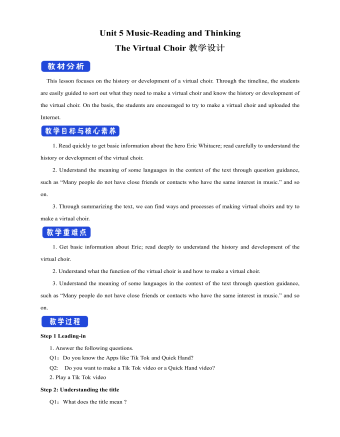
1. Get basic information about Eric; read deeply to understand the history and development of the virtual choir.2. Understand what the function of the virtual choir is and how to make a virtual choir.3. Understand the meaning of some languages in the context of the text through question guidance, such as “Many people do not have close friends or contacts who have the same interest in music.” and so on.Step 1 Leading-in1. Answer the following questions.Q1:Do you know the Apps like Tik Tok and Quick Hand?Q2: Do you want to make a Tik Tok video or a Quick Hand video?2. Play a Tik Tok video Step 2: Understanding the title Q1:What does the title mean ?Q2: Is the article a narration or exposition? Why? Q3: Can you change the title ? If you can, what is the title?Step 3: Scanning the whole text and getting the basic information1. Answer the following questions.Q1:Who came up with the idea for a virtual choir?Q2: Where did Eric studied the musical composition?Q3: What is his song?2. Find the main idea of each paragraph3. Deal with some new words.Step 4: Reading carefully to get detailed informationPara 1 How to make a virtual choir1. PreparationA. tools: a virtual camera; an Internet connectionB. hero/heroin: friends or some individuals who have the same interests2. Process
人教版高中语文必修1《别了,“不列颠尼亚”》教案
(“节马”:1841年1月7日,英国侵略者义律进攻虎门,沙田炮台副将陈连升率众浴血奋战,壮烈牺牲。其马“神骏”守护主人遗体,不屈敌之羁绊,不食敌之草料,不畏敌之鞭打刀刺,终不就范。“祖逖鞭”:祖逖,东晋名将,著名爱国将领,曾率军北伐,收复许多失地。此句大意为若要扬眉吐气,意气风发,仍需祖逖的这种精神。)八、本文反映的就是香港回归这一重大历史事件本文是一篇新闻特写。特写性消息,也称新闻速写、新闻素描,要求用类似电影“特写镜头”的手法来反映事实,是作者深入新闻事件现场,采写制作的一种新闻价值高、现场感较强、篇幅短小精粹的消息文体。特写性消息侧重于“再现”,往往采用文学手法,集中、突出地描述某一重大事件的发生现场,或某些重要和精彩的场面,生动、形象地将所报道的事实再现在读者面前。
人教版高中语文必修1《小狗包弟》教案2篇
巴金在十年浩劫中的大致经历:放弃包弟并没有换得保全一家人,1968年8月,巴金被关进牛棚改造,随后经受了大字报、挂牌游街等形式的批斗。1970年,到农村改造,掏大粪、喂猪、背稻草、种地……1972年,妻子萧珊在饱受精神折磨后患上癌症,病逝。巴金的儿子在劳动改造的过程中也饱受精神和肉体上的折磨,性格变得内向抑郁,疾病缠身。此时,巴金69岁。巴金曾在《病中》一文写道:“当姚文元拿着棒子的时候,我给关在牛棚里除了唯唯诺诺之外,敢于做过什么事情?十年间我不过是一条含着眼泪等人宰割的牛。”小结:(幻灯片12)社会是病态的社会,政治是高压的政治,人性是扭曲的人性。十年文革,十年浩劫,给多少人留下了累累不可弥合的精神创伤。即使一条小狗,也可能摆脱不了“文革”无情的迫害,比如包弟,比如艺术家邻居的小狗。
人教版高中语文必修1《烛之武退秦师》教案
四、讲读第一段(10分钟)1.抽生朗读本段,注意生字词读音。2.讲析本段译释由学生完成,师只作扼要补纠和简要分析。分析内容包括伏笔手法和语句深意,全段作用。3.让学生齐读全段。4.处理练习一之中的第1小题,要求学生试译回答,然后指导学生背诵本段。五、讲读第二段(15分钟)1.抽生朗读本段,注意生字词读音。2.讲析本段①重点讲析三个文言词“若”、“之”、“辞”的用法和人物对话。②字词句的理解仍然注意发挥学生的能动性,让他们完成为主,师纠补为辅。对要求掌握的三个文言词的用法要板书列于黑板上,对话部分要让学生试作语气练习。③小结的内容包括情节的曲折性、写法的详略和表达的特点。3.生齐读本段,然后处理相关练习。
人教版高中语文必修1《大卫·科波菲尔》教案2篇
(1)主人公大卫·科波菲尔:大卫·科波菲尔是《大卫·科波菲尔》中的主人公,曾经是个孤儿。作家描写了他从孤儿成长为一个具有人道主义精神的资产阶级民主主义作家的过程。他善良,诚挚,聪明,勤奋好学,有自强不息的勇气、百折不回的毅力和积极进取的精神,在逆境中满怀信心,在顺境中加倍努力,终于获得了事业上的成功和家庭的幸福。在这个人物身上寄托着狄更斯的道德理想。(2)《大卫·科波菲尔》中的女性形象:在狄更斯笔下,《大卫·科波菲尔》塑造了一个个有血有肉的人物形象,每个任务都给人留下了深刻的印象,尤其是成功塑造了不同性格、不同品德的女性形象:贝西姨婆、艾妮斯、佩葛蒂、克拉拉、朵拉、摩德斯通小姐、米考伯太太、艾米丽……贝西姨婆与摩德斯通小姐的对比,克拉拉、朵拉与艾妮斯的对比更使她们栩栩如生,对贝西姨婆、艾妮斯、佩葛蒂的爱就更深一层,对摩德斯通小姐更是恨之入骨,对朵拉、克拉拉既同情又气愤。