-
新人教版高中英语必修2Unit 2 Wildlife Protection-Reading for Writing教案二
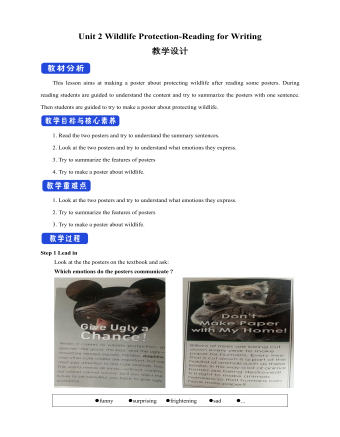
This lesson aims at making a poster about protecting wildlife after reading some posters. During reading students are guided to understand the content and try to summarize the posters with one sentence. Then students are guided to try to make a poster about protecting wildlife.1. Read the two posters and try to understand the summary sentences.2. Look at the two posters and try to understand what emotions they express.3. Try to summarize the features of posters4. Try to make a poster about wildlife.1. Look at the two posters and try to understand what emotions they express.2. Try to summarize the features of posters3. Try to make a poster about wildlife.Step 1 Lead inLook at the the posters on the textbook and ask:Which emotions do the posters communicate ?Step 2 Read the poster and answer the questions.1. What do you think of the animals in the poster on the left ?I think it is frightening and ugly.2. Why do we should protect the ugly animals ?All species--the good, the bad, and the ugly-- should be treated equally.The world needs all kinds--without variety, our planet cannot survive.3. Why are billions of trees being cut down every year ?To make paper for humans.4. What result will be lead to after the trees are cut down ?A lost of animal homes are being destroyed./The habitat of wildlife is being destroyed.Step 3 Find the feature of posters1. What does each poster use to stir up emotions ?On the left, it makes us a little frightened and it looks a little ugly, but it can activate our curiosity--What is it? And What is wrong with it?On the right, it makes us feel a little sad and want to protect them.
新人教版高中英语必修2Unit 2 Wildlife Protection-Listening &Speaking&Talking教案
Listening and Speaking introduces the topic of “how to save endangered wildlife and help wildlife in their neighborhood.” Due to the continuous deterioration of the living environment, a large number of wild animals are always facing the threat of endangered or extinction. Listening and speaking period enables students to understand the fact and reason why wild species are disappearing from the earth at an amazing speed, and realize that human beings ought to enhance the awareness of protecting wild species as soon as possible.Listening and Talking introduces the theme of " how to help wildlife in Ss’ neighborhood.". Now there are many volunteers who spontaneously protect wild animals, carry out various activities according to local conditions, and contribute their own strength to local animal protection with practical actions. Middle school students are also enthusiastic participants. They organize activities in their spare time, and take this opportunity to make friends, broaden their horizons, cultivate team spirit and communication skills. This section describes a bird watching activity organized by several middle school students of Bird watching Club. It aims to stimulate students' interest, improve their understanding of bird watching activities, and use the language structure of “being used for; in order to, so as to, to, so that, in order that ” to express the purpose for communication and discussion.1. Guide students to understand the content of listening texts in terms of using visuals to predict content.2. Cultivate students' ability to guess the meaning of words in listening; discuss with their peers how to save endangered wildlife and help wildlife in their neighborhood.3. Instruct students to use functional sentences of the dialogue such as “I am concerned about…” “what do you know about the endangered animals in…" and so on to talk about one of the endangered animals.
新人教版高中英语必修2Unit 3 The Internet-Listening &Speaking&Talking教案一
Listening and Speaking introduces the topic of “ask about online habits”. Many middle school students have been surfing the Internet for many years, but what they do with the Internet and how much time they spend every day may not be very clear to themselves, nor to other students. This section allows students to investigate their peers' Internet use, which is conducive to their mutual understanding and understanding of the Internet. It can also help them reflect on their own online behavior, learn from other people's good online habits, and get rid of their bad online behavior.The listening text of this section is an investigation interview. The investigators interview specific groups with the same questions to obtain information, so as to understand their views, practices or attitudes on this issue. There are two specific questions: “how much time do you spend online every day? What do you usually do online?”. The answers of the three respondents provide rich and different information, and achieve the purpose of the investigators. The oral discourse structure of survey interviews generally includes greeting and explaining the purpose of the interview, presenting the interview questions and the respondents' answers. Listening and Talking introduces the theme of “choosing the right application ". Listening text is a conversation between Laura and Xiao Bo. In this part of listening, “oink”; “piggy bank” may cause the students' hearing comprehension limitation. Oink refers to sound word and pig's sound. So, add some oink to my piggy bank is often used to describe "making a little money".1. Guide students to understand the content of listening texts in terms of listening for definitions.2. Cultivate students' ability to define words and understand an investigation interview.
新人教版高中英语必修2Unit 4 History and Traditions-Discovering Useful Structure教案二
This teaching period mainly deals with grammar: The past participle is used as attributive and objective complement.1. Guide students to review the basic usages of the past participle used as attributive and objective complement.2. Lead students to learn to use some special cases concerning the past participle used as attributive and objective complement flexibly.3. Strengthen students’ great interest in grammar learning.1. Help students to appreciate the function of the past participle used as attributive and objective complement.2. Instruct students to write essays using the past participle used as attributive and objective complement.Step1:温故而知新。Analyze the underlined phrases and then sum up the common usages of the past participles.1.(教材P41)They had castles built(build) all around England, and made changes to the legal system.2.(教材P42)They use the same flag, known(know) as the Union Jack,...3.(教材P42)Judy and I had our car parked(park) in an underground car park near Trafalgar Square, where we could get our car battery charged(charge).Common points: f the past participle used as attributive and objective complement.Step 2:过去分词作定语时的意义1.及物动词的过去分词作定语,在语态上表示被动;在时间上,常表示动作已经发生或完成,有时也不表示时间性。Our teacher watched us doing the experiment and gave us a satisfied smile at last.我们的老师看着我们做实验,最后给了我们一个满意的微笑。The plan put forward at the meeting will be carried out soon.会上提出的计划将很快被执行。2.不及物动词的过去分词作定语,它不表示被动意义,只强调动作完成。Many little kids like gathering fallen leaves in the yard.
新人教版高中英语必修2Unit 5 Music-Listening&Speaking&Talking教案
choir memberspeople to run food stands people to sell festival ticketspeople to sell music CDspeople to set up equipmentmusical performersStep 2: Listen to the announcement again and answer the questions. ? 1. What kind of songs will Grace Davis sing at the festival?? 2. Who can try out as a performer?? 3. What can those who think they do not have musical talent do?? 4. How can students volunteer to take part?? Talking about preferences:? Would you prefer doing ..?? What would you prefer to do?? Would you rather do .... or ….?? What would you rather do?? I'd prefer .... to ..? I'd rather have ... than .. Step 3: Speaking ProjectWork in groups. Role-play the conversation or make a new one.? Debbie: Where have you been? You missed the announcement about the music festival.? John: I was at the doctor's office. Music festival?? Frank: Yes, it's going to be next month on the school sports field. John, you can play the piano. How about playing it at the festival?? John: Well, I'd rather play the violin. I can play Liang Zhu.? Frank: Wow! Sounds good. What about you, Debbie? ? Debbie: Actually, I don't have much musical ability. I'd prefer just to help out with the crowds.? Frank: You can sell tickets or work at a food stand.? John: So can I assume that the aim of the festival is to raise money?? Debbie: Yes. All of the money will go to charity.
新人教版高中英语选修1Unit 1 People of Achievement教案
【设计意图】 基于上述分析,学生总结新闻故事语篇类型的特征,即标题的省略性、导语的概括性、数据的支撑性和引语的重要性。在此过程中,学生对新闻故事语篇类型有了更深层次的了解,对于学生阅读和写作具有重要意义。Activity 7: Discussing to make a writing outline.本活动为实现课时目标3。1.Discuss and make an outline.Ask students to discuss in groups of four and make their own writing outline.To celebrate the 70th anniversary of the People’s Republic of China, our school newspaper starts a new column about “People of Achievement”. You plan to write a news story about one of the winners of the Medal of the Republic in 2019, including Yu Min, Shen Jilan, Sun Jiadong, Li Yannian, Zhang Fuqing, Yuan Longping, Huang Xuhua and Tu Youyou.【设计意图】 教师创设情境,即为庆祝新中国成立70周年,校报新增有关卓有成就人物的栏目,你将从共和国勋章获得者中,选择一位写一篇新闻故事,向该栏目投稿。学生以小组合作形式,展开讨论,并写出新闻故事框架,有助于学生课后收集人物信息,撰写新闻故事。
新人教版高中英语选修4Unit 2 Iconic Attractions教案
帮助学生通过讨论与对主题的提升,反思自己的旅游方式,以便做出更优化的安排,在今后的旅程中有更多的收益。 Activity 2: Further discussion of the 6 elements above and supplement of more background knowledge 本活动为实现课时教学目标2。 1.Target Q: The writer’s clear target of traveling, meeting the people and experiencing the culture, is closely related to his major in social studies. Then what is social studies? Social studies is a part of a school or college curriculum concerned with the study of social relationships and the functioning of society and usually made up of courses in history, government, economics, civics, sociology, geography, and anthropology. (Dictionary by Merriam-Webster) Reflection: When you go out to travel, what targets do you usually have in mind? 2.Research Q: Suppose you are traveling to Hangzhou during the school holidays, how will you do research on the city? (surf the internet, read books or travel brochures, consult friends, ...) What information will you be interested to know? (location, iconic sites, local cuisines, interesting customs, shopping malls ...) 3.Abandonment To make the most of time, we have to learn to abandon so that we can accomplish our plan. What will you be interested in doing if you go to Hangzhou if you have a week’s time? What if you only have 2 days? 4~5. Venturing & Experiencing Q: What did he venture to do during the trip? What new experiences did he have? In Sydney: attend his first open-air barbecue, enjoy many different but yummy meals In Catherine: observe the life and customs of the aborigines appreciate their music & try the musical instruments: the didgeridoo
人教版高中历史必修1祖国统一大业教案2篇
教材分析改革开放后我国的综合国力不断增强,人民对祖国统一的愿望越来越迫切。本节课以“一国两制”构想的提出,香港、澳门的回归和海峡两岸关系的发展为中心,说明实现祖国统一,完成中华民族复兴是历史发展的必然。第一目“‘一国两制’构想的提出”主要讲述了“一国两制”的含义及历史意义。第二目“香港、澳门的回归”着重讲述了香港回归、澳门回归的经过及历史意义,这是“一国两制”成功的实践。第三目“海峡两岸关系的发展”讲述了大陆注重发展与台湾的关系,促进海峡两岸的经济文化交流与合作,打破了几十年来海峡两岸的隔绝状态,促进了祖国统一的进程。此外,教材还通过“资料回放”“历史纵横”“学思之窗”等栏目,为学生学习提供了一些详细的史料。在教学中要分析图表资料,引导学生理解完成祖国统一大业,实现中华民族的复兴,是任何人也阻挡不了的历史潮流。
人教版高中政治选修3国际组织概观教案
4、中国积极发展与区域性国际组织的关系。中国积极发展与区域性国际组织的关系。中国与欧盟建立了领导人年度会晤机制,致力于发展全面战略伙伴关系。中国重视与非洲国家的传统友谊,与非洲联盟团结合作。中国与阿拉伯国家联盟、石油输出国组织等发展中国家组建的国际组织发展友好关系,支持它们维护自身的正当权益,并与它们共同为建立公正合理的国际政治经济新秩序而努力。新中国与国际组织关系的历史演变大致经历了三个时期。从中华人民共和国建立初期到1971年:新中国被排斥在联合国等国际组织之外,为恢复在联合国的合法席位进行了不懈的斗争。从1 9 7 1年到改革开放前:中国恢复了在联合国的合法席位,并与大批国际组织建立、恢复了友好合作关系。改革开放以来:中国恢复了在世界银行和国际货币基金组织的席位,加入了世界贸易组织、亚太经合组织等经济组织。世界银行出资兴建的希望小学小结:4个主要特征:国际组织的四个主要特征即:①跨国性、②目的性、③组织性、④自主性。
人教版高中历史必修3宋明理学教案2篇
二、程朱理学:1、宋代“理学”的产生:(1)含义:所谓“理学”,就是用“理学”一词来指明当时两宋时期所呈现出来的儒学。广义的理学,泛指以讨论天道问题为中心的整个哲学思潮,包括各种不同的学派;狭义的理学,专指程颢、程颐、朱熹为代表的,以“理”为最高范畴的学说,称为“程朱理学”。理学是北宋政治、社会、经济发展的理论表现,是中国古代哲学长期发展的结果,是批判佛、道学说的产物。他们把“理”或“天理”视作哲学的最高范畴,认为理无所不在,不生不灭,不仅是世界的本原,也是社会生活的最高准则。在穷理方法上,程颢“主静”,强调“正心诚意”;程颐“主敬”,强调“格物致知”。在人性论上,二程主张“去人欲,存天理”,并深入阐释这一观点使之更加系统化。二程学说的出现,标志着宋代“理学”思想体系的正式形成。【合作探究】宋代“理学”兴起的社会条件:
人教版高中政治必修3建设学习型社会教案
三、第三阶段。课后感悟与收获1、让学生以“走向学习型社会”为题,将在收集与整理、展示与交流两个环节中获得的体验和感悟,以心得体会的形式写一篇小论文。2、办一期专栏或黑板报,将优秀小论文作集中展示与交流。(进行理论总结,将实践与理论相结合,让科学理论更好地指导实践。充分挖掘学生潜力,增强学生的自信)[评析]新课程理念之一就是政治课不应只局限于课堂上的教与学。把综合探究课与研究性学习相结合,不失为一种有益的尝试。传统的学习方式把学习建立在客观性、受动性、依赖性的基础上,把学生看成一个没有感情的接受容器,这种学习会窒息学生的思维和智力,成为学生发展的障碍。单元探究活动的开展就是要转变学生的学习方式,关注学生的学习过程,使得探究过程成为学生发现问题、提出问题、分析问题、解决问题的过程,培养学生的创新精神和实践能力。本教案的第一阶段充分发挥了学生的主动性。
人教版高中地理选修1板块构造学说教案
【启发想象 】能否将刚才讲的内容用一个游泳动作形容一下?这好像蛙泳动作。我们大家一起做:熔岩冒出(双手合十向上)→推向两边(双手向两侧分开)→遇陆俯冲(双手往下)→重熔再生(双手相向合并向上)。【小结板书】二、海底扩张学说前面我们学习了两个假说,整理一下已知条件:事实证明大陆是在漂移的,如欧洲与美洲的距离在扩张,但是漂移的动力不足;海底是不断扩张的,有生长与消亡。能否在前人研究的基础上,提出更准确更合理的假设呢?一个新的理论诞生了,它是目前最盛行、最活跃的全球构造理论【板书】三、板块构造学说1.板块概念学生读书。【启发提问】板块“漂移”与大陆“漂移”的位置有何不同?学生回答。板块漂移是指岩石圈漂在软流层上,大陆漂移发生在地壳两层之间。【提问】板块是如何划分的?读图用半分钟记下六大板块的位置和名称(提示:按大洲和大洋名称记忆)。
丰富的图形世界 展开与折叠教案教学设计
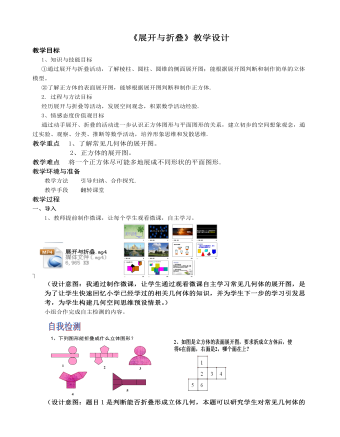
设计意图:题目1是判断能否折叠形成立体几何,本题可以研究学生对常见几何体的把握是否成熟。题目2是考察正方体的展开图,一方面可以研究学生对几何体的把握,另一方面可以引导学生思考,引出下面要学习的内容。)学生预设回答:题目一:学生应该很容易的说出折叠后形成的立体图形。题目二:①运用动手操作的方法,剪出题目中的图形,折叠后对题目做出判断。 ②利用空间观念,复原展开图,发现6的对面是1,2的对面是4,5的对面是3,进而做出判断。教师引导语预设:① 当学生运用动手操作的方法,可以让学生动手实践一下,下一步再引导学生观察正方体,发现规律。② 当学生运用空间观念,教师要放慢语调,和学生一起想象,锻炼学生空间想象能力。
人教版高中政治必修3思想道德修养和科学文化修养精品教案
一、教材分析《思想道德修养和科学文化修 养》是人教版高中政治必修一《文化生活》第十课第二框题的教学内容。主要学评析文化修养与思想道德修养的关系,说明青少年应该不断地追求更高的思想道德目标。二、教学目标1、知识目标识记:思想道德修养和科学文化修养的含义。理解:思想道德修养和科学文化修养的内在联系。分析:当代中国青年如何追求更高的思想道德目标。2、能力目标通过对“两个修养”的学习,提高学生比较分析问题的能力。3、情感、态度、价值观目标:通过本课的学习,增强当代中学生自觉提高自身全面素质的能力,不断地追求更高的思想道德目标。三、教学重难点教学重点:理解思想道德修养和科学文化修养的内在联系。教学难点:归纳如何追求更高的思想道德目标。四、学情分析通过上一框题的学习,学生从宏观上把握了国家加强思想道德建设的相关内容,,本课将从微观上即从个人的角度重点学习不断提高思想道德修养和科学文化修养的原因及具体要求。本课内容离学生的距离较近,是学 生比较感兴趣的。
中班棉签画教案:漂亮的大鱼课件教案
2、观看幼儿示范,倾听教师讲解,学习在指定范围内画彩色的点,表现美丽的大鱼。 3、学会认真、耐心地进行美术活动。 活动准备: 1、幼儿用书人手一册,棉签若干,颜料盘每组2-3盘。 2、水墨画、油画棒、水彩等形式表现的各种形态的鱼。 3、在白纸上画一条鱼的线条。 活动过程:一、听谜面、猜谜语、引出主题。 教师:有头没有颈,身上亮晶晶,有翅不能飞,没脚倒能行。这是一种生活在水里的动物,请你猜一猜这是什么动物?
中班主题课件教案:美丽的孔雀(说课和教案)
【说教材】 孔雀是孩子们喜欢的鸟类,他们在电视上、图书中见到过孔雀,而该活动进一步加深幼儿对孔雀的了解。《纲要》中指出:让幼儿感受生活的美,能用自己喜欢的方式表现自己的感受。因此我选择了这一活动,让幼儿大胆地展示自己。我班的幼儿大多数没上过幼儿园,在语言表达能力方面有些欠缺,但他们敢于用动作表现自己。【说目标】通过《纲要》的要求及对教材的分析,我制定了以下活动目标:(1)学习冠形、掌形和孔雀展翅的动作,能随音乐轻柔、优美地进行表演。(2)了解孔雀的外形特征和生活习性。(3)产生喜爱孔雀、爱护孔雀的情感。【说活动重、难点】从活动目标看出本节活动的重难点是:了解孔雀的外形特征及学习冠形、掌形和孔雀展翅的动作,并随音乐表演。
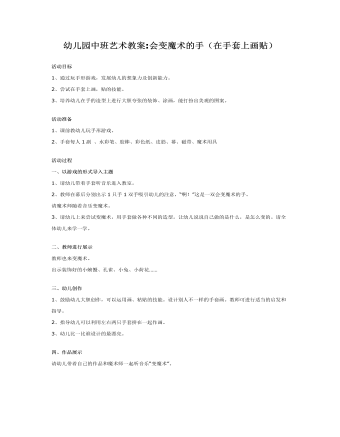
中班艺术教案:会变魔术的手课件教案
2、尝试在手套上画,贴的技能。 3、培养幼儿在手的造型上进行大胆夸张的装饰、涂画,能打扮出美观的图案。 活动准备 1、课前教幼儿玩手形游戏。 2、手套每人1副、水彩笔、胶棒、彩色纸、皮筋、幕、磁带、魔术用具活动过程一、以游戏的形式导入主题 1、请幼儿带着手套听音乐进入教室。 2、教师在幕后分别出示1只手1双手吸引幼儿的注意,“啊!”这是一双会变魔术的手。 请魔术师随着音乐变魔术。 3、请幼儿上来尝试变魔术,用手套做各种不同的造型。让幼儿说说自己做的是什么,是怎么变的。请全体幼儿来学一学。
人教部编版语文八年级上册口语交际复述与转述教案
五、加工信息,学会表述师:请同学们阅读课本P122第三题,用自己的话告诉同学,什么是经典。课件出示:1.经典作品是那些你经常听人家说“我正在重读……”而不是“我正读……”的书。2.经典作品是这样一些书,它们对读过并喜爱它们的人构成一种宝贵的经验;但是对那些保留这个机会,等到享受它们的最佳状态来临时才阅读它们的人,它们也仍然是一种丰富的经验。3.一部经典作品是一本每次重读都好像初读那样带来发现的书。4.一部经典作品是一本即使我们初读也好像是在重温我们以前读过的东西的书。5.一部经典作品是一本从不会耗尽它要向读者说的一切东西的书。6.经典作品是这样一些书,我们越是道听途说,以为我们懂了,当我们实际读它们,我们就越是觉得它们独特、意想不到和新颖。
人教部编版语文九年级下册任务二准备与排练教案
教师指导:每个表演小组可选剧务两名,负责服装道具的制作和音乐的准备。负责服装道具的同学要动手能力强,有一定的美术功底。负责配乐的同学对音乐有所了解。在适当时候教师可以给剧务同学提供相应的帮助。【设计意图】教师在指导的基础上,组织学生进行排练,排练过程中把自主权交给学生,充分锻炼学生的合作能力。三、合作排练根据研讨反馈,导演组织全剧组排练,剧务根据表演需要设计制作场景、服装,演员反复合练,及时发现表演、舞台、配合等各方面的问题,为“任务三”正式演出做好准备。本次教学设计的任务是准备与排练,学生虽有参与的热情,但组织剧组,担任导演、剧务等工作尚缺乏相关经验,因此在活动中,老师在其中承担顾问工作,给予必要的指导。对于并未接受过专业表演训练的同学们来说,要演好剧情,演活剧本并非易事,还需要多尝试,多训练。因此,在进行必要的排练指导后,就放手让学生去排练。
人教部编版语文九年级下册任务一阅读与思考教案
结束语:通过这节课的探究,我们了解了本单元三部戏剧的背景和主旨,相信大家对剧本的理解更深了。下节课,我们就要准备排练戏剧,希望大家课下再好好读读剧本,加深理解。五、布置作业1.课后查阅关于表演的相关资料,了解表演的知识。2.选择最喜欢的一个剧本熟读,并选择其中最喜欢的一个人物,揣摩应如何表演。剧本学习是一项新的教学内容,本次教学设计主要以人物为核心,从三个方面展开:(1)从文本的角度读剧本。从基本的情节入手,通过理解情节中的矛盾冲突来感知人物形象,让学生建立对剧本的基本理解。(2)从表演的角度读剧本。训练学生的朗读能力,引导学生通过台词来理解人物,为下阶段的舞台表演打下基础。(3)从现实的角度读剧本。指导学生认识剧本的现实意义,促进学生的成长。