-
人教版高中数学选修3离散型随机变量及其分布列(1)教学设计
4.写出下列随机变量可能取的值,并说明随机变量所取的值表示的随机试验的结果.(1)一个袋中装有8个红球,3个白球,从中任取5个球,其中所含白球的个数为X.(2)一个袋中有5个同样大小的黑球,编号为1,2,3,4,5,从中任取3个球,取出的球的最大号码记为X.(3). 在本例(1)条件下,规定取出一个红球赢2元,而每取出一个白球输1元,以ξ表示赢得的钱数,结果如何?[解] (1)X可取0,1,2,3.X=0表示取5个球全是红球;X=1表示取1个白球,4个红球;X=2表示取2个白球,3个红球;X=3表示取3个白球,2个红球.(2)X可取3,4,5.X=3表示取出的球编号为1,2,3;X=4表示取出的球编号为1,2,4;1,3,4或2,3,4.X=5表示取出的球编号为1,2,5;1,3,5;1,4,5;2,3,5;2,4,5或3,4,5.(3) ξ=10表示取5个球全是红球;ξ=7表示取1个白球,4个红球;ξ=4表示取2个白球,3个红球;ξ=1表示取3个白球,2个红球.
小学美术人教版六年级下册《第10课宇宙之旅》教学设计
2重点难点教学重点:1.了解中国航天知识和掌握飞船的主要结构。2.利用各种废弃物制作各种宇宙飞船。教学难点:学习利用各种废弃物制作宇宙飞船,培养学生养成收集有关宇宙飞船的信息与资料的习惯教学活动活动1【导入】导入新课.师:今年11月1日5时58分10秒神舟八号的发射成功,再一次圆了中国人民的千年飞天梦。真让人振奋啊!好,现在让我们一起回到那激动人心的时刻吧。教师播放在段有关“神州八号”载人飞船上天的影片,在播放过程中讲解有关“神州八号”的发射情况。
小学美术人教版六年级上册《第6课让剪影动起来》教学设计
2教学目标⒈知识与技能目标了解皮影的相关知识,体会皮影艺术的特点。⒉过程与方法目标学习怎样去制作剪影,最后怎样让剪影动起来,体验皮影艺人的表演技能。⒊情感与价值观目标通过对剪影知识的了解和制作剪影,增强学生对中国民间艺术的热爱,培养学生的创造精神。
高教版中职数学基础模块下册:6.3《等比数列》教学设计
课题序号6-3授课形式讲授与练习课题名称等比数列课时2教学 目标知识 目标理解并掌握等比数列的概念,掌握并能应用等比数列的通项公式及前n项和公式。能力 目标通过公式的推导和应用,使学生体会从特殊到一般,再从一般到特殊的思维规律,初步形成认识问题、分析问题、解决问题的一般思路和方法 。素质 目标通过对等比数列知识的学习,培养学生细心观察、认真分析、正确总结的科学思维习惯和严谨的学习态度。教学 重点等比数列的概念及通项公式、前n项和公式的推导过程及运用。教学 难点对等比数列的通项公式与求和公式变式运用。教学内容 调整无学生知识与 能力准备数列的概念课后拓展 练习 习题(P.21): 3,4.教学 反思 教研室 审核
高教版中职数学基础模块下册:9.5《柱、锥、球及其简单组合体》教学设计
课题序号 授课班级 授课课时2授课形式 教学方法 授课章节 名称9.5柱、锥、球及其组合体使用教具 教学目的1、使学生认识柱、锥、球及其组合体的结构特征,并能运用这些特征描述生活中简单物体的结构。 2、让学生了解柱、锥、球的侧面积和体积的计算公式。 3、培养学生观察能力、计算能力。
高教版中职数学基础模块下册:6.2《等差数列》教学设计
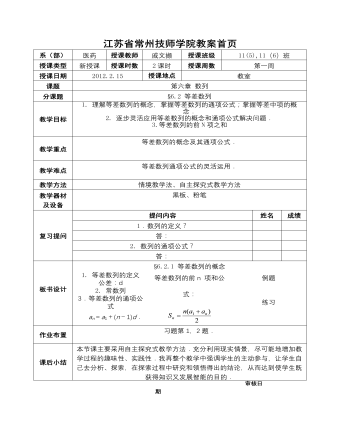
系(部)医药授课教师戚文撷授课班级11(5),11(6)班授课类型新授课授课时数2课时授课周数第一周授课日期2012.2.15授课地点 教室课题第六章数列分课题§6.2 等差数列教学目标1. 理解等差数列的概念,掌握等差数列的通项公式;掌握等差中项的概念. 2. 逐步灵活应用等差数列的概念和通项公式解决问题. 3.等差数列的前N项之和 . 4.培养学生分析、比较、归纳的逻辑思维能力. . 2. 3.教学重点等差数列的概念及其通项公式. 教学难点等差数列通项公式的灵活运用. 教学方法情境教学法、自主探究式教学方法教学器材及设备黑板、粉笔复习提问提问内容姓名成绩1.数列的定义? 答: 2. 数列的通项公式? 答: 板书设计 §6.2.1等差数列的概念 1. 1.等差数列的定义 公差:d 2.常数列 3.等差数列的通项公式 an=a1+(n-1)d. 等差数列的前n 项和公式: 例题 练习作业布置习题第1,2题.课后小结本节课主要采用自主探究式教学方法.充分利用现实情景,尽可能地增加教学过程的趣味性、实践性.我再整个教学中强调学生的主动参与,让学生自己去分析、探索,在探索过程中研究和领悟得出的结论,从而达到使学生既获得知识又发展智能的目的.
【高教版】中职数学拓展模块:1.2《正弦型函数》教学设计
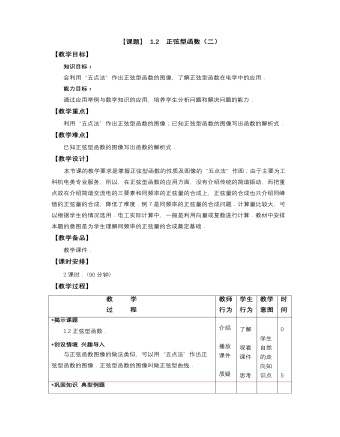
教 学 过 程教师 行为学生 行为教学 意图时间 *揭示课题 1.2正弦型函数. *创设情境 兴趣导入 与正弦函数图像的做法类似,可以用“五点法”作出正弦型函数的图像.正弦型函数的图像叫做正弦型曲线. 介绍 播放 课件 质疑 了解 观看 课件 思考 学生自然的走向知识点 0 5*巩固知识 典型例题 例3 作出函数在一个周期内的简图. 分析 函数与函数的周期都是,最大值都是2,最小值都是-2. 解 为求出图像上五个关键点的横坐标,分别令,,,,,求出对应的值与函数的值,列表1-1如下: 表 001000200 以表中每组的值为坐标,描出对应五个关键点(,0)、(,2)、(,0)、(,?2)、(,0).用光滑的曲线联结各点,得到函数在一个周期内的图像(如图). 图 引领 讲解 说明 引领 观察 思考 主动 求解 观察 通过 例题 进一 步领 会 注意 观察 学生 是否 理解 知识 点 15
【高教版】中职数学拓展模块:3.1《排列与组合》优秀教学设计
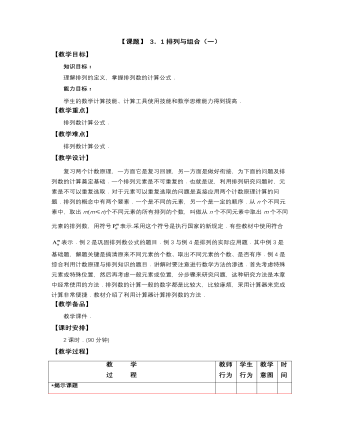
教 学 过 程教师 行为学生 行为教学 意图时间 *揭示课题 3.1 排列与组合. *创设情境 兴趣导入 基础模块中,曾经学习了两个计数原理.大家知道: (1)如果完成一件事,有N类方式.第一类方式有k1种方法,第二类方式有k2种方法,……,第n类方式有kn种方法,那么完成这件事的方法共有 = + +…+(种). (3.1) (2)如果完成一件事,需要分成N个步骤.完成第1个步骤有k1种方法,完成第2个步骤有k2种方法,……,完成第n个步骤有kn种方法,并且只有这n个步骤都完成后,这件事才能完成,那么完成这件事的方法共有 = · ·…·(种). (3.2) 下面看一个问题: 在北京、重庆、上海3个民航站之间的直达航线,需要准备多少种不同的机票? 这个问题就是从北京、重庆、上海3个民航站中,每次取出2个站,按照起点在前,终点在后的顺序排列,求不同的排列方法的总数. 首先确定机票的起点,从3个民航站中任意选取1个,有3种不同的方法;然后确定机票的终点,从剩余的2个民航站中任意选取1个,有2种不同的方法.根据分步计数原理,共有3×2=6种不同的方法,即需要准备6种不同的飞机票: 北京→重庆,北京→上海,重庆→北京,重庆→上海,上海→北京,上海→重庆. 介绍 播放 课件 质疑 了解 观看 课件 思考 引导 启发学生得出结果 0 15*动脑思考 探索新知 我们将被取的对象(如上面问题中的民航站)叫做元素,上面的问题就是:从3个不同元素中,任取2个,按照一定的顺序排成一列,可以得到多少种不同的排列. 一般地,从n个不同元素中,任取m (m≤n)个元素,按照一定的顺序排成一列,叫做从n个不同元素中取出m个元素的一个排列,时叫做选排列,时叫做全排列. 总结 归纳 分析 关键 词语 思考 理解 记忆 引导学生发现解决问题方法 20
人教版高中数学选修3分类变量与列联表教学设计
一、 问题导学前面两节所讨论的变量,如人的身高、树的胸径、树的高度、短跑100m世界纪录和创纪录的时间等,都是数值变量,数值变量的取值为实数.其大小和运算都有实际含义.在现实生活中,人们经常需要回答一定范围内的两种现象或性质之间是否存在关联性或相互影响的问题.例如,就读不同学校是否对学生的成绩有影响,不同班级学生用于体育锻炼的时间是否有差别,吸烟是否会增加患肺癌的风险,等等,本节将要学习的独立性检验方法为我们提供了解决这类问题的方案。在讨论上述问题时,为了表述方便,我们经常会使用一种特殊的随机变量,以区别不同的现象或性质,这类随机变量称为分类变量.分类变量的取值可以用实数表示,例如,学生所在的班级可以用1,2,3等表示,男性、女性可以用1,0表示,等等.在很多时候,这些数值只作为编号使用,并没有通常的大小和运算意义,本节我们主要讨论取值于{0,1}的分类变量的关联性问题.
人教版高中数学选修3离散型随机变量及其分布列(2)教学设计
温故知新 1.离散型随机变量的定义可能取值为有限个或可以一一列举的随机变量,我们称为离散型随机变量.通常用大写英文字母表示随机变量,例如X,Y,Z;用小写英文字母表示随机变量的取值,例如x,y,z.随机变量的特点: 试验之前可以判断其可能出现的所有值,在试验之前不可能确定取何值;可以用数字表示2、随机变量的分类①离散型随机变量:X的取值可一、一列出;②连续型随机变量:X可以取某个区间内的一切值随机变量将随机事件的结果数量化.3、古典概型:①试验中所有可能出现的基本事件只有有限个;②每个基本事件出现的可能性相等。二、探究新知探究1.抛掷一枚骰子,所得的点数X有哪些值?取每个值的概率是多少? 因为X取值范围是{1,2,3,4,5,6}而且"P(X=m)"=1/6,m=1,2,3,4,5,6.因此X分布列如下表所示
新人教版高中英语必修3Unit 1 Festivals and Celebrations-Reading and Thinking教学设计
The topic of this part is “Discover the reasons for festivals and celebrations.The Listening & Speaking & Talking part aims at talking about the experiences and feelings or emotions about the festivals and celebrations. This section aims at detecting the reason why the people celebrate the festivals, the time, the places, the types and the way of celebrations. It also explains why some traditions in the old celebrations are disappearing, like the firecrackers in the big cities and some new things are appearing like the prosperity of business or commerce. 1. Students can talk about what festivals they know and the reasons and the way of celebrating them.2. Students should learn the reading skills such as the headline and get the topic sentences, the structures of articles.3. Students can understand the past, the present situation of some festival around the world and why there are some changes about them. 4. Students can have the international awareness about the festivals.1. Students should learn the reading skills such as the headline and get the topic sentences, the structures of articles.2. Students can understand the past, the present situation of some festival around the world and why there are some changes about them.Step 1 Lead in---Small talkWhat festival do you like best ? Why ?I like the Spring Festivals because I can set off the fireworks, receive the lucky money and enjoy the Gala with my families.Step 2 Before reading---Pair workWhy do people celebrate different festivals ?The Spring Festivals is to celebrate the end of winter and the coming of spring and new life.The Mid-autumn Day is to celebrate the harvest and admire the moon.
新人教版高中英语必修3Unit 1 Festivals and Celebrations-Listening &Speaking&Talking教学设计
The theme of this section is “Talk about festival activities and festival experiences”.Festival and holiday is a relaxing and interesting topic for students. This part talks about the topic from the daily life of students’. In the part A ---Listening and Speaking, there are three conversations among different speakers from three countries(Japan, Rio and China), where the speakers are participating in or going to participate in the festivals and celebrations. So listening for the relationship among them is a fundamental task. Actually, with the globalization and more international communication, it is normal for Chinese or foreigners to witness different festivals and celebrations in or out of China. In the Conversation 1, a foreign reporter is interviewing a Japanese young girl who just had participated in the ceremony of the Coming-of-Age Day on the street and asking her feeling about the ceremony and the afterwards activities. Conversation 2, Chinese girl Li Mei is witnessing the Rio Carnival for the first time, and her friend Carla gives her some advice on the costumes which enables her to match with the carnival to have a good time. Conversation 3, a Chinese guide is showing a group of foreign visitors around the Lantern Festival and introducing the customs of the festival to them. The three conversations have a strong vitality and insert the festival and cultural elements from different countries. So perceiving the festivals and cultures from different countries is the second task. At the same time, the scripts also insert the targeted grammar --- v-ing as attributive and predicative, which students can perceive and experience in a real context and make a road for the further study. That is the third task. In the Part B--- Listening and Talking, the theme is “Talk about festival experience”, which is the common topic in our daily conversations. During the conversation, Song Lin, a Chinese student, asked Canadian friend Max about how to spend Christmas. In the conversation, Song Lin talked about experience and the feelings during the Chinese Spring Festival, during which there are not only some enjoyable things but some unpleasant things. After the listening, perhaps students find there are some similarities between Christmas and the Chinese Spring Festival as there are some differences in the origins and celebrations. For example, people always visit friends and relatives, decorate their houses, have a big dinner together, chat and give presents to each other.
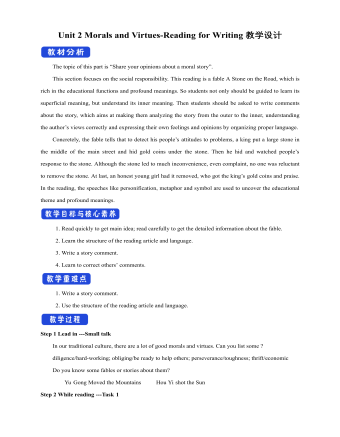
新人教版高中英语必修3Unit 2 Morals and Virtues-Reading for Writing教学设计
1. 这个寓言是一个关于一位国王古寓言。 The fable is an old fable about a king.2.作者用这个故事让读者对于社区的问题负有个人责任的必要印象深刻。The author used the story to impress upon readers with the need to take personal responsibility for problems in the community.3. 这个故事十分成功的实现了它的目的。The story was quite successful in achieving its purpose.Step 7 WritingPlease write a review of the story according the outline above.The fable is an old fable about a king who thought his people are lazy, so he put a large stone in the middle of the road and hides and waited to see if anyone will try to move it.The author used this story to impress upon readers with the need to take personal responsibility for problems in the community. The story was quite successful in achieving its purpose, and I liked it because it had a clear moral.However, while the moral of the story is clear, the actions of the king seemed pointless to me, because none of the characters in the story learnt anything. For this reason, I think there are better stories that can be used to impress upon people with the need for personal responsibility.Step 8 Pair workExchange drafts with a partner. Use this checklist to help your partner revise his/her draft.1. Does the writer give a short description of the story ?2. Does the description include the most important details of the story ?3. Does the writer give his or her opinion about the character or their actions ?4. Is the review well-organised ? 5. Does the writer use the -ing form as the adverbial correctly in the writing ?6. Are there any grammar, spelling, or punctuation errors ?Step 9 HomeworkPut up your revised draft in the classroom or read it to your class.
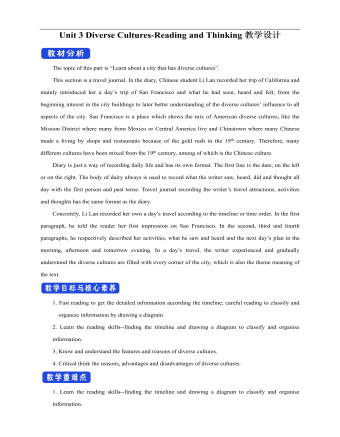
新人教版高中英语必修3Unit 3 Diverse Cultures-Reading and Thinking教学设计
Discuss these questions in groups.Q1: Have you ever been to a place that has a diverse culture ? What do you think about the culture diversity ?One culturally diverse place that I have been to is Harbin, the capital city of Heilongjiang Province. I went there last year with my family to see the Ice and Snow Festival, and I was amazed at how the culture as different to most other Chinese cities. There is a big Russian influence there, with beautiful Russian architecture and lots of interesting restaurants. I learnt that Harbin is called “the Oriental Moscow” and that many Russians settled there to help build the railway over 100 years ago.Q2: What are the benefits and challenges of cultural diversity ?The benefits: People are able to experience a wide variety of cultures, making their lives more interesting, and it can deepen the feelings for our national culture, it is also helpful for us to learn about other outstanding culture, which helps improve the ability to respect others. The challenges: People may have trouble communicating or understanding each other, and it may lead to disappearance of some civilizations and even make some people think “The western moon is rounder than his own.”Step 7 Post reading---RetellComplete the passage according to the text.Today, I arrived back in San Francisco, and it feels good (1) _____(be) back in the city again. The city succeeded in (2)_________ (rebuild) itself after the earthquake that (3)________ (occur) in 1906, and I stayed in the Mission District, enjoying some delicious noodles mixed with cultures. In the afternoon, I headed to a local museum (4)____ showed the historical changes in California. During the gold rush, many Chinese arrived, and some opened up shops and restaurants in Chinatown to earn a (5)_____ (live). Many others worked on (6)______ (farm), joined the gold rush, or went to build the railway that connected California to the east. The museum showed us (7)____ America was built by immigrants from (8)________ (difference) countries and cultures. In the evening, I went to Chinatown, and ate in a Cantonese restaurant that served food on (9)________(beauty) china plates. Tomorrow evening, I’m going to (10)__ jazz bar in the Richmond District. 答案:1. to be 2. rebuilding 3. occurred 4. that 5.living6. farms 7.how 8. different 9. beautiful 10. a
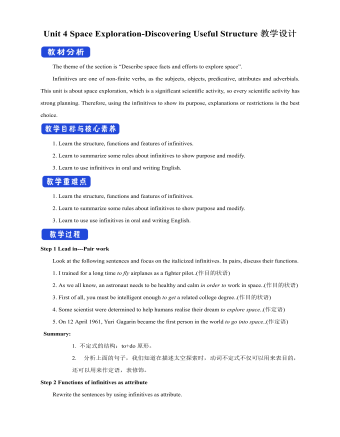
新人教版高中英语必修3Unit 4 Space Exploration-Discovering Useful Structure教学设计
The theme of the section is “Describe space facts and efforts to explore space”. Infinitives are one of non-finite verbs, as the subjects, objects, predicative, attributes and adverbials. This unit is about space exploration, which is a significant scientific activity, so every scientific activity has strong planning. Therefore, using the infinitives to show its purpose, explanations or restrictions is the best choice.1. Learn the structure, functions and features of infinitives.2. Learn to summarize some rules about infinitives to show purpose and modify.3. Learn to use infinitives in oral and writing English. 1. Learn the structure, functions and features of infinitives.2. Learn to summarize some rules about infinitives to show purpose and modify.3. Learn to use use infinitives in oral and writing English.Step 1 Lead in---Pair workLook at the following sentences and focus on the italicized infinitives. In pairs, discuss their functions. 1. I trained for a long time to fly airplanes as a fighter pilot..(作目的状语)2. As we all know, an astronaut needs to be healthy and calm in order to work in space..(作目的状语)3. First of all, you must be intelligent enough to get a related college degree..(作目的状语)4. Some scientist were determined to help humans realise their dream to explore space..(作定语)5. On 12 April 1961, Yuri Gagarin became the first person in the world to go into space..(作定语)Summary:1. 不定式的结构:to+do原形。2. 分析上面的句子,我们知道在描述太空探索时,动词不定式不仅可以用来表目的,还可以用来作定语,表修饰。
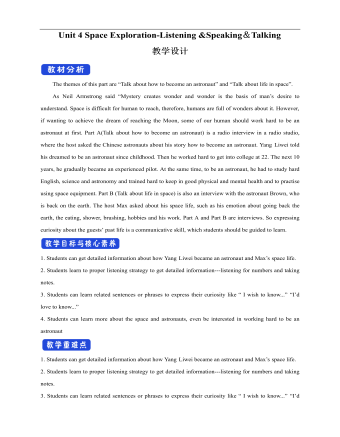
新人教版高中英语必修3Unit 4 Space Exploration-Listening&Speaking&Talking教学设计二
The themes of this part are “Talk about how to become an astronaut” and “Talk about life in space”. As Neil Armstrong said “Mystery creates wonder and wonder is the basis of man’s desire to understand. Space is difficult for human to reach, therefore, humans are full of wonders about it. However, if wanting to achieve the dream of reaching the Moon, some of our human should work hard to be an astronaut at first. Part A(Talk about how to become an astronaut) is a radio interview in a radio studio, where the host asked the Chinese astronauts about his story how to become an astronaut. Yang Liwei told his dreamed to be an astronaut since childhood. Then he worked hard to get into college at 22. The next 10 years, he gradually became an experienced pilot. At the same time, to be an astronaut, he had to study hard English, science and astronomy and trained hard to keep in good physical and mental health and to practise using space equipment. Part B (Talk about life in space) is also an interview with the astronaut Brown, who is back on the earth. The host Max asked about his space life, such as his emotion about going back the earth, the eating, shower, brushing, hobbies and his work. Part A and Part B are interviews. So expressing curiosity about the guests’ past life is a communicative skill, which students should be guided to learn.1. Students can get detailed information about how Yang Liwei became an astronaut and Max’s space life.2. Students learn to proper listening strategy to get detailed information---listening for numbers and taking notes.3. Students can learn related sentences or phrases to express their curiosity like “ I wish to know...” “I’d love to know...”4. Students can learn more about the space and astronauts, even be interested in working hard to be an astronaut
新人教版高中英语必修3Unit 5 The Value of Money-Listening &Speaking&Talking教学设计
4. A:We’d like to have someone to say a word at the beginning to welcome the group.B:↙Who?A:We thought that you or Dr.Johnson might do it.B用降调说Who,其意思是问,对方想让谁在开场时致欢迎词。Step 6 Pronunciation---Practice1. Listen to the short conversation and mark the intonation with ↗, ↙ or ↙, ↗. Then discuss with a partner what they intend to convey by using different intonation.Owner: You know what ?↗ It’s a million-pound bank note↙.Waiter 1: Really ?↗(question)Waiter 2: Really !↙(unbelievable and surprised)Waiter 3: Really ?!↙↗(first question then surprised)2. Listen to the conversations. Underline the parts that are stressed and mark the intonation. Then talk about the implied meanings of the responses with different intonations. Listen again and repeat.1) Henry: It’s a nice suit.Owner: Oh, it’s perfect!↙(The intonation means it is very suitable for Henry.)2) Henry: Well, that’s very kind of you.Owner: Kind, sir ?↗(what you said is not right) No, it’s kind of you. You must come whenever you want and have whatever you like. Just having you sit here is a great honour !!↙(welcome you to come again)3)Henry:Well, to be honest, I have none. Oliver:(happily) What luck!(excited) Brother↗, what luck!↙(It means “Didn’t you hear it?”)Henry: Well, it may seem lucky to you but not to me!↗(angry) If this is your idea of some kind of joke, I don’t think it’s very funny. Now if you’ll excuse me, I ought to be on my way.↙(If so, I would leave.)Roderick: Please don’t go↙...(hope Henry can wait for a moment)Part B Viewing and Talking---Describe people’s changing attitudes in a film clipStep 1 Before-listening---Tell the filmYou are going to watch part of the film The Million Pound Bank Note. Look at these photos and guess what happens in the film.
新人教版高中英语必修3Unit 5 The Value of Money-Listening &Speaking教学设计
Step 4: Listen again and decide if the following statements are true (T) or false (F).1 It was the first time Chen Liyan's story was reported. T口 F口2 Chen found 10,000 yuan in a small plastic bag in Taiyuan railway station口 F口3 Wang Zheng apologized to Chen because he couldn't offer her more money. T口 F口4 Chen took out a large loan to cure her daughter, T口 F口5 Wang set up a fundraising website for Chen's daughter after Chen told him about her situation. T口 F口Step 5:After listening, discuss the questions.1 What kind of person do you think Chen Liyan is?Chen Liyan is generous and honest because she returned a large sum of money to the owner.2 Did Chen return the money because she didn't need it?No. She returned the money because it was the right thing to do. Evidence for this is that she refused to accept the reward money because she felt that it had not been earned. 3 Is it common for people to do what Chen did?It depends on the culture. In some countries it is quite common to return money that has been found. In other countries, people believe "Finders are keepers!" 4 How did Wang Zheng feel about the return of his money?He must have been very happy and relieved to have gotten his money back. We know this because he thanked Chen repeatedly and even offered her a reward.5 Why did Ma Dongbao tell Wang about Chen's family?He must have had great sympathy for Chen and her daughter and wanted to help them.'We know this because he arranged help for them. 6 How did the news reporter feel about Chen's actions?The news reporter felt that it showed that money wasn't the most important thing in life. We know this because the reporter told us that this is what Chen believes. and then said, “that's a great attitude to take."
新人教版高中英语必修3Unit 5 the value of money-Reading For Writing教学设计一
【参考范文】Narrator:(Henry is smiling as he leaves the restaurant. As he is walking down the street, he sees a sign for a place that cuts hair. He decides to get it cut. )H=Henry;B=Barber;R=rude manH:Good afternoon, I'd like to get a cut, if I may. (The barber looks at Henry's hair and continues cutting another man's hair. )Er, I'd really like a haircut. As you can see it's much too long. B:(in a rude manner) Yes, I can see that. Indeed, I can. H:Fine, well I'll have a seat then. (He sits in one of the barber's chairs. The barber turns to look at Henry. )B:It's quite expensive here, you know!Are you sure you can afford it?H:Yes. I think so. (In comes the rude man. )R:Hey you there. I need a haircut quickly. Can you do me straightaway?B:All right, then, get in the chair and I'll see what I can do. R:Thank you. (sits down in one of the barber's chairs)H:Excuse me, but I was here first. Aren't you going to do my hair first?B:This man's in a hurry. H:Well so am I!I insist that you cut my hair first. B:OK, but I'll have to be quick. This gentleman is waiting. H:Thank you. (They both become quiet. After his hair is cut, the barber tells Henry how much he must pay. Henry shows the barber the bank note. )B:Why, Mr . . . (looks shocked)H:Adams. Henry Adams. I'm sorry, I don't have any change. R:You're that Mr Adams! Well,I'm glad I waited or I might never have known it was you. B:Why, Mr Adams, please don't worry!(wearing a big smile) Nothing to worry about!Nothing at all!Please come back any time, even if you only need too little hairs cut!It will be my honour to serve you!
新人教版高中英语选修2Unit 4 Journey Across a Vast Land教学设计
当孩子们由父母陪同时,他们才被允许进入这个运动场。3.过去分词(短语)作状语时的几种特殊情况(1)过去分词(短语)在句中作时间、条件、原因、让步状语时,相当于对应的时间、条件、原因及让步状语从句。Seen from the top of the mountain (=When it is seen from the top of the mountain), the whole town looks more beautiful.从山顶上看,整个城市看起来更美了。Given ten more minutes (=If we are given ten more minutes), we will finish the work perfectly.如果多给十分钟,我们会完美地完成这项工作。Greatly touched by his words (=Because she was greatly touched by his words), she was full of tears.由于被他的话深深地感动,她满眼泪花。Warned of the storm (=Though they were warned of the storm), the farmers were still working on the farm.尽管被警告了风暴的到来,但农民们仍在农场干活。(2)过去分词(短语)在句中作伴随、方式等状语时,可改为句子的并列谓语或改为并列分句。The teacher came into the room, followed by two students (=and was followed by two students).后面跟着两个学生,老师走进了房间。He spent the whole afternoon, accompanied by his mom(=and was accompanied by his mom).他由母亲陪着度过了一整个下午。