-
人教版高中语文必修2《巴黎圣母院》教案2篇
【教学设想】一、选题设想《巴黎圣母院》是雨果的代表作,无论从思想内容还是艺术风格都有明显的浪漫主义特征:奇异曲折、扣人心弦的故事情节;妙趣横生、别出心裁的奇遇巧合;强烈鲜明的美丑、善恶对比;丰富生动、珠玑迸发、富有哲理意味的语言。通过导读,来消除学生对外国名著的畏难情绪,增加学生课外阅读的兴趣和信心;让学生整体把握作品,窥一斑而识全豹,让学生高屋建瓴,了解其旨意,以极为精确而又充满意蕴的文字,对名著的概述及精要部分做了介绍;引导学生自主探究,交流合作,培养学生的独立思考的学习惯,指点进行名著阅读的门径。作为导读课,教师应注意不可“越位”,在学生学习的过程中,教师的“导”固然重要,学生的“读”更不可或缺,应避免以“导读”来代替名著阅读。因此,《巴黎圣母院》的教学定位为基于课内,面向课外,以求达到以学带读,以读促学的目的。
人教版高中语文必修5《归去来兮辞(并序)》教案
【教学目标】1.理解作者反抗黑暗,辞官归田,不与当时黑暗的上层社会同流合污而热爱田园生活的积极精神,学习其高洁的理想志趣和坚定的人生追求。2.掌握“胡、奚、曷、焉、何”五个疑问代词,归纳“行、引、乘、策”等四个词的一词多义,了解“以、而、之、兮、来”等文言虚词的用法。3.背诵全文。【教学重点】1.了解作者辞官归田的原因,深刻体味诗人鄙弃官场,热爱田园的无限欣喜之情。2.背诵全文。【教学难点】1.理解记述中渗透出的或喜或哀,或决绝或犹疑的复杂感情。2.归纳实词、虚词的用法,掌握省略句、倒装句两种句式。【教具准备】投影仪投影胶片【课时安排】2课时【教学过程】第一课时[教学要点]了解陶渊明及其作品。读课文,利用注释、工具书,初步把握文章,朗读课文,找出押韵的字,由押韵归纳各层大意,帮助学生理清背诵思路,背诵全文。[教学步骤]一、导语《桃花源记》是我们在初中接触过的陶渊明的作品。师生一同背诵。《桃花源记》中悠闲自得的田园生活正是作者精神追求的形象反映。今天我们学习的《归去来兮辞》正是作者决别官场,同上层社会分道扬镳的宣言书。
人教版高中语文必修4《张衡传》教案
采用明段意分段法:先逐段概括段意,然后用合并同类项法把相关联紧缩密的自然段合在一起。全文五个自然段中,二、三、四自然段讲的都是张衡取得的科学成就,自然应合为一大段。这样,就理清了文章的结构。全文可分为三个部分:(1)写张衡的品格和文才①(2)写张衡在科学技术上取得的成就(②③④)(3)写张衡的政治才干(⑤)第二部分是文章的重点,又可分为两层:一是仕途情况,以及制作浑天仪和著《灵宪》、《算图论》的情况;一是专门介绍候风地支仪。显然,后者又是第二部分的重点。作者这样处理文章的详略安排。无疑是非常正确的,因为张衡一生有多方面的才能和成就,而他在科技方面的才能和创造发明最为突出,理应成为本文记叙的重点。四、小结1.了解全文的内容和结构,掌握明段意分段法。2.了解文章的详略安排。五、作业
人教版高中语文必修4《长亭送别》教案
三.分析第三部分:1.夫妻赠诗表现了二人怎样的心情?提示:崔莺莺告诫张生切勿忘记她;张生则发誓永无别恋。这充分展示了二人深厚的情谊。2.怎样理解[耍孩儿]中的典故?提示:“红泪”借王嘉《拾遗记》的典故,司马青衫借白居易《琵琶行》的典故,表现主人公因离别而生的伤心之情。“伯劳飞去燕西归”则用牛郎织女的典故表现两人缠绵难舍的心情。3.[五煞]表明了主人公怎样的心情?提示:对张生的生活的关心,千叮万嘱,真情自现。4.[二煞]中所用是几个典故?这些典故的作用是什么?提示:三个典故,见课本。其作用是表明崔莺莺对张生的担心。四.分析第四部分:1.[一煞]中再写环境,其作用是否与先前所写相同?提示:稍有不同,这里是表现崔莺莺目送张生远去时那种凄怆悲苦的眷恋之情。以所见之物,写内心深藏之情。2.[收尾]中写‘残照’其含义是什么?提示:以“残照”表现内心的怅惘失意之情。
人教版高中语文必修5《逍遥游》教案
六、到此为止,我们了解到,作者对“笑”鲲鹏和别人的蜩与学鸠、斥鴳、宋荣子都一一作了否定。那么请大家讨论一下,1、作者对鲲鹏和“知效一官,行比一乡,德合一君,而征一国者”是不是肯定呢?明确:也都作了否定。否定后者好理解,关键是否定前者不好理解,因为“鲲鹏展翅”早已作为积极的意象被人们广泛引用。但在本文中,作者在讲述这一寓言故事时,突出的不是鲲鹏本身,而是风力,“故九万里,风斯在下矣,而后乃今培风;背负青天,而莫之夭阏者,而后乃今将图南”。对风力作用的突出,实际上就是对鲲鹏的否定。作者写了“笑”的双方,对“笑”的一方蜩与学鸠、斥鴳、宋荣子都作了否定,对被“笑”的一方鲲鹏和“知效一官,行比一乡,德合一君,而征一国者”也都作了否定,并且对顺便提及的野马、尘埃、芥、大舟、朝菌、蟪蛄、冥灵、大椿、彭祖、列子等事物或者人物也都作了否定。这种全盘否定的态度,如果我们借用本文中的一个形象的词语,可以说是:笑!是的,本文也可以说是:庄子“笑”万物!
人教版高中语文必修5《咬文嚼字》教案
【教学过程】第一课时一、导入新课清代唐彪在《读书作文谱》中引用武叔卿的话说:“文章有一笔写成不加点缀而工者,此神到之文,尚矣。其次须精思细改,如文章草创已定,便从头至尾—一标点。”同学们能列举出文学史上的作家哪些属于前者,哪些属于后者吗?前者有李白。后者如贾岛、王安石、欧阳修、曹雪芹等。(贾岛有关于推敲的典故。王安石修改“春风又绿江南岸”句传为佳话。欧阳修《醉翁亭记》的开头便是精心改成的。《红楼梦》更是“披阅十载,增删五次。”)提问:古今的伟大作家为什么像李白式的诗人很少,而大多数人却都要“咬文嚼字”,苦苦修改呢?这节课我们就来研究一下这个问题。二、整体感知1.快速浏览全文,熟悉主要内容。2.根据“学习重点”,确立学习目标。三、课文分析1.理清观点与材料的关系。首先,让学生找出本文在论证中所运用的材料。
人教版高中语文必修4《短文三篇》教案
③于是,大自然出现了惊人的奇迹,不毛的石缝间丛生出倔强的生命。④或者就只是一簇一簇无名的野草,春绿秋黄。岁岁枯荣。它们只有三两片长长的细瘦的薄叶,那细微的叶脉,告知你生存该是多么艰难;更有的。它们就在一簇一簇瘦叶下自己生长出根须,只为了少向母体吮吸一点乳汁,便自去寻找那不易被觉察到的石缝。这就是生命,如果这是一种本能,那么它正说明生命的本能是多么尊贵,生命有权自认为辉煌壮丽,生机竟是这样地不可扼制。⑤或者就是一团一团小小的山花,大多又都是那苦苦的蒲公英。它们不似田野上的同宗长得那样茁壮,它们的茎显得坚韧而苍老。它们的叶因枯萎而失却光泽。它们已经不能再去为人们作佐餐的鲜嫩的野菜,却默默地为攀登山路的人准备了一个可靠的抓手。生命就这样地被环境规定着,又被环境改变着,适者生存的规律尽管无情。但一切适者就是战胜环境的强者。生命现象告诉你,生命就是拼搏。
人教版高中语文必修4《李清照词两首》教案
2.【提问】《醉花阴》反映的是早年丈夫赵明诚游宦在外,作者一个人留在家中的生活状况和内心感受。对于这样的“闺怨”题材,应当怎样评价呢?【明确】作者作为一个封建时代的妇女,能够坦率地表达出自己对于丈夫深深的思恋之情,描写了闺中生活的孤独寂寞,这在当时乃是一种很大胆的行为。所以,有人批评说:李清照作词是“无顾忌”地“肆意落笔”。其实,感情的充沛、真挚,敢于正面地展露自己的行为和内心世界,正是她创作成功的重要原因之一,也正是她的词最值得珍视的地方。3.【提问】古人常常爱用花比喻人之美貌,如“芙蓉如面柳如眉”,“人面桃花相映红”等,而李清照却说“人比黄花瘦”,这样的比喻有什么丰富的内涵?【明确】黄色的菊花不止外形上雅淡、清秀,与作者因相思而消瘦的体态相近,而且在菊花品格的传统象征意义上,也酷似作者清高、淡泊的精神,这样的比喻正比较恰切地反映了当时作者由于离开丈夫而孤独、愁闷的生活状态和内心情感。
人教版高中语文必修4《柳永词两首》教案
(一)上片:描写杭州的自然风光和都市的繁华“东南形胜,三吴都会,钱塘自古繁华”,“东南形胜”,是从地理条件、自然条件着笔写的。杭州地处东南,地理位置很重要,风景很优美,故曰:“形胜”。“三吴都会”,是从社会条件着笔写的。它是三吴地区的重要都市,那里人众荟萃,财货聚集,故曰:“都会”。“钱塘自古繁华”,这一句是对前两句的总结,因为杭州具有这些特殊条件,所以“自古繁华”。下面就对“形胜”、“都会”和“自古繁华”进行铺叙。“烟柳画桥,风帘翠幕,参差十万人家”是对“三吴都会”的展开描写。“云树绕堤沙。怒涛卷霜雪,天堑无涯”是对“东南形胜”的展开描写。这里选择了钱塘江岸和江潮两种景物来写。“市列珠玑,户盈罗绮,竞豪奢”是对“钱塘自古繁华”的展开描写。描写了两个方面:一是商业贸易情况——“市列珠玑”,只用市场上的珍宝,代表了商业的丰富、商业的繁荣;二是衣着情况——“户盈罗绮”,家家披罗着锦。“竞豪奢”,又总括杭州的种种繁华景象。
人教版高中语文必修4《哈姆莱特》教案
一、作者简介:威廉·莎士比亚(1564~1616),英国文艺复兴时期伟大的戏剧家和诗人。(人文主义:欧洲文艺复兴时期新兴资产阶级反封建的社会思潮。资产阶级人道主义的最初形式。它肯定人性和人的价值,要求享受人世的欢乐,要求人的个性解放和自由平等,推崇人的感性经验和理性思维。)一生共写有37部戏剧,154首14行诗,两首长诗和许多其他诗歌。主要代表作有早期的历史剧、喜剧———《亨利四世》、《仲夏夜之梦》、《威尼斯商人》和《罗密欧与朱丽叶》等;中期的悲剧———《哈姆莱特》、《奥瑟罗》、《李尔王》和《麦克白》等;后期的传奇剧———《暴风雨》等。二、莎士比亚创作《哈姆莱特》的社会背景:莎士比亚是欧洲文艺复兴时期英国伟大的戏剧家和诗人。他生活在欧洲历史上封建制度日趋没落、资本主义兴起的交替时代。哈姆莱特是丹麦古代的王子。莎士比亚故意以超越时代的误差将哈姆莱特搬到伊丽莎白统治未年的英国现实中来。
新人教版高中英语必修1Unit 2 Travelling Around-Reading for Writing教案
Is there a clear purpose for the trip? :Does each paragraph have a clear main idea? Does the writer use the present continuous tense for future plans?Does the writer use commas, stops, and question marks correctly? Are all the words spelt correctly?Are all the proper nouns capitalized?Revise your draft according to your partner's comments.Step 5:The summary of how to write a travel plan.旅游计划是一种常见的应用文写作。旅游可分为观光游、文化游、美食游及探险游等不同类型,因此旅游计划也要根据不同的旅游目的进行设计。常规的旅游计划需要明确以下几个方面的问题:Travel planWhen will you leave for? Where is your the destination?How will you get there?What will you do there?How long will you there?Is there a clear purpose for the trip? 为了提升旅行计划的层级,还需注意以下几个方面的问题:1.每段是否有明确清晰的主题;2.用一般现在时代替一般将来时;3.用更高级的形容词词汇。例如:表达“好”时,不要总用“nice”,我们还可以用“smart, clean, excellent, exciting, beautiful, wonderful, clever, famous, grand”等表达更具有指向性的词汇;4.用更高级的动词词汇。比如:我们可以用“seem stand, lie .get stay, remain, look . sound, become . keep, grow”等代替"be";
新人教版高中英语必修1Unit 4 Natural Disasters-Discovering Useful Structures教案
【教材分析】This teaching period mainly deals with the grammar: the restrictive relative clauses.This period carries considerable significance to the cultivation of students’ writing competence and lays a solid foundation for the basic appreciation of language beauty. The teacher is expected to enable students to master this period thoroughly and consolidate the knowledge by doing some exercise of good quality.【教学目标与核心素养】1. Get students to have a good understanding of the basic usages of the restrictive relative clauses.2. Enable students to use the restrictive relative clauses flexibly.3. Develop students’ speaking and cooperating abilities.4. Strengthen students’ great interest in grammar learning.【教学重难点】How to enable students to have a good understanding of the restrictive relative clauses, especially the uses of the relative words such as which, that, who, whom.【教学过程】Step1: 语法知识呈现定语从句(一)—关系代词的用法在复合句中, 修饰名词或代词的从句叫定语从句。定语从句通常由关系代词或关系副词引导,说明事物的具体信息,从句位于被修饰词之后。被定语从句修饰的词叫先行词,引导定语从句的词叫关系词,关系词指代先行词,并在定语从句中充当成分。关系词有两种:关系代词who, whom ,whose, that, which, as和关系副词when, where, why。
新人教版高中英语必修1Welcome Unit-Discovering Useful Structures教案
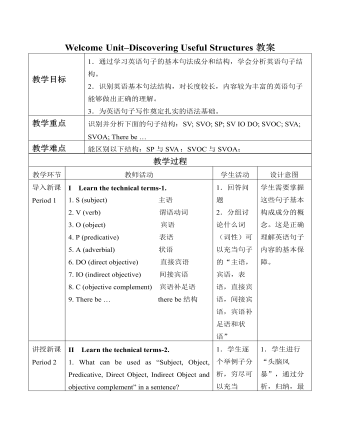
II Learn the technical terms-2.1. What can be used as “Subject, Object, Predicative, Direct Object, Indirect Object and objective complement” in a sentence?2. What can be used as “adverbial” in a sentence?3. What can be used as “verb” in a sentence?Answers to questions 1-3:1. Nouns, pronouns and appellations can be used as “Subject, Object, Predicative, Direct Object, Indirect Object and Objective Complement”. Besides, adjectives can be used as “Predicative and Objective Complement” in a sentence.2. Adverbs and prepositional phrases can be used as “Adverbial”.3. Verbs with actual meaning can be used as “Verb” in a sentence. Auxiliary verbs alone cannot be used as “Verb” in a sentence.III Learn to recognize the sentence structures.1. SV structure. For Example:(1) A bird flies.S V(2) A monkey jumps.S V(3) A fish swims.S V√ In SV structures, verbs are “intransitive verbs”.2. SVO structure. For Example:(1) A sheep eats grass.S V O(2) They like bananas.S V O(3) He wants candy.S V O√ In SVO structures, verbs are “transitive verbs”.3. SP structure. For Example:(1) This is great.S P (2) He looks well.S P (3) She became a teacher.S P √ In SP structures, Predicatives are formed by “link verbs” and “adjectives or nouns”.√ link verbs: be, become, grow, look, feel, taste, etc.4. SV IO DO structure. For Example:(1) He asked me a question.S V IO DO(2) Danny wrote me a letter.S V IO DO(3) Billy brought Sam a kite.S V IO DO√ In SV IO DO structures, the verbs are transitive and are followed by two objectives – pronouns or nouns as Indirect Objective, and nouns as Direct Objectives.
新人教版高中英语必修1Unit 5 Languages Around the World-Reading and Thinking教案
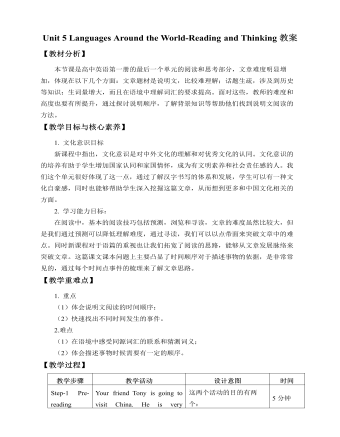
【教材分析】本节课是高中英语第一册的最后一个单元的阅读和思考部分,文章难度明显增加,体现在以下几个方面:文章题材是说明文,比较难理解;话题生疏,涉及到历史等知识;生词量增大,而且在语境中理解词汇的要求提高。面对这些,教师的难度和高度也要有所提升,通过探讨说明顺序,了解背景知识等帮助他们找到说明文阅读的方法。【教学目标与核心素养】1. 文化意识目标新课程中指出,文化意识是对中外文化的理解和对优秀文化的认同。文化意识的的培养有助于学生增加国家认同和家国情怀,成为有文明素养和社会责任感的人。我们这个单元很好体现了这一点,通过了解汉字书写的体系和发展,学生可以有一种文化自豪感,同时也能够帮助学生深入挖掘这篇文章,从而想到更多和中国文化相关的方面。2. 学习能力目标
新人教版高中英语必修1Welcome Unit-Reading and Thinking教案
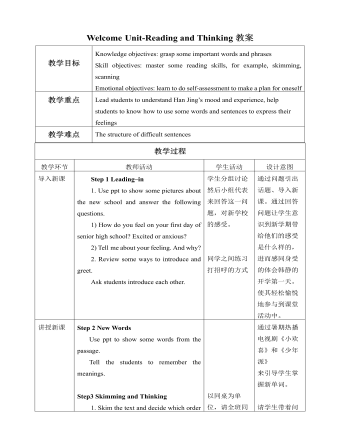
Step 2 New WordsUse ppt to show some words from the passage.Tell the students to remember the meanings.Step3 Skimming and Thinking1. Skim the text and decide which order Han Jing follows to talk about her first day. Time order or place order?Time order2. What is Han Jing worried about before she goes to senior high school?She is worried about whether she will make new friends and if no one talks to her, what she should do.Step 4 Fast Reading1. Match the main ideas with each paragraphParagraph 1:The worries about the new school day Paragraph 2Han Jing’s first maths classParagraph 3Han Jing’s first chemistry classParagraph 4Han Jing’s feelings about her first senior school dayStep 5 Careful Reading1. Fill in the chart with the words and phrases about Han Jing’s day. Answers: Senior high school, a little nervous; Her first maths class, classmates and teachers, friendly and helpful; Chemistry lab; new; great; annoying guy; Confident; a lot to explore2. Read the text again and discuss the questions.1) Why did Han Jing feel anxious before school?Because she was a new senior high student and she was not outgoing. What was more, she was worried about whether she can make friends.2) How was her first maths class?It was difficult but the teacher was kind and friendly. 3) What happened in the chemistry class? What would you do if this happened to you? A guy next to Han Jing tried to talk with her and she couldn’t concentrate on the experiment.
新人教版高中英语必修2Unit 1 Cultural Heritage-Discovering Useful Structure教案一
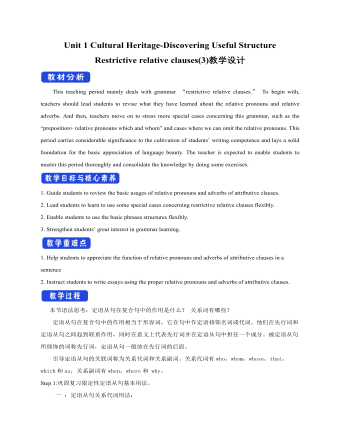
This teaching period mainly deals with grammar “restrictive relative clauses.” To begin with, teachers should lead students to revise what they have learned about the relative pronouns and relative adverbs. And then, teachers move on to stress more special cases concerning this grammar, such as the “preposition+ relative pronouns which and whom” and cases where we can omit the relative pronouns. This period carries considerable significance to the cultivation of students’ writing competence and lays a solid foundation for the basic appreciation of language beauty. The teacher is expected to enable students to master this period thoroughly and consolidate the knowledge by doing some exercises. 1. Guide students to review the basic usages of relative pronouns and adverbs of attributive clauses.2. Lead students to learn to use some special cases concerning restrictive relative clauses flexibly.2. Enable students to use the basic phrases structures flexibly.3. Strengthen students’ great interest in grammar learning.1. Help students to appreciate the function of relative pronouns and adverbs of attributive clauses in a sentence2. Instruct students to write essays using the proper relative pronouns and adverbs of attributive clauses.本节语法思考:定语从句在复合句中的作用是什么? 关系词有哪些?定语从句在复合句中的作用相当于形容词,它在句中作定语修饰名词或代词。他们在先行词和定语从句之间起到联系作用,同时在意义上代表先行词并在定语从句中担任一个成分。被定语从句所修饰的词称先行词,定语从句一般放在先行词的后面。
新人教版高中英语必修2Unit 1 Cultural Heritage-Reading and Thinking教案一
The theme of the reading and thinking is about “Understanding how a problem was solved”.The Listening & Speaking & Talking is about international co-work to protect the Mount Tai, in which the students from seven countries came up with many solutions even create the Mount Tai App. This section aims at showing how to solve a difficult and even tough problem about protecting the cultural heritage by the international co-work. So in this section, cultivating students’ international awareness is very clear and important. Concretely, with the economic development, how to balance the protection of cultural relics and social development is a big challenge for human. In the 1950s, the Egyptian government wanted to build the Aswan Dam across the Nile to control floods, produce electricity and water farms. But the proposal led to protests because it would destroy a lot of cultural relics. The Egyptian had no choice but ask the UN for help. Therefore, a international cooperation about how to protect the cultural relics began, which involved the time length about 20 years and a large amount of fund. Then, the problems was solved. 1. Read quickly to get the main idea and the structure of the article; read careful to get detailed information.2. Learn to use the reading strategy---making a timeline3. Learn how to solve a tough problem by asking for help and cooperation4. Have the international awareness and understand the great strength of international cooperation.1. Read quickly to get the main idea and the structure of the article; read careful to get detailed information.2. Learn to use the reading strategy---making a timeline.3. Learn how to solve a tough problem by asking for help and cooperation.
新人教版高中英语必修2Unit 2 Wildlife Protection-Listening and Speaking教案
This lesson is about wildlife protection. The listening and speaking is about “How to protect endangered wildlife ?” Faced with the facts and numbers of wildlife loss, people begin to detect the reasons, then people such as the celebrities (Prince William and Yao Ming) are calling on to protect them. So students are guided to enhance the awareness of protecting wildlife and try to take part in some volunteer activities of protecting wildlife.1. Predict the content by using visuals. 2. Learn to use the sentences such as “I’m concerned about.... But now they are in danger. I want to know the reasons/why./ What can we do to protect them ?3. Learn from the stars like Prince William and Yao Ming and enhance the awareness of protecting wildlife.4. Guide students to try to put forward the solutions to the problems of wildlife protection and then discuss them with partners and present the results of discussion.5. Master the pronunciation of stressed syllables.1. Learn from the stars like Prince William and Yao Ming and enhance the awareness of protecting wildlife.2. Guide students to try to put forward the solutions to the problems of wildlife protection and then discuss them with partners and present the results of discussion.3. Learn to use the sentences such as “I’m concerned about.... But now they are in danger. I want to know the reasons/why./ What can we do to protect them ?4. Master the pronunciation of stressed syllables.Part A Listening and Speaking--- How to save endangered wildlifeStep 1 Lead in1. Point at the pictures on P14 and ask Q1: What message do these posters share?
新人教版高中英语必修2Unit 2 Wildlife Protection-Reading and Thinking教案二
The theme of this unit is human and nature, focusing on the theme of wildlife protection. Nature is a complex ecosystem, in which there are delicate balance between animals and plants. Because of the role of the food chain, the extinction of one species will produce influence, causing a series of chain reaction. Large scale extinction of species will have a serious and even irreversible impact on the ecosystem, resulting in immeasurable losses. Therefore, it is of great significance to protect wild species. To protect wild species is to protect human beings themselves. The motto of this unit is "when the buying stops, the killing can too,” which is a public service advertising slogan to protect wildlife. It tells people that every rhinoceros horn, every fur, every bowl of shark fin soup, every Ivory product, and every tiger bone product, etc. consumed by human beings, are innocent wild animals slaughtered behind them. The mission of wild aid is to ban illegal trade in endangered wildlife and mitigate climate change. It aims to educate the public to reduce the consumption demand for endangered wildlife products through public publicity and improve the awareness of environmental protection.1. Improve the awareness of wildlife protection by acquiring the knowledge of wildlife protection.2. Focus on environmental protection and protection of all lives.3. Analysis of the living environment of wild animals with appropriate thinking mode.4. Skillfully use the vocabulary and grammar knowledge of this unit to cultivate self-study ability according to the unit content5. Develop cooperative learning ability through discussion and other ways1. Enable the Ss to talk about the current situation of wild animals.2. Guide the Ss to summarize the main idea of each paragraph as well as the main idea of the text.
新人教版高中英语必修2Unit 4 History and Traditions-Listening&Speaking&Talking教案一
This unit is about history and traditions. From the opening page, we can know that this unit will introduce the history and traditions around the world. As Marcus Garvey says “A people without the knowledge of their past history, origin and culture is like a tree without roots”, it is important for students to realize the importance and value of knowing the history and traditions and their further meanings. And this part ( listening and speaking ) is divided into two parts: Part A---share views on historic sites, Part B ---talk about a visit to a historic tourist destination. By talking with a foreigner, the speakers introduce the historic attractions and their cultures. Part A is that William, a British student, who was going to visit the Confucius Temple and a Chinese student, Xiao Kong, who was going to the Confucius Temple to meet with the members of the research group, went together and exchanged their views on the Confucius Temple, Confucius, Confucius' descendants and Confucius' educational thoughts. Part B is a conversation between Xiao Yan, a youth hostel receptionist and Paul, a backpacker about the feelings and experience after visiting the Chinese famous tourist attraction Pingyao.1. Guide students to understand the content of listening texts in terms of the whole and key details; 2. Cultivate students' ability to guess the meaning of words in listening; discuss with their peers how to talk about historic spots and great person.3. Instruct students to use functional sentences of showing one’s excitement, surprise and disappointment.1. Guide students to understand the content of listening texts in terms of the whole and key details; 2. Cultivate students' ability to discuss with their peers the related topics.3. Enable students to use the functional items of showing one’s excitement, surprise and disappointment.