-
人教版高中语文必修2《囚绿记》教案2篇
教学设想:本节课的主题是“生命之绿,璞玉心灵”,用圈点批注法解读爱绿的感情,让学生在批注中明确“绿”的象征意义,而不只是结论的传递。同时借助于阅读、感受和理解把握作者对绿的认识是不断升华的,由一般对生命希望之绿的喜爱,到与绿交往后被它的不畏强暴,永远向阳的精神所折服,最后在特定的时代背景下绿在作者的心目中已经成了我们民族不屈精神的象征。让学生评中求解,评中悟情,评中明理,评中品味。教学进程:一、导语上节课我们学习了朱自清的《绿》,初步了解了读书动笔的基本方法,这节课我们继续用圈点批注的方法来学习陆蠡的散文《囚绿记》。二、释题师:看标题,囚绿之“绿”在文中具体指什么?(一株常春藤)“囚”就是囚禁的意思,那题目就是记述囚禁绿色常春藤的经过。三、圈点、把握情节作者为什么要囚绿呢?文中除了写“囚绿”之外,还写了哪些有关绿的意念和行动?带着这样的质疑用自己喜欢的方式朗读课文,请同学们圈点出疑难字词,或结合书下注释,或同学合作解决,解决不了的,可提出来我们共同解决。标注段落节次。勾画出表现作者对绿意念和行动的句子。
人教版高中语文必修2《短歌行》教案2篇
教学过程:一、导语毛泽东在《沁园春雪》俯视封建君王“惜秦皇汉武。。。只识弯弓射大雕。”但如果历史上只有一个人可以与他相提并论,这个人只能是魏武帝曹操。“滚滚长江东逝水,浪花淘尽英雄。是非成败转头空,青山依旧在,几度夕阳红。”(《三国演义》卷首词)在历史的大浪淘沙中,有多少英雄能够经得起历史的千淘万漉而流芳百世呢?曹操应该是三国时代留下了浓重一笔的人物。老师总结,并启发他们去联系:我们学过他的《观沧海》“东临碣石,以观沧海…”还有《龟虽寿》“神龟虽寿,猷有竟时。老骥伏枥,志在千里;烈士暮年,壮心不已。”《青梅煮洒论英雄》中曾和他见过,《三国演义》电视剧播出后,大家和他也就频频见面了。《三国演义》第48回“宴长江曹操赋诗”中,赤壁之战前夕,曹操和众部将一起狂饮,他四顾空阔,心中大喜,与诸将讲述自己希望收服江南的雄心壮志。
人教版高中语文必修4《李贺小传》教案
一、明确目标1.注意小传的写作特色,如小传的“小”以及是怎样小中见大的。2.引导学生进行综合把握和比较阅读以更好地理解课文内容,看看在写法上各自有什么不同。3.一词多义的准确知识运用二、整体感知1.解题李商隐的《李贺小传》有别于一般传记文的客观直叙,是一篇性情之文;同时也和作者的诗歌风格相异,写得朴实自然而又不乏意趣。2.本文所体现的“小传”的特点本文最大的特点在于:小传虽小,但小中有大、以小见大。其“小”在于:作者并没有全面勾勒诗人李贺的一生,对他的生平经历也记叙不多,而是选取了他生活中的若干小片段进行插叙,以小片段撑起传记的主干。此外,在篇幅上,全文寥寥数百字,语言极为精练。而其“大”又体现在:极小极短的篇幅却具有很大的容量,集叙事、议论和曲折的抒情于一体。内容浑厚,意味深长。
人教版高中语文必修4《廉颇蔺相如列传》教案
(2)个性化的对话描写。在三个事件的描述中,大段对话占了很大篇幅,有的情节干脆由对话来表达,许多对话形象地表现了人物的思想和性格,使我们如闻其声,如见其人。先说蔺相如,他在秦廷上的慷慨陈词,有时语气平和,谦恭有礼,使对方放松警惕;有时直言斥责,有理有据,雄辩折人;有时坚决表态,分析利害,暗示对方;有时怒不可遏,咄咄逼人。总之,词锋犀利,刚柔兼施,而又轻重恰当,充分表现了他是一个热爱祖国、不畏强暴、有智有勇,长于辞令的外交家。再说廉颇,在将相交欢事件中,他先前说的这一番话,表现了他的自高自大和心胸狭窄,非常符合武将廉颇的性格特点,后来写他知过改过,负荆请罪时说:“鄙贱之人,不知将军宽之至此也!”语言不多,坦诚直率,可敬可爱。(解说:对话描写的分析,宜以学生为主,教师必要时适当点拨。)
人教版高中语文必修5《陈情表》教案
【教学目标】1.熟读全文,掌握文中出现的重要的实词、虚词、古汉语句式;2.鉴赏本文融情于事的表达和形象精粹的语言;3.深入体会文章凄切婉转的陈情技巧。【教学重点】重要的古汉语语词知识【教学难点】理解作者当时的处境和李密祖孙间真挚深厚的感情【教学方法】作为教读课,选择串讲的方式,突出朗读,以期能做到既落实知识,又能体会文章之美。课时安排为两课时。要重点做好预习工作。【教学步骤】一、以苏轼的评论导入读《出师表》不下泪者,其人必不忠;读《陈情表》不下泪者,其人必不孝;读《祭十二郎文》不下泪者,其人必不友二、预习检测1、下列红色字注音完全正确的一项()A、臣以险衅(xìn)夙遭闵(mǐn)凶终鲜(xiǎn)兄弟常在床蓐(rù)B、猥(wěi)以微贱责臣逋(bǔ)慢犹蒙衿(jīn)育宠命优渥(wò)C、岂敢盘桓(huán)有所希冀(yì)日薄(bó)西山除臣洗(xiǎn)马D、逮(dǎi)奉圣朝过蒙拔擢(zhuó)门衰祚(zuò)薄更(gēng)相为命分析:B责臣逋(bū)慢,C有所希冀(jì),D逮(dài)奉圣朝。
人教版高中语文必修4《苏武传》教案
二、课堂教学:1、学生简介背景:教师掌握:汉武帝开始对匈奴进行长期的讨伐战争,其中取得了三次具有决定意义的胜利,时间为公元前127年、前121年、前119年。匈奴的威势大大削弱之后,表示愿意与汉讲和,但双方矛盾还是根深蒂固。所以,到公元前100年,苏武出使匈奴时,却被扣留,并迫使他投降。《苏武传》集中叙写了苏武出使匈奴被扣留期间的事迹,热烈颂扬了他在敌人面前富贵不能淫,贫贱不能移,威武不能屈,饥寒压不倒,私情无所动的浩然正气,充分肯定了他坚毅忠贞,大义凛然,视死如归的民族气节。2、作者介绍:班固(32——92年),字孟坚,扶风安陵(今陕西咸阳市东)人。东汉著名的史学家。《后汉书·班固传》称他“年九岁,能属文,诵诗赋。及长,遂博贯载籍,九流百家之言,无不穷究。所学无常师,不为章句,举大义而已”。其父班彪曾续司马迁《史记》作《史记后传》,未成而故。
新人教版高中英语必修1Unit 1 Teenage Life-Discovering Useful Structure教案
(形容词短语most beautiful的构成形式为:副词+形容词,该短语在句中作定语修饰名词bird)④A good friend is someone who makes you really happy.好朋友就是能让你真正高兴的人。(形容词短语really happy的构成形式为:副词+形容词,该短语在句中作宾语补足语)[即学即练]画出下例句中的形容词短语并指明构成形式如:It is less cold today than it was yesterday.构成形式: 副词+形容词(1)Our country is becoming more and more beautiful.(2)The road is long enough.(3)The medicine is good for stomach.三、副词短语(Adverb Phrases)副词短语:指以一个副词为中心构成的短语,在句中的功能相当于副词,可以修饰动词、形容词或副词。常见副词短语的构成形式有:(副词)+副词如: much more beautifully①He did his work here yesterday.他昨天在这里工作。(副词短语here yesterday修饰动词did)②Bill did the work very well.比尔做的这份工作很好。副词短语very well修饰动词did③We are all entirely responsible for our action(副词短语all entirely, 修饰形容词短语responsible for)
新人教版高中英语必修1Unit 1 Teenage Life-Reading and Thinking教案
【教材分析】The topic of this unit is about teenage life, which belongs to the theme context of “humans and oneself”.As teenagers who shoulder the responsibility of “Chinese great dream”, they must fully know themselves, including their strengths, weaknesses and challenges etc. They are supposed to improve themselves continuously and readily study their subjects, and thus foster their strategies and confidence in lifelong studies.This period is entitled the freshmen challenges, which mainly concerns some big challenges for new students in Senior high school. In this period, a teacher should lead students to find out what their challenges are and guide them to figure out how to crack the challenges and better themselves. More importantly, a teacher should instruct students to absorb new language points and appreciate the language. Besides, a teacher must instruct students to acquire some skills concerning reading efficiently and inspire them to talk more about their new school life, especially their new problems and solutions both at school and in life.【教学目标与核心素养】1. Enable students to acquire the basic usage of the new words and expressions concerning the freshmen challenges and learn to use them flexibly.2. Enable students to have a good understanding of the freshmen challenges in the new senior high school which is quite different from junior middle school.3. Develop students’ sense of cooperative learning and individual thinking capability. 4. Develop students’ different learning skills to solve different reading comprehensive problems.
新人教版高中英语必修1Unit 1 Teenage Life-Reading for Writing教案
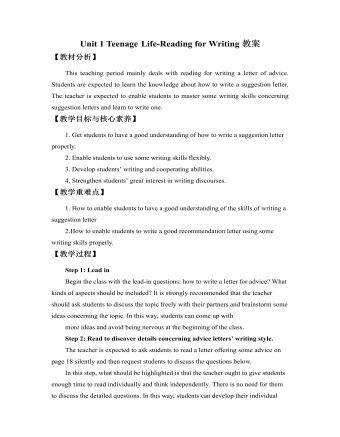
【教材分析】This teaching period mainly deals with reading for writing a letter of advice. Students are expected to learn the knowledge about how to write a suggestion letter. The teacher is expected to enable students to master some writing skills concerning suggestion letters and learn to write one.【教学目标与核心素养】1. Get students to have a good understanding of how to write a suggestion letter properly.2. Enable students to use some writing skills flexibly.3. Develop students’ writing and cooperating abilities.4. Strengthen students’ great interest in writing discourses.【教学重难点】1. How to enable students to have a good understanding of the skills of writing a suggestion letter2.How to enable students to write a good recommendation letter using some writing skills properly.【教学过程】Step 1: Lead in Begin the class with the lead-in questions: how to write a letter for advice? What kinds of aspects should be included? It is strongly recommended that the teacher should ask students to discuss the topic freely with their partners and brainstorm some ideas concerning the topic. In this way, students can come up with more ideas and avoid being nervous at the beginning of the class.Step 2: Read to discover details concerning advice letters’ writing style.The teacher is expected to ask students to read a letter offering some advice on page 18 silently and then request students to discuss the questions below.
新人教版高中英语必修1Unit 2 Travelling Around-Discovering Useful Structure教案
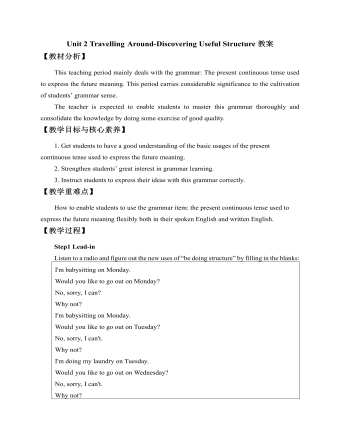
(5)be to do (可以和具体的时间状语连用)①表示按计划、安排即将发生的动作。②用于时间、条件状语从句中,表示“如果要……,想要……”。The students are to meet at the school gate tomorrow. 明天学生们将在学校大门口集会。 If you are to succeed, you must work as hard as possible. 如果你想要成功,比必须努力工作。(6)be about to do (不与具体的时间状语连用) 表示即将要发生的动作。We are about to start. 我们就要出发了。The new school year is about to begin. 新学年开学在即。(7)一般现在时表将来①表示按时间表规定将要发生的动作。常限于表示位置移动的短暂性动词。②在时间、条件或让步状语从句中,用一般现在时表将来。Look at the timetable. Hurry up! Flight 4026 takes off at 18:20. 你看看时刻表,快点!4026次航班的起飞时间是下午6点20分。Jane is in a hurry because the train to the airport leaves in half an hour. 简很匆忙,因为去机场的火车半小时后出发。
新人教版高中英语必修1Unit 2 Travelling Around–Listening and Speaking教案
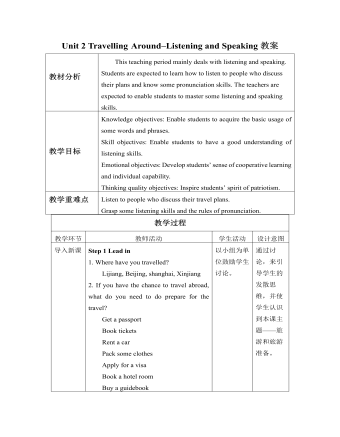
无论她说什么都不会对我们的安排有影响。Answers: for, arrangement3) Parents arrange everything for their children and spare no effort to pave the way for their success.父母为孩子安排好一切,不遗余力地为他们的成功铺路。4. extremely adv 极其,非常extreme adj 非常的1) Mary found it extremely difficult to get a job.2) I’m extremely sorry to have troubled you.Answers:玛丽发现找工作极其困难。给你添了麻烦,我十分抱歉。3) It had white-painted tunnels and bright red carriages, and proved _________ (extreme) popular with the public.它有白色的隧道和明亮的红色车厢,结果证明它非常受大众的欢迎。Answers: extremelyExercises1. I am continuing to apply_______ jobs though I have failed several times.2. All this had an _______ (extremely) bad effect on the criminal justice system.3. The invention would have wide ______ (apply) in industry.4. She’s happy with her unusual living _________ (arrange).5. I was banging so loudly that I’m ___________ (amaze) that they didn’t hear me.6. You haven’t changed at all you still look ___________ (exact) the same.7. “Was it what you expected?” “Yes, _________ (definite).”8. He was looking forward to______ (work) with the newPrime Minister. Answers: for extreme application arrangement amazed exactly definitely looking单句写作:1. _______________ (你要说些什么) when you get on the platform to accept the reward?2. Since_____________________(我们为这些事情做好了准备), we have nothing to worry about.
新人教版高中英语必修1Unit 2 Travelling Around-Reading and Thinking教案
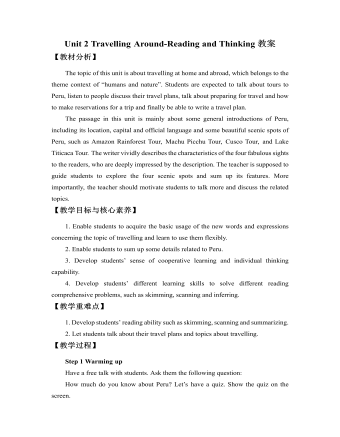
Good expressions that students can choose to use: help the travelers choose which tour to take1. In my opinion, you could/might choose…, because you prefer to…2. …could be a perfect choice for you, for…3. As far as I am concerned, you would enjoy…, for…4. …would probably suit you, because you enjoy/love/hate doing…Step 5 Passage ConsolidationLanguage appreciation:1. You can then spend three days exploring the rainforest with a local guide and enjoying the plants and animals unique to the rainforest. 在接下来的三天里,您可以在当地导游的陪同下,深入雨林进行探索,欣赏雨林特有的动植物。本句主体结构为spend some time doing sth. 2. Inca builders cut stones to exact sizes so that nothing was needed to hold walls together other than the perfect fit of the stones. 印加的建筑工人将石头切割成精确的尺寸,仅仅凭着石头间的完美契合,即可稳固墙体。本句为so that引导的结果状语从句。nothing与the perfect fit为并列成分; other than在句中意为“除了”。Step 6 HomeworkSuppose you will travel to Peru, write a short essay about your three-day tour plan.
新人教版高中英语必修1Unit 4 Natural Disasters- Reading for writing教案
①标题——标题应当简洁明了。②导语——导语是消息开头的第一段或第一句话,简明扼要地揭示出消息的核心内容。③主体——主体是消息的主要部分,要用充足的事实表现主题,对导语的内容作进一步的展开和阐述。④结束语——通常是对全文内容进行概括性的总结。3. 新闻报道增分句子(1)陈述事实常用的句型:①A terrible storm hit/struck ... , killing ..②It was a cool autumn night when the earthquake happened. A large number of buildings fell down and roads were destroyed, leaving a great many people homeless.地震发生在一个凉爽的秋夜。大量的建筑物倒塌,道路被毁,许多人无家可归。③With the help of the rescue team, people who were the trapped in the flood were saved.在救援队的帮助下,困在洪水中的人们得救了。(2)陈述观点常用的句型:①Clearly/Obviously/In my opinion/It seemed that people were shocked.显然/在我看来/似乎人们震惊了。②The whole city was in ruins after the earthquake.地震后整个城市成了一片废墟。(3)揭示原因常用的句型:Because of/As a result of/Thanks to the help of the army, people who got injured were sent to the hospital immediately.
新人教版高中英语必修1Unit 4 Natural Disasters-Listening and Speaking教案
【教材分析】高考听力材料的选用非常重视语言真实性和交际性的原则,语言材料一般来源于实际生活,对话的内容大都取材于日常生活,即衣、食、住、行、工作、学习、天气、生活环境等话题,可分为校园、公共场所、家庭等方面,如: shopping, finding the way, doing one’s homework, seeing a doctor, making a phone call, weather report, asking for different kinds of information等。新教材的特点就是利用生活中真实文本,只是降低难度,让学生注重语言的应用,将是我们高考把握方向的重要因素。【教学目标与核心素养】学习能力目标:在听力当中,学生应该有效规划学习方法,选择恰当的策略与方法。这节课的训练目标是让学生有正确的预测和抓住问题的关键信息,从而用心去听来找寻关键信息。根据生活中实际情况和高考常见语境,我们不难发现提前预测和抓住题干中的w很重要,即what, where, when, why等等。
新人教版高中英语必修1Unit 4 Natural Disasters-Reading & Thinking教案
5. Read to get detailed information about Paragraph 5.Q1. What shows the revival of Tangshan?Q2. How can Tangshan revive itself and get up on its feet again?Q3. In times of disasters, how can we go through it?T: In times of disasters, we should unify, show the wisdom and stay positive.Step 4 Activity 4 Highlighting the theme and reflecting1. Make a summary of the text.2. Further understand the titleQ: After our learning, why do you think the earth didn’t sleep on that night?T: An earthquake happened. The people in the earthquake suffered a lot, and the people outside Tangshan were concerned about the people there a lot.3. Reflect through discussion on what can be learnt after reading.T: Disasters are powerful. Unpreparedness can be deadly. Life is weak, but if people work together to help each other, disasters can be defeated.There is no love from disaster, but we have love in the human heart.Step 5 Assignment How does the writer convey that the earthquake was deadly, and that people were helpless during the earthquake? Try to find some attractive and impressive expressions and note them down.
新人教版高中英语必修1Welcome Unit-Discovering Useful Structures & Listening and Talking教案
常跟双宾语的动词有:(需借助to的)bring, ask, hand, offer, give, lend, send, show, teach, tell, write, pass, pay, promise, return等;基本句型 五S +V + O + OC(主+谓+宾+宾补)特点:动词虽然是及物动词,但是只跟一个宾语还不能表达完整的意思,必须加上一个补充成分来补足宾语,才能使意思完整。 判断原则:能表达成—宾语 是…/做…注:此结构由“主语+及物的谓语动词+宾语+宾语补足语”构成。宾语与宾语补足语之间有逻辑上的主谓关系或主表关系,若无宾语补足语,则句意不够完整。可以用做宾补的有:名词,形容词,副词,介词短语,动词不定式,分词等。如:He considers himself an expert on the subject.他认为自己是这门学科的专家。We must keep our classroom clean.我们必须保持教室清洁。I had my bike stolen.我的自行车被偷了。We invited him to come to our school.我们邀请他来我们学校。I beg you to keep secret what we talked here.我求你对这里所谈的话保密。用it做形式宾语,而将真正的宾语放到宾语补足语的后面,以使句子结构平衡,是英语常用的句型结构方式。即:主语+谓语+it+宾补+真正宾语。如:We think it a good idea to go climb the mountain this Sunday.
新人教版高中英语必修1Unit 5 Languages Around the World-Reading for Writing教案
Step 3: Read to sum upRead it again and sum up the problems of the three students, and then write down the advice that was given from others.Step 4: Work in pairs. List your learning problems in English and brainstorm some useful advice.Useful expressions ? I don't know how to…... Is a big difficulty for me. I cannot ...? You might try …. It's very important to…? I have no idea how/what .My biggest problem is .... ? I (also) have trouble with. My advice is …. This worked for me.? l cannot understand the teachers’ English in class.Step 5 Homework:为提高我校学生的英语口语水平,我们将举办英语演讲比赛(English- speaking contest),请你根据下面的信息,以学生会(the Students‘ Union)的名义写一份海报,欢迎全校同学参加,届时特邀本校美籍教师史密斯先生颁奖。? 报名时间 9月30日以前(报名:signup)? 报名地点 学生会办公室? 比赛时间 10月9日晚7:00~9:00? 比赛地点 学校大会议室? 奖励 前8名
新人教版高中英语必修1Welcome Unit-Reading for Writing教案
教学目标知识目标:让学生更好理解如何恰当地写一个人的信息介绍,并能让学生熟练地使用一些写作技能。能力目标:培养学生的写作能力和团队协作能力。情感目标:提升学生对写作的兴趣。教学重难点 教学重点:如何能让学生更好地理解个人信息介绍。教学难点:如何能让学生通过适当地使用一些写作技能来写一篇较好的个人信息介绍。教学准备 多媒体、黑板、粉笔一、Pre-class1. Greetings2. Leading-inAsk students how to write a profile. What kinds of aspects should be included? The teacher asks students to discuss the topic with each other and put forward to much more ideas about the answer.二、While-class1. The teacher lets students to read the student profiles on Page 8 silently and then asks students to discuss the questions below.1. What is Ann like? How do you know?2. What are Thando’s hobbies?3. Where does Thando come from?4. What is Thando’s dream?5. What does “You will never see me without a book or a pen” mean?
新人教版高中英语必修2Unit 1 Cultural Heritage-Discovering Useful Structure教案二
This theme of the part is “ Describe people or things in greater detail”. Students have learned the grammar(restrictive relative clauses) in Book 1, and further review and consolidate its structure “prep+relative pronouns(which/whom)” and the relative adverbs(when, where and why), besides students should understand its form, meaning and functions. In this section, students should be able to express the grammar correctly in daily communication and in the writing. 1. Review the basic usages of relative pronouns and adverbs of attributive clauses . 2. Learn to use some special cases about restrictive relative clauses.3. Learn to write sentences with restrictive relative clauses flexibly according to the context.1. Review the basic usages of relative pronouns and adverbs of attributive clauses .2. Learn to use some special cases about restrictive relative clauses.3. Learn tow rite sentences with restrictive relative clauses flexibly according to the context.Step 1. Observe the following sentences, and mark the relative pronouns and the adverbs. 1. After listening to the scientists who had studied the problems, and citizens who lived near the dam, the government turned to the United Nations for help.2. Temples and other cultural sites were taken down piece by piece, and then moved and put back together again in a place where they were safe from the water.Step 2 PracticePlease complete these sentences with relative pronouns and relative adverbs and answer the following questions.Questions: 1. What is the head noun ?2. What relative words should be used ?3. What elements do they act in these sentences ?
新人教版高中英语必修2Unit 1 Cultural Heritage-Listening&Speaking&Talking教案
Listening and Speaking introduces the topic of “Take part in a youth project”. The listening text is an interview about an international youth cultural heritage protection project. More than 20 high school students from seven countries participated in the project. The reporter interviewed two participants Stephanie and Liu Bin. By listening to the text, students can understand the significance of cultural heritage protection, and teenagers can use their knowledge, combine their own interests and advantages, etc. to participate in the action of cultural heritage protection. Listening and Talking introduces the theme of "Talk about history and culture". The listening text is a dialogue between two tourists and tour guides when they visit the Kremlin, red square and surrounding buildings. The dialogue focuses on the functional items of "starting a conversation", which is used to politely and appropriately attract the attention of the others, so as to smoothly start a conversation or start a new topic. The purpose of this section is to guide students to understand the history and current situation of Chinese and foreign cultural heritage in their own tourism experiences or from other people's tourism experiences, explore the historical and cultural values, and be able to express accurately and appropriately in oral communication.1. Guide students to understand the content of listening texts in terms of the whole and key details; 2. Cultivate students' ability to guess the meaning of words in listening; discuss with their peers how to participate in cultural heritage protection activities.3. Instruct students to use functional sentences of the dialogue such as “I beg your pardon, but…” “Forgive me for asking, but…" and so on to start the conversation more politely and appropriately.