-
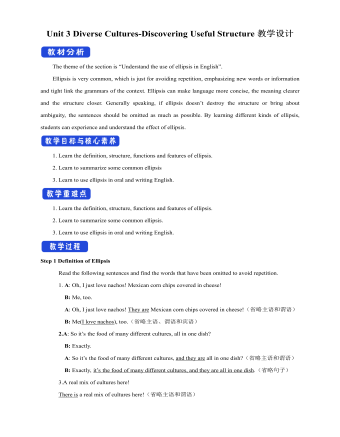
新人教版高中英语必修3Unit 3 Diverse Cultures-Discovering Useful Structure教学设计
Step 4 PracticeRead the conversation. Find out which words have been left out.Justin: Linlin, I’m going to Guizhou Province next month. I’m super excited! Any recommendations for places to visit?Linlin: Wow, cool! Guizhou is a province with a lot of cultural diversity. Places to visit...well, definitely the Huangguoshu Waterfall first.Justin: What’s special about the waterfall?Linlin: Well, have you ever heard of the Chinese novel Journey to the West ?Justin: Yes, I have. Why ?Linlin: In the back of the waterfall, you will find a cave, which is the home of the Monkey King.Justin: Really? Cool! I’ll definitely check it out.Linlin:And I strongly recommend the ethnic minority villages. You’ll find Chinese culture is much more diverse than you thought.Justin:Sounds great, thanks.Answers:Justin: Linlin, I’m going to Guizhou Province next month. I’m super excited! Do you have any recommendations for places to visit?Linlin: Wow, that’s cool! Guizhou is a province with a lot of cultural diversity. What are some places to visit in Guizhou ? Well, definitely the Huangguoshu Waterfall is the first place to visit in Guizhou Province.Justin: What’s special about the waterfall?Linlin: Well, have you ever heard of the Chinese novel Journey to the West ?Justin: Yes, I have heard of the Chinese novel Journey to the West . Why do you ask if I have heard of the Chinese novel Journey to the West?Linlin: In the back of the waterfall, you will find a cave, which is the home of the Monkey King from Journey to the West.Justin: That’s really true? It’s Cool! I’ll definitely check it out.Linlin:And I strongly recommend the ethnic minority villages on your trip to Guizhou Province. You’ll find Chinese culture is much more diverse than you thought it was.Justin:This all sounds great, thanks.
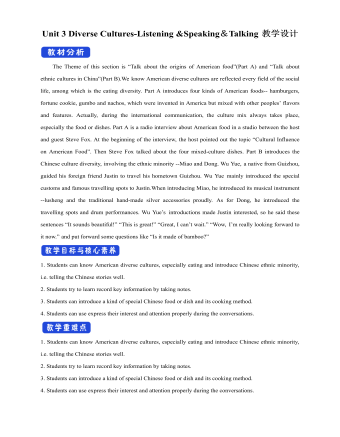
新人教版高中英语必修3Unit 3 Diverse Cultures-Listening &Speaking&Talking教学设计
1. In Picture 1 and Picture 2, where do you think they are from? How do you know?From their wearings, we can know they are from ethnic minority of China--- Miao and Dong.Picture 1, they are playing their traditional instrument lusheng in their traditional costumes.Picture 2. the girls are Miao because they wear their traditional costumes and silver accessory.2. In Picture 3, can you find which village it is? What time is it in the picture?It is Dong village. It is at night. Step 2 While-listeningJustin met a new friend while traveling in Guizhou. Listen to their conversation and complete the summaries below.Part 1Justin and Wu Yue watched some Miao people play the lusheng. The instrument has a history of over 3,000 years and it is even mentioned in the oldest collection of Chinese poetry. Then they watched the lusheng dance. Justin wanted to buy some hand-made silver/traditional accessories as souvenirs. He was told that the price will depend on the percentage of silver. Part 2They will go to a pretty Dong minority village called Zhaoxing. they will see the drum towers and the wind and rain bridges. They may also see a performance of the Grand Song of the Dong people.Step 3 Post-listening---TalkingWork in groups. Imagine Justin is telling some friends about his trip to Guizhou. One of you is Justin and the rest of you are his friends. Ask Justin questions about his trip and experience. The following expressions may help you.
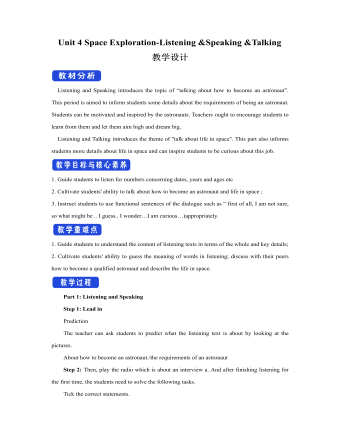
新人教版高中英语必修3Unit 4 Space Exploration-Listening&Speaking&Talking教学设计一
Listening and Speaking introduces the topic of “talking about how to become an astronaut”. This period is aimed to inform students some details about the requirements of being an astronaut. Students can be motivated and inspired by the astronauts. Teachers ought to encourage students to learn from them and let them aim high and dream big.Listening and Talking introduces the theme of "talk about life in space". This part also informs students more details about life in space and can inspire students to be curious about this job. 1. Guide students to listen for numbers concerning dates, years and ages etc2. Cultivate students' ability to talk about how to become an astronaut and life in space ; 3. Instruct students to use functional sentences of the dialogue such as “ first of all, I am not sure, so what might be .. I guess.. I wonder…I am curious…)appropriately.1. Guide students to understand the content of listening texts in terms of the whole and key details; 2. Cultivate students' ability to guess the meaning of words in listening; discuss with their peers how to become a qualified astronaut and describe the life in space.Part 1: Listening and SpeakingStep 1: Lead inPredictionThe teacher can ask students to predict what the listening text is about by looking at the pictures.About how to become an astronaut./the requirements of an astronautStep 2: Then, play the radio which is about an interview a. And after finishing listening for the first time, the students need to solve the following tasks.
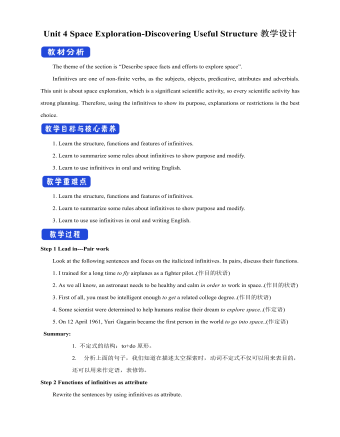
新人教版高中英语必修3Unit 4 Space Exploration-Discovering Useful Structure教学设计
The theme of the section is “Describe space facts and efforts to explore space”. Infinitives are one of non-finite verbs, as the subjects, objects, predicative, attributes and adverbials. This unit is about space exploration, which is a significant scientific activity, so every scientific activity has strong planning. Therefore, using the infinitives to show its purpose, explanations or restrictions is the best choice.1. Learn the structure, functions and features of infinitives.2. Learn to summarize some rules about infinitives to show purpose and modify.3. Learn to use infinitives in oral and writing English. 1. Learn the structure, functions and features of infinitives.2. Learn to summarize some rules about infinitives to show purpose and modify.3. Learn to use use infinitives in oral and writing English.Step 1 Lead in---Pair workLook at the following sentences and focus on the italicized infinitives. In pairs, discuss their functions. 1. I trained for a long time to fly airplanes as a fighter pilot..(作目的状语)2. As we all know, an astronaut needs to be healthy and calm in order to work in space..(作目的状语)3. First of all, you must be intelligent enough to get a related college degree..(作目的状语)4. Some scientist were determined to help humans realise their dream to explore space..(作定语)5. On 12 April 1961, Yuri Gagarin became the first person in the world to go into space..(作定语)Summary:1. 不定式的结构:to+do原形。2. 分析上面的句子,我们知道在描述太空探索时,动词不定式不仅可以用来表目的,还可以用来作定语,表修饰。
新人教版高中英语必修3Unit 4 Space Exploration-Reading and Thinking教学设计一
Q4: What is the function of the International exploration ?Having astronauts from different countries on boardQ5: What can you learn from Para 4 ?China has made great achievements in exploring spaceQ6: What is the attitude to the space exploration ?SupportiveStep 6 Post reading---RetellPeople have always wanted to learn more about space. Before the mid-20th century, most people felt (1)_________ (travel) into space was an impossible dream. However, (2)____ the help of scientists, peoplesucceeded in realizing their dream (3) _________ (explore) space. On 4 October 1957, the Sputnik 1 satellite (4) ____________(launch) by the USSR. (5) ________________ scientists try to make sure nothing goes wrong, accidents can still happen. These disasters made everyone(6)___________(disappoint), but people still believe in the importance of (7) ________(carry) on space exploration. In 2003, China became the third country to (8)_____________ (independent) send humans into space. Then Shenzhou 6 and 7 completed (9)____ second manned orbit and the first Chinese spacewalk. In spite of the difficulties, scientists hope future (10)__________ (discovery) will not only enable us to understand the universe but also help us survive well into the future.Answers: 1. travelling 2. with 3. to explore 4. was launched 5. Although6. disappointed 7. carrying 8. independently 9. a 10. discoveriesStep 6 Post reading---Critical thinkingQ1: What do you think of the space exploration ? I think it is beneficial to us. Through further study of space, people will make full use of it in the future, such as the space experiments by Wang Yaping in Tian Gong 1.Q2: If you are determined to be an astronaut, what should you prepare at present ?First of all, I should study hard to get a related college degree. Besides, I must keep mental and physical healthy.Step 7. HomeworkTry to summarize the structure of the article by a mind map.
新人教版高中英语必修3Unit 5 The Value of Money- Discovering Useful Structure教学设计
Step 3 Meaning1. 过去将来时表示从过去某一时间来看将要发生的动作或存在的状态, 常用在宾语从句中。一般由“would/should +动词原形”构成。She hoped that they would meet again someday. 她希望将来有一天他们能再见面。2. was/were going to+动词原形: 表示过去将要发生或很有可能发生的动作, 常用于口语中, 表示预言、意图或者打算等。He was going to start work the following week. 他打算下星期开始工作。3. was/were about to do: 常用来表示即将发生的动作, “刚要/正要做……”。注意该结构不与任何时间状语连用。I felt that something terrible was about to happen. 我感到某种可怕的事情即将发生。4.was/were to do: 表示“曾计划做某事”, 如果表示“本来计划做某事, 动作没实现”, 则需用 “was/were to have done”。She said she was to have told me about the accident. 她说她本来想告诉我关于事故的事。5.Start, go, come, leave, see, meet等动词的过去进行时: 表示就过去某一时刻而言即将发生的动作。She was coming later. 她随后就来。I had just put on my overcoat and was leaving to visit a friend of mine. 我刚穿上外套要去看我的一个朋友。
新人教版高中英语必修3Unit 5 The Value of Money-Listening &Speaking&Talking教学设计
4. A:We’d like to have someone to say a word at the beginning to welcome the group.B:↙Who?A:We thought that you or Dr.Johnson might do it.B用降调说Who,其意思是问,对方想让谁在开场时致欢迎词。Step 6 Pronunciation---Practice1. Listen to the short conversation and mark the intonation with ↗, ↙ or ↙, ↗. Then discuss with a partner what they intend to convey by using different intonation.Owner: You know what ?↗ It’s a million-pound bank note↙.Waiter 1: Really ?↗(question)Waiter 2: Really !↙(unbelievable and surprised)Waiter 3: Really ?!↙↗(first question then surprised)2. Listen to the conversations. Underline the parts that are stressed and mark the intonation. Then talk about the implied meanings of the responses with different intonations. Listen again and repeat.1) Henry: It’s a nice suit.Owner: Oh, it’s perfect!↙(The intonation means it is very suitable for Henry.)2) Henry: Well, that’s very kind of you.Owner: Kind, sir ?↗(what you said is not right) No, it’s kind of you. You must come whenever you want and have whatever you like. Just having you sit here is a great honour !!↙(welcome you to come again)3)Henry:Well, to be honest, I have none. Oliver:(happily) What luck!(excited) Brother↗, what luck!↙(It means “Didn’t you hear it?”)Henry: Well, it may seem lucky to you but not to me!↗(angry) If this is your idea of some kind of joke, I don’t think it’s very funny. Now if you’ll excuse me, I ought to be on my way.↙(If so, I would leave.)Roderick: Please don’t go↙...(hope Henry can wait for a moment)Part B Viewing and Talking---Describe people’s changing attitudes in a film clipStep 1 Before-listening---Tell the filmYou are going to watch part of the film The Million Pound Bank Note. Look at these photos and guess what happens in the film.
新人教版高中英语必修3Unit 5 The Value of Money-Listening &Speaking教学设计
Step 4: Listen again and decide if the following statements are true (T) or false (F).1 It was the first time Chen Liyan's story was reported. T口 F口2 Chen found 10,000 yuan in a small plastic bag in Taiyuan railway station口 F口3 Wang Zheng apologized to Chen because he couldn't offer her more money. T口 F口4 Chen took out a large loan to cure her daughter, T口 F口5 Wang set up a fundraising website for Chen's daughter after Chen told him about her situation. T口 F口Step 5:After listening, discuss the questions.1 What kind of person do you think Chen Liyan is?Chen Liyan is generous and honest because she returned a large sum of money to the owner.2 Did Chen return the money because she didn't need it?No. She returned the money because it was the right thing to do. Evidence for this is that she refused to accept the reward money because she felt that it had not been earned. 3 Is it common for people to do what Chen did?It depends on the culture. In some countries it is quite common to return money that has been found. In other countries, people believe "Finders are keepers!" 4 How did Wang Zheng feel about the return of his money?He must have been very happy and relieved to have gotten his money back. We know this because he thanked Chen repeatedly and even offered her a reward.5 Why did Ma Dongbao tell Wang about Chen's family?He must have had great sympathy for Chen and her daughter and wanted to help them.'We know this because he arranged help for them. 6 How did the news reporter feel about Chen's actions?The news reporter felt that it showed that money wasn't the most important thing in life. We know this because the reporter told us that this is what Chen believes. and then said, “that's a great attitude to take."
新人教版高中英语必修3Unit 5 The Value of Money-Reading and Thinking教学设计一
Everybody wants to get wealth.In today’s material world,making money or becoming wealthy symbolizes a person’s success and capability. Many people just make every effort, pay any price to attain greater wealth. With money,they can buy nice, large apartments in nice neighborhood. With money they can own luxurious cars. Wealth seems to bring all happiness in life.But is wealth the only road to happiness? Not really. There are many things in the world, which are beyond the means of money, such as friendship, love, health and knowledge. People are so preoccupied with struggling for money that they have no time or would not take the time to form or maintain friendship. What happiness can they feel living as lonely miserable creatures without love or friends in the world even if they accumulate tremendous wealth?In my opinion, people can’t do anything without money, but money is not everything. What money will bring you depends on your personal belief and goal in life. If you are kind enough to help others, especially the poor, money is a good thing to you. With it, you can do much more for the benefit of people and your country, and it will add to your own happiness. If you want money just for your own needs, you’ll never be satisfied or happy. In a word,you should have money spent for more people. Only then can money be the source of your happiness.Step 8 Homework4 students in a group, one acts Roderick, one Oliver, one servant and the fourth one acts Henry Adams, then listen to the tape, pay more attention to the difference between American English and British English in pronunciation, stress, tone.
人教版高中政治必修4第十二课实现人生的价值教案
有的学者还指出,要坚持集体主义还必须将集体主义的价值精神与社会主义市场经济的要求结合起来,批判地继承计划经济时代倡导的集体主义,合理地对其进行体系结构的调整和内容的更新,形成新的集体主义。与传统的集体主义相比,这种新的集体主义应具有如下两个主要特点。其一,强调集体的出发点是为了维护集体成员的正当个人利益。传统的集体主义具有片面强调集体至上性、绝对性的弊端;新的集体主义必须依据社会主义市场经济的现实要求,将集体应当对个人承担的义务加以科学的阐释。真正的集体应该维护各个集体成员的个人利益,实现组成集体的各个主体的自我价值。这种新型的集体主义是对社会主义市场经济条件下社会关系的真实反映,既与个人主义有本质区别,也不同于传统的集体主义。其二,要体现道德要求的先进性与广泛性的统一。
人教版高中政治必修4第二课百舸争流的思想教案
不可知论是否认人们认识世界或彻底改造世界的可能性的哲学学说。此概念首先由英国的赫胥黎(1825—1895)于1869年提出,不可知论的思想在古代就已产生,欧洲近代的主要代表是休谟和康德。其本质是把人的感觉看作是主观和客观之间的屏障而不是桥梁,不承认在感觉之外有确实可靠的客观外部世界的存在,不懂得认识过程中本质与现象、有限与无限的辩证关系。对不可知论最有力的驳斥是实践。有时不可知论一词也用以专指针对宗教教义而提出的一种学说,认为上帝是否存在、灵魂是否不朽是不可知的。2.二元论二元论是认为世界有两个本原的哲学学说,与一元论相对立,它把物质和意识绝对对立起来,认为物质和意识是两个各自独立、相互平行发展着的实体,谁也不产生谁,谁也不决定谁,都是世界的本原。它的观点是错误的:它肯定精神不依赖于物质而独立存在,这本身就是唯心主义的观点;它虽然承认物质是独立的本原,但在说明物质和精神的关系时,又把精神说成是唯一具有能动性的力量,必然倒向唯心主义。主要代表人物是法国的笛卡儿和德国的康德。
人教版高中政治必修4第二课百舸争流的思想精品教案
7、人总是按照自己对周围世界和人生的理解做事。有人认为命由天定,因而身处困境只是消极等待、逆来顺受;有人认为人定胜天,因而在困难面前积极奋争、不屈不挠。以上材料说明( )A哲学源于人们对实践的追问和对世界的思考B世界观决定方法论,方法论体现着世界观C哲学不等于自发的世界观D哲学是关于世界观的学说8、世界观和方法论的关系是()A世界观和方法论相互决定B方法论决定世界观,世界观体现方法论 C世界观决定方法论,方法论体现世界观 D世界观和方法论相互影响,相互决定9、下列关于哲学、世界观、具体知识之间联系的正确说法是()A哲学是关于世界观和具体知识的统一B哲学就是科学的世界观和具体知识C哲学是关于世界观的学说,是具体知识的概括和总结D哲学决定世界观,世界观决定具体知识10、下列对哲学的认识,不正确的是()A哲学是关于世界观的学说B哲学是世界观和方法论的统一C哲学是理论化、系统化、科学化的世界观D哲学是对具体知识的概括和总结
人教版高中地理必修1第二章第四节全球气候变化教案
气候变化对健康的影响 气候变化对人体健康的不良影响是不难发现的:热浪冲击频繁加重可致死亡率及某些疾病、特别是心脏呼吸系统疾病发病率增加;对气候变化敏感的传染性疾病如疟疾和登革热的传播范围可能增加。极端气候事件, 如干旱、水灾、暴风雨等, 使死亡率、伤残率及传染病疾病率上升, 并增加社会心理压力。某些媒介疾病的加重也可能与气候变化有间接的关系, 如疟疾是通过蚊子传播的疾病,气候变化可能使某些变暖地区的蚊子数目增加, 从而加重了疟疾的发生。我国1994年疟疾的发病率为5.3408/10万, 居全国法定传染病的第六位。血吸虫病的发展与高温及灌溉系统的扩增有关。我国1994年南方12省市血吸虫病患者的检出率高达3.67%,不能忽视气候变化对此的可能影响。还有一些疾病,如睡眠病、登革热、黑热病等也有与气候关系的报道。另外, CO2、一些空气污染物如氮氧化物、臭氧等可增加过敏疾患及心脏呼吸系统疾病和死亡。
人教版高中地理必修1第四章第二节山岳的形成教案
一、明确课标要求1.了解褶皱的概念和褶皱的基本形态;2.了解褶皱山的形成和褶皱山的基本形态特征;3.能够在不同的示意图中识别和判读背斜与向斜;4.知道和理解断层的概念和断块山的形成,了解断块山的基本形态特征;5.知道火山的形成、结构和规模。二、教学目标知识目标:1.结合具体图像,了解褶皱山的形成及基本形态特征。2.能在示意图上识别和判断背斜和向斜。3.理解内外力共同作用下形成的“背斜成谷,向斜成山”,并能够明白其形成的原因。4.能够结合实例,理解断块山的形成及基本特征。5.知道火山的形成、结构和规模。过程与方法目标:1.结合实例,分析造成地表形态变化的内力、外力因素。2.通过案例,尝试联系实际,培养动手演示、判读图像、比较、分析、归纳的能力。
人教版高中地理必修1第五章第二节自然地理环境的差异性教案
【补充说明】我们这节课简要地分析了陆地环境的三种地域分异规律。实际上,世界上的任何事物有其一般性,也有它的特 殊性。在地带性分异规律的基础上,陆地环境因为受到海陆分布、地形 起伏等因素的影响,也会出现一些不规律的现象,这种现象称为非地带性。例如,我们在初中地理中学过绿洲。还记得什么叫绿洲吗?再比如,在南美洲的西海岸(太平洋沿岸),有一条狭长的(热带)荒漠带,而缺少热带草原带,热带雨林带主要是分布在赤道以北地区。这主要是受大的地形起伏的影响。因为南美洲西部是一列高大的安第斯山脉,受其影响,两边的气候状况不同,所以就出现了分布规律不同的自然带,这也是一种非地带性现象。【总结】有规律分布的自然带构成了全球和谐的自然环境整体。自然带之间错综复杂的、微妙的要素关系,有许多是人类还没有认识到的。因此,人类不能随意去破坏任何哪怕是极微小的环节,也许它 带来的影响会是全球性的。保护全球环境,人人有责。
人教版高中地理必修3第二章第一节荒漠化的防治教案
1.根据下面的图文资料,说明前苏联垦荒区土壤风蚀的潜在自然背景。并说明人们的生产活动怎样加剧了这个过程。点拨:对图2.16的分析,要知道”垦荒地区”处于亚欧大 陆的中部偏北的地方,虽处于西风带但远离水汽来源,故降水稀少。从其周边的内陆湖“里海”、“咸海”的分布特点,可以推断,这是一个半荒漠向干草原的过渡地带,是一个生态环境比较脆弱的地区,其自然地理状况必定是寒冷、干旱、大风。2.20世纪60年代中期以来,前苏联在总结大规模垦荒经验教训的基础上,采取了一系列综合防护措施。仔细分析这些措施,你认为该地区防治荒漠化(土壤风蚀)的主要方向是什么?点拨:要善于将所列四项保护措施逐条进行分析,而后进行归纳,不难找出它们之间的共同的东西,那就是“抗旱、防风、保水、保土、保肥”。3.根据所学知识,你认为前苏联垦荒区防治荒漠化的对策与措施可以被我国的哪些地区所借鉴。
人教版高中地理必修3第四章第二节区域工业化与城市化教案
从右图“进出口贸易占全国的比重”可看出,珠三角地区的外向型经济特征很明显,但正在缓慢的发生转变;而长三角地区的外贸依存度在10年内迅速增长。由此可见,珠三角地区城市化过程,是伴随着该地特殊的经济发展相对自发地快速推进,缺乏宏观而理性的规划。阅读通过此阅读材料,使学生大致了解以下内容深圳作为珠江三角洲地区迅速城市化的一个典型代表,到目前为止,对其未来发展道路的构想,主要集中在:如何联合和依托临近区域、联合优势资源,扩大发展空间;如何明确功能,重新定位,合理分工,突出特色。活动长江三角洲地区城市的协调发展1.读图4.28,如果按人口规模>500万人、100万~500万人、50万~100万人、20万~50万人和<20万人将城市分为五级的话,分析长江三角洲地区城市的等级规模结构是否合理,这对其城市的协调发展有何影响?
人教版高中地理必修1第二章第三节常见的天气系统教案
一、知识和技能1.了解锋面系统、低压系统、高压系统的特点2.理解气旋与反气旋的形成过程、气流运动特点,掌握气旋、反气旋气流运动的规律性3.使学生掌握气旋和反气旋控制下的天气状况二、过程和方法1.掌握各天气系统活动规律和处在不同天气系统及其不同部位的天气特点,利用天气图进行天气形势分析预报2.能够说明这些天气系统是如何对所到达地区的天气产生影响的,能够结合当地情况分析学校所在地曾经发生的灾害性天气及其影响下的天气系统3.通过研究气旋和反气旋的形成过程,使学生初步具备研究问题的方法与步骤4.通过对冷锋与暖锋天气系统的对比分析来实现学生地理综合分析能力的提高。通过对锋面气旋的分析来建立地理空间思维的习惯三、情感、态度、价值观1.通过本节课学习,让学生懂得学科学、爱科学,献身气象事业,为“四化”建设服务
人教版高中地理必修1第一章第二节太阳对地球的影响教案
一、知识和技能1.使学生能够正确认识太阳的基本特征及其外部结构;2.了解太阳能量的来源,理解太阳是地球的主要能量源;3.了解太阳活动(主要是黑子和耀斑)对地球的影响。二、过程和方法1.能通过展示的图片理解太阳活动增强时会使地球无线电短波通讯受干扰及产生磁暴现象的原因。2.通过对各种资料的观察以及课前室外的观测,培养学生获取地理信息的能力和分析、判断、推理等逻辑思维能力三、情感、态度、价值观培养学生树立正确的人地观、科学的宇宙观,和热爱科学勇于探索的精神【教学重点】1.知道太阳辐射对地球的影响; 2.知道太阳活动对地球的影响;3.太阳的外部结构和能量来源【教学难点】太阳活动(黑子和耀斑)对地球的影响
人教版高中地理必修3第五章第二节产业转移教案
1.阅读图5.16,说明产业向国外转移对日本经济的不利影响。点拨:图5.16直观的显示了产业转移对日本经济的不利影响:形成“产业转移出去的多,转移进来的少→国内生产投资不足,生产困难→市场萎缩→产业向外转移,外资不愿进入”的恶性循环。2.尽管重化工业的环境污染比较严重,但是却能为工业化的发展提供坚实的基础,因此成为发达工业的象征。日本、韩国的经济发展都经历了由轻工业(劳动密集型)到重化工业(资源密集型和资金密集型)到高科技工业(技术密集型)的阶段。(1)为什么日本、韩国在重点发展重化工业之前,要先发展劳动密集型工业?点拨:重化工业的发展一方面需要有一定的工业基础和技术工人,另一方面需要投入大量的资金,先发展劳动密集型工业有利于利用劳动力资源丰富且廉价的优势,积累资金和造就产业工人。所以,劳动力丰富的发展中国家或地区的工业化往往从优先发展劳动密集型工业开始。