-
新人教版高中英语必修2Unit 1 Cultural Heritage-Discovering Useful Structure教案一
This teaching period mainly deals with grammar “restrictive relative clauses.” To begin with, teachers should lead students to revise what they have learned about the relative pronouns and relative adverbs. And then, teachers move on to stress more special cases concerning this grammar, such as the “preposition+ relative pronouns which and whom” and cases where we can omit the relative pronouns. This period carries considerable significance to the cultivation of students’ writing competence and lays a solid foundation for the basic appreciation of language beauty. The teacher is expected to enable students to master this period thoroughly and consolidate the knowledge by doing some exercises. 1. Guide students to review the basic usages of relative pronouns and adverbs of attributive clauses.2. Lead students to learn to use some special cases concerning restrictive relative clauses flexibly.2. Enable students to use the basic phrases structures flexibly.3. Strengthen students’ great interest in grammar learning.1. Help students to appreciate the function of relative pronouns and adverbs of attributive clauses in a sentence2. Instruct students to write essays using the proper relative pronouns and adverbs of attributive clauses.本节语法思考:定语从句在复合句中的作用是什么? 关系词有哪些?定语从句在复合句中的作用相当于形容词,它在句中作定语修饰名词或代词。他们在先行词和定语从句之间起到联系作用,同时在意义上代表先行词并在定语从句中担任一个成分。被定语从句所修饰的词称先行词,定语从句一般放在先行词的后面。
新人教版高中英语必修2Unit 1 Cultural Heritage-Listening&Speaking&Talking教案
Listening and Speaking introduces the topic of “Take part in a youth project”. The listening text is an interview about an international youth cultural heritage protection project. More than 20 high school students from seven countries participated in the project. The reporter interviewed two participants Stephanie and Liu Bin. By listening to the text, students can understand the significance of cultural heritage protection, and teenagers can use their knowledge, combine their own interests and advantages, etc. to participate in the action of cultural heritage protection. Listening and Talking introduces the theme of "Talk about history and culture". The listening text is a dialogue between two tourists and tour guides when they visit the Kremlin, red square and surrounding buildings. The dialogue focuses on the functional items of "starting a conversation", which is used to politely and appropriately attract the attention of the others, so as to smoothly start a conversation or start a new topic. The purpose of this section is to guide students to understand the history and current situation of Chinese and foreign cultural heritage in their own tourism experiences or from other people's tourism experiences, explore the historical and cultural values, and be able to express accurately and appropriately in oral communication.1. Guide students to understand the content of listening texts in terms of the whole and key details; 2. Cultivate students' ability to guess the meaning of words in listening; discuss with their peers how to participate in cultural heritage protection activities.3. Instruct students to use functional sentences of the dialogue such as “I beg your pardon, but…” “Forgive me for asking, but…" and so on to start the conversation more politely and appropriately.
新人教版高中英语必修2Unit 1 Cultural Heritage-Reading and Thinking教案二
1. This section focuses on "Understanding how a problem was solved”, which is aimed to guide students to analyze and discuss the challenges and problems faced by cultural heritage protection during the construction of Aswan Dam, as well as the solutions. On the basis of understanding, students should pay attention to the key role of international cooperation in solving problems, and attach importance to the balance and coordination between cultural heritage protection and social and economic development. Students are encouraged to face challenges actively, be good at cooperation, and make continuous efforts to find reasonable ways and means to solve problems.2. Enable students to understand the main information and text structure of the reading text;3. Motivate students to use the reading strategy "make a timeline" according to the appropriate text genre;4. Enable students to understand how a problem was solved;5. Enable students to understand the value of protecting cultural heritage by teamwork and global community;1. Guide students to pay attention to reading strategies, such as prediction, self-questioning and scanning.2. Help students sort out the topic language about protecting cultural relics and understand the narrative characteristics of "time-event" in illustrative style3. Lead students to understand the value of protecting cultural heritage by teamwork and global community;
新人教版高中英语必修2Unit 4 History and Traditions-Listening&Speaking&Talking教案一
This unit is about history and traditions. From the opening page, we can know that this unit will introduce the history and traditions around the world. As Marcus Garvey says “A people without the knowledge of their past history, origin and culture is like a tree without roots”, it is important for students to realize the importance and value of knowing the history and traditions and their further meanings. And this part ( listening and speaking ) is divided into two parts: Part A---share views on historic sites, Part B ---talk about a visit to a historic tourist destination. By talking with a foreigner, the speakers introduce the historic attractions and their cultures. Part A is that William, a British student, who was going to visit the Confucius Temple and a Chinese student, Xiao Kong, who was going to the Confucius Temple to meet with the members of the research group, went together and exchanged their views on the Confucius Temple, Confucius, Confucius' descendants and Confucius' educational thoughts. Part B is a conversation between Xiao Yan, a youth hostel receptionist and Paul, a backpacker about the feelings and experience after visiting the Chinese famous tourist attraction Pingyao.1. Guide students to understand the content of listening texts in terms of the whole and key details; 2. Cultivate students' ability to guess the meaning of words in listening; discuss with their peers how to talk about historic spots and great person.3. Instruct students to use functional sentences of showing one’s excitement, surprise and disappointment.1. Guide students to understand the content of listening texts in terms of the whole and key details; 2. Cultivate students' ability to discuss with their peers the related topics.3. Enable students to use the functional items of showing one’s excitement, surprise and disappointment.
新人教版高中英语必修2Unit 4 History and Traditions-Listening&Speaking&Talking教案二
Listening and Speaking introduces the topic of “Take part in a youth project”. The listening text is an interview about "sharing views on historical sites". Through listening to a dialogue between Chinese and foreign students on the way to the Confucius Temple, students can understand their views on the Confucius Temple, Confucius, Confucius' descendants and Confucius' educational thoughts, so as to realize and think about the profound influence of Confucius and his thoughts on Chinese historical tradition. At the same time, the dialogue naturally integrates English idioms and mentions Shakespeare, the British playwright, so as to provide language materials and context for students to understand English idioms and related cultural allusions, as well as to compare Chinese and foreign cultures, which is helpful for students to understand and express the language such as history, tradition, culture and custom significant impact.Text analysis: listening text is a dialogue between a British student and a Chinese student when he goes to the Confucius Temple. When William, a British student, visited the Confucius Temple, he asked Xiao Kong, a Chinese student, for directions. Xiao Kong was just going to the Confucius Temple to meet with the members of the research group, so they went together and exchanged their views on the Confucius Temple, Confucius, Confucius' descendants and Confucius' educational thoughts. From the perspective of foreign tourists, this paper describes their thoughts on Confucius, the great son of Confucius, who had a profound impact on Chinese history and cultural tradition, and his education.Listening and Talking introduces a visit to a historic tourist destination. Tourism is a common way to understand a country's history, culture, and customs and so on. Students listen to the dialogue between Xiao Yan, a youth hostel Usher, and Paul, a backpacker, to learn about Pingyao's famous historical and cultural attractions and Paul's travel experience and experience as a foreign tourist.
新人教版高中英语必修2Unit 4 History and traditions教案
这个地区有着深厚的传统。既学既练:为了让更多的外国游客了解中国文化,欣赏中国美丽的自然风光,感受中国发生的巨大变化,某外文杂志社将出版一本英语小册子来介绍中国的旅游景点。该杂志社邀请你为该小册子写一篇英语短文来介绍杭州,内容包括:1.杭州的位置(中国东南部)、面积(16 000多平方公里)及历史(2 200多年)等;2.杭州的旅游特色(自然风景、传统文化、特色小吃等);3.希望更多的游客来杭州参观。注意:1.词数80左右;2.可适当增加细节,以使行文连贯。Located in the southeast of China, Hangzhou is a beautiful city.Dating back more than 2,200 years, Hangzhou covers an area of more than 16,000 square kilometers.In Hangzhou, you can visit the West Lake, whose scenery is fascinating.In addition, you can’t miss its cultural relics and historical sites, from which you will learn more about excellent Chinese traditional culture and traditions.In Hangzhou, the special snacks are famous and visitors from different parts of the world think highly of them.As a tourist attraction, Hangzhou attracts a large number of visitors from home and abroad every year.Once you come to China, Hangzhou is a scenic spot you can’t miss.
新人教版高中英语必修2Unit 5 Music-Reading and Thinking教案二
1. Get basic information about Eric; read deeply to understand the history and development of the virtual choir.2. Understand what the function of the virtual choir is and how to make a virtual choir.3. Understand the meaning of some languages in the context of the text through question guidance, such as “Many people do not have close friends or contacts who have the same interest in music.” and so on.Step 1 Leading-in1. Answer the following questions.Q1:Do you know the Apps like Tik Tok and Quick Hand?Q2: Do you want to make a Tik Tok video or a Quick Hand video?2. Play a Tik Tok video Step 2: Understanding the title Q1:What does the title mean ?Q2: Is the article a narration or exposition? Why? Q3: Can you change the title ? If you can, what is the title?Step 3: Scanning the whole text and getting the basic information1. Answer the following questions.Q1:Who came up with the idea for a virtual choir?Q2: Where did Eric studied the musical composition?Q3: What is his song?2. Find the main idea of each paragraph3. Deal with some new words.Step 4: Reading carefully to get detailed informationPara 1 How to make a virtual choir1. PreparationA. tools: a virtual camera; an Internet connectionB. hero/heroin: friends or some individuals who have the same interests2. Process
新人教版高中英语必修2Unit 5 Music-Reading For Writing教案一
(4)Now we have heard a number of outstanding speeches ... 我们已经聆听了许多精彩的发言……(5)Because we wanted the nations of the world, working together, to deal with ... 因为我们希望全世界各国团结起来去应对……(6)And if we do not act ... 如果我们不采取行动……(7)Now, I share the concerns that have been expressed ... 我也同意对于……表达的担心(8)Let us show the world that by working together we can ... 让我们告诉全世界,通过一起努力我们可以……(9)It is now time for us to ... 是时候我们……(10)And I have always wished that ... 我一直希望……(11)Thank you for letting me share this day with me.感谢你们和我共度这一天。实践演练:假如你是高中生李华,你校将举办一次以“音乐”为主题的演讲比赛,请你按照主题,写下你的演讲稿。注意:词数100左右。First of all, thank you for listening to my speech. My topic is: love music like love yourself.Music is like the air we need to maintain our normal lives around us. You can't imagine how terrible a world without music would be. Movies and TV shows have no music, only dry conversations and scenes; mobile phones only vibrations; streets only noisy crowds; cafes, western restaurants only depressed meals. What a terrible world it is!As a student, I hope we all can enjoy the fun brought by music in our spare time. Instead of just listening to music, we can even make our own music. Let's enjoy the fun of music!Thanks again for your attention!
人教版高中历史必修2物质生活与习俗的变迁教案
★教学总结:(1)我国衣着服饰变化的三大阶段第一阶段(鸦片战争后到新中国的建立):这一阶段的阶段特征为中式与西式、传统和现代服饰并存男装:长袍马褂、西装、中山装 女装:旗袍(新式与旧式)第二阶段(新中国建立后到十一届三中全会):这一时期由于政治上的影响,阶段特征为衣着朴素,与革命相关的服饰成为主流男装:列宁装、中山装、绿军装女装:列宁装、布拉基、绿军装第三阶段(十一届三中全会后):阶段特征为与世界接轨,异彩纷呈;具体表现在,服饰由最基本的防寒保暖向美观大方转变,各种款式的服装层出不穷现在的服装是色彩鲜艳、款式多样,什么牛仔服、休闲服、西装、T恤衫、晚礼服,真是不胜枚举。每年服装的流行色、流行款式不断改变,大街上的姑娘和小伙子永远领导着时装新潮流。模特表演、模特广告和模特大赛已成为人们穿着方面不可缺少的内容。
人教版高中历史必修2发达的古代农业教案2篇
(四)概括古代中国农业经济的基本特点从历史地位、生产结构、基本特征、基本模式等几方面,小组讨论古代中国农业经济的特点,然后展示。1、历史地位:中国是独立发展、自成体系的世界农业起源中心之一。2、生产结构:种植业和家畜饲养业相结合,以种植业为主,家畜饲养业为辅。3、基本特征:农业生产精耕细作。 4、基本模式:一家一户的小农经济。知识拓展:当今中国农村人口膨胀,农民生活条件急需提高,如何处理好“三农”问题是中国社会走向和谐健康发展的重要课题,回顾中国古代农业的发展历程,结合农业发展的现状,谈谈你的看法和建议。展示:1.因地制宜,发挥各地特色优势2、精耕细作和现代科学相结合; 3.保护生态环境,坚持可持续发展;4.完善水利设施,政府重视。

人教版新课标高中物理必修2太阳与行星间的引力教案2篇
【学习内容分析】在行星运动规律与万有引力定律两节内容之间安排本节内容,是为了更突出发现万有引力定律的这个科学过程。如果说上一节内容是从运动学角度描述行星运动的话,那么,本节内容是从动力学角度来研究行星运动的,研究过程是依据已有规律进行的演绎推理过程。教科书在尊重历史事实的前提下,通过一些逻辑思维的铺垫,让学生以自己现有的知识基础身于历史的背景下,经历一次“发现”万有引力的过程,因此体验物理学研究问题的方法就成为主要的教学目标。【学情分析】在学太阳对行星的引力之前,学生已经对力、重力、向心力、加速度、重力加速度、向心加速度等概念有了较好的理解,并且掌握自由落体运动和圆周运动等运动规律,能熟练运用牛顿运动定律解决动力学问题。已经完全具备深入探究和学习万有引力定律的起点能力。所以在推导太阳与行星运动规律时,教师可以要求学生自主地运用原有的知识进行推导,并要求说明每一步推理的理论依据是什么,教师仅在难点问题上做适当的点拨。
人教版新课标高中物理必修2探究弹性势能的表达式教案2篇
“做功的过程就是能量转化过程”,这是本章教学中的一条主线。对于一种势能,就一定对应于相应的力做功。类比研究重力势能是从分析重力做功入手的,研究弹簧的弹性势能则应从弹簧的弹力做功入手。然而弹簧的弹力是一个变力,如何研究变力做功是本节的一个难点,也是重点。首先,要引导学生通过类比重力做功和重力势能的关系得出弹簧的弹力做功和弹簧的弹性势能的关系。其次,通过合理的猜想与假设得出弹簧的弹力做功与哪些物理量有关。最后,类比匀变速直线运动求位移的方法,进行知识迁移,利用微元法的思想得到弹簧弹力做功的表达式,逐步把微分和积分的思想渗透到学生的思维中。本节课通过游戏引入课题,通过生活中拉弓射箭、撑杆跳高和弹跳蛙等玩具以及各种弹簧等实例来创设情景,提出问题。给学生感性认识,引起学生的好奇心;让学生对弹簧弹力做功的影响因素进行猜想和假设,提出合理的推测,激发学生的探索心理,构思实验,为定性探究打下基础。然后,引导学生通过类比重力做功与重力势能的关系得出弹簧弹性势能与弹簧弹力做功的关系。
人教版新课标高中物理必修2行星的运动教案2篇
知识与技能1.知道地心说和日心说的基本内容.2.知道所有行星绕太阳运动的轨道都是椭圆,太阳处在椭圆的一个焦点上.3.知道所有行星的轨道的半长轴的三次方跟它的公转周期的二次方的比值都相等,且这个比值与行星的质量无关,但与太阳的质量有关.4.理解人们对行星运动的认识过程是漫长复杂的,真理是来之不易的.过程与方法通过托勒密、哥白尼、第谷·布拉赫、开普勒等几位科学家对行星运动的不同认识,了解人类认识事物本质的曲折性并加深对行星运动的理解.情感、态度与价值观1.澄清对天体运动裨秘、模糊的认识,掌握人类认识自然规律的科学方法.2.感悟科学是人类进步不竭的动力.教学重点理解和掌握开普勒行星运动定律,认识行星的运动.学好本节有利于对宇宙中行星的运动规律的认识,掌握人类认识自然规律的科学方法,并有利于对人造卫星的学习.
人教版高中历史必修2世界经济的区域集团化教案2篇
1、知识与能力:(1)了解欧洲联盟的形成过程,剖析欧洲国家的一体化由经济实体向政治实体转变的原因和实质;(2)了解北美自由贸易区的形成过程,由北美自由贸易区的形成原因分析世界经济全球化与经济区域集团化之间的关系和影响。(3)了解亚太经济合作组织的形成过程,明确其特点及出现此特点的原因。掌握中国在加入该组织后所发挥的作用,并由此引申出中国在经济区域集团化过程中所发挥的作用。2、过程与方法:(1)通过学生对三大经济区域集团形成过程和特点的比较,锻炼学生把具体的历史现象与整体的社会背景联系的能力,培养学生建立起全面的历史观。(2)通过对经济区域集团化趋势的出现和它与经济全球化之间关系的分析,培养学生辨证的看问题,透过现象分析本质的能力。
人教版高中历史必修2战后资本主义的新变化教案2篇
1、知识与能力:(1)识记:20 世纪 50 ~70 年代国家干预经济的政策、 70年代的经济“滞胀”“混合经济”;福利国家;第三产业的蓬勃发展;“新经济”的出现;(2)理解当代资本主义的新变化的实质是资本主义的自我扬弃,是在资本主义内部的自我改善,是资本主义生产关系的自我调整;(3)掌握以美国为代表的主要资本主义国家在战后的经济发展历程,分析各国经济发展的共同原因。2、过程与方法:(1)引导学生利用教材和相关史料,培养归纳、再现历史事件的能力,提高学生的历史思维能力;通过讨论提高学生的思辨能力,培养学生全面客观地分析问题的思维方式。(2)学生通过观察1977年发达国家国有经济比重表,懂得提取有效信息、分析数据的能力;(3)学生通过思考讨论西方福利制度的利弊,培养全面、客观分析和比较历史现象,辩证地观察和分析历史问题的能力。
人教版新课标高中物理必修2探究功与速度变化的关系教案2篇
说明:“倍增法”是一种重要的物理方法,历史上库仑在研究电荷间的相互作用力时曾用过此法,但学生在此前的物理学习中可能未曾遇到类似例子,因此引导学生通过交流,领会“倍增法”的妙处,这是本节课的一个要点.可用体育锻炼中的“拉力器”来类比。(2)该方案消除摩擦力影响的方法:所用的消除方法与实验方案2一样。也可使用气垫导轨代替木板,以更好地消除摩擦影响。(3)小车速度的确定方法:①确定打出来的点大致呈现什么规律:先密后疏(变加速),再均匀分布(匀速);②应研究小车在哪个时刻的速度:在橡皮筋刚恢复原长时小车的瞬时速度,即纸带上的点刚开始呈现均匀分布时的速度;③应如何取纸带上的点距以确定速度:由于实验器材和每次操作的分散性,尤其是橡皮筋不可能长度、粗细完全一致,使得每次改变橡皮筋的条数后,纸带上反映小车匀速运动的点数和点的位置,不一定都在事先的设定点(即用一条橡皮筋拉小车,橡皮筋刚好恢复原长时纸带上的点)处。
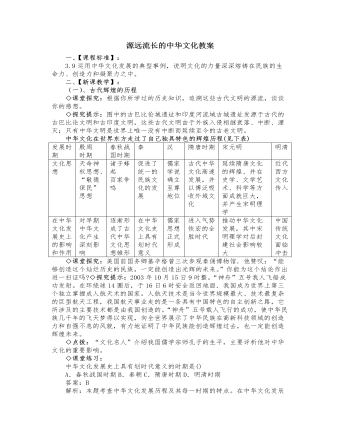
人教版高中政治必修3源远流长的中华文化精品教案
(一)知识目标(1)识记中华 文化源远流长的主要见证是文字和史学典籍 ,文字的作用、意义 ,史学典籍 ,中华文化的包容性。(2)说明中华文化源远流长的发展过程,是世界上唯一没有中断的文明 ,汉字与史学典籍是中华文化源远流长和见证,如何再创中华文化新的辉煌(3)分析说明中华文化源远流长,是当今世界上唯一没有中断的文明(二)能力目标通过学生课外探究、信息资源的收集整合,培养学生的信息素养、实践能力,激发学生的生活智慧与学习智慧、时代创新精神与团队合作精神。培养同学们综合思维能力,全面、辩证、历史地分析中华文化的基本特征。培养同学们辩证分析能力,辨析中华文化的区域特征,说明中华文化是中国各族人民共同创造的;展现源远流长的中华文化是中华民族延续和发展的重要标识。
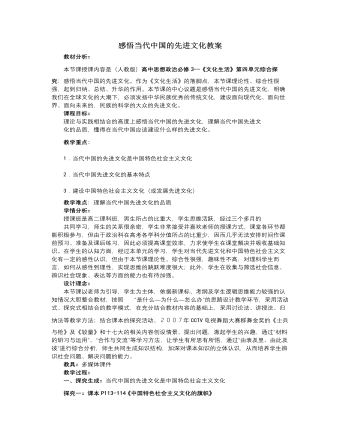
人教版高中政治必修3感悟当代中国的先进文化教案
3、探究四:课本P115《民族的科学的大众的号角》提出问题:为什么说中国特色社会主义文化是“民族的”、科学的”、“大众的”?老师引导,学生自主学习,共同合作归纳出:民族的:代表和维护中华民族的根本利益,渊源于中华民族五千多年文明,植根于中国社会主义现代化建设的实践是先进文化的立身之本。科学的:以马克思主义为指导,积极吸收了所有的科学的、进步思想的思想文化。大众的:植根于中国最广大人民群众的社会主义现代化建设的实践,体现和满足人民群众不同的层次的精神需求。4、通过视频舞蹈《较量》,创设情景(1.>只选了中国传统的哪类乐器?意图是什么?2、>与你刚才所看到的军人舞蹈有何区别,它最特殊的魅力在哪里?),点拔学生比较、分析,引入下一环节。5、温故知新:结合以上探究及视频,共同探讨:在当代中国,我们应该建设什么样的先进文化? 怎样建设中国特色社会主义文化?
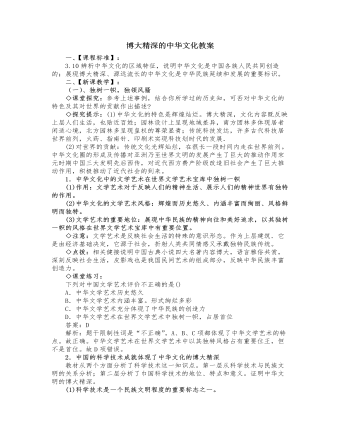
人教版高中政治必修3博大精深的中华文化教案
(2)蒙古族音乐的最典型的代表就是马头琴,代表曲目《马头琴》。维吾尔古典乐曲《十二木卡姆八十二部大曲》,是维吾尔民间音乐向套曲形式发展的重大成果,也是一部维吾尔民间音乐和舞蹈完美结合的艺术瑰宝,它包括古典叙咏歌曲、民间叙事组歌、舞蹈乐曲和器乐曲340多首,长期流传于南北疆各地。维吾尔族的古老乐器是弹布尔,主要曲目为《乌扎勒》。哈萨克族著名的《玛依拉)Ⅺ我的花儿》已成为国内乃至国际声乐坛上经常演唱的曲目。2.多民族文化对中华文化的意义此知识点教材从四个方面分析:第一,分析民族文化与中华文化关系;第二,分析了民族文化的地位;第兰,分析r民族文化之问的关系;第四,总结其意义。(1)中华民族是多民族的共同体,中华文化呈现多种民族文化的丰富色彩。中华各民族的文化,既有中华文化的共性,义有各自的民族特性。(2)地位。它们都足中华文化的瑰宝,都是中华民族的骄傲。(3)各民族文化的关系。各儿弟民族文化相互交融、相互促进,共同创造中华文化。
人教版高中政治必修3源远流长的中华文化教案
②在经济上:资本主义经济产生并发展,产生工业革命,开始冲击封建自然经济。③思想上:继文艺复兴后产生启蒙运动,人们的思想观念更加开放,动摇了封建统治的思想,冲击封建统治,人们的民族、民主意识增强。④在文化上:近代自然科学蓬勃发展,奠定近代自然科学的基础。⑤随着新航路的开辟,工业革命开展,西方国家展开殖民掠夺与,各大洲之间相对孤立状态被打破,世界日益成为一个相互影响、联系紧密的整体。(2)①清朝统治者极力提供程朱理学,残酷压抑进步思想.中国思想界“万马齐喑”,死气沉沉。②中国传统科技进入总结时期,现代科技水平落后,日益落在世界潮流后面;③人们封建落后意识浓厚.民族、民主意识薄弱。④以中因为中心的东亚文化圈浙渐稿失。⑤西学大量传入中田,西学东渐现象不断发晨,冲击中国传统思想文化。(3)①国家衰落使文化失去发展的政治、经济条件,加速了文化的衰落。国家衰落是文化衰落的决定性因素。②文化衰落是国家衰落的重要表现,反映了国家衰落.不利于国家发展。