-
新人教版高中英语必修3Unit 5 The Value of Money-Listening &Speaking教学设计
Step 4: Listen again and decide if the following statements are true (T) or false (F).1 It was the first time Chen Liyan's story was reported. T口 F口2 Chen found 10,000 yuan in a small plastic bag in Taiyuan railway station口 F口3 Wang Zheng apologized to Chen because he couldn't offer her more money. T口 F口4 Chen took out a large loan to cure her daughter, T口 F口5 Wang set up a fundraising website for Chen's daughter after Chen told him about her situation. T口 F口Step 5:After listening, discuss the questions.1 What kind of person do you think Chen Liyan is?Chen Liyan is generous and honest because she returned a large sum of money to the owner.2 Did Chen return the money because she didn't need it?No. She returned the money because it was the right thing to do. Evidence for this is that she refused to accept the reward money because she felt that it had not been earned. 3 Is it common for people to do what Chen did?It depends on the culture. In some countries it is quite common to return money that has been found. In other countries, people believe "Finders are keepers!" 4 How did Wang Zheng feel about the return of his money?He must have been very happy and relieved to have gotten his money back. We know this because he thanked Chen repeatedly and even offered her a reward.5 Why did Ma Dongbao tell Wang about Chen's family?He must have had great sympathy for Chen and her daughter and wanted to help them.'We know this because he arranged help for them. 6 How did the news reporter feel about Chen's actions?The news reporter felt that it showed that money wasn't the most important thing in life. We know this because the reporter told us that this is what Chen believes. and then said, “that's a great attitude to take."
新人教版高中英语必修3Unit 5 The value of money-Reading and Thinking教学设计二
? Could you offer me some kind of work here?? I don’t want your charity, I just want an honest job.? Careless: I landed in Britain by accident.Step 7:Consolidation.? Find Henry? Roderick and Oliver were I .making a bet when they saw Henry, a poor young man. ? Know Henry? About a month ago, Henry was sailing and later he found himself carried out to sea by a strong wind. Fortunately, he 2.was spotted by a ship. And it was the ship that brought him to 3.England? Offer money to Henry ? Oliver and Roderick gave Henry a letter and told him that there was money in it. They 4.persuaded him to accept it, and made him 5.promise that it wouldn't be opened until 2 o'clock.Step 8:Language pointsa large amount of: a large quantity of; a great deal ofe.g. They bought a large amount of furniture before they moved their new house.make a bet: make an arrangement to risk money, etc. on an event of which the result is doubtful.e.g. We made a bet on the result of the match.permit sb to do something: allow somebody to do somethinge.g. My mother doesn’t permit me to ride in the street after it rained.by accident: as a result of chancee.g. I only found it by accident.stare at: look at somebody or something with the eyes wide open in a fixed gaze( in astonishment, wonder, fear, etc)to be honest: to tell you the truth; to be franke.g. To be honest, I don’t think we have a chance of winning.Step7 Homework:What do you think will happen to Henry? Will the bank-note help him or get him into trouble?
新人教版高中英语必修3Unit 5 The Value of Money-Reading for Writing教学设计二
2. 您能看到, 我头发太长了。You can see that my hair is much too long.3. 无论什么时候, 只要您想回来就回来。Please come back whenever you want.4. 您仅有很少的头发要理! You only have too little hair to cut !5. 为您服务是我的荣幸!It is my honour to serve you!Step 9 Writing(Henry is walking down the street when he sees a sign for a place that cuts hair. He decides to have it cut. )H=Henry B=BarberH: Good afternoon, I’d like to have my hair cut, if I may. (The barber looks at Henry’s hair and continues cutting another man’s hair. ) Er, I’d really like a haircut. As you can see it’s much too long. B: (in a rude manner) Yes, I can see that. Indeed, I can. H: Fine, well, I’ll have a seat then. (He sits in one of the barber’s chairs. The barber turns to look at Henry. )B: It’s quite expensive here, you know! Are you sure you can afford it?H: Yes. I think so. (After his hair is cut, the barber tells Henry how much he must pay. Henry shows the barber the bank note. )B: Why Mr. . . (looks shocked)H: Adams. Henry Adams. I’m sorry. I don’t have any change. B: Please don’t worry! (wearing a big smile) Nothing to worry about! Nothing at all! Please come back whenever you want, even if you only have too little hair to cut! It will be my honour to serve you!Step 10 Pair workExchange drafts with a partner. Use this checklist to help your partner revise his/her draft.1. Are all the elements of a play included and in good order ?2. Do the character use suitable language ?3. Are the stage directions clear and useful ?4. Is the plot clear and exciting enough ?
新人教版高中英语必修3Unit 1 Festivals and Celebrations-Reading and Thinking教学设计
The topic of this part is “Discover the reasons for festivals and celebrations.The Listening & Speaking & Talking part aims at talking about the experiences and feelings or emotions about the festivals and celebrations. This section aims at detecting the reason why the people celebrate the festivals, the time, the places, the types and the way of celebrations. It also explains why some traditions in the old celebrations are disappearing, like the firecrackers in the big cities and some new things are appearing like the prosperity of business or commerce. 1. Students can talk about what festivals they know and the reasons and the way of celebrating them.2. Students should learn the reading skills such as the headline and get the topic sentences, the structures of articles.3. Students can understand the past, the present situation of some festival around the world and why there are some changes about them. 4. Students can have the international awareness about the festivals.1. Students should learn the reading skills such as the headline and get the topic sentences, the structures of articles.2. Students can understand the past, the present situation of some festival around the world and why there are some changes about them.Step 1 Lead in---Small talkWhat festival do you like best ? Why ?I like the Spring Festivals because I can set off the fireworks, receive the lucky money and enjoy the Gala with my families.Step 2 Before reading---Pair workWhy do people celebrate different festivals ?The Spring Festivals is to celebrate the end of winter and the coming of spring and new life.The Mid-autumn Day is to celebrate the harvest and admire the moon.
新人教版高中英语必修3Unit 1 Festivals and Celebrations-Listening &Speaking&Talking教学设计
The theme of this section is “Talk about festival activities and festival experiences”.Festival and holiday is a relaxing and interesting topic for students. This part talks about the topic from the daily life of students’. In the part A ---Listening and Speaking, there are three conversations among different speakers from three countries(Japan, Rio and China), where the speakers are participating in or going to participate in the festivals and celebrations. So listening for the relationship among them is a fundamental task. Actually, with the globalization and more international communication, it is normal for Chinese or foreigners to witness different festivals and celebrations in or out of China. In the Conversation 1, a foreign reporter is interviewing a Japanese young girl who just had participated in the ceremony of the Coming-of-Age Day on the street and asking her feeling about the ceremony and the afterwards activities. Conversation 2, Chinese girl Li Mei is witnessing the Rio Carnival for the first time, and her friend Carla gives her some advice on the costumes which enables her to match with the carnival to have a good time. Conversation 3, a Chinese guide is showing a group of foreign visitors around the Lantern Festival and introducing the customs of the festival to them. The three conversations have a strong vitality and insert the festival and cultural elements from different countries. So perceiving the festivals and cultures from different countries is the second task. At the same time, the scripts also insert the targeted grammar --- v-ing as attributive and predicative, which students can perceive and experience in a real context and make a road for the further study. That is the third task. In the Part B--- Listening and Talking, the theme is “Talk about festival experience”, which is the common topic in our daily conversations. During the conversation, Song Lin, a Chinese student, asked Canadian friend Max about how to spend Christmas. In the conversation, Song Lin talked about experience and the feelings during the Chinese Spring Festival, during which there are not only some enjoyable things but some unpleasant things. After the listening, perhaps students find there are some similarities between Christmas and the Chinese Spring Festival as there are some differences in the origins and celebrations. For example, people always visit friends and relatives, decorate their houses, have a big dinner together, chat and give presents to each other.
新人教版高中英语必修3Unit 1 Festivals and Celebrations-Reading for writing教学设计二
Step 3 Analyzing article structureActivity 31. Teachers raise questions to guide students to analyze the chapter structure of this diary and think about how to describe the festival experience. (1)What should be included in the opening/body/closing paragraph(s)?(2)How did the writer arrange his/her ideas?(3)What kind of interesting details did the writer describe?(4)How did the writer describe his/her feelings/emotions during the event?2. Students read and compare the three sentence patterns in activity 2. Try to rewrite the first paragraph of the diary with these three sentence patterns. After that, students exchange corrections with their partners. Such as:●This was my first time spending three days experiencing the Naadam Festival in China’s Inner Mongolia Autonomous Region and it was an enjoyable and exciting experience. ●I'll never forget my experience at the Naadam Festival because it was my first time to watch the exciting Mongolian games of horse racing, wrestling, and archery so closely. ●I'll always remember my first experience at the Naadam Festival in China’s Inner Mongolia Autonomous Region because it was so amazing to spend three days witnessing a grand Mongolian ceremony. Step 4 Accumulation of statementsActivity 41. Ask the students to read the diary again. Look for sentences that express feelings and emotions, especially those with the -ing form and the past participle. Such as:● …horse racing, wrestling, and archery, which are all so exciting to watch. ● some amazing performances● I was surprised to see…● I was a little worried about. . . ● feeling really tiredOther emotional statements:●I absolutely enjoyed the archery, too, but the horse races were my favourite part. ●I'm finally back home now, feeling really tired, but celebrating Naadam with my friend was totally worth it. ●He invited me back for the winter to stay in a traditional Mongolian tent and cat hot pot. I can’t wait!2. In addition to the use of the -ing form and the past participle, the teacher should guide the students in the appreciation of these statements, ask them to memorize them, and encourage them to use them reasonably in writing practice.
新人教版高中英语必修3Unit 2 Morals and Virtues-Discovering Useful Structure教学设计
1. 表示时间。Hearing these stories, I’m skeptical about the place. = When I heard these stories. . . 2. 表示原因。Not knowing his address, I can’t send this book to him. = Because/Since/As I don’t know his address. . . 3. 表示结果。His father died, leaving him a lot of money. =. . . and left him a lot of money4. 表示条件。Going straight down the road, you will find the department store. = If you go straight down the road. . . 5. 表示让步。Being tired, they went on working. =Although they were tired. . . 6. 表示行为方式、伴随情况或补充说明。He lay on the grass, staring at the sky for a long time. =. . . and stared at the sky for a long time注意:非谓语动词作状语时, 如所提供的动词不能和句子中的主语保持一致, 动词-ing形式必须有自己的逻辑主语, 通常由名词或代词来担任, 这就是独立主格结构。The last bus having gone, we had to walk home. (having gone的逻辑主语是the last bus, 而不是we)Weather permitting, the football match will be played on Friday. (permitting的逻辑主语是time, 而不是the football match)Step 7 Practice1. ________(study) hard, you are sure to get first prize. 2. People use plastic in their daily life, _______(leave) large amounts of waste. 3. ________(work) hard at your lessons, you are to succeed. 4. The old man, ____________(work) abroad for twenty years, is on the way back to his motherland. 5. ______________(finish) his homework, he was playing on the playground. Answers: 1. Studying 2. leaving 3. Working 4.having worked 5. Having finishedStep 8 HomeworkFinish the homework on Page 22.
新人教版高中英语必修3Unit 2 Morals and Virtues-Reading for Writing教学设计
1. 这个寓言是一个关于一位国王古寓言。 The fable is an old fable about a king.2.作者用这个故事让读者对于社区的问题负有个人责任的必要印象深刻。The author used the story to impress upon readers with the need to take personal responsibility for problems in the community.3. 这个故事十分成功的实现了它的目的。The story was quite successful in achieving its purpose.Step 7 WritingPlease write a review of the story according the outline above.The fable is an old fable about a king who thought his people are lazy, so he put a large stone in the middle of the road and hides and waited to see if anyone will try to move it.The author used this story to impress upon readers with the need to take personal responsibility for problems in the community. The story was quite successful in achieving its purpose, and I liked it because it had a clear moral.However, while the moral of the story is clear, the actions of the king seemed pointless to me, because none of the characters in the story learnt anything. For this reason, I think there are better stories that can be used to impress upon people with the need for personal responsibility.Step 8 Pair workExchange drafts with a partner. Use this checklist to help your partner revise his/her draft.1. Does the writer give a short description of the story ?2. Does the description include the most important details of the story ?3. Does the writer give his or her opinion about the character or their actions ?4. Is the review well-organised ? 5. Does the writer use the -ing form as the adverbial correctly in the writing ?6. Are there any grammar, spelling, or punctuation errors ?Step 9 HomeworkPut up your revised draft in the classroom or read it to your class.
新人教版高中英语必修3Unit 3 Diverse Cultures-Discovering Useful Structure教学设计
Step 4 PracticeRead the conversation. Find out which words have been left out.Justin: Linlin, I’m going to Guizhou Province next month. I’m super excited! Any recommendations for places to visit?Linlin: Wow, cool! Guizhou is a province with a lot of cultural diversity. Places to visit...well, definitely the Huangguoshu Waterfall first.Justin: What’s special about the waterfall?Linlin: Well, have you ever heard of the Chinese novel Journey to the West ?Justin: Yes, I have. Why ?Linlin: In the back of the waterfall, you will find a cave, which is the home of the Monkey King.Justin: Really? Cool! I’ll definitely check it out.Linlin:And I strongly recommend the ethnic minority villages. You’ll find Chinese culture is much more diverse than you thought.Justin:Sounds great, thanks.Answers:Justin: Linlin, I’m going to Guizhou Province next month. I’m super excited! Do you have any recommendations for places to visit?Linlin: Wow, that’s cool! Guizhou is a province with a lot of cultural diversity. What are some places to visit in Guizhou ? Well, definitely the Huangguoshu Waterfall is the first place to visit in Guizhou Province.Justin: What’s special about the waterfall?Linlin: Well, have you ever heard of the Chinese novel Journey to the West ?Justin: Yes, I have heard of the Chinese novel Journey to the West . Why do you ask if I have heard of the Chinese novel Journey to the West?Linlin: In the back of the waterfall, you will find a cave, which is the home of the Monkey King from Journey to the West.Justin: That’s really true? It’s Cool! I’ll definitely check it out.Linlin:And I strongly recommend the ethnic minority villages on your trip to Guizhou Province. You’ll find Chinese culture is much more diverse than you thought it was.Justin:This all sounds great, thanks.
新人教版高中英语必修3Unit 3 Diverse Cultures-Listening &Speaking&Talking教学设计
1. In Picture 1 and Picture 2, where do you think they are from? How do you know?From their wearings, we can know they are from ethnic minority of China--- Miao and Dong.Picture 1, they are playing their traditional instrument lusheng in their traditional costumes.Picture 2. the girls are Miao because they wear their traditional costumes and silver accessory.2. In Picture 3, can you find which village it is? What time is it in the picture?It is Dong village. It is at night. Step 2 While-listeningJustin met a new friend while traveling in Guizhou. Listen to their conversation and complete the summaries below.Part 1Justin and Wu Yue watched some Miao people play the lusheng. The instrument has a history of over 3,000 years and it is even mentioned in the oldest collection of Chinese poetry. Then they watched the lusheng dance. Justin wanted to buy some hand-made silver/traditional accessories as souvenirs. He was told that the price will depend on the percentage of silver. Part 2They will go to a pretty Dong minority village called Zhaoxing. they will see the drum towers and the wind and rain bridges. They may also see a performance of the Grand Song of the Dong people.Step 3 Post-listening---TalkingWork in groups. Imagine Justin is telling some friends about his trip to Guizhou. One of you is Justin and the rest of you are his friends. Ask Justin questions about his trip and experience. The following expressions may help you.
新人教版高中英语必修3Unit 4 Space Exploration-Discovering Useful Structure教学设计
The theme of the section is “Describe space facts and efforts to explore space”. Infinitives are one of non-finite verbs, as the subjects, objects, predicative, attributes and adverbials. This unit is about space exploration, which is a significant scientific activity, so every scientific activity has strong planning. Therefore, using the infinitives to show its purpose, explanations or restrictions is the best choice.1. Learn the structure, functions and features of infinitives.2. Learn to summarize some rules about infinitives to show purpose and modify.3. Learn to use infinitives in oral and writing English. 1. Learn the structure, functions and features of infinitives.2. Learn to summarize some rules about infinitives to show purpose and modify.3. Learn to use use infinitives in oral and writing English.Step 1 Lead in---Pair workLook at the following sentences and focus on the italicized infinitives. In pairs, discuss their functions. 1. I trained for a long time to fly airplanes as a fighter pilot..(作目的状语)2. As we all know, an astronaut needs to be healthy and calm in order to work in space..(作目的状语)3. First of all, you must be intelligent enough to get a related college degree..(作目的状语)4. Some scientist were determined to help humans realise their dream to explore space..(作定语)5. On 12 April 1961, Yuri Gagarin became the first person in the world to go into space..(作定语)Summary:1. 不定式的结构:to+do原形。2. 分析上面的句子,我们知道在描述太空探索时,动词不定式不仅可以用来表目的,还可以用来作定语,表修饰。
新人教版高中英语必修3Unit 4 Space Exploration-Reading for Writing教学设计二
⑦在我看来, 探索太空是值得的。As far as I am concerned, it is worthwhile to explore the space.Step 10 Writing---draftRecently, students in our class have had heated a discussion on whether space is worth exploring. Students hold different ideas about it.30% of us think space exploration is not worthwhile. They think space is too far away from us and our daily life and is a waste of money. And the money spent on space exploration can be used to solve the earth’s problems such as starvation and pollution.On the other hand,70% think space is worth exploring because we have benefited a lot from it,such as using satellites for communication and weather forecast. What’s more,with further space research,we may solve the population problem by moving to other planets one day. Also,space research will enable us to find new sources to solve the problem of energy shortages on the earth.As far as I am concerned, it is worthwhile to explore the space. Not only can it promote the development of society but also enrich our life. Step 11 Pair workExchange drafts with a partner. Use this checklist to help your partner revise his/her draft.1.Does the writer explain why he/she changed/wanted to change?2.Does the writer tell how the changes have improved or will improve his/her life?3.Is the text well-organised?4.Does the writer use words and expressions to show similarities and differences?5.Are there any grammar or spelling errors?6.Does the writer use correct punctuation?
新人教版高中英语必修3Unit 5 The Value of Money- Discovering Useful Structure教学设计
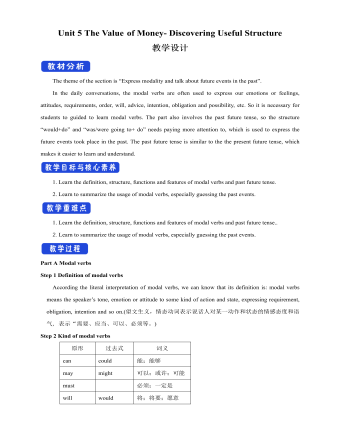
Step 3 Meaning1. 过去将来时表示从过去某一时间来看将要发生的动作或存在的状态, 常用在宾语从句中。一般由“would/should +动词原形”构成。She hoped that they would meet again someday. 她希望将来有一天他们能再见面。2. was/were going to+动词原形: 表示过去将要发生或很有可能发生的动作, 常用于口语中, 表示预言、意图或者打算等。He was going to start work the following week. 他打算下星期开始工作。3. was/were about to do: 常用来表示即将发生的动作, “刚要/正要做……”。注意该结构不与任何时间状语连用。I felt that something terrible was about to happen. 我感到某种可怕的事情即将发生。4.was/were to do: 表示“曾计划做某事”, 如果表示“本来计划做某事, 动作没实现”, 则需用 “was/were to have done”。She said she was to have told me about the accident. 她说她本来想告诉我关于事故的事。5.Start, go, come, leave, see, meet等动词的过去进行时: 表示就过去某一时刻而言即将发生的动作。She was coming later. 她随后就来。I had just put on my overcoat and was leaving to visit a friend of mine. 我刚穿上外套要去看我的一个朋友。
人教版新课标高中地理必修2第三章第一节农业区位的选择教案
1.澳大利亚混合农业地域在生产结构、经营方式、科技应用、农业专业化和地域化等方面有哪些特点?2.在澳大利亚混合农业地 域形成的过程中,有哪些区位因素在起作用?学生发言,教师适当引导、评点并作讲解。[教师提问]:那么,澳大利亚的墨累—达令盆地的区位因素有什么不足之处?知识拓展:课件展示澳大利亚大分水岭的雨影效应的形成原理及东水西调示意图。[教师讲解]:澳大利亚东南部受大分水岭的影响,降水集中于大分水岭的东侧,在其西侧形成山地的雨影效应,降水丰富地区与农业生产地区分布不一致,灌溉成为澳大利亚农牧业发展的限制性条件。因此,澳大利亚对水利工程建设很 重视,东水西调促进了墨累—达令盆地农牧业的发展。[课堂小结]:这节课我们学习了农业区位选择的基本原理。 通过学习我们了解到,农业的区位选择实质上就是对农业土地的合理利用。
人教版高中地理必修2第三章第一节农业的区位选择说课稿
◆设计意图:培养学生独立思考、合作学习的能力。分别说明市场、交通、劳动力、机械和政策对农业生产的影响,让学生切实地考虑,拓展学生思路。教师激发和维持学生学习动机、引导学生、帮助学生自主发现、探索知识,达到巩固所学知识,检验学生的实践应用能力。D.分析教材,识别图片,理解农业地域阅读、分析教材,看图识别,研究案例《澳大利亚地混合农业生产》、思考问题、解决问题◆设计意图:图片展示能清楚直观地说明问题,通过案例分析,了解澳大利亚的混合农业生产,培养学生独立思考问题、解决问题的能力,开拓学生思路。3.课堂小结:◆设计意图:帮助学生回顾课堂、巩固所学知识。4.反馈练习:◆设计意图:知识与能力强化训练,巩固本课所学知识,提高应用能力。
人教版高中政治必修1第一课神奇的货币教案
1、外汇与外币的关系:(1)外汇包括外币,但外汇不等于就是外币。外币是指外国的货币,包括外国的纸币、铸币;外汇通常是以外国货币表示的用于国际间结算的支付手段,具体包括外币、外币有价证券、外币支付凭证等。(2)外币属于外汇的范围,但不能把二者等同起来。通常情况下,只有可以自由兑换的外币才是外汇,因为外汇的实质是国际支付手段,如果某种货币不能自由兑换,它就不能成为国际支付手段。外汇执行的 主要是货币的支付手段的职能。(3)持有外汇意味着对外汇发行国拥有债权。持有外汇过多,一方面意味着国际支付能力强和有可能对外汇发行国施加影响;另一方面则意味着大量该由本国享受的资源,被借给外国利用,并要承担外汇贬值的风险。2、关于币值变化的分析:(1)对货币升值的具体分析:一个国家的货币升值(上浮)后,同量的这种货币能比以前换 取更多的他国货币,买到更多的他国商品。
人教版高中地理必修1第五章第一节自然地理环境的整体性教案
知识和技能 1、理解自然地理环境整体性的基本内涵。2、了解自然地理环境整体性的表现3、使学生树立普遍联系的观点,再利用和改造自然中要充分考虑各地理要素的关系,避免“牵一发而动全身”。过程与方法 1、自主学习,分析 讨论法。2、探究与活动, 理解地理环境的整体性。3、利用景观 图片分析地理环境的整体性。情感、态度与价值观帮助学生树立事物是普遍联系的思想 ,在利用自然中要做到统筹考虑。教学 重点1、地理环境整体性的原因。2、地理要素间相互作用产生新功能。3、自然地理环境的演化过程具有统一性。4、自然地理环境要素会“牵一发而动全身”。教学 难点地理要素间相互作用产生新功能;自然地理环境具有同一演化过 程。教具、资料多媒体课件、景观图片课时安排
人教版高中生物必修3第一章第二节《内环境稳态的重要性》说课稿
四、稳态的重要意义 为什么内环境稳态失调后,会对机体造成危害?引导学生从细胞代谢需要的物质和条件进行分析,最后总结出:内环境稳态是机体进行正常生命活动的必要条件。如何预防内环境稳态失调、保持机体健康?引导学生从外界环境和机体自身调节能力两个方面去思考。即通过加强自我保健,减少外界环境变化对机体的不良影响,同时增强机体的调节能力以适应多变的外界环境。具体如何做?学生讨论,总结。1.保护我们的生存环境,防治环境污染。2.加强体育锻炼,增强体质,提高机体适应外界环境的能力。3.加强自我保健,为机体保持健康创造有利条件。尤其是处于比较恶劣的工作环境中的人,更应注意自身保健,如边防战士注意保暖、炼钢工人注意降温、抗洪战士注意补充水盐等。了解这些知识后才能懂得如何关爱自身和他人。
人教版高中地理必修1第五章第一节自然地理环境的整体性说课稿
学生已学习水循环和岩石圈物质循环,对地理环境要素有初步的认识,对物质迁移和能量的交换有一定的了解,已具备基本的地理阅读分析、提取信息的能力。但学生还缺乏综合分析问题解决问题的能力,通过案例来帮助学生对自然地理环境整体性的认识,还需要补充光合作用、分解作用等知识,并进一步培养学生综合分析地理问题的能力。三、说教法案例教学、启发式讲授四、说学法学生原有的地理基础知识不扎实,学习地理方法简单;但学生思维活跃,有强烈的求知欲,所以在学习的过程中,老师应充分利用这一点,调动学生的积极性,激发学生的学习兴趣。学案导学法;合作探究法;案例分析法等,自主学习、合作学习,培养学生的主动学习的能力、团队精神,增强学习效果;体会自然地理环境的整体性和复杂性,将学习目标内化到行动上。
人教版新课标高中地理必修2第一章第一节人口的数量变化教案
材料四:印度提倡“只生一个好”——鼓励三人小家庭 生男生女都一样材料五:印度尼西亚《人口发展与幸福家庭法》材料六:我国基本国策 计划生育(小结)通过对以上材料的分析我们可以得出这样的结论,不同的国家应该采取不同的人口政策,对与发达国家来说人口增长缓慢,应采取鼓励生育,吸引移民的措施;发展中国家人口增长较快,实行控制人口的政策已经迫在眉睫。不论是发达国家还是发展中国家共同的目标就是实现环境人口和社会经济的协调发展。【课堂小结】这节课我们主要学习了人口的自然增长,影响人口自然增长的因素有哪些?(人口的自然增长率和人口的基数)世界人口的数量在不同的历史时期表现出不同的特征,同一历史时期的不同地区,人口数量的增长又有不同的特点。面对不同的人口形势,各国应采取不同的人口政策。