-
人教版高中语文必修2《短歌行》说课稿2篇
一、说教材《短歌行》是普通高中课程标准实验教科书必修(二)第二单元的一篇略读课文,本单元安排的是先秦到南北朝时期的诗歌。《短歌行》是著名政治家、军事家、文学家曹操的作品。诗中抓住“忧”字来写诗人为什么“忧”,如何解“忧”,从而表达希望能够招揽人才、完成统一天下的雄心壮志。所以本单元安排《短歌行》一诗,对学生全面了解曹操,感受曹操在短暂的人生中竭力创造伟业的气概。二、说学生我这一课的教学对象是高一学生。他们进入高中学习的时间只有三个多月,现在已经完成了必修(一)的学习。学习了现代诗歌单元,有了一定的诗歌学习基础,初步掌握了读诗的基本方法,但是还未能形成成熟的稳定的学习方式。同时,本单元学习是高中第一次接触古代诗歌,诗歌语言上的障碍和时间上的跨度对他们来说都是学习上的困难。因此教师要引导学生自主学习,合作学习,为他们设置新的学习情境,提供合作探究的机会。
人教版高中历史必修1八国联军侵华说课稿
4,教师重点点拨以下几个问题⑴廊坊战役:义和团浴血奋战,对敌人毫不退缩, 其胜利,挫败了西摩尔联军进犯北京的计划,沉重打击了侵略者的气焰,粉碎了所谓“西方军队无敌”的神话。这是对学生进行爱国主义的重要素材之一,教师重点点拨突出其情感教育的重要作用。⑵让学生(阅读教材小字和材料,结合插图,认清八国联军对中国人民犯下的滔天罪行。)并让学生分组探讨自己的看法,一方面培养学生的语言表诉能力,另一方面通过学生的诉说激发学生的爱国情感,树立落后就要挨打的观念.⑶指导学生通过对条约主要内容进行了分析,并自然得出结论:清政府完全成为帝国主义统治中国的工具,中国完全陷入半殖民地半封建社会。让学生逐步学会分析和归纳能力(4)进行拓展训练出示中国近代史上列强的大规模的侵华战争和中国人民的反抗斗争
人教版高中生物必修2基因在染色体上说课稿
三、孟德尔遗传规律的现代解释①分离定律:在杂合体的细胞中,位于一对同源染色体上的等位基因,具有一定的独立性;在减数分裂形成配子的过程中,等位基因随同源染色体的分开而分离,独立地随配子遗传给后代。②自由组合定律:位于非同源染色体上的非等位基因的分离或组合是互不干扰的;在减数分裂过程中,同源染色体的等位基因彼此分离的同时,非同源染色体上的非等位基因自由组合。总结:再次强调孟德尔遗传定律的现代解释课堂练习:书本31页6、教学反思:本节课设置了一系列问题情境,层层设问,在学生答问、质疑、讨论过程中让学生建构新概念和新的知识体系,并通过教师及时掌握反馈信息,适时点拨、调节,让学生在推理判断中培养良好的思维习惯和对知识的迁移能力,而且通过留出一定的时间让学生提问,体现了以学生为主体的思想。
人教版高中生物必修2染色体变异说课稿
四、说教学程序(一).温故知新、导入新课复习提问:基因突变导致生物变异的原因是什么?回答:基因突变是基因结构发生改变,从而使遗传信息改变,使蛋白质结构改变、生物性状改变,即生物发生了变异。那么,基因是什么?它和染色体又有何关系?回答:基因是有遗传效应的DNA片断,染色体是DNA的载体,基因在染色体上呈线形排列。引出新知:对于一个生物体来说,正常情况下,其染色体的结构和数量都是稳定的。但在自然条件或人为因素的影响下,染色体的结构和数量均会发生改变,从而导致生物性状的改变,这就属于染色体变异。(二).把握重点、突破难点重点的把握:1、染色体结构的变异播放影片:猫叫综合征幼儿。让学生观察: 患儿哭声轻、音调高,很像猫叫。教师补充: 患儿的征状---两眼较低、耳位低下,存在着严重的智力障碍。阐述病因---染色体片段缺失
人教版高中英语必修1Journey Down the Mekong说课稿
2. let the Ss complete the forms paragraph by paragraph. Purpose here is to help Ss to get the habit of reading a passage as a whole, and pay attention to the organization of the text, as a result the Ss will fully understand the whole passage.3. ask Ss to retell the passage with the help of the key words in the form.Since the Ss in the class are in different levels, so I let them to fill in the blank to understand the meaning of the words and phrases better. ( That’s all for the while-reading. Now let’s move to the fifth step.)Step V: Post-reading (10mins) ---DiscussionIn this part students are asked to discuss in groups and list Wang Kun’s and Wang Wei’s attitudes about the trip. After that, Ss are encouraged to express their attitudes with the whole class. Collect their answers and don’t forget to praise them even if their answers may not be perfect.In this activity, discussion provides a vivid and active learning environment for Ss to communicate in English with newly learned language items. (Finally it comes to the homework.)StepⅥ: Homework (1min)1. Ss are required to read the text again after class and figure out the meaning of some complex sentences.2. Do the exercises on P19; This can help Ss to consolidate what they’ve learnt and make preparation for the next lessonPart4. Blackboard design.(说板书设计)On the top, there is the title of this lesson. On the left, there are main ideas for each paragraph. On the right, there are some new words and expressions.Unit 3 Travel journalJourney down the MekongMain idea of each para.:Para1: deciding to take a great bike trip along the Mekong river.Para2: Different attitudes between Wang kun and Wang wei.
人教版高中英语必修4Body Language说课稿4篇
Textbook: Senior English for China (Book 4), by Liu Daoyi Time Allotment: 1 period (40 minutes)Date: March 20, 2014Teaching aids: blackboard, Multi-media, Power Point, chalk I. Text Analysis (教材分析)This unit is about body language, and the text selected in the reading part demonstrates the difference and similarity of body language in many parts of the world. Through learning this passage, students are required to raise their awareness of using body language in different parts of the world. As body language is closely related to our daily life, it is easy to arouse students’ interest in learning this text. Reading skills and speaking training are designed around the text.II. Teaching Objectives (教学目标)By the end of the lesson, students will be able to:1. Language Skill Objective(语言技能目标): develop reading ability (skimming and scanning)as well as speaking ability.2. Cultural Knowledge Objective(文化知识目标): know about the cultural differences of using body language.3. Affective Objective(情感目标): increase students’ awareness of using body language correctly in different cultures. III.Teaching Focuses and Difficulties(教学重点和难点)1. Teaching Focuses(教学重点): the difference and similarity of body language in many parts of the world.2. Teaching Difficulties(教学难点): develop students’ reading abilities of skimming and scanning and ask the students to show their opinions with fluent English.
人教版高中英语必修1English around the world说课稿
(3)v. 给:提出;展现,显现present sb. with sth. ; present sth. to sb. 把. . 交给;颁发;授予present sth. (for sth. )/present sth. to sb. e. g. Om his birthday, his friends presented him a collection of stamps. 在他生日时,他的朋友们送给他一套邮票作为礼物。The sword was presented by the family to the museum. 这家人把宝剑捐赠给了博物馆。The committee will present the final report to Parliament in June. 委员会将在六月向议会提交最后的报告。You need to present yourself better. 你需要更善于展现自己。It is essential that we present a united front. 至关重要的是我们要表现得更加团结。Step 4 ConsolidationT:Now that we have got a general idea of these words and phrases. Lets make up some sentences using them to master them. Suggested sentences:1. Your duties include typing letters and answering the telephone. 2. It is one of the greatest roles that she has played. 3. A large number of people have applied for the job. 4. The number of the panda is declining. 5. I'11 go there, even if I have to walk. 6. He came up to me to ask for a light. 7. The novel is about a family who can't communicate with each other. 8. He based his plan on interests of most people. 9. Why doesn't he make use of his singing talent?Step 5 Summary and homeworkT:Today we dealt with several new words and phrases. After class I hope that youcan read them again and again to keep them in mind. That's all for today. You aredismissed.
人教版高中英语必修1Nelson Mandela--A Modern Hero说课稿
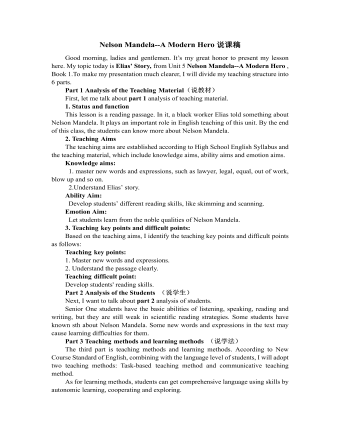
In this step, give students a few minutes to read the passage . While they are reading, I will write some key words of the text on the blackboard. Then ask students to retell the passage according to the key words.By retelling, students can improve their ability of language organization and have an overall understanding of the article.Step 4 Group discussionIn this step, students will be divided into groups of 4 to discussion the following question: What qualities make a great person?After their discussion, invite a few groups to make a report to the class.This group discussion can practice students’ oral English and cultivate their abilities of cooperation and communication.Step 5. HomeworkLet students write a short passage to introduce a great person he or she admires.The homework can consolidate the knowledge the students have learned and cultivate their writing ability. Part 6 Blackboard Design(板书设计)That’s all my teaching procedures. Finally, I’d like to say sth about part 6 blackboard design. On the top is the title. On the left, there will be some new words and expressions. In the middle of the blackboard, I will write some useful sentence structures so that the students can know clearly what they’ve learned and then try to master the knowledge.OK. That’s all for my presentation. Thank you for your attention.
人教版高中英语必修4Women of achievement说课稿4篇
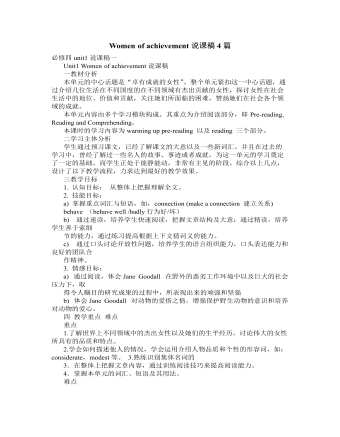
Good morning, distinguished judges:It’s my honor to talk about my teaching ideas with you. Today my topic is Women of Achievement. My presentation consists of six parts: the analysis of teaching material and student, teaching aims, key and difficult points, teaching and studying method, teaching procedures and blackboard design.First, let’s focus on the analysis of teaching material. This lesson is from New Senior English for China Student’s Book 4 Unit 1, the reading part. The main topic of the passage is the introduction of a student of Africanwildlife. After this lesson, the students will learn more information about her studying chimps in Africa, and their reading and speaking abilities can be developed as well.The next part is the analysis of students. My students are in senior high students. They have learnt English for many years, they’ve known many words and sentences, but their speaking and reading abilities are still not very good. So I will practice their speaking and reading abilities through different exercises.According to the New Standard Curriculum and the present situation, I set the teaching aims as follows: firstly, knowledge aims. Students can grasp some new words, such as worthwhile, move off. Moreover, students can understand the content of the passage and get familiar with the topic of studying chimps in wildlife. Secondly, ability aims. Students can use reading strategies such as skimming and scanning in reading process. Thirdly, emotional aims. Students can have the awareness of protecting animals and care about animals.Based on the above analysis, the key point of this lesson is to get the main idea and the detailed information from the passage; the difficult point is to talk about the wildlife protection and use reading strategies.
人教版高中英语必修5Making the news说课稿4篇
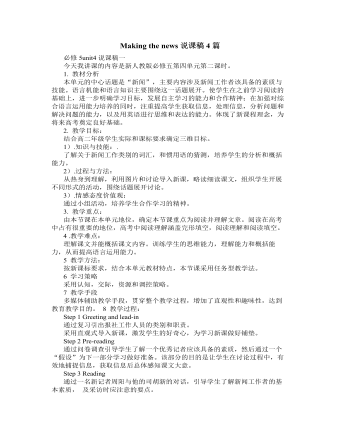
今天我们来介绍一下必修五第四单元的授课方式。这个单元的题目是Making the news。应该是学生比较感兴趣的话题,学生往往对新闻工作充满好奇,所以我们可以利用这个机会多设计一些师生互动和学生互动,来激发起学习的积极性,提高学习效率。同时我们可以利用这个单元不仅帮助学生掌握语言知识,培养语言能力,同时让其了解新闻工作的重要性,培养起社会智能感。这个单元分为六个课时,它的教学目标是这样的:语言目标是掌握词汇表中的常用单词和短语,掌握倒装句的一些基本用法。 技能目标是能初步掌握约会的基本句型并在真实的场景下正确运用。新闻报道类文章的写作技能。采访的基本规范和沟通技能。情感目标是对新闻报道的客观性和真实性有更好的理解。对新闻记者的职业有更深入的了解,并能体会其工作的重要性。下面我们来介绍一下第一课时的授课方式,第一课的教学目标是这样的第一课时的教学目标语言目标:单词:Occupation, journalist, editor, photographer, curious, personality, enthusiasm
人教版高中地理必修2绿色产品知多少说课稿
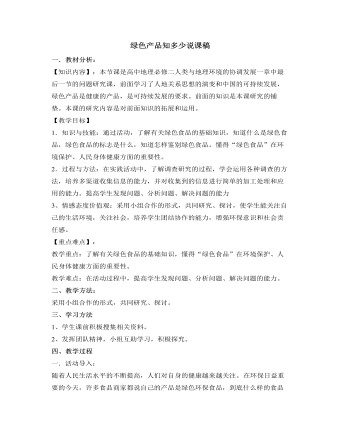
各小组派代表汇报。4、教师提出问题组织学生讨论:⑴要想了解更多的绿色食品,了解绿色食品的销售情况,我们应该怎么做?⑵要想了解广大消费者对绿色食品的态度,食用绿色食品的意义,是否懂得辨认绿色食品,以及什么样的人群对此知识最缺乏等,我们应该怎么做?组织学生汇报交流。5、做个“绿色食品”广告设计师。为你喜欢的绿色食品设计广告语,每组推荐一个。6、让学生了解绿色食品认证程序。7、绿色食品打“假”队员在行动。8、向学生介绍生态绿色食品基地。三、活动总结:通过研究、探讨,了解学生对绿色食品的态度。提问:民以食为天,吃,是一个大问题,如果你的爸爸妈妈让你到超市买牛奶、方便面等,你会选择什么样的食品?为什么?希望通过今天的学习,同学们能够做到绿色消费,也希望你们向自己的家人、向周围的了解学生对“无公害食品”、“有机食品”与“绿色食品”的认识。
人教版高中地理必修2煤城焦作出路何在说课稿
分析过焦作市的地理概况和产业优势后,就需要针对由于资源枯竭所带来的问题提出合理化的建议。既然是谈经济转型,就应该将话题的范围明确在这一领域内。通过材料3的相关内容,我们了解到焦作市需要在产业结构调整、培育新的优势产业、增强综合竞争力等三个整改方针上下功夫。因而引导学生针对优势与不足提出建议,以三个整改方针为基准,衡量建议的可行性是锻炼学生解决此类问题的有效途径。在此我将教会学生的是解决问题方法而非案例的内容,正所谓“授之以鱼,不如授之以渔”。接下来针对学生的建议和教材资料分析所罗列的10点整改思路,由学生自由发言提出看法,通过教师的指导和学生的讨论,进而确定经济转型建议的具体方案。最后注意将建议与产业优势相对照,看建议是否都是围绕着产业优势而提出的,这样做会加深学生的印象,通过建议和优势的对应关系,将不难找出此类问题的解题思路。
人教版新课标高中物理必修1摩擦力说课稿2篇
本节课是人教社物理必修1第三章第三节的内容,编排在弹力之后。该节知识既是力学的基础,也是组成整个高中物理知识的一块“基石”,所以这节内容的教学如何引领学生自主积极地探究摩擦力产生的条件和影响因素,体验摩擦力特点规律的发生过程是本节课的重点,应高度重视本节教学过程;由于摩擦力问题的复杂性,且在具体问题中又表现出“动中有静,静中有动”,尤其静摩擦在许多情形下似乎又是“若有若无,方向不定”,因此,对于初学者也是有一定难度的。也正是由于教材内容的上述特点,本节课又易于激起学生的求知欲,易于培养学生的辩证观点,易于锤炼学生的物理素质。要充分用好该节教材内容,深入挖掘知识间的有机联系,对学生开展针对性的思维训练,进而提高学生应用物理知识解决实际问题的能力和创新思维能力。高中物理《课标》对该知识点的要求是,“通过实验认识滑动摩擦、静摩擦的规律,能用动摩擦因数计算摩擦力”。其中,对静摩擦力规律的认识应该包括最大静摩擦力。
人教版高中历史必修1辛亥革命说课稿2篇
三、辛亥革命的结局1.袁世凯窃取革命果实由课件给出窃取革命果实的简单过程,帮学生理清思路,创设问题情境,由学生分析革命果实被窃取的原因,教师给以补充并揭示根本原因,贯穿整个革命的资产阶级的软弱性和妥协性,再次加深对难点的理解。2.历史功绩辛亥革命性质、功绩由学生阅读书本进行总结,再加以补充让学生在书本上做好记录,强调最大功绩是结束了两千多年的君主专制政体。辛亥革命的失败及其评价很易搞成生硬的一言堂形式,可以从多种角度把学生思维调动起来。这里采用列举一个合作探究,自由讨论的题目“有人认为辛亥革命因为没有完成反帝反封建的革命任务而失败,有人则认为辛亥革命是中国“从君主到民主”社会转型的成功开始。你同意哪种看法?”要求同学们自由讨论.各抒己见,大胆创新,言之在理即可.教师在一旁引导学生,活跃课堂气氛.最后教者归纳总结学习历史从不同的角度看问题可以得出不同的结论,学会用辩证的观点看待历史问题,对辛亥革命有个全面的认识。
人教版新课标高中物理必修2功说课稿2篇
探究一:高中阶段功的含义是什么?投影:初中九年级《物理》105页学生思考:①图中物体的势能、动能分别如何变化?②物体能量的变化和做功是否存在关系?学生:分组讨论,得出结论:如果物体的能量发生变化时,说明有力对物体做了功。教师:进行点评和小结(设计意图:对初中知识深化理论认识,并为以后功能关系的教学作准备)探究二:力对物体做功的两个要素是什么?情景再现:找体重相对悬殊的两位同学,①A同学试图抱起B同学,但没成功。②B同学抱起A同学在教室内匀速走动。学生思考:在①中,A是否对B做功?在②中,B是否对A做功?学生:分析得出做功的两要素:物体受到力的作用,并且在力的方向上发生位移.教师:让学生分别例举生活中力对物体做功和不做功的例子,(设计意图:让学生亲身参与课堂实验,烘托课堂气氛,相互协作增进同学情谊)探究三:如果物体的位移不再力的方向上,那么力是否还对物体做功?
人教版高中数学选择性必修二等差数列的前n项和公式(1)教学设计
高斯(Gauss,1777-1855),德国数学家,近代数学的奠基者之一. 他在天文学、大地测量学、磁学、光学等领域都做出过杰出贡献. 问题1:为什么1+100=2+99=…=50+51呢?这是巧合吗?试从数列角度给出解释.高斯的算法:(1+100)+(2+99)+…+(50+51)= 101×50=5050高斯的算法实际上解决了求等差数列:1,2,3,…,n,"… " 前100项的和问题.等差数列中,下标和相等的两项和相等.设 an=n,则 a1=1,a2=2,a3=3,…如果数列{an} 是等差数列,p,q,s,t∈N*,且 p+q=s+t,则 ap+aq=as+at 可得:a_1+a_100=a_2+a_99=?=a_50+a_51问题2: 你能用上述方法计算1+2+3+… +101吗?问题3: 你能计算1+2+3+… +n吗?需要对项数的奇偶进行分类讨论.当n为偶数时, S_n=(1+n)+[(2+(n-1)]+?+[(n/2+(n/2-1)]=(1+n)+(1+n)…+(1+n)=n/2 (1+n) =(n(1+n))/2当n为奇数数时, n-1为偶数
人教版高中数学选择性必修二导数的四则运算法则教学设计
求函数的导数的策略(1)先区分函数的运算特点,即函数的和、差、积、商,再根据导数的运算法则求导数;(2)对于三个以上函数的积、商的导数,依次转化为“两个”函数的积、商的导数计算.跟踪训练1 求下列函数的导数:(1)y=x2+log3x; (2)y=x3·ex; (3)y=cos xx.[解] (1)y′=(x2+log3x)′=(x2)′+(log3x)′=2x+1xln 3.(2)y′=(x3·ex)′=(x3)′·ex+x3·(ex)′=3x2·ex+x3·ex=ex(x3+3x2).(3)y′=cos xx′=?cos x?′·x-cos x·?x?′x2=-x·sin x-cos xx2=-xsin x+cos xx2.跟踪训练2 求下列函数的导数(1)y=tan x; (2)y=2sin x2cos x2解析:(1)y=tan x=sin xcos x,故y′=?sin x?′cos x-?cos x?′sin x?cos x?2=cos2x+sin2xcos2x=1cos2x.(2)y=2sin x2cos x2=sin x,故y′=cos x.例5 日常生活中的饮用水通常是经过净化的,随着水的纯净度的提高,所需进化费用不断增加,已知将1t水进化到纯净度为x%所需费用(单位:元),为c(x)=5284/(100-x) (80<x<100)求进化到下列纯净度时,所需进化费用的瞬时变化率:(1) 90% ;(2) 98%解:净化费用的瞬时变化率就是净化费用函数的导数;c^' (x)=〖(5284/(100-x))〗^'=(5284^’×(100-x)-"5284 " 〖(100-x)〗^’)/〖(100-x)〗^2 =(0×(100-x)-"5284 " ×(-1))/〖(100-x)〗^2 ="5284 " /〖(100-x)〗^2
人教版高中数学选择性必修二等比数列的概念 (1) 教学设计
新知探究我们知道,等差数列的特征是“从第2项起,每一项与它的前一项的差都等于同一个常数” 。类比等差数列的研究思路和方法,从运算的角度出发,你觉得还有怎样的数列是值得研究的?1.两河流域发掘的古巴比伦时期的泥版上记录了下面的数列:9,9^2,9^3,…,9^10; ①100,100^2,100^3,…,100^10; ②5,5^2,5^3,…,5^10. ③2.《庄子·天下》中提到:“一尺之锤,日取其半,万世不竭.”如果把“一尺之锤”的长度看成单位“1”,那么从第1天开始,每天得到的“锤”的长度依次是1/2,1/4,1/8,1/16,1/32,… ④3.在营养和生存空间没有限制的情况下,某种细菌每20 min 就通过分裂繁殖一代,那么一个这种细菌从第1次分裂开始,各次分裂产生的后代个数依次是2,4,8,16,32,64,… ⑤4.某人存入银行a元,存期为5年,年利率为 r ,那么按照复利,他5年内每年末得到的本利和分别是a(1+r),a〖(1+r)〗^2,a〖(1+r)〗^3,a〖(1+r)〗^4,a〖(1+r)〗^5 ⑥
人教版高中数学选择性必修二导数的概念及其几何意义教学设计
新知探究前面我们研究了两类变化率问题:一类是物理学中的问题,涉及平均速度和瞬时速度;另一类是几何学中的问题,涉及割线斜率和切线斜率。这两类问题来自不同的学科领域,但在解决问题时,都采用了由“平均变化率”逼近“瞬时变化率”的思想方法;问题的答案也是一样的表示形式。下面我们用上述思想方法研究更一般的问题。探究1: 对于函数y=f(x) ,设自变量x从x_0变化到x_0+ ?x ,相应地,函数值y就从f(x_0)变化到f(〖x+x〗_0) 。这时, x的变化量为?x,y的变化量为?y=f(x_0+?x)-f(x_0)我们把比值?y/?x,即?y/?x=(f(x_0+?x)-f(x_0)" " )/?x叫做函数从x_0到x_0+?x的平均变化率。1.导数的概念如果当Δx→0时,平均变化率ΔyΔx无限趋近于一个确定的值,即ΔyΔx有极限,则称y=f (x)在x=x0处____,并把这个________叫做y=f (x)在x=x0处的导数(也称为__________),记作f ′(x0)或________,即
人教版高中数学选择性必修二等比数列的概念 (2) 教学设计
二、典例解析例4. 用 10 000元购买某个理财产品一年.(1)若以月利率0.400%的复利计息,12个月能获得多少利息(精确到1元)?(2)若以季度复利计息,存4个季度,则当每季度利率为多少时,按季结算的利息不少于按月结算的利息(精确到10^(-5))?分析:复利是指把前一期的利息与本金之和算作本金,再计算下一期的利息.所以若原始本金为a元,每期的利率为r ,则从第一期开始,各期的本利和a , a(1+r),a(1+r)^2…构成等比数列.解:(1)设这笔钱存 n 个月以后的本利和组成一个数列{a_n },则{a_n }是等比数列,首项a_1=10^4 (1+0.400%),公比 q=1+0.400%,所以a_12=a_1 q^11 〖=10〗^4 (1+0.400%)^12≈10 490.7.所以,12个月后的利息为10 490.7-10^4≈491(元).解:(2)设季度利率为 r ,这笔钱存 n 个季度以后的本利和组成一个数列{b_n },则{b_n }也是一个等比数列,首项 b_1=10^4 (1+r),公比为1+r,于是 b_4=10^4 (1+r)^4.