-
人教版高中语文必修2《囚绿记》教案2篇
教学设想:本节课的主题是“生命之绿,璞玉心灵”,用圈点批注法解读爱绿的感情,让学生在批注中明确“绿”的象征意义,而不只是结论的传递。同时借助于阅读、感受和理解把握作者对绿的认识是不断升华的,由一般对生命希望之绿的喜爱,到与绿交往后被它的不畏强暴,永远向阳的精神所折服,最后在特定的时代背景下绿在作者的心目中已经成了我们民族不屈精神的象征。让学生评中求解,评中悟情,评中明理,评中品味。教学进程:一、导语上节课我们学习了朱自清的《绿》,初步了解了读书动笔的基本方法,这节课我们继续用圈点批注的方法来学习陆蠡的散文《囚绿记》。二、释题师:看标题,囚绿之“绿”在文中具体指什么?(一株常春藤)“囚”就是囚禁的意思,那题目就是记述囚禁绿色常春藤的经过。三、圈点、把握情节作者为什么要囚绿呢?文中除了写“囚绿”之外,还写了哪些有关绿的意念和行动?带着这样的质疑用自己喜欢的方式朗读课文,请同学们圈点出疑难字词,或结合书下注释,或同学合作解决,解决不了的,可提出来我们共同解决。标注段落节次。勾画出表现作者对绿意念和行动的句子。
新人教版高中英语必修2Unit 2 Wildlife Protection-Reading and Thinking教案一
The listening and speaking part aims at how to protect and help endangered animals by listening, speaking and talking about the facts and reasons. This lesson analyzes the decreasing clause of Tibetan antelope population and the measures of protecting Tibetan antelopes. So students can be guided to learn to analyse the title and use different reading skills or strategies, like scanning, skimming and careful reading.1. Read quickly to get the main ideas and the purpose of going to Tibetan; read carefully to understand what the author see and think.2. Understand the sentences of the present continuous passive voice such as “Much is being done to protect wildlife.” and the inverted sentence “Only when we learn to exist in harmony with nature can we stop being a threat to wildlife and to our planet.”3. Enhance the awareness of protecting wildlife.4. Cultivate the reading methods according to different materials.1. Read quickly to get the main ideas and the purpose of going to Tibetan; read carefully to understand what the author see and think.2. Understand the sentences of the present continuous passive voice such as “Much is being done to protect wildlife.” and the inverted sentence “Only when we learn to exist in harmony with nature can we stop being a threat to wildlife and to our planet.”3. Cultivate the reading methods according to different materials.Step 1 Leading-inWatch a video about elephants and whales and then ask:Why are they endangered ? They are killed/hunted
人教版高中语文必修4《语言生活的历史进程》教案
交谈时双方的空间距离也有一定讲究。和朋友谈话、和陌生人谈话、和异性谈话、招呼长者和上级,都需要有一个合适的距离。如果上级故意“缩减”与下级人员通常谈话时的距离,那是表示对下级的关切。说话的时候需要一面想,一面说,为了控制说话的主动权,免得被别人插人、打断,人们可以使用“唔”“啊”之类的音节,表示“话还没有说完,你别着急”之类的意思。空白也表示意思,在说唱艺术中,什么时候停顿,停多久,都有讲究,以便使交际更有成效。这就是说,空间和时间的因素也在交际中得到了适当的运用。所以,各种伴随动作也是交际的工具。它们一般都是在语言的基础上产生的。即使像“察颜观色”这一类特定的交际方式,也必须有语言的交际为基础,预先有了一定的了解,对方才能领会。总之,在上述的种种交际工具当中,身势等伴随动作是非语言的交际工具;旗语之类是建立在语言、文字基础之上的辅助性交际工具;文字是建立在语言基础之上的一种最重要的辅助交际工具;
人教版高中语文必修3《登高》教案2篇
【设计思想】诗歌教学的关键是感受诗景,体味诗情,领悟诗意,在此基础上孕育理解能力、鉴赏能力和审美情感。诗景、诗情、诗意均由文字来承载,把握文字组合的张力,是读诗赏诗的抓手。杜甫的诗歌素以炼字精深、涵盖深远著称,以《登高》而言,往往淡淡一字,平平一语,便笼大千于方寸,缩古今于一瞬。故细读文本,咀嚼字句,便是赏景、悟情、会意的基本路径。其次,不朽名作的特点是寄寓深广,古今评价甚多,见仁见智,不一而足。这正是培养学生问题意识、探究意识的极好凭借。第三,诗为语言之精华,是诗人心里涌出的情感之流。诵读乃赏诗之要着,精心感悟之时,设身处地,心惟口诵,是理解诗意的关键一步。基于是,笔者作如下同课异构,殊途同归。【教学目标】1.理解本诗所绘之景、所抒之情及绘景、抒情之法。2.学会用意象叠加法、字句推敲法、诵读体验法等欣赏诗歌。3.感受杜甫心系苍生、情寄邦国、忧国忧民、兼济天下的博大情怀。
人教版高中政治必修3文化塑造人生教案2篇
【教学内容】人教版高中思想政治必修3文化生活第一单元第二课第二框题《文化塑造人生》。【教学目标】1.知识目标理解优秀文化如何丰富人的精神世界、增强人的精神力量及促进人的全面发展。2.能力目标(1)能赏析优秀文化产品,感悟积极向上的文化生活对于丰富人们的精神世界,增强人民的精神力量的意义,确信其促进人的全面发展的重要作用。(2)结合文化塑造人生,不断丰富自己的精神世界,促进自身的全面发展3.情感、态度、价值观目标树立正确的世界观、人生观、价值观,丰富精神世界,增强精神力量,接受优秀文化,促进自身的全面发展。【教学重点】优秀文化能丰富人的精神世界,增强人的精神力量【教学难点】文化促进人的全面发展【教学准备】资料收集、多媒体课件【课时安排】1课时【教学过程】视频导入:播放我国残疾人艺术团在春节晚会上的精美舞蹈《千手观音》。
人教版高中地理必修2人口合理容量教案
(1)请同学们结合日常生活实例和教材分析说明人类要在世界各地消除贫困并保持人口的合理容量任务的艰巨性?(2)采取何种措施才能更好的解决这一问题的出现?教师总结(1)现实中的人口问题(如人口过快增长、人口城市化和人口老龄化等)引发了严重的资源问题和环境问题。①发达国家的人均消耗资源量很大,索取资源和转嫁有害生产的地域超出了本国的范围。②发展中国家不仅人口数量多,人均消费水平低,而且一些国家的人口仍在快速增长。若在现有的经济基础上,把发展中国家人均生活质量提高到与发达国家相当的水平,所引发的资源短缺和环境问题将会相当严重,解决的难度也很大。(2)I就整个世界来说:①国际社会要倡导各国,尤其发展中国家要尽最大可能把人口控制在合理的规模之内;②建立公平的秩序,保证大多数人拥有不断追求高水平生活质量的平等权利。
人教版高中语文必修3《寡人之于国也》教案2篇
一、引入:教师列举以下言论,让学生辨出哪些是孟子的,哪些不是。学生不知道的,由教师说出。学生不理解的,教师作简要解说。1.天将降大任于是人也,必先苦其心志,劳其筋骨,饿其体肤,空乏其身,行拂乱其所为。所以动心忍性,曾益其所不能。(孟子)2.域民不以封疆之界,固国不以山溪之险,威天下不以兵革之利。得道者多助,失道者寡助。(孟子)3.鱼,亦我所欲也,熊掌,亦我所欲也,二者不可得兼,舍鱼而取熊掌者也。生,亦我所欲也,义,亦我所欲也,二者不可得兼,舍生而取义者也。(孟子)4.富贵不能淫,贫贱不能移,威武不能屈。(孟子)5.非礼勿视,非礼勿听,非礼勿言,非礼勿动。(孔子)6.无恻隐之心非人也,无羞恶之心非人也,无辞让之心非人也,无是非之心非人也。(孟子)7.庖有肥肉,厩有肥马,民有饥色,野有饿殍。(孟子)8.人性之善也,犹水之就下也;人无有不善,水无有不下。(孟子)9.民为贵,社稷次之,君为轻。(孟子)10.君子坦荡荡,小人常戚戚。(孔子)
人教版高中语文必修3《老人与海》教案2篇
(一)导入[以视频欣赏导入]同学们,刚才欣赏的是大家熟悉、喜欢的电视剧《亮剑》中的精彩片段——李云龙论述什么是“亮剑”精神?同学们听后觉得好不好?牛不牛?“亮剑”精神简单理解就是敢于与强大的敌人(对手)做斗争,无论对手多么强大,都要满腔勇气和信心,永不放弃、永不言败,要敢于亮剑……今天我们一起来学习世界100部著名文学作品之一、美国里程碑式30部文学作品之一的世界名著——海明威的《老人与海》,看看主人公桑提亚哥“硬汉”性格和李云龙“亮剑”精神有么相似的地方。(请同学们翻到课文,课件显示课题《老人与海》)(二)走进作者:请同学们自己谈收集到的有关海明威的资料,然后教师梳理出下列核心内容识记:(课件显示)海明威(1899~1961),美国现代作家,20世纪美国文学史上最耀眼的名字之一。早期作品表现了第一次世界大战青年一代的彷徨情绪,以“迷惘的一代”的代表著称。20世纪末回到美国,写了不小以拳击家、渔民、猎人等为主人公的短篇小说,创造了“硬汉子”性格。
人教版高中地理必修2工业的区位因素与区位选择精品教案
思考:结合资料,看看“广钢”的搬迁还考虑到什么因素?主要从谁的角度去考虑?展示资料:广钢建于1958年,由于城市化进程的加快,原来地处偏僻的广钢一带现已成闹市,广钢因此给周边带来了许多不便,并屡被投诉,投诉的主要内容是烟气、粉尘超标。近日,《珠三角环境保护规划纲要(草案)》(以下简称《纲要》)正式提交省人大常委会审议,按照《纲要》要求,2010年前,广东省将关、停、并、转、迁位于城市中心区高能耗、重污染的工业企业。学生讨论:环保要素、政策要素……从市民、政府等社会角度去考虑板书:2、环保要素 3、政策的变化小结:影响工业区位选择的因素很多,不同的工业区位选择要考虑的主导因素可能是一个或几个,应因地制宜,具体分析。并且影响区位选择的因素随着社会的发展而变化;社会、环境需要对工业区位也有一定的影响力。所以工业区位选择是复杂的,应综合考虑各种因素,以取得最大的经济、社会、环境综合效益。学生活动:计算机模拟工业选址,看谁是最英明的决策者(通过实践应用让学生感受到工业的区位选择应综合考虑)
人教版新课标高中地理必修2第四章第二节工业地域的形成教案
在经济水平较高、工业地域规模较大的地区,其发展潜力就远不一样,如钢铁工业。钢铁工业的生产过程比较复杂(如课本图5.31),需要有相互接近的工厂,不仅包括从事钢铁生产各道工序的工厂,如烧结厂、焦化厂、炼铁厂、炼钢厂、轧钢厂,还包括与钢铁生产有联系的工厂,如氧气厂、机修厂、发电厂、水泥厂等,总共可达20~30个工厂。这些工厂集 聚,设备大,管线长,占地多。因此,这样形成的工业地域(钢铁工业区)面积广,发育程度高,发展潜力大。这类工业地域 再加上为方便众多工人生活所配置的服务业和其他工业,在发展过程中,往往由于工业地域的扩展而形成工业城市。例如,我国的鞍山(“钢都”)、攀枝花、马鞍山、包头(“草原钢城”)等钢铁工业城市的形成。除此之外,石油化工区、机械制造工业区等属于发育程度高的工业地域,也往往扩展而形成工业城市。例如,我国的石油城大庆、克拉玛依,汽车城十堰等。
人教版高中地理必修2农业的区位选择精品教案
案例探究:环地中海地区农业的变迁让学生思考:此地哪些因素发生了变化,农业生产方式进行了如何调整?效果如何?二、农业地域的形成1、农业地域的概念:由于以上各因素的共同影响,在一定的地域和一定的历史条件下,形成了相应的生产地区,称为农业地域。农业地域的类型主要有:种植业、畜牧业、混合农业。(在这里分别给学生展示一些农业生产类型的图片,并简单说明什么是种植业、什么是畜牧业、及什么是混合农业)案例探究:阅读澳大利亚地混合农业生产思考:(1)、澳大利亚农业生产的特点是什么?(2)、澳大利亚混合农业的分布在哪里?受哪些区位因素的影响?(3)澳大利亚混合农业生产有哪些优点?

人教版高中地理必修2工业的区位因素与区位选择教案
⑴ 原料、燃料对工业区位的影响逐渐减弱,市场对工业区位的影响逐渐加强; ⑵交通运输条件对工业具有很大的吸引力,在沿海沿江港口、铁路枢纽、高速公路沿线形成工业区;⑶信息通信网络的通达性作为工业区位的重要性越来越突出;⑷工业对劳动力技能的要求逐渐增强。再次显示上表最后一项“各因素的发展变化”。由工业生产的一般过程中可以知道,工厂产出产品的同时,也产出废气、废水、废渣。这些废弃物排入环境,会造成环境污染,危害人们的身体健康。随着人们环境意识的增强,环境质量已成为重要的区位因素。在工厂的区位选择时,应以不污染当地环境为佳,进行合理选择。读课本61页图4.6污染严重工业的区位选择,思考以下问题:1、严重污染空气的工厂布局时应考虑那些因素?2、严重污染水源的工厂布局时应考虑那些因素?3、对环境质量要求高的工厂布局时应考虑那些因素?教师解析:对这一部分知识需要强记。讲解要注意盛行风向,需结合必修一气候一节将难点突破,可分中国大部分地区、西欧、印度半岛等不同区域进行讲解以加深印象。
人教版新课标高中地理必修2第三章第一节农业区位的选择教案
1.澳大利亚混合农业地域在生产结构、经营方式、科技应用、农业专业化和地域化等方面有哪些特点?2.在澳大利亚混合农业地 域形成的过程中,有哪些区位因素在起作用?学生发言,教师适当引导、评点并作讲解。[教师提问]:那么,澳大利亚的墨累—达令盆地的区位因素有什么不足之处?知识拓展:课件展示澳大利亚大分水岭的雨影效应的形成原理及东水西调示意图。[教师讲解]:澳大利亚东南部受大分水岭的影响,降水集中于大分水岭的东侧,在其西侧形成山地的雨影效应,降水丰富地区与农业生产地区分布不一致,灌溉成为澳大利亚农牧业发展的限制性条件。因此,澳大利亚对水利工程建设很 重视,东水西调促进了墨累—达令盆地农牧业的发展。[课堂小结]:这节课我们学习了农业区位选择的基本原理。 通过学习我们了解到,农业的区位选择实质上就是对农业土地的合理利用。
人教版高中地理必修2工业地域的形成精品教案
2.音响生产的工业集聚有哪些优势?点拨:可以加强各企业间的信息交流和技术协作,降低中间产品的运输费用和能源消耗,进而降低生产成本,提高生产效率和利润,取得规模效益。3.根据惠州音响零件的来源百分比,说明惠州音响零件供应厂家的地域分布有什么规律。点拨:距离递减规律,距离惠州音响整机组装厂越近的地区零件来源所占比例越高。三)工业地域工业联系—--------- 工业集聚------------工业地域工业地域:工业集聚而形成的地域称之为工业地域。1.工业地域形成的两种情况⑴自发形成的工业地域: 以生产工序上的工业联系为基础,以降低生产成本为目的。⑵规划建设的工业地域:如我国许多地方的经济技术开发区:①把生产上有投入 产出联系密切的工厂布局在一起。②先建成基础设施,再吸引投资者建厂,形成空间和信息共同利用的工业联系。我国许多地方的经济技术开发区,就是利用这一原理建成的。2.两类不同性质的工业地域
新人教版高中英语必修1Unit 2 Travelling Around-Discovering Useful Structure教案
(5)be to do (可以和具体的时间状语连用)①表示按计划、安排即将发生的动作。②用于时间、条件状语从句中,表示“如果要……,想要……”。The students are to meet at the school gate tomorrow. 明天学生们将在学校大门口集会。 If you are to succeed, you must work as hard as possible. 如果你想要成功,比必须努力工作。(6)be about to do (不与具体的时间状语连用) 表示即将要发生的动作。We are about to start. 我们就要出发了。The new school year is about to begin. 新学年开学在即。(7)一般现在时表将来①表示按时间表规定将要发生的动作。常限于表示位置移动的短暂性动词。②在时间、条件或让步状语从句中,用一般现在时表将来。Look at the timetable. Hurry up! Flight 4026 takes off at 18:20. 你看看时刻表,快点!4026次航班的起飞时间是下午6点20分。Jane is in a hurry because the train to the airport leaves in half an hour. 简很匆忙,因为去机场的火车半小时后出发。
新人教版高中英语必修2Unit 1 Cultural Heritage-Listening&Speaking&Talking教案
Listening and Speaking introduces the topic of “Take part in a youth project”. The listening text is an interview about an international youth cultural heritage protection project. More than 20 high school students from seven countries participated in the project. The reporter interviewed two participants Stephanie and Liu Bin. By listening to the text, students can understand the significance of cultural heritage protection, and teenagers can use their knowledge, combine their own interests and advantages, etc. to participate in the action of cultural heritage protection. Listening and Talking introduces the theme of "Talk about history and culture". The listening text is a dialogue between two tourists and tour guides when they visit the Kremlin, red square and surrounding buildings. The dialogue focuses on the functional items of "starting a conversation", which is used to politely and appropriately attract the attention of the others, so as to smoothly start a conversation or start a new topic. The purpose of this section is to guide students to understand the history and current situation of Chinese and foreign cultural heritage in their own tourism experiences or from other people's tourism experiences, explore the historical and cultural values, and be able to express accurately and appropriately in oral communication.1. Guide students to understand the content of listening texts in terms of the whole and key details; 2. Cultivate students' ability to guess the meaning of words in listening; discuss with their peers how to participate in cultural heritage protection activities.3. Instruct students to use functional sentences of the dialogue such as “I beg your pardon, but…” “Forgive me for asking, but…" and so on to start the conversation more politely and appropriately.
新人教版高中英语必修2Unit 3 The Internet-Listening &Speaking&Talking教案一
Listening and Speaking introduces the topic of “ask about online habits”. Many middle school students have been surfing the Internet for many years, but what they do with the Internet and how much time they spend every day may not be very clear to themselves, nor to other students. This section allows students to investigate their peers' Internet use, which is conducive to their mutual understanding and understanding of the Internet. It can also help them reflect on their own online behavior, learn from other people's good online habits, and get rid of their bad online behavior.The listening text of this section is an investigation interview. The investigators interview specific groups with the same questions to obtain information, so as to understand their views, practices or attitudes on this issue. There are two specific questions: “how much time do you spend online every day? What do you usually do online?”. The answers of the three respondents provide rich and different information, and achieve the purpose of the investigators. The oral discourse structure of survey interviews generally includes greeting and explaining the purpose of the interview, presenting the interview questions and the respondents' answers. Listening and Talking introduces the theme of “choosing the right application ". Listening text is a conversation between Laura and Xiao Bo. In this part of listening, “oink”; “piggy bank” may cause the students' hearing comprehension limitation. Oink refers to sound word and pig's sound. So, add some oink to my piggy bank is often used to describe "making a little money".1. Guide students to understand the content of listening texts in terms of listening for definitions.2. Cultivate students' ability to define words and understand an investigation interview.
新人教版高中英语必修2Unit 4 History and Traditions-Listening&Speaking&Talking教案二
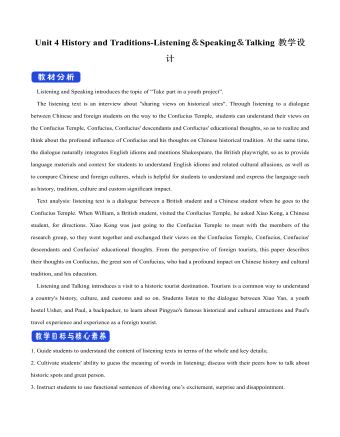
Listening and Speaking introduces the topic of “Take part in a youth project”. The listening text is an interview about "sharing views on historical sites". Through listening to a dialogue between Chinese and foreign students on the way to the Confucius Temple, students can understand their views on the Confucius Temple, Confucius, Confucius' descendants and Confucius' educational thoughts, so as to realize and think about the profound influence of Confucius and his thoughts on Chinese historical tradition. At the same time, the dialogue naturally integrates English idioms and mentions Shakespeare, the British playwright, so as to provide language materials and context for students to understand English idioms and related cultural allusions, as well as to compare Chinese and foreign cultures, which is helpful for students to understand and express the language such as history, tradition, culture and custom significant impact.Text analysis: listening text is a dialogue between a British student and a Chinese student when he goes to the Confucius Temple. When William, a British student, visited the Confucius Temple, he asked Xiao Kong, a Chinese student, for directions. Xiao Kong was just going to the Confucius Temple to meet with the members of the research group, so they went together and exchanged their views on the Confucius Temple, Confucius, Confucius' descendants and Confucius' educational thoughts. From the perspective of foreign tourists, this paper describes their thoughts on Confucius, the great son of Confucius, who had a profound impact on Chinese history and cultural tradition, and his education.Listening and Talking introduces a visit to a historic tourist destination. Tourism is a common way to understand a country's history, culture, and customs and so on. Students listen to the dialogue between Xiao Yan, a youth hostel Usher, and Paul, a backpacker, to learn about Pingyao's famous historical and cultural attractions and Paul's travel experience and experience as a foreign tourist.
新人教版高中英语必修2Unit 5 Music-Discovering Useful Structures教案一
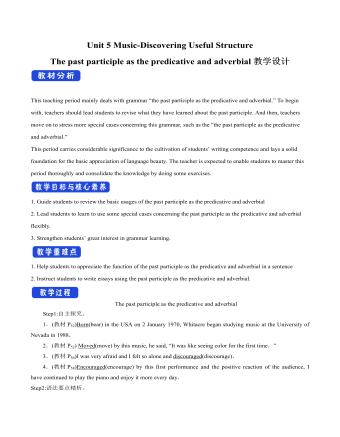
Step1:自主探究。1.(教材P52)Born(bear) in the USA on 2 January 1970, Whitacre began studying music at the University of Nevada in 1988.2.(教材P52) Moved(move) by this music, he said, “It was like seeing color for the first time.”3.(教材P56)I was very afraid and I felt so alone and discouraged(discourage).4.(教材P58)Encouraged(encourage) by this first performance and the positive reaction of the audience, I have continued to play the piano and enjoy it more every day.Step2:语法要点精析。用法1:过去分词作表语1).过去分词可放在连系动词be, get, feel, remain, seem, look, become等之后作表语,表示主语所处的状态Tom was astonished to see a snake moving across the floor.汤姆很惊讶地看到一条蛇正爬过地板。Finally the baby felt tired of playing with those toys.终于婴儿厌倦了玩那些玩具。注意:1).过去分词作表语时与被动语态的区别过去分词作表语时,强调主语所处的状态;而动词的被动语态表示主语是动作的承受者,强调动作。The library is now closed.(状态)图书馆现在关闭了。The cup was broken by my little sister yesterday.(动作)昨天我妹妹把杯子打碎了。2)感觉类及物动词的现在分词与过去分词作表语的区别过去分词作表语多表示人自身的感受或事物自身的状态,常译作“感到……的”;现在分词多表示事物具有的特性,常译作“令人……的”。
人教版高中语文必修1《大卫·科波菲尔》教案2篇
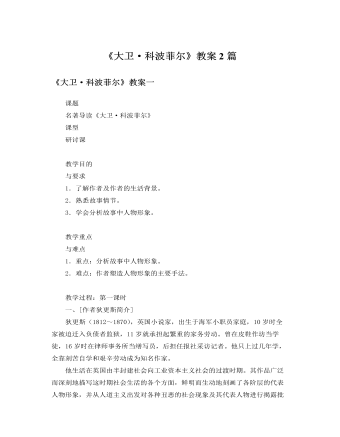
(1)主人公大卫·科波菲尔:大卫·科波菲尔是《大卫·科波菲尔》中的主人公,曾经是个孤儿。作家描写了他从孤儿成长为一个具有人道主义精神的资产阶级民主主义作家的过程。他善良,诚挚,聪明,勤奋好学,有自强不息的勇气、百折不回的毅力和积极进取的精神,在逆境中满怀信心,在顺境中加倍努力,终于获得了事业上的成功和家庭的幸福。在这个人物身上寄托着狄更斯的道德理想。(2)《大卫·科波菲尔》中的女性形象:在狄更斯笔下,《大卫·科波菲尔》塑造了一个个有血有肉的人物形象,每个任务都给人留下了深刻的印象,尤其是成功塑造了不同性格、不同品德的女性形象:贝西姨婆、艾妮斯、佩葛蒂、克拉拉、朵拉、摩德斯通小姐、米考伯太太、艾米丽……贝西姨婆与摩德斯通小姐的对比,克拉拉、朵拉与艾妮斯的对比更使她们栩栩如生,对贝西姨婆、艾妮斯、佩葛蒂的爱就更深一层,对摩德斯通小姐更是恨之入骨,对朵拉、克拉拉既同情又气愤。