-
新人教版高中英语选修2Unit 5 First Aid-Discovering useful structures教学设计
You have no excuse for not going.你没有理由不去。He was punished for not having finished his homework.他因未完成作业而受到惩罚。2.动词ing形式复合结构由物主代词或人称代词宾格、名词所有格或普通格加动词ing,即“sb./sb.'s+doing”构成。动词ing形式的复合结构实际上是给动词ing形式加了一个逻辑主语。动词ing形式的复合结构有四种形式:①形容词性物主代词+动词ing②名词所有格+动词ing③代词宾格+动词ing④名词+动词ingHer coming to help encouraged all of us.她来帮忙鼓舞了我们所有人。The baby was made awake by the door suddenly shutting.这个婴儿被突然的关门声吵醒了。Can you imagine him/Jack cooking at home?你能想象他/杰克在家做饭的样子吗?无生命名词无论是作主语还是作宾语都不能用第②种形式。Tom's winning first prize last year impressed me a lot.汤姆去年得了一等奖使我印象深刻。Do you mind my/me/Jack's/Jack leaving now?你介意我/杰克现在离开吗?Excuse me for my not coming on time.很抱歉我没能按时来。His father's being ill made him worried.他父亲病了,他很担心。We are looking forward to the singer's/the singer to give us a concert.我们盼望着这位歌手来给我们举办一场演唱会。
统编版三年级语文上第12课总也倒不了的老屋教学设计教案
《总也倒不了的老屋》是三年级上册第四单元的第一篇课文。课文主要描写了老屋帮助了很多人,为他们遮风挡雨的故事,赞扬了老屋的爱心和他的善良品质。本课的重点是通过感情朗读,理解课文内容,引导学生联系上下文,体会老屋善良、富有同情心的美好品质。本课的难点是学习预测故事,续编故事。课文用反复的手法推进情节的发展,各部分情节具有相似性,教学过程中可引导学生关注相关内容,这也可以为学生预测故事的发展提供方法上的引领,尤其是对老屋和小动物的语言、动作和心理等细节描写的相似为学生提供预测的依据。 1.会认“暴、凑”等6个生字,会写“准、备”13个生字,理解“准备、偶尔”等词语。2.能试着一边读一边预测故事的情节发展。3.能根据题目、插图和故事内容中的线索,结合生活经验和常识进行故事情节的预测,培养阅读兴趣。4.初步体会预测的好处和乐趣,学习老屋善良的品质。 1.教学重点:培养学生抓住重点词句理解课文内容的能力,能试着一边读一边预测故事的情节发展。2.教学难点:引导学生初步掌握通过故事情节的发展方向,预测故事结局的方法。 2课时
统编版三年级语文上第19课海滨小城教学设计教案
《海滨小城》《海滨小城》是一篇写景的美文。作者按由远及近的顺序,分别描绘了海天远景图、海上日出图、渔船归来沙滩图、小城庭院图、小城公园图、小城街道图。作者正是用这一幅幅的画面,抓住其中景物的特点,展现了海滨小城的美丽景色。本课在语言表达上也很有特点。作者运用“棕色、白色、灰色金黄色”等一系列表示颜色的词语,写出了海滨之美;以总起句的方式概括了小城庭院、公园、街道的特点。在教学中,要通过多种形式的朗读,将学生带入文字勾勒的画面,从而了解课文写了海滨小城的哪些景象,以及这些景色的特点,体会总起句的作用,进而积累语言,仿照课文练习表达。选编这篇课文的主要意图是加强学生自主阅读实践活动,加强对写景状物这一类文章特点的感悟,进一步学习抓住事物特点、按空间变换顺序记叙的表达方法。 1.认识本课“滨、鸥”等11个生字,正确认读多音字“臂”,会写“灰、渔”等13个生字,会写“海滨、街道”等16个词语。2.结合插图学习课文,理解课文内容。了解课文描写的主要景物及其样子。3.能找出第4~6自然段的关键语句,借助关键语句理解段落的意思。4.体会作者热爱家乡的感情,增强环境保护意识。 1.教学重点:理解课文内容,了解海滨小城的美丽的场景及其特点,从中体会作者对家乡的热爱之情。2.教学难点:能通过学习课文,体会作者热爱家乡的感情,增强环境保护意识。 2课时
统编版三年级语文上第22课读不完的大书教学设计教案
《读不完的大书》这篇课文以儿童的视角描写了野外与自家房前屋后的自然环境,并且融入了丰富的想象,展现出一幅幅生动有趣的大自然画面。学习这篇课文,学生可以借助课文优美的句子走进大自然,体会作者对大自然的喜爱之情。本课重点是借助第二题的学习,了解课文的主要内容,并且通过朗读、想象画面、联系生活等方式,感受课文中生动的语言并积累摘抄,结合课后第三题写一写从这篇课文中读到了什么。本课教学可注意两点内容:一要帮助学生理清文章的思路。熟读课文之后,引导学生说说课文都写了哪些好玩的东西。二要引导学生抓住重点语句讨论、交流。除了课后思考题二所列的4个句子外,还可以鼓励学生根据自己的理解再提出几个句子。讨论、交流时,可在引导学生理解语句含义的基础上,启发学生联系实际。 1.会认“妙、奏”等11个生字,会写“读、虾”等13个生字。掌握“高远、沉思”等词语。2.正确、流利、有感情地朗读课文,联系生活体验,感悟课文内容,感受大自然的乐趣。3.能找出作者具体描写了哪些有趣的事物,积累喜欢的语句。 1.教学重点:能找出作者具体描写了哪些有趣的事物,感受课文生动的语言,感受大自然的乐趣。2.教学难点:能简单地写出自己感受到的大自然的乐趣,并和同学交流。 2课时
统编版三年级语文上第21课大自然的声音教学设计教案
《大自然的声音》是部编版语文三年级上册第七单元的第一篇课文。这篇课文以清新活泼的笔调介绍了大自然中风的声音、水的声音和动物的声音,课文用生动的语言,把人们习以为常的声音写得非常鲜活,妙趣横生,体现了大自然的美丽。通过这篇课文的学习,学生可以借助课文优美的句子走进大自然,体会作者对大自然的热爱之情。本单元的人文主题是感受大自然的馈赠,语文要素之一是“感受课文生动的语言,积累喜欢的语句”。本文是一篇浅显易懂、优美生动的散文。这篇文章应以读为本,阅读是学生个性化的行为,要珍视学生独特的感受和理解。要引导学生在读中感悟,在读中激情,在读中体验、品味。 1.会认“妙、奏”等9个生字,会写“演、琴”等13个生字,掌握课文相关词语。2.正确、流利课文,感知课文内容,背诵课文第2~3自然段。3.能找到第2~4自然段的关键句,了解课文写了大自然的哪些声音,感受大自然的美。4.能联系生活经验,体会课文中描写声音的词语的生动,仿照课文,围绕一种听到过的声音写几句话。 1.教学重点:能找到第2~4自然段的关键句,了解课文写了大自然的哪些声音,感受大自然的美。2.教学难点:能联系生活经验,体会课文中描写声音的词语的生动,仿照课文,围绕一种听到过的声音写几句话。 2课时
新人教版高中英语必修3Unit 1 Festivals and Celebrations-Reading and Thinking教学设计
The topic of this part is “Discover the reasons for festivals and celebrations.The Listening & Speaking & Talking part aims at talking about the experiences and feelings or emotions about the festivals and celebrations. This section aims at detecting the reason why the people celebrate the festivals, the time, the places, the types and the way of celebrations. It also explains why some traditions in the old celebrations are disappearing, like the firecrackers in the big cities and some new things are appearing like the prosperity of business or commerce. 1. Students can talk about what festivals they know and the reasons and the way of celebrating them.2. Students should learn the reading skills such as the headline and get the topic sentences, the structures of articles.3. Students can understand the past, the present situation of some festival around the world and why there are some changes about them. 4. Students can have the international awareness about the festivals.1. Students should learn the reading skills such as the headline and get the topic sentences, the structures of articles.2. Students can understand the past, the present situation of some festival around the world and why there are some changes about them.Step 1 Lead in---Small talkWhat festival do you like best ? Why ?I like the Spring Festivals because I can set off the fireworks, receive the lucky money and enjoy the Gala with my families.Step 2 Before reading---Pair workWhy do people celebrate different festivals ?The Spring Festivals is to celebrate the end of winter and the coming of spring and new life.The Mid-autumn Day is to celebrate the harvest and admire the moon.
新人教版高中英语必修3Unit 1 Festivals and Celebrations-Listening &Speaking&Talking教学设计
The theme of this section is “Talk about festival activities and festival experiences”.Festival and holiday is a relaxing and interesting topic for students. This part talks about the topic from the daily life of students’. In the part A ---Listening and Speaking, there are three conversations among different speakers from three countries(Japan, Rio and China), where the speakers are participating in or going to participate in the festivals and celebrations. So listening for the relationship among them is a fundamental task. Actually, with the globalization and more international communication, it is normal for Chinese or foreigners to witness different festivals and celebrations in or out of China. In the Conversation 1, a foreign reporter is interviewing a Japanese young girl who just had participated in the ceremony of the Coming-of-Age Day on the street and asking her feeling about the ceremony and the afterwards activities. Conversation 2, Chinese girl Li Mei is witnessing the Rio Carnival for the first time, and her friend Carla gives her some advice on the costumes which enables her to match with the carnival to have a good time. Conversation 3, a Chinese guide is showing a group of foreign visitors around the Lantern Festival and introducing the customs of the festival to them. The three conversations have a strong vitality and insert the festival and cultural elements from different countries. So perceiving the festivals and cultures from different countries is the second task. At the same time, the scripts also insert the targeted grammar --- v-ing as attributive and predicative, which students can perceive and experience in a real context and make a road for the further study. That is the third task. In the Part B--- Listening and Talking, the theme is “Talk about festival experience”, which is the common topic in our daily conversations. During the conversation, Song Lin, a Chinese student, asked Canadian friend Max about how to spend Christmas. In the conversation, Song Lin talked about experience and the feelings during the Chinese Spring Festival, during which there are not only some enjoyable things but some unpleasant things. After the listening, perhaps students find there are some similarities between Christmas and the Chinese Spring Festival as there are some differences in the origins and celebrations. For example, people always visit friends and relatives, decorate their houses, have a big dinner together, chat and give presents to each other.
新人教版高中英语必修3Unit 1 Festivals and Celebrations-Reading for Writing教学设计一
The topic of this part is “Write about your festival experience”.During the Listening and Speaking and Talking, students are just asked to say out their festival experiences such as the Spring Festival, Mid-autumn Day, but this part students will be asked to write down their own festival experiences. During the reading part, it introduces the Naadam Festival in Inner Mongolia Autonomous Region, which can give students a good example to imitate. Students not only learn the festival, but touch and feel the Inner Mongolian’s character, the spirit and cultural atmosphere, which can help students form the cultural awareness and learn to enjoy and value the diversity of Chinese culture.Concretely, the dairy tells the experience that the author spent the Naadam Festival in Inner Mongolia Autonomous Region with his/her friend. The structure is clear. In the opening paragraph, it introduces the topic of the Naadam Festival and the whole feeling. Then it introduces the items of the festival like the ceremony, wrestling and horse racing. Finally, it summarizes this experience. Because this part is a travel journal, we must guide students pay more attention to these details: 1. use the first person. 2. use the past tense to tell the past thing and use the present or future tense to describe the scenery. 3. use the timeline to tell the development. 4. be careful for the author’s psychology, emotion and feeling, etc.1. Read quickly to get main idea; read carefully to get the detailed information about Naadam Festival.2. Learn the structure of the reading article and language.3. Write an article about a festival experience4. Learn to use the psychology, emotions and feeling in the writing.1. Write an article about a festival experience.2. Use the structure of the reading article and language.
新人教版高中英语必修3Unit 2 Morals and Virtues-Listening &Speaking&Talking教学设计
Example:One day, a poor boy who was trying to pay his way through school by sending newspapers door to door found that he only had one dime(一角)left. He was so hungry that he decided to beg for a meal at the next house.However, he lost his nerve when a lovely young woman opened the door. Instead of a meal he asked for a drink of water. She thought he looked hungry so she brought him a large glass of milk. He drank it slowly, and then asked, “How much do I owe you?” “You don’t owe me anything,” she replied, “Mother has taught me never to accept pay for a kindness.” “Then I thank you from the bottom of my heart.” With these words, Howard Kelly left that house.Years later the woman became badly ill and was finally sent to the hospital in a big city. Dr. Howard Kelly, now famous, was called in. When he heard the name of the town she came from, a strange light filled his eyes. Dressed in his doctor’s clothes, Dr. Kelly went into her room and recognized her at once. From that day on, he gave special attention to her, and decided to do his best to save her life.At last the woman was saved. Dr. Kelly asked the business office to pass the final bill to him. He looked at it and then wrote something on the side. The bill was sent to the woman’s room. She was afraid to open it because she was sure that it would take the rest of her life to pay for it off. Finally she looked, and the note on the side of the bill caught her attention. She read these words: “Paid in full with a glass of milk, Dr. Howard Kelly.” Tear of joy flooded her eyes.
新人教版高中英语必修3Unit 2 Morals and Virtues-Reading and Thinking教学设计
The topic of this part is “Learn to make choices in life”.The Listening & Speaking & Talking part aims at the moral dilemmas, and this part is about making choices in life. The heroin is Lin Qiaozhi, a famous medical scientist, made a great contribution to our country’s medical care. Most importantly, her life experience can inspire our students whether in studying or the development of career. she had moral dilemmas and life choices, which are similar to the students who will step into society. Besides, Lin has quite good virtues like kindness, self-improvement, insistence, job-loving , generosity and responsibility, which is worth being learned.Concretely, this article is a biography about Lin Qiaozhi. The article tells her whole life according the timeline, among which the life choices is emphasized. For example, whether married or chased her dream, returned home or stayed abroad, family or public, her choices all reflected her faith, spirit, responsibility and devotion.1. Fast reading to get the detailed information about Lin Qiaozhi; careful reading to do the deductive information.2. Learn the reading skills--deductive judgement according the context.3. Study the structure features and language features. 4. Communicate about Lin’s life choices and reflect their own life choices.1. Learn the reading skills--deductive judgement according the context.2. Study the structure features and language features.3. Communicate about Lin’s life choices and reflect their own life choices.Step 1 Lead in---Small talkWhat are some important life choices?Importance choices: university study, jobs and marriage partners. Because they can determine our future.
新人教版高中英语必修3Unit 3 Diverse Cultures-Reading for Writing教学设计
The topic of this part is “Describe a place with distinctive cultural identity”.This section focuses on Chinese culture by introducing Chinatown, whose purpose is to show the relationship between the Chinese culture and American culture. The Chinese culture in Chinatown is an important part of American culture. Chinatown is an important window of spreading Chinese culture and the spirit homeland of oversea Chinese, where foreigners can experience Chinese culture by themselves.Concretely, the title is “Welcome to Chinatown!”, from which we can know that the article aims at introducing Chinatown. The author used the “Introduction--Body Paragraph--Conclusion” to describe the people, language, architecture, business, famous food and drinks and people’s activities, which can be a centre for Chinese culture and shows its unique charm.1. Read quickly to get main idea; read carefully to get the detailed information.2. Learn the characteristics of writing and language.3. Learn to introduce your own town according to the text.4. Learn to correct others’ writing.1. Learn the characteristics of writing and language.2. Learn to introduce your own town according to the text.Step 1 Lead in ---Small talkIn the reading part, we mentioned the Chinatown of San Francisco. How much do you know about Chinatown of San Francisco ?Chinatown is a main living place for Chinese immigrants, where you can see many Chinese-style buildings, costumes, operas, restaurants, music and even hear Chinese.Step 2 Before reading ---Predict the contentWhat is the writer’s purpose of writing this text ? How do you know ?From the title(Welcome to Chinatown) and some key words from the text(tourist, visit, visitors, experience), we can know the purpose of the text is to introduce Chinatown and show the relationship between Chinese culture and American culture.
新人教版高中英语必修3Unit 4 Space Exploration-Listening&Speaking&Talking教学设计一
Listening and Speaking introduces the topic of “talking about how to become an astronaut”. This period is aimed to inform students some details about the requirements of being an astronaut. Students can be motivated and inspired by the astronauts. Teachers ought to encourage students to learn from them and let them aim high and dream big.Listening and Talking introduces the theme of "talk about life in space". This part also informs students more details about life in space and can inspire students to be curious about this job. 1. Guide students to listen for numbers concerning dates, years and ages etc2. Cultivate students' ability to talk about how to become an astronaut and life in space ; 3. Instruct students to use functional sentences of the dialogue such as “ first of all, I am not sure, so what might be .. I guess.. I wonder…I am curious…)appropriately.1. Guide students to understand the content of listening texts in terms of the whole and key details; 2. Cultivate students' ability to guess the meaning of words in listening; discuss with their peers how to become a qualified astronaut and describe the life in space.Part 1: Listening and SpeakingStep 1: Lead inPredictionThe teacher can ask students to predict what the listening text is about by looking at the pictures.About how to become an astronaut./the requirements of an astronautStep 2: Then, play the radio which is about an interview a. And after finishing listening for the first time, the students need to solve the following tasks.
新人教版高中英语必修3Unit 4 Space Exploration-Reading and Thinking教学设计一
Q4: What is the function of the International exploration ?Having astronauts from different countries on boardQ5: What can you learn from Para 4 ?China has made great achievements in exploring spaceQ6: What is the attitude to the space exploration ?SupportiveStep 6 Post reading---RetellPeople have always wanted to learn more about space. Before the mid-20th century, most people felt (1)_________ (travel) into space was an impossible dream. However, (2)____ the help of scientists, peoplesucceeded in realizing their dream (3) _________ (explore) space. On 4 October 1957, the Sputnik 1 satellite (4) ____________(launch) by the USSR. (5) ________________ scientists try to make sure nothing goes wrong, accidents can still happen. These disasters made everyone(6)___________(disappoint), but people still believe in the importance of (7) ________(carry) on space exploration. In 2003, China became the third country to (8)_____________ (independent) send humans into space. Then Shenzhou 6 and 7 completed (9)____ second manned orbit and the first Chinese spacewalk. In spite of the difficulties, scientists hope future (10)__________ (discovery) will not only enable us to understand the universe but also help us survive well into the future.Answers: 1. travelling 2. with 3. to explore 4. was launched 5. Although6. disappointed 7. carrying 8. independently 9. a 10. discoveriesStep 6 Post reading---Critical thinkingQ1: What do you think of the space exploration ? I think it is beneficial to us. Through further study of space, people will make full use of it in the future, such as the space experiments by Wang Yaping in Tian Gong 1.Q2: If you are determined to be an astronaut, what should you prepare at present ?First of all, I should study hard to get a related college degree. Besides, I must keep mental and physical healthy.Step 7. HomeworkTry to summarize the structure of the article by a mind map.
新人教版高中英语必修3Unit 4 Space Exploration-Reading for Writing教学设计二
⑦在我看来, 探索太空是值得的。As far as I am concerned, it is worthwhile to explore the space.Step 10 Writing---draftRecently, students in our class have had heated a discussion on whether space is worth exploring. Students hold different ideas about it.30% of us think space exploration is not worthwhile. They think space is too far away from us and our daily life and is a waste of money. And the money spent on space exploration can be used to solve the earth’s problems such as starvation and pollution.On the other hand,70% think space is worth exploring because we have benefited a lot from it,such as using satellites for communication and weather forecast. What’s more,with further space research,we may solve the population problem by moving to other planets one day. Also,space research will enable us to find new sources to solve the problem of energy shortages on the earth.As far as I am concerned, it is worthwhile to explore the space. Not only can it promote the development of society but also enrich our life. Step 11 Pair workExchange drafts with a partner. Use this checklist to help your partner revise his/her draft.1.Does the writer explain why he/she changed/wanted to change?2.Does the writer tell how the changes have improved or will improve his/her life?3.Is the text well-organised?4.Does the writer use words and expressions to show similarities and differences?5.Are there any grammar or spelling errors?6.Does the writer use correct punctuation?
新人教版高中英语必修3Unit 5 The Value of Money-Listening &Speaking教学设计
Step 4: Listen again and decide if the following statements are true (T) or false (F).1 It was the first time Chen Liyan's story was reported. T口 F口2 Chen found 10,000 yuan in a small plastic bag in Taiyuan railway station口 F口3 Wang Zheng apologized to Chen because he couldn't offer her more money. T口 F口4 Chen took out a large loan to cure her daughter, T口 F口5 Wang set up a fundraising website for Chen's daughter after Chen told him about her situation. T口 F口Step 5:After listening, discuss the questions.1 What kind of person do you think Chen Liyan is?Chen Liyan is generous and honest because she returned a large sum of money to the owner.2 Did Chen return the money because she didn't need it?No. She returned the money because it was the right thing to do. Evidence for this is that she refused to accept the reward money because she felt that it had not been earned. 3 Is it common for people to do what Chen did?It depends on the culture. In some countries it is quite common to return money that has been found. In other countries, people believe "Finders are keepers!" 4 How did Wang Zheng feel about the return of his money?He must have been very happy and relieved to have gotten his money back. We know this because he thanked Chen repeatedly and even offered her a reward.5 Why did Ma Dongbao tell Wang about Chen's family?He must have had great sympathy for Chen and her daughter and wanted to help them.'We know this because he arranged help for them. 6 How did the news reporter feel about Chen's actions?The news reporter felt that it showed that money wasn't the most important thing in life. We know this because the reporter told us that this is what Chen believes. and then said, “that's a great attitude to take."
新人教版高中英语必修3Unit 5 The value of money-Reading and Thinking教学设计二
? Could you offer me some kind of work here?? I don’t want your charity, I just want an honest job.? Careless: I landed in Britain by accident.Step 7:Consolidation.? Find Henry? Roderick and Oliver were I .making a bet when they saw Henry, a poor young man. ? Know Henry? About a month ago, Henry was sailing and later he found himself carried out to sea by a strong wind. Fortunately, he 2.was spotted by a ship. And it was the ship that brought him to 3.England? Offer money to Henry ? Oliver and Roderick gave Henry a letter and told him that there was money in it. They 4.persuaded him to accept it, and made him 5.promise that it wouldn't be opened until 2 o'clock.Step 8:Language pointsa large amount of: a large quantity of; a great deal ofe.g. They bought a large amount of furniture before they moved their new house.make a bet: make an arrangement to risk money, etc. on an event of which the result is doubtful.e.g. We made a bet on the result of the match.permit sb to do something: allow somebody to do somethinge.g. My mother doesn’t permit me to ride in the street after it rained.by accident: as a result of chancee.g. I only found it by accident.stare at: look at somebody or something with the eyes wide open in a fixed gaze( in astonishment, wonder, fear, etc)to be honest: to tell you the truth; to be franke.g. To be honest, I don’t think we have a chance of winning.Step7 Homework:What do you think will happen to Henry? Will the bank-note help him or get him into trouble?
新人教版高中英语选修2Unit 1 Science and Scientists-Discovering useful structures教学设计
The grammatical structure of this unit is predicative clause. Like object clause and subject clause, predicative clause is one of Nominal Clauses. The leading words of predicative clauses are that, what, how, what, where, as if, because, etc.The design of teaching activities aims to guide students to perceive the structural features of predicative clauses and think about their ideographic functions. Beyond that, students should be guided to use this grammar in the context apporpriately and flexibly.1. Enable the Ss to master the usage of the predicative clauses in this unit.2. Enable the Ss to use the predicative patterns flexibly.3. Train the Ss to apply some skills by doing the relevant exercises.1.Guide students to perceive the structural features of predicative clauses and think about their ideographic functions.2.Strengthen students' ability of using predicative clauses in context, but also cultivate their ability of text analysis and logical reasoning competence.Step1: Underline all the examples in the reading passage, where noun clauses are used as the predicative. Then state their meaning and functions.1) One theory was that bad air caused the disease.2) Another theory was that cholera was caused by an infection from germs in food or water.3) The truth was that the water from the Broad Street had been infected by waste.Sum up the rules of grammar:1. 以上黑体部分在句中作表语。2. 句1、2、3中的that在从句中不作成分,只起连接作用。 Step2: Review the basic components of predicative clauses1.Definition
设计服务合同
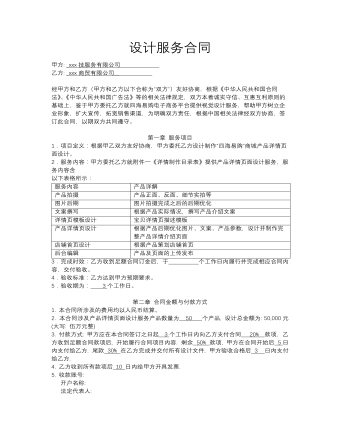
甲方: _xxx技服务有限公司 乙方: _xxx商贸有限公司__ 经甲方和乙方(甲方和乙方以下合称为“双方”)友好协商,根据《中华人民共和国合同法》、《中华人民共和国广告法》等的相关法律规定,双方本着诚实守信、互惠互利原则的基础上,鉴于甲方委托乙方就四海易购电子商务平台提供视觉设计服务,帮助甲方树立企业形象,扩大宣传,拓宽销售渠道,为明确双方责任,根据中国相关法律经双方协商,签订此合同,以期双方共同遵守。第一章 服务项目1.项目定义:根据甲乙双方友好协商,甲方委托乙方设计制作“四海易购”商城产品详情页面设计。2.服务内容:甲方委托乙方就附件一《详情制作目录表》提供产品详情页面设计服务,服务内容含以下表格所示:服务内容 产品详解产品拍摄 产品正面、反面、细节实拍等图片后期 图片拍摄完成之后的后期优化文案撰写 根据产品实际情况,撰写产品介绍文案详情页模板设计 宝贝详情页描述模板产品详情页设计 根据产品后期优化图片、文案、产品参数,设计并制作完整产品详情介绍页面店铺首页设计 根据产品策划店铺首页后台编辑 产品及页面的上传发布
委托设计合同书
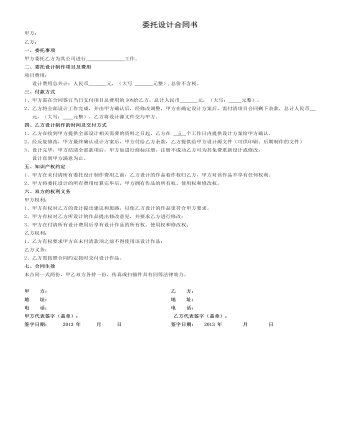
一、委托事项甲方委托乙方为其公司进行 工作。 二、委托设计制作项目及费用项目费用:设计费用总共计:人民币 元,(大写 元整),总价不含税。 三、付款方式1、甲方需在合同签订当日支付项目总费用的50%给乙方,总计人民币 元,(大写: 元整)。2、乙方将全部设计工作完成,并由甲方确认后,经修改调整,甲方在确定设计方案后,需付清项目合同剩下余款,总计人民币 元,(大写: 元整)。乙方将设计源文件交与甲方。四、乙方设计制作的时间及交付方式1、乙方在收到甲方提供全部设计相关需要的资料之日起,乙方在 5 个工作日内提供设计方案给甲方确认。2、经反复修改,甲方最终确认设计方案后,甲方付给乙方余款,乙方提供给甲方设计源文件(可供印刷、后期制作的文件)3、设计完毕,甲方结清全部款项后,甲方如进行商标注册,注册不成功乙方可为其免费重新设计或修改。设计直到甲方满意为止。
装饰设计合同
发包人委托设计人承担装修室内工程设计,经双方协商一致,签订本协议。第一条 本合同依据下列文件签订:1.1《中华人民共和国合同法》《建设工程勘察设计市场管理规定》。1.2国家地方有关建设工程勘察设计管理法规和规章。1.3建设工程批准文件。序号 分工程名称 建设规模 设计阶段及内容 估算总投资<万元) 费率% 设计费<万元)层数 建筑面积<m2) 公用部分 室内部分 施工图 1 合计 说明 1. 本设计不包括园林、厨房和智能化设计。2. 本设计不负责建报图和竣工图。第二条 本合同设计工程的内容:名称、规模、阶段、投资及设计费等见下表。