-
中班数学:快乐的小鱼课件教案
2、通过游戏培养幼儿对数学活动的兴趣;活动重点:复习认识以上三种图形;活动难点:掌握以上三种图形的特征;活动准备:用圆形、三角形、正方形拼成的小鱼图片,场地上画三个大的圆形、三角形、正方形。
中班数学:会变的圆圆课件教案
2、鼓励幼儿能运用自己已有的经验,通过对圆和圆的不同状态的想象与组合,创作出各种小动物的造型。 活动准备:1、会翻跟斗的圆圆一个、教师范例镜框一幅。 2、各种大小颜色不同的圆若干、水彩笔、固体胶、幼儿用小镜框人手一个。 活动过程:一、看看讲讲,寻找圆圆,体验变身的圆圆◎ 重要提问:1、在我们生活中有哪些东西也是圆圆的?2、 “圆圆”在哪里?它变了以后又躲在哪里?3、教师追问:“半圆形或扇形还能变成什么?”教师小结:原来,调皮的“圆圆”有时是圆圆的,当它翻一个跟斗时,能让自己变成半圆,如果翻两个跟斗就能让自己变成一把小扇子,“圆圆”的本领可大了。
中班数学:《小小飞行员》课件教案
二、重点及难点: 重点:感知8以内的数量 难点:能排除物体大小、颜色的干扰,理解数的实际意义。三、活动准备: 1、纸箱制战斗机(与幼儿人数相等)内有一个,炮弹8发。 2、恶魔城堡情境、小动物若干。四、活动流程: 语言引导、激发兴趣→情景练习、感知数量→排除干扰、巩固练习。五、活动过程:(一)、语言引导、激发兴趣 说明:请幼儿当小小飞行员上蓝天练本领,登上飞机。
中班数学:聪明的玩家课件教案
2、继续学习正确目测6以内的数群。3、乐意主动的讲述自己的操作过程和结果。活动准备:1、经验准备:幼儿已认识过数字,并乐意用目测数群的方法进行数数活动。2、物质准备: (1)教具:分类底版,6以内的实物卡片,相应数量的数卡 (2)学具:聪明的玩家(分类底版,6以内的各种实物卡片,相应数(点)卡等) 给一样多的发花(不同排列形式的实物操作卡,雪花片) 一样多的放一起(6以内不同排列形式的实物卡片)
中班数学:聪明的小动物课件教案
2、培养幼儿的观察力、判断力和思维的敏捷性。3、学习9以内数的点数,按数取物,分类计数。 [活动准备]1、大图画4幅,每幅画有房子4间。塑料几何图形片若干。2、画有9只小兔的背景图1幅,分类计数表1张,磁性数字卡0——9,磁性黑板。3、玩具保龄球2袋。
中班数学:家里的数字课件教案
三、准备: 1、幼儿人手一张记录卡; 家里的数字: 2、课件制作:我的家 课件一:家里的各种物品(鞋、桌子、椅子、茶杯、玩具、电视机等物品)。 4 6 5 3 2 1 课件二:厨房、客厅、卧室。 三、过程: 观看录像一)、认识数字,理解6以内各数字的实际意义: 1、幼儿交流记录卡,说说在家中发现了哪些数字? A、直观的数字(数序):如、电话上的数字、钟上的数字、电器上的数字;
中班数学:复习几何图形课件教案
2、让幼儿大胆想象,运用几何图形进行拼搭创造。活动准备:图形宝宝图片、背景图、固体胶、纸、环境布置活动重点:复习巩固对几何图形的认识活动难点:运用几何图形进行拼搭创造活动流程:引出课题 游戏巩固 活动延伸
中班数学:复习6的组成课件教案
2.积极参与讨论活动,大胆讲述自己的意见。活动准备:6的分合卡片,分类图一张。记录单、记号笔幼儿人手一份。 活动过程:1、复习5以内数的组成(1)游戏:碰球游戏前,由教师确定碰几球,如碰5球。教师问:“嗨,嗨,我的1球碰几球?”幼儿答:“嗨,嗨,我的1球碰4球?”速度可随着幼儿的熟练程度逐渐加快。游戏先集体后个人。
中班数学:分类计数课件教案
2、培养幼儿用语言讲述操作结果的习惯。活动准备: 图形拼图一幅,标记卡、数字卡若干,各种图形若干,数字印章,印泥、操作用纸若干。
中班数学:《蜘蛛买鞋》课件教案
2、感受儿歌幽默有趣的语言风格。3、学习改变儿歌的数字并仿编新的诗句。 4、聆听音乐并用仿编的内容歌唱和表演活动准备:各种鞋及图卡数张、每人10枚硬币、每人一个小盒子。活动重点:学习10以内简单加减概念。活动难点:改变儿歌数字、并仿编新的诗句。活动过程:开始部分:问幼儿:小朋友你有几只脚?穿几只鞋?蜘蛛有几只脚?穿几鞋?基本部分:1 、教师和幼儿一起看屏幕,念儿歌《蜘蛛买鞋》念过一遍后,请幼儿再次念儿歌。同时拿出与鞋子等值的硬币、念到最后一句:"总共花了10元钱"时,请幼儿算算桌面上总共有多少钱,再作出答案。
中班数学:7是多少课件教案
准备 l~7数字卡片若干套,画有不同数目的图片若干套(两个小人;两件衣服;一个杯子、一顶帽子;3只鸭;一根蚊香、一瓶香水、一枝月季;一个苹果、一个香蕉、一对连枝樱桃、一块糖……)。
中班数学:5以内的序数课件教案
二、活动目标:1、认识5以内的序数,学习序数词“第几”。2、能从不同的方向找到物体排列的位置。3、发展观察能力、判断能力,提高动手操作能力。三、活动准备:1、有5层高的楼房背景图一幅,幼儿熟悉的小动物5个,如小狗、小猫、小兔、小猪、小猴等。2、幼儿每人一份操作材料:5只不同的小动物,有5节车厢的火车或有5棵小树的图片等。
【高教版】中职数学基础模块上册:2.2《区间》教案设计
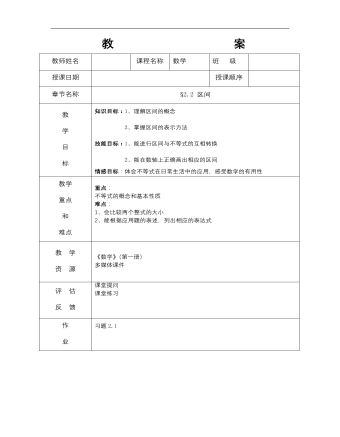
教师姓名 课程名称数学班 级 授课日期 授课顺序 章节名称§2.2 区间教 学 目 标知识目标:1、理解区间的概念 2、掌握区间的表示方法 技能目标:1、能进行区间与不等式的互相转换 2、能在数轴上正确画出相应的区间 情感目标:体会不等式在日常生活中的应用,感受数学的有用性教学 重点 和 难点 重点: 不等式的概念和基本性质 难点: 1、会比较两个整式的大小 2、能根据应用题的表述,列出相应的表达式教 学 资 源《数学》(第一册) 多媒体课件评 估 反 馈课堂提问 课堂练习作 业习题2.1
人教版高中历史必修3辉煌灿烂的文学教案
一、知识与能力:(1)了解中国古代不同时期的文学特色;(2)了解、诗,词、歌、赋等各种不同的知识内容和形式,知道和掌握一定数量的名家作品;(3)拓宽文化视野,提高赏析和运用古代文学作品的能力。二、过程与方法:(1)通过教科书及教师提供的材料以及自己的日常积累,通过阅读,讨论,分析,评论了解各个不同时期的文学发展特色。(2)通过阅读,观察,练习,欣赏,表演,评论,创作等方式积极参与教学;通过独立思考或合作学习对所学的内容进行比较,概括和阐释;学会合作学习和相互交流。三、情感态度与价值观:通过本课学习,了解中国古代灿烂的文化。通过对文学家、诗人及其文学作品的分析,把学生带进文学艺术的殿堂,感受古人的呼吸,思想,情操。增强文化修养。
人教版高中历史必修3宋明理学教案2篇
二、程朱理学:1、宋代“理学”的产生:(1)含义:所谓“理学”,就是用“理学”一词来指明当时两宋时期所呈现出来的儒学。广义的理学,泛指以讨论天道问题为中心的整个哲学思潮,包括各种不同的学派;狭义的理学,专指程颢、程颐、朱熹为代表的,以“理”为最高范畴的学说,称为“程朱理学”。理学是北宋政治、社会、经济发展的理论表现,是中国古代哲学长期发展的结果,是批判佛、道学说的产物。他们把“理”或“天理”视作哲学的最高范畴,认为理无所不在,不生不灭,不仅是世界的本原,也是社会生活的最高准则。在穷理方法上,程颢“主静”,强调“正心诚意”;程颐“主敬”,强调“格物致知”。在人性论上,二程主张“去人欲,存天理”,并深入阐释这一观点使之更加系统化。二程学说的出现,标志着宋代“理学”思想体系的正式形成。【合作探究】宋代“理学”兴起的社会条件:
新人教版高中英语必修3Unit 2 Morals and Virtues教学设计四
3.Teachers ask different groups to report the answers to the questions and ask them to try different sentence patterns.The teacher added some sentence patterns for students to refer to when writing.Step 4 Writing taskActivity 51.Write the first draft.Students first review the evaluation criteria in activity 5, and then independently complete the draft according to the outline of activity 4, the answers to the questions listed in the group discussion and report, and the reference sentence pattern.2.Change partners.The teacher guides the students to evaluate their partner's composition according to the checklist of activity 5 and proposes Suggestions for modification.3.Finalize the draft.Based on the peer evaluation, students revise their own compositions and determine the final draft.Finally, through group recommendation, the teacher selects excellent compositions for projection display or reading aloud in class, and gives comments and Suggestions.Step 5 Showing writingActivity 5T call some Ss to share their writing.Step 6 Homework1. Read the passage in this section to better understand the passage.2. Carefully understand the hierarchical structure of the article, and deeply understand the plot of the story according to the causes, process and results;3. Independently complete the relevant exercises in the guide plan.1、通过本节内容学习,学生是否理解和掌握阅读文本中的新词汇的意义与用法;2、通过本节内容学习,学生能否通过人物言行的对比分析道德故事的深层内涵;3、通过本节内容学习,学生能否根据故事的起因、经过和结果来深入理解故事的情节,从而了解文章的层次结构;4、结合现实生活案例发表自己的见解和看法,写一篇观点明确、层次分明的故事评论。
新人教版高中英语必修3Unit 3 Diverse Cultures教学设计四
该板块的活动主题是“介绍一个有显著文化特征的地方”( Describe a place with distinctive cultural identity)。该板块通过介绍中国城继续聚焦中国文化。本单元主题图呈现的是旧金山中国城的典型景象, Reading and Thinking部分也提到中国城,为该板块作铺垫。介绍中国城的目的主要是体现中国文化与美国多元文化的关系,它是美国多元文化的重要组成部分。中国城也是海外华人的精神家园和传播中国文化的重要窗口,外国人在中国城能近距离体验中国文化。1. Read the text to understand the cultural characteristics of Chinatown in San Francisco and the relationship between Chinese culture and American multiculturalism;2. Through reading, learn to comb the main information of the article, understand the author's writing purpose and writing characteristics;3. Learn to give a comprehensive, accurate, and organized description of the city or town you live in;Learn to revise and evaluate your writing.Importance:1. Guide the students to read the introduction of Chinatown in San Francisco and grasp its writing characteristics;2. Guide students to introduce their city or town in a comprehensive, accurate and organized way;3. Learn to comb the main information of the article, understand the author's writing purpose, and master the core vocabulary.
新人教版高中英语选修2Unit 3 Reading for writing教学设计
The theme of this part is to write an article about healthy diet. Through reading and writing activities, students can accumulate knowledge about healthy diet, deepen their understanding of the theme of healthy diet, and reflect on their own eating habits. This text describes the basic principles of healthy diet. The author uses data analysis, definition, comparison, examples and other methods. It also provides a demonstration of the use of conjunctions, which provides important information reference for students to complete the next collaborative task, writing skills, vivid language materials and expressions.1. Teach Ss to learn and skillfully use the new words learned from the text.2. Develop students’ ability to understand, extract and summarize information.3. Guide students to understand the theme of healthy diet and reflect on their own eating habits.4. To guide students to analyze and understand the reading discourse from the aspects of theme content, writing structure, language expression, etc., 5. Enable Ss to write in combination with relevant topics and opinions, and to talk about their eating habits.1. Guide students to analyze and understand the reading discourse from the aspects of theme content, writing structure, language expression, etc.2. Enable them to write in combination with relevant topics and opinions, and to talk about their eating habits.3. Guide the students to use the cohesive words correctly, strengthen the textual cohesion, and make the expression fluent and the thinking clear.Step1: Warming upbrainstorm some healthy eating habits.1.Eat slowly.2.Don’t eat too much fat or sugar.3.Eat healthy food.4.Have a balanced diet.Step2: Read the passage and then sum up the main idea of each paragraph.
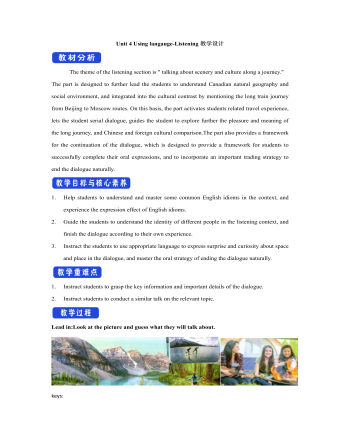
新人教版高中英语选修2Unit 4 Using langauge-Listening教学设计
The theme of the listening section is " talking about scenery and culture along a journey."The part is designed to further lead the students to understand Canadian natural geography and social environment, and integrated into the cultural contrast by mentioning the long train journey from Beijing to Moscow routes. On this basis, the part activates students related travel experience, lets the student serial dialogue, guides the student to explore further the pleasure and meaning of the long journey, and Chinese and foreign cultural comparison.The part also provides a framework for the continuation of the dialogue, which is designed to provide a framework for students to successfully complete their oral expressions, and to incorporate an important trading strategy to end the dialogue naturally.1. Help students to understand and master some common English idioms in the context, and experience the expression effect of English idioms.2. Guide the students to understand the identity of different people in the listening context, and finish the dialogue according to their own experience.3. Instruct the students to use appropriate language to express surprise and curiosity about space and place in the dialogue, and master the oral strategy of ending the dialogue naturally.1. Instruct students to grasp the key information and important details of the dialogue.2. Instruct students to conduct a similar talk on the relevant topic.
新人教版高中英语选修2Unit 5 Using langauge-Listening教学设计
The theme of this section is to learn how to make emergency calls. Students should learn how to make emergency calls not only in China, but also in foreign countries in English, so that they can be prepared for future situations outside the home.The emergency telephone number is a vital hotline, which should be the most clear, rapid and effective communication with the acute operator.This section helps students to understand the emergency calls in some countries and the precautions for making emergency calls. Through the study of this section, students can accumulate common expressions and sentence patterns in this context. 1.Help students accumulate emergency telephone numbers in different countries and learn more about first aid2.Guide the students to understand the contents and instructions of the telephone, grasp the characteristics of the emergency telephone and the requirements of the emergency telephone.3.Guide students to understand the first aid instructions of the operators.4.Enable Ss to make simulated emergency calls with their partners in the language they have learned1. Instruct students to grasp the key information and important details of the dialogue.2. Instruct students to conduct a similar talk on the relevant topic.Step1:Look and discuss:Match the pictures below to the medical emergencies, and then discuss the questions in groups.