-
人教版高中语文必修5《宇宙的未来》教案
(2)怎样理解本文的一些相关论述?【明确】这是一篇科学讲演,涉及较为复杂的背景知识。这些知识和讲演的主题是密切相关的,如果不作必要的交待,讲演的内容就会显得抽象和单薄。如,谈到天气预报、大脑工作原理都具有混沌性质,来反衬宇宙在大尺度上是"平滑而非混沌"的;如,谈到恒星的死亡(归宿)引出黑洞,为宇宙中暗物质的存在寻找理论支持;如,谈到现存宇宙对初始密度的极度敏感,引出了"人择原理"等等。这些相关的论述,或从对立面凸显观点,或从纵深面强化观点,使论证丰富多彩。(3)这篇讲演在语言上具有怎样的特点?【明确】讲演是面对面的交流,这种交流又是单向度的,如果不注意讲演的语言艺术,就达不到最佳的表达效果。这篇讲演,除了推理严谨外,语言幽默也是其突出的特点。幽默的语言创造出一种轻松愉快的气氛,更具有亲和力,使所阐发的事理更容易为听众接受。
人教版高中语文必修5《咬文嚼字》教案
【教学过程】第一课时一、导入新课清代唐彪在《读书作文谱》中引用武叔卿的话说:“文章有一笔写成不加点缀而工者,此神到之文,尚矣。其次须精思细改,如文章草创已定,便从头至尾—一标点。”同学们能列举出文学史上的作家哪些属于前者,哪些属于后者吗?前者有李白。后者如贾岛、王安石、欧阳修、曹雪芹等。(贾岛有关于推敲的典故。王安石修改“春风又绿江南岸”句传为佳话。欧阳修《醉翁亭记》的开头便是精心改成的。《红楼梦》更是“披阅十载,增删五次。”)提问:古今的伟大作家为什么像李白式的诗人很少,而大多数人却都要“咬文嚼字”,苦苦修改呢?这节课我们就来研究一下这个问题。二、整体感知1.快速浏览全文,熟悉主要内容。2.根据“学习重点”,确立学习目标。三、课文分析1.理清观点与材料的关系。首先,让学生找出本文在论证中所运用的材料。
人教版高中语文必修4《李清照词两首》教案
2.【提问】《醉花阴》反映的是早年丈夫赵明诚游宦在外,作者一个人留在家中的生活状况和内心感受。对于这样的“闺怨”题材,应当怎样评价呢?【明确】作者作为一个封建时代的妇女,能够坦率地表达出自己对于丈夫深深的思恋之情,描写了闺中生活的孤独寂寞,这在当时乃是一种很大胆的行为。所以,有人批评说:李清照作词是“无顾忌”地“肆意落笔”。其实,感情的充沛、真挚,敢于正面地展露自己的行为和内心世界,正是她创作成功的重要原因之一,也正是她的词最值得珍视的地方。3.【提问】古人常常爱用花比喻人之美貌,如“芙蓉如面柳如眉”,“人面桃花相映红”等,而李清照却说“人比黄花瘦”,这样的比喻有什么丰富的内涵?【明确】黄色的菊花不止外形上雅淡、清秀,与作者因相思而消瘦的体态相近,而且在菊花品格的传统象征意义上,也酷似作者清高、淡泊的精神,这样的比喻正比较恰切地反映了当时作者由于离开丈夫而孤独、愁闷的生活状态和内心情感。
人教版高中政治必修3文化创新的途径教案
这次大赛我们看到了启发讲授式,合作探究式,情景体验式,信息技术与学科教学整合式等多种教学方法,各有所长,也都发挥了各自不同的教学作用。重庆的李静老师在讲《文化创新的途径》这课中,从一个大家都非常关注的有些争议的张艺谋导演的雅典奥运会闭幕式上8分钟的表演的品评与思辩入手,学生非常兴奋,又到2008年北京奥运会开幕式的点火和文艺演出的创新设计,教学过程中既有学生的现场调查,又有充分发挥学生想象力的小组合作探究,还有小组间彼此的评价。在教学方式的设计上既有体验式,又有合作探究式,还有教师的启发讲授,多种教学方式的整合提高了课堂教学的整体效益。最后还要求学生把他们的设计通过E-mail等方式发给北京奥运会组委会,让学生非常兴奋。”
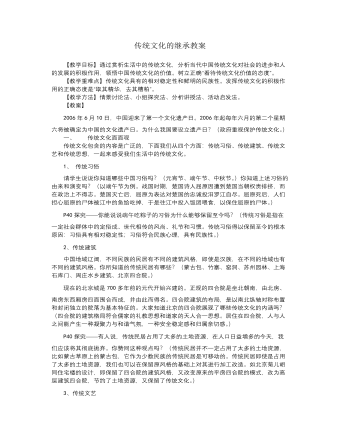
人教版高中政治必修3传统文化的继承教案
思考:在我们今天的生活中,应该如何认识“孝”道?(“孝”为中华民族传统道德之本。在封建社会,“孝”被异化为封建统治阶级统治人民、维系政权的一个最重要的工具;一切听命于“一家之长”的观念,使人们往往屈从于独断的权威或传统的家庭礼教,失去了独立的人格。另一方面,“孝”从它本身意义出发,所包含的尊老、敬老、养老,以及亲亲、爱人、爱国,正是中华民族的一大传统美德,是中华民族家庭和睦、邻里相亲、社会稳定的重要内在因素。因此,孝道已被列为中华传统道德教育的重要内容。)所以我们要辩证地认识传统文化在现实生活中的作用,做到“取其精华,去其糟粕;批判继承,古为今用”。对于传统文化中符合社会发展要求的、积极的、向上的内容,应该继续保持和发扬。对于传统文化中不符合社会发展要求的、落后的、腐朽的东西,必须“移风易俗”,自觉地加以改造或剔除。2、正确对待传统文化的意义
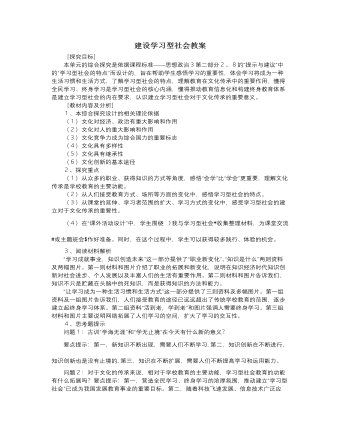
人教版高中政治必修3建设学习型社会教案
三、第三阶段。课后感悟与收获1、让学生以“走向学习型社会”为题,将在收集与整理、展示与交流两个环节中获得的体验和感悟,以心得体会的形式写一篇小论文。2、办一期专栏或黑板报,将优秀小论文作集中展示与交流。(进行理论总结,将实践与理论相结合,让科学理论更好地指导实践。充分挖掘学生潜力,增强学生的自信)[评析]新课程理念之一就是政治课不应只局限于课堂上的教与学。把综合探究课与研究性学习相结合,不失为一种有益的尝试。传统的学习方式把学习建立在客观性、受动性、依赖性的基础上,把学生看成一个没有感情的接受容器,这种学习会窒息学生的思维和智力,成为学生发展的障碍。单元探究活动的开展就是要转变学生的学习方式,关注学生的学习过程,使得探究过程成为学生发现问题、提出问题、分析问题、解决问题的过程,培养学生的创新精神和实践能力。本教案的第一阶段充分发挥了学生的主动性。
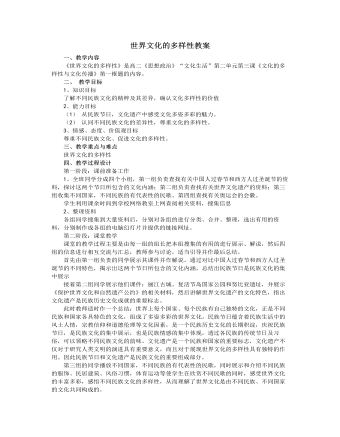
人教版高中政治必修3世界文化的多样性教案
五、课后反思课后组织学生讨论对本课的感受,同学们都非常乐意采取这种上课方式,既可以通过资料的搜集、整理提高自身信息采集的能力,也能够提高自己学习积极性,变枯燥为生动。本人在教学中也深深地感到:一方面,充分发挥学生的主体作用,有利于启发同学的思维,培养自主思考的能力。而充分利用网络的教学功能,将现代信息技术和学科教学很好地结合了起来。只有调动全体同学的积极性、主动性、创造性,我们的教学才能有生命力;另一方面,光有学生的活动也不行,虽然学生能够积极投入地利用互联网搜集并动手制作课件,在课堂交流中能很好地进行发散思维和创造性思维,但其集中思维和抽象性思维还存在一定的缺陷,主要体现在对搜集的材料的取舍是以及对知识点的归纳和深化方面,所以在充分发挥学生的主体作用的同时应该也必须重视教师主导作用的发挥,引导学生由形象到抽象、由发散到集中、由演绎到归纳的思维能力的逐步提高。
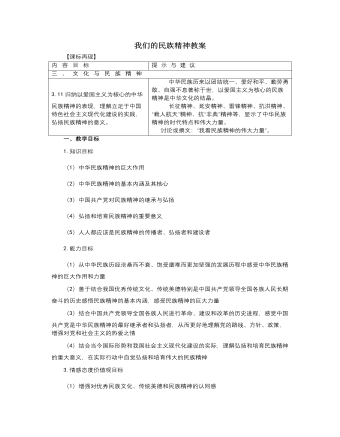
人教版高中政治必修3我们的民族精神教案
2.弘扬和培育中华民族精神,是提高全民族综合素质的必然要求Why:(1)一个民族的发展也取决于民族的综合素质(2)民族精神是民族综合素质的有机组成和集中体现(3)高昂奋进的民族精神能产生巨大的力量,发挥不可估量的作用学生活动:你能举出生活中民族素质有待提高的事例吗?试着分析一下如何解决。举例:南京的市骂、中国公民在国外的随地吐痰、乱扔乱丢现象。3.弘扬和培育中华民族精神,是不断增强我国国际竞争力的要求Why:(1)文化在综合国力的竞争中的地位和作用越来越突出(2)民族精神作为中华文化的精髓,具有凝聚和动员民族力量、展示民族形象的重要功能,已成为表明综合国力强弱的至关重要的因素之一学生活动:“忆一忆”文化在综合国力竞争中具有怎样的意义?(P11、P22,关键词:精神武器、深深熔铸、重要标志、智力支持、方向保证、精神动力)
人教版高中政治必修3世界文化的多样性教案
代中国人民的四大发明,古希腊人的哲学与艺术成就,占代印度人民在宗教和数学方面的成就等,都以其鲜明的民族特色}:富J,世界文化,共同推动了人类社会的进步和发展。总之,尊重和保存不同的民族文化,是人类生存和发展的基础。◇课堂探究:(1)对那些面临失传的占老民族文化,有人反对进行抢救和保护,认为应当顺其自然地让它们被历史淘汰。你同意这种看法吗?(2)你认为,我们还有哪些独特的文化形式可以申报人类口述和非物质遗产?◇探究提示:(1)文化遗产是一个民族的“身份证”,从文化意义上标识出一个民族的个性和一个民族的历史记忆。文化遗产是人类社会发展的见证,是人类文明的重要载体。文化遗产体现着一个民族独特的思维方式和文化价值,是民族的根基,是历史的纪念碑。文化遗产既属于一个国家、一个民族,也是全人类的共同财富。文化遗产具有不可再生性的特点,所以对那些面临失传的古老民族文化,我们不能坐视不管,要进行及时有效地抢救和保护。
人教版高中政治必修3文化与经济、政治教案
另一方面,文化素质影响公民政治权利的行使。随着民主和法制建设的发展,人们为了参与政治生活,需要更高的文化素养。文化水平提高了,人们受到的教育、接受的信息就越多,活动的领域就越广,民主法制和权利意识就越强,这些都会影响人们的民主素质和民主水平,使人们更好地进行政治参与,行使民主权利。(2)文化与国际政治相互交融,成为当代国际政治斗争的重要内容。随着世界多极化的发展,奉行霸权主义的国家,借助文化渗透的方式,竭力推销自己的价值观念,企图削弱和取代别国的民族文化,以推行强权政治。这使世界范围内反对文化霸权主义的斗争,成为当代国际政治斗争的重要内容。文化已经成为进行政治斗争、国际斗争的重要形式之一。对文化市场的争夺不仅仅是争夺票房价值、争夺经济效益,更主要的是对受众对象的争夺,对受众注意力这种特殊的稀缺资源的占有,以及在此基础上对舆论的控制与引导。因此,失去文化市场就意味着失去政治优势,意味着政治影响力的边缘化乃至萎缩或丧失。这一点,从目前世界正在进行的空前规模的“文化战争”,可以看得非常清楚。
人教版高中政治必修4价值与价值观精品教案
一、教材分析我们使用的是人教版第四册《生活与哲学》教材,本框属于第四单元第十二课第一框题。其内容主要分两目,第一目主要介绍价值的含义、人是社会一切财富的创造者、人的价值在于创造价值和对社会的责任和贡献,以及对一个人的评价主要看他的贡献等内容。第二目主要介绍价值观的导向作用,内容包括价值观的含义、价值观对人们认识世界和改造世界的活动具有导向作用以及对人生道路的选择具有导向作用。二、教学目标知识目标:1、识记价值和价值观的基本含义;价值观的导向作用。2、理解人的价值是什么?如何评价人的价值。3、运用所学知识及相关哲学原理,分析物的价值和人的价值的 不同,从中加深对人的价值的理解评论分析为什么对一个人的评价要看他的贡献,而不是索取了多少。
人教版高中政治必修4意识的本质精品教案
一、教材分析《意识的本质》是人教版高中政治必修四第5章第1框的教学内容,主要学习意识是客观存在的反映。二、 教学目标1.知识目标:识记意识的本质;理解意识是物质世界长期发展的产物、意识是人脑的机能、意识是客观存在的反映。2.能力目标:通过对意识起源和本质的原理学习,使学生逐步确立辨证唯物注意的意识观,具有正确认识意识现象、分辨物质和意识的界限、把握二者之间辨证关系的能力。3.情感、态度和价值观目标:牢固树立物质决定意识,意识对物质具有反作用的思想观点,坚定辨证唯物主义的信仰。三、教学重点难点意识的本质四、学情分析本框题的内容比较简单,主要是为学习第二框意识的作用作铺垫和准备的,所以,教师在讲这节课时不要在具体内容上花过多的时间。
人教版高中政治必修4世界的物质性精品教案
1.知识目标:◇识记 :(1)自然界的物质性(2)物质的含义(3)人类社会的物质性◇理解:(1)世界的物质性(2)自然界是物质的,不是上帝和神创造的(3) 物质和具体的物质形态的区别和联系(4)劳动创造了人和人类社会(5)人类社会是物质世界长期发展的产物◇分析:(1)联系当前自然界中万事万物的发展变化,说明自然界的物质性 (2)联系我国当前的社会改革以及社会发展的状况,说明人类社会的物质性(3)用课本知识分析,世界是物质的世界,世界的真正统一性在于它的物质性2.能力目标:(1)通过学习,体会如何去理解一个哲学观点,初步了解学习哲学的基本方法(2)通过学习、体会、分析与综合的思维方法,提高分析问题的能力(3)通过收集和分析材料,培养收集材料和整理材料的能力3.情感、态度和价值观目标:通过对本课的学习,能从世界本质问题上指出有神论的荒谬性,从根本上消除有神论的影响,初步树立唯物主义的自然界、世界观 三、教学重点难点重点:世界的物质统一性原理
新人教版高中英语必修2Unit 2 Wildlife Protection-Listening &Speaking&Talking教案
Listening and Speaking introduces the topic of “how to save endangered wildlife and help wildlife in their neighborhood.” Due to the continuous deterioration of the living environment, a large number of wild animals are always facing the threat of endangered or extinction. Listening and speaking period enables students to understand the fact and reason why wild species are disappearing from the earth at an amazing speed, and realize that human beings ought to enhance the awareness of protecting wild species as soon as possible.Listening and Talking introduces the theme of " how to help wildlife in Ss’ neighborhood.". Now there are many volunteers who spontaneously protect wild animals, carry out various activities according to local conditions, and contribute their own strength to local animal protection with practical actions. Middle school students are also enthusiastic participants. They organize activities in their spare time, and take this opportunity to make friends, broaden their horizons, cultivate team spirit and communication skills. This section describes a bird watching activity organized by several middle school students of Bird watching Club. It aims to stimulate students' interest, improve their understanding of bird watching activities, and use the language structure of “being used for; in order to, so as to, to, so that, in order that ” to express the purpose for communication and discussion.1. Guide students to understand the content of listening texts in terms of using visuals to predict content.2. Cultivate students' ability to guess the meaning of words in listening; discuss with their peers how to save endangered wildlife and help wildlife in their neighborhood.3. Instruct students to use functional sentences of the dialogue such as “I am concerned about…” “what do you know about the endangered animals in…" and so on to talk about one of the endangered animals.
新人教版高中英语必修2Unit 2 Wildlife Protection-Reading For Writing教案一
1. 标题首先根据海报的特点、格式写明标题。海报中往往把内容作为大标题。例如: Save the earth, Save the birds。2. 正文部分不同的海报其正文部分的侧重点不同。对于介绍性的海报, 首先要引出话题, 其次列出原因, 最后是总结。对于宣传类的海报, 要写明具体内容, 如: 活动内容, 地点以及参加活动的注意事项, 主持或举办单位等。1. 图片: 要选择引人注目的图片, 与主题要相关, 色彩明亮。话题句式 1. It is a treasure of our country. 它是我国的国宝。2. Believe it or not, at present only several thousand pandas exist in the world. 信不信由你, 目前世界上仅现存几千只熊猫。 3.It’s because of human activities that tigers are endangered. 正是因为人类的活动, 老虎处于濒危的状态。4. Many wild animals are in danger of dying out. 很多野生动物面临着灭绝的危险。 5. The government has taken effective measures to protect them. 政府已采取有效的措施来保护它们。6. People should raise the awareness of the protection of wild animals. 人们应该提高保护野生动物的意识。 7. It’s amazing that there are merely less than 1, 000 finless porpoises living in China. 非常令人吃惊, 目前中国仅有不足1 000只江豚。
新人教版高中英语必修2Unit 3 The Internet-Listening &Speaking&Talking教案一
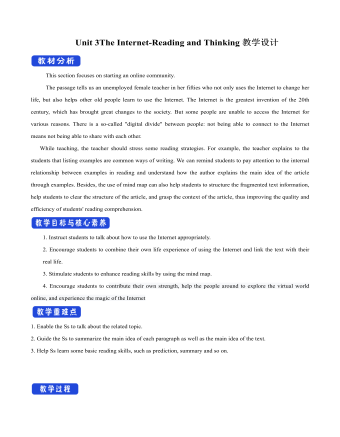
Listening and Speaking introduces the topic of “ask about online habits”. Many middle school students have been surfing the Internet for many years, but what they do with the Internet and how much time they spend every day may not be very clear to themselves, nor to other students. This section allows students to investigate their peers' Internet use, which is conducive to their mutual understanding and understanding of the Internet. It can also help them reflect on their own online behavior, learn from other people's good online habits, and get rid of their bad online behavior.The listening text of this section is an investigation interview. The investigators interview specific groups with the same questions to obtain information, so as to understand their views, practices or attitudes on this issue. There are two specific questions: “how much time do you spend online every day? What do you usually do online?”. The answers of the three respondents provide rich and different information, and achieve the purpose of the investigators. The oral discourse structure of survey interviews generally includes greeting and explaining the purpose of the interview, presenting the interview questions and the respondents' answers. Listening and Talking introduces the theme of “choosing the right application ". Listening text is a conversation between Laura and Xiao Bo. In this part of listening, “oink”; “piggy bank” may cause the students' hearing comprehension limitation. Oink refers to sound word and pig's sound. So, add some oink to my piggy bank is often used to describe "making a little money".1. Guide students to understand the content of listening texts in terms of listening for definitions.2. Cultivate students' ability to define words and understand an investigation interview.
新人教版高中英语必修2Unit 3 The Internet-Reading and Thinking教案一
Paragraph 3. Jan decided to start an IT club to teach old people how to use computers and the Internet. Paragraph 4. Jan has started taking online classes to learn more about how to use the Internet to make society better. Paragraph 5. Jan’s life has been greatly improved by the Internet. Step 5: Critical thinking:(1)How do you arrange your time spent on study and the Internet? Is it reasonable? I usually surf the Internet using my mobile phone for only an hour after class, and it is reasonable for me.(2)What are your online activities? Are they safe? I chat with my friends, read news and play games. I never give away my private information so I think they are safe.Step 4: summary Much has been written about the wonders of the World Wide Web. There are countless articles (1)______(tell) us how the Internet has made our lives more convenient. But the Internet has done a lot (2)_____(much) for people than simply make life more convenient. People’s lives (3) _________________(change) by online communities and social networks so far. Take Jan for example, who developed a serious illness that made her (4)_____(stick) at home with only her computer to keep (5)___(she) company. She joined an online group (6)______ she could share problems, support and advice with others. She considered the ability to remove the distance between people as one of the greatest (7)_______(benefit). She was so inspired (8)____ she started an IT club in which many people have been helped. She has started to learn more about how to use the Internet to make society better. Her next goal is to start a charity website to raise money (9)___ children in poor countries. Jan’s life has been (10)______(great) improved by the Internet. Step 5 Homework:Review what we have learned and find out the key language points in the text.
新人教版高中英语必修2Unit 4 History and Traditions-Discovering Useful Structure教案二
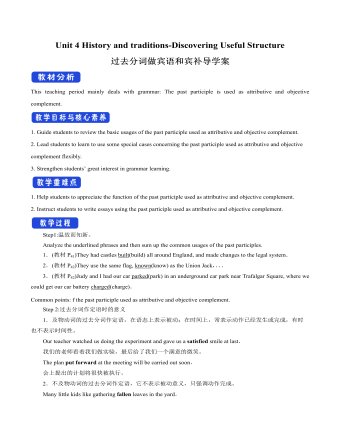
This teaching period mainly deals with grammar: The past participle is used as attributive and objective complement.1. Guide students to review the basic usages of the past participle used as attributive and objective complement.2. Lead students to learn to use some special cases concerning the past participle used as attributive and objective complement flexibly.3. Strengthen students’ great interest in grammar learning.1. Help students to appreciate the function of the past participle used as attributive and objective complement.2. Instruct students to write essays using the past participle used as attributive and objective complement.Step1:温故而知新。Analyze the underlined phrases and then sum up the common usages of the past participles.1.(教材P41)They had castles built(build) all around England, and made changes to the legal system.2.(教材P42)They use the same flag, known(know) as the Union Jack,...3.(教材P42)Judy and I had our car parked(park) in an underground car park near Trafalgar Square, where we could get our car battery charged(charge).Common points: f the past participle used as attributive and objective complement.Step 2:过去分词作定语时的意义1.及物动词的过去分词作定语,在语态上表示被动;在时间上,常表示动作已经发生或完成,有时也不表示时间性。Our teacher watched us doing the experiment and gave us a satisfied smile at last.我们的老师看着我们做实验,最后给了我们一个满意的微笑。The plan put forward at the meeting will be carried out soon.会上提出的计划将很快被执行。2.不及物动词的过去分词作定语,它不表示被动意义,只强调动作完成。Many little kids like gathering fallen leaves in the yard.
新人教版高中英语必修2Unit 4 History and Traditions-Reading and Thinking教案一
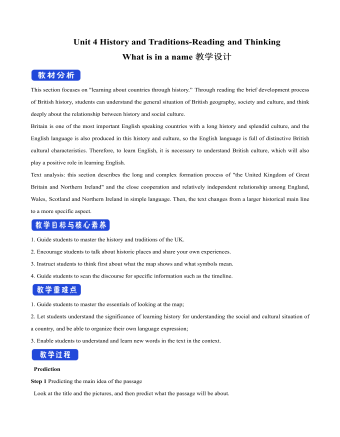
Features of languages1.Finally, in the 20th century, the southern part of Ireland broke away from the UK, which resulted in the full name we have today: the United Kingdom of Great Britain and Northern Ireland.该句是一个复合句。该句主句为:the southern part of Ireland broke away from the UK;which resulted in the full name we have today为which引导的定语从句代指前面整句话的内容,we have today为定语从句修饰先行词name。译文:最后,在20世纪,爱尔兰南部脱离英国,这导致了我们今天有的英国的全名:大不列颠及北爱尔兰联合王国。2.Almost everywhere you go in the UK, you will be surrounded by evidence of four different groups of people who took over at different times throughout history.该句是一个复合句。该句主句为:you will be surrounded by evidence of four different groups of people;其中Almost everywhere you go in the UK为让步状语从句; who took over at different times throughout history为定语从句修饰先行词people。译文:几乎无论你走到英国的任何地方,你都会发现历史上有四种不同的人在不同的时期统治过英国。3.The capital city London is a great place to start, as it is an ancient port city that has a history dating all the way back to Roman times.该句是一个复合句。该句主句为:The capital city London is a great place to start; as it is an ancient port city that has a history dating all the way back to Roman times.为原因状语从句;dating all the way back to Roman times为现在分词短语作定语修饰history。
新人教版高中英语必修2Unit 5 Music-Listening&Speaking&Talking教案
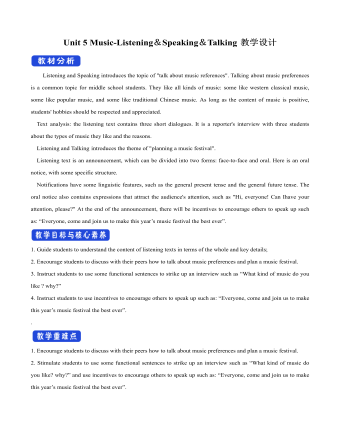
choir memberspeople to run food stands people to sell festival ticketspeople to sell music CDspeople to set up equipmentmusical performersStep 2: Listen to the announcement again and answer the questions. ? 1. What kind of songs will Grace Davis sing at the festival?? 2. Who can try out as a performer?? 3. What can those who think they do not have musical talent do?? 4. How can students volunteer to take part?? Talking about preferences:? Would you prefer doing ..?? What would you prefer to do?? Would you rather do .... or ….?? What would you rather do?? I'd prefer .... to ..? I'd rather have ... than .. Step 3: Speaking ProjectWork in groups. Role-play the conversation or make a new one.? Debbie: Where have you been? You missed the announcement about the music festival.? John: I was at the doctor's office. Music festival?? Frank: Yes, it's going to be next month on the school sports field. John, you can play the piano. How about playing it at the festival?? John: Well, I'd rather play the violin. I can play Liang Zhu.? Frank: Wow! Sounds good. What about you, Debbie? ? Debbie: Actually, I don't have much musical ability. I'd prefer just to help out with the crowds.? Frank: You can sell tickets or work at a food stand.? John: So can I assume that the aim of the festival is to raise money?? Debbie: Yes. All of the money will go to charity.