-
人教版高中政治必修3体味文化教案2篇
3、文化是人们的一种素养(1)人的文化素养是在社会生活、实践中形成的。每个人所具有的文化素养,不是天生的,而是通过对社会生活的体验,特别是通过参与文化生活、接受知识文化教育而逐步培养出来的。文化素养的形成,离不开生活、实践和教育。人们在社会实践中创造和发展文化,也在社会生活中获得和享用文化。(2)人的文化素养表现在日常言行中。教师活动:引导学生阅读教材7页“公交车漫画”材料,并思考所反映的问题学生活动:积极思考并讨论问题教师点评:人们的精神活动离不开物质活动,人们的文化素养总是要通过他在日常生活中的言行、在社会实践活动中的表现等表现出来。我们通过观察人们的社会行为,就可以从中透视人们的精神世界和精神生活。4、文化的传承和发展离不开物质载体。社会文化和精神产品离不开物质载体,一个时代的文化和精神产品,往往是这一时代社会发展轨迹的反映。
人教版高中政治必修3文化与经济、政治教案
另一方面,文化素质影响公民政治权利的行使。随着民主和法制建设的发展,人们为了参与政治生活,需要更高的文化素养。文化水平提高了,人们受到的教育、接受的信息就越多,活动的领域就越广,民主法制和权利意识就越强,这些都会影响人们的民主素质和民主水平,使人们更好地进行政治参与,行使民主权利。(2)文化与国际政治相互交融,成为当代国际政治斗争的重要内容。随着世界多极化的发展,奉行霸权主义的国家,借助文化渗透的方式,竭力推销自己的价值观念,企图削弱和取代别国的民族文化,以推行强权政治。这使世界范围内反对文化霸权主义的斗争,成为当代国际政治斗争的重要内容。文化已经成为进行政治斗争、国际斗争的重要形式之一。对文化市场的争夺不仅仅是争夺票房价值、争夺经济效益,更主要的是对受众对象的争夺,对受众注意力这种特殊的稀缺资源的占有,以及在此基础上对舆论的控制与引导。因此,失去文化市场就意味着失去政治优势,意味着政治影响力的边缘化乃至萎缩或丧失。这一点,从目前世界正在进行的空前规模的“文化战争”,可以看得非常清楚。
新人教版高中英语必修1Unit 3 Sports and Fitness-Reading and Thinking教案
2. Sort out detailed information about Michael Jordan.(1) Understand the transitional sentence.Q: Which part is about Michael Jordan as a master? Which part is about the example he set?(2) Have the Ss Focus on why Michael Jordan is a master and what good examples Michael Jordan set when they’re reading. And think about these questions as below:Q1: How does the author describe his impressive skills?Q2: How do you understand “time seemed to stand still”?Q3: What does “graceful” mean?Q4. Which sentence do you think best describes his mental strength?Q5. Which words is important in the sentence in describing his mental strength? Why?Q6: How do you understand “unique”?Q7: What can we learn from Michael Jordan?Step 5 Discussing and recommendingRecommend their own living legends of sports.Work in groups to choose your own living legend of sports and give the reasons of your choice. Step 6 HomeworkReview the stories of Lang Ping and Michael Jordan, and try to retell them.
新人教版高中英语必修1Unit 3 Sports and Fitness-Reading for Writing教案
Then have them write a short paragraph to describe and explain their changes. After that, get the Ss to exchange their drafts with their partners and use the checklist to give feedback on their drafts, and finally revise it.Step 5 Summary of how to write a wellness book1.健康书的审题步骤:第一步:明确要求该写作属于经验分享,故要用第一人称来写;时态以一股现在时为主。第二步:确定段落该类文章可以从以下三个方面人手:Para.1首先表明写作的目的Para.2自己的做法及心得体会Para.3表示期望及感谢第三步:提炼要点2.健康书常见句式:1) It is an honor for me to share my favorite sport with you,2) It makes me feel relaxed playing with my friends.3) It makes me rid myself of stress while playing with my friends.4) Moreover, it provides me a valuable chance to communicate with others.5) I we eat too little or too much, or if we choose the wrong food, we may become sick.6) We can do something to change the poor situation.Step 6Homework假如你的老师让你在班级Wellness Bok上分享自己的亲身经历及心得,请根据以下要点写一篇80字左右的文章1. 你喜欢的运动是什么?2. 你最喜欢的原因是什么?3. 你参加锻炼的体会。
新人教版高中英语必修3Unit 1 Festivals and Celebrations教学设计三
*wide range of origins(= a great number of different origins, many kinds of origins)*It featured a parade and a great feast with music, dancing, and sports. (=A parade and a great feast with music, dancing, and sports were included as important parts of the Egyptian harvest festival.)*.. some traditions may fade away and others may be established.(= Some traditions may disappear gradually, while other new traditions may come into being.)Step 6 Practice(1) Listen and follow the tape.The teacher may remind the students to pay attention to the meaning and usage of the black words in the context, so as to prepare for the completion of the blanks in activity 5 and vocabulary exercises in the exercise book.(2) Students complete the text of activity 5 by themselves.The teacher needs to remind the students to fill in the blanks with the correct form of the vocabulary they have learned in the text.Students exchange their answers with their partners, and then teachers and students check their answers.(3)Finish the Ex in Activity 5 of students’ book.Step 7 Homework1. Read the text again, in-depth understanding of the text;2. Discuss the origin of festivals, the historical changes of related customs, the influence of commercial society on festivals and the connotation and essential meaning of festivals.3. Complete relevant exercises in the guide plan.1、通过本节内容学习,学生是否理解和掌握阅读文本中的新词汇的意义与用法;2、通过本节内容学习,学生能否结合文本特点快速而准确地找到主题句;3、通过本节内容学习,学生能否理清论说文的语篇结构和文本逻辑,了解节日风俗发展与变迁,感悟节日的内涵与意义。
新人教版高中英语必修3Unit 2 Morals and Virtues教学设计三
The joke set her crying.这个玩笑使她哭起来。Step 5 ReadingActivity 31. Students read the small text in activity 3. The teacher provides several small questions to check whether students understand the content of the text and the ideographic function of the -ing form in the text.*Where are those people?*Why did Dr Bethune come to China?*How did he help the Chinese people during the war?*What did Chairman Mao Zedong say about him?2. Ss try to rewrite some sentences using the -ing form. Then check the answers. When checking the answers, the teacher can ask different students to read the rewritten sentences and give comments.Answers:1. he became very interested in medicine, deciding to become a doctor.2. …after hearing that many people were dying in the war.3. Helping to organise hospitals, he taught doctors and nurses, and showed people how to give first aid./ He helped to organise hospitals, teaching doctors and nurses, and showing people how to give first aid.4. …praising Dr Bethune as a hero to be remembered in China.Step 6 PracticeActivity 4Students complete grammar activities 2 and 3 on page 69 of the workbook.Step 6 Homework1. Understand and master the functions and usage of the -ing form;2. Finish the other exercises in Using structures.1、通过本节内容学习,学生是否理解和掌握动词-ing形式作宾语补足语语和状语语的功能和意义;2、通过本节内容学习,学生能否正确使用动词-ing形式描述人物的行为、动作及其经历;3、通过本节内容学习,学生能否独立完成练习册和导学案中的相关练习。
新人教版高中英语必修3Unit 2 Morals and Virtues教学设计四
3.Teachers ask different groups to report the answers to the questions and ask them to try different sentence patterns.The teacher added some sentence patterns for students to refer to when writing.Step 4 Writing taskActivity 51.Write the first draft.Students first review the evaluation criteria in activity 5, and then independently complete the draft according to the outline of activity 4, the answers to the questions listed in the group discussion and report, and the reference sentence pattern.2.Change partners.The teacher guides the students to evaluate their partner's composition according to the checklist of activity 5 and proposes Suggestions for modification.3.Finalize the draft.Based on the peer evaluation, students revise their own compositions and determine the final draft.Finally, through group recommendation, the teacher selects excellent compositions for projection display or reading aloud in class, and gives comments and Suggestions.Step 5 Showing writingActivity 5T call some Ss to share their writing.Step 6 Homework1. Read the passage in this section to better understand the passage.2. Carefully understand the hierarchical structure of the article, and deeply understand the plot of the story according to the causes, process and results;3. Independently complete the relevant exercises in the guide plan.1、通过本节内容学习,学生是否理解和掌握阅读文本中的新词汇的意义与用法;2、通过本节内容学习,学生能否通过人物言行的对比分析道德故事的深层内涵;3、通过本节内容学习,学生能否根据故事的起因、经过和结果来深入理解故事的情节,从而了解文章的层次结构;4、结合现实生活案例发表自己的见解和看法,写一篇观点明确、层次分明的故事评论。
人教版高中地理必修3产业转移教案
1.国家石油价格上涨,导致依赖于国际石油而建立起来的日本重化工业的制造成本提高,产品价格相应提高,削弱了日本重化工产品在国际市场上的竞争力。2.日元 的大幅度升值,意味着日本产品在国际市场上的价格大幅度提高。例如,同样的日本产品,如果原来在国际市场上卖1美元,日元升值1倍后其在国际市场上的售价就达2美元。所以,以国际市场为依托的日本传统产业只好纷纷向海外转移。3.自身市场满足不了发展需求,国际市场上亚洲发展中国家和地区的同类产品具有明显的价格优势。所以,日本企业在其国内发展的空间很小。4.劳动力价格高反映为产品的价格高,而劳动力数量又满足 不了企业进一步扩展对劳动力的需求。所以,日本从事传统产业的国内企业生产受劳动力价格和数量的双重制约。5.促进日本企业生产的区位选择向国土的南、北部和海外扩展。6.“技术立国”的政策明显对传统产业在国内生产不利,即企业生产要么向知识技术密集型转换(这需要大量的投资),要么转向海外。
人教版高中地理必修3区域农业发展教案
1.归纳珠江三角洲发展基塘生产有利的地理条件。珠江三角洲地势低平,河网密布,降水充沛。北回归线从珠江三角洲的北部穿过。珠江三角洲地区发展基塘农业生产有利条件可以结合材料,归纳为三个方面:地形、气候、市场(当地和海外)。2.基塘生产将哪些产业联系起来?哪些副产品(或废弃物)被充分利用起来?这种联系对农村经济发展有什么作用?基塘生产环节将种植业(桑、蔗等)、养殖业(养蚕、养鱼)、工业(丝厂、糖厂)等几种产业紧密的联系在一起。在此环节中,塘泥、蚕沙(蚕屎)、蚕蛹、缫丝、滤泥、蔗叶等副产品被充分的回收利用。养蚕业、蔗糖加工业同塘鱼养殖业紧密结合,作为一种综合的经营,几者之间相互依存、相互促进、扬长补短,有机地循环联系起来。基本上解决了桑、蔗的肥料和蚕、鱼的饲料问题。不仅养蚕、蔗糖加工和养鱼生产稳定,而且成本也大大降低。
人教版高中地理必修3区域工业化与城市化教案
知识和技能 1、 了解区域工业化和城市化之间的关系,以及它们对区域社会经济发展所起的作用 。2、分析导致珠江三角洲工业化和城市化快速推进的诸多思想束缚,并通过比较,认识到对外开放政策是其中的关键因素。3、 比较珠江三角 洲的 区工业化进程的两个主要阶段,归纳出不同时期的主要发展特点,并能够结合具体案例分析工业化进程对城市化的巨大推动。 4、分析珠江三角洲地区工业化和城市化进程中的问题,并尝试评价目前的一些调整措施和发展方向。5、通过分析我国珠江三角 洲地区工 业化、城市化的发展阶段、问题与对策,了解区域工业化和城市化的推进动力和发展规律。过程与方法 利用扮演不同的社会角色来谈对珠江三角洲地区未来经济和城镇发展的设想和建议,反馈学生知识、能力、价值观发展情况和效果, 培养学生对所学所得的运用能力,并为学生的创新精神的发 展营造有利氛围。情感、态度与价值观1、通过鼓励学生主动获 取资料的做法,关注学生实践能力、综合思维能力及终身学习能力的训练。
人教版高中语文必修3《劝学》教案2篇
五.研习第一段:1.诵读指导要处理好句中停顿2.请学生对照注释翻译本段重点词句:学不可以已已:停止。青,取之于蓝而青于蓝于:从;比。木直中绳中:zhàng符合,合于。虽有槁暴,不复挺者,揉使之然也有通又,揉通煣,以火烘木,使其弯曲。然:这样。翻译:故木受绳则直,金就砺则利,君子博学而日参省乎己,则知明而行无过矣。所以木材经墨线画过(再用斧锯加工)就直了,金属刀剑拿到磨刀石上(磨过)就锋利了,君子广博地学习并且每天对自己检验反省,就能智慧明达,行为没有过错了。3.本段是从哪个角度论述中心论点的?明确:本段是从学习的意义这个角度论述中心论点的。荀子认为人的知识、道德、才能都不是天生成的,而是后天不断学习获得的,学习的意义十分重大,所以学习不能停止。4.本段中几个比喻句是为了说明什么道理?学生讨论发言,教师明确:
新人教版高中英语必修3Unit 4 Space Exploration-Discovering Useful Structures导学案
【点津】 1.不定式的复合结构作目的状语 ,当不定式或不定式短语有自己的执行者时,要用不定式的复合结构?即在不定式或不定式短语之前加 for +名词或宾格代词?作状语。He opened the door for the children to come in. 他开门让孩子们进来。目的状语从句与不定式的转换 英语中的目的状语从句,还可以变为不定式或不定式短语作状语,从而使句子在结构上得以简化。可分为两种情况: 1?当目的状语从句中的主语与主句中的主语相同时,可以直接简化为不定式或不定式短语作状语。We'll start early in order that/so that we may arrive in time. →We'll start early in order to/so as to arrive in time. 2?当目的状语从句中的主语与主句中的主语不相同时,要用动词不定式的复合结构作状语。I came early in order that you might read my report before the meeting. →I came early in order for you to read my report before the meeting.
新人教版高中英语必修2Unit 1 Cultural Heritage-Discovering Useful Structure教案二
This theme of the part is “ Describe people or things in greater detail”. Students have learned the grammar(restrictive relative clauses) in Book 1, and further review and consolidate its structure “prep+relative pronouns(which/whom)” and the relative adverbs(when, where and why), besides students should understand its form, meaning and functions. In this section, students should be able to express the grammar correctly in daily communication and in the writing. 1. Review the basic usages of relative pronouns and adverbs of attributive clauses . 2. Learn to use some special cases about restrictive relative clauses.3. Learn to write sentences with restrictive relative clauses flexibly according to the context.1. Review the basic usages of relative pronouns and adverbs of attributive clauses .2. Learn to use some special cases about restrictive relative clauses.3. Learn tow rite sentences with restrictive relative clauses flexibly according to the context.Step 1. Observe the following sentences, and mark the relative pronouns and the adverbs. 1. After listening to the scientists who had studied the problems, and citizens who lived near the dam, the government turned to the United Nations for help.2. Temples and other cultural sites were taken down piece by piece, and then moved and put back together again in a place where they were safe from the water.Step 2 PracticePlease complete these sentences with relative pronouns and relative adverbs and answer the following questions.Questions: 1. What is the head noun ?2. What relative words should be used ?3. What elements do they act in these sentences ?
新人教版高中英语必修2Unit 2 Wildlife Protection-Reading for Writing教案二
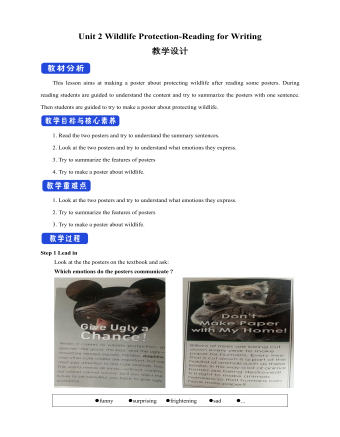
This lesson aims at making a poster about protecting wildlife after reading some posters. During reading students are guided to understand the content and try to summarize the posters with one sentence. Then students are guided to try to make a poster about protecting wildlife.1. Read the two posters and try to understand the summary sentences.2. Look at the two posters and try to understand what emotions they express.3. Try to summarize the features of posters4. Try to make a poster about wildlife.1. Look at the two posters and try to understand what emotions they express.2. Try to summarize the features of posters3. Try to make a poster about wildlife.Step 1 Lead inLook at the the posters on the textbook and ask:Which emotions do the posters communicate ?Step 2 Read the poster and answer the questions.1. What do you think of the animals in the poster on the left ?I think it is frightening and ugly.2. Why do we should protect the ugly animals ?All species--the good, the bad, and the ugly-- should be treated equally.The world needs all kinds--without variety, our planet cannot survive.3. Why are billions of trees being cut down every year ?To make paper for humans.4. What result will be lead to after the trees are cut down ?A lost of animal homes are being destroyed./The habitat of wildlife is being destroyed.Step 3 Find the feature of posters1. What does each poster use to stir up emotions ?On the left, it makes us a little frightened and it looks a little ugly, but it can activate our curiosity--What is it? And What is wrong with it?On the right, it makes us feel a little sad and want to protect them.
新人教版高中英语必修2Unit 1 Cultural Heritage-Reading and Thinking教案二
1. This section focuses on "Understanding how a problem was solved”, which is aimed to guide students to analyze and discuss the challenges and problems faced by cultural heritage protection during the construction of Aswan Dam, as well as the solutions. On the basis of understanding, students should pay attention to the key role of international cooperation in solving problems, and attach importance to the balance and coordination between cultural heritage protection and social and economic development. Students are encouraged to face challenges actively, be good at cooperation, and make continuous efforts to find reasonable ways and means to solve problems.2. Enable students to understand the main information and text structure of the reading text;3. Motivate students to use the reading strategy "make a timeline" according to the appropriate text genre;4. Enable students to understand how a problem was solved;5. Enable students to understand the value of protecting cultural heritage by teamwork and global community;1. Guide students to pay attention to reading strategies, such as prediction, self-questioning and scanning.2. Help students sort out the topic language about protecting cultural relics and understand the narrative characteristics of "time-event" in illustrative style3. Lead students to understand the value of protecting cultural heritage by teamwork and global community;
新人教版高中英语必修2Unit 2 Wildlife Protection-Discovering Useful Structure教案二
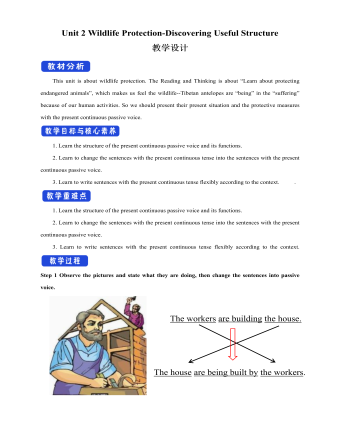
2.表示现阶段正在进行的被动动作(该动作在说话的瞬间未必正在进行)。Many interesting experiments are being carried out these days.(说话时,并不一定正在进行)3.表示一种经常性的被动行为,常和always,constantly 等表示频度的副词连用,这种用法常常带有赞扬或厌恶的感情色彩。He is always being praised by the leader.4.表示按计划或安排主语将要承受谓语动词所表示的动作(仅限于少数及物动词)。A party is being held tonight.Step 4 Special cases1.像take care of, look after, talk about, think of等动词与介词构成的短语用于现在进行时的被动语态时, 其中的介词不可省略。The ways to stop illegally hunting are being talked about. 2.可与部分情态动词连用,表示对正在发生的事情的推测。She may be being punished by her mother.3.有时可表示按计划或安排将要进行的一个被动动作。A celebration is being held this weekend for his success.4.某些表示“状态、心理活动、存在”等的动词,如have,want,need,love,一般不用现在进行时的被动语态,而常用一般现在时的被动语态。With the population increasing,more land is needed.5.“be+under/in+n.”可表示现在进行时的被动意义。My computer is under repair.=My computer is being repaired.
新人教版高中英语必修2Unit 2 Wildlife Protection-Reading and Thinking教案二
The theme of this unit is human and nature, focusing on the theme of wildlife protection. Nature is a complex ecosystem, in which there are delicate balance between animals and plants. Because of the role of the food chain, the extinction of one species will produce influence, causing a series of chain reaction. Large scale extinction of species will have a serious and even irreversible impact on the ecosystem, resulting in immeasurable losses. Therefore, it is of great significance to protect wild species. To protect wild species is to protect human beings themselves. The motto of this unit is "when the buying stops, the killing can too,” which is a public service advertising slogan to protect wildlife. It tells people that every rhinoceros horn, every fur, every bowl of shark fin soup, every Ivory product, and every tiger bone product, etc. consumed by human beings, are innocent wild animals slaughtered behind them. The mission of wild aid is to ban illegal trade in endangered wildlife and mitigate climate change. It aims to educate the public to reduce the consumption demand for endangered wildlife products through public publicity and improve the awareness of environmental protection.1. Improve the awareness of wildlife protection by acquiring the knowledge of wildlife protection.2. Focus on environmental protection and protection of all lives.3. Analysis of the living environment of wild animals with appropriate thinking mode.4. Skillfully use the vocabulary and grammar knowledge of this unit to cultivate self-study ability according to the unit content5. Develop cooperative learning ability through discussion and other ways1. Enable the Ss to talk about the current situation of wild animals.2. Guide the Ss to summarize the main idea of each paragraph as well as the main idea of the text.
新人教版高中英语必修2Unit 4 History and Traditions-Discovering Useful Structure教案二
This teaching period mainly deals with grammar: The past participle is used as attributive and objective complement.1. Guide students to review the basic usages of the past participle used as attributive and objective complement.2. Lead students to learn to use some special cases concerning the past participle used as attributive and objective complement flexibly.3. Strengthen students’ great interest in grammar learning.1. Help students to appreciate the function of the past participle used as attributive and objective complement.2. Instruct students to write essays using the past participle used as attributive and objective complement.Step1:温故而知新。Analyze the underlined phrases and then sum up the common usages of the past participles.1.(教材P41)They had castles built(build) all around England, and made changes to the legal system.2.(教材P42)They use the same flag, known(know) as the Union Jack,...3.(教材P42)Judy and I had our car parked(park) in an underground car park near Trafalgar Square, where we could get our car battery charged(charge).Common points: f the past participle used as attributive and objective complement.Step 2:过去分词作定语时的意义1.及物动词的过去分词作定语,在语态上表示被动;在时间上,常表示动作已经发生或完成,有时也不表示时间性。Our teacher watched us doing the experiment and gave us a satisfied smile at last.我们的老师看着我们做实验,最后给了我们一个满意的微笑。The plan put forward at the meeting will be carried out soon.会上提出的计划将很快被执行。2.不及物动词的过去分词作定语,它不表示被动意义,只强调动作完成。Many little kids like gathering fallen leaves in the yard.
新人教版高中英语必修2Unit 4 History and Traditions-Reading and Thinking教案二
Step 5 While reading---Task 3Read the text again and answer the following questions.Q1: How many countries does the UK consist of ?4 Q2: What are the four countries of the United Kingdom?England, Wales, Scotland and Northern Ireland Q3: Which two were the first to be joined together ?England and WalesQ4: What are the two chief advantages of studying the history of a country ?The first one is to help you understand more about the country and its traditions.The second one is to make visiting it more enjoyable.Q5: What’s the author’s attitude towards studying the history ?Supportive/positiveStep 6 Post reading---Retell the textThe United Kingdom, Great Britain, Britain, England—many people are confused by (1)_____ these different names mean. In the 16th century, the nearby country of Wales (2) __________(join) to the Kingdom of England. In the 19 th century, the Kingdom of Ireland was added to create the United Kingdom of Great Britain and Ireland. Finally, the southern part of Ireland (3) ______ (break) away from the UK, which resulted in the full name we have today. However, most people just use the (4)_________(shorten) name: the UK. The four countries (5)__________ belong to the United Kingdom work together in some areas. There were four sets of invaders and the last group were the Normans. They had castles (6)_________(build) all around England and made changes (7)__________ the legal system. Studying the history of the country will make your visit much more (8)_________(enjoy). The capital city London is (9)___ ancient port city that has a history (10)______(date) back to Roman times. 1. what 2.was joined 3.broke 4.shortened 5.that 6. built 7.to 8.enjoyable 9.an 10.dating Step 6 Homework
新人教版高中英语必修2Unit 4 History and Traditions-Listening&Speaking&Talking教案二
Listening and Speaking introduces the topic of “Take part in a youth project”. The listening text is an interview about "sharing views on historical sites". Through listening to a dialogue between Chinese and foreign students on the way to the Confucius Temple, students can understand their views on the Confucius Temple, Confucius, Confucius' descendants and Confucius' educational thoughts, so as to realize and think about the profound influence of Confucius and his thoughts on Chinese historical tradition. At the same time, the dialogue naturally integrates English idioms and mentions Shakespeare, the British playwright, so as to provide language materials and context for students to understand English idioms and related cultural allusions, as well as to compare Chinese and foreign cultures, which is helpful for students to understand and express the language such as history, tradition, culture and custom significant impact.Text analysis: listening text is a dialogue between a British student and a Chinese student when he goes to the Confucius Temple. When William, a British student, visited the Confucius Temple, he asked Xiao Kong, a Chinese student, for directions. Xiao Kong was just going to the Confucius Temple to meet with the members of the research group, so they went together and exchanged their views on the Confucius Temple, Confucius, Confucius' descendants and Confucius' educational thoughts. From the perspective of foreign tourists, this paper describes their thoughts on Confucius, the great son of Confucius, who had a profound impact on Chinese history and cultural tradition, and his education.Listening and Talking introduces a visit to a historic tourist destination. Tourism is a common way to understand a country's history, culture, and customs and so on. Students listen to the dialogue between Xiao Yan, a youth hostel Usher, and Paul, a backpacker, to learn about Pingyao's famous historical and cultural attractions and Paul's travel experience and experience as a foreign tourist.