-
人教版高中政治必修1股票与债券说课稿
一、说教材(一)说教材的地位和作用《股票、债券、保险》是人教版必修1《经济生活》第六课,第二框题的内容。本框题承接前面“企业与劳动者”:企业的发展资金从何而来,同时又为下一课“个人收入与分配”做好了铺垫,它在整个教材中起承上启下的作用。因此,本框题在《经济生活》中具有不容忽视的重要的地位。(二)说教学目标根据高一新课程标准要求,本教材的结构和内容分析,结合着高一年级学生的认知结构及其心理特征,我制定了以下的教学目标:1、知识目标(1)股票的含义、收益、特点和发展股票市场的意义。(2)债券的含义与分类(3)商业保险的含义与订立原则2、能力目标(1)重点培养学生辩证思维的能力,发现和分析、解决问题的能力。3、情感、态度与价值观目标培养科学理财的意识,形成“投资理财,利国利己”的观念。(三)说教学的重、难点本着高一新课程标准,在吃透教材基础上,我确定了以下的教学重点和难点
人教版高中政治必修1市场配置资源说课稿
(2)、市场调节存在固有的弊端:自发性:由于市场调节是在价值规律自发作用下进行的,在利益驱动下会产生一些违反市场原则的行为,如制造、销售假冒伪劣商品,大量排放废水、废气破坏环境,窃取他人智力成果等等。盲目性:由于人们不可能完全掌握生产各方面信息及其变化趋势,致使决策带有一定的盲目性。如某种商品有利可图则一哄而上,反之则一哄而退,从而造成资源浪费和消费得不到充分满足。滞后性:由于市场价格的形成和传递有一个过程,一旦传递到生产经营者手中进行生产调整,就有一个时间差,致使市场调节带有滞后性,成为一种事后调节。教师活动:请同学们想一想,市场的这些弊端和不足,会导致什么后果?(3)、危害教师总结:资源浪费,经济波动与混乱,分配不公两极分化等。设计意图:通过创设情景,加深对市场调节局限性的理解;要求学生结合生活实例探讨其弊端有助于加强对其产生原因和表现的记忆和理解。
人教版高中政治必修1面对经济全球化说课稿
2、传授新知与学生展示(35分钟) 先由老师点出本课的知识点,它包括:(1)经济全球化深入发展:结合课本91-93页理解经济全球化的含义;经济全球化的表现:生产全球化,贸易全球化,资本全球化;跨国公司是实现经济全球化的载体。(跨国公司的含义、目的、作用分别是什么)(2)经济全球化的影响: 经济全球化的实质:以发达资本主义国家为主导的经济全球化;消极影响积极影响;如何应对经济全球化。讲完了知识点,接着回归图片和书本的材料,给学生留下三个问题进行小组讨论:A :谈谈你感受到的经济全球化B :怎样理解经济全球化是一把“双刃剑”C:假如你是一位企业经营者,面对经济全球化趋势,你会怎么做?先完成讨论的小组可举手示意老师给予检查,老师根据需要抽查同学到讲台进行展示讨论的结果,并对表现突出的小组进行当堂奖励。
人教版高中政治必修2对人民负责说课稿
在学生活动的基础上,教师总结归纳:要坚持从群众中来到群众中去的工作方法。要求:政府要通过各种途径,利用各种群众组织、社会团体广泛收集群众意见和建议,认真对待群众的来信来访。还要为群众诚心诚意办实事,尽心竭力解难事,坚持不懈。通过合作探究,以此来培养学生的分析能力,探究能力以及透过现象看本质的能力,培养学生获取信息的能力,自主学习的能力以及全面看问题的能力,再结合教师的讲授,给学生一种茅塞顿开的感觉。环节四 回归生活 提升情感我将引导学生阅读课本,通过设置活动探究课,结合生活实际从时效,便利,实效等方面请学生评述公民求助或投诉的四种方式的特点和优点。在这一过程中,我还会用多媒体展示常用的热线电话,政府网站上有关信访、政务公开及其他便民利民的栏目,丰富课堂资源。让学生阅读课本,自行归纳知识点,有助于培养学生自主学习能力。
人教版高中政治必修1税收及其种类说课稿
在学生明确了税收的含义之后,我将分别对税收的三个基本特征进行解析。在讲解了之后,并分别用实例对其进行说明,加深学生对知识点的印象。最重要的是,总结出关键的字眼,使得学生能够清晰的区分出税收的三个基本特征。将强制性概括为依法征税、依法纳税;无偿性概括为不具有偿还性和返还型;固定性概括为规定应不应纳税、纳什么税、纳多少税。并跟学生指出,强制性是基本前提,无偿性是核心。由此根据书上的内容,推导出税收的三个基本特征相互之间的关系,即:三者缺一不可,统一于税法。而且,无偿性要求强制性,强制性保障无偿性;而无偿性与强制性又共同决定固定性。从而结束新课讲授。3、课堂总结根据板书内容重新回顾本课学习的主要内容,包括税收的含义,以及税收的三个基本特征和它们之间的相互关系。4、作业布置让学生预习税收的种类的内容,尤其是增值税和个人所得税。同时了解父母每月所缴纳的个人所得税和怎么计算的。
人教版高中政治必修1消费及其类型说课稿
(三)课堂小结接着进行课堂小结,先让学生自主总结,教师结合学生的总结,补充完善总结本节课的知识。并进行感情升华。这样设计课堂小结,是为了让学生学会自主总结知识,加深印象,教师总结帮助学生理清本课知识结构,并起到升华本节课的感情基调,落实教学目标。(四)课堂练习我将设计两道题让同学们做,巩固课堂知识。本课题板书设计我主要采用大纲的形式展现,让学生一目了然,便于识记和理解主干知识。五、教学预测最后我对本节课教学的效果进行预测:在这个教学过程中我都是从学生生活中感知的现象入手,设计情境,预设学生的分析,学生的体验,学生的感知,教师的点拨等。设计问题,学生自主合作探究,完成教学!通过这样的学习我想一定会收到较好的教学效果,当然,在实际的教学中,肯定也会出现一些意想不到的情况,我还会根据教学过程中的动态变化,及时地调整和修改预设内容。

人教版高中政治必修4意识的本质说课稿
师:分析得非常到位。大家来看看薛宝钗是怎么说的?薛宝钗的评论:“不像吟月了,月字底下放一个‘色’字倒还使得,你看句句倒是月色。这也罢了,原来诗从胡说来,再迟几天就好了。”生:(读第三首诗)“精华欲掩料应难,影自娟娟魄自寒。一片砧敲千里白,半轮鸡唱五更残。绿蓑江上秋闻笛,红袖楼头夜倚栏。博得嫦娥应借问,缘何不使永团圆!”这首诗语言很朴实,但意境很深远。我虽然读过《红楼梦》这本书,也看过电视剧,但我阅历太浅,说不出诗中所包含的深刻内涵。师:贾宝玉的评论:“这首不但好,而且新巧有意趣,可知俗语说的‘天下无难事,只怕有心人。2.意识的形式是主观的意识是人脑对客观存在的反映,意识是不是仅仅是人脑对客观存在原原本本的反映呢?“龙、凤”是中华民族的象征,是炎黄子孙的两大主要图腾,但地球上从来就没有出现过“龙、凤”,那么“龙、凤”的观念又是从何而来的呢?原来,“龙、凤”的观念最早产生于原始社会的图腾崇拜。、
人教版高中地理必修2绿色产品知多少说课稿
各小组派代表汇报。4、教师提出问题组织学生讨论:⑴要想了解更多的绿色食品,了解绿色食品的销售情况,我们应该怎么做?⑵要想了解广大消费者对绿色食品的态度,食用绿色食品的意义,是否懂得辨认绿色食品,以及什么样的人群对此知识最缺乏等,我们应该怎么做?组织学生汇报交流。5、做个“绿色食品”广告设计师。为你喜欢的绿色食品设计广告语,每组推荐一个。6、让学生了解绿色食品认证程序。7、绿色食品打“假”队员在行动。8、向学生介绍生态绿色食品基地。三、活动总结:通过研究、探讨,了解学生对绿色食品的态度。提问:民以食为天,吃,是一个大问题,如果你的爸爸妈妈让你到超市买牛奶、方便面等,你会选择什么样的食品?为什么?希望通过今天的学习,同学们能够做到绿色消费,也希望你们向自己的家人、向周围的了解学生对“无公害食品”、“有机食品”与“绿色食品”的认识。
人教版高中政治必修1价格变动的影响说课稿
回归生活:近几年,我国市场上猪肉价格在不断地波动。请智囊团商议:我们集团如何才能避免重蹈“张老汉”的覆辙?学生活动:思考、发言、群策群力。教师鼓励学生从多角度分析,找出解决问题的不同方法。教师点拨:在猪肉价格波动较大时,我们除了调节生产规模,还可以采用引进新品种、加强科学管理等手段来提高劳动生产率,从而在价格竞争中更具优势。同时,我们要在激烈的市场竞争中站稳脚跟,还必须以市场为导向,生产适销对路的高质量产品,做到“人无我有,人有我优,人优我转”。教师引导学生分析:价格变动对生产规模的调节、对劳动生产率的提高及促使企业生产适销对路的高质量产品,就是在价格、供求关系及市场竞争的刺激下,价值规律发挥“棒子”(调节资源配置)、“鞭子”(鞭策个别劳动生产率的提高)及“筛子”(优胜劣汰)作用的结果,从而将本节课的内容与第一框题有机联系在一起,帮助学生从不同角度更深刻的理解价值规律的作用。
人教版高中政治必修1信用工具和外汇说课稿
一、对教材内容的处理根据新课程标准的要求、知识的跨度、学生的认知水平,我对教材内容有增有减。二、教学策略的选用(一)运用了模拟活动,强化学生的生活体验,本框题知识所对应的经济现象,学生已具有了一定的生活体验,但是缺乏对这种体验的深入思考。因此在进一步强化这种体验的过程中进行了思考和认知,使知识从学生的生活体验中来,从学生的思考探究中来,有助于提高学生的兴趣,有助于充分调动学生现有的知识,培养学生的各种能力,也有助于实现理论知识与实际生活的交融。(二)组织学生探究知识并形成新的知识我从学生的生活体验入手,运用案例等形式创设情境呈现问题,使学生在自主探索、合作交流的过程中,发现问题、分析问题、解决问题,在问题的分析与解决中主动构建知识。也正是由于这些认识来自于学生自身的体验,因此学生不仅“懂”了,而且“信”了。从内心上认同这些观点,进而能够主动地内化为自己的情感、态度、价值观,并融入到实践活动中去,有助于实现知、行、信的统一。
部编版语文八年级下册《核舟记》说课稿
(2)教学内容的设计,一般须遵从学生认知规律,由表及里,由浅入深、完整、生动地呈现事物或事理本身的美学价值。在整体感知课文的艺术美和解决文字障碍之后,通过动手做“核舟”、改写评点“解说词” ,使学生在动手做、动手改、动口说中,理清课文层次和说明顺序。最后,学生们再一次通读全文,使他们的认知经历了从语言文字到形象生动的表象,再到语言文字的完整过程。帮助他们将语言形式和语言内容紧密结合起来。吉尔伯特·海特在其《教学的艺术》一书中曾谈到:“如果我们不能获得一声出自内心的笑,那么这一天的教学就白费了”。通过演课本剧,加深了学生对课文的理解和记忆,有利于培养学生的思考能力,想象能力,逻辑思维能力和语言表达能力。也正是获取一声声出自内心的笑的一种行之有效的方法。
新人教版高中英语必修2Unit 1 Cultural Heritage-Discovering Useful Structure教案二
This theme of the part is “ Describe people or things in greater detail”. Students have learned the grammar(restrictive relative clauses) in Book 1, and further review and consolidate its structure “prep+relative pronouns(which/whom)” and the relative adverbs(when, where and why), besides students should understand its form, meaning and functions. In this section, students should be able to express the grammar correctly in daily communication and in the writing. 1. Review the basic usages of relative pronouns and adverbs of attributive clauses . 2. Learn to use some special cases about restrictive relative clauses.3. Learn to write sentences with restrictive relative clauses flexibly according to the context.1. Review the basic usages of relative pronouns and adverbs of attributive clauses .2. Learn to use some special cases about restrictive relative clauses.3. Learn tow rite sentences with restrictive relative clauses flexibly according to the context.Step 1. Observe the following sentences, and mark the relative pronouns and the adverbs. 1. After listening to the scientists who had studied the problems, and citizens who lived near the dam, the government turned to the United Nations for help.2. Temples and other cultural sites were taken down piece by piece, and then moved and put back together again in a place where they were safe from the water.Step 2 PracticePlease complete these sentences with relative pronouns and relative adverbs and answer the following questions.Questions: 1. What is the head noun ?2. What relative words should be used ?3. What elements do they act in these sentences ?
新人教版高中英语必修2Unit 2 Wildlife Protection-Reading for Writing教案二
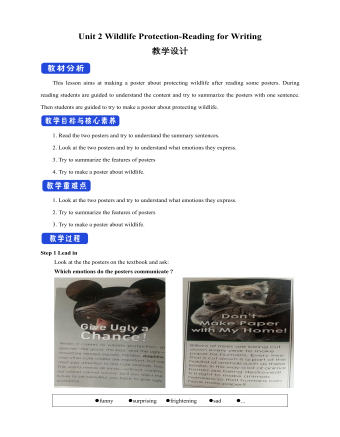
This lesson aims at making a poster about protecting wildlife after reading some posters. During reading students are guided to understand the content and try to summarize the posters with one sentence. Then students are guided to try to make a poster about protecting wildlife.1. Read the two posters and try to understand the summary sentences.2. Look at the two posters and try to understand what emotions they express.3. Try to summarize the features of posters4. Try to make a poster about wildlife.1. Look at the two posters and try to understand what emotions they express.2. Try to summarize the features of posters3. Try to make a poster about wildlife.Step 1 Lead inLook at the the posters on the textbook and ask:Which emotions do the posters communicate ?Step 2 Read the poster and answer the questions.1. What do you think of the animals in the poster on the left ?I think it is frightening and ugly.2. Why do we should protect the ugly animals ?All species--the good, the bad, and the ugly-- should be treated equally.The world needs all kinds--without variety, our planet cannot survive.3. Why are billions of trees being cut down every year ?To make paper for humans.4. What result will be lead to after the trees are cut down ?A lost of animal homes are being destroyed./The habitat of wildlife is being destroyed.Step 3 Find the feature of posters1. What does each poster use to stir up emotions ?On the left, it makes us a little frightened and it looks a little ugly, but it can activate our curiosity--What is it? And What is wrong with it?On the right, it makes us feel a little sad and want to protect them.
新人教版高中英语必修2Unit 1 Cultural Heritage-Reading and Thinking教案二
1. This section focuses on "Understanding how a problem was solved”, which is aimed to guide students to analyze and discuss the challenges and problems faced by cultural heritage protection during the construction of Aswan Dam, as well as the solutions. On the basis of understanding, students should pay attention to the key role of international cooperation in solving problems, and attach importance to the balance and coordination between cultural heritage protection and social and economic development. Students are encouraged to face challenges actively, be good at cooperation, and make continuous efforts to find reasonable ways and means to solve problems.2. Enable students to understand the main information and text structure of the reading text;3. Motivate students to use the reading strategy "make a timeline" according to the appropriate text genre;4. Enable students to understand how a problem was solved;5. Enable students to understand the value of protecting cultural heritage by teamwork and global community;1. Guide students to pay attention to reading strategies, such as prediction, self-questioning and scanning.2. Help students sort out the topic language about protecting cultural relics and understand the narrative characteristics of "time-event" in illustrative style3. Lead students to understand the value of protecting cultural heritage by teamwork and global community;
新人教版高中英语必修2Unit 2 Wildlife Protection-Discovering Useful Structure教案二
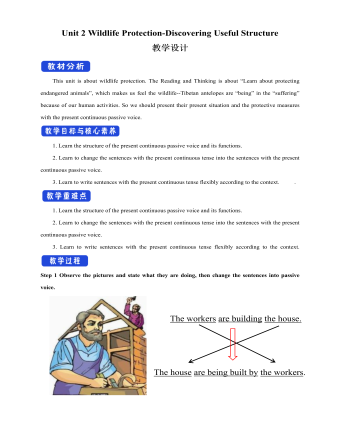
2.表示现阶段正在进行的被动动作(该动作在说话的瞬间未必正在进行)。Many interesting experiments are being carried out these days.(说话时,并不一定正在进行)3.表示一种经常性的被动行为,常和always,constantly 等表示频度的副词连用,这种用法常常带有赞扬或厌恶的感情色彩。He is always being praised by the leader.4.表示按计划或安排主语将要承受谓语动词所表示的动作(仅限于少数及物动词)。A party is being held tonight.Step 4 Special cases1.像take care of, look after, talk about, think of等动词与介词构成的短语用于现在进行时的被动语态时, 其中的介词不可省略。The ways to stop illegally hunting are being talked about. 2.可与部分情态动词连用,表示对正在发生的事情的推测。She may be being punished by her mother.3.有时可表示按计划或安排将要进行的一个被动动作。A celebration is being held this weekend for his success.4.某些表示“状态、心理活动、存在”等的动词,如have,want,need,love,一般不用现在进行时的被动语态,而常用一般现在时的被动语态。With the population increasing,more land is needed.5.“be+under/in+n.”可表示现在进行时的被动意义。My computer is under repair.=My computer is being repaired.
新人教版高中英语必修2Unit 3 The Internet-Listening &Speaking&Talking教案二
From the pictures in the text and the title--- choose the best app, we can know that this part is about how to save money by using apps.Step 2 While-listening1. Laura and Xiao Bo are talking about apps. Listen to their conversation and find out what apps they want.Xiao Bo is looking for a(n) exercise app to help him get in shape.Laura would like an app for getting rich and another that will make her grades better.2. Listen again. Are the sentences true T or false F?1). Both of Xiao Bo's apps keep track of the steps he takes._____2). Xiao Bo's second app can help him make a fitness plan._____3). Laura needs an app that will help her get discounts.______4). Laura needs an app that will add money to her bank account._______F T F T3. Listen once more and tick the sentence you hear. Underline the words used to express predictions, guesses, and beliefs.Predictions, Guesses, and Beliefs________It might help me walk more.________My guess is that it wouldn't work.________I imagine this app would help me get fit faster________I suppose that would be good.________I guess you could save a little with this app.________I suppose there would be some problems, too.________I believe this app could help me get thinner.
新人教版高中英语必修2Unit 3 The Internet-Reading for Writing教案二
8. However, the more polite you are, the less likely it is you will be attacked. 然而, 你越有礼貌, 你被攻击的可能性就越小。 Step 8 Writing---the articleHow to stay safe in the online chat roomToday I thought I’d blog about a question that has been asked many times--- how do you stay safe online and avoid bad experiences in the online chat room ? I’m not an expert, but many years as a blogger have taught me a thing or two.First of all, there’s the golden rule of the Internet: keep out of what makes you uneasy. Don’t post comments or click on anything. Second, protect your privacy. Don’t give out too much private information like your address, phone numbers, the ID numbers, etc. Third, be polite. If you are polite to others on the Internet, you won’t be attacked in normal situation. Finally, don’t believe in others easily and never meet someone you met online alone. It is very dangerous.Have you had any bad experiences online, or do you have some good advice for staying safe? Post your comments below!Step 9 Pair workExchange drafts with a partner. Use this checklist to help your partner revise his/her draft.1. Does the writer tell the reader what he/she know about the topic ?2. Are the tips and suggestions well organised ?3. Has the writer defined the new words ?4. Does the author include examples, comparison, or explanations ?5. Does the writer end by asking readers to leave comments and/or suggestions ?6. Can you find any grammar or spelling mistakes.Step 6 HomeworkPut up your revised draft in the classroom or read it to your class.
新人教版高中英语必修2Unit 4 History and Traditions-Reading and Thinking教案二
Step 5 While reading---Task 3Read the text again and answer the following questions.Q1: How many countries does the UK consist of ?4 Q2: What are the four countries of the United Kingdom?England, Wales, Scotland and Northern Ireland Q3: Which two were the first to be joined together ?England and WalesQ4: What are the two chief advantages of studying the history of a country ?The first one is to help you understand more about the country and its traditions.The second one is to make visiting it more enjoyable.Q5: What’s the author’s attitude towards studying the history ?Supportive/positiveStep 6 Post reading---Retell the textThe United Kingdom, Great Britain, Britain, England—many people are confused by (1)_____ these different names mean. In the 16th century, the nearby country of Wales (2) __________(join) to the Kingdom of England. In the 19 th century, the Kingdom of Ireland was added to create the United Kingdom of Great Britain and Ireland. Finally, the southern part of Ireland (3) ______ (break) away from the UK, which resulted in the full name we have today. However, most people just use the (4)_________(shorten) name: the UK. The four countries (5)__________ belong to the United Kingdom work together in some areas. There were four sets of invaders and the last group were the Normans. They had castles (6)_________(build) all around England and made changes (7)__________ the legal system. Studying the history of the country will make your visit much more (8)_________(enjoy). The capital city London is (9)___ ancient port city that has a history (10)______(date) back to Roman times. 1. what 2.was joined 3.broke 4.shortened 5.that 6. built 7.to 8.enjoyable 9.an 10.dating Step 6 Homework
新人教版高中英语必修2Unit 4 History and Traditions-Listening&Speaking&Talking教案二
Listening and Speaking introduces the topic of “Take part in a youth project”. The listening text is an interview about "sharing views on historical sites". Through listening to a dialogue between Chinese and foreign students on the way to the Confucius Temple, students can understand their views on the Confucius Temple, Confucius, Confucius' descendants and Confucius' educational thoughts, so as to realize and think about the profound influence of Confucius and his thoughts on Chinese historical tradition. At the same time, the dialogue naturally integrates English idioms and mentions Shakespeare, the British playwright, so as to provide language materials and context for students to understand English idioms and related cultural allusions, as well as to compare Chinese and foreign cultures, which is helpful for students to understand and express the language such as history, tradition, culture and custom significant impact.Text analysis: listening text is a dialogue between a British student and a Chinese student when he goes to the Confucius Temple. When William, a British student, visited the Confucius Temple, he asked Xiao Kong, a Chinese student, for directions. Xiao Kong was just going to the Confucius Temple to meet with the members of the research group, so they went together and exchanged their views on the Confucius Temple, Confucius, Confucius' descendants and Confucius' educational thoughts. From the perspective of foreign tourists, this paper describes their thoughts on Confucius, the great son of Confucius, who had a profound impact on Chinese history and cultural tradition, and his education.Listening and Talking introduces a visit to a historic tourist destination. Tourism is a common way to understand a country's history, culture, and customs and so on. Students listen to the dialogue between Xiao Yan, a youth hostel Usher, and Paul, a backpacker, to learn about Pingyao's famous historical and cultural attractions and Paul's travel experience and experience as a foreign tourist.
新人教版高中英语必修2Unit 5 Music-Reading and Thinking教案二
1. Get basic information about Eric; read deeply to understand the history and development of the virtual choir.2. Understand what the function of the virtual choir is and how to make a virtual choir.3. Understand the meaning of some languages in the context of the text through question guidance, such as “Many people do not have close friends or contacts who have the same interest in music.” and so on.Step 1 Leading-in1. Answer the following questions.Q1:Do you know the Apps like Tik Tok and Quick Hand?Q2: Do you want to make a Tik Tok video or a Quick Hand video?2. Play a Tik Tok video Step 2: Understanding the title Q1:What does the title mean ?Q2: Is the article a narration or exposition? Why? Q3: Can you change the title ? If you can, what is the title?Step 3: Scanning the whole text and getting the basic information1. Answer the following questions.Q1:Who came up with the idea for a virtual choir?Q2: Where did Eric studied the musical composition?Q3: What is his song?2. Find the main idea of each paragraph3. Deal with some new words.Step 4: Reading carefully to get detailed informationPara 1 How to make a virtual choir1. PreparationA. tools: a virtual camera; an Internet connectionB. hero/heroin: friends or some individuals who have the same interests2. Process