-
新人教版高中英语必修2Unit 2 Wildlife Protection-Reading and Thinking教案一
The listening and speaking part aims at how to protect and help endangered animals by listening, speaking and talking about the facts and reasons. This lesson analyzes the decreasing clause of Tibetan antelope population and the measures of protecting Tibetan antelopes. So students can be guided to learn to analyse the title and use different reading skills or strategies, like scanning, skimming and careful reading.1. Read quickly to get the main ideas and the purpose of going to Tibetan; read carefully to understand what the author see and think.2. Understand the sentences of the present continuous passive voice such as “Much is being done to protect wildlife.” and the inverted sentence “Only when we learn to exist in harmony with nature can we stop being a threat to wildlife and to our planet.”3. Enhance the awareness of protecting wildlife.4. Cultivate the reading methods according to different materials.1. Read quickly to get the main ideas and the purpose of going to Tibetan; read carefully to understand what the author see and think.2. Understand the sentences of the present continuous passive voice such as “Much is being done to protect wildlife.” and the inverted sentence “Only when we learn to exist in harmony with nature can we stop being a threat to wildlife and to our planet.”3. Cultivate the reading methods according to different materials.Step 1 Leading-inWatch a video about elephants and whales and then ask:Why are they endangered ? They are killed/hunted
新人教版高中英语必修2Unit 2 Wildlife Protection-Listening &Speaking&Talking教案
Listening and Speaking introduces the topic of “how to save endangered wildlife and help wildlife in their neighborhood.” Due to the continuous deterioration of the living environment, a large number of wild animals are always facing the threat of endangered or extinction. Listening and speaking period enables students to understand the fact and reason why wild species are disappearing from the earth at an amazing speed, and realize that human beings ought to enhance the awareness of protecting wild species as soon as possible.Listening and Talking introduces the theme of " how to help wildlife in Ss’ neighborhood.". Now there are many volunteers who spontaneously protect wild animals, carry out various activities according to local conditions, and contribute their own strength to local animal protection with practical actions. Middle school students are also enthusiastic participants. They organize activities in their spare time, and take this opportunity to make friends, broaden their horizons, cultivate team spirit and communication skills. This section describes a bird watching activity organized by several middle school students of Bird watching Club. It aims to stimulate students' interest, improve their understanding of bird watching activities, and use the language structure of “being used for; in order to, so as to, to, so that, in order that ” to express the purpose for communication and discussion.1. Guide students to understand the content of listening texts in terms of using visuals to predict content.2. Cultivate students' ability to guess the meaning of words in listening; discuss with their peers how to save endangered wildlife and help wildlife in their neighborhood.3. Instruct students to use functional sentences of the dialogue such as “I am concerned about…” “what do you know about the endangered animals in…" and so on to talk about one of the endangered animals.
新人教版高中英语必修2Unit 2 Wildlife Protection-Listening and Speaking教案
This lesson is about wildlife protection. The listening and speaking is about “How to protect endangered wildlife ?” Faced with the facts and numbers of wildlife loss, people begin to detect the reasons, then people such as the celebrities (Prince William and Yao Ming) are calling on to protect them. So students are guided to enhance the awareness of protecting wildlife and try to take part in some volunteer activities of protecting wildlife.1. Predict the content by using visuals. 2. Learn to use the sentences such as “I’m concerned about.... But now they are in danger. I want to know the reasons/why./ What can we do to protect them ?3. Learn from the stars like Prince William and Yao Ming and enhance the awareness of protecting wildlife.4. Guide students to try to put forward the solutions to the problems of wildlife protection and then discuss them with partners and present the results of discussion.5. Master the pronunciation of stressed syllables.1. Learn from the stars like Prince William and Yao Ming and enhance the awareness of protecting wildlife.2. Guide students to try to put forward the solutions to the problems of wildlife protection and then discuss them with partners and present the results of discussion.3. Learn to use the sentences such as “I’m concerned about.... But now they are in danger. I want to know the reasons/why./ What can we do to protect them ?4. Master the pronunciation of stressed syllables.Part A Listening and Speaking--- How to save endangered wildlifeStep 1 Lead in1. Point at the pictures on P14 and ask Q1: What message do these posters share?
新人教版高中英语必修2Unit 2 Wildlife Protection-Reading and Thinking教案二
The theme of this unit is human and nature, focusing on the theme of wildlife protection. Nature is a complex ecosystem, in which there are delicate balance between animals and plants. Because of the role of the food chain, the extinction of one species will produce influence, causing a series of chain reaction. Large scale extinction of species will have a serious and even irreversible impact on the ecosystem, resulting in immeasurable losses. Therefore, it is of great significance to protect wild species. To protect wild species is to protect human beings themselves. The motto of this unit is "when the buying stops, the killing can too,” which is a public service advertising slogan to protect wildlife. It tells people that every rhinoceros horn, every fur, every bowl of shark fin soup, every Ivory product, and every tiger bone product, etc. consumed by human beings, are innocent wild animals slaughtered behind them. The mission of wild aid is to ban illegal trade in endangered wildlife and mitigate climate change. It aims to educate the public to reduce the consumption demand for endangered wildlife products through public publicity and improve the awareness of environmental protection.1. Improve the awareness of wildlife protection by acquiring the knowledge of wildlife protection.2. Focus on environmental protection and protection of all lives.3. Analysis of the living environment of wild animals with appropriate thinking mode.4. Skillfully use the vocabulary and grammar knowledge of this unit to cultivate self-study ability according to the unit content5. Develop cooperative learning ability through discussion and other ways1. Enable the Ss to talk about the current situation of wild animals.2. Guide the Ss to summarize the main idea of each paragraph as well as the main idea of the text.
新人教版高中英语必修2Unit 2 Wildlife Protection-Reading For Writing教案一
1. 标题首先根据海报的特点、格式写明标题。海报中往往把内容作为大标题。例如: Save the earth, Save the birds。2. 正文部分不同的海报其正文部分的侧重点不同。对于介绍性的海报, 首先要引出话题, 其次列出原因, 最后是总结。对于宣传类的海报, 要写明具体内容, 如: 活动内容, 地点以及参加活动的注意事项, 主持或举办单位等。1. 图片: 要选择引人注目的图片, 与主题要相关, 色彩明亮。话题句式 1. It is a treasure of our country. 它是我国的国宝。2. Believe it or not, at present only several thousand pandas exist in the world. 信不信由你, 目前世界上仅现存几千只熊猫。 3.It’s because of human activities that tigers are endangered. 正是因为人类的活动, 老虎处于濒危的状态。4. Many wild animals are in danger of dying out. 很多野生动物面临着灭绝的危险。 5. The government has taken effective measures to protect them. 政府已采取有效的措施来保护它们。6. People should raise the awareness of the protection of wild animals. 人们应该提高保护野生动物的意识。 7. It’s amazing that there are merely less than 1, 000 finless porpoises living in China. 非常令人吃惊, 目前中国仅有不足1 000只江豚。
人教版高中语文必修3《登高》教案2篇
【设计思想】诗歌教学的关键是感受诗景,体味诗情,领悟诗意,在此基础上孕育理解能力、鉴赏能力和审美情感。诗景、诗情、诗意均由文字来承载,把握文字组合的张力,是读诗赏诗的抓手。杜甫的诗歌素以炼字精深、涵盖深远著称,以《登高》而言,往往淡淡一字,平平一语,便笼大千于方寸,缩古今于一瞬。故细读文本,咀嚼字句,便是赏景、悟情、会意的基本路径。其次,不朽名作的特点是寄寓深广,古今评价甚多,见仁见智,不一而足。这正是培养学生问题意识、探究意识的极好凭借。第三,诗为语言之精华,是诗人心里涌出的情感之流。诵读乃赏诗之要着,精心感悟之时,设身处地,心惟口诵,是理解诗意的关键一步。基于是,笔者作如下同课异构,殊途同归。【教学目标】1.理解本诗所绘之景、所抒之情及绘景、抒情之法。2.学会用意象叠加法、字句推敲法、诵读体验法等欣赏诗歌。3.感受杜甫心系苍生、情寄邦国、忧国忧民、兼济天下的博大情怀。
人教版高中语文必修3《寡人之于国也》教案2篇
一、引入:教师列举以下言论,让学生辨出哪些是孟子的,哪些不是。学生不知道的,由教师说出。学生不理解的,教师作简要解说。1.天将降大任于是人也,必先苦其心志,劳其筋骨,饿其体肤,空乏其身,行拂乱其所为。所以动心忍性,曾益其所不能。(孟子)2.域民不以封疆之界,固国不以山溪之险,威天下不以兵革之利。得道者多助,失道者寡助。(孟子)3.鱼,亦我所欲也,熊掌,亦我所欲也,二者不可得兼,舍鱼而取熊掌者也。生,亦我所欲也,义,亦我所欲也,二者不可得兼,舍生而取义者也。(孟子)4.富贵不能淫,贫贱不能移,威武不能屈。(孟子)5.非礼勿视,非礼勿听,非礼勿言,非礼勿动。(孔子)6.无恻隐之心非人也,无羞恶之心非人也,无辞让之心非人也,无是非之心非人也。(孟子)7.庖有肥肉,厩有肥马,民有饥色,野有饿殍。(孟子)8.人性之善也,犹水之就下也;人无有不善,水无有不下。(孟子)9.民为贵,社稷次之,君为轻。(孟子)10.君子坦荡荡,小人常戚戚。(孔子)
人教版高中语文必修3《老人与海》教案2篇
(一)导入[以视频欣赏导入]同学们,刚才欣赏的是大家熟悉、喜欢的电视剧《亮剑》中的精彩片段——李云龙论述什么是“亮剑”精神?同学们听后觉得好不好?牛不牛?“亮剑”精神简单理解就是敢于与强大的敌人(对手)做斗争,无论对手多么强大,都要满腔勇气和信心,永不放弃、永不言败,要敢于亮剑……今天我们一起来学习世界100部著名文学作品之一、美国里程碑式30部文学作品之一的世界名著——海明威的《老人与海》,看看主人公桑提亚哥“硬汉”性格和李云龙“亮剑”精神有么相似的地方。(请同学们翻到课文,课件显示课题《老人与海》)(二)走进作者:请同学们自己谈收集到的有关海明威的资料,然后教师梳理出下列核心内容识记:(课件显示)海明威(1899~1961),美国现代作家,20世纪美国文学史上最耀眼的名字之一。早期作品表现了第一次世界大战青年一代的彷徨情绪,以“迷惘的一代”的代表著称。20世纪末回到美国,写了不小以拳击家、渔民、猎人等为主人公的短篇小说,创造了“硬汉子”性格。
人教版高中政治必修3文化塑造人生教案2篇
【教学内容】人教版高中思想政治必修3文化生活第一单元第二课第二框题《文化塑造人生》。【教学目标】1.知识目标理解优秀文化如何丰富人的精神世界、增强人的精神力量及促进人的全面发展。2.能力目标(1)能赏析优秀文化产品,感悟积极向上的文化生活对于丰富人们的精神世界,增强人民的精神力量的意义,确信其促进人的全面发展的重要作用。(2)结合文化塑造人生,不断丰富自己的精神世界,促进自身的全面发展3.情感、态度、价值观目标树立正确的世界观、人生观、价值观,丰富精神世界,增强精神力量,接受优秀文化,促进自身的全面发展。【教学重点】优秀文化能丰富人的精神世界,增强人的精神力量【教学难点】文化促进人的全面发展【教学准备】资料收集、多媒体课件【课时安排】1课时【教学过程】视频导入:播放我国残疾人艺术团在春节晚会上的精美舞蹈《千手观音》。
人教版高中地理必修2人口合理容量教案
(1)请同学们结合日常生活实例和教材分析说明人类要在世界各地消除贫困并保持人口的合理容量任务的艰巨性?(2)采取何种措施才能更好的解决这一问题的出现?教师总结(1)现实中的人口问题(如人口过快增长、人口城市化和人口老龄化等)引发了严重的资源问题和环境问题。①发达国家的人均消耗资源量很大,索取资源和转嫁有害生产的地域超出了本国的范围。②发展中国家不仅人口数量多,人均消费水平低,而且一些国家的人口仍在快速增长。若在现有的经济基础上,把发展中国家人均生活质量提高到与发达国家相当的水平,所引发的资源短缺和环境问题将会相当严重,解决的难度也很大。(2)I就整个世界来说:①国际社会要倡导各国,尤其发展中国家要尽最大可能把人口控制在合理的规模之内;②建立公平的秩序,保证大多数人拥有不断追求高水平生活质量的平等权利。
人教版高中语文必修2《荷塘月色》教案3篇
请问,作者究竟听到歌声没有?”学生回答:“没有。”“这里是比喻,因为这里用得是‘仿佛’一词……”对,是比喻。也就是说,作者是用歌声来比喻荷香,是吧?“但是,“荷香与歌声有什么可比的共同点吗?”“荷香与歌声都是断断续续、若有若无的。”“而且朦朦胧胧的。”“对。“荷香和歌声都是‘缕缕’的、‘渺茫’的。这是比喻。这是一种特殊的比喻,钱钟书先生把它叫做‘通感’。人们通过视觉、听觉、触觉、味觉、嗅觉等五官感知外界事物时,在一般情况下,彼此不能交错;但在特殊情况下,五官功能却能出现互相转化、彼此沟通的现象叫“通感”,也叫“移觉”。举几个例子来说明:诗人艾青曾写诗这样描绘日本著名指挥家小泽征尔:‘你的耳朵在侦察,你的眼睛在倾听……’这也是通感。又如:“那笛声里有故乡绿色平原上青草的香味,有四月的龙眼花的香味,有太阳的光明。”(郭风《叶笛》)
人教版高中语文必修3《劝学》教案2篇
五.研习第一段:1.诵读指导要处理好句中停顿2.请学生对照注释翻译本段重点词句:学不可以已已:停止。青,取之于蓝而青于蓝于:从;比。木直中绳中:zhàng符合,合于。虽有槁暴,不复挺者,揉使之然也有通又,揉通煣,以火烘木,使其弯曲。然:这样。翻译:故木受绳则直,金就砺则利,君子博学而日参省乎己,则知明而行无过矣。所以木材经墨线画过(再用斧锯加工)就直了,金属刀剑拿到磨刀石上(磨过)就锋利了,君子广博地学习并且每天对自己检验反省,就能智慧明达,行为没有过错了。3.本段是从哪个角度论述中心论点的?明确:本段是从学习的意义这个角度论述中心论点的。荀子认为人的知识、道德、才能都不是天生成的,而是后天不断学习获得的,学习的意义十分重大,所以学习不能停止。4.本段中几个比喻句是为了说明什么道理?学生讨论发言,教师明确:
人教版高中语文必修3《马嵬(其二)》教案2篇
结合历史自古以来,江山美人历来都是引无数英雄豪杰竞折腰的,如果说英雄选择了美人却丢了江山,把所有罪名都归结于“女人是祸水”。但是,纣王无道,和有了妲己有必然的联系吗?有人说妲己坏透了,坏透了的妲己如果不是取得纣王的信任是坏不起来的,纣王听信了妲己的谗言,听与不听决定权在纣王,而不在妲己。强势永远在纣王一边。再来看看西施和杨贵妃:西施是作为越国贡献给吴国的供品来到吴王夫差的身边的,杨贵妃更是先是李隆基的儿媳妇被看中而得宠的。所以,西施和杨贵妃这两个可怜的女人根本没有自己的独立选择,没有独立的爱情,如果没有西施,就会有南施,或北施;如果没有杨贵妃,就会有李贵妃,王贵妃,总之什么施,什么妃是不能少的,因为那是吴王和李隆基的需要。
人教版高中政治必修3体味文化教案2篇
3、文化是人们的一种素养(1)人的文化素养是在社会生活、实践中形成的。每个人所具有的文化素养,不是天生的,而是通过对社会生活的体验,特别是通过参与文化生活、接受知识文化教育而逐步培养出来的。文化素养的形成,离不开生活、实践和教育。人们在社会实践中创造和发展文化,也在社会生活中获得和享用文化。(2)人的文化素养表现在日常言行中。教师活动:引导学生阅读教材7页“公交车漫画”材料,并思考所反映的问题学生活动:积极思考并讨论问题教师点评:人们的精神活动离不开物质活动,人们的文化素养总是要通过他在日常生活中的言行、在社会实践活动中的表现等表现出来。我们通过观察人们的社会行为,就可以从中透视人们的精神世界和精神生活。4、文化的传承和发展离不开物质载体。社会文化和精神产品离不开物质载体,一个时代的文化和精神产品,往往是这一时代社会发展轨迹的反映。
新人教版高中英语必修1Unit 2 Travelling Around-Discovering Useful Structure教案
(5)be to do (可以和具体的时间状语连用)①表示按计划、安排即将发生的动作。②用于时间、条件状语从句中,表示“如果要……,想要……”。The students are to meet at the school gate tomorrow. 明天学生们将在学校大门口集会。 If you are to succeed, you must work as hard as possible. 如果你想要成功,比必须努力工作。(6)be about to do (不与具体的时间状语连用) 表示即将要发生的动作。We are about to start. 我们就要出发了。The new school year is about to begin. 新学年开学在即。(7)一般现在时表将来①表示按时间表规定将要发生的动作。常限于表示位置移动的短暂性动词。②在时间、条件或让步状语从句中,用一般现在时表将来。Look at the timetable. Hurry up! Flight 4026 takes off at 18:20. 你看看时刻表,快点!4026次航班的起飞时间是下午6点20分。Jane is in a hurry because the train to the airport leaves in half an hour. 简很匆忙,因为去机场的火车半小时后出发。
新人教版高中英语必修1Unit 2 Travelling Around-Reading and Thinking教案
Good expressions that students can choose to use: help the travelers choose which tour to take1. In my opinion, you could/might choose…, because you prefer to…2. …could be a perfect choice for you, for…3. As far as I am concerned, you would enjoy…, for…4. …would probably suit you, because you enjoy/love/hate doing…Step 5 Passage ConsolidationLanguage appreciation:1. You can then spend three days exploring the rainforest with a local guide and enjoying the plants and animals unique to the rainforest. 在接下来的三天里,您可以在当地导游的陪同下,深入雨林进行探索,欣赏雨林特有的动植物。本句主体结构为spend some time doing sth. 2. Inca builders cut stones to exact sizes so that nothing was needed to hold walls together other than the perfect fit of the stones. 印加的建筑工人将石头切割成精确的尺寸,仅仅凭着石头间的完美契合,即可稳固墙体。本句为so that引导的结果状语从句。nothing与the perfect fit为并列成分; other than在句中意为“除了”。Step 6 HomeworkSuppose you will travel to Peru, write a short essay about your three-day tour plan.
新人教版高中英语必修2Unit 1 Cultural Heritage-Discovering Useful Structure教案二
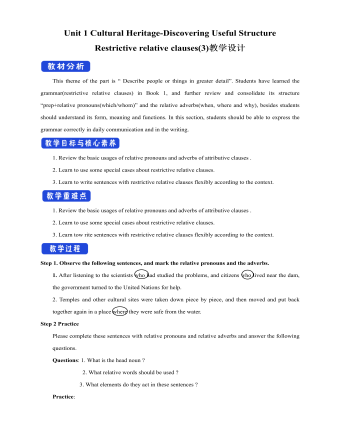
This theme of the part is “ Describe people or things in greater detail”. Students have learned the grammar(restrictive relative clauses) in Book 1, and further review and consolidate its structure “prep+relative pronouns(which/whom)” and the relative adverbs(when, where and why), besides students should understand its form, meaning and functions. In this section, students should be able to express the grammar correctly in daily communication and in the writing. 1. Review the basic usages of relative pronouns and adverbs of attributive clauses . 2. Learn to use some special cases about restrictive relative clauses.3. Learn to write sentences with restrictive relative clauses flexibly according to the context.1. Review the basic usages of relative pronouns and adverbs of attributive clauses .2. Learn to use some special cases about restrictive relative clauses.3. Learn tow rite sentences with restrictive relative clauses flexibly according to the context.Step 1. Observe the following sentences, and mark the relative pronouns and the adverbs. 1. After listening to the scientists who had studied the problems, and citizens who lived near the dam, the government turned to the United Nations for help.2. Temples and other cultural sites were taken down piece by piece, and then moved and put back together again in a place where they were safe from the water.Step 2 PracticePlease complete these sentences with relative pronouns and relative adverbs and answer the following questions.Questions: 1. What is the head noun ?2. What relative words should be used ?3. What elements do they act in these sentences ?
新人教版高中英语必修2Unit 1 Cultural Heritage-Listening&Speaking&Talking教案
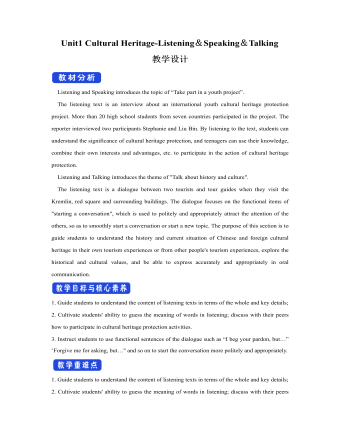
Listening and Speaking introduces the topic of “Take part in a youth project”. The listening text is an interview about an international youth cultural heritage protection project. More than 20 high school students from seven countries participated in the project. The reporter interviewed two participants Stephanie and Liu Bin. By listening to the text, students can understand the significance of cultural heritage protection, and teenagers can use their knowledge, combine their own interests and advantages, etc. to participate in the action of cultural heritage protection. Listening and Talking introduces the theme of "Talk about history and culture". The listening text is a dialogue between two tourists and tour guides when they visit the Kremlin, red square and surrounding buildings. The dialogue focuses on the functional items of "starting a conversation", which is used to politely and appropriately attract the attention of the others, so as to smoothly start a conversation or start a new topic. The purpose of this section is to guide students to understand the history and current situation of Chinese and foreign cultural heritage in their own tourism experiences or from other people's tourism experiences, explore the historical and cultural values, and be able to express accurately and appropriately in oral communication.1. Guide students to understand the content of listening texts in terms of the whole and key details; 2. Cultivate students' ability to guess the meaning of words in listening; discuss with their peers how to participate in cultural heritage protection activities.3. Instruct students to use functional sentences of the dialogue such as “I beg your pardon, but…” “Forgive me for asking, but…" and so on to start the conversation more politely and appropriately.
新人教版高中英语必修2Unit 1 Cultural Heritage-Reading and Thinking教案一
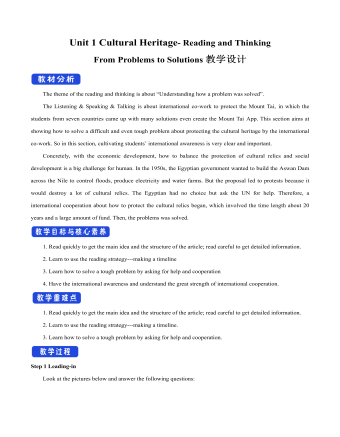
The theme of the reading and thinking is about “Understanding how a problem was solved”.The Listening & Speaking & Talking is about international co-work to protect the Mount Tai, in which the students from seven countries came up with many solutions even create the Mount Tai App. This section aims at showing how to solve a difficult and even tough problem about protecting the cultural heritage by the international co-work. So in this section, cultivating students’ international awareness is very clear and important. Concretely, with the economic development, how to balance the protection of cultural relics and social development is a big challenge for human. In the 1950s, the Egyptian government wanted to build the Aswan Dam across the Nile to control floods, produce electricity and water farms. But the proposal led to protests because it would destroy a lot of cultural relics. The Egyptian had no choice but ask the UN for help. Therefore, a international cooperation about how to protect the cultural relics began, which involved the time length about 20 years and a large amount of fund. Then, the problems was solved. 1. Read quickly to get the main idea and the structure of the article; read careful to get detailed information.2. Learn to use the reading strategy---making a timeline3. Learn how to solve a tough problem by asking for help and cooperation4. Have the international awareness and understand the great strength of international cooperation.1. Read quickly to get the main idea and the structure of the article; read careful to get detailed information.2. Learn to use the reading strategy---making a timeline.3. Learn how to solve a tough problem by asking for help and cooperation.
新人教版高中英语必修2Unit 3 The Internet-Discovering Useful Structure教案二
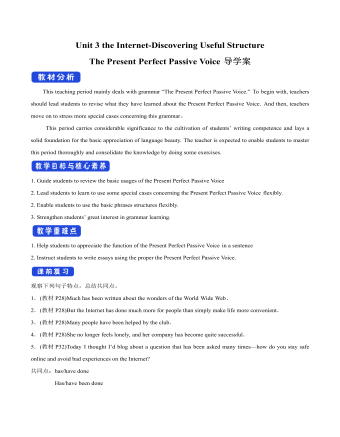
This teaching period mainly deals with grammar “The Present Perfect Passive Voice.” To begin with, teachers should lead students to revise what they have learned about the Present Perfect Passive Voice. And then, teachers move on to stress more special cases concerning this grammar。This period carries considerable significance to the cultivation of students’ writing competence and lays a solid foundation for the basic appreciation of language beauty. The teacher is expected to enable students to master this period thoroughly and consolidate the knowledge by doing some exercises. 1. Guide students to review the basic usages of the Present Perfect Passive Voice2. Lead students to learn to use some special cases concerning the Present Perfect Passive Voice flexibly.2. Enable students to use the basic phrases structures flexibly.3. Strengthen students’ great interest in grammar learning.1. Help students to appreciate the function of the Present Perfect Passive Voice in a sentence2. Instruct students to write essays using the proper the Present Perfect Passive Voice.观察下列句子特点,总结共同点。1.(教材P28)Much has been written about the wonders of the World Wide Web.2.(教材P28)But the Internet has done much more for people than simply make life more convenient.3.(教材P28)Many people have been helped by the club.4.(教材P28)She no longer feels lonely, and her company has become quite successful.5.(教材P32)Today I thought I’d blog about a question that has been asked many times—how do you stay safe online and avoid bad experiences on the Internet?