-
人教版高中语文必修3《动物游戏之迷》教案2篇
一、内容与解析内容:科普说明文《动物游戏之谜》。解析:《动物游戏之谜》是高中语文(必修)3第四单元的一篇科普说明文。科学是人类认识世界的重要工具,是人类文化的重要组成部分,是标志人类文明的尺度。阅读科普文章,可以启迪心志,激发想象,带领我们进入全新的科学天地,在科学海洋中遨游。本文思路清晰,内容生动,揭开了动物日常游戏行为的神秘面纱,摆出研究者的种种结论,既让我们扩大了视野,增长了知识,也让我们明白了科学探索永无止境。学习本文的重点是提高的科普文的阅读能力,培养学生勤于探索、勇于钻研的科学精神。二、教学目标及解析1、理清文章思路,明确本文的说明内容和顺序。2、品读文章,感受本文的语言特色。3、激发探究兴趣,培养筛选信息、提取要素及概括叙述的能力。4、挖掘人文内涵,培养学生保护动物的意识和勤于探索、勇于钻研的科学精神。
人教版高中语文必修3《劝学》教案2篇
五.研习第一段:1.诵读指导要处理好句中停顿2.请学生对照注释翻译本段重点词句:学不可以已已:停止。青,取之于蓝而青于蓝于:从;比。木直中绳中:zhàng符合,合于。虽有槁暴,不复挺者,揉使之然也有通又,揉通煣,以火烘木,使其弯曲。然:这样。翻译:故木受绳则直,金就砺则利,君子博学而日参省乎己,则知明而行无过矣。所以木材经墨线画过(再用斧锯加工)就直了,金属刀剑拿到磨刀石上(磨过)就锋利了,君子广博地学习并且每天对自己检验反省,就能智慧明达,行为没有过错了。3.本段是从哪个角度论述中心论点的?明确:本段是从学习的意义这个角度论述中心论点的。荀子认为人的知识、道德、才能都不是天生成的,而是后天不断学习获得的,学习的意义十分重大,所以学习不能停止。4.本段中几个比喻句是为了说明什么道理?学生讨论发言,教师明确:
新人教版高中英语必修1Unit 2 Travelling Around-Discovering Useful Structure教案
(5)be to do (可以和具体的时间状语连用)①表示按计划、安排即将发生的动作。②用于时间、条件状语从句中,表示“如果要……,想要……”。The students are to meet at the school gate tomorrow. 明天学生们将在学校大门口集会。 If you are to succeed, you must work as hard as possible. 如果你想要成功,比必须努力工作。(6)be about to do (不与具体的时间状语连用) 表示即将要发生的动作。We are about to start. 我们就要出发了。The new school year is about to begin. 新学年开学在即。(7)一般现在时表将来①表示按时间表规定将要发生的动作。常限于表示位置移动的短暂性动词。②在时间、条件或让步状语从句中,用一般现在时表将来。Look at the timetable. Hurry up! Flight 4026 takes off at 18:20. 你看看时刻表,快点!4026次航班的起飞时间是下午6点20分。Jane is in a hurry because the train to the airport leaves in half an hour. 简很匆忙,因为去机场的火车半小时后出发。
新人教版高中英语必修1Unit 2 Travelling Around-Reading for Writing教案
Is there a clear purpose for the trip? :Does each paragraph have a clear main idea? Does the writer use the present continuous tense for future plans?Does the writer use commas, stops, and question marks correctly? Are all the words spelt correctly?Are all the proper nouns capitalized?Revise your draft according to your partner's comments.Step 5:The summary of how to write a travel plan.旅游计划是一种常见的应用文写作。旅游可分为观光游、文化游、美食游及探险游等不同类型,因此旅游计划也要根据不同的旅游目的进行设计。常规的旅游计划需要明确以下几个方面的问题:Travel planWhen will you leave for? Where is your the destination?How will you get there?What will you do there?How long will you there?Is there a clear purpose for the trip? 为了提升旅行计划的层级,还需注意以下几个方面的问题:1.每段是否有明确清晰的主题;2.用一般现在时代替一般将来时;3.用更高级的形容词词汇。例如:表达“好”时,不要总用“nice”,我们还可以用“smart, clean, excellent, exciting, beautiful, wonderful, clever, famous, grand”等表达更具有指向性的词汇;4.用更高级的动词词汇。比如:我们可以用“seem stand, lie .get stay, remain, look . sound, become . keep, grow”等代替"be";
新人教版高中英语必修2Unit 1 Cultural Heritage-Reading and Thinking教案一
The theme of the reading and thinking is about “Understanding how a problem was solved”.The Listening & Speaking & Talking is about international co-work to protect the Mount Tai, in which the students from seven countries came up with many solutions even create the Mount Tai App. This section aims at showing how to solve a difficult and even tough problem about protecting the cultural heritage by the international co-work. So in this section, cultivating students’ international awareness is very clear and important. Concretely, with the economic development, how to balance the protection of cultural relics and social development is a big challenge for human. In the 1950s, the Egyptian government wanted to build the Aswan Dam across the Nile to control floods, produce electricity and water farms. But the proposal led to protests because it would destroy a lot of cultural relics. The Egyptian had no choice but ask the UN for help. Therefore, a international cooperation about how to protect the cultural relics began, which involved the time length about 20 years and a large amount of fund. Then, the problems was solved. 1. Read quickly to get the main idea and the structure of the article; read careful to get detailed information.2. Learn to use the reading strategy---making a timeline3. Learn how to solve a tough problem by asking for help and cooperation4. Have the international awareness and understand the great strength of international cooperation.1. Read quickly to get the main idea and the structure of the article; read careful to get detailed information.2. Learn to use the reading strategy---making a timeline.3. Learn how to solve a tough problem by asking for help and cooperation.
新人教版高中英语必修2Unit 4 History and Traditions-Discovering Useful Structure教案一
Step 5 Practice一、完成下列句子。1. Judy and I _______________(把车停下来(park))in an underground car Park near Trafalgar Square, where we could ______________________(让我们的车充电(charge)).2. When we finally reached the service desk to ask for audio guides, we heard it ___________ that there were no audio guides____________(留下,剩下).3. We__________________________(发现自己对...很惊讶)the large number of visitors and the amount of noise at the entrance of the National Gallery.4. Judy ____________________(眼神专注于) Van Gogh’s Sunflowers. It was hard to approach the painting as there were so many people around.5. She ____________________(把这幅画的复制品装箱(box)) to ensure that it was delivered safely.答案:1.had our car parked get our car battery charged 2. announced left 3. found ourselves very surprised 4. had her eyes fixed on 5. had a copy of the painting boxed二、用过去分词对下列句子进行改写。1. Loch Ness was surrounded by beautiful natural landscape, which made it look amazing.2. Carl and his friend stayed with a generous family who offered them bread with butter and honey that was homemade.3. The family’s ancestors once attended to soldiers who were wounded in the First World War.4. The young people were attracted by the legend of Loch Ness. They watched over the lake with their cameras and binoculars, which were positioned on the hill.答案:1. Loch Ness surrounded by beautiful natural landscape looks amazing.2. Carl and his friends stayed with a generous family who offered them homemade bread with butter and honey.3. The family’s ancestors once attended to wounded soldiers in the First World War.4. The young people attracted by the legend of Loch Ness watched over the lake with their cameras and binoculars positioned on the hill.
新人教版高中英语必修2Unit 3 The Internet-Reading and Thinking教案一
Paragraph 3. Jan decided to start an IT club to teach old people how to use computers and the Internet. Paragraph 4. Jan has started taking online classes to learn more about how to use the Internet to make society better. Paragraph 5. Jan’s life has been greatly improved by the Internet. Step 5: Critical thinking:(1)How do you arrange your time spent on study and the Internet? Is it reasonable? I usually surf the Internet using my mobile phone for only an hour after class, and it is reasonable for me.(2)What are your online activities? Are they safe? I chat with my friends, read news and play games. I never give away my private information so I think they are safe.Step 4: summary Much has been written about the wonders of the World Wide Web. There are countless articles (1)______(tell) us how the Internet has made our lives more convenient. But the Internet has done a lot (2)_____(much) for people than simply make life more convenient. People’s lives (3) _________________(change) by online communities and social networks so far. Take Jan for example, who developed a serious illness that made her (4)_____(stick) at home with only her computer to keep (5)___(she) company. She joined an online group (6)______ she could share problems, support and advice with others. She considered the ability to remove the distance between people as one of the greatest (7)_______(benefit). She was so inspired (8)____ she started an IT club in which many people have been helped. She has started to learn more about how to use the Internet to make society better. Her next goal is to start a charity website to raise money (9)___ children in poor countries. Jan’s life has been (10)______(great) improved by the Internet. Step 5 Homework:Review what we have learned and find out the key language points in the text.
新人教版高中英语必修2Unit 4 History and Traditions-Listening&Speaking&Talking教案二
Listening and Speaking introduces the topic of “Take part in a youth project”. The listening text is an interview about "sharing views on historical sites". Through listening to a dialogue between Chinese and foreign students on the way to the Confucius Temple, students can understand their views on the Confucius Temple, Confucius, Confucius' descendants and Confucius' educational thoughts, so as to realize and think about the profound influence of Confucius and his thoughts on Chinese historical tradition. At the same time, the dialogue naturally integrates English idioms and mentions Shakespeare, the British playwright, so as to provide language materials and context for students to understand English idioms and related cultural allusions, as well as to compare Chinese and foreign cultures, which is helpful for students to understand and express the language such as history, tradition, culture and custom significant impact.Text analysis: listening text is a dialogue between a British student and a Chinese student when he goes to the Confucius Temple. When William, a British student, visited the Confucius Temple, he asked Xiao Kong, a Chinese student, for directions. Xiao Kong was just going to the Confucius Temple to meet with the members of the research group, so they went together and exchanged their views on the Confucius Temple, Confucius, Confucius' descendants and Confucius' educational thoughts. From the perspective of foreign tourists, this paper describes their thoughts on Confucius, the great son of Confucius, who had a profound impact on Chinese history and cultural tradition, and his education.Listening and Talking introduces a visit to a historic tourist destination. Tourism is a common way to understand a country's history, culture, and customs and so on. Students listen to the dialogue between Xiao Yan, a youth hostel Usher, and Paul, a backpacker, to learn about Pingyao's famous historical and cultural attractions and Paul's travel experience and experience as a foreign tourist.
新人教版高中英语必修2Unit 4 History and Traditions-Reading and Thinking教案一
Features of languages1.Finally, in the 20th century, the southern part of Ireland broke away from the UK, which resulted in the full name we have today: the United Kingdom of Great Britain and Northern Ireland.该句是一个复合句。该句主句为:the southern part of Ireland broke away from the UK;which resulted in the full name we have today为which引导的定语从句代指前面整句话的内容,we have today为定语从句修饰先行词name。译文:最后,在20世纪,爱尔兰南部脱离英国,这导致了我们今天有的英国的全名:大不列颠及北爱尔兰联合王国。2.Almost everywhere you go in the UK, you will be surrounded by evidence of four different groups of people who took over at different times throughout history.该句是一个复合句。该句主句为:you will be surrounded by evidence of four different groups of people;其中Almost everywhere you go in the UK为让步状语从句; who took over at different times throughout history为定语从句修饰先行词people。译文:几乎无论你走到英国的任何地方,你都会发现历史上有四种不同的人在不同的时期统治过英国。3.The capital city London is a great place to start, as it is an ancient port city that has a history dating all the way back to Roman times.该句是一个复合句。该句主句为:The capital city London is a great place to start; as it is an ancient port city that has a history dating all the way back to Roman times.为原因状语从句;dating all the way back to Roman times为现在分词短语作定语修饰history。
新人教版高中英语必修2Unit 5 Music-Listening and Speaking教案
This lesson is about music. Students can classify the types of music through the instruments and its sound and can talk about their preferences about music, even join some activities and play a role in them according to their musical talents. On the basis, they are guided to use the languages to express their preferences and some plosive sounds and their rules.1. Classify the music types through the instruments and its sound.2. Listen and understand what the speakers’ preferences are and the reasons; talk about their own preferences and give their own reasons, using these sentences: “What kind of music do you like? And why? “ “Because it makes/gives me energy/peaceful.../touches my heart...”.3. Learn some plosives and the rules.4. Join some activities and play a role in them according to the talents. 1. Listen and understand what the speakers’ preferences are and the reasons;2. talk about their own preferences and give their own reasons, using these sentences: “What kind of music do you like? And why? “ “Because it makes/gives me energy/peaceful.../touches my heart...”.3. Learn some plosives and incomplete plosives and its rules.Step 1 Lead inPoint at the pictures on P50 and ask Q1: What are the people doing in the pictures below?Q2: What kind of music they are?Then play the MP3s one by oneStep 2 ListeningTask 1: A reporter from the school newspaper is interviewing students about music. Listen to the interviews. Draw lines between the words to make complete sentences. Some words will not be used.
新人教版高中英语必修2Unit 5 Music-Reading and Thinking教案二
1. Get basic information about Eric; read deeply to understand the history and development of the virtual choir.2. Understand what the function of the virtual choir is and how to make a virtual choir.3. Understand the meaning of some languages in the context of the text through question guidance, such as “Many people do not have close friends or contacts who have the same interest in music.” and so on.Step 1 Leading-in1. Answer the following questions.Q1:Do you know the Apps like Tik Tok and Quick Hand?Q2: Do you want to make a Tik Tok video or a Quick Hand video?2. Play a Tik Tok video Step 2: Understanding the title Q1:What does the title mean ?Q2: Is the article a narration or exposition? Why? Q3: Can you change the title ? If you can, what is the title?Step 3: Scanning the whole text and getting the basic information1. Answer the following questions.Q1:Who came up with the idea for a virtual choir?Q2: Where did Eric studied the musical composition?Q3: What is his song?2. Find the main idea of each paragraph3. Deal with some new words.Step 4: Reading carefully to get detailed informationPara 1 How to make a virtual choir1. PreparationA. tools: a virtual camera; an Internet connectionB. hero/heroin: friends or some individuals who have the same interests2. Process
新人教版高中英语必修3Unit 2 Morals and Virtues教学设计四
3.Teachers ask different groups to report the answers to the questions and ask them to try different sentence patterns.The teacher added some sentence patterns for students to refer to when writing.Step 4 Writing taskActivity 51.Write the first draft.Students first review the evaluation criteria in activity 5, and then independently complete the draft according to the outline of activity 4, the answers to the questions listed in the group discussion and report, and the reference sentence pattern.2.Change partners.The teacher guides the students to evaluate their partner's composition according to the checklist of activity 5 and proposes Suggestions for modification.3.Finalize the draft.Based on the peer evaluation, students revise their own compositions and determine the final draft.Finally, through group recommendation, the teacher selects excellent compositions for projection display or reading aloud in class, and gives comments and Suggestions.Step 5 Showing writingActivity 5T call some Ss to share their writing.Step 6 Homework1. Read the passage in this section to better understand the passage.2. Carefully understand the hierarchical structure of the article, and deeply understand the plot of the story according to the causes, process and results;3. Independently complete the relevant exercises in the guide plan.1、通过本节内容学习,学生是否理解和掌握阅读文本中的新词汇的意义与用法;2、通过本节内容学习,学生能否通过人物言行的对比分析道德故事的深层内涵;3、通过本节内容学习,学生能否根据故事的起因、经过和结果来深入理解故事的情节,从而了解文章的层次结构;4、结合现实生活案例发表自己的见解和看法,写一篇观点明确、层次分明的故事评论。
新人教版高中英语必修3Unit 2 Morals and virtues教学设计一
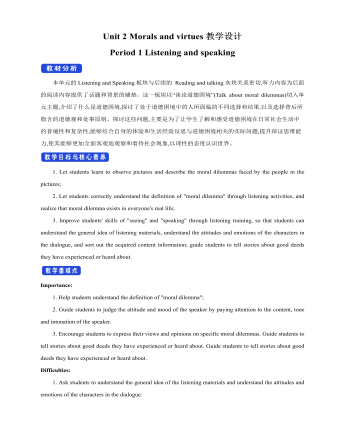
(2) students are divided into groups according to the requirements of activity 3. Each student shares a story of personal experience or hearing-witnessing kindness, and then selects the most touching story in the group and shares it with the whole class. Before the students share the story, the teacher can instruct them to use the words and sentence patterns in the box to express. For example, the words in the box can be classified:Time order: first of all, then, after that, later, finally logical relationship :so, however, although, butTeachers can also appropriately add some transitional language to enrich students' expression:Afterwards, afterwards, at last, in the end, eventuallySpatial order: next to, far from, on the left, in front ofOtherwise, nevertheless, as a result, therefore, furthermore, in addition, as well asSummary: in a word, in short, on the whole, to sum up, in briefStep 8 Homework1. Understand the definition of "moral dilemma" and establish a correct moral view;2. Accumulate vocabulary about attitudes and emotions in listening texts and use them to express your own views;3. Complete relevant exercises in the guide plan.1、通过本节内容学习,学生能否理解理解“道德困境”的定义;2、通过本节内容学习,学生能否通过说话人所表达的内容、说话的语气、语调等来判断其态度和情绪;3、通过本节内容学习,学生能否针对具体的道德困境发表自己的看法和见解,能否掌握听力理训练中的听力策略。
人教版高中语文必修1《大卫·科波菲尔》教案2篇
(1)主人公大卫·科波菲尔:大卫·科波菲尔是《大卫·科波菲尔》中的主人公,曾经是个孤儿。作家描写了他从孤儿成长为一个具有人道主义精神的资产阶级民主主义作家的过程。他善良,诚挚,聪明,勤奋好学,有自强不息的勇气、百折不回的毅力和积极进取的精神,在逆境中满怀信心,在顺境中加倍努力,终于获得了事业上的成功和家庭的幸福。在这个人物身上寄托着狄更斯的道德理想。(2)《大卫·科波菲尔》中的女性形象:在狄更斯笔下,《大卫·科波菲尔》塑造了一个个有血有肉的人物形象,每个任务都给人留下了深刻的印象,尤其是成功塑造了不同性格、不同品德的女性形象:贝西姨婆、艾妮斯、佩葛蒂、克拉拉、朵拉、摩德斯通小姐、米考伯太太、艾米丽……贝西姨婆与摩德斯通小姐的对比,克拉拉、朵拉与艾妮斯的对比更使她们栩栩如生,对贝西姨婆、艾妮斯、佩葛蒂的爱就更深一层,对摩德斯通小姐更是恨之入骨,对朵拉、克拉拉既同情又气愤。
人教版高中语文必修1《飞向太空的航程》教案2篇
第7~10段,我们取得了初步的成就。先写毛泽东主席的号召,激励无数的航天人去实现千年梦想;接着写我们的计划,上天毕竟是一件天大的事情,不是谁一句话就能吹上去的,需要有周密的计划,这计划的第一步是研制火箭,成功了,而从毛主席发出号召开始到火箭成功发射才用了1年零9个月;又用了不到10年的时间中国的第一颗人造卫星又上了天,“宣告中国进入了航天时代”。由号召,到计划,到成功,一步一步写来,紧张的任务,紧凑的文章,娓娓道来,条理清晰。第11~13段,人造卫星上天了,下一步就是载人飞天,圆千年梦想。我们也做了大量的准备工作,一是航天材料、食品等的准备,一是航天员的准备,已经挑选了19位优秀的飞行员,他们是航天员的预备军。看来实现中国人的航天梦已为时不远了。可是在科学上是没有坦途的,由于多方面的原因,计划搁浅了,我们的飞天梦想“只能尘封在一张张构思草图中”,这是多么遗憾的事啊!
人教版高中语文必修1《论语》教案2篇
【教学意图】要了解中国传统文化,必须阅读古诗文名著名篇。但在中国文化形成过程中影响最大的是什么?可以说是儒家学说,包括《论语》这部经典。《论语》等书是读书人求仕做官的必修课本,是知识分子的思想言行基础,而且影响到整个社会生活,内容包括伦理道德、教育体制、民间习俗等方面的思想。因此,要了解中国传统文化,有必要读一读《论语》。【教学设计】因《论语》的年代已久远,对学生而言,要理解透彻文句是比较深奥困难的,因此必须在充分理解文意的基础上,对《论语》进行思想上的解读。可由教师从《论语》中概括出几点与生活、现实相关的要点,要求学生分组进行透彻的学习和领会,如“小人与君子”、“学习的方法”、“教育的理念”等等。〖教学重点、难点〗读《论语》知儒家思想。〖教学方法〗讲解启发、探究梳理、拓展延伸。
人教版高中语文必修1《再别康桥》教案2篇
教学过程:一、交流诵读课文技巧。——节奏、韵脚、感情……(5分钟)二、再读确定自己的学习主题(15分)1、主题提示:音乐美、绘画美、建筑美简介诗歌“三美”追求闻一多先生是我国现代文学史上集诗人、学者和斗士于一身的重要诗人。他不但致力于新诗艺术美的探索,提出了音乐美、绘画美、建筑美的诗歌\"三美\"的新格律诗理论主张,还努力进行创作实践,写出了许多精美诗篇。他的新格律诗理论被后人称为现代诗学的奠基石,影响深远。《诗的格律》是闻一多先生系列诗论中最重要的一篇。在这篇论文中,他系统的提出\"诗的实力不独包括音乐的美(音节)、绘画的美(词藻),并且还有建筑的美(节的匀称和句的均齐)。\"这一关于新诗\"三美\"主张遂成为新格律诗派的理论纲领。

人教版高中语文必修1《奇妙的对联》教案2篇
3、介绍对联的历史引出本课的重点。人类历史上的第一副对联是“新年纳余庆,嘉节号长春”。出现在五代十国时期(公元964年),距离现在已经有1044年了。有着一千多年历史的对联有什么基本的特点呢?这是我们这节课学习的重点。请在座的各位当回医生,给下面这幅对联号号脉,看它对仗是否工整?上联:冬去春来千条杨柳迎风绿下联:冰消雪化梅花万朵扑鼻有什么问题,怎么改?刚才这几位同学指出了这幅对联的两个问题,也提出了两条修改意见。第一是下联少了一个字,最好是添加一个“香”字;第二是下联的“梅花万朵”与上联的“千条杨柳”是数量词对名词,名词对数量词,对仗不工整,要调整为“万朵梅花”。这样,数量词“万朵”对“千条”,名词“梅花”对“杨柳”。大家还有没有不同的看法。这样我们就可以得出对联的两个特点特点:第一个特点是上下联字数要相等(板书)。就是上联有几个字,下联也要有几个字。大家记下来,对联基本要求一,“上下联字数相等”。这个要求是很严格的,一般来说,违反这个规则就不成对联了。
人教版高中语文必修1《优美的汉字》教案2篇
书法艺术的繁荣期,是从东汉开始的东汉时期出现了专门的书法理论著作,最早的书法理论提出者是东西汉之交的扬雄第一部书法理论专著是东汉时期崔瑗的《草书势》汉代书法家可分为两类:一类是汉隶书家,以蔡邕为代表一类是草书家,以杜度、崔瑗、张芝为代表,张芝被后人称之为“草圣”最能代表汉代书法特色的,莫过於是碑刻和简牍上的书法东汉碑刻林立,这一时期的碑刻,以汉隶刻之,字型方正,法度谨严、波磔分明此时隶书已登峰造极汉代创兴草书,草书的诞生,在书法艺术的发展史上有著重大意义它标志著书法开始成为一种能够高度自由的抒发情感,表现书法家个性的艺术草书的最初阶段是草隶,到了东汉时期,草隶进一步发展,形成了章草,后由张芝创立了今草,即草书
人教版高中语文必修2《荷塘月色》教案3篇
请问,作者究竟听到歌声没有?”学生回答:“没有。”“这里是比喻,因为这里用得是‘仿佛’一词……”对,是比喻。也就是说,作者是用歌声来比喻荷香,是吧?“但是,“荷香与歌声有什么可比的共同点吗?”“荷香与歌声都是断断续续、若有若无的。”“而且朦朦胧胧的。”“对。“荷香和歌声都是‘缕缕’的、‘渺茫’的。这是比喻。这是一种特殊的比喻,钱钟书先生把它叫做‘通感’。人们通过视觉、听觉、触觉、味觉、嗅觉等五官感知外界事物时,在一般情况下,彼此不能交错;但在特殊情况下,五官功能却能出现互相转化、彼此沟通的现象叫“通感”,也叫“移觉”。举几个例子来说明:诗人艾青曾写诗这样描绘日本著名指挥家小泽征尔:‘你的耳朵在侦察,你的眼睛在倾听……’这也是通感。又如:“那笛声里有故乡绿色平原上青草的香味,有四月的龙眼花的香味,有太阳的光明。”(郭风《叶笛》)