-
新人教版高中英语必修2Unit 1 Cultural Heritage-Discovering Useful Structure教案二
This theme of the part is “ Describe people or things in greater detail”. Students have learned the grammar(restrictive relative clauses) in Book 1, and further review and consolidate its structure “prep+relative pronouns(which/whom)” and the relative adverbs(when, where and why), besides students should understand its form, meaning and functions. In this section, students should be able to express the grammar correctly in daily communication and in the writing. 1. Review the basic usages of relative pronouns and adverbs of attributive clauses . 2. Learn to use some special cases about restrictive relative clauses.3. Learn to write sentences with restrictive relative clauses flexibly according to the context.1. Review the basic usages of relative pronouns and adverbs of attributive clauses .2. Learn to use some special cases about restrictive relative clauses.3. Learn tow rite sentences with restrictive relative clauses flexibly according to the context.Step 1. Observe the following sentences, and mark the relative pronouns and the adverbs. 1. After listening to the scientists who had studied the problems, and citizens who lived near the dam, the government turned to the United Nations for help.2. Temples and other cultural sites were taken down piece by piece, and then moved and put back together again in a place where they were safe from the water.Step 2 PracticePlease complete these sentences with relative pronouns and relative adverbs and answer the following questions.Questions: 1. What is the head noun ?2. What relative words should be used ?3. What elements do they act in these sentences ?
新人教版高中英语必修2Unit 2 Wildlife Protection-Reading for Writing教案二
This lesson aims at making a poster about protecting wildlife after reading some posters. During reading students are guided to understand the content and try to summarize the posters with one sentence. Then students are guided to try to make a poster about protecting wildlife.1. Read the two posters and try to understand the summary sentences.2. Look at the two posters and try to understand what emotions they express.3. Try to summarize the features of posters4. Try to make a poster about wildlife.1. Look at the two posters and try to understand what emotions they express.2. Try to summarize the features of posters3. Try to make a poster about wildlife.Step 1 Lead inLook at the the posters on the textbook and ask:Which emotions do the posters communicate ?Step 2 Read the poster and answer the questions.1. What do you think of the animals in the poster on the left ?I think it is frightening and ugly.2. Why do we should protect the ugly animals ?All species--the good, the bad, and the ugly-- should be treated equally.The world needs all kinds--without variety, our planet cannot survive.3. Why are billions of trees being cut down every year ?To make paper for humans.4. What result will be lead to after the trees are cut down ?A lost of animal homes are being destroyed./The habitat of wildlife is being destroyed.Step 3 Find the feature of posters1. What does each poster use to stir up emotions ?On the left, it makes us a little frightened and it looks a little ugly, but it can activate our curiosity--What is it? And What is wrong with it?On the right, it makes us feel a little sad and want to protect them.
新人教版高中英语必修2Unit 1 Cultural Heritage-Reading For Writing教案
This report is short, concise and has typical news content and language features. The title uses the verb phrases, embodying the characteristics of being concise and general. The introduction is the first two sentences in the first paragraph, describing the general situation of the cultural heritage protection project, including time, place, characters, events and other news elements, so that readers can see the main points of the news report at a glance. The main body is the second and third paragraphs, which report the important historical and cultural value of Mogao Grottoes and the production of Mogao Grottoes Material digital photos, which are of great significance to the inheritance of historical culture and the promotion of international cultural understanding, exchange and cooperation. Direct citation is used in the report, as well as background introduction and other news writing techniques.1. Get students to have a good understanding of some features about a news report by reading the text.2. Instruct students to write a summary about a news report properly using some newly acquired writing skills in this period.3. Develop students’ writing and cooperating abilities.4. Strengthen students’ great interest in writing discourses.1. Stimulate students to have a good understanding of how to a summary about a news report 2. Cultivate students to write a news report properly and concisely.Step 1: Lead in Do you think it is necessary for us to circulate our cultural heritage to the world? Why or why not?Do we need to learn more about other countries’ cultural heritage? Why or why not?Step 2: Read to discover details concerning the main body of the news report.
新人教版高中英语必修2Unit 2 Wildlife Protection-Discovering Useful Structure教案一
The activity topic of this section is "report an ongoing event", and the structure is the passive voice of present continuous tense. Rare wild animals are suffering from large-scale poaching, and species are on the brink of danger. Rescue operations are underway. "Being" and "suffering" are the meanings of the present progressive passive voice.The usage of present progressive passive voice is of great importance in writing a good discourse and appreciating some difficult language items, so it is vital to master it and use it flexibly in a context.1. Motivate Ss to deepen the understanding of the usage of present progressive passive voice in a fixed context.2. Enable Ss to master the usage of present progressive passive voice and use it flexibly in a context.3. Lead Ss to construct sentences or appreciate sentences used master it and use it flexibly in a context.1. Help students to appreciate the function of the usage of present progressive passive voice in a sentence2. Instruct students to write essays using the proper usage of present progressive passive voice.Look at the picture and tell me what are workers doing? What is the house being done?
新人教版高中英语必修2Unit 2 Wildlife Protection-Reading and Thinking教案一
The listening and speaking part aims at how to protect and help endangered animals by listening, speaking and talking about the facts and reasons. This lesson analyzes the decreasing clause of Tibetan antelope population and the measures of protecting Tibetan antelopes. So students can be guided to learn to analyse the title and use different reading skills or strategies, like scanning, skimming and careful reading.1. Read quickly to get the main ideas and the purpose of going to Tibetan; read carefully to understand what the author see and think.2. Understand the sentences of the present continuous passive voice such as “Much is being done to protect wildlife.” and the inverted sentence “Only when we learn to exist in harmony with nature can we stop being a threat to wildlife and to our planet.”3. Enhance the awareness of protecting wildlife.4. Cultivate the reading methods according to different materials.1. Read quickly to get the main ideas and the purpose of going to Tibetan; read carefully to understand what the author see and think.2. Understand the sentences of the present continuous passive voice such as “Much is being done to protect wildlife.” and the inverted sentence “Only when we learn to exist in harmony with nature can we stop being a threat to wildlife and to our planet.”3. Cultivate the reading methods according to different materials.Step 1 Leading-inWatch a video about elephants and whales and then ask:Why are they endangered ? They are killed/hunted
新人教版高中英语必修2Unit 2 Wildlife Protection-Listening and Speaking教案
This lesson is about wildlife protection. The listening and speaking is about “How to protect endangered wildlife ?” Faced with the facts and numbers of wildlife loss, people begin to detect the reasons, then people such as the celebrities (Prince William and Yao Ming) are calling on to protect them. So students are guided to enhance the awareness of protecting wildlife and try to take part in some volunteer activities of protecting wildlife.1. Predict the content by using visuals. 2. Learn to use the sentences such as “I’m concerned about.... But now they are in danger. I want to know the reasons/why./ What can we do to protect them ?3. Learn from the stars like Prince William and Yao Ming and enhance the awareness of protecting wildlife.4. Guide students to try to put forward the solutions to the problems of wildlife protection and then discuss them with partners and present the results of discussion.5. Master the pronunciation of stressed syllables.1. Learn from the stars like Prince William and Yao Ming and enhance the awareness of protecting wildlife.2. Guide students to try to put forward the solutions to the problems of wildlife protection and then discuss them with partners and present the results of discussion.3. Learn to use the sentences such as “I’m concerned about.... But now they are in danger. I want to know the reasons/why./ What can we do to protect them ?4. Master the pronunciation of stressed syllables.Part A Listening and Speaking--- How to save endangered wildlifeStep 1 Lead in1. Point at the pictures on P14 and ask Q1: What message do these posters share?
新人教版高中英语必修2Unit 2 Wildlife Protection-Reading and Thinking教案二
The theme of this unit is human and nature, focusing on the theme of wildlife protection. Nature is a complex ecosystem, in which there are delicate balance between animals and plants. Because of the role of the food chain, the extinction of one species will produce influence, causing a series of chain reaction. Large scale extinction of species will have a serious and even irreversible impact on the ecosystem, resulting in immeasurable losses. Therefore, it is of great significance to protect wild species. To protect wild species is to protect human beings themselves. The motto of this unit is "when the buying stops, the killing can too,” which is a public service advertising slogan to protect wildlife. It tells people that every rhinoceros horn, every fur, every bowl of shark fin soup, every Ivory product, and every tiger bone product, etc. consumed by human beings, are innocent wild animals slaughtered behind them. The mission of wild aid is to ban illegal trade in endangered wildlife and mitigate climate change. It aims to educate the public to reduce the consumption demand for endangered wildlife products through public publicity and improve the awareness of environmental protection.1. Improve the awareness of wildlife protection by acquiring the knowledge of wildlife protection.2. Focus on environmental protection and protection of all lives.3. Analysis of the living environment of wild animals with appropriate thinking mode.4. Skillfully use the vocabulary and grammar knowledge of this unit to cultivate self-study ability according to the unit content5. Develop cooperative learning ability through discussion and other ways1. Enable the Ss to talk about the current situation of wild animals.2. Guide the Ss to summarize the main idea of each paragraph as well as the main idea of the text.
新人教版高中英语必修2Unit 3 The Internet-Discovering Useful Structure教案一
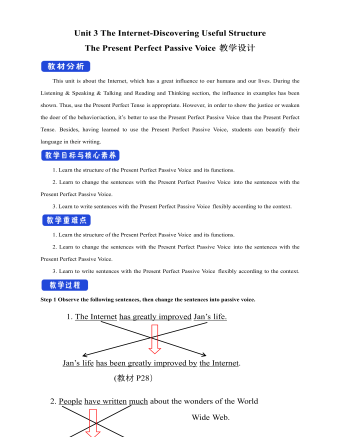
This unit is about the Internet, which has a great influence to our humans and our lives. During the Listening & Speaking & Talking and Reading and Thinking section, the influence in examples has been shown. Thus, use the Present Perfect Tense is appropriate. However, in order to show the justice or weaken the doer of the behavior/action, it’s better to use the Present Perfect Passive Voice than the Present Perfect Tense. Besides, having learned to use the Present Perfect Passive Voice, students can beautify their language in their writing. 1. Learn the structure of the Present Perfect Passive Voice and its functions. 2. Learn to change the sentences with the Present Perfect Passive Voice into the sentences with the Present Perfect Passive Voice. 3. Learn to write sentences with the Present Perfect Passive Voice flexibly according to the context. 1. Learn the structure of the Present Perfect Passive Voice and its functions. 2. Learn to change the sentences with the Present Perfect Passive Voice into the sentences with the Present Perfect Passive Voice. 3. Learn to write sentences with the Present Perfect Passive Voice flexibly according to the context. Step 1 Observe the following sentences, then change the sentences into passive voice.He has been selected to take part in the sports meeting.(肯定句)他已被挑选出来参加运动会。The ink has not been removed from his overcoat.(否定句)墨迹还没有从他外套上去掉。
新人教版高中英语必修2Unit 3 The Internet-Reading and Thinking教案一
Paragraph 3. Jan decided to start an IT club to teach old people how to use computers and the Internet. Paragraph 4. Jan has started taking online classes to learn more about how to use the Internet to make society better. Paragraph 5. Jan’s life has been greatly improved by the Internet. Step 5: Critical thinking:(1)How do you arrange your time spent on study and the Internet? Is it reasonable? I usually surf the Internet using my mobile phone for only an hour after class, and it is reasonable for me.(2)What are your online activities? Are they safe? I chat with my friends, read news and play games. I never give away my private information so I think they are safe.Step 4: summary Much has been written about the wonders of the World Wide Web. There are countless articles (1)______(tell) us how the Internet has made our lives more convenient. But the Internet has done a lot (2)_____(much) for people than simply make life more convenient. People’s lives (3) _________________(change) by online communities and social networks so far. Take Jan for example, who developed a serious illness that made her (4)_____(stick) at home with only her computer to keep (5)___(she) company. She joined an online group (6)______ she could share problems, support and advice with others. She considered the ability to remove the distance between people as one of the greatest (7)_______(benefit). She was so inspired (8)____ she started an IT club in which many people have been helped. She has started to learn more about how to use the Internet to make society better. Her next goal is to start a charity website to raise money (9)___ children in poor countries. Jan’s life has been (10)______(great) improved by the Internet. Step 5 Homework:Review what we have learned and find out the key language points in the text.
新人教版高中英语必修2Unit 5 Music-Discovering Useful Structures教案二
4. When he got absorbed in his world of music, he felt as if he could “see” the beauty of the world around him, like he had in his previous life.P·P as adverbial: _________________________________________________________________.Function: _______________________________________________________________________.Step 5 Solid Complete the passage with the words in brackets in their correct forms.Well known as a successful band, the Impact members show quite a few striking qualities. They never ever give up. When _____________(question) by the media, they are not _____________(discourage) and practise even harder. They are improving themselves by attending several master training class. They are united. _____________(fill with) team spirit, they act as a whole, always aiming for glory. Step 6 Difference and similarity from -ingObserve the following examples.1. He went out, shutting the door behind him.=He went out, ________________________________________________________.2. Not knowing what to do, he went to his parents for help.=__________________________________________, he went to his parents for help.Similarity: _______________________________________________________________________________________________________________________________________________________.Difference : _______________________________________________________________________________________________________________________________________________________.Step Practice1. ________ in a hurry, this article was not so good. 因为写得匆忙, 这篇文章不是很好。2. ________ carefully, he found something he hadn’t known before. 他仔细读书时, 发现了一些从前不知道的东西。3. ________ why he did it, the monitor said it was his duty. 当被问及他为什么要这么做时, 班长说这是他的职责
新人教版高中英语必修2Unit 5 Music-Listening and Speaking教案
This lesson is about music. Students can classify the types of music through the instruments and its sound and can talk about their preferences about music, even join some activities and play a role in them according to their musical talents. On the basis, they are guided to use the languages to express their preferences and some plosive sounds and their rules.1. Classify the music types through the instruments and its sound.2. Listen and understand what the speakers’ preferences are and the reasons; talk about their own preferences and give their own reasons, using these sentences: “What kind of music do you like? And why? “ “Because it makes/gives me energy/peaceful.../touches my heart...”.3. Learn some plosives and the rules.4. Join some activities and play a role in them according to the talents. 1. Listen and understand what the speakers’ preferences are and the reasons;2. talk about their own preferences and give their own reasons, using these sentences: “What kind of music do you like? And why? “ “Because it makes/gives me energy/peaceful.../touches my heart...”.3. Learn some plosives and incomplete plosives and its rules.Step 1 Lead inPoint at the pictures on P50 and ask Q1: What are the people doing in the pictures below?Q2: What kind of music they are?Then play the MP3s one by oneStep 2 ListeningTask 1: A reporter from the school newspaper is interviewing students about music. Listen to the interviews. Draw lines between the words to make complete sentences. Some words will not be used.
新人教版高中英语必修2Unit 5 Music-Reading and Thinking教案二
1. Get basic information about Eric; read deeply to understand the history and development of the virtual choir.2. Understand what the function of the virtual choir is and how to make a virtual choir.3. Understand the meaning of some languages in the context of the text through question guidance, such as “Many people do not have close friends or contacts who have the same interest in music.” and so on.Step 1 Leading-in1. Answer the following questions.Q1:Do you know the Apps like Tik Tok and Quick Hand?Q2: Do you want to make a Tik Tok video or a Quick Hand video?2. Play a Tik Tok video Step 2: Understanding the title Q1:What does the title mean ?Q2: Is the article a narration or exposition? Why? Q3: Can you change the title ? If you can, what is the title?Step 3: Scanning the whole text and getting the basic information1. Answer the following questions.Q1:Who came up with the idea for a virtual choir?Q2: Where did Eric studied the musical composition?Q3: What is his song?2. Find the main idea of each paragraph3. Deal with some new words.Step 4: Reading carefully to get detailed informationPara 1 How to make a virtual choir1. PreparationA. tools: a virtual camera; an Internet connectionB. hero/heroin: friends or some individuals who have the same interests2. Process
新人教版高中英语必修2Unit 5 Music-Reading For Writing教案一
(4)Now we have heard a number of outstanding speeches ... 我们已经聆听了许多精彩的发言……(5)Because we wanted the nations of the world, working together, to deal with ... 因为我们希望全世界各国团结起来去应对……(6)And if we do not act ... 如果我们不采取行动……(7)Now, I share the concerns that have been expressed ... 我也同意对于……表达的担心(8)Let us show the world that by working together we can ... 让我们告诉全世界,通过一起努力我们可以……(9)It is now time for us to ... 是时候我们……(10)And I have always wished that ... 我一直希望……(11)Thank you for letting me share this day with me.感谢你们和我共度这一天。实践演练:假如你是高中生李华,你校将举办一次以“音乐”为主题的演讲比赛,请你按照主题,写下你的演讲稿。注意:词数100左右。First of all, thank you for listening to my speech. My topic is: love music like love yourself.Music is like the air we need to maintain our normal lives around us. You can't imagine how terrible a world without music would be. Movies and TV shows have no music, only dry conversations and scenes; mobile phones only vibrations; streets only noisy crowds; cafes, western restaurants only depressed meals. What a terrible world it is!As a student, I hope we all can enjoy the fun brought by music in our spare time. Instead of just listening to music, we can even make our own music. Let's enjoy the fun of music!Thanks again for your attention!
人教版高中地理必修1全球气候变化教案
科学家预测,就地区而言,位于低纬度的大部分国家,农作物的产量将减少;而位于高纬度的国家,农作物产量有可能增加。由于不少发展中国家位于低纬度地区,因此,气候变化的这种区域差异性,可能会使发展中国家所面临的问题更为严峻。板书:3全球变暖将加剧水资源的不稳定性与供需矛盾。介绍:全球变暖会影响整个水循环过程,可能使蒸发加大,改变区域降水量和降水分布格局,增加降水极端异常事件的发生,导致洪涝、干旱灾害的频次和强度增加,以及地表径流发生变化。随着径流减少,蒸发增强,全球变暖将加剧水资源的不稳定性与供需矛盾。转折:既然全球变暖会引起很多不利影响,那么作为人类应如何面对这一挑战呢?这就是我们要讨论的第三个问题。板书:三、气候变化的适应对策讨论:请大家阅读结合教材P53气候变化的适应对策部分讨论人类应如何面对全球变暖这一问题 呢?
人教版高中地理必修2城市内部空间结构教案
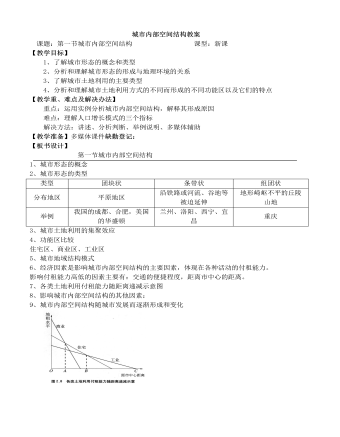
过渡:在实际生活中,城市内部空间结构并非完全按照这一经济规律呈现,而是更具复杂性。这说明除了经济因素外,还有很多其他因素在起作用,请大家结合你的认识、图2.9和案例1:纽约市的少数民族区谈谈你的看法。(2)其他因素I收入——形成不同级别住宅区的常见原因。有能力支付昂贵租金和选择最佳居住环境的人,其居住地往往形成高级住宅区。II知名度——城市内某些地区在历史、文化或经济方面具有很高的声誉,这往往会吸引更多新的住宅或商场建在该处,以提高其知名度。III种族聚居区的形成——在有些城市的某一区域内,如果某个种族或宗教团体占优势,就可能形成种族聚居区。如纽约市的唐人街、哈林区、小意大利区等。IV历史因素——城市的建筑物和街道设计可以维持久远,早期的土地利用方式对日后的功能分区有着深远的影响。
人教版高中地理必修3产业转移教案
1.国家石油价格上涨,导致依赖于国际石油而建立起来的日本重化工业的制造成本提高,产品价格相应提高,削弱了日本重化工产品在国际市场上的竞争力。2.日元 的大幅度升值,意味着日本产品在国际市场上的价格大幅度提高。例如,同样的日本产品,如果原来在国际市场上卖1美元,日元升值1倍后其在国际市场上的售价就达2美元。所以,以国际市场为依托的日本传统产业只好纷纷向海外转移。3.自身市场满足不了发展需求,国际市场上亚洲发展中国家和地区的同类产品具有明显的价格优势。所以,日本企业在其国内发展的空间很小。4.劳动力价格高反映为产品的价格高,而劳动力数量又满足 不了企业进一步扩展对劳动力的需求。所以,日本从事传统产业的国内企业生产受劳动力价格和数量的双重制约。5.促进日本企业生产的区位选择向国土的南、北部和海外扩展。6.“技术立国”的政策明显对传统产业在国内生产不利,即企业生产要么向知识技术密集型转换(这需要大量的投资),要么转向海外。
人教版高中地理必修3区域工业化与城市化教案
知识和技能 1、 了解区域工业化和城市化之间的关系,以及它们对区域社会经济发展所起的作用 。2、分析导致珠江三角洲工业化和城市化快速推进的诸多思想束缚,并通过比较,认识到对外开放政策是其中的关键因素。3、 比较珠江三角 洲的 区工业化进程的两个主要阶段,归纳出不同时期的主要发展特点,并能够结合具体案例分析工业化进程对城市化的巨大推动。 4、分析珠江三角洲地区工业化和城市化进程中的问题,并尝试评价目前的一些调整措施和发展方向。5、通过分析我国珠江三角 洲地区工 业化、城市化的发展阶段、问题与对策,了解区域工业化和城市化的推进动力和发展规律。过程与方法 利用扮演不同的社会角色来谈对珠江三角洲地区未来经济和城镇发展的设想和建议,反馈学生知识、能力、价值观发展情况和效果, 培养学生对所学所得的运用能力,并为学生的创新精神的发 展营造有利氛围。情感、态度与价值观1、通过鼓励学生主动获 取资料的做法,关注学生实践能力、综合思维能力及终身学习能力的训练。
人教版新课标高中物理必修1弹力教案2篇
一般情况下,凡是支持物对物体的支持力,都是支持物因发生形变而对物体产生弹力。所以支持力的方向总是垂直于支持面而指向被支持的物体。例1:放在水平桌面上的书书由于重力的作用而压迫桌面,使书和桌面同时发生微小形变,要恢复原状,对桌面产生垂直于桌面向下的弹力f1,这就是书对桌面的压力;桌面由于发生微小的形变,对书产生垂直于书面向上的弹力f2,这就是桌面对书的支持力。学生分析:静止地放在倾斜木板上的书,书对木板的压力和木板对书的支持力。并画出力的示意图。结论:压力、支持力都是弹力。压力的方向总是垂直于支持面而指向被压的物体,支持力的方向总是垂直于支持面而指向被支持的物体。引导学生分析静止时,悬绳对重物的拉力及方向。引导得出:悬挂物由于重力的作用而拉紧悬绳,使重物、悬绳同时发生微小的形变。重物由于发生微小的形变,对悬绳产生竖直向下的弹力f1,这是物对绳的拉力;悬绳由于发生微小形变,对物产生竖直向上的弹力f2,这就是绳对物体的拉力。
人教版新课标高中物理必修1摩擦力教案2篇
l.知识与技能:(1)知道摩擦力产生的条件。(2)能在简单问题中,根据物体的运动状态,判断静摩擦力的有无、大小和方向;知道存在着最大静摩擦力。(3)掌握动磨擦因数,会在具体问题中计算滑动磨擦力,掌握判定摩擦力方向的方法。(4)知道影响到摩擦因数的因素。2.过程与方法:通过观察演示实验,概括出摩擦力产生的条件及摩擦力的特点,培养学生的观察、概括能力。通过静摩擦力与滑动摩擦力的区别对比,培养学生分析综合能力。3.情感态度价值观:在分析物体所受摩擦力时,突出主要矛盾,忽略次要因素及无关因素,总结出摩擦力产生的条件和规律。二、重点、难点分析1.本节课的内容分滑动摩擦力和静摩擦力两部分。重点是摩擦力产生的条件、特性和规律,通过演示实验得出关系f=μN。2.难点是学生有初中的知识,往往误认为压力N的大小总是跟滑动物体所受的重力相等,因此必须指出只有当两物体的接触面垂直,物体在水平拉力作用下,沿水平面滑动时,压力N的大小才跟物体所受的重力相等。
人教版新课标高中物理必修2功率教案2篇
1.用CAI课件模拟汽车的启动过程。师生共同讨论:①如果作用在物体上的力为恒力,且物体以匀速运动,则力对物体做功的功率保持不变。此情况下,任意一段时间内的平均功率与任一瞬时的瞬时功率都是相同的。②很多动力机器通常有一个额定功率,且通常使其在额定功率状态工作(如汽车),根据P=FV可知:当路面阻力较小时,牵引力也小,速度大,即汽车可以跑得快些;当路面阻力较大,或爬坡时,需要比较大的牵引力,速度必须小。这就是爬坡时汽车换低速挡的道理。③如果动力机器在实际功率小于额定功率的条件下工作,例如汽车刚刚起动后的一段时间内,速度逐渐增大过程中,牵引力仍可增大,即F和v可以同时增大,但是这一情况应以二者乘积等于额定功率为限度,即当实际功率大于额定功率以后,这种情况不可能实现。