-
新人教版高中英语必修1Unit 4 Natural Disasters- Reading for writing教案
①标题——标题应当简洁明了。②导语——导语是消息开头的第一段或第一句话,简明扼要地揭示出消息的核心内容。③主体——主体是消息的主要部分,要用充足的事实表现主题,对导语的内容作进一步的展开和阐述。④结束语——通常是对全文内容进行概括性的总结。3. 新闻报道增分句子(1)陈述事实常用的句型:①A terrible storm hit/struck ... , killing ..②It was a cool autumn night when the earthquake happened. A large number of buildings fell down and roads were destroyed, leaving a great many people homeless.地震发生在一个凉爽的秋夜。大量的建筑物倒塌,道路被毁,许多人无家可归。③With the help of the rescue team, people who were the trapped in the flood were saved.在救援队的帮助下,困在洪水中的人们得救了。(2)陈述观点常用的句型:①Clearly/Obviously/In my opinion/It seemed that people were shocked.显然/在我看来/似乎人们震惊了。②The whole city was in ruins after the earthquake.地震后整个城市成了一片废墟。(3)揭示原因常用的句型:Because of/As a result of/Thanks to the help of the army, people who got injured were sent to the hospital immediately.
新人教版高中英语必修1Unit 4 Natural Disasters-Discovering Useful Structures教案
【教材分析】This teaching period mainly deals with the grammar: the restrictive relative clauses.This period carries considerable significance to the cultivation of students’ writing competence and lays a solid foundation for the basic appreciation of language beauty. The teacher is expected to enable students to master this period thoroughly and consolidate the knowledge by doing some exercise of good quality.【教学目标与核心素养】1. Get students to have a good understanding of the basic usages of the restrictive relative clauses.2. Enable students to use the restrictive relative clauses flexibly.3. Develop students’ speaking and cooperating abilities.4. Strengthen students’ great interest in grammar learning.【教学重难点】How to enable students to have a good understanding of the restrictive relative clauses, especially the uses of the relative words such as which, that, who, whom.【教学过程】Step1: 语法知识呈现定语从句(一)—关系代词的用法在复合句中, 修饰名词或代词的从句叫定语从句。定语从句通常由关系代词或关系副词引导,说明事物的具体信息,从句位于被修饰词之后。被定语从句修饰的词叫先行词,引导定语从句的词叫关系词,关系词指代先行词,并在定语从句中充当成分。关系词有两种:关系代词who, whom ,whose, that, which, as和关系副词when, where, why。
新人教版高中英语必修1Unit 4 Natural Disasters-Listening and Speaking教案
【教材分析】高考听力材料的选用非常重视语言真实性和交际性的原则,语言材料一般来源于实际生活,对话的内容大都取材于日常生活,即衣、食、住、行、工作、学习、天气、生活环境等话题,可分为校园、公共场所、家庭等方面,如: shopping, finding the way, doing one’s homework, seeing a doctor, making a phone call, weather report, asking for different kinds of information等。新教材的特点就是利用生活中真实文本,只是降低难度,让学生注重语言的应用,将是我们高考把握方向的重要因素。【教学目标与核心素养】学习能力目标:在听力当中,学生应该有效规划学习方法,选择恰当的策略与方法。这节课的训练目标是让学生有正确的预测和抓住问题的关键信息,从而用心去听来找寻关键信息。根据生活中实际情况和高考常见语境,我们不难发现提前预测和抓住题干中的w很重要,即what, where, when, why等等。
新人教版高中英语必修1Welcome Unit-Discovering Useful Structures教案
II Learn the technical terms-2.1. What can be used as “Subject, Object, Predicative, Direct Object, Indirect Object and objective complement” in a sentence?2. What can be used as “adverbial” in a sentence?3. What can be used as “verb” in a sentence?Answers to questions 1-3:1. Nouns, pronouns and appellations can be used as “Subject, Object, Predicative, Direct Object, Indirect Object and Objective Complement”. Besides, adjectives can be used as “Predicative and Objective Complement” in a sentence.2. Adverbs and prepositional phrases can be used as “Adverbial”.3. Verbs with actual meaning can be used as “Verb” in a sentence. Auxiliary verbs alone cannot be used as “Verb” in a sentence.III Learn to recognize the sentence structures.1. SV structure. For Example:(1) A bird flies.S V(2) A monkey jumps.S V(3) A fish swims.S V√ In SV structures, verbs are “intransitive verbs”.2. SVO structure. For Example:(1) A sheep eats grass.S V O(2) They like bananas.S V O(3) He wants candy.S V O√ In SVO structures, verbs are “transitive verbs”.3. SP structure. For Example:(1) This is great.S P (2) He looks well.S P (3) She became a teacher.S P √ In SP structures, Predicatives are formed by “link verbs” and “adjectives or nouns”.√ link verbs: be, become, grow, look, feel, taste, etc.4. SV IO DO structure. For Example:(1) He asked me a question.S V IO DO(2) Danny wrote me a letter.S V IO DO(3) Billy brought Sam a kite.S V IO DO√ In SV IO DO structures, the verbs are transitive and are followed by two objectives – pronouns or nouns as Indirect Objective, and nouns as Direct Objectives.
新人教版高中英语必修1Unit 4 Natural Disasters-Reading & Thinking教案
5. Read to get detailed information about Paragraph 5.Q1. What shows the revival of Tangshan?Q2. How can Tangshan revive itself and get up on its feet again?Q3. In times of disasters, how can we go through it?T: In times of disasters, we should unify, show the wisdom and stay positive.Step 4 Activity 4 Highlighting the theme and reflecting1. Make a summary of the text.2. Further understand the titleQ: After our learning, why do you think the earth didn’t sleep on that night?T: An earthquake happened. The people in the earthquake suffered a lot, and the people outside Tangshan were concerned about the people there a lot.3. Reflect through discussion on what can be learnt after reading.T: Disasters are powerful. Unpreparedness can be deadly. Life is weak, but if people work together to help each other, disasters can be defeated.There is no love from disaster, but we have love in the human heart.Step 5 Assignment How does the writer convey that the earthquake was deadly, and that people were helpless during the earthquake? Try to find some attractive and impressive expressions and note them down.
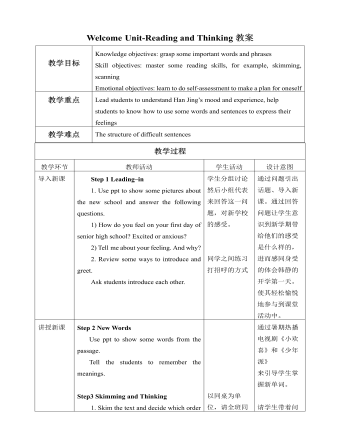
新人教版高中英语必修1Welcome Unit-Reading and Thinking教案
Step 2 New WordsUse ppt to show some words from the passage.Tell the students to remember the meanings.Step3 Skimming and Thinking1. Skim the text and decide which order Han Jing follows to talk about her first day. Time order or place order?Time order2. What is Han Jing worried about before she goes to senior high school?She is worried about whether she will make new friends and if no one talks to her, what she should do.Step 4 Fast Reading1. Match the main ideas with each paragraphParagraph 1:The worries about the new school day Paragraph 2Han Jing’s first maths classParagraph 3Han Jing’s first chemistry classParagraph 4Han Jing’s feelings about her first senior school dayStep 5 Careful Reading1. Fill in the chart with the words and phrases about Han Jing’s day. Answers: Senior high school, a little nervous; Her first maths class, classmates and teachers, friendly and helpful; Chemistry lab; new; great; annoying guy; Confident; a lot to explore2. Read the text again and discuss the questions.1) Why did Han Jing feel anxious before school?Because she was a new senior high student and she was not outgoing. What was more, she was worried about whether she can make friends.2) How was her first maths class?It was difficult but the teacher was kind and friendly. 3) What happened in the chemistry class? What would you do if this happened to you? A guy next to Han Jing tried to talk with her and she couldn’t concentrate on the experiment.
新人教版高中英语必修2Unit 1 Cultural Heritage-Discovering Useful Structure教案一
This teaching period mainly deals with grammar “restrictive relative clauses.” To begin with, teachers should lead students to revise what they have learned about the relative pronouns and relative adverbs. And then, teachers move on to stress more special cases concerning this grammar, such as the “preposition+ relative pronouns which and whom” and cases where we can omit the relative pronouns. This period carries considerable significance to the cultivation of students’ writing competence and lays a solid foundation for the basic appreciation of language beauty. The teacher is expected to enable students to master this period thoroughly and consolidate the knowledge by doing some exercises. 1. Guide students to review the basic usages of relative pronouns and adverbs of attributive clauses.2. Lead students to learn to use some special cases concerning restrictive relative clauses flexibly.2. Enable students to use the basic phrases structures flexibly.3. Strengthen students’ great interest in grammar learning.1. Help students to appreciate the function of relative pronouns and adverbs of attributive clauses in a sentence2. Instruct students to write essays using the proper relative pronouns and adverbs of attributive clauses.本节语法思考:定语从句在复合句中的作用是什么? 关系词有哪些?定语从句在复合句中的作用相当于形容词,它在句中作定语修饰名词或代词。他们在先行词和定语从句之间起到联系作用,同时在意义上代表先行词并在定语从句中担任一个成分。被定语从句所修饰的词称先行词,定语从句一般放在先行词的后面。
新人教版高中英语必修2Unit 1 Cultural Heritage-Listening&Speaking&Talking教案
Listening and Speaking introduces the topic of “Take part in a youth project”. The listening text is an interview about an international youth cultural heritage protection project. More than 20 high school students from seven countries participated in the project. The reporter interviewed two participants Stephanie and Liu Bin. By listening to the text, students can understand the significance of cultural heritage protection, and teenagers can use their knowledge, combine their own interests and advantages, etc. to participate in the action of cultural heritage protection. Listening and Talking introduces the theme of "Talk about history and culture". The listening text is a dialogue between two tourists and tour guides when they visit the Kremlin, red square and surrounding buildings. The dialogue focuses on the functional items of "starting a conversation", which is used to politely and appropriately attract the attention of the others, so as to smoothly start a conversation or start a new topic. The purpose of this section is to guide students to understand the history and current situation of Chinese and foreign cultural heritage in their own tourism experiences or from other people's tourism experiences, explore the historical and cultural values, and be able to express accurately and appropriately in oral communication.1. Guide students to understand the content of listening texts in terms of the whole and key details; 2. Cultivate students' ability to guess the meaning of words in listening; discuss with their peers how to participate in cultural heritage protection activities.3. Instruct students to use functional sentences of the dialogue such as “I beg your pardon, but…” “Forgive me for asking, but…" and so on to start the conversation more politely and appropriately.
新人教版高中英语必修2Unit 1 Cultural Heritage-Reading and Thinking教案二
1. This section focuses on "Understanding how a problem was solved”, which is aimed to guide students to analyze and discuss the challenges and problems faced by cultural heritage protection during the construction of Aswan Dam, as well as the solutions. On the basis of understanding, students should pay attention to the key role of international cooperation in solving problems, and attach importance to the balance and coordination between cultural heritage protection and social and economic development. Students are encouraged to face challenges actively, be good at cooperation, and make continuous efforts to find reasonable ways and means to solve problems.2. Enable students to understand the main information and text structure of the reading text;3. Motivate students to use the reading strategy "make a timeline" according to the appropriate text genre;4. Enable students to understand how a problem was solved;5. Enable students to understand the value of protecting cultural heritage by teamwork and global community;1. Guide students to pay attention to reading strategies, such as prediction, self-questioning and scanning.2. Help students sort out the topic language about protecting cultural relics and understand the narrative characteristics of "time-event" in illustrative style3. Lead students to understand the value of protecting cultural heritage by teamwork and global community;
新人教版高中英语必修2Unit 1 Cultural Heritage-Reading and Thinking教案一
The theme of the reading and thinking is about “Understanding how a problem was solved”.The Listening & Speaking & Talking is about international co-work to protect the Mount Tai, in which the students from seven countries came up with many solutions even create the Mount Tai App. This section aims at showing how to solve a difficult and even tough problem about protecting the cultural heritage by the international co-work. So in this section, cultivating students’ international awareness is very clear and important. Concretely, with the economic development, how to balance the protection of cultural relics and social development is a big challenge for human. In the 1950s, the Egyptian government wanted to build the Aswan Dam across the Nile to control floods, produce electricity and water farms. But the proposal led to protests because it would destroy a lot of cultural relics. The Egyptian had no choice but ask the UN for help. Therefore, a international cooperation about how to protect the cultural relics began, which involved the time length about 20 years and a large amount of fund. Then, the problems was solved. 1. Read quickly to get the main idea and the structure of the article; read careful to get detailed information.2. Learn to use the reading strategy---making a timeline3. Learn how to solve a tough problem by asking for help and cooperation4. Have the international awareness and understand the great strength of international cooperation.1. Read quickly to get the main idea and the structure of the article; read careful to get detailed information.2. Learn to use the reading strategy---making a timeline.3. Learn how to solve a tough problem by asking for help and cooperation.
新人教版高中英语必修2Unit 1 Cultural Heritage-Reading For Writing教案
This report is short, concise and has typical news content and language features. The title uses the verb phrases, embodying the characteristics of being concise and general. The introduction is the first two sentences in the first paragraph, describing the general situation of the cultural heritage protection project, including time, place, characters, events and other news elements, so that readers can see the main points of the news report at a glance. The main body is the second and third paragraphs, which report the important historical and cultural value of Mogao Grottoes and the production of Mogao Grottoes Material digital photos, which are of great significance to the inheritance of historical culture and the promotion of international cultural understanding, exchange and cooperation. Direct citation is used in the report, as well as background introduction and other news writing techniques.1. Get students to have a good understanding of some features about a news report by reading the text.2. Instruct students to write a summary about a news report properly using some newly acquired writing skills in this period.3. Develop students’ writing and cooperating abilities.4. Strengthen students’ great interest in writing discourses.1. Stimulate students to have a good understanding of how to a summary about a news report 2. Cultivate students to write a news report properly and concisely.Step 1: Lead in Do you think it is necessary for us to circulate our cultural heritage to the world? Why or why not?Do we need to learn more about other countries’ cultural heritage? Why or why not?Step 2: Read to discover details concerning the main body of the news report.
新人教版高中英语必修3Unit 1 Festivals and Celebrations教学设计一
本板块的活动主题是“谈论节日活动”(Talk about festival activities),主要是从贴近学生日常生活的角度来切入“节日”主题。学生会听到发生在三个国家不同节日场景下的简短对话,对话中的人们正在参与或将要亲历不同的庆祝活动。随着全球化的进程加速,国际交流日益频繁,无论是国人走出国门还是外国友人访问中国,都已成为司空见惯的事情。因此,该板块所选取的三个典型节日场景都是属于跨文化交际语境,不仅每组对话中的人物来自不同的文化背景,对话者的身份和关系也不尽相同。1. Master the new words related to holiday: the lantern, Carnival, costume, dress(sb)up, march, congratulation, congratulate, riddle, ceremony, samba, make - up, after all. 2. To understand the origin of major world festivals and the activities held to celebrate them and the significance of these activities;3. Improve listening comprehension and oral expression of the topic by listening and talking about traditional festivals around the world;4. Improve my understanding of the topic by watching pictures and videos about different traditional festivals around the world;5. Review the common assimilation phenomenon in English phonetics, can distinguish the assimilated phonemes in the natural language flow, and consciously use the assimilation skill in oral expression. Importance:1. Guide students to pay attention to the attitude of the speaker in the process of listening, and identify the relationship between the characters;2. Inspire students to use topic words to describe the festival activities based on their background knowledge. Difficulties:In the process of listening to the correct understanding of the speaker's attitude, accurately identify the relationship between the characters.
新人教版高中英语必修3Unit 1 Festivals and Celebrations教学设计三
*wide range of origins(= a great number of different origins, many kinds of origins)*It featured a parade and a great feast with music, dancing, and sports. (=A parade and a great feast with music, dancing, and sports were included as important parts of the Egyptian harvest festival.)*.. some traditions may fade away and others may be established.(= Some traditions may disappear gradually, while other new traditions may come into being.)Step 6 Practice(1) Listen and follow the tape.The teacher may remind the students to pay attention to the meaning and usage of the black words in the context, so as to prepare for the completion of the blanks in activity 5 and vocabulary exercises in the exercise book.(2) Students complete the text of activity 5 by themselves.The teacher needs to remind the students to fill in the blanks with the correct form of the vocabulary they have learned in the text.Students exchange their answers with their partners, and then teachers and students check their answers.(3)Finish the Ex in Activity 5 of students’ book.Step 7 Homework1. Read the text again, in-depth understanding of the text;2. Discuss the origin of festivals, the historical changes of related customs, the influence of commercial society on festivals and the connotation and essential meaning of festivals.3. Complete relevant exercises in the guide plan.1、通过本节内容学习,学生是否理解和掌握阅读文本中的新词汇的意义与用法;2、通过本节内容学习,学生能否结合文本特点快速而准确地找到主题句;3、通过本节内容学习,学生能否理清论说文的语篇结构和文本逻辑,了解节日风俗发展与变迁,感悟节日的内涵与意义。
人教版高中语文必修2《家》教案3篇
(幻灯六)巴金作品《家》描写的是“五四”之后,成都地区一个封建大家庭走向崩溃的故事。故事集中在1920年冬到1921年秋的八九个月时间里。成都的一个官僚地主家庭高公馆,一家之主的高老太爷,封建专制,顽固不化。长房长孙觉新,为人厚道,却很软弱,原与梅表姐相爱,后屈从于老太爷之命而与李瑞珏结婚。后来梅和瑞珏双双惨死。觉新的胞弟觉民、觉慧积极参加爱国运动,从而和冯公馆的冯乐山成了死对头。觉民爱上琴,冯乐山却要他娶自己的侄孙女,在觉民觉慧的反抗下,他们终于取得胜利。觉慧爱上聪明伶俐的婢女鸣凤,但冯乐山却指名要娶鸣凤为妾,鸣凤坚决不从,投湖自尽…至此,觉新有所觉醒,而觉慧则毅然脱离家庭,投身革命。(故事主要以高家三兄弟的爱情遭际为线索。)
人教版高中语文必修3《林黛玉进贾府》教案2篇
2、黛玉进入贾府到贾母处,她看到了什么?提示:从荣府西角门进去,走“一射之地”,转至垂花门,过穿堂,绕插屏,再经三间过厅,后面方是贾母居住的正房大院。“正面五间上房,皆雕梁画栋,两边穿山游廊厢房,挂着各色鹦鹉、画眉等鸟雀。”这样穿堂过厅一路行来,仆役、婆子、丫环轮番更换,的确给人以侯门深似海的感觉。然而贾母居处还不是正内室。3、黛玉去拜见二舅舅时又看到什么?提示:往东。“穿过一个东西的穿堂,向南大厅之后,仪门内大院落,上面五间大正房,两边厢房鹿顶耳房钻山,四通八达,轩昂壮丽”。堂屋中迎面“一个赤金九龙青地大匾,匾上写着斗大的三个大字,是‘荣禧堂’,后有一行小字:‘某年月日,书赐荣国公贾源’,又有‘万几宸翰之宝’。”屋内摆设有名贵的家具,珍贵的字画、古玩。“又有一副对联,乃乌木联牌,镶着錾银的字迹,道是:座上珠讥昭日月,堂前黼黻焕烟霞。”由堂屋进入东耳房,这里是起居室,另有一番布置,再到东廊三间小正房王夫人的住室,又别有摆设。
人教版高中语文必修3《锦瑟》教案2篇
【参考】“沧海月明珠有泪,蓝田日暖玉生烟。”沧海中的珍珠只有在明月之夜,才能流下晶莹的泪花;蓝田下的美玉只有在日暖之时,才能升腾飘逸的烟霞。物犹如此,人当如是。“沧海月明”与“蓝田日暖”优美意境的创设,不仅仅是诗人精妙绝伦艺术素养的表现和挥洒,更是诗人回答人生价值的标准和尺度。诗人以物推人,拓展深化了诗作的主题,整篇的闪光点在此,魂亦在此。【参考】“此情可待成追忆,只是当时已惘然。”追忆过去,尽管自己以一颗浸满血泪的真诚之心,付出巨大的努力,去追求美好的人生理想,可“五十弦”如玉的岁月、如珠的年华,值得珍惜之时却等闲而过;面对现实:恋人生离、爱妻死别、盛年已逝、抱负难展、功业未建……,幡醒悟之日已风光不再。如泣如诉的悲剧式结问,又让诗人重新回到对“人生价值到底是什么?到底该怎样实现?”深深的思考和迷惑之中,大大增强了诗作的震撼力。
人教版高中语文必修5《边城》教案
【教学过程】一、介绍作者沈从文先生(1902~1988),现代作家、历史文物研究学者。原名沈岳焕,笔名小兵、懋琳、休芸芸等。湖南凤凰(今属湘西土家族苗族自治州)人。1926年出版第一本创作集《鸭子》,有7O余种作品集,被人称为多产作家。主要代表作有:短篇小说《丈夫》、《贵生》、《三三》,长篇小说《边城》、《长河》,以反映湘西下层人民生活的作品最具特色。他的创作表现手法不拘一格,文体不拘常例,故事不拘常格,尝试各种体式和结构进行创作,成为现代文学史上不可多得的“文体作家”。在文学态度上,沈从文先生一直坚持自由主义立场,坚持文学要超越政治和商业的影响。1948年沈从文先生受到了左翼文化界猛烈批判,郭沫若斥责沈从文先生:“一直是有意识的作为反动派而活动着”。下半生从事文物、工艺美术图案及物质文化史的研究工作。1978年调中国社会科学院历史研究所任研究员,致力于中国古代服饰及其他史学领域的研究。于1980年应邀赴美国讲学,并进入诺贝尔文学奖的终审名单。
人教版高中语文必修5《滕王阁序》教案
⒈作者是如何写洪州的地理风貌的?突出了什么特点?明确:“豫章故郡,洪都新府。”――历史久远“星分翼轸,地接衡庐”――界域辽阔。“襟三江而带五湖,控蛮荆而引瓯越”――地势宏伟2.作者怎样写参加宴会的人物,照应了前文的哪个词语?明确:作者在写参加宴席人物时,用了“雅望”“懿范”“胜友”“高朋”“腾蛟起凤”“紫电清霜”等词语,极尽人物的文韬武略,照应了前文的“俊采”一词。3.文章开始不写楼台,不写宴会,而先写地势与人物,这样写有何好处?明确:文章借用铺陈的手法,历叙界域之大,地势之雄,物产丰富,人才俊美,既渲染了和乐的氛围、宴会的高雅,同时也紧扣照应了题目《秋日登洪府滕王阁饯别序》7.小结:本段略写洪州的地理风貌,极写滕王阁的无限壮美,和周围环境的超凡脱俗,以及阁中如云高朋的文才武略。这样写,既初步写出了滕王阁的不同凡响,又为后文详写做好了铺垫。
人教版高中语文必修5《指印》教案
一、明确目标1.引导学生熟读课文,理清文章的论述线索,抓住作者的主要观点;2.通过学习,了解有关数学文化的一些知识;3.引导学生悉心体会作者对数学源头的溯访,感受其令人信服的推理能力和独特的语言魅力;二、整体感知1.导入新课"屈指可数""弹指一挥见",手指在生活中的计数功能,直接催生了数学这门科学,丹齐克的《指印》为我们揭开了这二者的关系(板书课题)。2.作者及相关背景介绍丹齐克(1884-1956),原籍立陶宛,曾在巴黎大学求学。1910年去美国,入美国国籍,先后在哥伦比亚大学、约翰·霍普金斯大学、马里兰大学讲授数学。三、重点、难点的学习与目标达成过程1.感知课文,明确本文的整体写作思路。(1)学生读课文,整理文章的结构脉络。(2)小组交流讨论。
人教版高中语文必修4《雷雨》教案
节选部分结构:节选自第二幕,主要写周朴园与鲁家母子的对话,分两部分。第一部分:三十年后周朴园和侍萍再次相见。第一层:侍萍以叙述别人故事的口吻,揭露周朴园的罪恶,诉说自己的遭遇。──写他们过去的矛盾第二层:通过周朴园态度的变化,暴露他的伪善面目,表现侍萍这个劳动妇女的阶级本色。──写他们现在的矛盾第二部分:周朴园与鲁大海父子、侍萍与周萍母子见面。通过周朴园和鲁大海的激烈冲突,揭露周朴园压榨工人的罪行,反映工人阶级的反抗斗争。分段依据:第一部分从家庭生活方面来揭露周朴园;第二部分从社会生活方面来揭露周朴园。为了使周鲁两家三十年的新仇旧恨集中在一幕戏中得到反映,作者灵活地运用了“回顾”的方法,把历史和现实,过去和现在紧紧联系起来了,用以刻画人物性格,推动剧情发展。