-
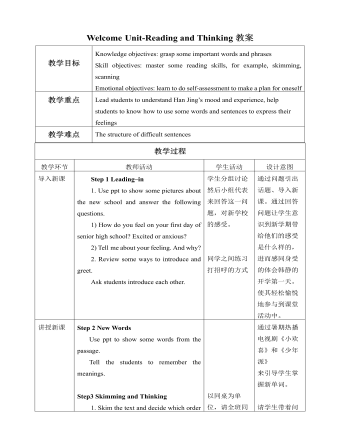
新人教版高中英语必修1Welcome Unit-Reading and Thinking教案
Step 2 New WordsUse ppt to show some words from the passage.Tell the students to remember the meanings.Step3 Skimming and Thinking1. Skim the text and decide which order Han Jing follows to talk about her first day. Time order or place order?Time order2. What is Han Jing worried about before she goes to senior high school?She is worried about whether she will make new friends and if no one talks to her, what she should do.Step 4 Fast Reading1. Match the main ideas with each paragraphParagraph 1:The worries about the new school day Paragraph 2Han Jing’s first maths classParagraph 3Han Jing’s first chemistry classParagraph 4Han Jing’s feelings about her first senior school dayStep 5 Careful Reading1. Fill in the chart with the words and phrases about Han Jing’s day. Answers: Senior high school, a little nervous; Her first maths class, classmates and teachers, friendly and helpful; Chemistry lab; new; great; annoying guy; Confident; a lot to explore2. Read the text again and discuss the questions.1) Why did Han Jing feel anxious before school?Because she was a new senior high student and she was not outgoing. What was more, she was worried about whether she can make friends.2) How was her first maths class?It was difficult but the teacher was kind and friendly. 3) What happened in the chemistry class? What would you do if this happened to you? A guy next to Han Jing tried to talk with her and she couldn’t concentrate on the experiment.
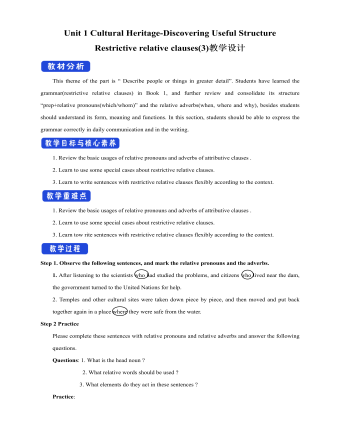
新人教版高中英语必修2Unit 1 Cultural Heritage-Discovering Useful Structure教案二
This theme of the part is “ Describe people or things in greater detail”. Students have learned the grammar(restrictive relative clauses) in Book 1, and further review and consolidate its structure “prep+relative pronouns(which/whom)” and the relative adverbs(when, where and why), besides students should understand its form, meaning and functions. In this section, students should be able to express the grammar correctly in daily communication and in the writing. 1. Review the basic usages of relative pronouns and adverbs of attributive clauses . 2. Learn to use some special cases about restrictive relative clauses.3. Learn to write sentences with restrictive relative clauses flexibly according to the context.1. Review the basic usages of relative pronouns and adverbs of attributive clauses .2. Learn to use some special cases about restrictive relative clauses.3. Learn tow rite sentences with restrictive relative clauses flexibly according to the context.Step 1. Observe the following sentences, and mark the relative pronouns and the adverbs. 1. After listening to the scientists who had studied the problems, and citizens who lived near the dam, the government turned to the United Nations for help.2. Temples and other cultural sites were taken down piece by piece, and then moved and put back together again in a place where they were safe from the water.Step 2 PracticePlease complete these sentences with relative pronouns and relative adverbs and answer the following questions.Questions: 1. What is the head noun ?2. What relative words should be used ?3. What elements do they act in these sentences ?
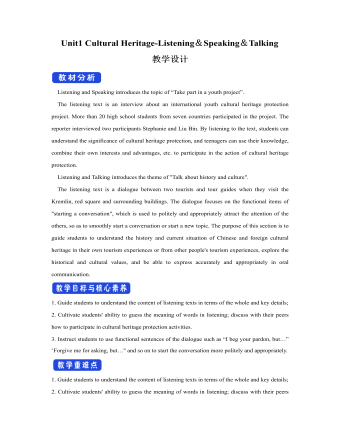
新人教版高中英语必修2Unit 1 Cultural Heritage-Listening&Speaking&Talking教案
Listening and Speaking introduces the topic of “Take part in a youth project”. The listening text is an interview about an international youth cultural heritage protection project. More than 20 high school students from seven countries participated in the project. The reporter interviewed two participants Stephanie and Liu Bin. By listening to the text, students can understand the significance of cultural heritage protection, and teenagers can use their knowledge, combine their own interests and advantages, etc. to participate in the action of cultural heritage protection. Listening and Talking introduces the theme of "Talk about history and culture". The listening text is a dialogue between two tourists and tour guides when they visit the Kremlin, red square and surrounding buildings. The dialogue focuses on the functional items of "starting a conversation", which is used to politely and appropriately attract the attention of the others, so as to smoothly start a conversation or start a new topic. The purpose of this section is to guide students to understand the history and current situation of Chinese and foreign cultural heritage in their own tourism experiences or from other people's tourism experiences, explore the historical and cultural values, and be able to express accurately and appropriately in oral communication.1. Guide students to understand the content of listening texts in terms of the whole and key details; 2. Cultivate students' ability to guess the meaning of words in listening; discuss with their peers how to participate in cultural heritage protection activities.3. Instruct students to use functional sentences of the dialogue such as “I beg your pardon, but…” “Forgive me for asking, but…" and so on to start the conversation more politely and appropriately.
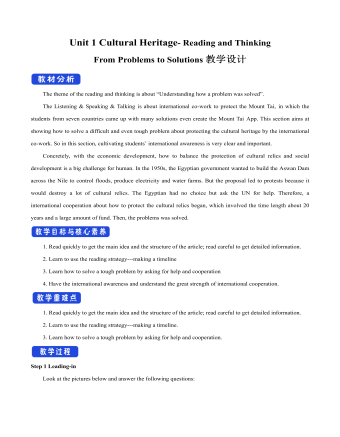
新人教版高中英语必修2Unit 1 Cultural Heritage-Reading and Thinking教案一
The theme of the reading and thinking is about “Understanding how a problem was solved”.The Listening & Speaking & Talking is about international co-work to protect the Mount Tai, in which the students from seven countries came up with many solutions even create the Mount Tai App. This section aims at showing how to solve a difficult and even tough problem about protecting the cultural heritage by the international co-work. So in this section, cultivating students’ international awareness is very clear and important. Concretely, with the economic development, how to balance the protection of cultural relics and social development is a big challenge for human. In the 1950s, the Egyptian government wanted to build the Aswan Dam across the Nile to control floods, produce electricity and water farms. But the proposal led to protests because it would destroy a lot of cultural relics. The Egyptian had no choice but ask the UN for help. Therefore, a international cooperation about how to protect the cultural relics began, which involved the time length about 20 years and a large amount of fund. Then, the problems was solved. 1. Read quickly to get the main idea and the structure of the article; read careful to get detailed information.2. Learn to use the reading strategy---making a timeline3. Learn how to solve a tough problem by asking for help and cooperation4. Have the international awareness and understand the great strength of international cooperation.1. Read quickly to get the main idea and the structure of the article; read careful to get detailed information.2. Learn to use the reading strategy---making a timeline.3. Learn how to solve a tough problem by asking for help and cooperation.
新人教版高中英语必修2Unit 1 Cultural Heritage-Reading For Writing教案
This report is short, concise and has typical news content and language features. The title uses the verb phrases, embodying the characteristics of being concise and general. The introduction is the first two sentences in the first paragraph, describing the general situation of the cultural heritage protection project, including time, place, characters, events and other news elements, so that readers can see the main points of the news report at a glance. The main body is the second and third paragraphs, which report the important historical and cultural value of Mogao Grottoes and the production of Mogao Grottoes Material digital photos, which are of great significance to the inheritance of historical culture and the promotion of international cultural understanding, exchange and cooperation. Direct citation is used in the report, as well as background introduction and other news writing techniques.1. Get students to have a good understanding of some features about a news report by reading the text.2. Instruct students to write a summary about a news report properly using some newly acquired writing skills in this period.3. Develop students’ writing and cooperating abilities.4. Strengthen students’ great interest in writing discourses.1. Stimulate students to have a good understanding of how to a summary about a news report 2. Cultivate students to write a news report properly and concisely.Step 1: Lead in Do you think it is necessary for us to circulate our cultural heritage to the world? Why or why not?Do we need to learn more about other countries’ cultural heritage? Why or why not?Step 2: Read to discover details concerning the main body of the news report.
新人教版高中英语必修3Unit 1 Festivals and Celebrations教学设计一
本板块的活动主题是“谈论节日活动”(Talk about festival activities),主要是从贴近学生日常生活的角度来切入“节日”主题。学生会听到发生在三个国家不同节日场景下的简短对话,对话中的人们正在参与或将要亲历不同的庆祝活动。随着全球化的进程加速,国际交流日益频繁,无论是国人走出国门还是外国友人访问中国,都已成为司空见惯的事情。因此,该板块所选取的三个典型节日场景都是属于跨文化交际语境,不仅每组对话中的人物来自不同的文化背景,对话者的身份和关系也不尽相同。1. Master the new words related to holiday: the lantern, Carnival, costume, dress(sb)up, march, congratulation, congratulate, riddle, ceremony, samba, make - up, after all. 2. To understand the origin of major world festivals and the activities held to celebrate them and the significance of these activities;3. Improve listening comprehension and oral expression of the topic by listening and talking about traditional festivals around the world;4. Improve my understanding of the topic by watching pictures and videos about different traditional festivals around the world;5. Review the common assimilation phenomenon in English phonetics, can distinguish the assimilated phonemes in the natural language flow, and consciously use the assimilation skill in oral expression. Importance:1. Guide students to pay attention to the attitude of the speaker in the process of listening, and identify the relationship between the characters;2. Inspire students to use topic words to describe the festival activities based on their background knowledge. Difficulties:In the process of listening to the correct understanding of the speaker's attitude, accurately identify the relationship between the characters.
新人教版高中英语必修3Unit 1 Festivals and Celebrations教学设计三
*wide range of origins(= a great number of different origins, many kinds of origins)*It featured a parade and a great feast with music, dancing, and sports. (=A parade and a great feast with music, dancing, and sports were included as important parts of the Egyptian harvest festival.)*.. some traditions may fade away and others may be established.(= Some traditions may disappear gradually, while other new traditions may come into being.)Step 6 Practice(1) Listen and follow the tape.The teacher may remind the students to pay attention to the meaning and usage of the black words in the context, so as to prepare for the completion of the blanks in activity 5 and vocabulary exercises in the exercise book.(2) Students complete the text of activity 5 by themselves.The teacher needs to remind the students to fill in the blanks with the correct form of the vocabulary they have learned in the text.Students exchange their answers with their partners, and then teachers and students check their answers.(3)Finish the Ex in Activity 5 of students’ book.Step 7 Homework1. Read the text again, in-depth understanding of the text;2. Discuss the origin of festivals, the historical changes of related customs, the influence of commercial society on festivals and the connotation and essential meaning of festivals.3. Complete relevant exercises in the guide plan.1、通过本节内容学习,学生是否理解和掌握阅读文本中的新词汇的意义与用法;2、通过本节内容学习,学生能否结合文本特点快速而准确地找到主题句;3、通过本节内容学习,学生能否理清论说文的语篇结构和文本逻辑,了解节日风俗发展与变迁,感悟节日的内涵与意义。
人教版高中地理必修1河流地貌的发育教案
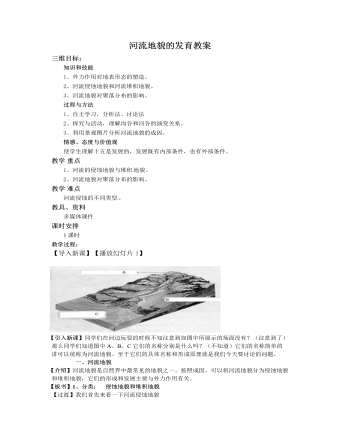
【引入新课】同学们在河边玩耍的时候不知注意到如图中所展示的场面没有?(注意到了)那么同学们知道图中A、B、C它们的名称分别是什么吗?(不知道)它们的名称简单的讲可以统称为河流地貌。至于它们的具体名称和形成原理就是我们今天要讨论的问题。一、河流地貌【介绍】河流地貌是自然界中最常见的地貌之一。按照成因,可以将河流地貌分为侵蚀地貌和堆积地貌,它们的形成和发展主要与外力作用有关。【板书】1、分类: 侵蚀地貌和堆积地貌【过渡】我们首先来看一下河流侵蚀地貌【板书】2、河流侵蚀地貌【介绍】河流在流动过程 中,会破坏并掀起地表的物质,形成侵 蚀地貌。河流侵蚀地貌是由溯源侵蚀、下蚀和侧蚀共同作用形成的。【引导读书】请同学们快速阅读教材P83倒数 第二段,添出以下表格。
人教版高中地理必修1地球的运动教案
三维目标:知识和技能 1、了解地球自转和公转的方向及一些基本数据:周期、速度、公转轨道、黄赤交角。2、理解由于地球自转运动造成的昼夜交替、地方时差,掌握时间的有关换算,能正确判断晨昏线。3、理解地球自转和公转的关系,理解太阳直射点的南北移动的过程及其原因,并能演示其运动规律。4、理 解昼夜长短和正午太阳高度的季节变坏纬度变化 。过程与方法 1、通过运用地球仪演示地球的自传和公转现象,学生能够准确的画出夏至日到冬至日太阳照射地球的示意图2、能根据“二分二至日太阳照射地球示意图”分析全球各 地的昼夜长短和正午太阳高度的变化,分析同纬度地区不同季节和不同纬度地区相同季节的昼夜长短和正午太阳高度的变化。
人教版高中地理必修1山岳的形成教案
【转折过渡】除了以上所说的褶皱山和断层山之 外,是否还有其他类型的山脉呢?试举一例说明。【学生思考后回答】有,如富士山属于火山。【教师总结】同学们回答的很好,还有火山,那么火山是如何形成的呢?这就是我们要研究的下一个问题。【板书】3、火山【指导读书】请同学们阅读教材P81思考:①玄武岩高原和火山有什么联系与区别? ②火山由哪几部分构成的?③火山的规模是否相同?【学生回答】①联系:玄武岩高原和火山都是由于处于地下深处的岩浆,在巨大的压力作用下,有时候会沿着地壳的薄弱地带喷出地表而形成的。区别:玄武岩高原是岩浆沿着地壳的线状裂隙流出,往往比较宽广。如哥伦比亚高原。火山是岩浆沿着地壳的中央喷出口或管道喷出。如我国长白山的主峰。②火山由火山口和火山锥两部分组成。③火山的规模大小不一,大火山的相对高度可达4 000~5 000米,火山口直径为数百米;小火山的相对高度不及100米。
人教版高中语文必修1《小狗包弟》教案2篇
巴金在十年浩劫中的大致经历:放弃包弟并没有换得保全一家人,1968年8月,巴金被关进牛棚改造,随后经受了大字报、挂牌游街等形式的批斗。1970年,到农村改造,掏大粪、喂猪、背稻草、种地……1972年,妻子萧珊在饱受精神折磨后患上癌症,病逝。巴金的儿子在劳动改造的过程中也饱受精神和肉体上的折磨,性格变得内向抑郁,疾病缠身。此时,巴金69岁。巴金曾在《病中》一文写道:“当姚文元拿着棒子的时候,我给关在牛棚里除了唯唯诺诺之外,敢于做过什么事情?十年间我不过是一条含着眼泪等人宰割的牛。”小结:(幻灯片12)社会是病态的社会,政治是高压的政治,人性是扭曲的人性。十年文革,十年浩劫,给多少人留下了累累不可弥合的精神创伤。即使一条小狗,也可能摆脱不了“文革”无情的迫害,比如包弟,比如艺术家邻居的小狗。
人教版高中语文必修1《大卫·科波菲尔》教案2篇
(1)主人公大卫·科波菲尔:大卫·科波菲尔是《大卫·科波菲尔》中的主人公,曾经是个孤儿。作家描写了他从孤儿成长为一个具有人道主义精神的资产阶级民主主义作家的过程。他善良,诚挚,聪明,勤奋好学,有自强不息的勇气、百折不回的毅力和积极进取的精神,在逆境中满怀信心,在顺境中加倍努力,终于获得了事业上的成功和家庭的幸福。在这个人物身上寄托着狄更斯的道德理想。(2)《大卫·科波菲尔》中的女性形象:在狄更斯笔下,《大卫·科波菲尔》塑造了一个个有血有肉的人物形象,每个任务都给人留下了深刻的印象,尤其是成功塑造了不同性格、不同品德的女性形象:贝西姨婆、艾妮斯、佩葛蒂、克拉拉、朵拉、摩德斯通小姐、米考伯太太、艾米丽……贝西姨婆与摩德斯通小姐的对比,克拉拉、朵拉与艾妮斯的对比更使她们栩栩如生,对贝西姨婆、艾妮斯、佩葛蒂的爱就更深一层,对摩德斯通小姐更是恨之入骨,对朵拉、克拉拉既同情又气愤。
人教版高中语文必修1《荆轲刺秦王》教案
教学目标:1、知识与能力:①了解荆轲刺秦王的历史背景和过程,整体感知课文。②掌握文言文中重要的字、词、句解释,提高翻译能力。③学会从人物的对话、动作、神态描写入手,分析主要人物形象。2、情感与态度:正确看待荆轲刺秦王这一事件,学会历史而辩证地评价人物。重点难点:评价历史事件,分析人物形象。教学方法:朗读法、提问法、讨论法课时安排:三课时教学过程:第一课时一、导入:(课前展示雕塑照片)来到正定讲课,我感到非常高兴,一进县城,就被这里浓郁的历史文化气息所感染。我们住在华阳假日酒店,外面正在兴建文化广场,刚才的照片就是在那里拍摄的。在此,我进一步了解到正定这座文化古城悠久的历史渊源,这里有南越王赵佗,常胜将军赵云,一代名家颜真卿等等,可谓物华天宝、人杰地灵。因此我相信我们正定中学的同学们一定都非常优秀。这也让我更深刻地体会到一个道理:语文的外延就是生活的外延。

人教版高中语文必修1《奇妙的对联》教案2篇
3、介绍对联的历史引出本课的重点。人类历史上的第一副对联是“新年纳余庆,嘉节号长春”。出现在五代十国时期(公元964年),距离现在已经有1044年了。有着一千多年历史的对联有什么基本的特点呢?这是我们这节课学习的重点。请在座的各位当回医生,给下面这幅对联号号脉,看它对仗是否工整?上联:冬去春来千条杨柳迎风绿下联:冰消雪化梅花万朵扑鼻有什么问题,怎么改?刚才这几位同学指出了这幅对联的两个问题,也提出了两条修改意见。第一是下联少了一个字,最好是添加一个“香”字;第二是下联的“梅花万朵”与上联的“千条杨柳”是数量词对名词,名词对数量词,对仗不工整,要调整为“万朵梅花”。这样,数量词“万朵”对“千条”,名词“梅花”对“杨柳”。大家还有没有不同的看法。这样我们就可以得出对联的两个特点特点:第一个特点是上下联字数要相等(板书)。就是上联有几个字,下联也要有几个字。大家记下来,对联基本要求一,“上下联字数相等”。这个要求是很严格的,一般来说,违反这个规则就不成对联了。
人教版高中历史必修1抗日战争教案
【备课资料】百团大战八路军从8月20日起,在华北敌后出动105个团,约40万兵力,在2500公里长的战线上,发动了规模最大的“以彻底破坏正太路若干要隘,消灭部分敌人截断该线交通”为目的的举世闻名的“百团大战”。八路军提出“不留一根铁轨、不留一根枕木、不留一个车站、不留一个碉堡、不留一座桥梁”的口号,“让敌人用脚同我们赛跑”,“让敌人用牛驴搬炮弹、飞机大炮”。八路军展开攻坚战,端掉敌一系列据点。据有关资料记载,从8月20日到12月5日,在历时三个半月的“百四大战”中,我军共进行大小战斗1824次,毙伤日伪军25800余人,俘日伪军18600余人,缴获了大批武器、弹药和军用食品等;破坏铁路470多公里,公路1500多公里,桥梁、车站、隧道等260余处,使正太铁路停运月余;攻克日伪据点2993个,巩固和扩大了抗日军民占领区。
人教版高中历史必修1马克思主义的诞生教案
【合作探究】分析说明巴黎公社是无产阶级建立政权的第一次伟大尝试(1)从巴黎公社产生的情况来看,它是在巴黎无产阶级通过暴力革命,推翻反动的资产阶级政府的基础上,通过普选建立起的新型国家。(2)从巴黎公社的政权的领导人和阶级成分来看,通过民主选举产生的公社委员会的成员,大多数是工人,其中有些委员会虽然从事不同的职业,有的不是马克思主义者,但公认是公认阶级的代表。(3)从巴黎公社实行的政策措施来看,这是最能说明公社性质的一个方面。公社在建设新政权的同时,打碎资产阶级国家机器,做出建立无产阶级专政国家机器的伟大尝试。公社的社会经济措施和其他民主措施,都在一定程度上体现了它的无产阶级性质。没收逃亡资本家的工厂,触及资本主义私有制,具有明显的无产阶级性质。
人教版高中历史必修1鸦片战争教案2篇
1.知识与能力:(1)通过引导学生分析鉴赏19世纪以来有代表性的音乐与美术作品,了解这些作品产生的时代背景及其艺术价值。(2)通过分析世界艺术产生的历史背景,可以帮助学生正确认识人类文化的多样性、时代性和民族性,培养学生结合历史背景分析历史问题的能力。(3)通过对19世纪以来的音乐与美术史实的分析、综合、比较、归纳、概括等认知活动,培养历史思维和解决问题的能力。2.过程与方法:(1)让学生在搜集资料、自主探究、合作交流过程中,发展学生在社会中学习、网络学习、终身学习的能力。(2)通过上网了解艺术大师及分析鉴赏其各类美术、音乐作品,感受其艺术价值。 (3)思维方法:学会知识迁移,在从感知历史到不断积累历史知识,进而不断加深对历史和现实的理解过程中,提高分析理解问题能力。学会善于从不同的角度发现问题,积极探索解决问题的方法,从而做到论从史出、史论结合。
新人教版高中英语必修1Unit 2 Travelling Around-Discovering Useful Structure教案
(5)be to do (可以和具体的时间状语连用)①表示按计划、安排即将发生的动作。②用于时间、条件状语从句中,表示“如果要……,想要……”。The students are to meet at the school gate tomorrow. 明天学生们将在学校大门口集会。 If you are to succeed, you must work as hard as possible. 如果你想要成功,比必须努力工作。(6)be about to do (不与具体的时间状语连用) 表示即将要发生的动作。We are about to start. 我们就要出发了。The new school year is about to begin. 新学年开学在即。(7)一般现在时表将来①表示按时间表规定将要发生的动作。常限于表示位置移动的短暂性动词。②在时间、条件或让步状语从句中,用一般现在时表将来。Look at the timetable. Hurry up! Flight 4026 takes off at 18:20. 你看看时刻表,快点!4026次航班的起飞时间是下午6点20分。Jane is in a hurry because the train to the airport leaves in half an hour. 简很匆忙,因为去机场的火车半小时后出发。
新人教版高中英语必修1Unit 2 Travelling Around–Listening and Speaking教案
无论她说什么都不会对我们的安排有影响。Answers: for, arrangement3) Parents arrange everything for their children and spare no effort to pave the way for their success.父母为孩子安排好一切,不遗余力地为他们的成功铺路。4. extremely adv 极其,非常extreme adj 非常的1) Mary found it extremely difficult to get a job.2) I’m extremely sorry to have troubled you.Answers:玛丽发现找工作极其困难。给你添了麻烦,我十分抱歉。3) It had white-painted tunnels and bright red carriages, and proved _________ (extreme) popular with the public.它有白色的隧道和明亮的红色车厢,结果证明它非常受大众的欢迎。Answers: extremelyExercises1. I am continuing to apply_______ jobs though I have failed several times.2. All this had an _______ (extremely) bad effect on the criminal justice system.3. The invention would have wide ______ (apply) in industry.4. She’s happy with her unusual living _________ (arrange).5. I was banging so loudly that I’m ___________ (amaze) that they didn’t hear me.6. You haven’t changed at all you still look ___________ (exact) the same.7. “Was it what you expected?” “Yes, _________ (definite).”8. He was looking forward to______ (work) with the newPrime Minister. Answers: for extreme application arrangement amazed exactly definitely looking单句写作:1. _______________ (你要说些什么) when you get on the platform to accept the reward?2. Since_____________________(我们为这些事情做好了准备), we have nothing to worry about.
新人教版高中英语必修1Unit 2 Travelling Around-Reading and Thinking教案
Good expressions that students can choose to use: help the travelers choose which tour to take1. In my opinion, you could/might choose…, because you prefer to…2. …could be a perfect choice for you, for…3. As far as I am concerned, you would enjoy…, for…4. …would probably suit you, because you enjoy/love/hate doing…Step 5 Passage ConsolidationLanguage appreciation:1. You can then spend three days exploring the rainforest with a local guide and enjoying the plants and animals unique to the rainforest. 在接下来的三天里,您可以在当地导游的陪同下,深入雨林进行探索,欣赏雨林特有的动植物。本句主体结构为spend some time doing sth. 2. Inca builders cut stones to exact sizes so that nothing was needed to hold walls together other than the perfect fit of the stones. 印加的建筑工人将石头切割成精确的尺寸,仅仅凭着石头间的完美契合,即可稳固墙体。本句为so that引导的结果状语从句。nothing与the perfect fit为并列成分; other than在句中意为“除了”。Step 6 HomeworkSuppose you will travel to Peru, write a short essay about your three-day tour plan.