-
人教版新课标PEP小学英语六年级上册What Are You Going to Do教案
1.热身(Warm-up) (1)全班一起吟唱Let’s chant的歌谣。 (2)单词拼写竞赛 要拼写的单词包括:this morning/afternoon/evening,next week,newspaper, postcard等。可采取小组合作的“接龙式”拼写形式;也可以选取组内一名学生拼写全部单词。拼出单词最快最多的组获胜。 (3)教师出示简明地图,师生问答如下: r:What shop is it? s:It’s a bookstore. r:What can you buy in the bookstore? s:… 在学生回答各商店所出售的物品时,教师根据其回答贴出物品的小卡片,如: Fruit stand:orange,apple,pear,banana….Shoe store:sneakers,sandals,boots….(此时可引导学生说“a pair of sneakers/boots’’等) 2.预习(Preview) Let’s try 教师指着地图中的商店及各商店所出售的物品说:Look!There are so many stores and so many goods.Let’s listen to the tape and find out:①Where is Sarah going? ②What is she going to buy? ③Who is she going with? 教师放三遍Let’s try部分的录音,以上问题可根据学生的实际情况分三次提出,直到多数学生能回答并能将前两项答案填人教师课前画出的表格中。在填表过程中,教师请学生一起拼写其中的四会单词,如:bookstore,comic book。
人教版新课标PEP小学英语六年级下册Recycle1 Let’s Take a Trip教案
4.巩固和扩展(Consolidation and extension) (1) 做本单元活动手册配套练习。 (2) 翻卡片说单词。学生两人一组,把单词卡片反面朝上放在桌子上,然后同时翻开两张单词卡(如:going, holiday),就马上组织成一句话(如:Where are you going on the holiday?/ I’m going to Kunming this holiday.),说得快又正确者为胜。 (3) 教师播放C部分Story time的录音或VCD,帮助学生理解故事内容。学生再听一遍录音,跟读故事里的句子,教师指导学生发音。 (4) Bright eyes. 在黑板上张贴Let’s find out的8幅图片,Mike, Zhang Peng, Sarah, Kathy等4个人物图片分别放在8幅图片上,如:Mike ---take pictures---buy presents。学生仔细观察后,请学生闭上眼睛,教师就趁学生闭眼之际交换人物位置(如把Mike放到eat noodles),然后请学生张开眼睛回答:What did Mike do just now ? 引导学生回答: Mike took pictures and bought presents. 教学参考资料库 1.文化背景介绍: 机场标志: Airport 飞机场 Airport lounges 机场休息室Airports shuttle 机场班车 Arrivals 进港Assistance 问讯处Check in area (zone) 办理登机区Departure airport 离港时间Departure times on reverse 返航时间 Welcome aboard 欢迎登机
人教版新课标PEP小学英语六年级下册What’s the Matter, Mike教案
回答:She’s sad. She failed the math test.并板书:fail the math test。准备一张很糟的数学试卷,是学生了解语意。进一步教学其他短语a Chinese test, a English test,并 让学生了解pass the Chinese test, pass the English test, pass the math test. (4)教师请学生扮演Sarah,师生对话如下: T: Hello! Sarah, how are you? You look sad today. Sarah: Yes, I failed the math test. 教师接着说:I’m sorry to hear that.让学生理解意思。并引申出句子:I’m glad to hear that.让学生分角色朗读对话。 (5)Let’s check.让学生看Sarah的表情,并读两篇对话,选出正确的答案。 (6)活动名称:心理医生 活动目的:操练句型“How are you? You look…”.学生间自由组合编排对话.通过对话对学生展开情感教学,让学生理解健康的体魄和愉悦的心情的心情是一个人成功的重要因素,使学生形成良好的心理健康状态。 活动过程:A: How are you? You look bored today. B: Yes. I failed my math test. A: I’m sorry to hear that. Believe yourself. Work hard. You can pass the text next time. (7)活动名称:难忘时刻 活动目的:围绕照片上的表情展开询问和讨论.操练句型 “How do you feel? How does she/he feel?
人教版新课标小学数学二年级上册求比一个数少几的数教案
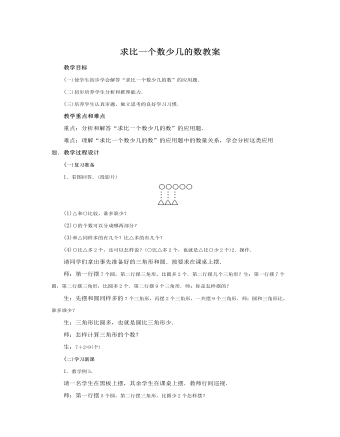
课堂教学设计说明求比一个数少几的数的应用题是低年级教学的一个难点.为了分散难点,在复习准备阶段做了孕伏.如:圆比三角形多2个,也可以说三角形比圆少2个.为了突破难点,让学生动手摆、动口说、动笔写,全方位地调动学生的各种感官参与教学全过程,使学生在参与学习的活动中领悟出“求比一个数少几的数”的应用题仍然是把较大数看作两部分组成的,从大数中去掉大数比小数多的部分,就是小数与大数同样多的部分,也就是小数的数值.也可以通过“假设同样多”去透彻地理解比一个数少几的实际意义.确实使学生理解和掌握了这类应用题用减法计算的道理和解答方法.为了让学生进一步加深理解和掌握“求比一个数少几的数”的应用题的数量关系和解答方法,在巩固练习的最后设计了一组对比题目.
人教版新课标小学数学四年级上册数学广角教案
教学目标:知识与技能:1、使学生初步体会对策论方法在解决实际问题中的应用。2使学生认识到解决问题策略的多样性,形成寻找解决问题最优方案的意识。3、培养学生的应用意识和解决实际问题的能力。过程与方法:使学生理解优化的思想,形成从多种方案中寻找最优方案的意识,提高学生解决问题的能力。情感、态度和价值观:使学生感受到数学在日常生活中的广泛应用,尝试用数学的方法解决生活中的简单问题。重点:体会优化的思想难点:寻找解决问题最优方案,提高学生解决问题的能力。教具:图片教学过程:一、情境导入:1、你们听过“田忌赛马“的故事吗?田忌是怎样赢了齐王的?谁能给大家讲一讲这个故事?2、问:田忌的马都不如齐王的马,但他却赢了?这是为什么呢?3、这节课我们就来研究研究。板书课题:数学广角
人教版新课标小学数学一年级上册1~5的认识和加减法教案
教学难点:利用数的分解组成,正确地计算5以内的减法。教学准备:小圆片、小棒、小黑板。教学过程:一、复习:1、拍手接力游戏 。2、看图说图意,并列式计算。3、复习5以内数的组成。二、新授:1、(小黑板)出示画图:树上有5只鸟,飞走了一只。根据这幅图,你能提什么问题呢?2、那么你怎么列式呢?先和小组里的小朋友说一说,再指名回答,请学生上来板书列式。3、小组内交流:“5-1”得几?你是怎么算的?和组里的小朋友交流,每个小朋友都说自己的想法,是怎样得出结果的。4、汇报情况:指名小老师上来教大家计算的过程(提倡算法多样化,教师可以有意识请想法不同的学生上来说一说)5、抽象出计算过程:引导学生如果不看图,不数手指,你会计算“5-1”得几吗?(引导学生用数的组成知识来计算)
人教版新课标小学数学一年级上册认识钟表教案
二、认识半时1、挂图出示钟面:7时半、8时半师:请小朋友拿出自己的钟,拨一拨这二个钟面上所表示的时刻,你能发现这两个钟面有什么共同的特点吗?2、学生自由回答。教师小结,得出规律:钟面上半时时,分针指着数字6,而时针总是指向两个数字的中间。挂图再出示二个钟面上的表示的时刻,师:你说一说这两个钟面的时刻是多少3、认一认挂图出示图片(即书中第93面的做一做)师:请你说一说图中的小朋友,几时在干什么?4、挂图出示7时、7时半师:请你们认真观察,说一说这两个钟面上表示的时刻,看一看两根指针的位置有什么不同?5、教师小结。三、练习反馈,激活思维1、请你在你的钟上面拨一个你最喜欢的半点时刻,并说一说你为什么最喜欢这个时刻?
人教版新课标小学数学一年级下册100以内数的认识教案
(1)第1题:这是一道按顺序填数的题。根据要求在括号里填数。学生独立完成,订正。①所填数中,哪个数最接近100?②67接近60还是更接近70?62呢?(2)第2题:这是一道按要求排列数的题。把下面的卡片按从小到大的顺序重新排列,想一想:从小到大排列,要把什么样数放在最前面?什么样的数放在最后面?学生拿出数字卡片,在小组中完成。指名板演订正。(3)第3题:这是一道游戏形式的比较大小的题。帮小蜜蜂回家,学生独立完成连线。①大于60的数有哪些?②小于60的数有哪些?三、小结:谈谈这节课你的收获。作业布置:第八课时、练习教学内容:练习八4~8题。教学目标:巩固本单元所学知识。教学过程:一、揭题:这节课我们继续做练习,完成练习八余下的练习。三、完成练习:1、第4题:这是一道估数题。根据小青蛙说的话,估计一下它吃了多少只害虫。
人教版新课标小学数学一年级下册立体图形的拼组教案
小结:分别沿正方形纸的两组对边做出的圆筒一样长、也一样粗,因为正方形的四条边都相等。解决问题。课件出示:你能用几种方法,数出下图中小正方体的个数?方法一:可以从上往下数(或从下往上数)第一层有2个,第二层有4个,第三层有6个,三层共有:2 + 4 + 6 = 12(个);方法二:也可以从左往右数(或从右往左数)。第一排有4个,第二排有6个,第三排有2个,三排共有:4 + 6 + 2 = 12(个);方法三:还可以将最上面一层的2个移到第二层的右侧。这样,这堆木块就变成了两层,每层都有6个,共有6 + 6 = 12(个)。(四)全课总结这节课我们用长方体和正方体拼组了很多不同形状的图形。其实在我们的生活中,有很多物体的形状都是由长方体和正方体拼组而成的,希望同学们课下留心观察。(五)练习数一数,下面的图形由几个正方体组成?
人教版新课标小学数学二年级上册表内乘法(二)教案
三、利用乘法口诀进行计算1.复习口诀的含义。任意挑出一句乘法口诀(两个因数不同的),让学生说说它表示什么意思。如"七八五十六",使学生知道它既表示8个7相加是56,又表示?个8相加是56。2.以游戏的方式开展用口诀进行计算的活动。(1)已知两个因数求积的游戏。方法是:请一位学生随意说出一个两位数,另一位学生则将这个两位数的十位数字与个位数字相乘,并算出结果,如果结果又是一个两位数,再将这个两位数的十位数字和个位数字相乘,直至结果是一位数或零。如,一位学生说:"79",另一位学生则口算:7X9=636X3=181X8=8;一位学生说:"58":另一位学生口算:5X8=404X0=0(告诉学生0和一个数相乘得零)一位学生报了3个数以后,互换角色进行。(2)已知积求两个因数的游戏。
人教版新课标小学数学六年级上册分数除法教案
教学追记:本节课的内容相对而言较容易掌握,因而学生在学习中并没有出现什么困难。教学中,我两种方法并重,并让学生理解两种方法的殊途同归之处。对于类型稍有不同的题目,如“做一做”第2题,以人数为比例进行分配的,我在教学时添加了一道例题,教学后再让学生独力完成第2题,这样的教学让学生学得较为轻松,也对这种类型题掌握得较扎实。4、整理和复习整理复习(1)复习目标:使学生进一步掌握本章所学的基本概念和计算法则,提高学生的计算能力和解题能力。复习重点:分数除法的计算方法,化简比。复习难点:正确计算分数除法。复习过程:一、复习分数除法的意义和计算法则1、这一章我们学习了分数除法的有关知识.请大家回忆一下分数除法有几种类型?(1)分数除以整数,例如 ÷5;(2)一个数除以分数,它又包括整数除以分数,例如20÷ ;和分数除以分数,例如÷ 。(3)做第52页“整理和复习”的第2题。2、分数除法的意义
人教版新课标小学数学六年级下册扇形统计图教案
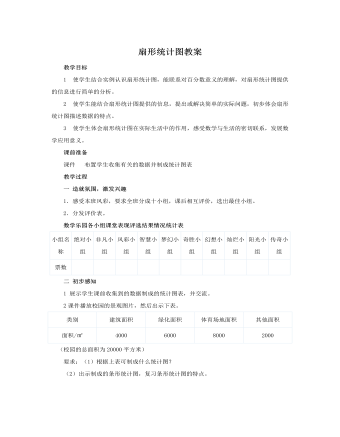
2 根据下面4幅,你能判断出哪个学校的女生人数最多吗?(1) 如果甲校的学生总人数900人,那么甲校的女生有多少人?(2) 如果丙校男生与甲校的同样多,那么丙校学生总人数有多少人?(3) 如果乙校的学生总人数与丙校的同样多,那么乙校男生有多少人?(4) 如果丁校的男生与乙校的同样多,那么乙校的女生有多少人?3 出示课件《中国人口占世界的百分比》和《中国国土面积占世界的百分比》统计图和有关的数据。(1)中国人口约13亿 (2)中国国土面积约960万平方千米(请同学认真观察统计图和有关的数据,请你说说获得了哪些信息?并提出我们能够解决的问题。要求:先在小组交流,然后派代表提出问题,并指定他组回答,其他同学当评委;如果回答正确,由的同学提问题,否则,由提问题的同学继续提问。同组成员可帮助。)还有什么想法?3 出示西山村果园各种果树种植面积情况,要求学生根据给出的数据制成扇形统计图。
人教版新课标PEP小学英语三年级下册Welcome back to school教案
教学过程:1.热身/复习(Warm-up/Revision)(1)教师用肢体语言表示出字母,让学生猜出字母,并大声读出。(2)出示字母卡,学生认读,并提问学生回忆以它开头的单词。(3)放A部分Let’s chant的录音,学生有节奏地跟唱歌谣。2.新课展示(Presentation)(1)出示字母卡学习Dd,再单独呈现大写或小写,反复教读。用同样方法教读Ee。(2)出示以这两个字母为首字母的单词图片,问学生:What’s this ?回答:It’s a duck .教读duck,dog,egg,elephant。注意egg是an egg,不是“a egg”.(3)放Let’s say部分的录音,学生跟读。3.趣味操练(Practice)(1)呈现大写或小写字母的趣味图片,让学生认读。(2)让学生发挥想象,说出这些字母 像什么。(3)教师按笔顺书写字母,让学生观察后按笔顺书写字母。(4)游戏:找朋友游戏:看谁站得快学生手执卡片,听教师发令后,产成一排,下面的学生边读边检查。
人教版新课标PEP小学英语六年级上册How do you go there教案
教师检查有多少学生能够准确区分14与40的发音,如果答对率低,教师要注意纠正。教师还可以板书一组相似的数字,如:13/30,18/80,15/50,教师说英文,学生说出中文的数字,帮助学生区分/-ti:n/与l-u/。 3.新课呈现(Presentation) Let’s talk (1)教师根据学生平时常去的场所提问,如当地的一家电影院、风景点、或学生的祖父母家等:“How can you get to…? Can you go by …? Is it fast/slow/expensive to go by …? ”进行师生间的自由会话,再让学生感知一下新句型:How can I/ you get to…? 然后,教师请学生根据课本中提供的地图回答问题:“How can I get to Zhongshan Park? ”引导学生回答,提示他们坐15路公交车为:“By the No.15 bus.”教师提供完整的答句:“Yes.I can go by the No.15 bus.”教师板书这组句子。 (2)教师继续提问:“It’s a place.You can buy food,drink,fruit,veget ables,school things and clothes there.What is it? (It’s a supermarket.)”教师最好出示一张当地比较有名的超市的照片或图片来给出谜底。教师再提问:“How can I get there? By bus or by bike? ”然后领读句子:“I can go to the supermarket by …”帮助学生理解supermarket是一个合成词,来源于super与market。
人教版新课标PEP小学英语六年级上册What Does She Do教案
(3)教师就黑板上的内容和学生做对话练习,如:What does your mother do?Where does she work?How does she go to work?教师板书“Where does she work?”和“How does she go to work?”,示范朗读,学生跟说。学生两人一组根据黑板上的语言提示做对话练习。 (4)“看卡片,说句子”活动 教师面前放一摞单词卡片,依次为:职业名称卡片,工作地点卡片和交通方式卡片。活动开始,教师随意从第一摞卡片中抽取一张职业卡片,如:engineer,举起来问:“What does your father do?”学生回答“He’s an engineer.”教师继续抽取一张工作地点卡片,举起来,如:Car company,问:“Where does he work?”学生说:“He works in a Car company.”教师再抽取一张交通方式卡片,如:bus,问:“How does he go to work?学生回答:“He go es to work by bus.”游戏进行几轮后,可以请几名学生轮流代替教师抽卡片,提问题。 (5)教师放本部分的录音,学生跟读。学生两人一组读课文对话。 (6)学生两人一组做对话替换练习。 (7)教师指导学生书写四会句子。 4.巩固和延伸(Consolidation and ex tension) Group work
新人教版高中英语必修3Unit 3 Diverse Cultures-Discovering Useful Structure教学设计
Step 4 PracticeRead the conversation. Find out which words have been left out.Justin: Linlin, I’m going to Guizhou Province next month. I’m super excited! Any recommendations for places to visit?Linlin: Wow, cool! Guizhou is a province with a lot of cultural diversity. Places to visit...well, definitely the Huangguoshu Waterfall first.Justin: What’s special about the waterfall?Linlin: Well, have you ever heard of the Chinese novel Journey to the West ?Justin: Yes, I have. Why ?Linlin: In the back of the waterfall, you will find a cave, which is the home of the Monkey King.Justin: Really? Cool! I’ll definitely check it out.Linlin:And I strongly recommend the ethnic minority villages. You’ll find Chinese culture is much more diverse than you thought.Justin:Sounds great, thanks.Answers:Justin: Linlin, I’m going to Guizhou Province next month. I’m super excited! Do you have any recommendations for places to visit?Linlin: Wow, that’s cool! Guizhou is a province with a lot of cultural diversity. What are some places to visit in Guizhou ? Well, definitely the Huangguoshu Waterfall is the first place to visit in Guizhou Province.Justin: What’s special about the waterfall?Linlin: Well, have you ever heard of the Chinese novel Journey to the West ?Justin: Yes, I have heard of the Chinese novel Journey to the West . Why do you ask if I have heard of the Chinese novel Journey to the West?Linlin: In the back of the waterfall, you will find a cave, which is the home of the Monkey King from Journey to the West.Justin: That’s really true? It’s Cool! I’ll definitely check it out.Linlin:And I strongly recommend the ethnic minority villages on your trip to Guizhou Province. You’ll find Chinese culture is much more diverse than you thought it was.Justin:This all sounds great, thanks.
新人教版高中英语必修3Unit 3 Diverse Cultures-Listening &Speaking&Talking教学设计
1. In Picture 1 and Picture 2, where do you think they are from? How do you know?From their wearings, we can know they are from ethnic minority of China--- Miao and Dong.Picture 1, they are playing their traditional instrument lusheng in their traditional costumes.Picture 2. the girls are Miao because they wear their traditional costumes and silver accessory.2. In Picture 3, can you find which village it is? What time is it in the picture?It is Dong village. It is at night. Step 2 While-listeningJustin met a new friend while traveling in Guizhou. Listen to their conversation and complete the summaries below.Part 1Justin and Wu Yue watched some Miao people play the lusheng. The instrument has a history of over 3,000 years and it is even mentioned in the oldest collection of Chinese poetry. Then they watched the lusheng dance. Justin wanted to buy some hand-made silver/traditional accessories as souvenirs. He was told that the price will depend on the percentage of silver. Part 2They will go to a pretty Dong minority village called Zhaoxing. they will see the drum towers and the wind and rain bridges. They may also see a performance of the Grand Song of the Dong people.Step 3 Post-listening---TalkingWork in groups. Imagine Justin is telling some friends about his trip to Guizhou. One of you is Justin and the rest of you are his friends. Ask Justin questions about his trip and experience. The following expressions may help you.
新人教版高中英语必修3Unit 3 Diverse Cultures-Reading for Writing教学设计
The topic of this part is “Describe a place with distinctive cultural identity”.This section focuses on Chinese culture by introducing Chinatown, whose purpose is to show the relationship between the Chinese culture and American culture. The Chinese culture in Chinatown is an important part of American culture. Chinatown is an important window of spreading Chinese culture and the spirit homeland of oversea Chinese, where foreigners can experience Chinese culture by themselves.Concretely, the title is “Welcome to Chinatown!”, from which we can know that the article aims at introducing Chinatown. The author used the “Introduction--Body Paragraph--Conclusion” to describe the people, language, architecture, business, famous food and drinks and people’s activities, which can be a centre for Chinese culture and shows its unique charm.1. Read quickly to get main idea; read carefully to get the detailed information.2. Learn the characteristics of writing and language.3. Learn to introduce your own town according to the text.4. Learn to correct others’ writing.1. Learn the characteristics of writing and language.2. Learn to introduce your own town according to the text.Step 1 Lead in ---Small talkIn the reading part, we mentioned the Chinatown of San Francisco. How much do you know about Chinatown of San Francisco ?Chinatown is a main living place for Chinese immigrants, where you can see many Chinese-style buildings, costumes, operas, restaurants, music and even hear Chinese.Step 2 Before reading ---Predict the contentWhat is the writer’s purpose of writing this text ? How do you know ?From the title(Welcome to Chinatown) and some key words from the text(tourist, visit, visitors, experience), we can know the purpose of the text is to introduce Chinatown and show the relationship between Chinese culture and American culture.
新人教版高中英语必修3Unit 3 Diverse Cultures-Reading and Thinking教学设计
Discuss these questions in groups.Q1: Have you ever been to a place that has a diverse culture ? What do you think about the culture diversity ?One culturally diverse place that I have been to is Harbin, the capital city of Heilongjiang Province. I went there last year with my family to see the Ice and Snow Festival, and I was amazed at how the culture as different to most other Chinese cities. There is a big Russian influence there, with beautiful Russian architecture and lots of interesting restaurants. I learnt that Harbin is called “the Oriental Moscow” and that many Russians settled there to help build the railway over 100 years ago.Q2: What are the benefits and challenges of cultural diversity ?The benefits: People are able to experience a wide variety of cultures, making their lives more interesting, and it can deepen the feelings for our national culture, it is also helpful for us to learn about other outstanding culture, which helps improve the ability to respect others. The challenges: People may have trouble communicating or understanding each other, and it may lead to disappearance of some civilizations and even make some people think “The western moon is rounder than his own.”Step 7 Post reading---RetellComplete the passage according to the text.Today, I arrived back in San Francisco, and it feels good (1) _____(be) back in the city again. The city succeeded in (2)_________ (rebuild) itself after the earthquake that (3)________ (occur) in 1906, and I stayed in the Mission District, enjoying some delicious noodles mixed with cultures. In the afternoon, I headed to a local museum (4)____ showed the historical changes in California. During the gold rush, many Chinese arrived, and some opened up shops and restaurants in Chinatown to earn a (5)_____ (live). Many others worked on (6)______ (farm), joined the gold rush, or went to build the railway that connected California to the east. The museum showed us (7)____ America was built by immigrants from (8)________ (difference) countries and cultures. In the evening, I went to Chinatown, and ate in a Cantonese restaurant that served food on (9)________(beauty) china plates. Tomorrow evening, I’m going to (10)__ jazz bar in the Richmond District. 答案:1. to be 2. rebuilding 3. occurred 4. that 5.living6. farms 7.how 8. different 9. beautiful 10. a
人教版高中生物必修1物质跨膜运输的方式说课稿
(4)提出问题:三种运输方式有哪些异同 组织学生分析填表,反馈和纠正.提出问题:影响自由扩散,协助扩散和主动运输速度的主要因素各是什么 画出细胞对某物的自由扩散,协助扩散和主动运输速度随细胞外浓度的改变而变化的曲线图组织学生分组讨论,并作图,展示各组的成果.教学说明:本环节巩固理论知识是对课本知识扩展和对重点,难点内容的深入理解和总结,只有理解了三种运输方式的异同,才能完成本环节教学任务,既突显书本知识,又培养学生的团结协作的精神,提高学生制做图表的能力和抽象化思维能力的形成.2.大分子的运输引导学生回忆分泌蛋白的分泌过程,得出胞吐现象,提出问题:那大家知道白细胞是如何吃掉病菌的吗 显示有关图片.强调:胞吞和胞吐作用都需要能量提出问题:胞吞和胞吐体现了细胞膜结构的特点是什么 与书本前面知识相联系.(四)技能训练指导学生就《技能训练》部分进行讨论五,反馈练习1.教师小结几种运输方式,特别是自由扩散,协助扩散和主动运输的特点