-
人教版高中语文必修5《陈情表》教案
【教学目标】1.熟读全文,掌握文中出现的重要的实词、虚词、古汉语句式;2.鉴赏本文融情于事的表达和形象精粹的语言;3.深入体会文章凄切婉转的陈情技巧。【教学重点】重要的古汉语语词知识【教学难点】理解作者当时的处境和李密祖孙间真挚深厚的感情【教学方法】作为教读课,选择串讲的方式,突出朗读,以期能做到既落实知识,又能体会文章之美。课时安排为两课时。要重点做好预习工作。【教学步骤】一、以苏轼的评论导入读《出师表》不下泪者,其人必不忠;读《陈情表》不下泪者,其人必不孝;读《祭十二郎文》不下泪者,其人必不友二、预习检测1、下列红色字注音完全正确的一项()A、臣以险衅(xìn)夙遭闵(mǐn)凶终鲜(xiǎn)兄弟常在床蓐(rù)B、猥(wěi)以微贱责臣逋(bǔ)慢犹蒙衿(jīn)育宠命优渥(wò)C、岂敢盘桓(huán)有所希冀(yì)日薄(bó)西山除臣洗(xiǎn)马D、逮(dǎi)奉圣朝过蒙拔擢(zhuó)门衰祚(zuò)薄更(gēng)相为命分析:B责臣逋(bū)慢,C有所希冀(jì),D逮(dài)奉圣朝。
人教版高中语文必修5《归去来兮辞(并序)》教案
【教学目标】1.理解作者反抗黑暗,辞官归田,不与当时黑暗的上层社会同流合污而热爱田园生活的积极精神,学习其高洁的理想志趣和坚定的人生追求。2.掌握“胡、奚、曷、焉、何”五个疑问代词,归纳“行、引、乘、策”等四个词的一词多义,了解“以、而、之、兮、来”等文言虚词的用法。3.背诵全文。【教学重点】1.了解作者辞官归田的原因,深刻体味诗人鄙弃官场,热爱田园的无限欣喜之情。2.背诵全文。【教学难点】1.理解记述中渗透出的或喜或哀,或决绝或犹疑的复杂感情。2.归纳实词、虚词的用法,掌握省略句、倒装句两种句式。【教具准备】投影仪投影胶片【课时安排】2课时【教学过程】第一课时[教学要点]了解陶渊明及其作品。读课文,利用注释、工具书,初步把握文章,朗读课文,找出押韵的字,由押韵归纳各层大意,帮助学生理清背诵思路,背诵全文。[教学步骤]一、导语《桃花源记》是我们在初中接触过的陶渊明的作品。师生一同背诵。《桃花源记》中悠闲自得的田园生活正是作者精神追求的形象反映。今天我们学习的《归去来兮辞》正是作者决别官场,同上层社会分道扬镳的宣言书。
人教版高中语文必修4《张衡传》教案
采用明段意分段法:先逐段概括段意,然后用合并同类项法把相关联紧缩密的自然段合在一起。全文五个自然段中,二、三、四自然段讲的都是张衡取得的科学成就,自然应合为一大段。这样,就理清了文章的结构。全文可分为三个部分:(1)写张衡的品格和文才①(2)写张衡在科学技术上取得的成就(②③④)(3)写张衡的政治才干(⑤)第二部分是文章的重点,又可分为两层:一是仕途情况,以及制作浑天仪和著《灵宪》、《算图论》的情况;一是专门介绍候风地支仪。显然,后者又是第二部分的重点。作者这样处理文章的详略安排。无疑是非常正确的,因为张衡一生有多方面的才能和成就,而他在科技方面的才能和创造发明最为突出,理应成为本文记叙的重点。四、小结1.了解全文的内容和结构,掌握明段意分段法。2.了解文章的详略安排。五、作业
人教版高中语文必修4《长亭送别》教案
三.分析第三部分:1.夫妻赠诗表现了二人怎样的心情?提示:崔莺莺告诫张生切勿忘记她;张生则发誓永无别恋。这充分展示了二人深厚的情谊。2.怎样理解[耍孩儿]中的典故?提示:“红泪”借王嘉《拾遗记》的典故,司马青衫借白居易《琵琶行》的典故,表现主人公因离别而生的伤心之情。“伯劳飞去燕西归”则用牛郎织女的典故表现两人缠绵难舍的心情。3.[五煞]表明了主人公怎样的心情?提示:对张生的生活的关心,千叮万嘱,真情自现。4.[二煞]中所用是几个典故?这些典故的作用是什么?提示:三个典故,见课本。其作用是表明崔莺莺对张生的担心。四.分析第四部分:1.[一煞]中再写环境,其作用是否与先前所写相同?提示:稍有不同,这里是表现崔莺莺目送张生远去时那种凄怆悲苦的眷恋之情。以所见之物,写内心深藏之情。2.[收尾]中写‘残照’其含义是什么?提示:以“残照”表现内心的怅惘失意之情。
人教版高中语文必修5《咬文嚼字》教案
【教学过程】第一课时一、导入新课清代唐彪在《读书作文谱》中引用武叔卿的话说:“文章有一笔写成不加点缀而工者,此神到之文,尚矣。其次须精思细改,如文章草创已定,便从头至尾—一标点。”同学们能列举出文学史上的作家哪些属于前者,哪些属于后者吗?前者有李白。后者如贾岛、王安石、欧阳修、曹雪芹等。(贾岛有关于推敲的典故。王安石修改“春风又绿江南岸”句传为佳话。欧阳修《醉翁亭记》的开头便是精心改成的。《红楼梦》更是“披阅十载,增删五次。”)提问:古今的伟大作家为什么像李白式的诗人很少,而大多数人却都要“咬文嚼字”,苦苦修改呢?这节课我们就来研究一下这个问题。二、整体感知1.快速浏览全文,熟悉主要内容。2.根据“学习重点”,确立学习目标。三、课文分析1.理清观点与材料的关系。首先,让学生找出本文在论证中所运用的材料。
人教版高中语文必修4《短文三篇》教案
③于是,大自然出现了惊人的奇迹,不毛的石缝间丛生出倔强的生命。④或者就只是一簇一簇无名的野草,春绿秋黄。岁岁枯荣。它们只有三两片长长的细瘦的薄叶,那细微的叶脉,告知你生存该是多么艰难;更有的。它们就在一簇一簇瘦叶下自己生长出根须,只为了少向母体吮吸一点乳汁,便自去寻找那不易被觉察到的石缝。这就是生命,如果这是一种本能,那么它正说明生命的本能是多么尊贵,生命有权自认为辉煌壮丽,生机竟是这样地不可扼制。⑤或者就是一团一团小小的山花,大多又都是那苦苦的蒲公英。它们不似田野上的同宗长得那样茁壮,它们的茎显得坚韧而苍老。它们的叶因枯萎而失却光泽。它们已经不能再去为人们作佐餐的鲜嫩的野菜,却默默地为攀登山路的人准备了一个可靠的抓手。生命就这样地被环境规定着,又被环境改变着,适者生存的规律尽管无情。但一切适者就是战胜环境的强者。生命现象告诉你,生命就是拼搏。

人教版高中历史必修2罗斯福新政教案
【教学参考】对“新政”作用的评价史学界对“新政”作用的评价是仁者见仁、智者见智,但基本上有三种观点,即“功大于过论”、“过大于功论”和“功过参半论”。持“功大于过论”者认为“新政”在美国历史上基本上是一种进步现象,首先,“新政”挽救了危机,使美国人民摆脱了危机的困苦局面;其次,在缺少足够的宏观经济政策知识的时代,罗斯福所做的努力确实是开创性的;再次,罗斯福“新政”开启了美国以后历届政府实施国家干预政策的大门,成为缓解自由主义经济制度之弊病的一剂良方,并在实质上加强了美国联邦政府的权威;最后,在30年代资本主义世界经济危机的背景下,同日本、德国为转嫁危机而发动战争的策略相比,“新政”无疑代表了一种进步、民主的解救危机方式。持“过大于功论”者认为“新政”未能使美国走出萧条、步入繁荣。
人教版高中历史必修3从蒸汽机到互联网教案
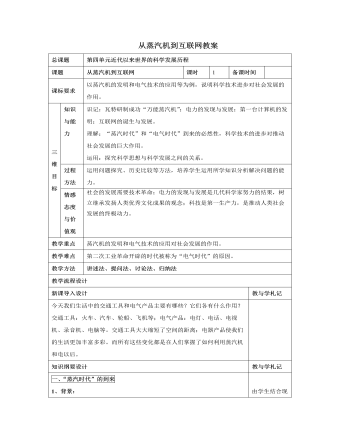
(2)根据材料二与所学知识,从经济、政治、思想文化三个方面,分析欧洲近代科技迅速发展的原因。答:资本主义工商业的成长刺激了对技术的需求,为近代科技的发展提供了工具和手段;资产阶级革命为资本主义发展、科技进步开辟了道路;人文主义和理性精神解放了思想,推动近代科技迅速发展。(如答出其它原因,言之有理,可酌情加分,但不得超过该问总分)(3)根据材料二三与所学知识,分析清代(鸦片战争前)中国科技发展停滞的原因。答:君主专制维系腐朽制度;重农抑商、闭关政策阻碍资本主义萌芽发展;自然经济不能提供近代科技发展的物质基础;文化专制政策(或崇尚理学、八股取士、文字狱等)禁锢思想,摧残人才,阻碍科技发展。(如答出其它原因,言之有理,可酌情加分,但不得超过该问总分。)(4)简述从中西方科技发展变化的历史中得到的启示。答:评分说明:围绕生产力发展,政治经济变革、思想解放与科技发展的关系等任一角度回答,言之有理,均可酌情赋分
人教版高中政治必修3文化与经济、政治教案
另一方面,文化素质影响公民政治权利的行使。随着民主和法制建设的发展,人们为了参与政治生活,需要更高的文化素养。文化水平提高了,人们受到的教育、接受的信息就越多,活动的领域就越广,民主法制和权利意识就越强,这些都会影响人们的民主素质和民主水平,使人们更好地进行政治参与,行使民主权利。(2)文化与国际政治相互交融,成为当代国际政治斗争的重要内容。随着世界多极化的发展,奉行霸权主义的国家,借助文化渗透的方式,竭力推销自己的价值观念,企图削弱和取代别国的民族文化,以推行强权政治。这使世界范围内反对文化霸权主义的斗争,成为当代国际政治斗争的重要内容。文化已经成为进行政治斗争、国际斗争的重要形式之一。对文化市场的争夺不仅仅是争夺票房价值、争夺经济效益,更主要的是对受众对象的争夺,对受众注意力这种特殊的稀缺资源的占有,以及在此基础上对舆论的控制与引导。因此,失去文化市场就意味着失去政治优势,意味着政治影响力的边缘化乃至萎缩或丧失。这一点,从目前世界正在进行的空前规模的“文化战争”,可以看得非常清楚。
人教版高中政治必修4价值与价值观精品教案
一、教材分析我们使用的是人教版第四册《生活与哲学》教材,本框属于第四单元第十二课第一框题。其内容主要分两目,第一目主要介绍价值的含义、人是社会一切财富的创造者、人的价值在于创造价值和对社会的责任和贡献,以及对一个人的评价主要看他的贡献等内容。第二目主要介绍价值观的导向作用,内容包括价值观的含义、价值观对人们认识世界和改造世界的活动具有导向作用以及对人生道路的选择具有导向作用。二、教学目标知识目标:1、识记价值和价值观的基本含义;价值观的导向作用。2、理解人的价值是什么?如何评价人的价值。3、运用所学知识及相关哲学原理,分析物的价值和人的价值的 不同,从中加深对人的价值的理解评论分析为什么对一个人的评价要看他的贡献,而不是索取了多少。
新人教版高中英语必修2Unit 2 Wildlife Protection-Reading for Writing教案二
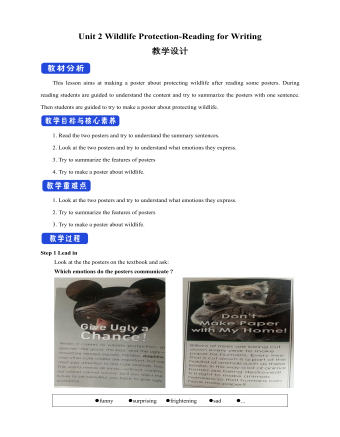
This lesson aims at making a poster about protecting wildlife after reading some posters. During reading students are guided to understand the content and try to summarize the posters with one sentence. Then students are guided to try to make a poster about protecting wildlife.1. Read the two posters and try to understand the summary sentences.2. Look at the two posters and try to understand what emotions they express.3. Try to summarize the features of posters4. Try to make a poster about wildlife.1. Look at the two posters and try to understand what emotions they express.2. Try to summarize the features of posters3. Try to make a poster about wildlife.Step 1 Lead inLook at the the posters on the textbook and ask:Which emotions do the posters communicate ?Step 2 Read the poster and answer the questions.1. What do you think of the animals in the poster on the left ?I think it is frightening and ugly.2. Why do we should protect the ugly animals ?All species--the good, the bad, and the ugly-- should be treated equally.The world needs all kinds--without variety, our planet cannot survive.3. Why are billions of trees being cut down every year ?To make paper for humans.4. What result will be lead to after the trees are cut down ?A lost of animal homes are being destroyed./The habitat of wildlife is being destroyed.Step 3 Find the feature of posters1. What does each poster use to stir up emotions ?On the left, it makes us a little frightened and it looks a little ugly, but it can activate our curiosity--What is it? And What is wrong with it?On the right, it makes us feel a little sad and want to protect them.
新人教版高中英语必修2Unit 2 Wildlife Protection-Discovering Useful Structure教案二
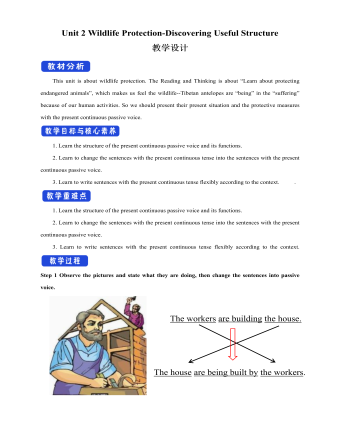
2.表示现阶段正在进行的被动动作(该动作在说话的瞬间未必正在进行)。Many interesting experiments are being carried out these days.(说话时,并不一定正在进行)3.表示一种经常性的被动行为,常和always,constantly 等表示频度的副词连用,这种用法常常带有赞扬或厌恶的感情色彩。He is always being praised by the leader.4.表示按计划或安排主语将要承受谓语动词所表示的动作(仅限于少数及物动词)。A party is being held tonight.Step 4 Special cases1.像take care of, look after, talk about, think of等动词与介词构成的短语用于现在进行时的被动语态时, 其中的介词不可省略。The ways to stop illegally hunting are being talked about. 2.可与部分情态动词连用,表示对正在发生的事情的推测。She may be being punished by her mother.3.有时可表示按计划或安排将要进行的一个被动动作。A celebration is being held this weekend for his success.4.某些表示“状态、心理活动、存在”等的动词,如have,want,need,love,一般不用现在进行时的被动语态,而常用一般现在时的被动语态。With the population increasing,more land is needed.5.“be+under/in+n.”可表示现在进行时的被动意义。My computer is under repair.=My computer is being repaired.
新人教版高中英语必修2Unit 3 The Internet-Discovering Useful Structure教案二
This teaching period mainly deals with grammar “The Present Perfect Passive Voice.” To begin with, teachers should lead students to revise what they have learned about the Present Perfect Passive Voice. And then, teachers move on to stress more special cases concerning this grammar。This period carries considerable significance to the cultivation of students’ writing competence and lays a solid foundation for the basic appreciation of language beauty. The teacher is expected to enable students to master this period thoroughly and consolidate the knowledge by doing some exercises. 1. Guide students to review the basic usages of the Present Perfect Passive Voice2. Lead students to learn to use some special cases concerning the Present Perfect Passive Voice flexibly.2. Enable students to use the basic phrases structures flexibly.3. Strengthen students’ great interest in grammar learning.1. Help students to appreciate the function of the Present Perfect Passive Voice in a sentence2. Instruct students to write essays using the proper the Present Perfect Passive Voice.观察下列句子特点,总结共同点。1.(教材P28)Much has been written about the wonders of the World Wide Web.2.(教材P28)But the Internet has done much more for people than simply make life more convenient.3.(教材P28)Many people have been helped by the club.4.(教材P28)She no longer feels lonely, and her company has become quite successful.5.(教材P32)Today I thought I’d blog about a question that has been asked many times—how do you stay safe online and avoid bad experiences on the Internet?
新人教版高中英语必修2Unit 5 Music-Reading for Writing教案二
The Internet celebrity Gao Yifeng. Years ago, he owned 5 companies and the staffs over 1,000, but during the economy crisis, he became nothing but debt. He was so worried that his hair became white overnight. There was a time when he wanted to killed himself. But after listening to the song Start Over by Liu Huan, he decided to cheer himself up. He started a steamed bun shop and gradually became a national chain shops. Now he became successful again.Walter Haddon said, “Music is the medicine of a troubled mind.” Music contains such a pleasant and inspiring force. Music gave him courage and bravery. When he listened to the song, it made his spirit fly like a kite in the wind. Music gave him strength and brought him relief. It was the rock I leant on to become strong and to get through those hard times. I hope none of us have to go through the same kind of suffering that he did. At the same time, we all go through various periods when we feel sad or alone. During those times, music can help us in the same way that it helped him. I hope we all will somehow begin to treasure music and make it a part of our life. Thank you for your listening !5.Revise your writing each other.Does he/she explain how music has changed his/her/someone else’s life?Are some of the rhetorical devices included and used properly ?Does he/she talk about how music makes him/her/someone feel?Is the first word in each sentences capitalised?Does he/she use correct punctuation ?
新人教版高中英语必修3Unit 2 Morals and Virtues教学设计二
Activity 41. Students complete the task of activity 4, then teachers and students check the answers. 2. The teacher organized the students to work together and asked them to use the tables and mind maps sorted out before to retold the important choices in Lin Qiaozhi's life and their resultsStep 5 Language points1. The teacher asks the students to read the text carefully, find out the core words and long and difficult sentences in the text and draw lines, understand the use of vocabulary, and analyze the structure of long and difficult sentences. 2. The teacher explains and summarizes the usage of core vocabulary and asks the students to take notes. 3. The teacher analyzes and explains the long and difficult sentences that the students don't understand, so that the students can understand them better. Step 6 Homework1. Read the text again, in-depth understanding of the text; 2. Master the use of core vocabulary and understand the long and difficult sentences. 3. Complete relevant exercises in the guide plan. 1、通过本节内容学习,学生是否理解和掌握阅读文本中的新词汇的意义与用法;2、通过本节内容学习,学生能否结合文本特点总结林巧稚的人生原则和人格品质特征;3、通过本节内容学习,学生能否针对人生抉择发表自己的看法;能否全面地、客观地、理性地看待问题,进而对道德和人性有更加深入的思考和理解。
新人教版高中英语必修3Unit 2 Morals and Virtues教学设计三
The joke set her crying.这个玩笑使她哭起来。Step 5 ReadingActivity 31. Students read the small text in activity 3. The teacher provides several small questions to check whether students understand the content of the text and the ideographic function of the -ing form in the text.*Where are those people?*Why did Dr Bethune come to China?*How did he help the Chinese people during the war?*What did Chairman Mao Zedong say about him?2. Ss try to rewrite some sentences using the -ing form. Then check the answers. When checking the answers, the teacher can ask different students to read the rewritten sentences and give comments.Answers:1. he became very interested in medicine, deciding to become a doctor.2. …after hearing that many people were dying in the war.3. Helping to organise hospitals, he taught doctors and nurses, and showed people how to give first aid./ He helped to organise hospitals, teaching doctors and nurses, and showing people how to give first aid.4. …praising Dr Bethune as a hero to be remembered in China.Step 6 PracticeActivity 4Students complete grammar activities 2 and 3 on page 69 of the workbook.Step 6 Homework1. Understand and master the functions and usage of the -ing form;2. Finish the other exercises in Using structures.1、通过本节内容学习,学生是否理解和掌握动词-ing形式作宾语补足语语和状语语的功能和意义;2、通过本节内容学习,学生能否正确使用动词-ing形式描述人物的行为、动作及其经历;3、通过本节内容学习,学生能否独立完成练习册和导学案中的相关练习。
新人教版高中英语必修3Unit 2 Morals and Virtues教学设计四
3.Teachers ask different groups to report the answers to the questions and ask them to try different sentence patterns.The teacher added some sentence patterns for students to refer to when writing.Step 4 Writing taskActivity 51.Write the first draft.Students first review the evaluation criteria in activity 5, and then independently complete the draft according to the outline of activity 4, the answers to the questions listed in the group discussion and report, and the reference sentence pattern.2.Change partners.The teacher guides the students to evaluate their partner's composition according to the checklist of activity 5 and proposes Suggestions for modification.3.Finalize the draft.Based on the peer evaluation, students revise their own compositions and determine the final draft.Finally, through group recommendation, the teacher selects excellent compositions for projection display or reading aloud in class, and gives comments and Suggestions.Step 5 Showing writingActivity 5T call some Ss to share their writing.Step 6 Homework1. Read the passage in this section to better understand the passage.2. Carefully understand the hierarchical structure of the article, and deeply understand the plot of the story according to the causes, process and results;3. Independently complete the relevant exercises in the guide plan.1、通过本节内容学习,学生是否理解和掌握阅读文本中的新词汇的意义与用法;2、通过本节内容学习,学生能否通过人物言行的对比分析道德故事的深层内涵;3、通过本节内容学习,学生能否根据故事的起因、经过和结果来深入理解故事的情节,从而了解文章的层次结构;4、结合现实生活案例发表自己的见解和看法,写一篇观点明确、层次分明的故事评论。
新人教版高中英语必修3Unit 3 Diverse Cultures教学设计二
(2)Consolidate key vocabulary.Ask the students to complete the exercises of activity 6 by themselves. Then ask them to check the answers with their partners.(The first language:Damage of the 1906 San Francisco earthquake and fire.A second language: Yunnan - one of the most diverse provinces in China).Step 5 Language points1. The teacher asks the students to read the text carefully, find out the more words and long and difficult sentences in the text and draw lines, understand the use of vocabulary, and analyze the structure of long and difficult sentences.2. The teacher explains and summarizes the usage of core vocabulary and asks the students to take notes.3. The teacher analyzes and explains the long and difficult sentences that the students don't understand, so that the students can understand them better.Step 6 Homework1. Read the text again, in-depth understanding of the text;2. Master the use of core vocabulary and understand the long and difficult sentences.3. Complete relevant exercises in the guide plan.1、通过本节内容学习,学生是否理解和掌握阅读文本中的新词汇的意义与用法;2、通过本节内容学习,学生能否结合文本特点了解文章的结构和作者的写作逻辑;3、通过本节内容学习,学生能否了解旧金山的城市风貌、文化特色,以及加利福尼亚州的历史,体会多元文化对美国的影响。
新人教版高中英语必修3Unit 3 Diverse Cultures教学设计四
该板块的活动主题是“介绍一个有显著文化特征的地方”( Describe a place with distinctive cultural identity)。该板块通过介绍中国城继续聚焦中国文化。本单元主题图呈现的是旧金山中国城的典型景象, Reading and Thinking部分也提到中国城,为该板块作铺垫。介绍中国城的目的主要是体现中国文化与美国多元文化的关系,它是美国多元文化的重要组成部分。中国城也是海外华人的精神家园和传播中国文化的重要窗口,外国人在中国城能近距离体验中国文化。1. Read the text to understand the cultural characteristics of Chinatown in San Francisco and the relationship between Chinese culture and American multiculturalism;2. Through reading, learn to comb the main information of the article, understand the author's writing purpose and writing characteristics;3. Learn to give a comprehensive, accurate, and organized description of the city or town you live in;Learn to revise and evaluate your writing.Importance:1. Guide the students to read the introduction of Chinatown in San Francisco and grasp its writing characteristics;2. Guide students to introduce their city or town in a comprehensive, accurate and organized way;3. Learn to comb the main information of the article, understand the author's writing purpose, and master the core vocabulary.
新人教版高中英语必修3Unit 4 Space Exploration-Discovering Useful Structures导学案
【点津】 1.不定式的复合结构作目的状语 ,当不定式或不定式短语有自己的执行者时,要用不定式的复合结构?即在不定式或不定式短语之前加 for +名词或宾格代词?作状语。He opened the door for the children to come in. 他开门让孩子们进来。目的状语从句与不定式的转换 英语中的目的状语从句,还可以变为不定式或不定式短语作状语,从而使句子在结构上得以简化。可分为两种情况: 1?当目的状语从句中的主语与主句中的主语相同时,可以直接简化为不定式或不定式短语作状语。We'll start early in order that/so that we may arrive in time. →We'll start early in order to/so as to arrive in time. 2?当目的状语从句中的主语与主句中的主语不相同时,要用动词不定式的复合结构作状语。I came early in order that you might read my report before the meeting. →I came early in order for you to read my report before the meeting.