-
人教版高中地理必修1河流地貌的发育教案
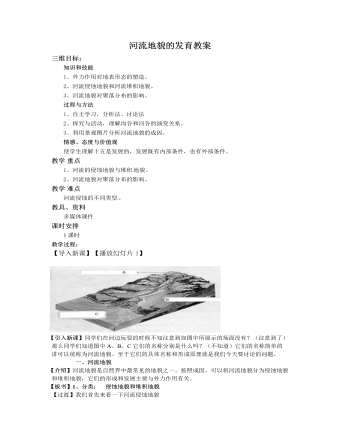
【引入新课】同学们在河边玩耍的时候不知注意到如图中所展示的场面没有?(注意到了)那么同学们知道图中A、B、C它们的名称分别是什么吗?(不知道)它们的名称简单的讲可以统称为河流地貌。至于它们的具体名称和形成原理就是我们今天要讨论的问题。一、河流地貌【介绍】河流地貌是自然界中最常见的地貌之一。按照成因,可以将河流地貌分为侵蚀地貌和堆积地貌,它们的形成和发展主要与外力作用有关。【板书】1、分类: 侵蚀地貌和堆积地貌【过渡】我们首先来看一下河流侵蚀地貌【板书】2、河流侵蚀地貌【介绍】河流在流动过程 中,会破坏并掀起地表的物质,形成侵 蚀地貌。河流侵蚀地貌是由溯源侵蚀、下蚀和侧蚀共同作用形成的。【引导读书】请同学们快速阅读教材P83倒数 第二段,添出以下表格。
人教版高中地理必修1大规模的海水运动教案
4.海洋污染(1)阅读书本P64,由学生归纳:(2)展示图片资料:“威望号油轮泄漏事故”【讨论】石油污染将对该海区的生态环境造成怎样的影响?【小结】本节课我们从四个方面了解了洋流对地 理环境和人类活动的影响,重点学习洋流对气候和对渔场形成的影响。同学们听说过“厄尔尼诺”现象吗?“厄尔尼诺”现象会影 响秘鲁渔场的渔获量;也会对气候产生影响,导致全球气候异常。『探究“神奇的厄尔尼诺”现象』学习小组交流【小结】“厄尔尼诺”现象还有许多不解之谜,其中之一是形成原因,尚未能解释清楚。有人认为是南半球东南信风减弱造成的,也有人认为是大气环流减弱造成的结果;且“厄尔 尼诺”现象发生有没有自身的规律?发生周期长短受什么制约?等等,这些谜团等待我们去一一解开。
人教版高中地理必修1地球的圈层结构教案
师:很好。由于存在地球大气圈、地球水圈和地表的矿物,在地球上这个合适的温度条件下,形成了适合于生物生存的自然环境。人们通常所说的生物,是指有生命的物体,包括植物、动物和微生物。据估计,现有生存的植物约有40万种,动物约有110多万种,微生物至少有10多万种。据统计,在地质历史上曾生存过的生物约有5亿~10亿种之多,然而,在地球漫长的演化过程中,绝大部分都已经灭绝了。现存的生物生活在岩石圈的上层部分、大气圈的下层部分和水圈的全部,构成了地球上一个独特的圈层,称为生物圈。生物圈是太阳系所有行星中仅在地球上存在的一个独特圈层。课堂小结:地球所有的外部圈层是相互渗透、相互影响,甚至相互重叠的,在太阳和人类生活的参与下,整个地球生机盎然;同时,它们起着保护地球的作用,可以减弱太阳和宇宙辐射对地表的影响,减少宇宙中的陨石对地球表面的撞击。外部各圈中的物质运动和循环,是促使地表物质和形态演变的重要动力。
人教版高中地理必修1山岳的形成教案
【转折过渡】除了以上所说的褶皱山和断层山之 外,是否还有其他类型的山脉呢?试举一例说明。【学生思考后回答】有,如富士山属于火山。【教师总结】同学们回答的很好,还有火山,那么火山是如何形成的呢?这就是我们要研究的下一个问题。【板书】3、火山【指导读书】请同学们阅读教材P81思考:①玄武岩高原和火山有什么联系与区别? ②火山由哪几部分构成的?③火山的规模是否相同?【学生回答】①联系:玄武岩高原和火山都是由于处于地下深处的岩浆,在巨大的压力作用下,有时候会沿着地壳的薄弱地带喷出地表而形成的。区别:玄武岩高原是岩浆沿着地壳的线状裂隙流出,往往比较宽广。如哥伦比亚高原。火山是岩浆沿着地壳的中央喷出口或管道喷出。如我国长白山的主峰。②火山由火山口和火山锥两部分组成。③火山的规模大小不一,大火山的相对高度可达4 000~5 000米,火山口直径为数百米;小火山的相对高度不及100米。
人教版高中地理必修1太阳对地球的影响教案
当时,不只发生了太阳风暴,同时还有其它的现象发生,导致灾难巨大。 如果,这些现象单独地发生,结果就会是另外一个样子。正是由于这些因素综合起来,1859年的太阳风暴,才在人类历史上留下了浓墨重彩的一笔。太阳磁暴开始干扰通信日本卫星首个被“击中”日本航天机构29日声明,受强烈的太阳磁暴影响,28日晚,日本“儿玉(Kodama)”通讯卫星信号中断。 据美联社报道,在太阳黑子活动减弱后,“儿玉”通讯卫星恢复正常运转。 美欧研究人员28日发布新闻公告称,太阳当天发生了一次强烈的耀斑爆发,预示着新一轮太阳风暴将在今后一两天内抵达地球,地球上的通信等设施可能会因此受到部分干扰。与这次耀斑爆发相伴,太阳表面还产生了一股强大的日冕物质喷射,方向几乎直冲地球。研究人员说,喷射产生的带电粒子流正以约每小时750万公里的速度奔地球而来,其与地球磁场作用后可能会形成比较强烈的地磁暴,使地球两极出现极光,并可能对卫星运行和通信等造成干扰。
人教版高中地理必修2工业地域类型教案
1.生产上的联系:有投入——产出的关系工业生产的过程复杂,工序繁多,往往需要经过多家工厂的加工才能完成一种产品的生产过程。因此,在这些工厂之间就存在着产品与原料的联系。一家工厂生产的产品是另一家工厂的原料,这两家工厂之间就形成了工序上的工业联系。2.非生产上的联系:如地理空间上的联系布局在同一个工业区内,共同利用工业区的道路、供水、供电、通信等基础设施以及其他生产、生活服务设施,或者共同利用当地廉价的劳动力,形成了空间利用上的工业联系。我国许多地方的经济技术开发区就是建立在这种工业联系基础上的。(二)工业集聚1.形成具有工业联系的一些工厂往往近距离地聚集起来,形成工业集聚现象。2.工业集聚可获得效应(1)工业集聚可以加强企业间的信息交流和技术协作,降低中间产品的运输费用和能源消耗,进而降低生产成本,提高生产效率和利润,取得规模效益。
人教版新课标高中物理必修2功率教案2篇
1.用CAI课件模拟汽车的启动过程。师生共同讨论:①如果作用在物体上的力为恒力,且物体以匀速运动,则力对物体做功的功率保持不变。此情况下,任意一段时间内的平均功率与任一瞬时的瞬时功率都是相同的。②很多动力机器通常有一个额定功率,且通常使其在额定功率状态工作(如汽车),根据P=FV可知:当路面阻力较小时,牵引力也小,速度大,即汽车可以跑得快些;当路面阻力较大,或爬坡时,需要比较大的牵引力,速度必须小。这就是爬坡时汽车换低速挡的道理。③如果动力机器在实际功率小于额定功率的条件下工作,例如汽车刚刚起动后的一段时间内,速度逐渐增大过程中,牵引力仍可增大,即F和v可以同时增大,但是这一情况应以二者乘积等于额定功率为限度,即当实际功率大于额定功率以后,这种情况不可能实现。
人教版新课标高中物理必修2平抛运动教案2篇
(五)平抛运动规律的应用例1:一架老式飞机在高出海面45m的高处,以80m/s的速度水平飞行,为了使飞机上投下的炸弹落在停在海面上的敌船,应该在与轰炸目标的水平距离为多远的地方投弹?不计空气阻力。分析:对于这道题我们可以从以下几个方面来考虑:(1)从水平飞行的飞机上投下的炸弹,做什么运动?为什么?(2)炸弹的这种运动可分解为哪两个什么样的分运动?3)要想使炸弹投到指定的目标处,你认为炸弹落地前在水平方向通过的距离与投弹时飞机离目标的水平距离之间有什么关系?拓展:1、式飞机在高出海面45m的高处,以80m/s的速度水平飞行,尾追一艘以15m/s逃逸的敌船,为了使飞机上投下的炸弹正好击中敌船,应该在与轰炸目标的水平距离为多远的地方投弹?不计空气阻力。2、在一次摩托车跨越壕沟的表演中,摩托车从壕沟的一侧以速度v=40m/s沿水平方向向另一侧,壕沟两侧的高度及宽度如图所示,摩托车可看做质点,不计空气阻力。(1)判断摩托车能否跨越壕沟?请计算说明(2)若能跨过,求落地速度?
高中数学人教版必修二直线的点斜式方程教案
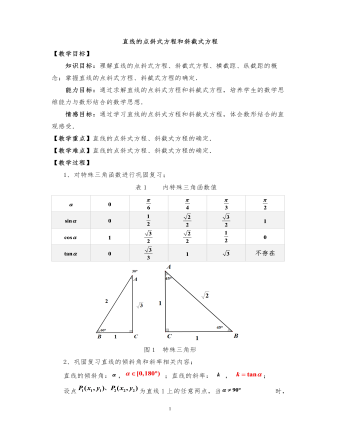
【教学目标】知识目标:理解直线的点斜式方程、斜截式方程、横截距、纵截距的概念;掌握直线的点斜式方程、斜截式方程的确定.能力目标:通过求解直线的点斜式方程和斜截式方程,培养学生的数学思维能力与数形结合的数学思想.情感目标:通过学习直线的点斜式方程和斜截式方程,体会数形结合的直观感受.【教学重点】直线的点斜式方程、斜截式方程的确定.【教学难点】直线的点斜式方程、斜截式方程的确定.
人教版高中地理必修1水资源的合理利教案
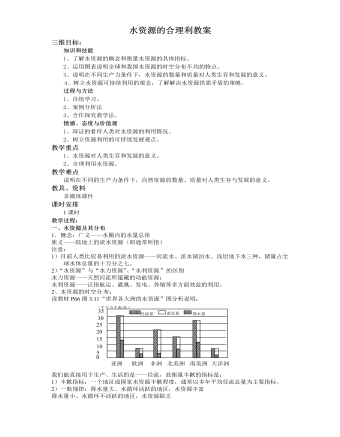
知识和技能 1、了解水资源的概念和衡量水资源的具体指标。2、运用图表说明全球和我国水资源的时空分布不 均的特点。3、说明在不同生产力条件下,水资源的数量和质量对人类生存和发展的意义。4、树立水资源可持续利用的观念,了解解决水资源供需矛盾的策略。过程与方法 1、自组学习。2、案例分析法3、合作探究教学法。情感、态度与价值观1、辩证的看待人类对水资源的利用情况。2、树立资源利用的可持续发展观点。教学重点1、水资源对人类生存和发展的意义。2、合理利用水资源。教学难点说明在不同的生产力条件下,自然资源的数量、质量对人类生存与发展的意义。教具、资料多媒体课件课时安排1课时教学过程:一、水资源及其分布 1.概念:广义——水圈内的水量总体狭义——陆地上的淡水资源(即通常所指)
人教版高中地理必修2农业的区位选择教案
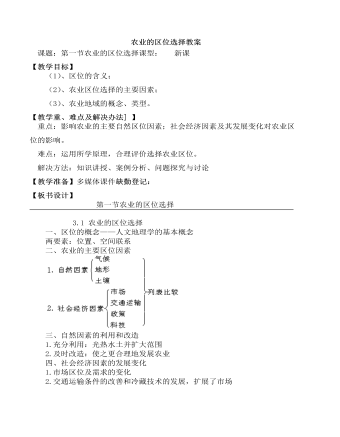
【教学目标】 (1)、区位的含义;(2)、农业区位选择的主要因素;(3)、农业地域的概念、类型。【教学重、难点及解决办法] 】重点:影响农业的主要自然区位因素;社会经济因素及其发展变化对农业区位的影响。难点:运用所学原理,合理评价选择农业区位。解决方法:知识讲授、案例分析、问题探究与讨论【教学准备】多媒体课件缺勤登记:三、自然因素的利用和改造1.充分利用:光热水土并扩大范围2.及时改造:使之更合理地发展农业四、社会经济因素的发展变化1.市场区位及需求的变化2.交通运输条件的改善和冷藏技术的发展,扩展了市场
人教版高中历史必修1鸦片战争教案2篇
1.知识与能力:(1)通过引导学生分析鉴赏19世纪以来有代表性的音乐与美术作品,了解这些作品产生的时代背景及其艺术价值。(2)通过分析世界艺术产生的历史背景,可以帮助学生正确认识人类文化的多样性、时代性和民族性,培养学生结合历史背景分析历史问题的能力。(3)通过对19世纪以来的音乐与美术史实的分析、综合、比较、归纳、概括等认知活动,培养历史思维和解决问题的能力。2.过程与方法:(1)让学生在搜集资料、自主探究、合作交流过程中,发展学生在社会中学习、网络学习、终身学习的能力。(2)通过上网了解艺术大师及分析鉴赏其各类美术、音乐作品,感受其艺术价值。 (3)思维方法:学会知识迁移,在从感知历史到不断积累历史知识,进而不断加深对历史和现实的理解过程中,提高分析理解问题能力。学会善于从不同的角度发现问题,积极探索解决问题的方法,从而做到论从史出、史论结合。
人教版高中历史必修1祖国统一大业教案2篇
教材分析改革开放后我国的综合国力不断增强,人民对祖国统一的愿望越来越迫切。本节课以“一国两制”构想的提出,香港、澳门的回归和海峡两岸关系的发展为中心,说明实现祖国统一,完成中华民族复兴是历史发展的必然。第一目“‘一国两制’构想的提出”主要讲述了“一国两制”的含义及历史意义。第二目“香港、澳门的回归”着重讲述了香港回归、澳门回归的经过及历史意义,这是“一国两制”成功的实践。第三目“海峡两岸关系的发展”讲述了大陆注重发展与台湾的关系,促进海峡两岸的经济文化交流与合作,打破了几十年来海峡两岸的隔绝状态,促进了祖国统一的进程。此外,教材还通过“资料回放”“历史纵横”“学思之窗”等栏目,为学生学习提供了一些详细的史料。在教学中要分析图表资料,引导学生理解完成祖国统一大业,实现中华民族的复兴,是任何人也阻挡不了的历史潮流。
新人教版高中英语必修1Unit 1 Teenage Life-Reading and Thinking教案
【教材分析】The topic of this unit is about teenage life, which belongs to the theme context of “humans and oneself”.As teenagers who shoulder the responsibility of “Chinese great dream”, they must fully know themselves, including their strengths, weaknesses and challenges etc. They are supposed to improve themselves continuously and readily study their subjects, and thus foster their strategies and confidence in lifelong studies.This period is entitled the freshmen challenges, which mainly concerns some big challenges for new students in Senior high school. In this period, a teacher should lead students to find out what their challenges are and guide them to figure out how to crack the challenges and better themselves. More importantly, a teacher should instruct students to absorb new language points and appreciate the language. Besides, a teacher must instruct students to acquire some skills concerning reading efficiently and inspire them to talk more about their new school life, especially their new problems and solutions both at school and in life.【教学目标与核心素养】1. Enable students to acquire the basic usage of the new words and expressions concerning the freshmen challenges and learn to use them flexibly.2. Enable students to have a good understanding of the freshmen challenges in the new senior high school which is quite different from junior middle school.3. Develop students’ sense of cooperative learning and individual thinking capability. 4. Develop students’ different learning skills to solve different reading comprehensive problems.
新人教版高中英语必修1Unit 2 Travelling Around-Reading for Writing教案
Is there a clear purpose for the trip? :Does each paragraph have a clear main idea? Does the writer use the present continuous tense for future plans?Does the writer use commas, stops, and question marks correctly? Are all the words spelt correctly?Are all the proper nouns capitalized?Revise your draft according to your partner's comments.Step 5:The summary of how to write a travel plan.旅游计划是一种常见的应用文写作。旅游可分为观光游、文化游、美食游及探险游等不同类型,因此旅游计划也要根据不同的旅游目的进行设计。常规的旅游计划需要明确以下几个方面的问题:Travel planWhen will you leave for? Where is your the destination?How will you get there?What will you do there?How long will you there?Is there a clear purpose for the trip? 为了提升旅行计划的层级,还需注意以下几个方面的问题:1.每段是否有明确清晰的主题;2.用一般现在时代替一般将来时;3.用更高级的形容词词汇。例如:表达“好”时,不要总用“nice”,我们还可以用“smart, clean, excellent, exciting, beautiful, wonderful, clever, famous, grand”等表达更具有指向性的词汇;4.用更高级的动词词汇。比如:我们可以用“seem stand, lie .get stay, remain, look . sound, become . keep, grow”等代替"be";
新人教版高中英语必修1Unit 4 Natural Disasters-Listening and Speaking教案
【教材分析】高考听力材料的选用非常重视语言真实性和交际性的原则,语言材料一般来源于实际生活,对话的内容大都取材于日常生活,即衣、食、住、行、工作、学习、天气、生活环境等话题,可分为校园、公共场所、家庭等方面,如: shopping, finding the way, doing one’s homework, seeing a doctor, making a phone call, weather report, asking for different kinds of information等。新教材的特点就是利用生活中真实文本,只是降低难度,让学生注重语言的应用,将是我们高考把握方向的重要因素。【教学目标与核心素养】学习能力目标:在听力当中,学生应该有效规划学习方法,选择恰当的策略与方法。这节课的训练目标是让学生有正确的预测和抓住问题的关键信息,从而用心去听来找寻关键信息。根据生活中实际情况和高考常见语境,我们不难发现提前预测和抓住题干中的w很重要,即what, where, when, why等等。
新人教版高中英语必修2Unit 2 Wildlife Protection-Reading for Writing教案二
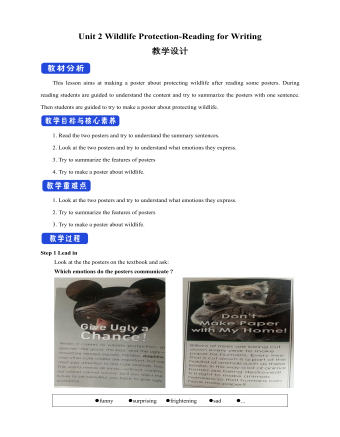
This lesson aims at making a poster about protecting wildlife after reading some posters. During reading students are guided to understand the content and try to summarize the posters with one sentence. Then students are guided to try to make a poster about protecting wildlife.1. Read the two posters and try to understand the summary sentences.2. Look at the two posters and try to understand what emotions they express.3. Try to summarize the features of posters4. Try to make a poster about wildlife.1. Look at the two posters and try to understand what emotions they express.2. Try to summarize the features of posters3. Try to make a poster about wildlife.Step 1 Lead inLook at the the posters on the textbook and ask:Which emotions do the posters communicate ?Step 2 Read the poster and answer the questions.1. What do you think of the animals in the poster on the left ?I think it is frightening and ugly.2. Why do we should protect the ugly animals ?All species--the good, the bad, and the ugly-- should be treated equally.The world needs all kinds--without variety, our planet cannot survive.3. Why are billions of trees being cut down every year ?To make paper for humans.4. What result will be lead to after the trees are cut down ?A lost of animal homes are being destroyed./The habitat of wildlife is being destroyed.Step 3 Find the feature of posters1. What does each poster use to stir up emotions ?On the left, it makes us a little frightened and it looks a little ugly, but it can activate our curiosity--What is it? And What is wrong with it?On the right, it makes us feel a little sad and want to protect them.
新人教版高中英语必修2Unit 4 History and Traditions-Listening&Speaking&Talking教案一
This unit is about history and traditions. From the opening page, we can know that this unit will introduce the history and traditions around the world. As Marcus Garvey says “A people without the knowledge of their past history, origin and culture is like a tree without roots”, it is important for students to realize the importance and value of knowing the history and traditions and their further meanings. And this part ( listening and speaking ) is divided into two parts: Part A---share views on historic sites, Part B ---talk about a visit to a historic tourist destination. By talking with a foreigner, the speakers introduce the historic attractions and their cultures. Part A is that William, a British student, who was going to visit the Confucius Temple and a Chinese student, Xiao Kong, who was going to the Confucius Temple to meet with the members of the research group, went together and exchanged their views on the Confucius Temple, Confucius, Confucius' descendants and Confucius' educational thoughts. Part B is a conversation between Xiao Yan, a youth hostel receptionist and Paul, a backpacker about the feelings and experience after visiting the Chinese famous tourist attraction Pingyao.1. Guide students to understand the content of listening texts in terms of the whole and key details; 2. Cultivate students' ability to guess the meaning of words in listening; discuss with their peers how to talk about historic spots and great person.3. Instruct students to use functional sentences of showing one’s excitement, surprise and disappointment.1. Guide students to understand the content of listening texts in terms of the whole and key details; 2. Cultivate students' ability to discuss with their peers the related topics.3. Enable students to use the functional items of showing one’s excitement, surprise and disappointment.
新人教版高中英语必修2Unit 4 History and Traditions-Reading and Thinking教案二
Step 5 While reading---Task 3Read the text again and answer the following questions.Q1: How many countries does the UK consist of ?4 Q2: What are the four countries of the United Kingdom?England, Wales, Scotland and Northern Ireland Q3: Which two were the first to be joined together ?England and WalesQ4: What are the two chief advantages of studying the history of a country ?The first one is to help you understand more about the country and its traditions.The second one is to make visiting it more enjoyable.Q5: What’s the author’s attitude towards studying the history ?Supportive/positiveStep 6 Post reading---Retell the textThe United Kingdom, Great Britain, Britain, England—many people are confused by (1)_____ these different names mean. In the 16th century, the nearby country of Wales (2) __________(join) to the Kingdom of England. In the 19 th century, the Kingdom of Ireland was added to create the United Kingdom of Great Britain and Ireland. Finally, the southern part of Ireland (3) ______ (break) away from the UK, which resulted in the full name we have today. However, most people just use the (4)_________(shorten) name: the UK. The four countries (5)__________ belong to the United Kingdom work together in some areas. There were four sets of invaders and the last group were the Normans. They had castles (6)_________(build) all around England and made changes (7)__________ the legal system. Studying the history of the country will make your visit much more (8)_________(enjoy). The capital city London is (9)___ ancient port city that has a history (10)______(date) back to Roman times. 1. what 2.was joined 3.broke 4.shortened 5.that 6. built 7.to 8.enjoyable 9.an 10.dating Step 6 Homework
新人教版高中英语必修2Unit 4 History and Traditions-Listening&Speaking&Talking教案二
Listening and Speaking introduces the topic of “Take part in a youth project”. The listening text is an interview about "sharing views on historical sites". Through listening to a dialogue between Chinese and foreign students on the way to the Confucius Temple, students can understand their views on the Confucius Temple, Confucius, Confucius' descendants and Confucius' educational thoughts, so as to realize and think about the profound influence of Confucius and his thoughts on Chinese historical tradition. At the same time, the dialogue naturally integrates English idioms and mentions Shakespeare, the British playwright, so as to provide language materials and context for students to understand English idioms and related cultural allusions, as well as to compare Chinese and foreign cultures, which is helpful for students to understand and express the language such as history, tradition, culture and custom significant impact.Text analysis: listening text is a dialogue between a British student and a Chinese student when he goes to the Confucius Temple. When William, a British student, visited the Confucius Temple, he asked Xiao Kong, a Chinese student, for directions. Xiao Kong was just going to the Confucius Temple to meet with the members of the research group, so they went together and exchanged their views on the Confucius Temple, Confucius, Confucius' descendants and Confucius' educational thoughts. From the perspective of foreign tourists, this paper describes their thoughts on Confucius, the great son of Confucius, who had a profound impact on Chinese history and cultural tradition, and his education.Listening and Talking introduces a visit to a historic tourist destination. Tourism is a common way to understand a country's history, culture, and customs and so on. Students listen to the dialogue between Xiao Yan, a youth hostel Usher, and Paul, a backpacker, to learn about Pingyao's famous historical and cultural attractions and Paul's travel experience and experience as a foreign tourist.