-
人教版高中英语必修2The Olympic Games说课稿2篇
Purpose of my design:To ask the students to do these two tasks will make the Ss predict the story of this passage. As a result, it will deepen Ss’ memory of this story because they will have their own understanding of this story.Step 3. While-readingTask 1. (Individual work _____min)Skimming: ask students to skim the text and the main ideas of each paragraph in this passage. Please read it quickly and then match the sentences with the letters.Task 2. (Individual work _____min)Scanning: read the text quickly and decide the whether the following statements are true or false and give reasons.Task 3. (Pair work _____min)Listen to the tape and fill in the banks. Then read the paragraph with expression to your partner.Task4 (individual work min)Listen to the tape again and write down the main idea in one sentence.Purpose of my design: Enable students to understand the given material better by using different reading skills. And proper competition can arouse the Ss’ interest in English learning. “Task-based” teaching method is used here todevelop the Ss’ ability of communication and also their ability of co-operation will be well trainedStep 4. Post-readingTask 1. (Individual work, pair work, group work, class work; _____min)Discussion (group of 4):1. If you were Hippomenes, would you run against Atlanta?2. Do you think Hippomenes deserved to win the race? Why or why not?Step 5. HomeworkPlease read the story again carefully after class and imagine: What will happen during the race between Hippomenes and Atlanta? Who do you think will win the race? Do you think Atlanta would marry Hippomenes? Write an end for the story with thses questions.Purpose of my design: Homework is so important and necessary for to master the knowledge they learned after class. It will check whether the Ss achieve the teaching aims.Part 5 Blackboard design
人教版高中英语必修3Astronomy the science of the stars说课稿3篇
Step 2 Pre-listeningAfter students finish their discussion, I will show a picture of Newton and ask them: Who is him? What is he famous for? Could you find out some words to describe him? Maybe students will answer that he is genius for his finding of theGravitation, making a great contribution to the progress of human being. At that time I will show another two pictures of Einstein and Hawking, letting students guess who they are and write down their idea about the Gravitation. For I have arranged them to search more information about the gravity before this class, Students have beenfamiliar with the topic and will not be afraid about this abstract conception, which is helpful for their listening.Step 3 While-listeningIn this step, students will be required to listen the material for three times. The first and listening is extensive listening and the second and third listening is intensive listening. In the first time, They are required to listen a material including Part 1 and Part 2 and choose the best summary of the listening text. After they choose the right answer, They also need work in group to explain what is wrong with the others. Then I will make a conclusion that we should pay attention to the first paragraph and last paragraph and some keys to get the main idea. By doing this, their capacity of generalization will have a great improvement.Before the second listening, I will ask students to scan the blank on the power point quickly and ask them to note down some key words .Then ask them to listen to the Part 1again and fill the first column of the chart. Maybe some students just show the ideas of these three scientists an still can’t catch their development of gravity. Therefore, I will ask them to listen to Part 2 again and fill in the rest. After finish the listening, I will give them ten minutes to discuss with their partner. I will also guidethem to improve their answers when they discuss with others.
人教版高中英语必修2Wildlife Protection说课稿3篇
When it comes to the students’ studying methods, I'd like to introduce my Ss first. The Ss have a good command of basic language points. They’re interested in learning English, and they take an active part in English class, so they will have fun in autonomous, cooperative and inquiry learning. I will just serve as a guide, showing them the way to explore how to make more progress in their English learning.Now it’s time for the most important stage of this lesson. My teaching procedures are arranged as follows:Step1.Leading-in (3 minute)Play a video of a wide variety of wildlife to introduce my topic. Step2. Speaking (12 minutes)We will use our textbook Page25. Let the Ss fast read the short paragraph to warm up. Ask them to talk about the report on some endangered wildlife in China with the dialogue patterns on the screen. Lastly, I will invite some groups to demonstrate their dialogues about saving wildlife in China.Step3.English play (3 minutes)Watch another video in praise of their excellent performance just now. It’s about Jack Chen’s(成龙)and Yang Ziqiong’s wildlife protection.Step4. Listening (twice 13 minutes)This time, I’ll ask the Ss to fill in the blanks of the monologue of the 2 movie stars above. Step5.Discussion (3 minutes)Which would you like to choose to wear, clothes made of cotton, artificial leather or animal skins? Why ?Step6. Summary (3 minutes)1. If there were no wildlife, there wouldn’t exist human beings. If the buying stops, the killing can, too.2. Animals are our friends. To love animals is to love ourselves. Stop hunting, killing and destroying wildlife.3. Let’s live in harmony with all the living things in the world. Step7. Music appreciation (3 minutes)Let the Ss appreciate the song Earth Song by Michael Jackson. Last but not the least, I will show you my blackboard design.
人教版高中英语必修4A taste of English Humor说课稿3篇
Then I would ask them to think of a funny English or Chinese and tell it to partners. While telling stories, they can use expressions and some acting to help make the story funny. 5 minutes would be given to do this.Those stories they told there will be the material for their writing. Soletting them tell it at first is helpful. And they can make a difference between telling a funny story and writing it down. Generally speaking, it is difficult forstudents to write well because they don’t know what to write and how to write. Asking them to tell their own stories at first can help them come up with what to write.After their telling, I would invite someone to share his/her story with all of us and I would write it down on the blackboard.This example story would be used as a sample to illustrate the format of funny story. Different from a story from teacher or textbook, a story from students can obviously become a interesting material to draw students’ attention.Then I would ask the whole class to put this story into several parts. It might be a little bit difficult for them. So I would ask them to find out whether all the sentences are necessary. After delete some sentences, there are 6 sentences left behind. Then they can easily put them into three parts. After interaction with students, I would teach them the right terms for each part and conclude the format of funny story.This step is the key and difficult point in my lesson. So I mainly usetask-based teaching method in this part and the task for students was divided into several stages. With the separated difficult level, students can find there are usually three parts in writing. They can also learn to write without the unnecessary parts in the process of analyzing. And then I wouldn’t rush to tell them the right terms to them directly. Instead, I would ask them to name them by their own. A confused mind is better for acquiring knowledge.While-writing:Then I would give students 7 minutes to write down this story, without other requirements.With all the preparations in pre-writing, students’ difficulties were cleared. So it would be much easier for them to write down the story within 7 minutes. There are no other requirements because students’ first writing is actually a drafting. It would be revise and edit several times later. Writing, as a skill
人教版高中英语必修3Healthy Eating说课稿4篇
Language learning needs a context, which can help the learners to understand the language and then can product comprehensible output, so computer has the advantages to make the materials attractive.Part 3 Learning MethodsTask-based, self-dependent and cooperative learningPart 4 Teaching ProcedureStep One Lead-in“Interest is the best teacher.” Therefore, at the very beginning of the class, I should spark the students’ mind to focus on the centre topic “the band”. I’ll show some pictures of food to attract their attention and then bring some questions.Question:What kind of food they like?What should go into a good meal?The answers must relate to the diet. After this, the students will be eager to know something about a balance diet and this is the very time to naturally lead the class into Step 2Step 2 Reading for information: skimming and scanning In this step, I use Task-based Language Teaching method, which can give students a clear and specific purpose while skimming and scanning the context.Task 1 General ideaThe students will be asked to just glance at the title and the pictures of the passage, and then guess what they will read in the text. And they’ll be divided into groups of four to have a discussion.The purpose is to inspire the students to read actively, not passively. In addition, the task is to develop the students’ reading skill by making prediction and to encourage the students to express their thoughts in English and cooperate with each other.Task 2 Main idea of each paragraphCooperative learning can raise the students’ interest and create an atmosphere of achievement. Based on this theory, I divide the whole class into 4 groups to skim the whole text and get the main idea of each paragraph.
人教版高中英语必修3The million pound bank note说课稿3篇
在接下来的细读环节,我套用了高考对阅读理解的考查方式设置了5个问题,分别为三个推理判断题,一个细节题和一个主旨大意题。学生需要对文章的内容进行分析、归纳、推理、猜测等高级思维活动才能做出正确的回答。【设计意图】这一过程是对学生进行细读的训练,培养学生获取特定信息和挖掘文章深层次信息的能力。第三环节:Intensive-reading (精读) 15′第三个环节精读,既是最重要的环节,也是突破本课重难点的关键。首先,让学生思考剧本中人物看到百万英镑前后的态度发生了怎样的变化。其次,让学生仔细阅读文章,找出可以表现人物态度变化的具体的语言和动作。最后,让学生总结人物的态度发生变化的根本原因是什么,从而引出Money Talks, 供学生思考。【设计意图】通过一系列的活动培养学生学习从人物的语言和动作探究人物的心理,使学生进一步体会戏剧语言的魅力,从而对文章背后所反映的社会问题进行思考,也为下一步的讨论环节做好铺垫。
人教版高中英语必修5First aid说课稿6篇
In this class, I have 3 teaching aims, that is, knowledge aims, ability aims and emotion aims.1) Knowledge-Teach students new words and expressions, such as temporary, bleed,sprain choke, first aid, fall ill and so on.-Enable students to have a better understanding for some basic knowledge of first aid.2) Ability-Train students’ speaking, reading and writing abilities by different teaching activities, such as skimming, comprehending, team work, role play, retelling and writing.-Develop students’ reading strategy on how to move general idea to specific information.3) Emotion-Promote students’ awareness of giving first aid.- Cultivate students’ creativities.Then let’s come to my teaching methods and activities.III. Teaching methods and activities:To achieve different teaching aims, various kinds of teaching methods and activities will be adopted throughout this period, such as TBL (task-based learning), skimming, team work, brainstorm and others, which can offer students opportunities to fulfill tasks in which they can use language to achieve a specific outcome.IV. Teaching aids:Computer and blackboardV. Teaching important points:1) Make students have a clear mind for the structure of the text.2) Help students understand the theme of the text.VI. Teaching difficulties:1) So many new words may affect students’ understanding.2) How to get students to know about the functions of the skin and thecauses, characteristics and treatments for different degree burns,and the knowledge about giving first aid. VII. Blackboard design:
人教版高中英语必修5Great scientists说课稿4篇
通过写文章梗概,培养学生综合运用语言的能力,学习用恰当的英语描述科学家的故事。这是本课的教学难点。教师可以使用完形填空的方式来帮助学生整理语篇,从而来降低难度。本课的教学重点的突破方法是:在阅读前,让学生初步了解得出科学观点所需要的基本程序,从而轻松而自然地导入文章的阅读;在阅读过程中,由易到难设计快速阅读和精读的问题,层层推进各种阅读活动,让学生对阅读内容从整体感知到细节理解,最后深层读懂整篇文章,同时加强阅读策略的指导,让每个学生都主动参与课堂教学活动,最终达到提高阅读能力的目的。Step 4 Post-readingGroup Activities四人小组共同合作,在老师的适当指导下,就以下2个问题展开讨论,让学生就所知、所学、所感和所想融入话题,然后抽若干同学代表作小组发言。1. What do you think about John Snow, and what should we learn from him?2. Cholera was 19th century disease, which two diseases are similar to cholera today? Why?
人教版高中英语必修5Life in the Future说课稿5篇
Good afternoon, everyone. It’s my great pleasure to be here sharing my lesson with you. The content of my lesson is Senior English for China Book5 Unit 3 Life in the Future. I’ll be ready to begin this lesson from six parts: Analysis of the teaching material, Analysis of the students, Teaching aims and important and difficult points, Teaching methods and aids, Teaching procedures, and Blackboard design. First, let me talk about the teaching material.Part 1 Analysis of the Teaching Material:This unit is about what human beings’ life will be like in about one thousand years. By studying of this unit, we’ll Enable the students to know the changes in humans’ life and some new inventions bringing about the change and develop the interest in science. This lesson plays an important part in the English teaching in this unit. This is an important lesson in Book Five. From this lesson, it starts asking the Ss to grasp contents of each passage. Therefore, this lesson is in the important position of the teaching material. If the Ss can learn it well, it will be helpful to make the Ss learn the rest of this unit.Part 2 Analysis of the SsAs Senior2 Ss, they are at different levels of English fluency, some of them have lost interest in English. So during the lesson, I arrange a variety of activities to let all of them join in to attract their interest and let them be confident and taste the joy of success.
人教版高中语文必修2《囚绿记》说课稿2篇
“深入探究,把握主旨”这一步则是解决教学的重点难点,这里涉及到课文的深层意蕴,学生理解有难度,教师在通过问题引领学生探讨的基础上,还要适时启发、点拨,因为教学时间有限,让学生漫无边际的讨论,可能难以完成预定的教学任务,会使教学过程不完整。至于本文的写作特点的教学视时间而定,有时间可以让学生说一说,没有时间用小黑板出示一下,让学生了解就行,如果时间不够,甚至可以不讲。第三阶段是“延伸练习,巩固提高”。
人教版高中语文必修2《氓》说课稿3篇
四、教学方法和学法。课前学生搜集有关《诗经》的资料必不可少。另外,时隔数千年,年代久远,文字的障碍很大,然而,过分纠缠于文字的疏通会破坏诗歌的“气”,丧失诗歌的“神”,所以在学习时,应舍去条分缕析的理论评价,指导学生结合注释疏通文字,然后引领他们经由文字再现形象和事件,经由形象和事件领略情感,感受其中浓浓的诗情。诵读的环节是重要的,配以二胡独奏《长相思》,营造意境,学生沉浸在音乐营造的意境中反复吟咏,读出节奏,读出音调,读出感情,细细体味,让或优或喜的情愫萦绕心间,我们就触到了先民的灵魂。比兴手法为《诗经》独创,重章叠句同样别致而新鲜,教学过程中结合具体语境让学生自己去发现并进行讨论,不搞枯燥的知识传授。还引入讲故事、改写两种活泼的学习形式,从而达到加深理解的目的。
人教版高中语文必修2《兰亭集序》说课稿3篇
(二)分析课文,理清思路第1、2段为第一部分,主要是叙事、写景,先叙述集会的时间、地点,然后渲染出兰亭优美的自然环境。在这里足以“游目骋怀”“极视听之娱”,可以自由地观察、思考,满足人们目视耳闻的需求。这里正是与会“畅叙幽情”、尽兴尽欢的绝好处所。这些描写都富有诗情画意,作者的情感是轻松愉快的。第3、4段为第二部分,主要是抒情、议论,作者由美景妙时引发出乐与忧、生与死的感慨。他认为人生的快乐是有极限的,待快乐得到满足时,就会感觉兴味索然。往事转眼间便成为历史,人到了生命的尽头就会死亡。作者由“一死生为虚诞,齐彭殇为妄作”的认识,产生了一种珍惜时间、眷恋生活、热爱文明的思考。虽然文中的寿夭、生死不能自由决定,从而有些伤感,但作者仍然认识到盛衰、生死是必然的。人生无常,时不我待,故著文留传后世,以承袭前人,启示来者。
人教版高中语文必修2《赤壁赋》说课稿3篇
[教学反思]人教版高中语文必修二第三单元安排了《兰亭集序》《赤壁赋》《游褒禅山记》三篇古代山水游记散文,它们借游赏之事,探索生命的意义、治学的道理。师者,所以传道、授业、解惑也。高中的教材选用的都是历史经典名篇,每一篇都闪烁着儒道释等百家光辉的思想。编者要老师传道的意图很明显。即非如此,看着这些影响历代、影响世界的如日月之耀眼光华的伟大思想就躺在我们的教科书里,又如何能不讲呢?所以,我将本课的教学重难点拟定为:帮助学生建立积极的生死观,掌握多角度看问题的正确的思想方法。当然,也让学生领会了融写景、抒情、说理于一炉的大家手法。整堂课各教学环节,环环相扣,过渡自然,读、思、议、写训练到位,而且全部围绕“生死观”展开,如一篇形散神不散的散文。
人教版高中语文必修2《短歌行》说课稿2篇
一、说教材《短歌行》是普通高中课程标准实验教科书必修(二)第二单元的一篇略读课文,本单元安排的是先秦到南北朝时期的诗歌。《短歌行》是著名政治家、军事家、文学家曹操的作品。诗中抓住“忧”字来写诗人为什么“忧”,如何解“忧”,从而表达希望能够招揽人才、完成统一天下的雄心壮志。所以本单元安排《短歌行》一诗,对学生全面了解曹操,感受曹操在短暂的人生中竭力创造伟业的气概。二、说学生我这一课的教学对象是高一学生。他们进入高中学习的时间只有三个多月,现在已经完成了必修(一)的学习。学习了现代诗歌单元,有了一定的诗歌学习基础,初步掌握了读诗的基本方法,但是还未能形成成熟的稳定的学习方式。同时,本单元学习是高中第一次接触古代诗歌,诗歌语言上的障碍和时间上的跨度对他们来说都是学习上的困难。因此教师要引导学生自主学习,合作学习,为他们设置新的学习情境,提供合作探究的机会。
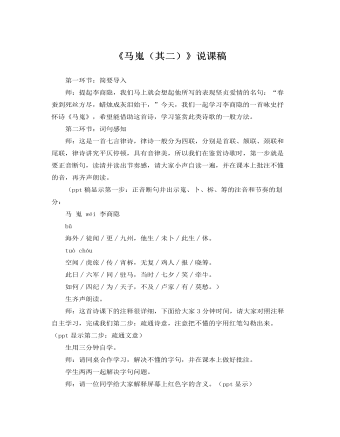
人教版高中语文必修3《马嵬(其二)》说课稿
生2:颔联的意思是只听到禁卫军中传来夜间巡逻的梆子声,不再向宫中那样安逸地听到有鸡人打鸣报时的声音了。生3:颈联的意思是说事变发生那天军队发生哗变停留不前,但当年唐玄宗以为自己可以和贵妃天天在一起,对天上的牵牛和织女一年一度的会见还加以嘲笑呢。生4:尾联的含义是为什么唐玄宗当了四十五年的皇帝,还不如普通百姓夫妻恩爱,长相厮守。师:好的。请大家再齐读一遍诗文,做到人人都能疏通诗的含义。学生再次齐读。第三环节:专项探究师:白居易曾说:“文章合为时而著,歌诗合为事而作。”这首诗就是作者途经马嵬驿,咏马嵬之变这一历史事件而作,所以我们鉴赏的第三步,就是通过标题和诗文,弄清诗中的历史事件。请同学们找出诗中哪些诗句描述了这一事件?
人教版高中语文必修3《杜甫诗三首》说课稿
我以以《登高》为例,引导学生进行意象分析,感悟意境美。古人云“立象以尽意”“古诗之妙,专求意象”意象是诗人情感的载体,是诗歌的灵魂。引导学生张开联想和想象的翅膀去感受,去体验是意象,诗歌鉴赏的关键。科林伍德说“真正艺术的作品,不是看见的,也不是听到的,而是想象中的某种东西。”诗人通过想象创造出诗的形象,我们读者通过想象丰富地再现诗人创造的形象。而感受体验则是以全部身心投入作品,心灵与心灵相沟通,感情与感情相交流,对诗人的想象活动进行再经历和再体验。因此,在引导意象解读中,我先让学生点击这一个,就是通过抓修饰词、依据感情基调、展开想象具体分析本诗中每个意象的情感意蕴和审美意蕴,使学生明白意象在每首诗中的独特性。
人教版高中语文必修3《过秦论》说课稿3篇
本文篇幅较长,并且有一字句不易理解,因而对高一学生来说完全读懂内容有一些困难。这样的话,老师就要做好引导工作,把一些难点,或是出现词类活用比较多,局势比较特殊的句子,老师可以先给学生画出来,存疑,或是与同学们一起讨论解决。对那些不易懂的字词就引导学生联系上下文提供的语境、前后涉及的情节加以推测、判断,以培养学生依据文脉推断词义的好方法。要求学生点出重点实词、框出通假字,主要是为帮助学生积累和掌握一些文言文中常见的一词多义、异读现象、古今异义和通假现象的词语,并进一步得出规律,指导今后的文言文学习。词类活用和特殊句式在文言文翻译中难度较大,也是本文教学的两大难点。要求学生标出有活用现象的字和划出句式特殊的句子,是基于两点考虑:1、积累一定数量的第一手例句;2、引导学生加以分类,找出每类的相同特征,并抽取出来形成规律性的东西,从而上升到理性认识,使学生能由学会一个到会学多个。翻译过程中注重指导学生养成用符号法表示重点字句的好习惯,如点、框、圈、划线等符号应约定一致,便于突出翻译中的重点、难点及复习。我的提示着重归纳了实词“制”“亡”“遗”“利”等,名词活用、形容词活用、使动用法,被动句、状语后置句。
人教版高中语文必修3《琵琶行 并序》说课稿2篇
说教材A.教材简析《琵琶行(并序)》是人教版《普通高中课程标准实验教科书语文》必修3第二单元的一篇讲读课文。本单元学习的是唐代诗歌,共七首诗。《琵琶行(并序)》是唐代著名现实主义诗人白居易写的一首歌行体长篇叙事诗,是我国古代叙事诗和音乐诗中的“千古绝喝”。诗歌主题鲜明、人物形象生动,抒情真切细腻,具有深刻的思想内容和卓越的艺术技巧。B.教学目标《全日制普通高中高级中学语文教学大纲》明确要求我们:在阅读教学过程中要引导学生“感受文学形象,品味文学作品的语言和艺术技巧,初步鉴赏文学作品”。而本单元的教学要求是培养学生诗歌鉴赏的能力。根据教学大纲和单元教学要求,结合本课特点,我制定本课的教学目标是:1.知识目标:了解文学常识;积累重点文言实词;品味主旨句“同是天涯沦落人,相逢何必曾相识”的内涵;感知作者把音乐描写与听者、演奏者的感情融为一体的写作特点。
人教版高中语文必修3《劝学》说课稿3篇
《劝学》是普通高中课程标准试验教科书语文必修三第三单元的重点篇目,该文集中反映著名思想家荀子在学习问题上的观点和精彩斐然的论证艺术。该单元所选课文都是古代的议论性散文。通过本单元的学习在于让学生感受我国传统文化的精神,掌握基础的文言语法知识,学习如何清晰有力的表达自己的思想和见解。本文安排在单元的第一篇,如何指导学生学好这篇课文,是实现“授之以渔”,树立学生学好文言文的信心,掌握文言学习方法的关键。根据新课标倡导从“知识与能力”、“过程与方法”、“情感态度与价值观”三方面出发设计课程目标的要求和高一的学生对于文言文的知识还在积累的阶段,应该注重基础知识的积累和一定量的诵读的实际情况。我拟确定以下教学目标:1,了解荀子论述学习的思想,明确学习要靠积累、坚持不懈、专心致志的道理。2,掌握积累文言实词、虚词,活用、古今异议等现象和固定句式。
人教版高中语文必修3《师说》说课稿3篇
一、设计理念教学设计坚持少讲多学、以学为主的教学理念,重视学培养生的学习兴趣,要充分调动学生学习的积极性和主动性,充分发挥学生的主体性。教师要以组织者、引导者、合作者的角色参与到教学活动中去。力图通过导学案努力培养学生的自学习惯和自学能力。二、教材分析与处理1、教材的地位与作用:必修三第三单元所选的文言文都是古代的议论性散文。本课是“唐宋八大家”之首、中唐古文运动的倡导者韩愈的力作,是唐宋散文中的名篇,具有很强的代表性。通过这篇自读课的学习,能使学生了解唐宋散文的风貌,更能使学生进一步积累文言文基础知识,提高学生的文言文阅读欣赏能力,从而提升学生的文言文自读能力。2、教学目标:《高中语文课程标准》要求高中学生能阅读浅易文言文,能借助注释和工具书,理解词句含义,读懂文章内容;了解并梳理常见的文言实词、文言虚词、文言句式的意义或用法,注重在阅读实践中举一反三;对文章有一定的分析欣赏能力。高一的学生对于文言文的知识还在积累阶段,应该注重基础知识的积累和一定量的诵读。对此,我将教学目标确定为: