-
新人教版高中英语必修2Unit 4 History and Traditions-Discovering Useful Structure教案一
Step 5 Practice一、完成下列句子。1. Judy and I _______________(把车停下来(park))in an underground car Park near Trafalgar Square, where we could ______________________(让我们的车充电(charge)).2. When we finally reached the service desk to ask for audio guides, we heard it ___________ that there were no audio guides____________(留下,剩下).3. We__________________________(发现自己对...很惊讶)the large number of visitors and the amount of noise at the entrance of the National Gallery.4. Judy ____________________(眼神专注于) Van Gogh’s Sunflowers. It was hard to approach the painting as there were so many people around.5. She ____________________(把这幅画的复制品装箱(box)) to ensure that it was delivered safely.答案:1.had our car parked get our car battery charged 2. announced left 3. found ourselves very surprised 4. had her eyes fixed on 5. had a copy of the painting boxed二、用过去分词对下列句子进行改写。1. Loch Ness was surrounded by beautiful natural landscape, which made it look amazing.2. Carl and his friend stayed with a generous family who offered them bread with butter and honey that was homemade.3. The family’s ancestors once attended to soldiers who were wounded in the First World War.4. The young people were attracted by the legend of Loch Ness. They watched over the lake with their cameras and binoculars, which were positioned on the hill.答案:1. Loch Ness surrounded by beautiful natural landscape looks amazing.2. Carl and his friends stayed with a generous family who offered them homemade bread with butter and honey.3. The family’s ancestors once attended to wounded soldiers in the First World War.4. The young people attracted by the legend of Loch Ness watched over the lake with their cameras and binoculars positioned on the hill.
新人教版高中英语必修2Unit 4 History and Traditions-Listening&Speaking&Talking教案一
This unit is about history and traditions. From the opening page, we can know that this unit will introduce the history and traditions around the world. As Marcus Garvey says “A people without the knowledge of their past history, origin and culture is like a tree without roots”, it is important for students to realize the importance and value of knowing the history and traditions and their further meanings. And this part ( listening and speaking ) is divided into two parts: Part A---share views on historic sites, Part B ---talk about a visit to a historic tourist destination. By talking with a foreigner, the speakers introduce the historic attractions and their cultures. Part A is that William, a British student, who was going to visit the Confucius Temple and a Chinese student, Xiao Kong, who was going to the Confucius Temple to meet with the members of the research group, went together and exchanged their views on the Confucius Temple, Confucius, Confucius' descendants and Confucius' educational thoughts. Part B is a conversation between Xiao Yan, a youth hostel receptionist and Paul, a backpacker about the feelings and experience after visiting the Chinese famous tourist attraction Pingyao.1. Guide students to understand the content of listening texts in terms of the whole and key details; 2. Cultivate students' ability to guess the meaning of words in listening; discuss with their peers how to talk about historic spots and great person.3. Instruct students to use functional sentences of showing one’s excitement, surprise and disappointment.1. Guide students to understand the content of listening texts in terms of the whole and key details; 2. Cultivate students' ability to discuss with their peers the related topics.3. Enable students to use the functional items of showing one’s excitement, surprise and disappointment.
新人教版高中英语必修2Unit 5 Music-Discovering Useful Structures教案一
Step1:自主探究。1.(教材P52)Born(bear) in the USA on 2 January 1970, Whitacre began studying music at the University of Nevada in 1988.2.(教材P52) Moved(move) by this music, he said, “It was like seeing color for the first time.”3.(教材P56)I was very afraid and I felt so alone and discouraged(discourage).4.(教材P58)Encouraged(encourage) by this first performance and the positive reaction of the audience, I have continued to play the piano and enjoy it more every day.Step2:语法要点精析。用法1:过去分词作表语1).过去分词可放在连系动词be, get, feel, remain, seem, look, become等之后作表语,表示主语所处的状态Tom was astonished to see a snake moving across the floor.汤姆很惊讶地看到一条蛇正爬过地板。Finally the baby felt tired of playing with those toys.终于婴儿厌倦了玩那些玩具。注意:1).过去分词作表语时与被动语态的区别过去分词作表语时,强调主语所处的状态;而动词的被动语态表示主语是动作的承受者,强调动作。The library is now closed.(状态)图书馆现在关闭了。The cup was broken by my little sister yesterday.(动作)昨天我妹妹把杯子打碎了。2)感觉类及物动词的现在分词与过去分词作表语的区别过去分词作表语多表示人自身的感受或事物自身的状态,常译作“感到……的”;现在分词多表示事物具有的特性,常译作“令人……的”。
新人教版高中英语必修2Unit 5 Music-Listening and Speaking教案
This lesson is about music. Students can classify the types of music through the instruments and its sound and can talk about their preferences about music, even join some activities and play a role in them according to their musical talents. On the basis, they are guided to use the languages to express their preferences and some plosive sounds and their rules.1. Classify the music types through the instruments and its sound.2. Listen and understand what the speakers’ preferences are and the reasons; talk about their own preferences and give their own reasons, using these sentences: “What kind of music do you like? And why? “ “Because it makes/gives me energy/peaceful.../touches my heart...”.3. Learn some plosives and the rules.4. Join some activities and play a role in them according to the talents. 1. Listen and understand what the speakers’ preferences are and the reasons;2. talk about their own preferences and give their own reasons, using these sentences: “What kind of music do you like? And why? “ “Because it makes/gives me energy/peaceful.../touches my heart...”.3. Learn some plosives and incomplete plosives and its rules.Step 1 Lead inPoint at the pictures on P50 and ask Q1: What are the people doing in the pictures below?Q2: What kind of music they are?Then play the MP3s one by oneStep 2 ListeningTask 1: A reporter from the school newspaper is interviewing students about music. Listen to the interviews. Draw lines between the words to make complete sentences. Some words will not be used.
新人教版高中英语必修2Unit 5 Music-Reading and Thinking教案一
This section focuses on "learning about experiencing music Online". This virtual choir is a new form of music performance. Members from all over the world don't need to love to come to a place. Instead, they use the new technology to model the various parts and wonderful virtual harmony group of music in the family. Students need to understand the main meaning of each paragraph. Finding topic sentences is an important way to understand the general idea of a paragraph. After the topic sentence, it is usually the detail sentence that supports and explains the topic sentence. Some paragraphs have obvious subject sentences, for example, the first sentence of the second paragraph is the subject sentence of the paragraph, and the following sentenceStudents need to pay attention to the topic sentences and key sentences, and then pay attention to how the sentences after the meaning explain, explain and support the topic sentences or key sentences before.1.Guide students to learn about experiencing music online2.Guide students to scan and circle the information in the text.3.Guide students to find the numbers and dates to fill in the timeline.4.Guide students to learn more about music by completing the sentences with the correct forms of the words and phrases. And then make a mind map about the outline of the passage.1. Guide students to pay attention to reading strategies, such as prediction, self-questioning and scanning.2. Help students sort out the main meaning of each paragraph and understand the narrative characteristics of "timeline” in illustrative style.3. Lead students to understand the changes that have been caused by the Internet.
新人教版高中英语必修1Unit 5 Languages Around the World-Reading for Writing教案
Step 3: Read to sum upRead it again and sum up the problems of the three students, and then write down the advice that was given from others.Step 4: Work in pairs. List your learning problems in English and brainstorm some useful advice.Useful expressions ? I don't know how to…... Is a big difficulty for me. I cannot ...? You might try …. It's very important to…? I have no idea how/what .My biggest problem is .... ? I (also) have trouble with. My advice is …. This worked for me.? l cannot understand the teachers’ English in class.Step 5 Homework:为提高我校学生的英语口语水平,我们将举办英语演讲比赛(English- speaking contest),请你根据下面的信息,以学生会(the Students‘ Union)的名义写一份海报,欢迎全校同学参加,届时特邀本校美籍教师史密斯先生颁奖。? 报名时间 9月30日以前(报名:signup)? 报名地点 学生会办公室? 比赛时间 10月9日晚7:00~9:00? 比赛地点 学校大会议室? 奖励 前8名
新人教版高中英语必修2Unit 1 Cultural Heritage-Reading For Writing教案
This report is short, concise and has typical news content and language features. The title uses the verb phrases, embodying the characteristics of being concise and general. The introduction is the first two sentences in the first paragraph, describing the general situation of the cultural heritage protection project, including time, place, characters, events and other news elements, so that readers can see the main points of the news report at a glance. The main body is the second and third paragraphs, which report the important historical and cultural value of Mogao Grottoes and the production of Mogao Grottoes Material digital photos, which are of great significance to the inheritance of historical culture and the promotion of international cultural understanding, exchange and cooperation. Direct citation is used in the report, as well as background introduction and other news writing techniques.1. Get students to have a good understanding of some features about a news report by reading the text.2. Instruct students to write a summary about a news report properly using some newly acquired writing skills in this period.3. Develop students’ writing and cooperating abilities.4. Strengthen students’ great interest in writing discourses.1. Stimulate students to have a good understanding of how to a summary about a news report 2. Cultivate students to write a news report properly and concisely.Step 1: Lead in Do you think it is necessary for us to circulate our cultural heritage to the world? Why or why not?Do we need to learn more about other countries’ cultural heritage? Why or why not?Step 2: Read to discover details concerning the main body of the news report.
大班语言教案:《i,u,ü》教学设计
2、学会正确认读i、u、ü的带调韵母。知道ü上标声调时,上面的小圆点不写。3、会在四线格里抄写i、u、ü三个单韵母。课时安排:2课时第一课时 教学目标:教学单韵母i、u并抄写。 教学过程: 一、 复习检查。 1、猜谜语。 (1)白鹅倒影是什么韵母? (2)圆脸小姑娘,小辫右边扎。这是什么韵母? (3)像个圆圈是什么韵母? 2、抽读字母卡片。 二、 教学单韵母i。 1、看图说话引出i。 图上画着什么?图上画着一件衣服。i的发音与“衣”的音相同。 2、教学i的发音,认清字形。 (1)发音要领:发音时嘴比发e时开得更小,只留一条小缝,舌前部升高,接近上腭,舌尖抵住下齿背,让气从舌尖和上腭中间自然流出。 (2)教师范读、领读。 (3)记忆字形。 i像什么?顺口溜:“像支蜡烛i、i、i。” 3、书写指导:先写竖,再写点,两笔写成。 三、 教学单韵母u。 1、看图说话引出u。 图上画着什么?“树上有一只乌鸦。”乌鸦的“乌”就是u。 2、教学u的发音,认清字形。 (1)发音要领:发音时把嘴唇收拢,嘴唇比发o时更圆更小,舌尖后缩,舌根抬高,让气从小洞中出来。 (2)教师范读,领读。 (3)记忆字形。 可用顺口溜:“像只茶杯u、u、u。” 3、书写指导:u一笔写成。 四、 巩固复习。
大班语言教案:《m, f》教学设计
2.学会声母“b”和单韵母“a”拼读音节的方法。 3.学会拼读“b p m f”与“u、o”组成的音节。 教学难点 掌握拼读声母和韵母组成的音节。 教学过程 一、谈话导入 我们已经认识了韵母家族的6个朋友(出示a o e i u ü)一起读读,你们读得真准,能不能按字母顺序摆一摆,再按顺序读一读。你们记得真清楚。这节课我们一起到拼音王国里再认识四个声母家族的朋友,你们愿意吗? 二、学习“b p m f ”的音形 (一)学习“b”的音形 1.出示“b”的图 (1)引导学生提问:图上的小朋友在干什么? (2)问:这个字母念什么?学生试读“b”。 (3)讲:听广播的“播”读得轻短些,发音时,把两片嘴闭合,把气 憋住,然后突然放开,让气流冲出双唇就是“b”的音。 (4)教师范读。 (5)学生学读,体会发音方法。 (6)开火车读。 2.学习“b”的形 (1)引导学生提问:怎样记住“b”的形?或“b”与图中的哪一部分很像? (2)你们能编一个记忆“b”的小儿歌吗? 拉开天线听广播“b b b”。 右下半圆“b b b”。 6字“b”。…… 3.指导书写b(1)讲:我们先认识一个字母基本笔画:“丨”上竖。 (2)请同学们观察书中字母“b”先写哪笔,再写哪笔,几笔写成?占什么格?同桌同学互相说说。(3)学生说笔顺、位置,教师范写,强调“b”的第一笔在上格的三分之一处起笔到第三条线停笔。 (4)学生书空笔顺。 (5)学生在拼音本上抄字头。教师行间巡视,进行个别辅导。纠正学生的写姿和执笔方法。对姿势正确的学生及时表扬鼓励。
扇形统计图教案教学设计
教学目标1、明确扇形统计图的制作步骤,能够根据相关数据较为准确地制作扇形统计图.2、进一步理解扇形统计图的特点,建立百分比大小和扇形圆心角大小之间初步的直观敏感度.3、能够实现不同统计图数据间的合理转换,再次体会几种统计图的不同特点,为合理选择统计图表示数据打下一定的基础.4、通过实例,理解三种统计图的特点,能根据具体问题选择合适的统计图清晰、有效地描述数据.5、在统计活动的过程中,通过相互间的合作与交流,掌握画统计图和选择统计图的方法;经历数据的收集、整理和简单分析、作出决策的统计活动过程,发展统计观念.6、通过对现实生活中的数据分析,感受数学与现实生活的密切联系,说出统计图在现实生活中的应用,提高学习数学兴趣.
学做家常菜教学设计教案
小学五年级的学生应该具备一些生活技能, 学做家常菜是我们生活的必需,是每个,人都应该掌握的生存技能。本主题的目的通过学习做简单的家常菜,引领小学生走进家务劳动,锻炼生活的自理能力和提高适应生活的能力,体会生活和学习的乐趣,激发学生将学校学习和家务劳动密切结合起来,形成积极的生活和学习的态度。本主题安排了“问题与思考”“学习与探究”“实践与体验”总结与交流“拓展与创新”五个环节,从提出问题开始,到探究与体验,最后到学有所用,循序渐进,引导学习走进中式餐饮文化,学做日常生活中的家常菜,掌握劳动的技能和方法,体验做家务劳动带来的快乐和享受,激发学生对家常菜的探究与实践的兴趣,逐步掌握日常生活所需的基本技能,培养热爱劳动、热爱生活的意识。
李商隐诗两首教学设计教案
我们不妨将主旨放在“庄生晓梦迷蝴蝶,望帝春心托杜鹃。沧海月明珠有泪,蓝田日暖玉生烟。”二联之前,那么,事情就变得简单起来了:华年如庄生晓梦迷蝴蝶;华年如望帝春心托杜鹃;华年如沧海月明珠有泪;华年如蓝田日暖玉生烟。从课下注释,我们很容易就可以看出,这四句每一句都在用典。因此,我们通过对典故的解读,然后加以整理,将其理顺,似乎就可以完成对诗歌内容的解读;至于什么悼亡、爱情,不妨抛之脑后,毕竟,没有那些其他的主题,也并没有让诗歌失色,而加上这些捉摸不定的主题,只是让诗歌增加了所谓的神秘色彩,徒增阅读难度而已。
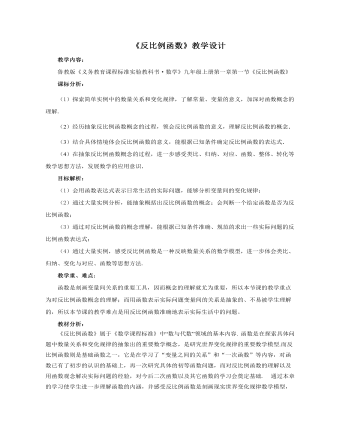
反比例函数教案教学设计
本节的内容主要是反比例函数的概念教学.反比例函数概念的建立,不能从形式上进行简单的抽象与概括,而是对这些实例从不同角度抽象出本质属性后,再进行概括。教材设计的基本思路是从现实生活中大量的反比例关系中抽象出反比例函数概念,让学生进一步感受函数是反映现实世界中变量关系的一种有效数学模型,逐步从对具体反比例函数的感性认识上升到对抽象的反比例函数概念的理性认识. 同时本节的学习内容,直接关系到本章后续内容的学习,也是继续学习其它各类函数的基础,其中蕴涵的类比、归纳、对应和函数的数学思想方法,对学生今后研究问题、解决问题以及终身的发展都是非常有益的.基于以上分析,本节教学设计是建立在一个个数学活动的基础上,经过对情境理解、本质抽象的积累而形成的.让学生对一类问题情境中两个变量间的关系,在充分经历写表达式,计算函数值和观察函数值随自变量变化规律的过程中,逐步概括形成反比例函数的概念.针对教学实际,我选取了贴学生现实的,有价值的实例“文具店里买学习用品”和“剪面积为定值的长方形纸片”等作为问题情境.
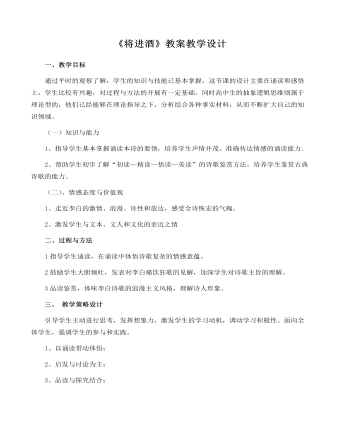
《将进酒》教案教学设计
(一)知识与能力 1、指导学生基本掌握诵读本诗的要领,培养学生声情并茂、准确传达情感的诵读能力. 2、帮助学生初步了解“初读—精读—悟读—美读”的诗歌鉴赏方法,培养学生鉴赏古典诗歌的能力。(二)、情感态度与价值观 1、走近李白的激情、浪漫、诗性和放达,感受全诗恢宏的气魄。 2、激发学生与文本、文人和文化的亲近之情
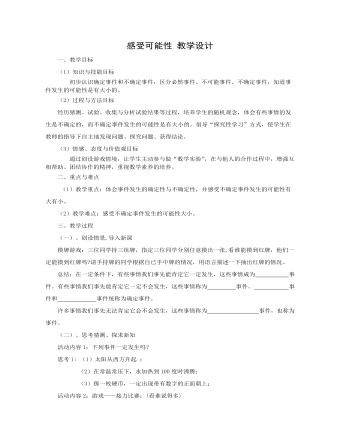
感受可能性教案教学设计
(一)、创设情景,导入新课摸牌游戏:三位同学持三组牌,指定三位同学分别任意摸出一张,看谁能摸到红牌,他们一定能摸到红牌吗?请手持牌的同学根据自已手中牌的情况,用语言描述一下抽出红牌的情况。总结:在一定条件下,有些事情我们事先能肯定它一定发生,这些事情成为 事件。有些事情我们事先能肯定它一定不会发生,这些事情称为 事件。 事件和 事件统称为确定事件。许多事情我们事先无法肯定它会不会发生,这些事情称为 事件,也称为 事件。
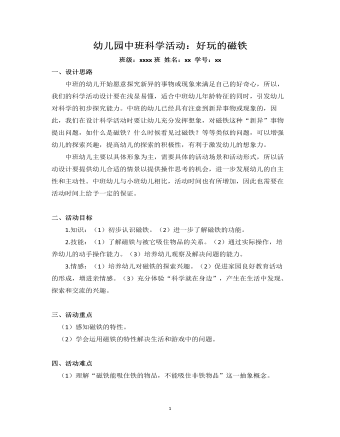
好玩的磁铁教案教学设计
中班的幼儿开始愿意探究新异的事物或现象来满足自己的好奇心,所以,我们的科学活动设计要在浅显易懂,适合中班幼儿年龄特征的同时,引发幼儿对科学的初步探究能力。中班的幼儿已经具有注意到新异事物或现象的,因此,我们在设计科学活动时要让幼儿充分发挥想象,对磁铁这种“新异”事物提出问题,如什么是磁铁?什么时候看见过磁铁?等等类似的问题,可以增强幼儿的探索兴趣,提高幼儿的探索的积极性,有利于激发幼儿的想象力。 中班幼儿主要以具体形象为主,需要具体的活动场景和活动形式,所以活动设计要提供幼儿合适的情景以提供操作思考的机会,进一步发展幼儿的自主性和主动性。中班幼儿与小班幼儿相比,活动时间也有所增加,因此也需要在活动时间上给予一定的保证。
图形的全等教案教学设计
教法分析:在新课程的教学中教师要向学生提供从事数学活动的机会,倡导让学生亲身经历数学知识的形成与应用过程,鼓励学生自主探索与合作交流,让学生在实践中体验、学习。因此,本节课我采用了多媒体辅助教学与学生动手操作、观察、讨论的方式,一方面能够直观、生动地反映各种图形的特征,增加课堂的容量,吸引学生注意力,激发学生的学习兴趣;另一方面也有利于突出重点、突破难点,更好地提高课堂效率。学法分析:初二年级学习对新事物比较敏感,通过新课程教学的实施,学生已具有一定探索学习与合作交流的习惯。但是一下子要学生从直观的图形去概括出抽象图形全等的概念这是比较困难的。因此,我指导学生:一要善于观察发现;二要勇于探索、动手实验;三要把自己的所思所想大胆地进行交流,从而得出正确的结论,并掌握知识。
认识三角形教案教学设计
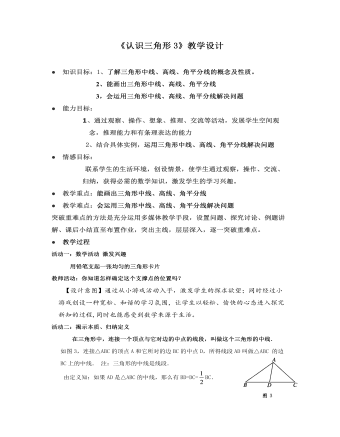
四个同学为一个合作小组;每个小组利用教师为其准备的各类三角形,作出它们的高.比一比,看哪一个小组做得最快,发现的结论多. 师生行为:学生操作、讨论,教师巡视、指导,使学生理解【设计意图】通过让学生操作、观察、推理、交流等活动,来培养学生的动手、动脑能力,发展其空间观察.活动结论:1.锐角三角形的三条高都在三角形内; 2.直角三角形的一条高在三角形内(即斜边上的高),而另两条高恰是它的两条直角边; 3.钝角三角形的一条高在三角形内,而另两条高在三角形外.(这是难点,需多加说明) 总之:任何三角形都有三条高,且三条高所在的直线相交于一点.(我们把这一点叫垂心)课堂小结 1.三角形中三条重要线段:三角形的高、中线和角平分线的概念. 2.学会画三角形的高、中线和角平分线.
有理数复习教案教学设计
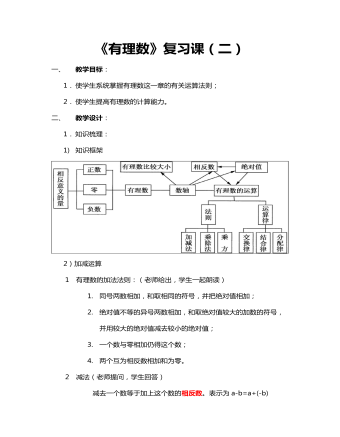
3)乘除运算①有理数的乘法法则:(老师给出,学生一起朗读)1. 两数相乘,同号得正,异号得负,并把绝对值相乘;2. 任何数与零相乘都得零;3. 几个不等于零的数相乘,积的符号由负因数的个数决定,当负因数有奇数个数,积为负;当负因数的个数为偶数个时,积为正;4. 几个有理数相乘,若其中有一个为零,积就为零。②有理数的除法法则:(老师提问,学生回答)1. 两个有理数相除,同号得正,异号得负,并把绝对值相除;2. 除以一个数等于乘以这个数的倒数。③关系(老师给出)除法转化为乘法进行运算。
数据的整理教案教学设计
一、课前准备师:同学们想一想,你同父母一起去商店买衣服时,衣服上的号码都有哪些,标志是什么?学生:我看到有些衣服上标有M、S、L、XL、XXL等号码.但我不清楚代表的具体范围,适合什么人穿,但肯定与身高、胖瘦有关.师:这位同学很善动脑,也爱观察.S代表最小号,身高在150~155cm的人适合穿S号.M号适合身高在155~160cm的人着装……厂家做衣服订尺寸也并不是按所有人的尺寸定做,而是按某个范围分组批量生产.你觉得这种生产方法有什么优点?学校要为同学们订制校服,为此小明调查了他们班50名同学的身高,结果(单位cm).如下