-
人教版高中历史必修1辛亥革命教案2篇
①从政府人员组成看,南京政府是一个以资产阶级革命派为主体的政府。②从政府颁发的法令和措施看,这些法令体现了资产阶级民主革命的要求,对于发展民族资本主义经济、资产阶级民主政治和文化教育以及改革社会风气,都起了积极作用。③从颁布的《中华民国临时约法》看,宪法体现了三权分立的政治体制,体现了资产阶级民主主义的要求,是中国历史上第一部资产阶级民主宪法,具有反封建专制制度的进步意义。(2)从南京临时政府的内外政策分析南京政府的根本弱点①未彻底地反封建。它没有采取比较彻底的反对封建主义的措施,特别是对封建统治的基础——地主阶级土地所有制没有触动,这样,南京临时政府也就不能真正地把广大人民群众动员起来,因而缺乏真正的群众基础。
人教版高中历史必修1抗日战争教案
【备课资料】百团大战八路军从8月20日起,在华北敌后出动105个团,约40万兵力,在2500公里长的战线上,发动了规模最大的“以彻底破坏正太路若干要隘,消灭部分敌人截断该线交通”为目的的举世闻名的“百团大战”。八路军提出“不留一根铁轨、不留一根枕木、不留一个车站、不留一个碉堡、不留一座桥梁”的口号,“让敌人用脚同我们赛跑”,“让敌人用牛驴搬炮弹、飞机大炮”。八路军展开攻坚战,端掉敌一系列据点。据有关资料记载,从8月20日到12月5日,在历时三个半月的“百四大战”中,我军共进行大小战斗1824次,毙伤日伪军25800余人,俘日伪军18600余人,缴获了大批武器、弹药和军用食品等;破坏铁路470多公里,公路1500多公里,桥梁、车站、隧道等260余处,使正太铁路停运月余;攻克日伪据点2993个,巩固和扩大了抗日军民占领区。
人教版高中历史必修1鸦片战争教案2篇
1.知识与能力:(1)通过引导学生分析鉴赏19世纪以来有代表性的音乐与美术作品,了解这些作品产生的时代背景及其艺术价值。(2)通过分析世界艺术产生的历史背景,可以帮助学生正确认识人类文化的多样性、时代性和民族性,培养学生结合历史背景分析历史问题的能力。(3)通过对19世纪以来的音乐与美术史实的分析、综合、比较、归纳、概括等认知活动,培养历史思维和解决问题的能力。2.过程与方法:(1)让学生在搜集资料、自主探究、合作交流过程中,发展学生在社会中学习、网络学习、终身学习的能力。(2)通过上网了解艺术大师及分析鉴赏其各类美术、音乐作品,感受其艺术价值。 (3)思维方法:学会知识迁移,在从感知历史到不断积累历史知识,进而不断加深对历史和现实的理解过程中,提高分析理解问题能力。学会善于从不同的角度发现问题,积极探索解决问题的方法,从而做到论从史出、史论结合。

人教版高中历史必修2罗斯福新政教案
【教学参考】对“新政”作用的评价史学界对“新政”作用的评价是仁者见仁、智者见智,但基本上有三种观点,即“功大于过论”、“过大于功论”和“功过参半论”。持“功大于过论”者认为“新政”在美国历史上基本上是一种进步现象,首先,“新政”挽救了危机,使美国人民摆脱了危机的困苦局面;其次,在缺少足够的宏观经济政策知识的时代,罗斯福所做的努力确实是开创性的;再次,罗斯福“新政”开启了美国以后历届政府实施国家干预政策的大门,成为缓解自由主义经济制度之弊病的一剂良方,并在实质上加强了美国联邦政府的权威;最后,在30年代资本主义世界经济危机的背景下,同日本、德国为转嫁危机而发动战争的策略相比,“新政”无疑代表了一种进步、民主的解救危机方式。持“过大于功论”者认为“新政”未能使美国走出萧条、步入繁荣。
人教版高中政治必修1消费及其类型教案
贷款消费不仅满足了消费者的生活需要,提高了消费者的生活质量,而且促进了经济的发展,特别是我国经济发展进入买方市场后,贷款消费对扩大内需,拉动经济的增长起来重要的作用。所以,我们要转变传统的消费观念,以积极的态度来对待贷款消费,通过贷款消费满足来满足当前的需要,通过生活质量。当然,在贷款消费是也要考虑自己的偿还能力,还要讲究信用,按时还贷。(3)按消费的目的不同,可分为生存资料消费、发展资料消费和享受资料消费。其中生存资料消费是最基本的消费。随着经济水平的提高,发展资料和享受资料消费将逐渐增加。3、消费结构 教师活动:引导学生看书,指出(1)消费结构的含义:就是指人们各类消费支出在消费总支出中所占的比重。教师活动:引导学生分析个人及家庭消费状况的变化,说明对消费结构的理解,并总结消费结构的变化特点。学生活动:积极讨论,踊跃发言
人教版高中政治必修1社会主义市场经济教案
教师总结:社会主义市场经济是使市场在国家宏观调控下起基础性配置作用的经济,充分发挥市场基础性调节作用,就必须主要靠经济手段、法律手段,而不是行政手段。(三)课堂总结、点评这节课我们重点学习了社会主义市场经济的有关知识,知道了社会主义市场经济的基本特征,以及国家宏观调控的含义、目标和主要手段。这对于我们在经济生活中正确地认识我国市场经济的性质和作用,理解国家宏观调控的措施及意义,增强社会主义优越感和民族自强意识,自觉投身现代化建设等将有重大指导作用。★课余作业 讨论:联系经济生活中国家宏观调控的实例,讨论应如何认识和理解国家各种宏观调控手段的综合运用,对国民经济发展的意义。★教学体会 本节内容与学生生活实际联系密切,在学习中应该多引入日常生产、生活中常见的一些宏观调控实例,让学生去深刻理解、把握宏观调控手段及其作用。
人教版高中政治必修1税收及其种类教案
教师总结:近二十多年来,我国个人所得税的征收发展迅速,这也反映了我国经济水平、人民生活收入有了较大提高。与增值税的计税方法不同,个人所得税采用累进税率的计税办法,就是个人所得越高,税率越高,纳税人个人收入越多,缴纳个人所得税越多。这一特点从教材83页个人所得税税率表上可以看出。教师点拨:个人所得税的计算办法是分段计算的,个人收入800元以内不计税,多余800元以上部分,按不同税率分段计税。请同学们计算教材所列题目。学生活动:计算。应税所得额:4000元;不超过500元部分:25元;500――2000元部分:150元;2000――4000元部分:300元;累计所得税:475元教师活动:同学们想一想,这样计算个人所得税有什么意义呢?学生活动:认真思考,回答问题教师点拨:有利于增加财政收入,有利于调节个人收入分配,实现社会公平。(三)课堂总结、点评
人教版高中政治必修4价值与价值观精品教案
一、教材分析我们使用的是人教版第四册《生活与哲学》教材,本框属于第四单元第十二课第一框题。其内容主要分两目,第一目主要介绍价值的含义、人是社会一切财富的创造者、人的价值在于创造价值和对社会的责任和贡献,以及对一个人的评价主要看他的贡献等内容。第二目主要介绍价值观的导向作用,内容包括价值观的含义、价值观对人们认识世界和改造世界的活动具有导向作用以及对人生道路的选择具有导向作用。二、教学目标知识目标:1、识记价值和价值观的基本含义;价值观的导向作用。2、理解人的价值是什么?如何评价人的价值。3、运用所学知识及相关哲学原理,分析物的价值和人的价值的 不同,从中加深对人的价值的理解评论分析为什么对一个人的评价要看他的贡献,而不是索取了多少。
新人教版高中英语必修1Unit 1 Teenage Life-Discovering Useful Structure教案
(形容词短语most beautiful的构成形式为:副词+形容词,该短语在句中作定语修饰名词bird)④A good friend is someone who makes you really happy.好朋友就是能让你真正高兴的人。(形容词短语really happy的构成形式为:副词+形容词,该短语在句中作宾语补足语)[即学即练]画出下例句中的形容词短语并指明构成形式如:It is less cold today than it was yesterday.构成形式: 副词+形容词(1)Our country is becoming more and more beautiful.(2)The road is long enough.(3)The medicine is good for stomach.三、副词短语(Adverb Phrases)副词短语:指以一个副词为中心构成的短语,在句中的功能相当于副词,可以修饰动词、形容词或副词。常见副词短语的构成形式有:(副词)+副词如: much more beautifully①He did his work here yesterday.他昨天在这里工作。(副词短语here yesterday修饰动词did)②Bill did the work very well.比尔做的这份工作很好。副词短语very well修饰动词did③We are all entirely responsible for our action(副词短语all entirely, 修饰形容词短语responsible for)
新人教版高中英语必修1Unit 1 Teenage Life-Reading and Thinking教案
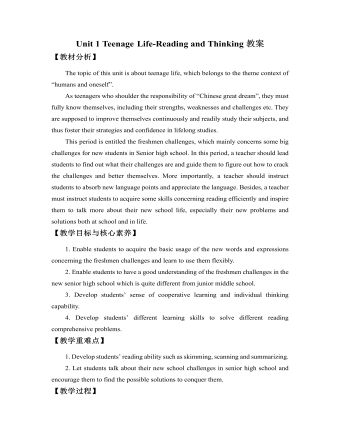
【教材分析】The topic of this unit is about teenage life, which belongs to the theme context of “humans and oneself”.As teenagers who shoulder the responsibility of “Chinese great dream”, they must fully know themselves, including their strengths, weaknesses and challenges etc. They are supposed to improve themselves continuously and readily study their subjects, and thus foster their strategies and confidence in lifelong studies.This period is entitled the freshmen challenges, which mainly concerns some big challenges for new students in Senior high school. In this period, a teacher should lead students to find out what their challenges are and guide them to figure out how to crack the challenges and better themselves. More importantly, a teacher should instruct students to absorb new language points and appreciate the language. Besides, a teacher must instruct students to acquire some skills concerning reading efficiently and inspire them to talk more about their new school life, especially their new problems and solutions both at school and in life.【教学目标与核心素养】1. Enable students to acquire the basic usage of the new words and expressions concerning the freshmen challenges and learn to use them flexibly.2. Enable students to have a good understanding of the freshmen challenges in the new senior high school which is quite different from junior middle school.3. Develop students’ sense of cooperative learning and individual thinking capability. 4. Develop students’ different learning skills to solve different reading comprehensive problems.
新人教版高中英语必修1Unit 2 Travelling Around-Discovering Useful Structure教案
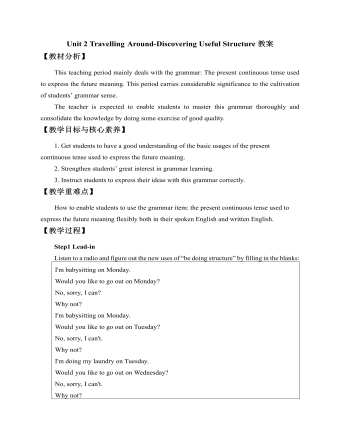
(5)be to do (可以和具体的时间状语连用)①表示按计划、安排即将发生的动作。②用于时间、条件状语从句中,表示“如果要……,想要……”。The students are to meet at the school gate tomorrow. 明天学生们将在学校大门口集会。 If you are to succeed, you must work as hard as possible. 如果你想要成功,比必须努力工作。(6)be about to do (不与具体的时间状语连用) 表示即将要发生的动作。We are about to start. 我们就要出发了。The new school year is about to begin. 新学年开学在即。(7)一般现在时表将来①表示按时间表规定将要发生的动作。常限于表示位置移动的短暂性动词。②在时间、条件或让步状语从句中,用一般现在时表将来。Look at the timetable. Hurry up! Flight 4026 takes off at 18:20. 你看看时刻表,快点!4026次航班的起飞时间是下午6点20分。Jane is in a hurry because the train to the airport leaves in half an hour. 简很匆忙,因为去机场的火车半小时后出发。
新人教版高中英语必修1Unit 2 Travelling Around-Reading for Writing教案
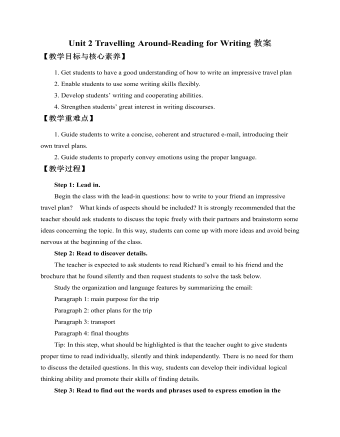
Is there a clear purpose for the trip? :Does each paragraph have a clear main idea? Does the writer use the present continuous tense for future plans?Does the writer use commas, stops, and question marks correctly? Are all the words spelt correctly?Are all the proper nouns capitalized?Revise your draft according to your partner's comments.Step 5:The summary of how to write a travel plan.旅游计划是一种常见的应用文写作。旅游可分为观光游、文化游、美食游及探险游等不同类型,因此旅游计划也要根据不同的旅游目的进行设计。常规的旅游计划需要明确以下几个方面的问题:Travel planWhen will you leave for? Where is your the destination?How will you get there?What will you do there?How long will you there?Is there a clear purpose for the trip? 为了提升旅行计划的层级,还需注意以下几个方面的问题:1.每段是否有明确清晰的主题;2.用一般现在时代替一般将来时;3.用更高级的形容词词汇。例如:表达“好”时,不要总用“nice”,我们还可以用“smart, clean, excellent, exciting, beautiful, wonderful, clever, famous, grand”等表达更具有指向性的词汇;4.用更高级的动词词汇。比如:我们可以用“seem stand, lie .get stay, remain, look . sound, become . keep, grow”等代替"be";
新人教版高中英语必修1Unit 4 Natural Disasters-Discovering Useful Structures教案
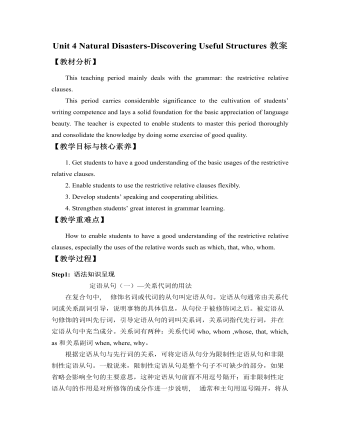
【教材分析】This teaching period mainly deals with the grammar: the restrictive relative clauses.This period carries considerable significance to the cultivation of students’ writing competence and lays a solid foundation for the basic appreciation of language beauty. The teacher is expected to enable students to master this period thoroughly and consolidate the knowledge by doing some exercise of good quality.【教学目标与核心素养】1. Get students to have a good understanding of the basic usages of the restrictive relative clauses.2. Enable students to use the restrictive relative clauses flexibly.3. Develop students’ speaking and cooperating abilities.4. Strengthen students’ great interest in grammar learning.【教学重难点】How to enable students to have a good understanding of the restrictive relative clauses, especially the uses of the relative words such as which, that, who, whom.【教学过程】Step1: 语法知识呈现定语从句(一)—关系代词的用法在复合句中, 修饰名词或代词的从句叫定语从句。定语从句通常由关系代词或关系副词引导,说明事物的具体信息,从句位于被修饰词之后。被定语从句修饰的词叫先行词,引导定语从句的词叫关系词,关系词指代先行词,并在定语从句中充当成分。关系词有两种:关系代词who, whom ,whose, that, which, as和关系副词when, where, why。
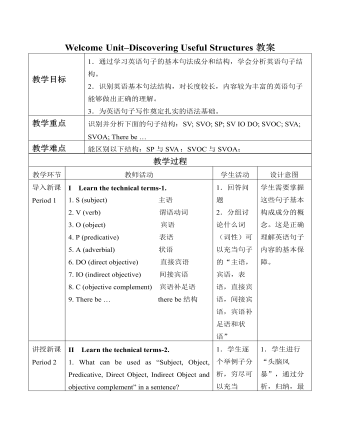
新人教版高中英语必修1Welcome Unit-Discovering Useful Structures教案
II Learn the technical terms-2.1. What can be used as “Subject, Object, Predicative, Direct Object, Indirect Object and objective complement” in a sentence?2. What can be used as “adverbial” in a sentence?3. What can be used as “verb” in a sentence?Answers to questions 1-3:1. Nouns, pronouns and appellations can be used as “Subject, Object, Predicative, Direct Object, Indirect Object and Objective Complement”. Besides, adjectives can be used as “Predicative and Objective Complement” in a sentence.2. Adverbs and prepositional phrases can be used as “Adverbial”.3. Verbs with actual meaning can be used as “Verb” in a sentence. Auxiliary verbs alone cannot be used as “Verb” in a sentence.III Learn to recognize the sentence structures.1. SV structure. For Example:(1) A bird flies.S V(2) A monkey jumps.S V(3) A fish swims.S V√ In SV structures, verbs are “intransitive verbs”.2. SVO structure. For Example:(1) A sheep eats grass.S V O(2) They like bananas.S V O(3) He wants candy.S V O√ In SVO structures, verbs are “transitive verbs”.3. SP structure. For Example:(1) This is great.S P (2) He looks well.S P (3) She became a teacher.S P √ In SP structures, Predicatives are formed by “link verbs” and “adjectives or nouns”.√ link verbs: be, become, grow, look, feel, taste, etc.4. SV IO DO structure. For Example:(1) He asked me a question.S V IO DO(2) Danny wrote me a letter.S V IO DO(3) Billy brought Sam a kite.S V IO DO√ In SV IO DO structures, the verbs are transitive and are followed by two objectives – pronouns or nouns as Indirect Objective, and nouns as Direct Objectives.
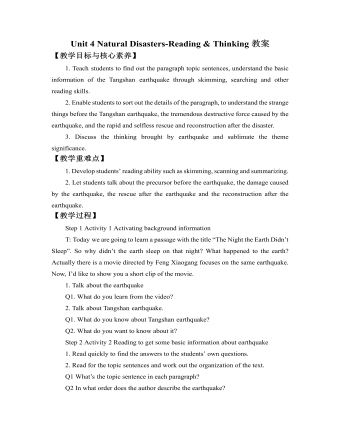
新人教版高中英语必修1Unit 4 Natural Disasters-Reading & Thinking教案
5. Read to get detailed information about Paragraph 5.Q1. What shows the revival of Tangshan?Q2. How can Tangshan revive itself and get up on its feet again?Q3. In times of disasters, how can we go through it?T: In times of disasters, we should unify, show the wisdom and stay positive.Step 4 Activity 4 Highlighting the theme and reflecting1. Make a summary of the text.2. Further understand the titleQ: After our learning, why do you think the earth didn’t sleep on that night?T: An earthquake happened. The people in the earthquake suffered a lot, and the people outside Tangshan were concerned about the people there a lot.3. Reflect through discussion on what can be learnt after reading.T: Disasters are powerful. Unpreparedness can be deadly. Life is weak, but if people work together to help each other, disasters can be defeated.There is no love from disaster, but we have love in the human heart.Step 5 Assignment How does the writer convey that the earthquake was deadly, and that people were helpless during the earthquake? Try to find some attractive and impressive expressions and note them down.
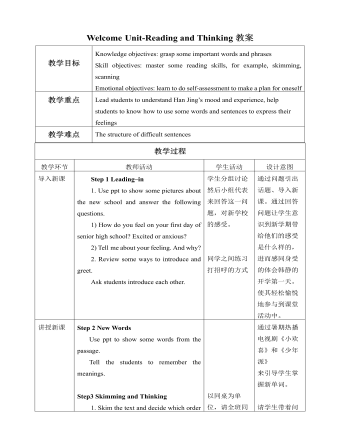
新人教版高中英语必修1Welcome Unit-Reading and Thinking教案
Step 2 New WordsUse ppt to show some words from the passage.Tell the students to remember the meanings.Step3 Skimming and Thinking1. Skim the text and decide which order Han Jing follows to talk about her first day. Time order or place order?Time order2. What is Han Jing worried about before she goes to senior high school?She is worried about whether she will make new friends and if no one talks to her, what she should do.Step 4 Fast Reading1. Match the main ideas with each paragraphParagraph 1:The worries about the new school day Paragraph 2Han Jing’s first maths classParagraph 3Han Jing’s first chemistry classParagraph 4Han Jing’s feelings about her first senior school dayStep 5 Careful Reading1. Fill in the chart with the words and phrases about Han Jing’s day. Answers: Senior high school, a little nervous; Her first maths class, classmates and teachers, friendly and helpful; Chemistry lab; new; great; annoying guy; Confident; a lot to explore2. Read the text again and discuss the questions.1) Why did Han Jing feel anxious before school?Because she was a new senior high student and she was not outgoing. What was more, she was worried about whether she can make friends.2) How was her first maths class?It was difficult but the teacher was kind and friendly. 3) What happened in the chemistry class? What would you do if this happened to you? A guy next to Han Jing tried to talk with her and she couldn’t concentrate on the experiment.
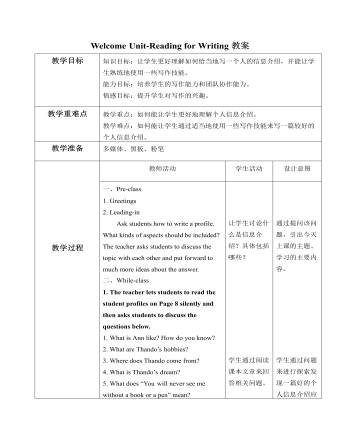
新人教版高中英语必修1Welcome Unit-Reading for Writing教案
教学目标知识目标:让学生更好理解如何恰当地写一个人的信息介绍,并能让学生熟练地使用一些写作技能。能力目标:培养学生的写作能力和团队协作能力。情感目标:提升学生对写作的兴趣。教学重难点 教学重点:如何能让学生更好地理解个人信息介绍。教学难点:如何能让学生通过适当地使用一些写作技能来写一篇较好的个人信息介绍。教学准备 多媒体、黑板、粉笔一、Pre-class1. Greetings2. Leading-inAsk students how to write a profile. What kinds of aspects should be included? The teacher asks students to discuss the topic with each other and put forward to much more ideas about the answer.二、While-class1. The teacher lets students to read the student profiles on Page 8 silently and then asks students to discuss the questions below.1. What is Ann like? How do you know?2. What are Thando’s hobbies?3. Where does Thando come from?4. What is Thando’s dream?5. What does “You will never see me without a book or a pen” mean?
新人教版高中英语必修2Unit 1 Cultural Heritage-Listening&Speaking&Talking教案
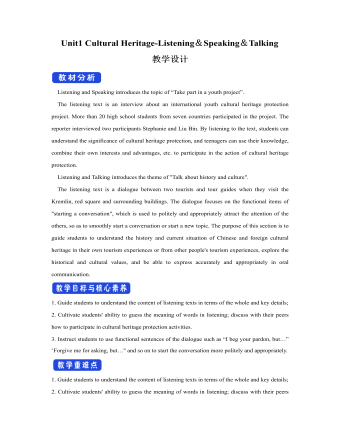
Listening and Speaking introduces the topic of “Take part in a youth project”. The listening text is an interview about an international youth cultural heritage protection project. More than 20 high school students from seven countries participated in the project. The reporter interviewed two participants Stephanie and Liu Bin. By listening to the text, students can understand the significance of cultural heritage protection, and teenagers can use their knowledge, combine their own interests and advantages, etc. to participate in the action of cultural heritage protection. Listening and Talking introduces the theme of "Talk about history and culture". The listening text is a dialogue between two tourists and tour guides when they visit the Kremlin, red square and surrounding buildings. The dialogue focuses on the functional items of "starting a conversation", which is used to politely and appropriately attract the attention of the others, so as to smoothly start a conversation or start a new topic. The purpose of this section is to guide students to understand the history and current situation of Chinese and foreign cultural heritage in their own tourism experiences or from other people's tourism experiences, explore the historical and cultural values, and be able to express accurately and appropriately in oral communication.1. Guide students to understand the content of listening texts in terms of the whole and key details; 2. Cultivate students' ability to guess the meaning of words in listening; discuss with their peers how to participate in cultural heritage protection activities.3. Instruct students to use functional sentences of the dialogue such as “I beg your pardon, but…” “Forgive me for asking, but…" and so on to start the conversation more politely and appropriately.
新人教版高中英语必修2Unit 2 Wildlife Protection-Reading and Thinking教案一
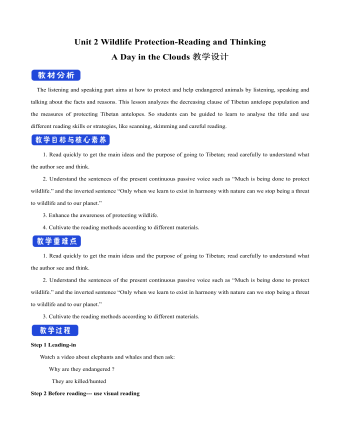
The listening and speaking part aims at how to protect and help endangered animals by listening, speaking and talking about the facts and reasons. This lesson analyzes the decreasing clause of Tibetan antelope population and the measures of protecting Tibetan antelopes. So students can be guided to learn to analyse the title and use different reading skills or strategies, like scanning, skimming and careful reading.1. Read quickly to get the main ideas and the purpose of going to Tibetan; read carefully to understand what the author see and think.2. Understand the sentences of the present continuous passive voice such as “Much is being done to protect wildlife.” and the inverted sentence “Only when we learn to exist in harmony with nature can we stop being a threat to wildlife and to our planet.”3. Enhance the awareness of protecting wildlife.4. Cultivate the reading methods according to different materials.1. Read quickly to get the main ideas and the purpose of going to Tibetan; read carefully to understand what the author see and think.2. Understand the sentences of the present continuous passive voice such as “Much is being done to protect wildlife.” and the inverted sentence “Only when we learn to exist in harmony with nature can we stop being a threat to wildlife and to our planet.”3. Cultivate the reading methods according to different materials.Step 1 Leading-inWatch a video about elephants and whales and then ask:Why are they endangered ? They are killed/hunted
新人教版高中英语必修2Unit 2 Wildlife Protection-Listening &Speaking&Talking教案
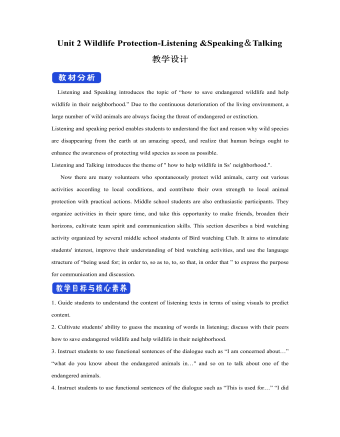
Listening and Speaking introduces the topic of “how to save endangered wildlife and help wildlife in their neighborhood.” Due to the continuous deterioration of the living environment, a large number of wild animals are always facing the threat of endangered or extinction. Listening and speaking period enables students to understand the fact and reason why wild species are disappearing from the earth at an amazing speed, and realize that human beings ought to enhance the awareness of protecting wild species as soon as possible.Listening and Talking introduces the theme of " how to help wildlife in Ss’ neighborhood.". Now there are many volunteers who spontaneously protect wild animals, carry out various activities according to local conditions, and contribute their own strength to local animal protection with practical actions. Middle school students are also enthusiastic participants. They organize activities in their spare time, and take this opportunity to make friends, broaden their horizons, cultivate team spirit and communication skills. This section describes a bird watching activity organized by several middle school students of Bird watching Club. It aims to stimulate students' interest, improve their understanding of bird watching activities, and use the language structure of “being used for; in order to, so as to, to, so that, in order that ” to express the purpose for communication and discussion.1. Guide students to understand the content of listening texts in terms of using visuals to predict content.2. Cultivate students' ability to guess the meaning of words in listening; discuss with their peers how to save endangered wildlife and help wildlife in their neighborhood.3. Instruct students to use functional sentences of the dialogue such as “I am concerned about…” “what do you know about the endangered animals in…" and so on to talk about one of the endangered animals.