-
新人教版高中英语必修3Unit 5 The Value of Money-Reading for Writing教学设计二
2. 您能看到, 我头发太长了。You can see that my hair is much too long.3. 无论什么时候, 只要您想回来就回来。Please come back whenever you want.4. 您仅有很少的头发要理! You only have too little hair to cut !5. 为您服务是我的荣幸!It is my honour to serve you!Step 9 Writing(Henry is walking down the street when he sees a sign for a place that cuts hair. He decides to have it cut. )H=Henry B=BarberH: Good afternoon, I’d like to have my hair cut, if I may. (The barber looks at Henry’s hair and continues cutting another man’s hair. ) Er, I’d really like a haircut. As you can see it’s much too long. B: (in a rude manner) Yes, I can see that. Indeed, I can. H: Fine, well, I’ll have a seat then. (He sits in one of the barber’s chairs. The barber turns to look at Henry. )B: It’s quite expensive here, you know! Are you sure you can afford it?H: Yes. I think so. (After his hair is cut, the barber tells Henry how much he must pay. Henry shows the barber the bank note. )B: Why Mr. . . (looks shocked)H: Adams. Henry Adams. I’m sorry. I don’t have any change. B: Please don’t worry! (wearing a big smile) Nothing to worry about! Nothing at all! Please come back whenever you want, even if you only have too little hair to cut! It will be my honour to serve you!Step 10 Pair workExchange drafts with a partner. Use this checklist to help your partner revise his/her draft.1. Are all the elements of a play included and in good order ?2. Do the character use suitable language ?3. Are the stage directions clear and useful ?4. Is the plot clear and exciting enough ?
新人教版高中英语必修3Unit 5 the value of money-Reading For Writing教学设计一
【参考范文】Narrator:(Henry is smiling as he leaves the restaurant. As he is walking down the street, he sees a sign for a place that cuts hair. He decides to get it cut. )H=Henry;B=Barber;R=rude manH:Good afternoon, I'd like to get a cut, if I may. (The barber looks at Henry's hair and continues cutting another man's hair. )Er, I'd really like a haircut. As you can see it's much too long. B:(in a rude manner) Yes, I can see that. Indeed, I can. H:Fine, well I'll have a seat then. (He sits in one of the barber's chairs. The barber turns to look at Henry. )B:It's quite expensive here, you know!Are you sure you can afford it?H:Yes. I think so. (In comes the rude man. )R:Hey you there. I need a haircut quickly. Can you do me straightaway?B:All right, then, get in the chair and I'll see what I can do. R:Thank you. (sits down in one of the barber's chairs)H:Excuse me, but I was here first. Aren't you going to do my hair first?B:This man's in a hurry. H:Well so am I!I insist that you cut my hair first. B:OK, but I'll have to be quick. This gentleman is waiting. H:Thank you. (They both become quiet. After his hair is cut, the barber tells Henry how much he must pay. Henry shows the barber the bank note. )B:Why, Mr . . . (looks shocked)H:Adams. Henry Adams. I'm sorry, I don't have any change. R:You're that Mr Adams! Well,I'm glad I waited or I might never have known it was you. B:Why, Mr Adams, please don't worry!(wearing a big smile) Nothing to worry about!Nothing at all!Please come back any time, even if you only need too little hairs cut!It will be my honour to serve you!
新人教版高中英语必修3Unit 1 Festivals and Celebrations-Reading and Thinking教学设计
The topic of this part is “Discover the reasons for festivals and celebrations.The Listening & Speaking & Talking part aims at talking about the experiences and feelings or emotions about the festivals and celebrations. This section aims at detecting the reason why the people celebrate the festivals, the time, the places, the types and the way of celebrations. It also explains why some traditions in the old celebrations are disappearing, like the firecrackers in the big cities and some new things are appearing like the prosperity of business or commerce. 1. Students can talk about what festivals they know and the reasons and the way of celebrating them.2. Students should learn the reading skills such as the headline and get the topic sentences, the structures of articles.3. Students can understand the past, the present situation of some festival around the world and why there are some changes about them. 4. Students can have the international awareness about the festivals.1. Students should learn the reading skills such as the headline and get the topic sentences, the structures of articles.2. Students can understand the past, the present situation of some festival around the world and why there are some changes about them.Step 1 Lead in---Small talkWhat festival do you like best ? Why ?I like the Spring Festivals because I can set off the fireworks, receive the lucky money and enjoy the Gala with my families.Step 2 Before reading---Pair workWhy do people celebrate different festivals ?The Spring Festivals is to celebrate the end of winter and the coming of spring and new life.The Mid-autumn Day is to celebrate the harvest and admire the moon.
新人教版高中英语必修3Unit 1 Festivals and Celebrations-Reading for Writing教学设计一
The topic of this part is “Write about your festival experience”.During the Listening and Speaking and Talking, students are just asked to say out their festival experiences such as the Spring Festival, Mid-autumn Day, but this part students will be asked to write down their own festival experiences. During the reading part, it introduces the Naadam Festival in Inner Mongolia Autonomous Region, which can give students a good example to imitate. Students not only learn the festival, but touch and feel the Inner Mongolian’s character, the spirit and cultural atmosphere, which can help students form the cultural awareness and learn to enjoy and value the diversity of Chinese culture.Concretely, the dairy tells the experience that the author spent the Naadam Festival in Inner Mongolia Autonomous Region with his/her friend. The structure is clear. In the opening paragraph, it introduces the topic of the Naadam Festival and the whole feeling. Then it introduces the items of the festival like the ceremony, wrestling and horse racing. Finally, it summarizes this experience. Because this part is a travel journal, we must guide students pay more attention to these details: 1. use the first person. 2. use the past tense to tell the past thing and use the present or future tense to describe the scenery. 3. use the timeline to tell the development. 4. be careful for the author’s psychology, emotion and feeling, etc.1. Read quickly to get main idea; read carefully to get the detailed information about Naadam Festival.2. Learn the structure of the reading article and language.3. Write an article about a festival experience4. Learn to use the psychology, emotions and feeling in the writing.1. Write an article about a festival experience.2. Use the structure of the reading article and language.
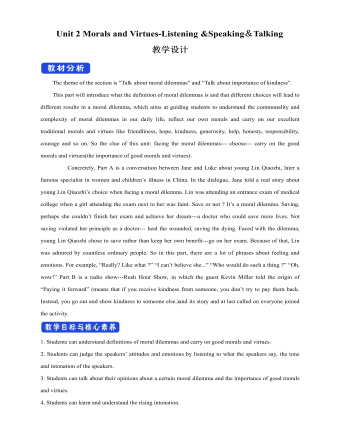
新人教版高中英语必修3Unit 2 Morals and Virtues-Listening &Speaking&Talking教学设计
Example:One day, a poor boy who was trying to pay his way through school by sending newspapers door to door found that he only had one dime(一角)left. He was so hungry that he decided to beg for a meal at the next house.However, he lost his nerve when a lovely young woman opened the door. Instead of a meal he asked for a drink of water. She thought he looked hungry so she brought him a large glass of milk. He drank it slowly, and then asked, “How much do I owe you?” “You don’t owe me anything,” she replied, “Mother has taught me never to accept pay for a kindness.” “Then I thank you from the bottom of my heart.” With these words, Howard Kelly left that house.Years later the woman became badly ill and was finally sent to the hospital in a big city. Dr. Howard Kelly, now famous, was called in. When he heard the name of the town she came from, a strange light filled his eyes. Dressed in his doctor’s clothes, Dr. Kelly went into her room and recognized her at once. From that day on, he gave special attention to her, and decided to do his best to save her life.At last the woman was saved. Dr. Kelly asked the business office to pass the final bill to him. He looked at it and then wrote something on the side. The bill was sent to the woman’s room. She was afraid to open it because she was sure that it would take the rest of her life to pay for it off. Finally she looked, and the note on the side of the bill caught her attention. She read these words: “Paid in full with a glass of milk, Dr. Howard Kelly.” Tear of joy flooded her eyes.
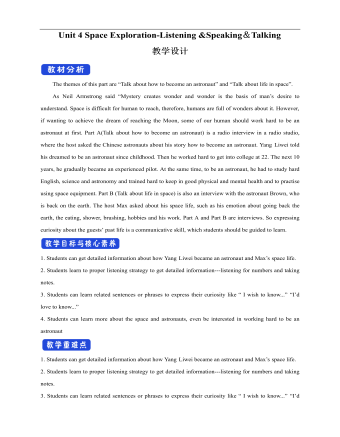
新人教版高中英语必修3Unit 4 Space Exploration-Listening&Speaking&Talking教学设计二
The themes of this part are “Talk about how to become an astronaut” and “Talk about life in space”. As Neil Armstrong said “Mystery creates wonder and wonder is the basis of man’s desire to understand. Space is difficult for human to reach, therefore, humans are full of wonders about it. However, if wanting to achieve the dream of reaching the Moon, some of our human should work hard to be an astronaut at first. Part A(Talk about how to become an astronaut) is a radio interview in a radio studio, where the host asked the Chinese astronauts about his story how to become an astronaut. Yang Liwei told his dreamed to be an astronaut since childhood. Then he worked hard to get into college at 22. The next 10 years, he gradually became an experienced pilot. At the same time, to be an astronaut, he had to study hard English, science and astronomy and trained hard to keep in good physical and mental health and to practise using space equipment. Part B (Talk about life in space) is also an interview with the astronaut Brown, who is back on the earth. The host Max asked about his space life, such as his emotion about going back the earth, the eating, shower, brushing, hobbies and his work. Part A and Part B are interviews. So expressing curiosity about the guests’ past life is a communicative skill, which students should be guided to learn.1. Students can get detailed information about how Yang Liwei became an astronaut and Max’s space life.2. Students learn to proper listening strategy to get detailed information---listening for numbers and taking notes.3. Students can learn related sentences or phrases to express their curiosity like “ I wish to know...” “I’d love to know...”4. Students can learn more about the space and astronauts, even be interested in working hard to be an astronaut
人教部编版道德与法制六年级下册多元文化,多样魅力说课稿
师:中国饮食影响别国,就充分说明了世界各地的文化在不断融合、发展,但是在这过程中,也会有因文化差异引起的尴尬、矛盾或冲突,你知道该怎么处理吗 ?案例回放:1. 不接受赞美 =虚伪? 总结:西方人乐于赞美别人,同时也乐于接受别人的赞美。而中国人为了显示谦恭,常常会“拒绝“他人的赞美。这种“拒绝”会让老外觉得莫明其妙, 好像你不领他的情似的。2. 要不要付小费 ?在美国给小费是一个很常见的现象。从餐厅吃饭、坐出租车、让酒店工作 人员帮你拿行李等等,都需要给一定数额的小费作为给对方劳动的一个认可和补偿 . 大部分情况是占你消查数额的15%左右。当然你可以根据这家餐厅/ 酒店的高级程度,服务的质量有所调壁。但是不给小费一般是一种不礼貌的行为,而且会让你成为不受欢迎的客人。总结:我们要了解差异,并学会尊重差异。 活动总结:中国文化也在不断走向世界。请你课后去收集一些类似的报道 .感受多元文化的魅力。
人教版高中历史必修3充满魅力的书画和戏曲艺术说课稿2篇
师:很好!我们知道,元明清时期,我国封建社会进入衰落时期,封建专制不断加强,对文人的思想控制也在不断加强,士大夫文人只有通过画来表达自己的想法和内心世界,所以这时候的画强调借物抒情。大家可以再看到这幅清朝郑板桥《墨竹图》,竹子非常清新俊逸,抒发了一个清高的文人情怀。大家可以仔细品味,郑板桥的竹子有种脱俗的感觉,看后让人非常静心。同学们,在欣赏国画的时候,我们不是一味地去看它像不像,而要更多去体会他的精神与气质,没有思想与内涵的人是画不出一副好画的,就算他画技再好,他的也是没有灵魂的。中国的水墨画,虽然没有涂颜料,它却会使你感受到春天的绿,秋天的黄和冬天的白,我们可以在画中找寻到自己精神的共鸣。好,刚刚讲了这么多,现在请一位同学看到这表格来归纳一下每个时期国画的不同特点。
人教版高中历史必修3建国以来的重大科技成就说课稿2篇
说教材(一)、本课在教材中的地位:教材在第3单元介绍了古代中国科技的辉煌。第四单元介绍世界近代科技成就,本课主要介绍了现代中国的科技成就。通过对本课的学习,有利于学生感受中国科技古代辉煌、近代落后、现代又取得很大成就这一重要历程,因此本课在教材中具有重要作用。(二)教学内容分析和课标要求:本课主要介绍新中国成立以来我国科学技术成就及作用。从核研究、航空技术、农业新品种研究、计算机应用、生物技术五方面介绍了新中国成立以来取得的举世瞩目的成就。课标对这部分知识作了如下的要求:列举新中国成立以来科技发展的主要成绩,认识科技进步在现代化建设中的重大作用。根据以上对教材内容的分析和课标要求,我将本课的三维目标确定如下:(三)、教学目标1、知识与能力:识记建国后六十多年来所取得的科技成就;理解科学技术是生产力的论断;探究科技的发展在现代化建设中的重要作用。
人教版高中生物必修3第一章第二节《内环境稳态的重要性》说课稿
四、稳态的重要意义 为什么内环境稳态失调后,会对机体造成危害?引导学生从细胞代谢需要的物质和条件进行分析,最后总结出:内环境稳态是机体进行正常生命活动的必要条件。如何预防内环境稳态失调、保持机体健康?引导学生从外界环境和机体自身调节能力两个方面去思考。即通过加强自我保健,减少外界环境变化对机体的不良影响,同时增强机体的调节能力以适应多变的外界环境。具体如何做?学生讨论,总结。1.保护我们的生存环境,防治环境污染。2.加强体育锻炼,增强体质,提高机体适应外界环境的能力。3.加强自我保健,为机体保持健康创造有利条件。尤其是处于比较恶劣的工作环境中的人,更应注意自身保健,如边防战士注意保暖、炼钢工人注意降温、抗洪战士注意补充水盐等。了解这些知识后才能懂得如何关爱自身和他人。
人教版高中生物必修3第一章第一节《细胞生活的内环境》说课稿
1. 该节内容属于人教版高中生物必修三《稳态与环境》第一章第一节的内容:细胞生活的环境。本节内容主要突出的是内环境的概念,为下一节稳态的重要性及下一章动物和人的生命活动的调节做铺垫。2. 教学目标:(1)知识目标:①描述内环境的组成和理化性质。②说明内环境是细胞与外界环境进行物质交换的媒介。(2)能力目标:①通过思考与讨论培养学生语言表达能力②通过相关练习培养学生知识迁移的能力(3)情感目标:关注维持内环境稳态与健康的关系。*目标确定依据:主要根据课标要求及教材内容特点。3.重难点及依据(1)重点:①内环境的组成和理化性质。②内环境是细胞与外界环境进行物质交换的媒介。*依据:根据课标要求,同时是高考考点。(2)难点:①内环境的组成和理化性质。②内环境是细胞与外界环境进行物质交换的媒介。* 依据:学生缺少相关的有机化学的知识基础,且内容相对枯燥抽象。
人教版高中生物必修3第三章第二节《生长素的生理作用》说课稿
强调重力对生长素分布的影响,为下面的内容讲解做铺垫,明确植物出现向光性与生长素分布不均有关。复习旧知识,产生首因效应,巩固和加强记忆。通过植物向光性是生长素分布较多而促进生长,进而提出“对于植物来说,生长素是不是越多越好”这个问题,引发思考,锻炼思维。说明生长素浓度对不同器官产生的影响不同,让学生对这一情况有一个整体印象。结合数学知识逐步分析图上各点和各曲线的含义,引导学生得出不同器官对生长素浓度的敏感性顺序,为解释横放植物“S”型生长做铺垫。通过对曲线的分析,得出低生长素浓度起促进作用,高浓度有抑制作用这种双重性,并得出其双重性表现。通过以上的分析和总结,对横放植物“S”型生长进行解释,达到首尾呼应的效果。采用“蒙太奇”手法,引申到“太空中,横放植物将会如何生长”这个问题,引发学生的联想和思考,以这种提问方式结课为下节课的开课做了铺垫,掌握了主动权。
人教版高中生物必修3第二章第四节《免疫调节》说课稿
(四)、活动交流,体验科学通过资料分析讨论以下三个问题:1、你知道爱滋病的传播途径吗?2、如何预防爱滋病?3、我们应如何对待爱滋病患者?面对艾滋病我们能做些什么?从而进入情感态度的教育。除此之外,我还设计一个开放性的作业“向全社会为关注艾滋病设计一个宣传广告”(形式不限,漫画、板书、倡议书等),让学生把爱心付诸于实际行动。在此基础上引出“免疫学的应用”从免疫预防、免疫治疗、器官移植三个方面讲述,让学生充分体验到知识和社会生活的紧密联系,让他们不在感到科学是那么的遥远,而是可爱的有用的。通过交流,让同学们体会到合作的魅力和重要性,进一步培养合作意识和合作能力。最后我设计一个资料搜集,让同学们选一个感兴趣的主题利用电脑在网上搜集有关资料。主题:1、你知道世界艾滋病日吗?历年的主题是什么?开展世界艾滋病运动有什么意义?
人教版高中生物必修3第四章第一节《种群的特征》说课稿
第二环节合作讨论,获得新的知识展示图片,一块草地上的全部蒲公英,估算所有蒲公英的数量,引出种群密度的概念。回到问题即调查蒲公英的种群密度,教师启发,学生阅读教材讨论总结说出样方法,以问题承接“一片草地上的所有山羊”怎么知道其种群密度,激起学生认知冲突,进一步思考讨论,得出标志重捕法,教师引导学生完成标志重捕法的概念、操作过程,计算公式,并与样方法进行比较。教师陈述“种群密度是种群最基本的数量特征,反应种群在一定时期的数量,不能反应种群的变化趋势”引出反映种群变化趋势的其他特征——出生率和死亡率,迁入和迁出,年龄组成和性别比例。学生讨论总结这些特征的概念、对种群密度的影响及对生产生活实践的指导意义。使学生认同计划生育国策,关注濒危动物的种群数量变化。之后引导学生构建种群特征的关系图。再简明阐述种群空间特征即:随即分布,均匀分布、集群分布。第三环节反馈练习,巩固新知识通过对学生练习结果的评价,了解学生对知识的掌握情况。即以学生为核心的教学评价。
人教版高中生物必修3第六章第二节《保护我们共同的家园》说课稿
1.潜在价值──某种不知名的昆虫。间接价值──每个物种都维系着它们所在的生态系统的结构和功能。直接价值──芦苇是一种重要的造纸原料;蝉蜕是一种动物性药物;鲁班通过观察某种叶片的叶缘得到启示,研制出了木工用的锯;海洋和森林等生态系统能陶冶情操、激发创作的灵感。2.主要的困难是,一些发达国家(如美国、加拿大和欧盟国家等),拒绝核准或迟迟不予核准该议定书。主要争议的问题是,这些国家担心影响本国经济的发展和其他国家可能不承担相应的责任。例如,美国政府在2003年3月以“减少温室气体排放将会影响美国经济发展”和“发展中国家也应该承担减排和限排温室气体的义务”为由,宣布拒绝执行《京都议定书》。建议世界各国特别是发展中国家联合起来,通过联合国大会和各国的政府以及民间组织等多种途径,呼吁每年大量产生温室气体的发达国家率先核准《京都议定书》(我国政府早在2002年9月就核准了《京都议定书》)。
人教版高中生物必修3第四章第三节《群落的结构》说课稿
建构群落特征3群落有一定的空间结构,包括垂直结构和水平结构。思维拓展从结构与功能相统一的角度思考群落内的分层结构的意义。6.4运用群落核心知识概念解决未知群落问题学生已掌握了同一时间内聚集在一定区域中各种生物种群的集合是生物群落,所有群落都有一定的物种组成、种间关系、空间结构,不同群落主要表现在其具体特征上的差异。在此基础上,为学生提供新的问题情境,利用多媒体课件,展示不同生态环境下不同生物群落问题,让学生运用已建构的群落概念,通过分析、演绎和具体化等辩证思维的过程解决未知的群落问题,课件展示热带雨林、温带草原、海洋、湖泊等生物群落。学生运用概念说明不同的群落的物种丰富度差异,列举不同群落的种间关系,分析不同群落的垂直结构和水平结构,研究造成不同群落重要特征差异的原因。评价人类的活动对群落的结构的影响。
人教版高中生物必修3第五章第五节《生态系统的稳定性》说课稿
主要让学生明确以下观点:(1)自然生态系统是人类生存的基本环境;(2)人类活动的干扰正在全球范围内使生态系统偏离稳定状态;(3)人类生存与发展的命运就掌握在自己手中,但又受到自然规律的制约。反思总结,练习巩固:对本节知识点进行回顾,整理出简要的知识主线,为学生系统性复习巩固提供思路,课件展示老师课前收集准备的相关练习题,指导学生完成练习题,加学生深对本节知识的理解把握。结课布置作业:我们已经学习了生态系统的稳定性,那么,生态系统的各种功能之间的关系是怎样的呢?在下一节课我们一起来学习这一方面的内容。这节课后大家可以先预习这一部分,着重分析他们之间的关系。并完成本节的课后练习及课后延伸拓展作业。达到对本节内容知识的巩固提高和延展的目的。八、板书设计第五节生态系统的稳定性一、 生态系统的稳定性概念1.概念:生态系统所具有的保持或恢复自身结构和功能相对稳定的能力,
人教版高中生物必修3第五章第三节《生态系统的物质循环》说课稿
步骤四:展示点评、质疑探究展示小组展示讨论论成果,要求每组B、C层次学生进行展示。展示结束后由点评同学对展示结果进行点评,要求先点评对错;再点评思路方法和应注意的问题。既要有结论,又要有分析,力争有相关的总结和拓展。下面的同学注意倾听、思考,关键内容做好笔记,有补充或不明白的地方及时、大胆提出,力争全部过关,解决疑难点。根据学生点评结果,教师适当点评拓展。步骤五:拓展提升、总结升华简单扼要的课堂小结,系统回顾知识,强化学生对于生态系统物质循环的认识。环节三:课后检测布置训练内容,巩固知识。五、课后反思:本堂课采用我校163高效课堂模式,通过小组合作探究、展示自我、互相点评的方式完成整堂课的教学内容,充分突出了新课标中以学生为主体的指导思想。教学过程中,依据学生的个性差异,提出不同要求,布置不同任务,让不同层次的学生都能参与其中,调动全体学生的积极性,促进全体学生的发展。

人教版高中生物必修3第五章第四节《生态系统的信息传递》说课稿
教师通过引导学生看课本的“资料分析”,要求学生从中得出生态系统中的信息传递在生态系统中的作用。学生通过分析、讨论可以得出结论,这时教师要适时的点拨,给予小结,并引导学生站在整个生态系统的角度去分析信息传递,并和能量流动、物质循环联系在一起,说明它们都是生态系统各组分必不可少的一部分,同时指出信息传递是长期的生物进化的结果。学生了解了生态系统中信息传递的作用后,教师适时进行话题的转移,“我们学习信息传递,是为了更好的利用它,谁能说出信息传递在我们生产和生活中应用方面的例子”?学生们这时就开始讨论了,他们可能做不出正确的回答,但他们却能举出生活中有关信息传递的许多例子。讨论几分钟后,让看看信息传递在农业生产中有哪些应用吧?使教学回归课本,使知识得以沉淀,形成自己牢固的知识体系。(依时可以安排学生自学)
人教版新课标高中物理必修2能量守恒定律与能源说课稿3篇
(3)内陆和中西部城镇主要以煤和火电为主;广大农村和边远地区大多正从使用农作物秸秆等生物能源。(4)人均能源资源不足。我国是世界第三大能源生产国和第二大能源消费国,而我国能源短缺,特别是油气资源短缺已成为制约我国经济发展的重要因素。相关数据——煤炭、石油和天然气的人均资源占有量只有95t,世界平均值为209t,约是世界人均值的1/2;我国人均石油可采储量3t,世界平均值为28t,约为世界平均值的1/10。我国人均能源消费量不足1.2吨标准煤,居世界89位,不足世界人均能源消费水平的一半,仅占发达国家的1/5~1/10。其中人均消费650kg标准煤,是世界平均额的95%;人均消费石油相当145kg标准煤,为世界平均数的16.8%;人均消费天然气相当17.7kg标准煤,为世界平均数的3.9%;人均消费电力501.5kWh,为世界平均水平的25%。(5)是能源消费结构不合理,突出存在着一低两高:即电能消费比例低,非商品生物能源消费量高,一次性商品能源消费中原煤消费比重高。原煤消费达到75%,远高于26.2%的世界平均水平。