-
新人教版高中英语必修2Unit 1 Cultural Heritage-Discovering Useful Structure教案二
This theme of the part is “ Describe people or things in greater detail”. Students have learned the grammar(restrictive relative clauses) in Book 1, and further review and consolidate its structure “prep+relative pronouns(which/whom)” and the relative adverbs(when, where and why), besides students should understand its form, meaning and functions. In this section, students should be able to express the grammar correctly in daily communication and in the writing. 1. Review the basic usages of relative pronouns and adverbs of attributive clauses . 2. Learn to use some special cases about restrictive relative clauses.3. Learn to write sentences with restrictive relative clauses flexibly according to the context.1. Review the basic usages of relative pronouns and adverbs of attributive clauses .2. Learn to use some special cases about restrictive relative clauses.3. Learn tow rite sentences with restrictive relative clauses flexibly according to the context.Step 1. Observe the following sentences, and mark the relative pronouns and the adverbs. 1. After listening to the scientists who had studied the problems, and citizens who lived near the dam, the government turned to the United Nations for help.2. Temples and other cultural sites were taken down piece by piece, and then moved and put back together again in a place where they were safe from the water.Step 2 PracticePlease complete these sentences with relative pronouns and relative adverbs and answer the following questions.Questions: 1. What is the head noun ?2. What relative words should be used ?3. What elements do they act in these sentences ?
新人教版高中英语必修2Unit 2 Wildlife Protection-Reading for Writing教案二
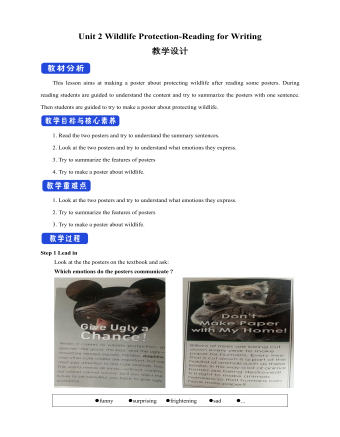
This lesson aims at making a poster about protecting wildlife after reading some posters. During reading students are guided to understand the content and try to summarize the posters with one sentence. Then students are guided to try to make a poster about protecting wildlife.1. Read the two posters and try to understand the summary sentences.2. Look at the two posters and try to understand what emotions they express.3. Try to summarize the features of posters4. Try to make a poster about wildlife.1. Look at the two posters and try to understand what emotions they express.2. Try to summarize the features of posters3. Try to make a poster about wildlife.Step 1 Lead inLook at the the posters on the textbook and ask:Which emotions do the posters communicate ?Step 2 Read the poster and answer the questions.1. What do you think of the animals in the poster on the left ?I think it is frightening and ugly.2. Why do we should protect the ugly animals ?All species--the good, the bad, and the ugly-- should be treated equally.The world needs all kinds--without variety, our planet cannot survive.3. Why are billions of trees being cut down every year ?To make paper for humans.4. What result will be lead to after the trees are cut down ?A lost of animal homes are being destroyed./The habitat of wildlife is being destroyed.Step 3 Find the feature of posters1. What does each poster use to stir up emotions ?On the left, it makes us a little frightened and it looks a little ugly, but it can activate our curiosity--What is it? And What is wrong with it?On the right, it makes us feel a little sad and want to protect them.
新人教版高中英语必修2Unit 1 Cultural Heritage-Reading and Thinking教案二
1. This section focuses on "Understanding how a problem was solved”, which is aimed to guide students to analyze and discuss the challenges and problems faced by cultural heritage protection during the construction of Aswan Dam, as well as the solutions. On the basis of understanding, students should pay attention to the key role of international cooperation in solving problems, and attach importance to the balance and coordination between cultural heritage protection and social and economic development. Students are encouraged to face challenges actively, be good at cooperation, and make continuous efforts to find reasonable ways and means to solve problems.2. Enable students to understand the main information and text structure of the reading text;3. Motivate students to use the reading strategy "make a timeline" according to the appropriate text genre;4. Enable students to understand how a problem was solved;5. Enable students to understand the value of protecting cultural heritage by teamwork and global community;1. Guide students to pay attention to reading strategies, such as prediction, self-questioning and scanning.2. Help students sort out the topic language about protecting cultural relics and understand the narrative characteristics of "time-event" in illustrative style3. Lead students to understand the value of protecting cultural heritage by teamwork and global community;
新人教版高中英语必修2Unit 2 Wildlife Protection-Discovering Useful Structure教案二
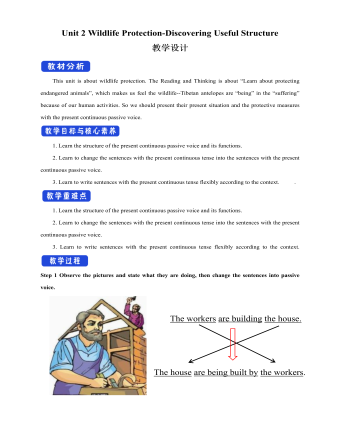
2.表示现阶段正在进行的被动动作(该动作在说话的瞬间未必正在进行)。Many interesting experiments are being carried out these days.(说话时,并不一定正在进行)3.表示一种经常性的被动行为,常和always,constantly 等表示频度的副词连用,这种用法常常带有赞扬或厌恶的感情色彩。He is always being praised by the leader.4.表示按计划或安排主语将要承受谓语动词所表示的动作(仅限于少数及物动词)。A party is being held tonight.Step 4 Special cases1.像take care of, look after, talk about, think of等动词与介词构成的短语用于现在进行时的被动语态时, 其中的介词不可省略。The ways to stop illegally hunting are being talked about. 2.可与部分情态动词连用,表示对正在发生的事情的推测。She may be being punished by her mother.3.有时可表示按计划或安排将要进行的一个被动动作。A celebration is being held this weekend for his success.4.某些表示“状态、心理活动、存在”等的动词,如have,want,need,love,一般不用现在进行时的被动语态,而常用一般现在时的被动语态。With the population increasing,more land is needed.5.“be+under/in+n.”可表示现在进行时的被动意义。My computer is under repair.=My computer is being repaired.
新人教版高中英语必修2Unit 1 Cultural Heritage-Reading For Writing教案
This report is short, concise and has typical news content and language features. The title uses the verb phrases, embodying the characteristics of being concise and general. The introduction is the first two sentences in the first paragraph, describing the general situation of the cultural heritage protection project, including time, place, characters, events and other news elements, so that readers can see the main points of the news report at a glance. The main body is the second and third paragraphs, which report the important historical and cultural value of Mogao Grottoes and the production of Mogao Grottoes Material digital photos, which are of great significance to the inheritance of historical culture and the promotion of international cultural understanding, exchange and cooperation. Direct citation is used in the report, as well as background introduction and other news writing techniques.1. Get students to have a good understanding of some features about a news report by reading the text.2. Instruct students to write a summary about a news report properly using some newly acquired writing skills in this period.3. Develop students’ writing and cooperating abilities.4. Strengthen students’ great interest in writing discourses.1. Stimulate students to have a good understanding of how to a summary about a news report 2. Cultivate students to write a news report properly and concisely.Step 1: Lead in Do you think it is necessary for us to circulate our cultural heritage to the world? Why or why not?Do we need to learn more about other countries’ cultural heritage? Why or why not?Step 2: Read to discover details concerning the main body of the news report.
新人教版高中英语必修2Unit 2 Wildlife Protection-Reading and Thinking教案二
The theme of this unit is human and nature, focusing on the theme of wildlife protection. Nature is a complex ecosystem, in which there are delicate balance between animals and plants. Because of the role of the food chain, the extinction of one species will produce influence, causing a series of chain reaction. Large scale extinction of species will have a serious and even irreversible impact on the ecosystem, resulting in immeasurable losses. Therefore, it is of great significance to protect wild species. To protect wild species is to protect human beings themselves. The motto of this unit is "when the buying stops, the killing can too,” which is a public service advertising slogan to protect wildlife. It tells people that every rhinoceros horn, every fur, every bowl of shark fin soup, every Ivory product, and every tiger bone product, etc. consumed by human beings, are innocent wild animals slaughtered behind them. The mission of wild aid is to ban illegal trade in endangered wildlife and mitigate climate change. It aims to educate the public to reduce the consumption demand for endangered wildlife products through public publicity and improve the awareness of environmental protection.1. Improve the awareness of wildlife protection by acquiring the knowledge of wildlife protection.2. Focus on environmental protection and protection of all lives.3. Analysis of the living environment of wild animals with appropriate thinking mode.4. Skillfully use the vocabulary and grammar knowledge of this unit to cultivate self-study ability according to the unit content5. Develop cooperative learning ability through discussion and other ways1. Enable the Ss to talk about the current situation of wild animals.2. Guide the Ss to summarize the main idea of each paragraph as well as the main idea of the text.
新人教版高中英语必修2Unit 5 Music-Discovering Useful Structures教案二
4. When he got absorbed in his world of music, he felt as if he could “see” the beauty of the world around him, like he had in his previous life.P·P as adverbial: _________________________________________________________________.Function: _______________________________________________________________________.Step 5 Solid Complete the passage with the words in brackets in their correct forms.Well known as a successful band, the Impact members show quite a few striking qualities. They never ever give up. When _____________(question) by the media, they are not _____________(discourage) and practise even harder. They are improving themselves by attending several master training class. They are united. _____________(fill with) team spirit, they act as a whole, always aiming for glory. Step 6 Difference and similarity from -ingObserve the following examples.1. He went out, shutting the door behind him.=He went out, ________________________________________________________.2. Not knowing what to do, he went to his parents for help.=__________________________________________, he went to his parents for help.Similarity: _______________________________________________________________________________________________________________________________________________________.Difference : _______________________________________________________________________________________________________________________________________________________.Step Practice1. ________ in a hurry, this article was not so good. 因为写得匆忙, 这篇文章不是很好。2. ________ carefully, he found something he hadn’t known before. 他仔细读书时, 发现了一些从前不知道的东西。3. ________ why he did it, the monitor said it was his duty. 当被问及他为什么要这么做时, 班长说这是他的职责
新人教版高中英语必修2Unit 5 Music-Reading and Thinking教案二
1. Get basic information about Eric; read deeply to understand the history and development of the virtual choir.2. Understand what the function of the virtual choir is and how to make a virtual choir.3. Understand the meaning of some languages in the context of the text through question guidance, such as “Many people do not have close friends or contacts who have the same interest in music.” and so on.Step 1 Leading-in1. Answer the following questions.Q1:Do you know the Apps like Tik Tok and Quick Hand?Q2: Do you want to make a Tik Tok video or a Quick Hand video?2. Play a Tik Tok video Step 2: Understanding the title Q1:What does the title mean ?Q2: Is the article a narration or exposition? Why? Q3: Can you change the title ? If you can, what is the title?Step 3: Scanning the whole text and getting the basic information1. Answer the following questions.Q1:Who came up with the idea for a virtual choir?Q2: Where did Eric studied the musical composition?Q3: What is his song?2. Find the main idea of each paragraph3. Deal with some new words.Step 4: Reading carefully to get detailed informationPara 1 How to make a virtual choir1. PreparationA. tools: a virtual camera; an Internet connectionB. hero/heroin: friends or some individuals who have the same interests2. Process
新人教版高中英语必修2Unit 5 Music-Reading for Writing教案二
The Internet celebrity Gao Yifeng. Years ago, he owned 5 companies and the staffs over 1,000, but during the economy crisis, he became nothing but debt. He was so worried that his hair became white overnight. There was a time when he wanted to killed himself. But after listening to the song Start Over by Liu Huan, he decided to cheer himself up. He started a steamed bun shop and gradually became a national chain shops. Now he became successful again.Walter Haddon said, “Music is the medicine of a troubled mind.” Music contains such a pleasant and inspiring force. Music gave him courage and bravery. When he listened to the song, it made his spirit fly like a kite in the wind. Music gave him strength and brought him relief. It was the rock I leant on to become strong and to get through those hard times. I hope none of us have to go through the same kind of suffering that he did. At the same time, we all go through various periods when we feel sad or alone. During those times, music can help us in the same way that it helped him. I hope we all will somehow begin to treasure music and make it a part of our life. Thank you for your listening !5.Revise your writing each other.Does he/she explain how music has changed his/her/someone else’s life?Are some of the rhetorical devices included and used properly ?Does he/she talk about how music makes him/her/someone feel?Is the first word in each sentences capitalised?Does he/she use correct punctuation ?
新人教版高中英语必修1Unit 2 Travelling Around-Reading and Thinking教案
Good expressions that students can choose to use: help the travelers choose which tour to take1. In my opinion, you could/might choose…, because you prefer to…2. …could be a perfect choice for you, for…3. As far as I am concerned, you would enjoy…, for…4. …would probably suit you, because you enjoy/love/hate doing…Step 5 Passage ConsolidationLanguage appreciation:1. You can then spend three days exploring the rainforest with a local guide and enjoying the plants and animals unique to the rainforest. 在接下来的三天里,您可以在当地导游的陪同下,深入雨林进行探索,欣赏雨林特有的动植物。本句主体结构为spend some time doing sth. 2. Inca builders cut stones to exact sizes so that nothing was needed to hold walls together other than the perfect fit of the stones. 印加的建筑工人将石头切割成精确的尺寸,仅仅凭着石头间的完美契合,即可稳固墙体。本句为so that引导的结果状语从句。nothing与the perfect fit为并列成分; other than在句中意为“除了”。Step 6 HomeworkSuppose you will travel to Peru, write a short essay about your three-day tour plan.
小学美术人教版一年级下册《第3课花地毯》教学设计
2学情分析一年级的学生,虽然经过了一学期学习但好习惯还没养成,课上易失去注意力等。因此我在教学中要关注学生的注意力,抓住学生的兴趣点加以引导、启发,说易懂的语言,练学生易学的方法,让学生在宽松融洽的气氛快乐的学习。a教学重点教学重点:以最简单的方式让学生了解图案的基本构成特点。学时难点把握个人创作与集体合作的关系。
统编版三年级语文上第27课一个粗瓷大碗教学设计教案
《一个粗瓷大碗》是统编版教材三年级语文上册第八单元的一篇略读课文,本文围绕“粗瓷大碗”讲述了赵一曼把小通讯员盛给她的高粱米饭倒进病号灶的锅里,和战士们一起喝野菜粥;把小通讯员给她找的用来吃饭的碗又一次丢掉了的故事,表现了她在艰苦的环境中关爱战士胜过关心自己,与战士同甘共苦、坚持革命的高贵品质。课文是一篇略读课文,学习时可带着问题默读,边读边思考,这样可以更好地理解课文的内容。教学本文时,要由浅入深地设置问题,让学生带着问题默读课文;还要提示学生,默读时,没读懂的地方标记下来,可以联系上下文进一步思考,也可以读完之后和同学一起探讨。 1.认识“陈、曼”等7个生字,读准多音字“还”。2.能带着问题默读课文,了解围绕“粗瓷大碗”发生的故事。3.能从人物的语言、动作等描写中感受到人物的心情、品质。 1.教学重点:能带着问题默读课文,了解围绕“粗瓷大碗”发生的故事。2.教学难点:深入理解文章内容,感受赵一曼的高贵品质。 1课时
人教版高中数学选修3分类加法计数原理与分步乘法计数原理(2)教学设计
当A,C颜色相同时,先染P有4种方法,再染A,C有3种方法,然后染B有2种方法,最后染D也有2种方法.根据分步乘法计数原理知,共有4×3×2×2=48(种)方法;当A,C颜色不相同时,先染P有4种方法,再染A有3种方法,然后染C有2种方法,最后染B,D都有1种方法.根据分步乘法计数原理知,共有4×3×2×1×1=24(种)方法.综上,共有48+24=72(种)方法.故选B.答案:B5.某艺术小组有9人,每人至少会钢琴和小号中的一种乐器,其中7人会钢琴,3人会小号,从中选出会钢琴与会小号的各1人,有多少种不同的选法?解:由题意可知,在艺术小组9人中,有且仅有1人既会钢琴又会小号(把该人记为甲),只会钢琴的有6人,只会小号的有2人.把从中选出会钢琴与会小号各1人的方法分为两类.第1类,甲入选,另1人只需从其他8人中任选1人,故这类选法共8种;第2类,甲不入选,则会钢琴的只能从6个只会钢琴的人中选出,有6种不同的选法,会小号的也只能从只会小号的2人中选出,有2种不同的选法,所以这类选法共有6×2=12(种).因此共有8+12=20(种)不同的选法.
人教版高中数学选修3分类加法计数原理与分步乘法计数原理(1)教学设计
问题1. 用一个大写的英文字母或一个阿拉伯数字给教室里的一个座位编号,总共能编出多少种不同的号码?因为英文字母共有26个,阿拉伯数字共有10个,所以总共可以编出26+10=36种不同的号码.问题2.你能说说这个问题的特征吗?上述计数过程的基本环节是:(1)确定分类标准,根据问题条件分为字母号码和数字号码两类;(2)分别计算各类号码的个数;(3)各类号码的个数相加,得出所有号码的个数.你能举出一些生活中类似的例子吗?一般地,有如下分类加法计数原理:完成一件事,有两类办法. 在第1类办法中有m种不同的方法,在第2类方法中有n种不同的方法,则完成这件事共有:N= m+n种不同的方法.二、典例解析例1.在填写高考志愿时,一名高中毕业生了解到,A,B两所大学各有一些自己感兴趣的强项专业,如表,
大班语言教案:《m, f》教学设计
2.学会声母“b”和单韵母“a”拼读音节的方法。 3.学会拼读“b p m f”与“u、o”组成的音节。 教学难点 掌握拼读声母和韵母组成的音节。 教学过程 一、谈话导入 我们已经认识了韵母家族的6个朋友(出示a o e i u ü)一起读读,你们读得真准,能不能按字母顺序摆一摆,再按顺序读一读。你们记得真清楚。这节课我们一起到拼音王国里再认识四个声母家族的朋友,你们愿意吗? 二、学习“b p m f ”的音形 (一)学习“b”的音形 1.出示“b”的图 (1)引导学生提问:图上的小朋友在干什么? (2)问:这个字母念什么?学生试读“b”。 (3)讲:听广播的“播”读得轻短些,发音时,把两片嘴闭合,把气 憋住,然后突然放开,让气流冲出双唇就是“b”的音。 (4)教师范读。 (5)学生学读,体会发音方法。 (6)开火车读。 2.学习“b”的形 (1)引导学生提问:怎样记住“b”的形?或“b”与图中的哪一部分很像? (2)你们能编一个记忆“b”的小儿歌吗? 拉开天线听广播“b b b”。 右下半圆“b b b”。 6字“b”。…… 3.指导书写b(1)讲:我们先认识一个字母基本笔画:“丨”上竖。 (2)请同学们观察书中字母“b”先写哪笔,再写哪笔,几笔写成?占什么格?同桌同学互相说说。(3)学生说笔顺、位置,教师范写,强调“b”的第一笔在上格的三分之一处起笔到第三条线停笔。 (4)学生书空笔顺。 (5)学生在拼音本上抄字头。教师行间巡视,进行个别辅导。纠正学生的写姿和执笔方法。对姿势正确的学生及时表扬鼓励。
大班语言教案:《i,u,ü》教学设计
2、学会正确认读i、u、ü的带调韵母。知道ü上标声调时,上面的小圆点不写。3、会在四线格里抄写i、u、ü三个单韵母。课时安排:2课时第一课时 教学目标:教学单韵母i、u并抄写。 教学过程: 一、 复习检查。 1、猜谜语。 (1)白鹅倒影是什么韵母? (2)圆脸小姑娘,小辫右边扎。这是什么韵母? (3)像个圆圈是什么韵母? 2、抽读字母卡片。 二、 教学单韵母i。 1、看图说话引出i。 图上画着什么?图上画着一件衣服。i的发音与“衣”的音相同。 2、教学i的发音,认清字形。 (1)发音要领:发音时嘴比发e时开得更小,只留一条小缝,舌前部升高,接近上腭,舌尖抵住下齿背,让气从舌尖和上腭中间自然流出。 (2)教师范读、领读。 (3)记忆字形。 i像什么?顺口溜:“像支蜡烛i、i、i。” 3、书写指导:先写竖,再写点,两笔写成。 三、 教学单韵母u。 1、看图说话引出u。 图上画着什么?“树上有一只乌鸦。”乌鸦的“乌”就是u。 2、教学u的发音,认清字形。 (1)发音要领:发音时把嘴唇收拢,嘴唇比发o时更圆更小,舌尖后缩,舌根抬高,让气从小洞中出来。 (2)教师范读,领读。 (3)记忆字形。 可用顺口溜:“像只茶杯u、u、u。” 3、书写指导:u一笔写成。 四、 巩固复习。
扇形统计图教案教学设计
教学目标1、明确扇形统计图的制作步骤,能够根据相关数据较为准确地制作扇形统计图.2、进一步理解扇形统计图的特点,建立百分比大小和扇形圆心角大小之间初步的直观敏感度.3、能够实现不同统计图数据间的合理转换,再次体会几种统计图的不同特点,为合理选择统计图表示数据打下一定的基础.4、通过实例,理解三种统计图的特点,能根据具体问题选择合适的统计图清晰、有效地描述数据.5、在统计活动的过程中,通过相互间的合作与交流,掌握画统计图和选择统计图的方法;经历数据的收集、整理和简单分析、作出决策的统计活动过程,发展统计观念.6、通过对现实生活中的数据分析,感受数学与现实生活的密切联系,说出统计图在现实生活中的应用,提高学习数学兴趣.
学做家常菜教学设计教案
小学五年级的学生应该具备一些生活技能, 学做家常菜是我们生活的必需,是每个,人都应该掌握的生存技能。本主题的目的通过学习做简单的家常菜,引领小学生走进家务劳动,锻炼生活的自理能力和提高适应生活的能力,体会生活和学习的乐趣,激发学生将学校学习和家务劳动密切结合起来,形成积极的生活和学习的态度。本主题安排了“问题与思考”“学习与探究”“实践与体验”总结与交流“拓展与创新”五个环节,从提出问题开始,到探究与体验,最后到学有所用,循序渐进,引导学习走进中式餐饮文化,学做日常生活中的家常菜,掌握劳动的技能和方法,体验做家务劳动带来的快乐和享受,激发学生对家常菜的探究与实践的兴趣,逐步掌握日常生活所需的基本技能,培养热爱劳动、热爱生活的意识。
《将进酒》教案教学设计
教师活动 学生活动设计意图 情境导入:教师配乐叙述诗歌创作背景投入倾听 尽可能调动学生情绪诵读入境:“读李诗者于雄快之中得其深远宕逸之神,才是谪仙人面目”(投影展示)教师范读,酝酿情感(播放配乐)1、学生自读感知诗韵 2、学生齐读进入诗境 调动学生积极性,诵读时用自己的情绪感染学生精读涵咏:教师就诗歌内容进行提问,李白怎样喝酒,劝朋友喝酒的方式、原因,他有那些愁并说明理由,并按照自己的理解诵读。教师必要时给出相应的提示。投影展示:人生苦短 怀才不遇 交流研讨诵读 引导学生从诗句入手,疏通诗意,把握情感
认识三角形教案教学设计
四个同学为一个合作小组;每个小组利用教师为其准备的各类三角形,作出它们的高.比一比,看哪一个小组做得最快,发现的结论多. 师生行为:学生操作、讨论,教师巡视、指导,使学生理解【设计意图】通过让学生操作、观察、推理、交流等活动,来培养学生的动手、动脑能力,发展其空间观察.活动结论:1.锐角三角形的三条高都在三角形内; 2.直角三角形的一条高在三角形内(即斜边上的高),而另两条高恰是它的两条直角边; 3.钝角三角形的一条高在三角形内,而另两条高在三角形外.(这是难点,需多加说明) 总之:任何三角形都有三条高,且三条高所在的直线相交于一点.(我们把这一点叫垂心)课堂小结 1.三角形中三条重要线段:三角形的高、中线和角平分线的概念. 2.学会画三角形的高、中线和角平分线.