-
在绿书签行动关爱青少年成长主题活动上的讲话
大家早上好!很荣幸有这个机会,与xxx共同作为承办单位,承办由xxx主办的绿书签行动关爱青少年成长主题活动。这次活动倡导全方位“护苗”、“育苗”,让孩子们在优秀健康积极文化的滋养下健康、快乐地成长,我觉得此次活动对于各位同学们来说真的是非常正能量,活动的意义重大而深远。刚刚跟大家一起听了学生代表宣读“绿书签”行动倡议书后,下面我也要向各位同学提几点要求:一、我们要做一个“好(hào)读书”的人。读书最奇妙的地方就在于“读书的人能经历一千种人生,而不读书的人只能经历一种人生”。非淡泊无以明志,非宁静无以致远。最能致远是书香,读书是一种最自然的生命状态,是一种高贵至美的人生境界,所以我们要做一个好(hào)读书、爱读书的人,俗语说“书中自有黄金屋,书中自有颜如玉”,我们通过读书开拓视野,丰富知识,增长智慧。二、我们要做一个“读好书”的人。人类从远古愚昧的旧石器时代发展到今天瞬息万变的网络时代,其间每前进一步,都离不开对知识的不断追求、创新以及文化的层层积淀。通过文化的传承,才有今天社会的日新月异。培根说过:“知识就是力量!”书籍是取之不尽的智慧背囊,好书中积累了丰富的人生阅历,积累着做人的道理,它们是不竭的力量源泉!今天,我们可以一本本好书中,徜徉在先人为我们构筑的琳琅满目、繁花似锦的文化大观园中,领略祖国的旖旎风光、风土人情;聆听诗人的豪情万丈、忧国忧民;并从中感受到中华五千年文化的不朽与辉煌。
《一百条裙子》阅读课导读教案教学设计
1、书中还有许多描写旺达的片段,哪一处给你留下了深刻的印象呢?请同座位互相交流。全班交流。老师也想和大家一起分享一点感受。老师读第13页片段,并谈感受。课件出示:孤单,被嘲笑者2、你有过被人嘲笑的经历吗?谈一谈。旺达是怎样面对同学们的嘲笑?3、转学之后,十三班的同学们收到了她爸爸的来信。谁愿意读读这封信?圣诞节来临之际,旺达也写来一封信。学生读。读完这两封信,大家肯定感慨万千,一定有很多话想说吧?全班交流课件出示:善良 宽容
中班社会《我想帮忙》说课稿
根据中班幼儿与人交往能力较差,缺乏友爱、助人为乐意识的年龄特点我选择了《我想帮忙》这节活动。这节活动选自凤凰康轩中班上册语言领域《好朋友》这一主题。本活动选用了幼儿熟悉的小兔、小鸡、小羊等动物形象为角色,以主角河马的思想、行为活动为主线展开情节讲述。在原有教材的基础上,我首先以谈话导入,创设一个幼儿想说、敢说、愿意说、有机会说的语言环境,又抓住幼儿喜欢小动物的心理出示动物形象,激发幼儿学习兴趣。通过设置悬疑问题引导幼儿积极动脑思考,充分发挥想象,进一步激发幼儿积极探索的欲望和兴趣。又利用情境表演环节帮助幼儿感受和体验河马助人为乐的情感,同时培养幼儿的自信,进而学习帮助他人。
新人教版高中英语必修3Unit 1 Festivals and Celebrations教学设计一
本板块的活动主题是“谈论节日活动”(Talk about festival activities),主要是从贴近学生日常生活的角度来切入“节日”主题。学生会听到发生在三个国家不同节日场景下的简短对话,对话中的人们正在参与或将要亲历不同的庆祝活动。随着全球化的进程加速,国际交流日益频繁,无论是国人走出国门还是外国友人访问中国,都已成为司空见惯的事情。因此,该板块所选取的三个典型节日场景都是属于跨文化交际语境,不仅每组对话中的人物来自不同的文化背景,对话者的身份和关系也不尽相同。1. Master the new words related to holiday: the lantern, Carnival, costume, dress(sb)up, march, congratulation, congratulate, riddle, ceremony, samba, make - up, after all. 2. To understand the origin of major world festivals and the activities held to celebrate them and the significance of these activities;3. Improve listening comprehension and oral expression of the topic by listening and talking about traditional festivals around the world;4. Improve my understanding of the topic by watching pictures and videos about different traditional festivals around the world;5. Review the common assimilation phenomenon in English phonetics, can distinguish the assimilated phonemes in the natural language flow, and consciously use the assimilation skill in oral expression. Importance:1. Guide students to pay attention to the attitude of the speaker in the process of listening, and identify the relationship between the characters;2. Inspire students to use topic words to describe the festival activities based on their background knowledge. Difficulties:In the process of listening to the correct understanding of the speaker's attitude, accurately identify the relationship between the characters.
新人教版高中英语必修3Unit 1 Festivals and Celebrations教学设计三
*wide range of origins(= a great number of different origins, many kinds of origins)*It featured a parade and a great feast with music, dancing, and sports. (=A parade and a great feast with music, dancing, and sports were included as important parts of the Egyptian harvest festival.)*.. some traditions may fade away and others may be established.(= Some traditions may disappear gradually, while other new traditions may come into being.)Step 6 Practice(1) Listen and follow the tape.The teacher may remind the students to pay attention to the meaning and usage of the black words in the context, so as to prepare for the completion of the blanks in activity 5 and vocabulary exercises in the exercise book.(2) Students complete the text of activity 5 by themselves.The teacher needs to remind the students to fill in the blanks with the correct form of the vocabulary they have learned in the text.Students exchange their answers with their partners, and then teachers and students check their answers.(3)Finish the Ex in Activity 5 of students’ book.Step 7 Homework1. Read the text again, in-depth understanding of the text;2. Discuss the origin of festivals, the historical changes of related customs, the influence of commercial society on festivals and the connotation and essential meaning of festivals.3. Complete relevant exercises in the guide plan.1、通过本节内容学习,学生是否理解和掌握阅读文本中的新词汇的意义与用法;2、通过本节内容学习,学生能否结合文本特点快速而准确地找到主题句;3、通过本节内容学习,学生能否理清论说文的语篇结构和文本逻辑,了解节日风俗发展与变迁,感悟节日的内涵与意义。
新人教版高中英语必修3Unit 2 Morals and Virtues教学设计四
3.Teachers ask different groups to report the answers to the questions and ask them to try different sentence patterns.The teacher added some sentence patterns for students to refer to when writing.Step 4 Writing taskActivity 51.Write the first draft.Students first review the evaluation criteria in activity 5, and then independently complete the draft according to the outline of activity 4, the answers to the questions listed in the group discussion and report, and the reference sentence pattern.2.Change partners.The teacher guides the students to evaluate their partner's composition according to the checklist of activity 5 and proposes Suggestions for modification.3.Finalize the draft.Based on the peer evaluation, students revise their own compositions and determine the final draft.Finally, through group recommendation, the teacher selects excellent compositions for projection display or reading aloud in class, and gives comments and Suggestions.Step 5 Showing writingActivity 5T call some Ss to share their writing.Step 6 Homework1. Read the passage in this section to better understand the passage.2. Carefully understand the hierarchical structure of the article, and deeply understand the plot of the story according to the causes, process and results;3. Independently complete the relevant exercises in the guide plan.1、通过本节内容学习,学生是否理解和掌握阅读文本中的新词汇的意义与用法;2、通过本节内容学习,学生能否通过人物言行的对比分析道德故事的深层内涵;3、通过本节内容学习,学生能否根据故事的起因、经过和结果来深入理解故事的情节,从而了解文章的层次结构;4、结合现实生活案例发表自己的见解和看法,写一篇观点明确、层次分明的故事评论。
新人教版高中英语必修3Unit 3 Diverse Cultures教学设计一
Activity 81.Grasp the main idea of the listening.Listen to the tape and answer the following questions:Who are the two speakers in the listening? What is their relationship?What is the main idea of the first part of the listening? How about the second part?2.Complete the passage.Ask the students to quickly review the summaries of the two listening materials in activity 2. Then play the recording for the second time.Ask them to complete the passage and fill in the blanks.3.Play the recording again and ask the students to use the structure diagram to comb the information structure in the listening.(While listening, take notes. Capture key information quickly and accurately.)Step 8 Talking Activity 91.Focus on the listening text.Listen to the students and listen to the tape. Let them understand the attitudes of Wu Yue and Justin in the conversation.How does Wu Yue feel about Chinese minority cultures?What does Justin think of the Miao and Dong cultures?How do you know that?2.learn functional items that express concerns.Ask students to focus on the expressions listed in activity. 3.And try to analyze the meaning they convey, including praise (Super!).Agree (Exactly!)"(You're kidding.!)Tell me more about it. Tell me more about it.For example, "Yeah Sure." "Definitely!" "Certainly!" "No kidding!" "No wonder!" and so on.4.Ask the students to have conversations in small groups, acting as Jsim and his friends.Justin shares his travels in Guizhou with friends and his thoughts;Justin's friends should give appropriate feedback, express their interest in relevant information, and ask for information when necessary.In order to enrich the dialogue, teachers can expand and supplement the introduction of Miao, dong, Lusheng and Dong Dage.After the group practice, the teacher can choose several groups of students to show, and let the rest of the students listen carefully, after listening to the best performance of the group, and give at least two reasons.
新人教版高中英语选修2Unit 2 Learning about Language教学设计
The activity theme of this section is to design various activities around the key words in the first text. Therefore, the activities require students to pay attention to the spelling of words. On the other hand, let students grasp the meaning of words more accurately through sentences and short texts. This kind of teaching design also helps to improve the ability of using English thinking.1. Cultivating students' ability to use word formation to induce and memorize vocabulary, and the ability to use lexical chunks to express meaning.2. Guide the students to think independently and use the correct form of words to complete sentences3. Cultivate students' habit of using lexical chunks to express language completely, guide students to draw words in sentences quickly, pay attention to word collocation, so as to accumulate more authentic expressions4. Instruct students to create sentences with the chunks.1. Enable students to use the language points in the real situation or specific contexts flexibly and appropriately.2. Guiding the Ss to use unit topic words and the sentence patterns in a richer context.Step1: Think of a word that best fits each definition.1. to remember sth2.to accept, admit, or recognize sth or the truth/existence of sth3. the process of changing sth or yourself to suit a new situation4 .to make sb feel less worried or unhappy5. a strong desire to achieve sth
新人教版高中英语选修2Unit 5 Reading for writing教学设计
你校英语报计划出版一期急救常识专刊,现面向全校学生公开征集稿件,你有意参加。请你根据下面提示内容,用英语写一篇短文,介绍在车祸现场对伤者进行急救的方法和步骤。1.确保现场的安全;2.询问伤者,确保其呼吸正常;3.检查伤口,如流血则应采取止血措施;4.如需急救,确保其处于康复位置。注意:1.词数80左右;2.可以适当增加细节,以使行文连贯。参考词汇:康复位置 recovery positionAs we all know, having a knowledge of first aid can make a great difference in our daily life. If a traffic accident happens and someone is injured, the following steps can be used to treat the injured.In the first place, we should make sure that the accident scene is safe so that we won’t get hurt. We should ask the injured person if he is OK, and see if he is breathing. What’s more, we should check for cuts and wounds. If he is bleeding badly, it is vital that we should try to stop the bleeding by applying pressure to the injury. This is because if a person loses too much blood, he may die. If necessary, take the injured person to the hospital as soon as possible.Do remember: when giving first aid, please be sure to place the person in a recovery position.
新人教版高中英语选修2Unit 2 Reading and thinking教学设计
Her tutor told her to acknowledge __________ other people had said if she cited their ideas, and advised her _______(read) lots of information in order to form __________wise opinion of her own.Now halfway __________ her exchange year, Xie Lei felt much more at home in the UK. She said __________ (engage) in British culture had helped and that she had been__________ (involve) in social activities. She also said while learning about business, she was acting as a cultural messenger __________(build) a bridge between the two countries. keys:Xie Lei, a 19yearold Chinese student, said goodbye to her family and friends in China and boarded (board) a plane for London six months ago in order to get a business qualification. She was ambitious(ambition) to set up a business after graduation. It was the first time that she had left (leave) home.At first, Xie Lei had to adapt to life in a different country. She chose to live with a host family, who can help with her adaptation (adapt) to the new culture. When she missed home, she felt comforted (comfort) to have a second family. Also Xie Lei had to satisfy academic requirements. Her tutor told her to acknowledge what other people had said if she cited their ideas, and advised her to read lots of information in order to form a wise opinion of her own.Now halfway through her exchange year, Xie Lei felt much more at home in the UK. She said engaging (engage) in British culture had helped and that she had been involved (involve) in social activities. She also said while learning about business, she was acting as a cultural messenger building a bridge between the two countries.
新人教版高中英语选修2Unit 3 Reading for writing教学设计
The theme of this part is to write an article about healthy diet. Through reading and writing activities, students can accumulate knowledge about healthy diet, deepen their understanding of the theme of healthy diet, and reflect on their own eating habits. This text describes the basic principles of healthy diet. The author uses data analysis, definition, comparison, examples and other methods. It also provides a demonstration of the use of conjunctions, which provides important information reference for students to complete the next collaborative task, writing skills, vivid language materials and expressions.1. Teach Ss to learn and skillfully use the new words learned from the text.2. Develop students’ ability to understand, extract and summarize information.3. Guide students to understand the theme of healthy diet and reflect on their own eating habits.4. To guide students to analyze and understand the reading discourse from the aspects of theme content, writing structure, language expression, etc., 5. Enable Ss to write in combination with relevant topics and opinions, and to talk about their eating habits.1. Guide students to analyze and understand the reading discourse from the aspects of theme content, writing structure, language expression, etc.2. Enable them to write in combination with relevant topics and opinions, and to talk about their eating habits.3. Guide the students to use the cohesive words correctly, strengthen the textual cohesion, and make the expression fluent and the thinking clear.Step1: Warming upbrainstorm some healthy eating habits.1.Eat slowly.2.Don’t eat too much fat or sugar.3.Eat healthy food.4.Have a balanced diet.Step2: Read the passage and then sum up the main idea of each paragraph.
新人教版高中英语选修2Unit 2 Reading for writing教学设计
The theme of this section is to express people's views on studying abroad. With the continuous development of Chinese economic construction, especially the general improvement of people's living standards, the number of Chinese students studying abroad at their own expense is on the rise. Many students and parents turn their attention to the world and regard studying abroad as an effective way to improve their quality, broaden their horizons and master the world's advanced scientific knowledge, which is very important for the fever of going abroad. Studying abroad is also an important decision made by a family for their children. Therefore, it is of great social significance to discuss this issue. The theme of this section is the column discussion in the newspaper: the advantages and disadvantages of studying abroad. The discourse is about two parents' contribution letters on this issue. They respectively express their own positions. One thinks that the disadvantages outweigh the advantages, and the other thinks that the advantages outweigh the disadvantages. The two parents' arguments are well founded and logical. It is worth noting that the two authors do not express their views on studying abroad from an individual point of view, but from a national or even global point of view. These two articles have the characteristics of both letters and argumentative essays1.Guide the students to read these two articles, and understand the author's point of view and argument ideas2.Help the students to summarize the structure and writing methods of argumentative writing, and guides students to correctly understand the advantages and disadvantages of studying abroad3.Cultivate students' ability to analyze problems objectively, comprehensively and deeply
新人教版高中英语选修2Unit 2 Using langauge-Listening教学设计
? B: Absolutely! Getting involved with Chinese cultural activities there definitely helped a lot. I got to practice my Chinese on a daily basis, and I could learn how native Chinese speakers spoke.? A: What do you feel is your biggest achievement?? B: Learning Chinese characters! I have learnt about 1,500 so far. When I first started, I didn't think it was even going to be possible to learn so many, but now I find that I can read signs, menus, and even some easy newspaper articles.? A: What are you most keen on?? B: I've really become keen on learning more about the Chinese culture, in particular Chinese calligraphy. As I have learnt Chinese characters, I have developed a great appreciation for their meaning. I want to explore Chinese characters by learning how to write them in a more beautiful way. ? A: Finally, what do you want to say to anyone interested in learning Chinese?? I have really become keen on learning more about the Chinese culture, in particular Chinese Calligraphy. As I have learnt Chinese character, I have developed a great appreciation for their meaning. I want to explore Chinese characters by learning how to write them in a more beautiful way.? A: Finally, what do you want to say to anyone interested in learning Chinese?? B: I'd say, give it a shot! While some aspects may be difficult, it is quite rewarding and you will be happy that you tried.? A: Thanks for your time. ? B:You're welcome.
新人教版高中英语选修2Unit 3 Using langauge-Listening教学设计
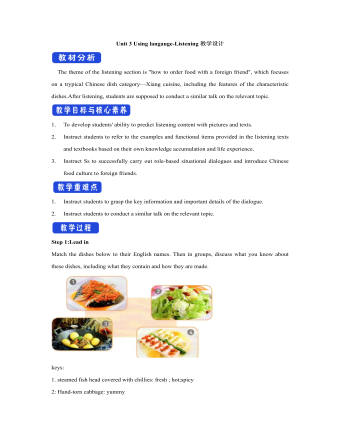
1. How is Hunan cuisine somewhat different from Sichuan cuisine?The heat in Sichuan cuisine comes from chilies and Sichuan peppercorns. Human cuisine is often hotter and the heat comes from just chilies.2.What are the reasons why Hunan people like spicy food?Because they are a bold people. But many Chinese people think that hot food helps them overcome the effects of rainy or wet weather.3.Why do so many people love steamed fish head covered with chilies?People love it because the meat is quite tender and there are very few small bones.4.Why does Tingting recommend bridge tofu instead of dry pot duck with golden buns?Because bridge tofu has a lighter taste.5 .Why is red braised pork the most famous dish?Because Chairman Mao was from Hunan, and this was his favorite food.Step 5: Instruct students to make a short presentation to the class about your choice. Use the example and useful phrases below to help them.? In groups of three, discuss what types of restaurant you would like to take a foreign visitor to, and why. Then take turns role-playing taking your foreign guest to the restaurant you have chosen. One of you should act as the foreign guest, one as the Chinese host, and one as the waiter or waitress. You may start like this:? EXAMPLE? A: I really love spicy food, so what dish would you recommend?? B: I suggest Mapo tofu.? A: Really ? what's that?
新人教版高中英语选修2Unit 4 Using langauge-Listening教学设计
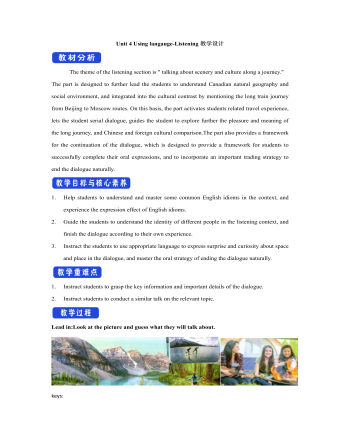
The theme of the listening section is " talking about scenery and culture along a journey."The part is designed to further lead the students to understand Canadian natural geography and social environment, and integrated into the cultural contrast by mentioning the long train journey from Beijing to Moscow routes. On this basis, the part activates students related travel experience, lets the student serial dialogue, guides the student to explore further the pleasure and meaning of the long journey, and Chinese and foreign cultural comparison.The part also provides a framework for the continuation of the dialogue, which is designed to provide a framework for students to successfully complete their oral expressions, and to incorporate an important trading strategy to end the dialogue naturally.1. Help students to understand and master some common English idioms in the context, and experience the expression effect of English idioms.2. Guide the students to understand the identity of different people in the listening context, and finish the dialogue according to their own experience.3. Instruct the students to use appropriate language to express surprise and curiosity about space and place in the dialogue, and master the oral strategy of ending the dialogue naturally.1. Instruct students to grasp the key information and important details of the dialogue.2. Instruct students to conduct a similar talk on the relevant topic.
新人教版高中英语选修2Unit 5 Reading and thinking教学设计
The theme of this activity is to learn the first aid knowledge of burns. Burns is common in life, but there are some misunderstandings in manual treatment. This activity provides students with correct first aid methods, so as not to take them for granted in an emergency. This section guides students to analyze the causes of scald and help students avoid such things. From the perspective of text structure and collaborative features, the text is expository. Expository, with explanation as the main way of expression, transmits knowledge and information to readers by analyzing concepts and elaborating examples. This text arranges the information in logical order, clearly presents three parts of the content through the subtitle, accurately describes the causes, types, characteristics and first aid measures of burns, and some paragraphs use topic sentences to summarize the main idea, and the level is very clear.1. Guide students to understand the causes, types, characteristics and first aid methods of burns, through reading2. Enhance students’ ability to deal withburnss and their awareness of burns prevention3. Enable students to improve the ability to judge the types of texts accurately and to master the characteristics and writing techniques of expository texts.Guide students to understand the causes, types, characteristics and first aid methods of burns, through readingStep1: Lead in by discussing the related topic:1. What first-aid techniques do you know of ?CPR; mouth to mouth artificial respiration; the Heimlich Manoeuvre
新人教版高中英语必修3Unit 1 Festivals and Celebrations教学设计二
1. Ss look at the picture and scan the passage to understand the main idea while teacher is giving the following questions to inspire Ss to think.*Where are those people?*What are they doing?*Why are they so excited?2. Ss complete the passage with the appropriate -ing form. Then discuss and check the answers with class.Answers: boring, interesting, taking, exciting, amazing3. The teacher raises questions for the students to discuss and encourages them to express their opinions.*Do you like La Tomatina? Why or why not?4. Each group representative reports the discussion result, the teacher gives feedback and the evaluation.Step 6 PracticeActivity 41. Ss complete the Ex 2 in Using structures.2. Check the answers after finishing the exercises.①The dragon boat races are the most exciting part of the Dragon Boat Festival.② The children were excited to go Easter egg hunting.③What an amazing performance! This is the best music festival I have ever been to.④We were amazed by her funny-looking hat.⑤His inspiring speech at the conference won the admiration/ favour of the audience.⑥This is a challenging game to test your memory and observation capabilities. 3. T asks Ss to finish Ex 3 and 4 in Using structures by themselves, then check the answers with class.Step 6 Homework1. Understand and master the functions and usage of the -ing form;2. Finish the other exercises in Using structures.1、通过本节内容学习,学生是否理解和掌握动词-ing形式作定语和表语的功能和意义;2、通过本节内容学习,学生能否在理解文段内容的基础上,根据上下文语境和表达逻辑,能正确运用动词-ing形式描述节日庆典。3、通过本节内容学习,学生是否归纳和积累用于表达情绪的相关词汇。
新人教版高中英语必修3Unit 2 Morals and Virtues教学设计二
Activity 41. Students complete the task of activity 4, then teachers and students check the answers. 2. The teacher organized the students to work together and asked them to use the tables and mind maps sorted out before to retold the important choices in Lin Qiaozhi's life and their resultsStep 5 Language points1. The teacher asks the students to read the text carefully, find out the core words and long and difficult sentences in the text and draw lines, understand the use of vocabulary, and analyze the structure of long and difficult sentences. 2. The teacher explains and summarizes the usage of core vocabulary and asks the students to take notes. 3. The teacher analyzes and explains the long and difficult sentences that the students don't understand, so that the students can understand them better. Step 6 Homework1. Read the text again, in-depth understanding of the text; 2. Master the use of core vocabulary and understand the long and difficult sentences. 3. Complete relevant exercises in the guide plan. 1、通过本节内容学习,学生是否理解和掌握阅读文本中的新词汇的意义与用法;2、通过本节内容学习,学生能否结合文本特点总结林巧稚的人生原则和人格品质特征;3、通过本节内容学习,学生能否针对人生抉择发表自己的看法;能否全面地、客观地、理性地看待问题,进而对道德和人性有更加深入的思考和理解。
新人教版高中英语必修3Unit 2 Morals and Virtues教学设计三
The joke set her crying.这个玩笑使她哭起来。Step 5 ReadingActivity 31. Students read the small text in activity 3. The teacher provides several small questions to check whether students understand the content of the text and the ideographic function of the -ing form in the text.*Where are those people?*Why did Dr Bethune come to China?*How did he help the Chinese people during the war?*What did Chairman Mao Zedong say about him?2. Ss try to rewrite some sentences using the -ing form. Then check the answers. When checking the answers, the teacher can ask different students to read the rewritten sentences and give comments.Answers:1. he became very interested in medicine, deciding to become a doctor.2. …after hearing that many people were dying in the war.3. Helping to organise hospitals, he taught doctors and nurses, and showed people how to give first aid./ He helped to organise hospitals, teaching doctors and nurses, and showing people how to give first aid.4. …praising Dr Bethune as a hero to be remembered in China.Step 6 PracticeActivity 4Students complete grammar activities 2 and 3 on page 69 of the workbook.Step 6 Homework1. Understand and master the functions and usage of the -ing form;2. Finish the other exercises in Using structures.1、通过本节内容学习,学生是否理解和掌握动词-ing形式作宾语补足语语和状语语的功能和意义;2、通过本节内容学习,学生能否正确使用动词-ing形式描述人物的行为、动作及其经历;3、通过本节内容学习,学生能否独立完成练习册和导学案中的相关练习。
新人教版高中英语必修3Unit 2 Morals and virtues教学设计一
(2) students are divided into groups according to the requirements of activity 3. Each student shares a story of personal experience or hearing-witnessing kindness, and then selects the most touching story in the group and shares it with the whole class. Before the students share the story, the teacher can instruct them to use the words and sentence patterns in the box to express. For example, the words in the box can be classified:Time order: first of all, then, after that, later, finally logical relationship :so, however, although, butTeachers can also appropriately add some transitional language to enrich students' expression:Afterwards, afterwards, at last, in the end, eventuallySpatial order: next to, far from, on the left, in front ofOtherwise, nevertheless, as a result, therefore, furthermore, in addition, as well asSummary: in a word, in short, on the whole, to sum up, in briefStep 8 Homework1. Understand the definition of "moral dilemma" and establish a correct moral view;2. Accumulate vocabulary about attitudes and emotions in listening texts and use them to express your own views;3. Complete relevant exercises in the guide plan.1、通过本节内容学习,学生能否理解理解“道德困境”的定义;2、通过本节内容学习,学生能否通过说话人所表达的内容、说话的语气、语调等来判断其态度和情绪;3、通过本节内容学习,学生能否针对具体的道德困境发表自己的看法和见解,能否掌握听力理训练中的听力策略。