-
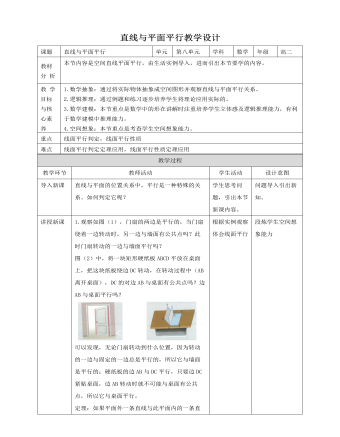
人教A版高中数学必修二直线与直线垂直教学设计
6.例二:如图在正方体ABCD-A’B’C’D’中,O’为底面A’B’C’D’的中心,求证:AO’⊥BD 证明:如图,连接B’D’,∵ABCD-A’B’C’D’是正方体∴BB’//DD’,BB’=DD’∴四边形BB’DD’是平行四边形∴B’D’//BD∴直线AO’与B’D’所成角即为直线AO’与BD所成角连接AB’,AD’易证AB’=AD’又O’为底面A’B’C’D’的中心∴O’为B’D’的中点∴AO’⊥B’D’,AO’⊥BD7.例三如图所示,四面体A-BCD中,E,F分别是AB,CD的中点.若BD,AC所成的角为60°,且BD=AC=2.求EF的长度.解:取BC中点O,连接OE,OF,如图。∵E,F分别是AB,CD的中点,∴OE//AC且OE=1/2AC,OF//AC且OF=1/2BD,∴OE与OF所成的锐角就是AC与BD所成的角∵BD,AC所成角为60°,∴∠EOF=60°或120°∵BD=AC=2,∴OE=OF=1当∠EOF=60°时,EF=OE=OF=1,当∠EOF=120°时,取EF的中点M,连接OM,则OM⊥EF,且∠EOM=60°∴EM= ,∴EF=2EM=
统编版二年级语文上第3课植物妈妈有办法教学设计教案
《植物妈妈有办法》是统编版二年级上册第一单元的一篇讲述植物传播种子的诗歌,作者运用比喻和拟人的修辞手法,以富有韵律感的语言,生动形象地介绍了蒲公英、苍耳、豌豆传播种子的方法。从植物妈妈的办法中,能感到大自然的奇妙,激发学生了解更多的植物知识的愿望,培养学生留心观察身边事物的习惯。教学过程中,可以将课文插图与诗句相配合,感受三种植物传播种子的方式。课文插图画面鲜活、直观、富有儿童情趣,既能激发学生的学习热情,又能辅助学生认识事物,理解重点词句。 1.认识“植、如”等12个生字,会写“法、如”等10个生字,读准多音字“为”和“得”。2.正确、流利、有感情地朗读课文,背诵课文。3.了解蒲公英、苍耳、豌豆三种植物传播种子的方法。4.激发学生观察植物、了解植物知识、探究植物奥秘的兴趣。 1.教学重点:正确、流利、有感情地朗读课文,背诵课文。了解蒲公英、苍耳、豌豆三种植物传播种子的方法。2.教学难点:激发学生观察植物、了解植物知识、探究植物奥秘的兴趣。 2课时
统编版三年级语文上第15课搭船的鸟教学设计教案
本单元的主题是留心观察。本单元也是本套教材中第一次出现的习作单元,这种单元自成体系。教材力图引导学生做生活的有心人,留心观察周围的人、事、景物,感受作者留心观察的细致,体会细致观察的好处。《搭船的鸟》是一篇内容浅显而富有童趣的文章,本文以一个孩子的口气写了他在大自然中认识翠鸟的过程,记录了“我”旅途中的观察所得。既观察了旅途中听到的雨声,也观察了翠鸟的外貌和捕鱼时的动作。题目一个“搭”字使鸟儿具有了灵性,体现了鸟和人在自然中的和谐。 1.认识“父、鹦、鹉、悄”等4个生字,读准多音字“啦”,会写“搭、亲”等13个生字,会写“母亲、外祖父”等11个词语。2.整体把握文章的意思,理解题意。3.通过描写翠鸟的语句,了解“我”对翠鸟的外貌、动作所作的观察,感受作者观察的细致,初步体会留心观察的好处。4.在学习作者细致观察的基础上,培养学生留心观察周围事物的习惯。 1.教学重点:整体把握文章的意思,理解题意。通过描写翠鸟的语句,了解“我”对翠鸟的外貌、动作所作的观察,感受作者观察的细致,初步体会留心观察的好处。2.教学难点:在学习作者细致观察的基础上,培养学生留心观察周围事物的习惯。 2课时
统编版三年级语文上第22课读不完的大书教学设计教案
《读不完的大书》这篇课文以儿童的视角描写了野外与自家房前屋后的自然环境,并且融入了丰富的想象,展现出一幅幅生动有趣的大自然画面。学习这篇课文,学生可以借助课文优美的句子走进大自然,体会作者对大自然的喜爱之情。本课重点是借助第二题的学习,了解课文的主要内容,并且通过朗读、想象画面、联系生活等方式,感受课文中生动的语言并积累摘抄,结合课后第三题写一写从这篇课文中读到了什么。本课教学可注意两点内容:一要帮助学生理清文章的思路。熟读课文之后,引导学生说说课文都写了哪些好玩的东西。二要引导学生抓住重点语句讨论、交流。除了课后思考题二所列的4个句子外,还可以鼓励学生根据自己的理解再提出几个句子。讨论、交流时,可在引导学生理解语句含义的基础上,启发学生联系实际。 1.会认“妙、奏”等11个生字,会写“读、虾”等13个生字。掌握“高远、沉思”等词语。2.正确、流利、有感情地朗读课文,联系生活体验,感悟课文内容,感受大自然的乐趣。3.能找出作者具体描写了哪些有趣的事物,积累喜欢的语句。 1.教学重点:能找出作者具体描写了哪些有趣的事物,感受课文生动的语言,感受大自然的乐趣。2.教学难点:能简单地写出自己感受到的大自然的乐趣,并和同学交流。 2课时
统编版三年级语文上第24课司马光教学设计教案
《司马光》统编版教材三年级语文上册第二单元的一篇精读课文,也是小学阶段安排的第一篇文言文,讲述了一个广为流传的小故事,它以精练的笔触,勾勒出一个机敏的七岁男孩的形象。“众皆弃去,光持石击瓮破之”实为文眼,突显了司马光的聪颖机智,遇事沉着冷静。全篇内容简单,言简意赅,但故事情节完整。本课重点是能借助注释,理解课文大意,并用自己的话讲故事。初步感受文言文的特点,简单说出文言文与现代文的区别。本文是中年级学生接触的简单的文言文,它犹如在孩子面前打开了一扇窗户,铺开了一条通道,让他们穿越时空隧道,走近历史先贤,在阅读与思考中汲取古代优秀文化的精髓,这将为培养学生学习古文的兴趣,对于掌握学习古文的方法,为打好学习古文的基础具有重要的地位和作用。为他们进一步了解祖国文化做好铺垫,并对其一生文化素养的积淀起到非常关键的作用。 1.会认“司、跌”等5个生字,会写“司、庭”等7个生字。2.把握好词句间的停顿,能正确、流利地朗读课文。背诵课文。3.借助注释理解课文内容,并能用自己的话讲故事。4.掌握文言文学习的一般方法,培养学生对文言文的喜爱以及对传统文化的热爱之情。 1.教学重点:能借助注释,理解课文大意,并用自己的话讲故事。背诵课文。2.教学难点:通过学法迁移,让学生能初步感悟小古文和其他课文在语言上的不同。 2课时
统编版三年级语文上第27课一个粗瓷大碗教学设计教案
《一个粗瓷大碗》是统编版教材三年级语文上册第八单元的一篇略读课文,本文围绕“粗瓷大碗”讲述了赵一曼把小通讯员盛给她的高粱米饭倒进病号灶的锅里,和战士们一起喝野菜粥;把小通讯员给她找的用来吃饭的碗又一次丢掉了的故事,表现了她在艰苦的环境中关爱战士胜过关心自己,与战士同甘共苦、坚持革命的高贵品质。课文是一篇略读课文,学习时可带着问题默读,边读边思考,这样可以更好地理解课文的内容。教学本文时,要由浅入深地设置问题,让学生带着问题默读课文;还要提示学生,默读时,没读懂的地方标记下来,可以联系上下文进一步思考,也可以读完之后和同学一起探讨。 1.认识“陈、曼”等7个生字,读准多音字“还”。2.能带着问题默读课文,了解围绕“粗瓷大碗”发生的故事。3.能从人物的语言、动作等描写中感受到人物的心情、品质。 1.教学重点:能带着问题默读课文,了解围绕“粗瓷大碗”发生的故事。2.教学难点:深入理解文章内容,感受赵一曼的高贵品质。 1课时
新人教版高中英语必修3Unit 1 Festivals and Celebrations-Reading and Thinking教学设计
The topic of this part is “Discover the reasons for festivals and celebrations.The Listening & Speaking & Talking part aims at talking about the experiences and feelings or emotions about the festivals and celebrations. This section aims at detecting the reason why the people celebrate the festivals, the time, the places, the types and the way of celebrations. It also explains why some traditions in the old celebrations are disappearing, like the firecrackers in the big cities and some new things are appearing like the prosperity of business or commerce. 1. Students can talk about what festivals they know and the reasons and the way of celebrating them.2. Students should learn the reading skills such as the headline and get the topic sentences, the structures of articles.3. Students can understand the past, the present situation of some festival around the world and why there are some changes about them. 4. Students can have the international awareness about the festivals.1. Students should learn the reading skills such as the headline and get the topic sentences, the structures of articles.2. Students can understand the past, the present situation of some festival around the world and why there are some changes about them.Step 1 Lead in---Small talkWhat festival do you like best ? Why ?I like the Spring Festivals because I can set off the fireworks, receive the lucky money and enjoy the Gala with my families.Step 2 Before reading---Pair workWhy do people celebrate different festivals ?The Spring Festivals is to celebrate the end of winter and the coming of spring and new life.The Mid-autumn Day is to celebrate the harvest and admire the moon.
新人教版高中英语必修3Unit 1 Festivals and Celebrations-Listening &Speaking&Talking教学设计
The theme of this section is “Talk about festival activities and festival experiences”.Festival and holiday is a relaxing and interesting topic for students. This part talks about the topic from the daily life of students’. In the part A ---Listening and Speaking, there are three conversations among different speakers from three countries(Japan, Rio and China), where the speakers are participating in or going to participate in the festivals and celebrations. So listening for the relationship among them is a fundamental task. Actually, with the globalization and more international communication, it is normal for Chinese or foreigners to witness different festivals and celebrations in or out of China. In the Conversation 1, a foreign reporter is interviewing a Japanese young girl who just had participated in the ceremony of the Coming-of-Age Day on the street and asking her feeling about the ceremony and the afterwards activities. Conversation 2, Chinese girl Li Mei is witnessing the Rio Carnival for the first time, and her friend Carla gives her some advice on the costumes which enables her to match with the carnival to have a good time. Conversation 3, a Chinese guide is showing a group of foreign visitors around the Lantern Festival and introducing the customs of the festival to them. The three conversations have a strong vitality and insert the festival and cultural elements from different countries. So perceiving the festivals and cultures from different countries is the second task. At the same time, the scripts also insert the targeted grammar --- v-ing as attributive and predicative, which students can perceive and experience in a real context and make a road for the further study. That is the third task. In the Part B--- Listening and Talking, the theme is “Talk about festival experience”, which is the common topic in our daily conversations. During the conversation, Song Lin, a Chinese student, asked Canadian friend Max about how to spend Christmas. In the conversation, Song Lin talked about experience and the feelings during the Chinese Spring Festival, during which there are not only some enjoyable things but some unpleasant things. After the listening, perhaps students find there are some similarities between Christmas and the Chinese Spring Festival as there are some differences in the origins and celebrations. For example, people always visit friends and relatives, decorate their houses, have a big dinner together, chat and give presents to each other.
新人教版高中英语必修3Unit 2 Morals and Virtues-Reading for Writing教学设计
1. 这个寓言是一个关于一位国王古寓言。 The fable is an old fable about a king.2.作者用这个故事让读者对于社区的问题负有个人责任的必要印象深刻。The author used the story to impress upon readers with the need to take personal responsibility for problems in the community.3. 这个故事十分成功的实现了它的目的。The story was quite successful in achieving its purpose.Step 7 WritingPlease write a review of the story according the outline above.The fable is an old fable about a king who thought his people are lazy, so he put a large stone in the middle of the road and hides and waited to see if anyone will try to move it.The author used this story to impress upon readers with the need to take personal responsibility for problems in the community. The story was quite successful in achieving its purpose, and I liked it because it had a clear moral.However, while the moral of the story is clear, the actions of the king seemed pointless to me, because none of the characters in the story learnt anything. For this reason, I think there are better stories that can be used to impress upon people with the need for personal responsibility.Step 8 Pair workExchange drafts with a partner. Use this checklist to help your partner revise his/her draft.1. Does the writer give a short description of the story ?2. Does the description include the most important details of the story ?3. Does the writer give his or her opinion about the character or their actions ?4. Is the review well-organised ? 5. Does the writer use the -ing form as the adverbial correctly in the writing ?6. Are there any grammar, spelling, or punctuation errors ?Step 9 HomeworkPut up your revised draft in the classroom or read it to your class.
新人教版高中英语必修3Unit 3 Diverse Cultures-Reading and Thinking教学设计
Discuss these questions in groups.Q1: Have you ever been to a place that has a diverse culture ? What do you think about the culture diversity ?One culturally diverse place that I have been to is Harbin, the capital city of Heilongjiang Province. I went there last year with my family to see the Ice and Snow Festival, and I was amazed at how the culture as different to most other Chinese cities. There is a big Russian influence there, with beautiful Russian architecture and lots of interesting restaurants. I learnt that Harbin is called “the Oriental Moscow” and that many Russians settled there to help build the railway over 100 years ago.Q2: What are the benefits and challenges of cultural diversity ?The benefits: People are able to experience a wide variety of cultures, making their lives more interesting, and it can deepen the feelings for our national culture, it is also helpful for us to learn about other outstanding culture, which helps improve the ability to respect others. The challenges: People may have trouble communicating or understanding each other, and it may lead to disappearance of some civilizations and even make some people think “The western moon is rounder than his own.”Step 7 Post reading---RetellComplete the passage according to the text.Today, I arrived back in San Francisco, and it feels good (1) _____(be) back in the city again. The city succeeded in (2)_________ (rebuild) itself after the earthquake that (3)________ (occur) in 1906, and I stayed in the Mission District, enjoying some delicious noodles mixed with cultures. In the afternoon, I headed to a local museum (4)____ showed the historical changes in California. During the gold rush, many Chinese arrived, and some opened up shops and restaurants in Chinatown to earn a (5)_____ (live). Many others worked on (6)______ (farm), joined the gold rush, or went to build the railway that connected California to the east. The museum showed us (7)____ America was built by immigrants from (8)________ (difference) countries and cultures. In the evening, I went to Chinatown, and ate in a Cantonese restaurant that served food on (9)________(beauty) china plates. Tomorrow evening, I’m going to (10)__ jazz bar in the Richmond District. 答案:1. to be 2. rebuilding 3. occurred 4. that 5.living6. farms 7.how 8. different 9. beautiful 10. a
新人教版高中英语必修3Unit 4 Space Exploration-Discovering Useful Structure教学设计
The theme of the section is “Describe space facts and efforts to explore space”. Infinitives are one of non-finite verbs, as the subjects, objects, predicative, attributes and adverbials. This unit is about space exploration, which is a significant scientific activity, so every scientific activity has strong planning. Therefore, using the infinitives to show its purpose, explanations or restrictions is the best choice.1. Learn the structure, functions and features of infinitives.2. Learn to summarize some rules about infinitives to show purpose and modify.3. Learn to use infinitives in oral and writing English. 1. Learn the structure, functions and features of infinitives.2. Learn to summarize some rules about infinitives to show purpose and modify.3. Learn to use use infinitives in oral and writing English.Step 1 Lead in---Pair workLook at the following sentences and focus on the italicized infinitives. In pairs, discuss their functions. 1. I trained for a long time to fly airplanes as a fighter pilot..(作目的状语)2. As we all know, an astronaut needs to be healthy and calm in order to work in space..(作目的状语)3. First of all, you must be intelligent enough to get a related college degree..(作目的状语)4. Some scientist were determined to help humans realise their dream to explore space..(作定语)5. On 12 April 1961, Yuri Gagarin became the first person in the world to go into space..(作定语)Summary:1. 不定式的结构:to+do原形。2. 分析上面的句子,我们知道在描述太空探索时,动词不定式不仅可以用来表目的,还可以用来作定语,表修饰。
新人教版高中英语必修3Unit 4 Space Exploration-Listening&Speaking&Talking教学设计二
The themes of this part are “Talk about how to become an astronaut” and “Talk about life in space”. As Neil Armstrong said “Mystery creates wonder and wonder is the basis of man’s desire to understand. Space is difficult for human to reach, therefore, humans are full of wonders about it. However, if wanting to achieve the dream of reaching the Moon, some of our human should work hard to be an astronaut at first. Part A(Talk about how to become an astronaut) is a radio interview in a radio studio, where the host asked the Chinese astronauts about his story how to become an astronaut. Yang Liwei told his dreamed to be an astronaut since childhood. Then he worked hard to get into college at 22. The next 10 years, he gradually became an experienced pilot. At the same time, to be an astronaut, he had to study hard English, science and astronomy and trained hard to keep in good physical and mental health and to practise using space equipment. Part B (Talk about life in space) is also an interview with the astronaut Brown, who is back on the earth. The host Max asked about his space life, such as his emotion about going back the earth, the eating, shower, brushing, hobbies and his work. Part A and Part B are interviews. So expressing curiosity about the guests’ past life is a communicative skill, which students should be guided to learn.1. Students can get detailed information about how Yang Liwei became an astronaut and Max’s space life.2. Students learn to proper listening strategy to get detailed information---listening for numbers and taking notes.3. Students can learn related sentences or phrases to express their curiosity like “ I wish to know...” “I’d love to know...”4. Students can learn more about the space and astronauts, even be interested in working hard to be an astronaut
新人教版高中英语必修3Unit 4 Space Exploration-Reading for Writing教学设计二
⑦在我看来, 探索太空是值得的。As far as I am concerned, it is worthwhile to explore the space.Step 10 Writing---draftRecently, students in our class have had heated a discussion on whether space is worth exploring. Students hold different ideas about it.30% of us think space exploration is not worthwhile. They think space is too far away from us and our daily life and is a waste of money. And the money spent on space exploration can be used to solve the earth’s problems such as starvation and pollution.On the other hand,70% think space is worth exploring because we have benefited a lot from it,such as using satellites for communication and weather forecast. What’s more,with further space research,we may solve the population problem by moving to other planets one day. Also,space research will enable us to find new sources to solve the problem of energy shortages on the earth.As far as I am concerned, it is worthwhile to explore the space. Not only can it promote the development of society but also enrich our life. Step 11 Pair workExchange drafts with a partner. Use this checklist to help your partner revise his/her draft.1.Does the writer explain why he/she changed/wanted to change?2.Does the writer tell how the changes have improved or will improve his/her life?3.Is the text well-organised?4.Does the writer use words and expressions to show similarities and differences?5.Are there any grammar or spelling errors?6.Does the writer use correct punctuation?
新人教版高中英语必修3Unit 4 Space Exploration-Reading For Writing教学设计一
另一方面,其余的人反对这个计划,因为它可能会导致一些不好的影响。7.I hold the belief that space exploration not only enable us to understand how the universe began but also help us survived well into the future.我坚信探索太空不仅能够使我们了解宇宙的起源而且能够帮助我们更好地走进未来。8.I think we should spend more time and money exploring space so as to provide new and better solutions to people's shortterm and longterm problems.为了给人类的短期和长期问题提供更新和更好的解决方法,我认为我们应该花更多的时间和金钱来探索太空。9.From my point of view,it is wrong of young people to depend on their telephones too much,which may do harm to both their physical and mental health.在我看来,年轻人过度依赖手机是不对的,因为它们可能会对他们的身心健康都有害。最近你班同学就“人类是否应该进行宇宙探索”这个问题进行了激烈的讨论。有人认为,探索宇宙不仅让人类更好地了解宇宙的发展,还可以用来指导农业生产,以及把一些探索太空的高新技术用于现实生活;也有一些人认为探索太空花掉了大量的人力物力;影响了人们的生活水平。请你根据以下情况写一篇报告并发表自己的观点。注意:1.写作内容应包括以上全部要点,可适当发挥,使上下文连贯;
新人教版高中英语必修3Unit 5 The Value of Money-Reading and Thinking教学设计一
Everybody wants to get wealth.In today’s material world,making money or becoming wealthy symbolizes a person’s success and capability. Many people just make every effort, pay any price to attain greater wealth. With money,they can buy nice, large apartments in nice neighborhood. With money they can own luxurious cars. Wealth seems to bring all happiness in life.But is wealth the only road to happiness? Not really. There are many things in the world, which are beyond the means of money, such as friendship, love, health and knowledge. People are so preoccupied with struggling for money that they have no time or would not take the time to form or maintain friendship. What happiness can they feel living as lonely miserable creatures without love or friends in the world even if they accumulate tremendous wealth?In my opinion, people can’t do anything without money, but money is not everything. What money will bring you depends on your personal belief and goal in life. If you are kind enough to help others, especially the poor, money is a good thing to you. With it, you can do much more for the benefit of people and your country, and it will add to your own happiness. If you want money just for your own needs, you’ll never be satisfied or happy. In a word,you should have money spent for more people. Only then can money be the source of your happiness.Step 8 Homework4 students in a group, one acts Roderick, one Oliver, one servant and the fourth one acts Henry Adams, then listen to the tape, pay more attention to the difference between American English and British English in pronunciation, stress, tone.
新人教版高中英语必修3Unit 5 The Value of Money-Reading for Writing教学设计二
2. 您能看到, 我头发太长了。You can see that my hair is much too long.3. 无论什么时候, 只要您想回来就回来。Please come back whenever you want.4. 您仅有很少的头发要理! You only have too little hair to cut !5. 为您服务是我的荣幸!It is my honour to serve you!Step 9 Writing(Henry is walking down the street when he sees a sign for a place that cuts hair. He decides to have it cut. )H=Henry B=BarberH: Good afternoon, I’d like to have my hair cut, if I may. (The barber looks at Henry’s hair and continues cutting another man’s hair. ) Er, I’d really like a haircut. As you can see it’s much too long. B: (in a rude manner) Yes, I can see that. Indeed, I can. H: Fine, well, I’ll have a seat then. (He sits in one of the barber’s chairs. The barber turns to look at Henry. )B: It’s quite expensive here, you know! Are you sure you can afford it?H: Yes. I think so. (After his hair is cut, the barber tells Henry how much he must pay. Henry shows the barber the bank note. )B: Why Mr. . . (looks shocked)H: Adams. Henry Adams. I’m sorry. I don’t have any change. B: Please don’t worry! (wearing a big smile) Nothing to worry about! Nothing at all! Please come back whenever you want, even if you only have too little hair to cut! It will be my honour to serve you!Step 10 Pair workExchange drafts with a partner. Use this checklist to help your partner revise his/her draft.1. Are all the elements of a play included and in good order ?2. Do the character use suitable language ?3. Are the stage directions clear and useful ?4. Is the plot clear and exciting enough ?
新人教版高中英语选修2Unit 1 Science and Scientists-Discovering useful structures教学设计
The grammatical structure of this unit is predicative clause. Like object clause and subject clause, predicative clause is one of Nominal Clauses. The leading words of predicative clauses are that, what, how, what, where, as if, because, etc.The design of teaching activities aims to guide students to perceive the structural features of predicative clauses and think about their ideographic functions. Beyond that, students should be guided to use this grammar in the context apporpriately and flexibly.1. Enable the Ss to master the usage of the predicative clauses in this unit.2. Enable the Ss to use the predicative patterns flexibly.3. Train the Ss to apply some skills by doing the relevant exercises.1.Guide students to perceive the structural features of predicative clauses and think about their ideographic functions.2.Strengthen students' ability of using predicative clauses in context, but also cultivate their ability of text analysis and logical reasoning competence.Step1: Underline all the examples in the reading passage, where noun clauses are used as the predicative. Then state their meaning and functions.1) One theory was that bad air caused the disease.2) Another theory was that cholera was caused by an infection from germs in food or water.3) The truth was that the water from the Broad Street had been infected by waste.Sum up the rules of grammar:1. 以上黑体部分在句中作表语。2. 句1、2、3中的that在从句中不作成分,只起连接作用。 Step2: Review the basic components of predicative clauses1.Definition
新人教版高中英语选修2Unit 1 Science and Scientists-Using langauge教学设计
This happens because the dish soap molecules have a strong negative charge, and the milk molecules have a strong positive charge. Like magnets, these molecules are attracted to each other, and so they appear to move around on the plate, taking the food coloring with them, making it look like the colors are quickly moving to escape from the soap.Listening text:? Judy: Oh, I'm so sorry that you were ill and couldn't come with us on our field trip. How are you feeling now? Better?? Bill: Much better, thanks. But how was it?? Judy: Wonderful! I especially liked an area of the museum called Light Games.it was really cool. They had a hall of mirrors where I could see myself reflected thousands of times!? Bill: A hall of mirrors can be a lot of fun. What else did they have?? Judy: Well, they had an experiment where we looked at a blue screen for a while, and then suddenly we could see tiny bright lights moving around on it. You'll never guess what those bright lights were!? Bill: Come on, tell me!? Judy: They were our own blood cells. For some reason, our eyes play tricks on us when we look at a blue screen, and we can see our own blood cells moving around like little lights! But there was another thing I liked better. I stood in front of a white light, and it cast different shadows of me in every color of the rainbow!? Bill: Oh, I wish I had been there. Tell me more!? Judy: Well, they had another area for sound. They had a giant piano keyboard that you could use your feet to play. But then, instead of playing the sounds of a piano, it played the voices of classical singers! Then they had a giant dish, and when you spoke into it, it reflected the sound back and made it louder. You could use it to speak in a whisper to someone 17 meters away.? Bill: It all sounds so cool. I wish I could have gone with you? Judy: I know, but we can go together this weekend. I'd love to go there again!? Bill: That sounds like a great idea!
新人教版高中英语选修2Unit 2 Bridging Cultures-Discovering useful structures教学设计
The grammar of this unit is designed to review noun clauses. Sentences that use nouns in a sentence are called noun clauses. Nominal clauses can act as subject, object, predicate, appositive and other components in compound sentences. According to the above-mentioned different grammatical functions, nominal clauses are divided into subject clause, object clause, predicate clause and appositive clause. In this unit, we will review the three kinds of nominal clauses. Appositive clauses are not required to be mastered in the optional compulsory stage, so they are not involved.1. Guide the students to judge the compound sentences and determine the composition of the clauses in the sentence.2. Instruct students to try to learn grammar by generalizing grammar rules, controlling written practice, and semi-open oral output.3. Inspire the students to systematize the function and usage of noun clause1.Instruct students to try to learn grammar by generalizing grammar rules, controlling written practice, and semi-open oral output.2.Inspire the students to systematize the function and usage of noun clauseStep1: The teacher ask studetns to find out more nominal clauses from the reading passage and udnerline the nominal clauses.
统编版二年级语文上第1课小蝌蚪找妈妈教学设计教案
《小蝌蚪找妈妈》是统编版二年级上册第一单元的一篇富有童趣的课文。课文以浅显的文字生动地描写了小蝌蚪找妈妈的故事,同时向学生叙述了小蝌蚪是怎样变成青蛙的。从教材编排看,课文中人物角色较多,语言生动趣味性强,是进行朗读训练的典型教材:从教材结构看,课文二三四自然段段落相仿,也是进行学法指导的最佳范例。课文中的动词用得巧,增强了表达效果。课文3幅插图,分别画的是第二至五自然段的内容,不仅生动地展现出小蝌蚪找妈妈的过程,而且有序地呈现出蝌蚪的变化过程:长出后腿--长出前腿--尾巴不见了。插图画面色彩鲜艳,形象活泼生动,极具吸引力和感染力。 1.认识“塘、脑”等14个生字,读准多音字“教”,会写“两、哪”10个生字。2.正确、流利、有感情地分角色朗读课文。3.结合课文内容,借助课文图片,按顺序说清楚小蝌蚪成长的变化过程,感受小蝌蚪遇事主动探索的精神,增强阅读科学童话的兴趣。4.知道青蛙是捕捉害虫的能手,是庄稼的好朋友,树立保护青蛙的意识。 1.教学重点:能分角色朗读课文,借助图片、表示时间变化的句子、表示动作的词语,了解课文内容。2.教学难点:能按顺序说清楚小蝌蚪成长的变化过程,感受小蝌蚪遇事主动探索的精神,增强阅读科学童话的兴趣。 2课时