-
人教版高中地理必修1自然界的水循环教案
情感、态度与价值观帮助学生确立事物普遍联系的观点。帮助学生树立正确认识利用自然规律,实现人类与环境的和谐发展的观念 。教学 重点水循环的形成过程和地理意义。人类活动对水循环的影响教学 难点水循环的地理意义。教具、资料多媒体课件课 时安排1课时教学过程:【新课导入】出示计算机图片:地球卫星图片、太阳系九大行星图片。请同学们看,这是人类的家园——地球,与太阳系其它大行星相比,它的最大特点是什么呢?(有丰富的水)是的,我们所居住的这颗行星,表面四分之三为水所覆盖,是一颗“水的行星”。我们这一章要学习的就是地球上的水 。【引导】水有哪些物理化学性质?(固液气三态变化、比热、胀缩、溶剂等)那么,地球上的水都存在哪里呢?(海洋、河 流、湖泊、地下、冰川、沼泽、大气、生物体等)【总结】水在地理环境中以气态、固态和液态三种形式相互转化,形成各种水体,共同构成了一个连续但不规则的圈层。这实际上就是水圈。
人教版高中地理必修3区域农业发展教案
1.归纳珠江三角洲发展基塘生产有利的地理条件。珠江三角洲地势低平,河网密布,降水充沛。北回归线从珠江三角洲的北部穿过。珠江三角洲地区发展基塘农业生产有利条件可以结合材料,归纳为三个方面:地形、气候、市场(当地和海外)。2.基塘生产将哪些产业联系起来?哪些副产品(或废弃物)被充分利用起来?这种联系对农村经济发展有什么作用?基塘生产环节将种植业(桑、蔗等)、养殖业(养蚕、养鱼)、工业(丝厂、糖厂)等几种产业紧密的联系在一起。在此环节中,塘泥、蚕沙(蚕屎)、蚕蛹、缫丝、滤泥、蔗叶等副产品被充分的回收利用。养蚕业、蔗糖加工业同塘鱼养殖业紧密结合,作为一种综合的经营,几者之间相互依存、相互促进、扬长补短,有机地循环联系起来。基本上解决了桑、蔗的肥料和蚕、鱼的饲料问题。不仅养蚕、蔗糖加工和养鱼生产稳定,而且成本也大大降低。
人教版高中地理必修3森林的开发和保护教案
角色扮演:学生扮演政府官员、热带丛林土著居民、 世界环保组织官员、开发商等角色,从角色的立场讨论亚马孙河流域热带雨林的开发活动规则: 每个小组认领一种角色,用5分钟的时间讨论和整理思路,然后推荐一位代表做中心发言,小组的其他同学可以随时补充。发言时请说 明所扮演的角色,尽可能多的发表建设性意见。如果需要,可以上台展示材料【学生互动】 风云辩论:雨林破坏谁之错?正方观点:雨林破坏,亚马孙地区 的国家和 居民应负主要责任反方观点: 雨林破坏,发达国家应负主要责任 【师生小结】 雨林的开发,既有发展中国家经济的需要,也有发达国家国际市场的牵动。保护雨林,是全人类的共同责任,尤其发达国家应该承担更多的责任。保护亚马逊雨林符合长远利益和全球利益。但这与雨林所在地国家的发展产生了矛盾,如何解决之一矛盾是雨林开发与保护的关键。【过渡承转】 绿色和平组织警告说,如果不采取有效措施制止对森林的破坏,80年内热带雨林可能完全从地球上消失。开发还是保护?这是雨林的两种前途,也
人教版高中地理必修3能源资源的开发教案
知识与技 能 1、了解能源资源开发与区域可持续发展的关系。2、理解能源资源开发的条件。3、了解山西省能源基地建设的成就。4、理解山西省构筑三条产 业链的资源条件及意义。5、理解山西省 产业结构调整与能源的综合利用与环境保护治理的关系。6、了解科技创新是山西省经济发展的先决条件。7、理解山西省工矿区生态环境建设模式,学会知识迁移,为我国其它工矿区生态环境建设出谋划策。过程与方法 1、通过阅读图表、资料,分析能源资源开发的条件及能源基地建设的成就。2、通过师生交流讨论,培养学生良好的地理思维能力。情感态度与价值观1、能源工业是发展国民经济的基 础,我国把能源工业放在战略重点的首位,急需科技人才为能源工业出谋划策,使学生深知肩负的重任,同时学会一分为二的看待能源基地的建 设成就,力求能源基地的建设能有新的突破。
人教版高中地理必修1水资源的合理利教案
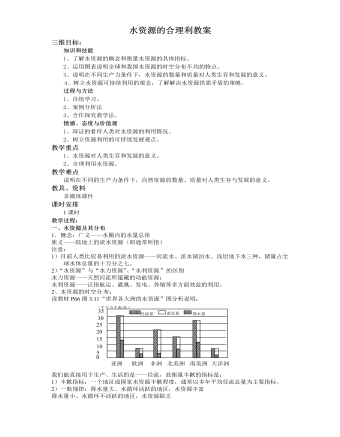
知识和技能 1、了解水资源的概念和衡量水资源的具体指标。2、运用图表说明全球和我国水资源的时空分布不 均的特点。3、说明在不同生产力条件下,水资源的数量和质量对人类生存和发展的意义。4、树立水资源可持续利用的观念,了解解决水资源供需矛盾的策略。过程与方法 1、自组学习。2、案例分析法3、合作探究教学法。情感、态度与价值观1、辩证的看待人类对水资源的利用情况。2、树立资源利用的可持续发展观点。教学重点1、水资源对人类生存和发展的意义。2、合理利用水资源。教学难点说明在不同的生产力条件下,自然资源的数量、质量对人类生存与发展的意义。教具、资料多媒体课件课时安排1课时教学过程:一、水资源及其分布 1.概念:广义——水圈内的水量总体狭义——陆地上的淡水资源(即通常所指)
人教版高中政治必修1影响价格的因素教案
(2)、价值规律 教师总结:通过这一节的学习我们明白了一个道理:商品的价值量由生产商品的社会必要劳动时间决定,商品交换以价值量为基础实行等价交换。这一经济原则就叫做价值规律。受供求关系影响,商品价格围绕价值上下波动,是价值规律要求发生作用的具体表现。(3)、价格围绕价值上下波动是价值规律的表现形式(三)课堂总结、点评 本节内容讲述的主要知识如下:1、气候、时间、地域、生产、习俗等因素会改变供求关系状况,供求关系变化影响价格变动,形成卖方市场和买方市场。2、商品价格由价值决定,价值量与社会必要劳动时间成正比,与劳动生产率成反比。3、商品价格由价值决定,并受供求关系影响,在二者共同作用下形成市场价格。4、社会必要劳动时间决定商品价值量,商品交换以价值量为基础实行等价交换,是价值规律的基本内容,价格围绕价值上下波动是价值规律的表现形式。
人教版高中政治必修1社会主义市场经济教案
教师总结:社会主义市场经济是使市场在国家宏观调控下起基础性配置作用的经济,充分发挥市场基础性调节作用,就必须主要靠经济手段、法律手段,而不是行政手段。(三)课堂总结、点评这节课我们重点学习了社会主义市场经济的有关知识,知道了社会主义市场经济的基本特征,以及国家宏观调控的含义、目标和主要手段。这对于我们在经济生活中正确地认识我国市场经济的性质和作用,理解国家宏观调控的措施及意义,增强社会主义优越感和民族自强意识,自觉投身现代化建设等将有重大指导作用。★课余作业 讨论:联系经济生活中国家宏观调控的实例,讨论应如何认识和理解国家各种宏观调控手段的综合运用,对国民经济发展的意义。★教学体会 本节内容与学生生活实际联系密切,在学习中应该多引入日常生产、生活中常见的一些宏观调控实例,让学生去深刻理解、把握宏观调控手段及其作用。
人教版高中政治必修1信用工具和外汇教案
(3)人民币外汇牌价:我国通常采用100单位外币作为标准,折算为一定数量的人民币。如果用100单位外币可以兑换更多的人民币,说明外汇汇率升高;反之,则说明外汇汇率跌落。教师活动:大家知道汇率是经常变动的,为什么汇率经常变动?我国在美国、日本等国再三施加压力的情况下,为什么保持汇率稳定,人民币不升值?学生活动:学生就老师提出的问题去阅读教材;然后展开讨论,并回答(4)保持人民币币值稳定的意义教师点评:影响汇率变动的因素主要有:外汇的供求关系、通货膨胀(或紧缩)率的差异、经济增长率、利率水平、国家货币当局的干预与管制、市场预期、外汇投机活动等。外汇在国家经济发展和国际贸易中具有重要的作用:通过汇率的升降调节进出口贸易;可以影响国际资本的流动方向和数量;可以影响国内物价水平;影响外汇储备的实际价值等。
人教版高中政治必修1依法纳税教案
(3)骗税 骗税是指纳税人用欺骗手段获得国家税收优惠的行为。教师活动:请同学们看教材87页“相关链接”,了解骗税行为的特点和法律处罚规定。学生活动:认真阅读,积极思考。(4)抗税 抗税是指纳税人以暴力、威胁等手段,拒不缴纳税款的行为。教师活动:请同学们看教材87页“相关链接”,了解骗税行为的特点和法律处罚规定。学生活动:认真阅读,积极思考。3、公民要增强税收监督意识教师活动:请同学们看教材88页“相关链接”,思考公民如何维护国家税收工作?学生活动:认真阅读,积极思考。教师总结:公民是国家税收的最终负税人,应自觉增强税收监督意识,以主人翁的态度积极监督国家公职人员及公共权力的行为,关注税收的征收和使用情况,对他们的违法行为进行批评、检举,维护国家利益和自身利益。
人教版高中政治必修1第三课多彩的消费教案
二、做理智的消费者1、量入为出,适度消费2、避免盲从,理性消费3、保护环境,绿色消费4、勤俭节约,艰苦奋斗十、教学反思本课的设计采用了课前下发预习学案,学生预习本节内容,找出自己迷惑的地方。课堂上师生主要解决重点、难点、疑点、考点、探究点以及学生学习过程中易忘、易混点等,最后进行当堂检测,课后进行延伸拓展,以达到提高课堂效率的目的。这节课我们主要学习了影响人们消费的几种消费心理和几种科学的消费观。本节课与学生生活十分贴近所以这节课充分的调动了学生学习的兴趣和积极性,并且让学生针对案例进行充分的分组讨论分析,通过学生的展示分析和补充可以知道学生们不但深层次分析了教学原理也透彻理解了教学重难点大大提高了课堂效率.。通过案例的分析进一步领会了教材原理突破了本节课的难点——树立正确的消费观。整堂课学生求知旺盛,复杂的知识变得简单化,从阅读教材到独立思考分析再到合作讨论最后的展示质疑答疑,加深了印象,提高了能力。
人教版高中地理必修1全球气候变化教案
科学家预测,就地区而言,位于低纬度的大部分国家,农作物的产量将减少;而位于高纬度的国家,农作物产量有可能增加。由于不少发展中国家位于低纬度地区,因此,气候变化的这种区域差异性,可能会使发展中国家所面临的问题更为严峻。板书:3全球变暖将加剧水资源的不稳定性与供需矛盾。介绍:全球变暖会影响整个水循环过程,可能使蒸发加大,改变区域降水量和降水分布格局,增加降水极端异常事件的发生,导致洪涝、干旱灾害的频次和强度增加,以及地表径流发生变化。随着径流减少,蒸发增强,全球变暖将加剧水资源的不稳定性与供需矛盾。转折:既然全球变暖会引起很多不利影响,那么作为人类应如何面对这一挑战呢?这就是我们要讨论的第三个问题。板书:三、气候变化的适应对策讨论:请大家阅读结合教材P53气候变化的适应对策部分讨论人类应如何面对全球变暖这一问题 呢?
人教版高中地理必修1山岳的形成教案
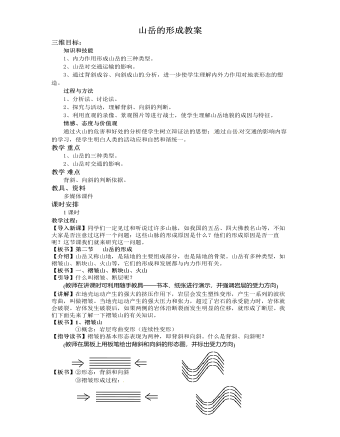
【转折过渡】除了以上所说的褶皱山和断层山之 外,是否还有其他类型的山脉呢?试举一例说明。【学生思考后回答】有,如富士山属于火山。【教师总结】同学们回答的很好,还有火山,那么火山是如何形成的呢?这就是我们要研究的下一个问题。【板书】3、火山【指导读书】请同学们阅读教材P81思考:①玄武岩高原和火山有什么联系与区别? ②火山由哪几部分构成的?③火山的规模是否相同?【学生回答】①联系:玄武岩高原和火山都是由于处于地下深处的岩浆,在巨大的压力作用下,有时候会沿着地壳的薄弱地带喷出地表而形成的。区别:玄武岩高原是岩浆沿着地壳的线状裂隙流出,往往比较宽广。如哥伦比亚高原。火山是岩浆沿着地壳的中央喷出口或管道喷出。如我国长白山的主峰。②火山由火山口和火山锥两部分组成。③火山的规模大小不一,大火山的相对高度可达4 000~5 000米,火山口直径为数百米;小火山的相对高度不及100米。
人教版高中地理必修3产业转移教案
1.国家石油价格上涨,导致依赖于国际石油而建立起来的日本重化工业的制造成本提高,产品价格相应提高,削弱了日本重化工产品在国际市场上的竞争力。2.日元 的大幅度升值,意味着日本产品在国际市场上的价格大幅度提高。例如,同样的日本产品,如果原来在国际市场上卖1美元,日元升值1倍后其在国际市场上的售价就达2美元。所以,以国际市场为依托的日本传统产业只好纷纷向海外转移。3.自身市场满足不了发展需求,国际市场上亚洲发展中国家和地区的同类产品具有明显的价格优势。所以,日本企业在其国内发展的空间很小。4.劳动力价格高反映为产品的价格高,而劳动力数量又满足 不了企业进一步扩展对劳动力的需求。所以,日本从事传统产业的国内企业生产受劳动力价格和数量的双重制约。5.促进日本企业生产的区位选择向国土的南、北部和海外扩展。6.“技术立国”的政策明显对传统产业在国内生产不利,即企业生产要么向知识技术密集型转换(这需要大量的投资),要么转向海外。
人教版高中地理必修3区域工业化与城市化教案
知识和技能 1、 了解区域工业化和城市化之间的关系,以及它们对区域社会经济发展所起的作用 。2、分析导致珠江三角洲工业化和城市化快速推进的诸多思想束缚,并通过比较,认识到对外开放政策是其中的关键因素。3、 比较珠江三角 洲的 区工业化进程的两个主要阶段,归纳出不同时期的主要发展特点,并能够结合具体案例分析工业化进程对城市化的巨大推动。 4、分析珠江三角洲地区工业化和城市化进程中的问题,并尝试评价目前的一些调整措施和发展方向。5、通过分析我国珠江三角 洲地区工 业化、城市化的发展阶段、问题与对策,了解区域工业化和城市化的推进动力和发展规律。过程与方法 利用扮演不同的社会角色来谈对珠江三角洲地区未来经济和城镇发展的设想和建议,反馈学生知识、能力、价值观发展情况和效果, 培养学生对所学所得的运用能力,并为学生的创新精神的发 展营造有利氛围。情感、态度与价值观1、通过鼓励学生主动获 取资料的做法,关注学生实践能力、综合思维能力及终身学习能力的训练。
新人教版高中英语必修3Unit 1 Festivals and celebrations-Discovering Useful Structure教学设计
4.That was an experience that frightened everyone. →That was _____________________. 答案:1. taking 2. being discussed 3. in the reading room 4. a frightening experienceStep 6 The meaning and function of V-ing as the predicative动词-ing形式作表语,它通常位于系动词后面,用以说明主语“是什么”或“怎么样”一种表示主语的特质、特征和状态, 其作用相当于形容词; 另一种具体说明主语的内容, 即主语等同于表语, 两者可互换。The music they are playing sounds so exciting. 他们演奏的音乐听起来令人激动。The result is disappointing. 结果令人失望。Our job is playing all kinds of music. 我们的工作就是演奏各种音乐。Seeing is believing. 眼见为实。Step 7 Practice1. It is ________(amaze) that the boy is able to solve the problem so quickly.2. Buying a car is simply _______(waste) money. 3. Please stop making the noise—it’s getting ________(annoy). 4. complete the passage with the appropriate -ing form.La Tomatina is a festival that takes place in the Spanish town Bunol every August. I think many food festivals are __________ because people are just eating. however, this festival is _________ because people don't actually eat the tomatoes. Instead, they throw them at each other! the number of people ________ part in this tomato fight, can reach up to 20,000, and it is a very __________ fight that lasts for a whole hour. The _______ thing is how clean Bunol is after the tomatoes are washed away after the fight. this is because the juice form tomatoes is really good for making surfaces clean!答案:1. amazing 2. wasting 3. annoying4. boring interesting taking exciting amazing
新人教版高中英语必修3Unit 5 The Value of Money-Listening &Speaking&Talking教学设计
4. A:We’d like to have someone to say a word at the beginning to welcome the group.B:↙Who?A:We thought that you or Dr.Johnson might do it.B用降调说Who,其意思是问,对方想让谁在开场时致欢迎词。Step 6 Pronunciation---Practice1. Listen to the short conversation and mark the intonation with ↗, ↙ or ↙, ↗. Then discuss with a partner what they intend to convey by using different intonation.Owner: You know what ?↗ It’s a million-pound bank note↙.Waiter 1: Really ?↗(question)Waiter 2: Really !↙(unbelievable and surprised)Waiter 3: Really ?!↙↗(first question then surprised)2. Listen to the conversations. Underline the parts that are stressed and mark the intonation. Then talk about the implied meanings of the responses with different intonations. Listen again and repeat.1) Henry: It’s a nice suit.Owner: Oh, it’s perfect!↙(The intonation means it is very suitable for Henry.)2) Henry: Well, that’s very kind of you.Owner: Kind, sir ?↗(what you said is not right) No, it’s kind of you. You must come whenever you want and have whatever you like. Just having you sit here is a great honour !!↙(welcome you to come again)3)Henry:Well, to be honest, I have none. Oliver:(happily) What luck!(excited) Brother↗, what luck!↙(It means “Didn’t you hear it?”)Henry: Well, it may seem lucky to you but not to me!↗(angry) If this is your idea of some kind of joke, I don’t think it’s very funny. Now if you’ll excuse me, I ought to be on my way.↙(If so, I would leave.)Roderick: Please don’t go↙...(hope Henry can wait for a moment)Part B Viewing and Talking---Describe people’s changing attitudes in a film clipStep 1 Before-listening---Tell the filmYou are going to watch part of the film The Million Pound Bank Note. Look at these photos and guess what happens in the film.
新人教版高中英语必修3Unit 5 The Value of Money-Listening &Speaking教学设计
Step 4: Listen again and decide if the following statements are true (T) or false (F).1 It was the first time Chen Liyan's story was reported. T口 F口2 Chen found 10,000 yuan in a small plastic bag in Taiyuan railway station口 F口3 Wang Zheng apologized to Chen because he couldn't offer her more money. T口 F口4 Chen took out a large loan to cure her daughter, T口 F口5 Wang set up a fundraising website for Chen's daughter after Chen told him about her situation. T口 F口Step 5:After listening, discuss the questions.1 What kind of person do you think Chen Liyan is?Chen Liyan is generous and honest because she returned a large sum of money to the owner.2 Did Chen return the money because she didn't need it?No. She returned the money because it was the right thing to do. Evidence for this is that she refused to accept the reward money because she felt that it had not been earned. 3 Is it common for people to do what Chen did?It depends on the culture. In some countries it is quite common to return money that has been found. In other countries, people believe "Finders are keepers!" 4 How did Wang Zheng feel about the return of his money?He must have been very happy and relieved to have gotten his money back. We know this because he thanked Chen repeatedly and even offered her a reward.5 Why did Ma Dongbao tell Wang about Chen's family?He must have had great sympathy for Chen and her daughter and wanted to help them.'We know this because he arranged help for them. 6 How did the news reporter feel about Chen's actions?The news reporter felt that it showed that money wasn't the most important thing in life. We know this because the reporter told us that this is what Chen believes. and then said, “that's a great attitude to take."
新人教版高中英语必修3Unit 1 Festivals and Celebrations-Listening &Speaking&Talking教学设计
The theme of this section is “Talk about festival activities and festival experiences”.Festival and holiday is a relaxing and interesting topic for students. This part talks about the topic from the daily life of students’. In the part A ---Listening and Speaking, there are three conversations among different speakers from three countries(Japan, Rio and China), where the speakers are participating in or going to participate in the festivals and celebrations. So listening for the relationship among them is a fundamental task. Actually, with the globalization and more international communication, it is normal for Chinese or foreigners to witness different festivals and celebrations in or out of China. In the Conversation 1, a foreign reporter is interviewing a Japanese young girl who just had participated in the ceremony of the Coming-of-Age Day on the street and asking her feeling about the ceremony and the afterwards activities. Conversation 2, Chinese girl Li Mei is witnessing the Rio Carnival for the first time, and her friend Carla gives her some advice on the costumes which enables her to match with the carnival to have a good time. Conversation 3, a Chinese guide is showing a group of foreign visitors around the Lantern Festival and introducing the customs of the festival to them. The three conversations have a strong vitality and insert the festival and cultural elements from different countries. So perceiving the festivals and cultures from different countries is the second task. At the same time, the scripts also insert the targeted grammar --- v-ing as attributive and predicative, which students can perceive and experience in a real context and make a road for the further study. That is the third task. In the Part B--- Listening and Talking, the theme is “Talk about festival experience”, which is the common topic in our daily conversations. During the conversation, Song Lin, a Chinese student, asked Canadian friend Max about how to spend Christmas. In the conversation, Song Lin talked about experience and the feelings during the Chinese Spring Festival, during which there are not only some enjoyable things but some unpleasant things. After the listening, perhaps students find there are some similarities between Christmas and the Chinese Spring Festival as there are some differences in the origins and celebrations. For example, people always visit friends and relatives, decorate their houses, have a big dinner together, chat and give presents to each other.
新人教版高中英语必修3Unit 1 Festivals and Celebrations-Reading for writing教学设计二
Step 3 Analyzing article structureActivity 31. Teachers raise questions to guide students to analyze the chapter structure of this diary and think about how to describe the festival experience. (1)What should be included in the opening/body/closing paragraph(s)?(2)How did the writer arrange his/her ideas?(3)What kind of interesting details did the writer describe?(4)How did the writer describe his/her feelings/emotions during the event?2. Students read and compare the three sentence patterns in activity 2. Try to rewrite the first paragraph of the diary with these three sentence patterns. After that, students exchange corrections with their partners. Such as:●This was my first time spending three days experiencing the Naadam Festival in China’s Inner Mongolia Autonomous Region and it was an enjoyable and exciting experience. ●I'll never forget my experience at the Naadam Festival because it was my first time to watch the exciting Mongolian games of horse racing, wrestling, and archery so closely. ●I'll always remember my first experience at the Naadam Festival in China’s Inner Mongolia Autonomous Region because it was so amazing to spend three days witnessing a grand Mongolian ceremony. Step 4 Accumulation of statementsActivity 41. Ask the students to read the diary again. Look for sentences that express feelings and emotions, especially those with the -ing form and the past participle. Such as:● …horse racing, wrestling, and archery, which are all so exciting to watch. ● some amazing performances● I was surprised to see…● I was a little worried about. . . ● feeling really tiredOther emotional statements:●I absolutely enjoyed the archery, too, but the horse races were my favourite part. ●I'm finally back home now, feeling really tired, but celebrating Naadam with my friend was totally worth it. ●He invited me back for the winter to stay in a traditional Mongolian tent and cat hot pot. I can’t wait!2. In addition to the use of the -ing form and the past participle, the teacher should guide the students in the appreciation of these statements, ask them to memorize them, and encourage them to use them reasonably in writing practice.
新人教版高中英语必修3Unit 3 Diverse Cultures-Discovering Useful Structure教学设计
Step 4 PracticeRead the conversation. Find out which words have been left out.Justin: Linlin, I’m going to Guizhou Province next month. I’m super excited! Any recommendations for places to visit?Linlin: Wow, cool! Guizhou is a province with a lot of cultural diversity. Places to visit...well, definitely the Huangguoshu Waterfall first.Justin: What’s special about the waterfall?Linlin: Well, have you ever heard of the Chinese novel Journey to the West ?Justin: Yes, I have. Why ?Linlin: In the back of the waterfall, you will find a cave, which is the home of the Monkey King.Justin: Really? Cool! I’ll definitely check it out.Linlin:And I strongly recommend the ethnic minority villages. You’ll find Chinese culture is much more diverse than you thought.Justin:Sounds great, thanks.Answers:Justin: Linlin, I’m going to Guizhou Province next month. I’m super excited! Do you have any recommendations for places to visit?Linlin: Wow, that’s cool! Guizhou is a province with a lot of cultural diversity. What are some places to visit in Guizhou ? Well, definitely the Huangguoshu Waterfall is the first place to visit in Guizhou Province.Justin: What’s special about the waterfall?Linlin: Well, have you ever heard of the Chinese novel Journey to the West ?Justin: Yes, I have heard of the Chinese novel Journey to the West . Why do you ask if I have heard of the Chinese novel Journey to the West?Linlin: In the back of the waterfall, you will find a cave, which is the home of the Monkey King from Journey to the West.Justin: That’s really true? It’s Cool! I’ll definitely check it out.Linlin:And I strongly recommend the ethnic minority villages on your trip to Guizhou Province. You’ll find Chinese culture is much more diverse than you thought it was.Justin:This all sounds great, thanks.