-
人教版高中语文必修2《演讲》教案2篇
一个世纪前,一位了不起的美国人签署了奴隶解放宣言,而我们今天就站在他的塑像下面。对于千千万万身受不公正待遇之苦的黑奴来说,这份划时代的文件,是一座光芒万丈的希望灯塔,是结束他们被束缚之漫漫长夜的快乐黎明。我有一个梦,有朝一日在乔治亚州的丘陵地带,奴隶的后代与奴隶主的后代,将能够兄弟般地相处。我有一个梦,有朝一日甚至密西西比州,这个充满不平与压迫的州,将转化成一片自由与公正的绿洲。我有一个梦,我的四个孩子,有朝一日将可以生活在这样一个国度里:在此人们不是根据他们的肤色,而是根据他们的品行来衡量他们。我今天有一个梦!我有一个梦,有朝一日在阿拉巴马州,尽管目前有许多恶毒的种族主义者,尽管州长叫嚷着要与联邦政府对抗,有朝一日在阿拉巴马州,黑人孩子与白人孩子将会像兄弟姊妹那样亲密无间。
人教版高中语文必修2《孔雀东南飞并序》教案2篇
让学生仔细聆听美妙的音乐,合作讨论,加深理解。(1)本诗文中的“兰芝被遣”和“兰芝抗婚”的情节,可与乐曲展开部第一阶段“逼嫁抗婚”对比阅读。文中的刘兰芝是在封建礼教的压迫下被遣归及被迫“改嫁”,刘兰芝与祝英台一样都进行了抗争。乐曲中的乐器奏出了具有威胁力的封建势力的主题,代表着封建势力的凶暴残酷,同时叙述了祝英台的悲痛和不安心情,表现了控诉、抗争的感情。(2)本诗文中的“夫妻誓别”的情节,可与乐曲呈示部中的结束部“长亭惜别”对比阅读。文中刘兰芝与焦仲卿的誓别。二人分手之际,依依不舍,“举手长劳劳,二情同依依”。乐曲中梁祝分别时依依不舍又充满悲伤,音调抒情徐缓。让学生在徐缓的音乐中去感受刘兰芝与焦仲卿生离死别的痛苦。
人教版高中语文必修2《我有一个梦想》教案2篇
全班齐读第五段内容。请一位同学分析,接着让这位同学按他分析的读一遍。3、4两自然段的平缓之后,第5段作者的情感再次抬升。为了满足这种情感的张扬,作一口气连用了四个排比句式“现在是……时候”,一方面这是情感发泄的需要,另一方面这种排山倒海的语势也加强了内容的表达,极强地突出了现实为自由、平等而战的重要性。四、学会演讲我们刚才细读了课文,但读和讲是有区别的。所谓演讲,是一门语言艺术,它的主要形式是“讲”,即运用有声语言并追求言辞的表现力和声音的感染力;同时还要辅之以“演”,即运用面部表情、手势动作、身体姿态乃至一切可以理解的态势语言,使讲话“艺术化”起来,从而产生一种非凡的艺术魅力。那么,接下来就假设一下假如你是马丁·路德·金,你会怎样去讲这篇演讲辞。
人教版高中语文必修2《巴黎圣母院》教案2篇
【教学设想】一、选题设想《巴黎圣母院》是雨果的代表作,无论从思想内容还是艺术风格都有明显的浪漫主义特征:奇异曲折、扣人心弦的故事情节;妙趣横生、别出心裁的奇遇巧合;强烈鲜明的美丑、善恶对比;丰富生动、珠玑迸发、富有哲理意味的语言。通过导读,来消除学生对外国名著的畏难情绪,增加学生课外阅读的兴趣和信心;让学生整体把握作品,窥一斑而识全豹,让学生高屋建瓴,了解其旨意,以极为精确而又充满意蕴的文字,对名著的概述及精要部分做了介绍;引导学生自主探究,交流合作,培养学生的独立思考的学习惯,指点进行名著阅读的门径。作为导读课,教师应注意不可“越位”,在学生学习的过程中,教师的“导”固然重要,学生的“读”更不可或缺,应避免以“导读”来代替名著阅读。因此,《巴黎圣母院》的教学定位为基于课内,面向课外,以求达到以学带读,以读促学的目的。
人教版高中语文必修4《苏武传》教案
二、课堂教学:1、学生简介背景:教师掌握:汉武帝开始对匈奴进行长期的讨伐战争,其中取得了三次具有决定意义的胜利,时间为公元前127年、前121年、前119年。匈奴的威势大大削弱之后,表示愿意与汉讲和,但双方矛盾还是根深蒂固。所以,到公元前100年,苏武出使匈奴时,却被扣留,并迫使他投降。《苏武传》集中叙写了苏武出使匈奴被扣留期间的事迹,热烈颂扬了他在敌人面前富贵不能淫,贫贱不能移,威武不能屈,饥寒压不倒,私情无所动的浩然正气,充分肯定了他坚毅忠贞,大义凛然,视死如归的民族气节。2、作者介绍:班固(32——92年),字孟坚,扶风安陵(今陕西咸阳市东)人。东汉著名的史学家。《后汉书·班固传》称他“年九岁,能属文,诵诗赋。及长,遂博贯载籍,九流百家之言,无不穷究。所学无常师,不为章句,举大义而已”。其父班彪曾续司马迁《史记》作《史记后传》,未成而故。
人教版高中语文必修4《李清照词两首》教案
2.【提问】《醉花阴》反映的是早年丈夫赵明诚游宦在外,作者一个人留在家中的生活状况和内心感受。对于这样的“闺怨”题材,应当怎样评价呢?【明确】作者作为一个封建时代的妇女,能够坦率地表达出自己对于丈夫深深的思恋之情,描写了闺中生活的孤独寂寞,这在当时乃是一种很大胆的行为。所以,有人批评说:李清照作词是“无顾忌”地“肆意落笔”。其实,感情的充沛、真挚,敢于正面地展露自己的行为和内心世界,正是她创作成功的重要原因之一,也正是她的词最值得珍视的地方。3.【提问】古人常常爱用花比喻人之美貌,如“芙蓉如面柳如眉”,“人面桃花相映红”等,而李清照却说“人比黄花瘦”,这样的比喻有什么丰富的内涵?【明确】黄色的菊花不止外形上雅淡、清秀,与作者因相思而消瘦的体态相近,而且在菊花品格的传统象征意义上,也酷似作者清高、淡泊的精神,这样的比喻正比较恰切地反映了当时作者由于离开丈夫而孤独、愁闷的生活状态和内心情感。
人教版高中历史必修1抗日战争教案
【备课资料】百团大战八路军从8月20日起,在华北敌后出动105个团,约40万兵力,在2500公里长的战线上,发动了规模最大的“以彻底破坏正太路若干要隘,消灭部分敌人截断该线交通”为目的的举世闻名的“百团大战”。八路军提出“不留一根铁轨、不留一根枕木、不留一个车站、不留一个碉堡、不留一座桥梁”的口号,“让敌人用脚同我们赛跑”,“让敌人用牛驴搬炮弹、飞机大炮”。八路军展开攻坚战,端掉敌一系列据点。据有关资料记载,从8月20日到12月5日,在历时三个半月的“百四大战”中,我军共进行大小战斗1824次,毙伤日伪军25800余人,俘日伪军18600余人,缴获了大批武器、弹药和军用食品等;破坏铁路470多公里,公路1500多公里,桥梁、车站、隧道等260余处,使正太铁路停运月余;攻克日伪据点2993个,巩固和扩大了抗日军民占领区。
人教版高中历史必修1鸦片战争教案2篇
1.知识与能力:(1)通过引导学生分析鉴赏19世纪以来有代表性的音乐与美术作品,了解这些作品产生的时代背景及其艺术价值。(2)通过分析世界艺术产生的历史背景,可以帮助学生正确认识人类文化的多样性、时代性和民族性,培养学生结合历史背景分析历史问题的能力。(3)通过对19世纪以来的音乐与美术史实的分析、综合、比较、归纳、概括等认知活动,培养历史思维和解决问题的能力。2.过程与方法:(1)让学生在搜集资料、自主探究、合作交流过程中,发展学生在社会中学习、网络学习、终身学习的能力。(2)通过上网了解艺术大师及分析鉴赏其各类美术、音乐作品,感受其艺术价值。 (3)思维方法:学会知识迁移,在从感知历史到不断积累历史知识,进而不断加深对历史和现实的理解过程中,提高分析理解问题能力。学会善于从不同的角度发现问题,积极探索解决问题的方法,从而做到论从史出、史论结合。
人教版高中政治必修1税收及其种类教案
教师总结:近二十多年来,我国个人所得税的征收发展迅速,这也反映了我国经济水平、人民生活收入有了较大提高。与增值税的计税方法不同,个人所得税采用累进税率的计税办法,就是个人所得越高,税率越高,纳税人个人收入越多,缴纳个人所得税越多。这一特点从教材83页个人所得税税率表上可以看出。教师点拨:个人所得税的计算办法是分段计算的,个人收入800元以内不计税,多余800元以上部分,按不同税率分段计税。请同学们计算教材所列题目。学生活动:计算。应税所得额:4000元;不超过500元部分:25元;500――2000元部分:150元;2000――4000元部分:300元;累计所得税:475元教师活动:同学们想一想,这样计算个人所得税有什么意义呢?学生活动:认真思考,回答问题教师点拨:有利于增加财政收入,有利于调节个人收入分配,实现社会公平。(三)课堂总结、点评
新人教版高中英语必修1Unit 1 Teenage Life-Reading and Thinking教案
【教材分析】The topic of this unit is about teenage life, which belongs to the theme context of “humans and oneself”.As teenagers who shoulder the responsibility of “Chinese great dream”, they must fully know themselves, including their strengths, weaknesses and challenges etc. They are supposed to improve themselves continuously and readily study their subjects, and thus foster their strategies and confidence in lifelong studies.This period is entitled the freshmen challenges, which mainly concerns some big challenges for new students in Senior high school. In this period, a teacher should lead students to find out what their challenges are and guide them to figure out how to crack the challenges and better themselves. More importantly, a teacher should instruct students to absorb new language points and appreciate the language. Besides, a teacher must instruct students to acquire some skills concerning reading efficiently and inspire them to talk more about their new school life, especially their new problems and solutions both at school and in life.【教学目标与核心素养】1. Enable students to acquire the basic usage of the new words and expressions concerning the freshmen challenges and learn to use them flexibly.2. Enable students to have a good understanding of the freshmen challenges in the new senior high school which is quite different from junior middle school.3. Develop students’ sense of cooperative learning and individual thinking capability. 4. Develop students’ different learning skills to solve different reading comprehensive problems.
新人教版高中英语必修1Unit 2 Travelling Around-Reading and Thinking教案
Good expressions that students can choose to use: help the travelers choose which tour to take1. In my opinion, you could/might choose…, because you prefer to…2. …could be a perfect choice for you, for…3. As far as I am concerned, you would enjoy…, for…4. …would probably suit you, because you enjoy/love/hate doing…Step 5 Passage ConsolidationLanguage appreciation:1. You can then spend three days exploring the rainforest with a local guide and enjoying the plants and animals unique to the rainforest. 在接下来的三天里,您可以在当地导游的陪同下,深入雨林进行探索,欣赏雨林特有的动植物。本句主体结构为spend some time doing sth. 2. Inca builders cut stones to exact sizes so that nothing was needed to hold walls together other than the perfect fit of the stones. 印加的建筑工人将石头切割成精确的尺寸,仅仅凭着石头间的完美契合,即可稳固墙体。本句为so that引导的结果状语从句。nothing与the perfect fit为并列成分; other than在句中意为“除了”。Step 6 HomeworkSuppose you will travel to Peru, write a short essay about your three-day tour plan.
新人教版高中英语必修1Unit 4 Natural Disasters-Discovering Useful Structures教案
【教材分析】This teaching period mainly deals with the grammar: the restrictive relative clauses.This period carries considerable significance to the cultivation of students’ writing competence and lays a solid foundation for the basic appreciation of language beauty. The teacher is expected to enable students to master this period thoroughly and consolidate the knowledge by doing some exercise of good quality.【教学目标与核心素养】1. Get students to have a good understanding of the basic usages of the restrictive relative clauses.2. Enable students to use the restrictive relative clauses flexibly.3. Develop students’ speaking and cooperating abilities.4. Strengthen students’ great interest in grammar learning.【教学重难点】How to enable students to have a good understanding of the restrictive relative clauses, especially the uses of the relative words such as which, that, who, whom.【教学过程】Step1: 语法知识呈现定语从句(一)—关系代词的用法在复合句中, 修饰名词或代词的从句叫定语从句。定语从句通常由关系代词或关系副词引导,说明事物的具体信息,从句位于被修饰词之后。被定语从句修饰的词叫先行词,引导定语从句的词叫关系词,关系词指代先行词,并在定语从句中充当成分。关系词有两种:关系代词who, whom ,whose, that, which, as和关系副词when, where, why。
新人教版高中英语必修1Welcome Unit-Discovering Useful Structures教案
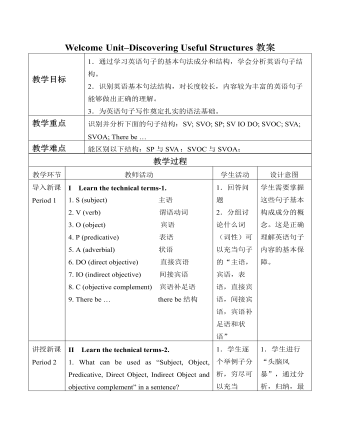
II Learn the technical terms-2.1. What can be used as “Subject, Object, Predicative, Direct Object, Indirect Object and objective complement” in a sentence?2. What can be used as “adverbial” in a sentence?3. What can be used as “verb” in a sentence?Answers to questions 1-3:1. Nouns, pronouns and appellations can be used as “Subject, Object, Predicative, Direct Object, Indirect Object and Objective Complement”. Besides, adjectives can be used as “Predicative and Objective Complement” in a sentence.2. Adverbs and prepositional phrases can be used as “Adverbial”.3. Verbs with actual meaning can be used as “Verb” in a sentence. Auxiliary verbs alone cannot be used as “Verb” in a sentence.III Learn to recognize the sentence structures.1. SV structure. For Example:(1) A bird flies.S V(2) A monkey jumps.S V(3) A fish swims.S V√ In SV structures, verbs are “intransitive verbs”.2. SVO structure. For Example:(1) A sheep eats grass.S V O(2) They like bananas.S V O(3) He wants candy.S V O√ In SVO structures, verbs are “transitive verbs”.3. SP structure. For Example:(1) This is great.S P (2) He looks well.S P (3) She became a teacher.S P √ In SP structures, Predicatives are formed by “link verbs” and “adjectives or nouns”.√ link verbs: be, become, grow, look, feel, taste, etc.4. SV IO DO structure. For Example:(1) He asked me a question.S V IO DO(2) Danny wrote me a letter.S V IO DO(3) Billy brought Sam a kite.S V IO DO√ In SV IO DO structures, the verbs are transitive and are followed by two objectives – pronouns or nouns as Indirect Objective, and nouns as Direct Objectives.
新人教版高中英语必修1Welcome Unit-Discovering Useful Structures & Listening and Talking教案
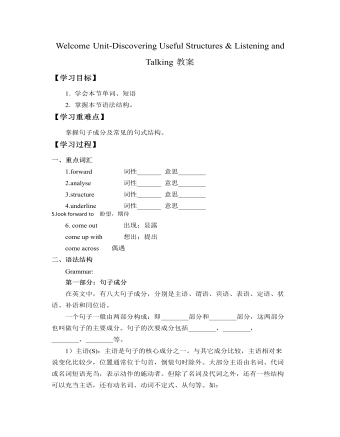
常跟双宾语的动词有:(需借助to的)bring, ask, hand, offer, give, lend, send, show, teach, tell, write, pass, pay, promise, return等;基本句型 五S +V + O + OC(主+谓+宾+宾补)特点:动词虽然是及物动词,但是只跟一个宾语还不能表达完整的意思,必须加上一个补充成分来补足宾语,才能使意思完整。 判断原则:能表达成—宾语 是…/做…注:此结构由“主语+及物的谓语动词+宾语+宾语补足语”构成。宾语与宾语补足语之间有逻辑上的主谓关系或主表关系,若无宾语补足语,则句意不够完整。可以用做宾补的有:名词,形容词,副词,介词短语,动词不定式,分词等。如:He considers himself an expert on the subject.他认为自己是这门学科的专家。We must keep our classroom clean.我们必须保持教室清洁。I had my bike stolen.我的自行车被偷了。We invited him to come to our school.我们邀请他来我们学校。I beg you to keep secret what we talked here.我求你对这里所谈的话保密。用it做形式宾语,而将真正的宾语放到宾语补足语的后面,以使句子结构平衡,是英语常用的句型结构方式。即:主语+谓语+it+宾补+真正宾语。如:We think it a good idea to go climb the mountain this Sunday.
新人教版高中英语必修1Unit 5 Languages Around the World-Reading and Thinking教案
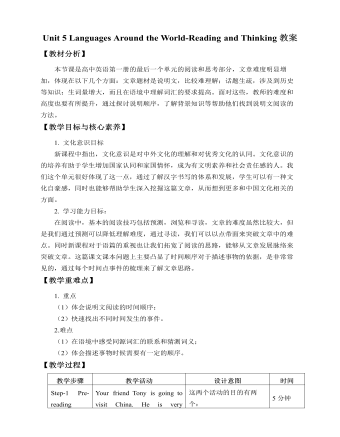
【教材分析】本节课是高中英语第一册的最后一个单元的阅读和思考部分,文章难度明显增加,体现在以下几个方面:文章题材是说明文,比较难理解;话题生疏,涉及到历史等知识;生词量增大,而且在语境中理解词汇的要求提高。面对这些,教师的难度和高度也要有所提升,通过探讨说明顺序,了解背景知识等帮助他们找到说明文阅读的方法。【教学目标与核心素养】1. 文化意识目标新课程中指出,文化意识是对中外文化的理解和对优秀文化的认同。文化意识的的培养有助于学生增加国家认同和家国情怀,成为有文明素养和社会责任感的人。我们这个单元很好体现了这一点,通过了解汉字书写的体系和发展,学生可以有一种文化自豪感,同时也能够帮助学生深入挖掘这篇文章,从而想到更多和中国文化相关的方面。2. 学习能力目标
新人教版高中英语必修1Unit 5 Languages Around the World-Reading for Writing教案
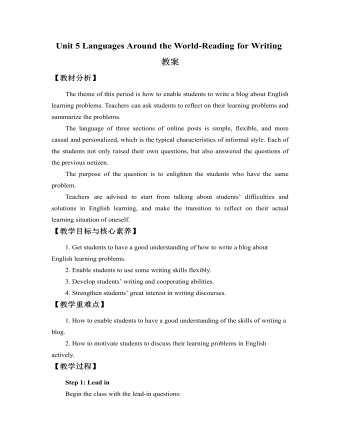
Step 3: Read to sum upRead it again and sum up the problems of the three students, and then write down the advice that was given from others.Step 4: Work in pairs. List your learning problems in English and brainstorm some useful advice.Useful expressions ? I don't know how to…... Is a big difficulty for me. I cannot ...? You might try …. It's very important to…? I have no idea how/what .My biggest problem is .... ? I (also) have trouble with. My advice is …. This worked for me.? l cannot understand the teachers’ English in class.Step 5 Homework:为提高我校学生的英语口语水平,我们将举办英语演讲比赛(English- speaking contest),请你根据下面的信息,以学生会(the Students‘ Union)的名义写一份海报,欢迎全校同学参加,届时特邀本校美籍教师史密斯先生颁奖。? 报名时间 9月30日以前(报名:signup)? 报名地点 学生会办公室? 比赛时间 10月9日晚7:00~9:00? 比赛地点 学校大会议室? 奖励 前8名
新人教版高中英语必修2Unit 1 Cultural Heritage-Discovering Useful Structure教案二
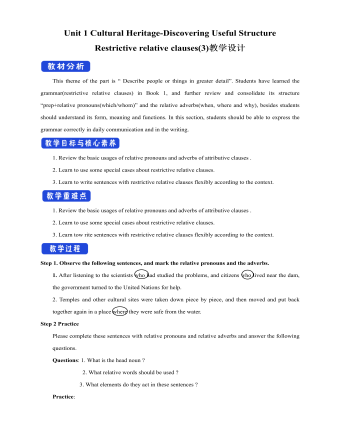
This theme of the part is “ Describe people or things in greater detail”. Students have learned the grammar(restrictive relative clauses) in Book 1, and further review and consolidate its structure “prep+relative pronouns(which/whom)” and the relative adverbs(when, where and why), besides students should understand its form, meaning and functions. In this section, students should be able to express the grammar correctly in daily communication and in the writing. 1. Review the basic usages of relative pronouns and adverbs of attributive clauses . 2. Learn to use some special cases about restrictive relative clauses.3. Learn to write sentences with restrictive relative clauses flexibly according to the context.1. Review the basic usages of relative pronouns and adverbs of attributive clauses .2. Learn to use some special cases about restrictive relative clauses.3. Learn tow rite sentences with restrictive relative clauses flexibly according to the context.Step 1. Observe the following sentences, and mark the relative pronouns and the adverbs. 1. After listening to the scientists who had studied the problems, and citizens who lived near the dam, the government turned to the United Nations for help.2. Temples and other cultural sites were taken down piece by piece, and then moved and put back together again in a place where they were safe from the water.Step 2 PracticePlease complete these sentences with relative pronouns and relative adverbs and answer the following questions.Questions: 1. What is the head noun ?2. What relative words should be used ?3. What elements do they act in these sentences ?
新人教版高中英语必修2Unit 1 Cultural Heritage-Discovering Useful Structure教案一
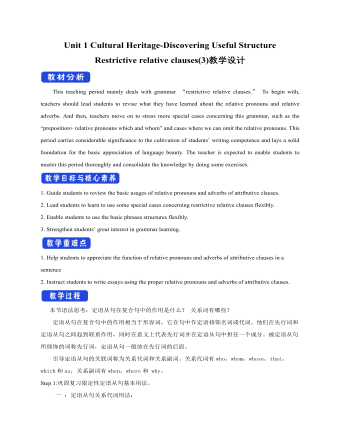
This teaching period mainly deals with grammar “restrictive relative clauses.” To begin with, teachers should lead students to revise what they have learned about the relative pronouns and relative adverbs. And then, teachers move on to stress more special cases concerning this grammar, such as the “preposition+ relative pronouns which and whom” and cases where we can omit the relative pronouns. This period carries considerable significance to the cultivation of students’ writing competence and lays a solid foundation for the basic appreciation of language beauty. The teacher is expected to enable students to master this period thoroughly and consolidate the knowledge by doing some exercises. 1. Guide students to review the basic usages of relative pronouns and adverbs of attributive clauses.2. Lead students to learn to use some special cases concerning restrictive relative clauses flexibly.2. Enable students to use the basic phrases structures flexibly.3. Strengthen students’ great interest in grammar learning.1. Help students to appreciate the function of relative pronouns and adverbs of attributive clauses in a sentence2. Instruct students to write essays using the proper relative pronouns and adverbs of attributive clauses.本节语法思考:定语从句在复合句中的作用是什么? 关系词有哪些?定语从句在复合句中的作用相当于形容词,它在句中作定语修饰名词或代词。他们在先行词和定语从句之间起到联系作用,同时在意义上代表先行词并在定语从句中担任一个成分。被定语从句所修饰的词称先行词,定语从句一般放在先行词的后面。
新人教版高中英语必修2Unit 2 Wildlife Protection-Reading for Writing教案二
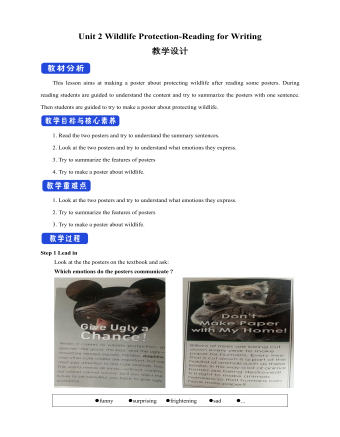
This lesson aims at making a poster about protecting wildlife after reading some posters. During reading students are guided to understand the content and try to summarize the posters with one sentence. Then students are guided to try to make a poster about protecting wildlife.1. Read the two posters and try to understand the summary sentences.2. Look at the two posters and try to understand what emotions they express.3. Try to summarize the features of posters4. Try to make a poster about wildlife.1. Look at the two posters and try to understand what emotions they express.2. Try to summarize the features of posters3. Try to make a poster about wildlife.Step 1 Lead inLook at the the posters on the textbook and ask:Which emotions do the posters communicate ?Step 2 Read the poster and answer the questions.1. What do you think of the animals in the poster on the left ?I think it is frightening and ugly.2. Why do we should protect the ugly animals ?All species--the good, the bad, and the ugly-- should be treated equally.The world needs all kinds--without variety, our planet cannot survive.3. Why are billions of trees being cut down every year ?To make paper for humans.4. What result will be lead to after the trees are cut down ?A lost of animal homes are being destroyed./The habitat of wildlife is being destroyed.Step 3 Find the feature of posters1. What does each poster use to stir up emotions ?On the left, it makes us a little frightened and it looks a little ugly, but it can activate our curiosity--What is it? And What is wrong with it?On the right, it makes us feel a little sad and want to protect them.
新人教版高中英语必修2Unit 1 Cultural Heritage-Reading and Thinking教案二
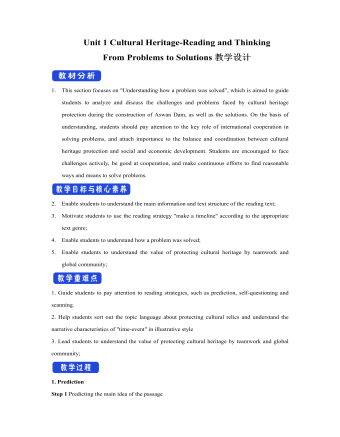
1. This section focuses on "Understanding how a problem was solved”, which is aimed to guide students to analyze and discuss the challenges and problems faced by cultural heritage protection during the construction of Aswan Dam, as well as the solutions. On the basis of understanding, students should pay attention to the key role of international cooperation in solving problems, and attach importance to the balance and coordination between cultural heritage protection and social and economic development. Students are encouraged to face challenges actively, be good at cooperation, and make continuous efforts to find reasonable ways and means to solve problems.2. Enable students to understand the main information and text structure of the reading text;3. Motivate students to use the reading strategy "make a timeline" according to the appropriate text genre;4. Enable students to understand how a problem was solved;5. Enable students to understand the value of protecting cultural heritage by teamwork and global community;1. Guide students to pay attention to reading strategies, such as prediction, self-questioning and scanning.2. Help students sort out the topic language about protecting cultural relics and understand the narrative characteristics of "time-event" in illustrative style3. Lead students to understand the value of protecting cultural heritage by teamwork and global community;