-
新人教版高中英语必修2Unit 5 Music-Discovering Useful Structures教案一
Step1:自主探究。1.(教材P52)Born(bear) in the USA on 2 January 1970, Whitacre began studying music at the University of Nevada in 1988.2.(教材P52) Moved(move) by this music, he said, “It was like seeing color for the first time.”3.(教材P56)I was very afraid and I felt so alone and discouraged(discourage).4.(教材P58)Encouraged(encourage) by this first performance and the positive reaction of the audience, I have continued to play the piano and enjoy it more every day.Step2:语法要点精析。用法1:过去分词作表语1).过去分词可放在连系动词be, get, feel, remain, seem, look, become等之后作表语,表示主语所处的状态Tom was astonished to see a snake moving across the floor.汤姆很惊讶地看到一条蛇正爬过地板。Finally the baby felt tired of playing with those toys.终于婴儿厌倦了玩那些玩具。注意:1).过去分词作表语时与被动语态的区别过去分词作表语时,强调主语所处的状态;而动词的被动语态表示主语是动作的承受者,强调动作。The library is now closed.(状态)图书馆现在关闭了。The cup was broken by my little sister yesterday.(动作)昨天我妹妹把杯子打碎了。2)感觉类及物动词的现在分词与过去分词作表语的区别过去分词作表语多表示人自身的感受或事物自身的状态,常译作“感到……的”;现在分词多表示事物具有的特性,常译作“令人……的”。
新人教版高中英语必修2Unit 5 Music-Listening and Speaking教案
This lesson is about music. Students can classify the types of music through the instruments and its sound and can talk about their preferences about music, even join some activities and play a role in them according to their musical talents. On the basis, they are guided to use the languages to express their preferences and some plosive sounds and their rules.1. Classify the music types through the instruments and its sound.2. Listen and understand what the speakers’ preferences are and the reasons; talk about their own preferences and give their own reasons, using these sentences: “What kind of music do you like? And why? “ “Because it makes/gives me energy/peaceful.../touches my heart...”.3. Learn some plosives and the rules.4. Join some activities and play a role in them according to the talents. 1. Listen and understand what the speakers’ preferences are and the reasons;2. talk about their own preferences and give their own reasons, using these sentences: “What kind of music do you like? And why? “ “Because it makes/gives me energy/peaceful.../touches my heart...”.3. Learn some plosives and incomplete plosives and its rules.Step 1 Lead inPoint at the pictures on P50 and ask Q1: What are the people doing in the pictures below?Q2: What kind of music they are?Then play the MP3s one by oneStep 2 ListeningTask 1: A reporter from the school newspaper is interviewing students about music. Listen to the interviews. Draw lines between the words to make complete sentences. Some words will not be used.
新人教版高中英语必修2Unit 5 Music-Reading and Thinking教案二
1. Get basic information about Eric; read deeply to understand the history and development of the virtual choir.2. Understand what the function of the virtual choir is and how to make a virtual choir.3. Understand the meaning of some languages in the context of the text through question guidance, such as “Many people do not have close friends or contacts who have the same interest in music.” and so on.Step 1 Leading-in1. Answer the following questions.Q1:Do you know the Apps like Tik Tok and Quick Hand?Q2: Do you want to make a Tik Tok video or a Quick Hand video?2. Play a Tik Tok video Step 2: Understanding the title Q1:What does the title mean ?Q2: Is the article a narration or exposition? Why? Q3: Can you change the title ? If you can, what is the title?Step 3: Scanning the whole text and getting the basic information1. Answer the following questions.Q1:Who came up with the idea for a virtual choir?Q2: Where did Eric studied the musical composition?Q3: What is his song?2. Find the main idea of each paragraph3. Deal with some new words.Step 4: Reading carefully to get detailed informationPara 1 How to make a virtual choir1. PreparationA. tools: a virtual camera; an Internet connectionB. hero/heroin: friends or some individuals who have the same interests2. Process
新人教版高中英语必修2Unit 5 Music-Reading and Thinking教案一
This section focuses on "learning about experiencing music Online". This virtual choir is a new form of music performance. Members from all over the world don't need to love to come to a place. Instead, they use the new technology to model the various parts and wonderful virtual harmony group of music in the family. Students need to understand the main meaning of each paragraph. Finding topic sentences is an important way to understand the general idea of a paragraph. After the topic sentence, it is usually the detail sentence that supports and explains the topic sentence. Some paragraphs have obvious subject sentences, for example, the first sentence of the second paragraph is the subject sentence of the paragraph, and the following sentenceStudents need to pay attention to the topic sentences and key sentences, and then pay attention to how the sentences after the meaning explain, explain and support the topic sentences or key sentences before.1.Guide students to learn about experiencing music online2.Guide students to scan and circle the information in the text.3.Guide students to find the numbers and dates to fill in the timeline.4.Guide students to learn more about music by completing the sentences with the correct forms of the words and phrases. And then make a mind map about the outline of the passage.1. Guide students to pay attention to reading strategies, such as prediction, self-questioning and scanning.2. Help students sort out the main meaning of each paragraph and understand the narrative characteristics of "timeline” in illustrative style.3. Lead students to understand the changes that have been caused by the Internet.
新人教版高中英语必修2Unit 5 Music-Reading for Writing教案二
The Internet celebrity Gao Yifeng. Years ago, he owned 5 companies and the staffs over 1,000, but during the economy crisis, he became nothing but debt. He was so worried that his hair became white overnight. There was a time when he wanted to killed himself. But after listening to the song Start Over by Liu Huan, he decided to cheer himself up. He started a steamed bun shop and gradually became a national chain shops. Now he became successful again.Walter Haddon said, “Music is the medicine of a troubled mind.” Music contains such a pleasant and inspiring force. Music gave him courage and bravery. When he listened to the song, it made his spirit fly like a kite in the wind. Music gave him strength and brought him relief. It was the rock I leant on to become strong and to get through those hard times. I hope none of us have to go through the same kind of suffering that he did. At the same time, we all go through various periods when we feel sad or alone. During those times, music can help us in the same way that it helped him. I hope we all will somehow begin to treasure music and make it a part of our life. Thank you for your listening !5.Revise your writing each other.Does he/she explain how music has changed his/her/someone else’s life?Are some of the rhetorical devices included and used properly ?Does he/she talk about how music makes him/her/someone feel?Is the first word in each sentences capitalised?Does he/she use correct punctuation ?
新人教版高中英语必修2Unit 5 Music-Reading For Writing教案一
(4)Now we have heard a number of outstanding speeches ... 我们已经聆听了许多精彩的发言……(5)Because we wanted the nations of the world, working together, to deal with ... 因为我们希望全世界各国团结起来去应对……(6)And if we do not act ... 如果我们不采取行动……(7)Now, I share the concerns that have been expressed ... 我也同意对于……表达的担心(8)Let us show the world that by working together we can ... 让我们告诉全世界,通过一起努力我们可以……(9)It is now time for us to ... 是时候我们……(10)And I have always wished that ... 我一直希望……(11)Thank you for letting me share this day with me.感谢你们和我共度这一天。实践演练:假如你是高中生李华,你校将举办一次以“音乐”为主题的演讲比赛,请你按照主题,写下你的演讲稿。注意:词数100左右。First of all, thank you for listening to my speech. My topic is: love music like love yourself.Music is like the air we need to maintain our normal lives around us. You can't imagine how terrible a world without music would be. Movies and TV shows have no music, only dry conversations and scenes; mobile phones only vibrations; streets only noisy crowds; cafes, western restaurants only depressed meals. What a terrible world it is!As a student, I hope we all can enjoy the fun brought by music in our spare time. Instead of just listening to music, we can even make our own music. Let's enjoy the fun of music!Thanks again for your attention!
人教版新课标高中物理必修1弹力教案2篇
一般情况下,凡是支持物对物体的支持力,都是支持物因发生形变而对物体产生弹力。所以支持力的方向总是垂直于支持面而指向被支持的物体。例1:放在水平桌面上的书书由于重力的作用而压迫桌面,使书和桌面同时发生微小形变,要恢复原状,对桌面产生垂直于桌面向下的弹力f1,这就是书对桌面的压力;桌面由于发生微小的形变,对书产生垂直于书面向上的弹力f2,这就是桌面对书的支持力。学生分析:静止地放在倾斜木板上的书,书对木板的压力和木板对书的支持力。并画出力的示意图。结论:压力、支持力都是弹力。压力的方向总是垂直于支持面而指向被压的物体,支持力的方向总是垂直于支持面而指向被支持的物体。引导学生分析静止时,悬绳对重物的拉力及方向。引导得出:悬挂物由于重力的作用而拉紧悬绳,使重物、悬绳同时发生微小的形变。重物由于发生微小的形变,对悬绳产生竖直向下的弹力f1,这是物对绳的拉力;悬绳由于发生微小形变,对物产生竖直向上的弹力f2,这就是绳对物体的拉力。
人教版新课标高中物理必修1摩擦力教案2篇
l.知识与技能:(1)知道摩擦力产生的条件。(2)能在简单问题中,根据物体的运动状态,判断静摩擦力的有无、大小和方向;知道存在着最大静摩擦力。(3)掌握动磨擦因数,会在具体问题中计算滑动磨擦力,掌握判定摩擦力方向的方法。(4)知道影响到摩擦因数的因素。2.过程与方法:通过观察演示实验,概括出摩擦力产生的条件及摩擦力的特点,培养学生的观察、概括能力。通过静摩擦力与滑动摩擦力的区别对比,培养学生分析综合能力。3.情感态度价值观:在分析物体所受摩擦力时,突出主要矛盾,忽略次要因素及无关因素,总结出摩擦力产生的条件和规律。二、重点、难点分析1.本节课的内容分滑动摩擦力和静摩擦力两部分。重点是摩擦力产生的条件、特性和规律,通过演示实验得出关系f=μN。2.难点是学生有初中的知识,往往误认为压力N的大小总是跟滑动物体所受的重力相等,因此必须指出只有当两物体的接触面垂直,物体在水平拉力作用下,沿水平面滑动时,压力N的大小才跟物体所受的重力相等。
人教版新课标高中物理必修2功率教案2篇
1.用CAI课件模拟汽车的启动过程。师生共同讨论:①如果作用在物体上的力为恒力,且物体以匀速运动,则力对物体做功的功率保持不变。此情况下,任意一段时间内的平均功率与任一瞬时的瞬时功率都是相同的。②很多动力机器通常有一个额定功率,且通常使其在额定功率状态工作(如汽车),根据P=FV可知:当路面阻力较小时,牵引力也小,速度大,即汽车可以跑得快些;当路面阻力较大,或爬坡时,需要比较大的牵引力,速度必须小。这就是爬坡时汽车换低速挡的道理。③如果动力机器在实际功率小于额定功率的条件下工作,例如汽车刚刚起动后的一段时间内,速度逐渐增大过程中,牵引力仍可增大,即F和v可以同时增大,但是这一情况应以二者乘积等于额定功率为限度,即当实际功率大于额定功率以后,这种情况不可能实现。
人教版新课标高中物理必修2平抛运动教案2篇
(五)平抛运动规律的应用例1:一架老式飞机在高出海面45m的高处,以80m/s的速度水平飞行,为了使飞机上投下的炸弹落在停在海面上的敌船,应该在与轰炸目标的水平距离为多远的地方投弹?不计空气阻力。分析:对于这道题我们可以从以下几个方面来考虑:(1)从水平飞行的飞机上投下的炸弹,做什么运动?为什么?(2)炸弹的这种运动可分解为哪两个什么样的分运动?3)要想使炸弹投到指定的目标处,你认为炸弹落地前在水平方向通过的距离与投弹时飞机离目标的水平距离之间有什么关系?拓展:1、式飞机在高出海面45m的高处,以80m/s的速度水平飞行,尾追一艘以15m/s逃逸的敌船,为了使飞机上投下的炸弹正好击中敌船,应该在与轰炸目标的水平距离为多远的地方投弹?不计空气阻力。2、在一次摩托车跨越壕沟的表演中,摩托车从壕沟的一侧以速度v=40m/s沿水平方向向另一侧,壕沟两侧的高度及宽度如图所示,摩托车可看做质点,不计空气阻力。(1)判断摩托车能否跨越壕沟?请计算说明(2)若能跨过,求落地速度?
人教版新课标高中物理必修2向心力教案2篇
3.进一步体会力是产生加速度的原因,并通过牛顿第二定律来理解匀速圆周运动、变速圆周运动及一般曲线运动的各自特点。(三)、情感、态度与价值观1.在实验中,培养学生动手、探究的习惯。2.体会实验的意义,感受成功的快乐,激发学生探究问题的热情、乐于学习的品质。教学重点1.体会牛顿第二定律在向心力上的应用。2.明确向心力的意义、作用、公式及其变形,并经行计算。教学难点1.对向心力的理解及来源的寻找。2.运用向心力、向心加速度的知识解决圆周运动问题。教学过程(一)、 引入新课:复习提问:匀速圆周运动的物体的加速度——向心加速度,它的方向和大小有何特点呢?学生回答后进一步引导:那做匀速圆周运动物体的受力有什么特点呢?是什么力使物体做圆周运动而不沿直线飞出?请同学们先阅读教材
新人教版高中英语必修1Unit 4 Natural Disasters-Discovering Useful Structures教案
【教材分析】This teaching period mainly deals with the grammar: the restrictive relative clauses.This period carries considerable significance to the cultivation of students’ writing competence and lays a solid foundation for the basic appreciation of language beauty. The teacher is expected to enable students to master this period thoroughly and consolidate the knowledge by doing some exercise of good quality.【教学目标与核心素养】1. Get students to have a good understanding of the basic usages of the restrictive relative clauses.2. Enable students to use the restrictive relative clauses flexibly.3. Develop students’ speaking and cooperating abilities.4. Strengthen students’ great interest in grammar learning.【教学重难点】How to enable students to have a good understanding of the restrictive relative clauses, especially the uses of the relative words such as which, that, who, whom.【教学过程】Step1: 语法知识呈现定语从句(一)—关系代词的用法在复合句中, 修饰名词或代词的从句叫定语从句。定语从句通常由关系代词或关系副词引导,说明事物的具体信息,从句位于被修饰词之后。被定语从句修饰的词叫先行词,引导定语从句的词叫关系词,关系词指代先行词,并在定语从句中充当成分。关系词有两种:关系代词who, whom ,whose, that, which, as和关系副词when, where, why。
新人教版高中英语必修1Unit 5 Languages Around the World-Reading for Writing教案
Step 3: Read to sum upRead it again and sum up the problems of the three students, and then write down the advice that was given from others.Step 4: Work in pairs. List your learning problems in English and brainstorm some useful advice.Useful expressions ? I don't know how to…... Is a big difficulty for me. I cannot ...? You might try …. It's very important to…? I have no idea how/what .My biggest problem is .... ? I (also) have trouble with. My advice is …. This worked for me.? l cannot understand the teachers’ English in class.Step 5 Homework:为提高我校学生的英语口语水平,我们将举办英语演讲比赛(English- speaking contest),请你根据下面的信息,以学生会(the Students‘ Union)的名义写一份海报,欢迎全校同学参加,届时特邀本校美籍教师史密斯先生颁奖。? 报名时间 9月30日以前(报名:signup)? 报名地点 学生会办公室? 比赛时间 10月9日晚7:00~9:00? 比赛地点 学校大会议室? 奖励 前8名
新人教版高中英语必修2Unit 2 Wildlife Protection-Reading for Writing教案二
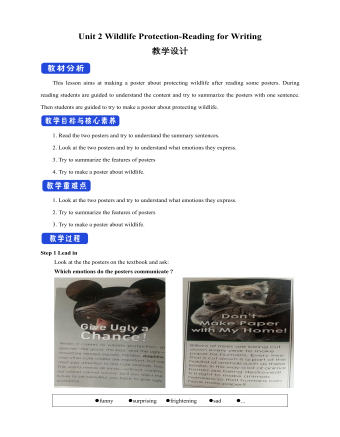
This lesson aims at making a poster about protecting wildlife after reading some posters. During reading students are guided to understand the content and try to summarize the posters with one sentence. Then students are guided to try to make a poster about protecting wildlife.1. Read the two posters and try to understand the summary sentences.2. Look at the two posters and try to understand what emotions they express.3. Try to summarize the features of posters4. Try to make a poster about wildlife.1. Look at the two posters and try to understand what emotions they express.2. Try to summarize the features of posters3. Try to make a poster about wildlife.Step 1 Lead inLook at the the posters on the textbook and ask:Which emotions do the posters communicate ?Step 2 Read the poster and answer the questions.1. What do you think of the animals in the poster on the left ?I think it is frightening and ugly.2. Why do we should protect the ugly animals ?All species--the good, the bad, and the ugly-- should be treated equally.The world needs all kinds--without variety, our planet cannot survive.3. Why are billions of trees being cut down every year ?To make paper for humans.4. What result will be lead to after the trees are cut down ?A lost of animal homes are being destroyed./The habitat of wildlife is being destroyed.Step 3 Find the feature of posters1. What does each poster use to stir up emotions ?On the left, it makes us a little frightened and it looks a little ugly, but it can activate our curiosity--What is it? And What is wrong with it?On the right, it makes us feel a little sad and want to protect them.
新人教版高中英语必修2Unit 2 Wildlife Protection-Reading and Thinking教案一
The listening and speaking part aims at how to protect and help endangered animals by listening, speaking and talking about the facts and reasons. This lesson analyzes the decreasing clause of Tibetan antelope population and the measures of protecting Tibetan antelopes. So students can be guided to learn to analyse the title and use different reading skills or strategies, like scanning, skimming and careful reading.1. Read quickly to get the main ideas and the purpose of going to Tibetan; read carefully to understand what the author see and think.2. Understand the sentences of the present continuous passive voice such as “Much is being done to protect wildlife.” and the inverted sentence “Only when we learn to exist in harmony with nature can we stop being a threat to wildlife and to our planet.”3. Enhance the awareness of protecting wildlife.4. Cultivate the reading methods according to different materials.1. Read quickly to get the main ideas and the purpose of going to Tibetan; read carefully to understand what the author see and think.2. Understand the sentences of the present continuous passive voice such as “Much is being done to protect wildlife.” and the inverted sentence “Only when we learn to exist in harmony with nature can we stop being a threat to wildlife and to our planet.”3. Cultivate the reading methods according to different materials.Step 1 Leading-inWatch a video about elephants and whales and then ask:Why are they endangered ? They are killed/hunted
新人教版高中英语必修2Unit 4 History and Traditions-Listening&Speaking&Talking教案一
This unit is about history and traditions. From the opening page, we can know that this unit will introduce the history and traditions around the world. As Marcus Garvey says “A people without the knowledge of their past history, origin and culture is like a tree without roots”, it is important for students to realize the importance and value of knowing the history and traditions and their further meanings. And this part ( listening and speaking ) is divided into two parts: Part A---share views on historic sites, Part B ---talk about a visit to a historic tourist destination. By talking with a foreigner, the speakers introduce the historic attractions and their cultures. Part A is that William, a British student, who was going to visit the Confucius Temple and a Chinese student, Xiao Kong, who was going to the Confucius Temple to meet with the members of the research group, went together and exchanged their views on the Confucius Temple, Confucius, Confucius' descendants and Confucius' educational thoughts. Part B is a conversation between Xiao Yan, a youth hostel receptionist and Paul, a backpacker about the feelings and experience after visiting the Chinese famous tourist attraction Pingyao.1. Guide students to understand the content of listening texts in terms of the whole and key details; 2. Cultivate students' ability to guess the meaning of words in listening; discuss with their peers how to talk about historic spots and great person.3. Instruct students to use functional sentences of showing one’s excitement, surprise and disappointment.1. Guide students to understand the content of listening texts in terms of the whole and key details; 2. Cultivate students' ability to discuss with their peers the related topics.3. Enable students to use the functional items of showing one’s excitement, surprise and disappointment.
人教版新课标高中地理必修2第一章第三节人口合理容量教案
生:环境承载力是指环境能持续供养的人口数量。师:对了。但是有同学仍然会感到这是一个很抽象的概念。下面我们具体来了解什么是环境承载力。我们可以从两个部分去理解:一、环境,它主要是指环境的单个要素(如:土地、水、气候、植被等。)及其组合方式。二、是承载力,它指在特定的条件下,具体某事物能承受的某种活动的最大值。那环境承载力的科学定义是怎样表达的呢?生:环境承载力是指某一时期,某种状态条件下,某地区环境所能承受的人类活动作用的阈值。师:很对。 我们可以用一个生动的例子来说明。一只木桶里面的水的多少在底面积固定不变的情况下是由哪块木板来决定?生:最短的那块。师:确实如此。这就是我们平常所讲的 “木桶效应”。那影响环境承载力的大小也是由环境个要素里面最紧缺的那个要素来决定的。下面我们用一个例子来印证一下。
人教版新课标高中物理必修1重力基本相互作用教案2篇
具体过程:先用悬挂法确定重心之后,在板上固定一条细线ab,让ab穿过重心c点,再在其重心c处拴上细绳提拉,验证薄板可以水平平衡.如图3-1-6、3-1-7所示.归纳:物体的重心可在物体之上,也可在物体之外.结论:规则均匀的物体重心在其几何中心;不规则不均匀的物体重心用悬挂法.例3一个被吊着的均匀的球壳,其内部注满了水,在球的底部有一带阀门的细出水口.在打开阀门让水慢慢流出的过程中,球壳与其中的水的共同重心将会()A.一直下降B.一直不变C.先下降后上升D.先上升后下降先让学生自己回答,估计很多学生会选择A;教师提示开始和最终重心的位置,学生很快就能得出正确答案.借机引导学生思考问题要全面.参考答案:在注满水时,球壳和水的共同重心在球心,随着水的流出,球壳的重心不变,但是水的重心下降,二者共同的重心在下降.当水流完时,重心又回到球心,故选项C正确.
人教版新课标高中物理必修1重力基本相互作用教案2篇
阅读教材后总结:是万有引力的作用把宇宙中的恒星和行星聚集在一起,组成了太阳系、银河系和其他星系.力的相互作用遍布我们周围的一切物体.除此之外还有电荷间的相互作用、磁体间的相互作用,我们把这种力称为电磁相互作用.【思考与讨论】质子带正电,但质子(与中子一起)却能聚集在一起构成原子核.你能推测是什么力的作用结果吗?攻略一:阅读教材53页,师生共同讨论、总结.攻略二:网络搜索或工具书查阅“四种基本相互作用”,进一步了解概念.结论:决定物质的结构和变化过程的基本的相互作用.近代物理确认各种物质之间的基本的相互作用可归结为四种:引力相互作用、电磁相互作用、弱相互作用和强相互作用.近代物理的观点倾向于认为:四种基本相互作用是统一的,物理学家们正在为建立大统一理论而努力.但至今也没有公认的结论,望同学们好好学习,为科学事业奉献自己的聪明和才智.
人教版新课标高中地理必修2第四章第一节工业的区位因素与区位选择教案
教学目标1.知识与技能目标:结合实例理解影响工业区位选择的因素。联系实际理解工业区位的发展变化。理解环境对工业区位的影响。2.过程与方法目标:利用图表,分析影响 工业区位,培养学生应用基础知识及读图分析能力。了解本地工业发展情况,培养学生的分析能力。3.情感态度价值观:通过对工业区位因素的学习,激发学生探究地理问题的兴趣。由环境对工业区位选择的影响,培养学生的环保意识,树立工业发展必须走可持续发展之路的思想。教学重点1影响工业区位的主要因素;2.运用工业区选择的基本原理对工厂进行合理的区位选择。教学难点 判断影响某个工厂区位的主导因素及其合理布局。教学方法 案例分析法、对比分析法、读图分析法、探究法教学用具 多媒体课件,图表及补充材料课堂类型