-
新人教版高中英语选修2Unit 2 Reading for writing教学设计
The theme of this section is to express people's views on studying abroad. With the continuous development of Chinese economic construction, especially the general improvement of people's living standards, the number of Chinese students studying abroad at their own expense is on the rise. Many students and parents turn their attention to the world and regard studying abroad as an effective way to improve their quality, broaden their horizons and master the world's advanced scientific knowledge, which is very important for the fever of going abroad. Studying abroad is also an important decision made by a family for their children. Therefore, it is of great social significance to discuss this issue. The theme of this section is the column discussion in the newspaper: the advantages and disadvantages of studying abroad. The discourse is about two parents' contribution letters on this issue. They respectively express their own positions. One thinks that the disadvantages outweigh the advantages, and the other thinks that the advantages outweigh the disadvantages. The two parents' arguments are well founded and logical. It is worth noting that the two authors do not express their views on studying abroad from an individual point of view, but from a national or even global point of view. These two articles have the characteristics of both letters and argumentative essays1.Guide the students to read these two articles, and understand the author's point of view and argument ideas2.Help the students to summarize the structure and writing methods of argumentative writing, and guides students to correctly understand the advantages and disadvantages of studying abroad3.Cultivate students' ability to analyze problems objectively, comprehensively and deeply
新人教版高中英语选修2Unit 3 Using langauge-Listening教学设计
1. How is Hunan cuisine somewhat different from Sichuan cuisine?The heat in Sichuan cuisine comes from chilies and Sichuan peppercorns. Human cuisine is often hotter and the heat comes from just chilies.2.What are the reasons why Hunan people like spicy food?Because they are a bold people. But many Chinese people think that hot food helps them overcome the effects of rainy or wet weather.3.Why do so many people love steamed fish head covered with chilies?People love it because the meat is quite tender and there are very few small bones.4.Why does Tingting recommend bridge tofu instead of dry pot duck with golden buns?Because bridge tofu has a lighter taste.5 .Why is red braised pork the most famous dish?Because Chairman Mao was from Hunan, and this was his favorite food.Step 5: Instruct students to make a short presentation to the class about your choice. Use the example and useful phrases below to help them.? In groups of three, discuss what types of restaurant you would like to take a foreign visitor to, and why. Then take turns role-playing taking your foreign guest to the restaurant you have chosen. One of you should act as the foreign guest, one as the Chinese host, and one as the waiter or waitress. You may start like this:? EXAMPLE? A: I really love spicy food, so what dish would you recommend?? B: I suggest Mapo tofu.? A: Really ? what's that?
新人教版高中英语选修2Unit 4 Learning about Language教学设计
This section guides students to pay attention to the typical context of vocabulary use, helps students accumulate vocabulary around the key vocabulary of this unit, and uses the learned words and word chunks in different contexts to deeply understand their meaning and usage, so as to achieve the purpose of review and consolidation.The teaching design activities aim to guide students to pay attention to the typical context in which the target vocabulary is used, as well as the common vocabulary used in collocation, so that students can complete the sentence with correct words. In terms of vocabulary learning strategies, this unit focuses on cultivating students' ability to pay attention to collocation of words and to use word blocks to express meaning.For vocabulary learning, it is not enough just to know the meaning of a single word, but the most important thing is to master the common collocations of words, namely word blocks.Teachers should timely guide students to summarize common vocabulary collocation, such as verb and noun collocation, verb and preposition collocation, preposition and noun collocation, and so on.1. Guide students to understand and consolidate the meaning and usage of the vocabulary in the context, 2. Guide the students to use the unit topic vocabulary in a richer context3. Let the students sort out and accumulate the accumulated vocabulary, establishes the semantic connection between the vocabulary,4. Enable students to understand and master the vocabulary more effectivelyGuiding the Ss to use unit topic words and the sentence patterns in a richer context.
新人教版高中英语选修2Unit 4 Reading for writing教学设计
假定你是英国的Jack,打算来中国旅行,请你给你的中国笔友李华写一封信,要点如下:1.你的旅行计划:北京→泰山→杭州;2.征求建议并询问他是否愿意充当你的导游。注意:1.词数80左右(开头和结尾已给出,不计入总词数);2.可以适当增加细节,以使行文连贯。参考词汇:故宫 the Forbidden City;泰山 Mount TaiDear Li Hua,I'm glad to tell you that 'm going to visit China.First,I am planning to visit Beijing,the capitalof China,where I am looking forward to enjoying the Great Wall,the Forbidden City and somebeautiful parks.Then I intend to go to visit Mount Tai in Shandong Province.I've heard that it is one ofthe most famous mountains in China and I can't wait to enjoy the amazing sunrise there.After that,I amalso going to Hangzhou.It is said that it is a beautiful modern city with breathtaking natural sights,among which the West Lake is a well- known tourist attraction.What do you think of my travel plan? Will you act as my guide? Hope to hear from you soon.
新人教版高中英语选修2Unit 5 Reading and thinking教学设计
The theme of this activity is to learn the first aid knowledge of burns. Burns is common in life, but there are some misunderstandings in manual treatment. This activity provides students with correct first aid methods, so as not to take them for granted in an emergency. This section guides students to analyze the causes of scald and help students avoid such things. From the perspective of text structure and collaborative features, the text is expository. Expository, with explanation as the main way of expression, transmits knowledge and information to readers by analyzing concepts and elaborating examples. This text arranges the information in logical order, clearly presents three parts of the content through the subtitle, accurately describes the causes, types, characteristics and first aid measures of burns, and some paragraphs use topic sentences to summarize the main idea, and the level is very clear.1. Guide students to understand the causes, types, characteristics and first aid methods of burns, through reading2. Enhance students’ ability to deal withburnss and their awareness of burns prevention3. Enable students to improve the ability to judge the types of texts accurately and to master the characteristics and writing techniques of expository texts.Guide students to understand the causes, types, characteristics and first aid methods of burns, through readingStep1: Lead in by discussing the related topic:1. What first-aid techniques do you know of ?CPR; mouth to mouth artificial respiration; the Heimlich Manoeuvre
新人教版高中英语选修2Unit 5 Using langauge-Listening教学设计
The theme of this section is to learn how to make emergency calls. Students should learn how to make emergency calls not only in China, but also in foreign countries in English, so that they can be prepared for future situations outside the home.The emergency telephone number is a vital hotline, which should be the most clear, rapid and effective communication with the acute operator.This section helps students to understand the emergency calls in some countries and the precautions for making emergency calls. Through the study of this section, students can accumulate common expressions and sentence patterns in this context. 1.Help students accumulate emergency telephone numbers in different countries and learn more about first aid2.Guide the students to understand the contents and instructions of the telephone, grasp the characteristics of the emergency telephone and the requirements of the emergency telephone.3.Guide students to understand the first aid instructions of the operators.4.Enable Ss to make simulated emergency calls with their partners in the language they have learned1. Instruct students to grasp the key information and important details of the dialogue.2. Instruct students to conduct a similar talk on the relevant topic.Step1:Look and discuss:Match the pictures below to the medical emergencies, and then discuss the questions in groups.
人教部编版语文八年级上册写作学写传记教案
在我到了入学年龄时,父亲为了我能够受到更好的教育,又将我和弟弟接回温州,我开始了我的读书生涯,父亲也开始了他全新的创业史。2015年,他当起了老板开始卖橱柜。为了使自己的橱柜能够做得更好,他到处去学习,读书上课都成了他的日常。他注册了“九周橱柜”的商标,做了极富特色的Logo,将“高雅品质,好而不贵”八个字定为自己企业的宣传口号。四年时间,他日思夜想的,都是如何将产品做得更加物美价廉。也正是因为他的执着与专注,他的企业很快从一家门店扩展到了五家门店,为温州千家万户安装上了崭新的橱柜。父亲今年35岁,他的身上总散发着一种向上的力量,吸引着周围的人同他一起进步。他说自己正当奋斗努力的时候,还需要不断进步。再过十年,我给他写的小传会更为精彩。我也拭目以待。
部编版语文八年级上册《写作:学习写消息》教案
1.叙述式:用摘要或综合的方法,对消息中最新鲜、最主要的事实作扼要的叙述。2.描写式:对消息中的主要事实或某一个有意义的侧面、细节,作简洁朴素而又有特点的描写。3.评论式:对所报道的事实,作简洁、精辟的评论,以揭示事件的意义和目的。4.提问式:把主要事实用提问的方式写出来,使报道的问题更为尖锐,以引起读者的注意。目标导学三:展开丰实的主体主体是消息的躯干,是对导语内容的展开和补充。其结构形式有两种:1.先后顺序。即按事物发展的先后顺序安排层次。2.逻辑顺序。即按事物的逻辑关系(如因果、并列、主次、点面等关系)安排层次。目标导学四:介绍背景和结语消息的背景和结语是一篇消息中可有可无的内容。1.背景是指消息所报道事实的历史情况和环境条件。消息使用的背景材料一般有三类:(1)对比性的;(2)说明性的;(3)注释性的。2.结语结语是消息的最后一句话或者一段话。有的消息已经把事实说清楚了,就不需要结语了。常见的结语有三种形式:(1)概括小节式;(2)预测趋势式;(3)提出问题式。
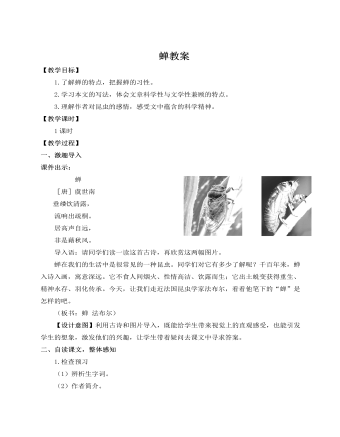
人教部编版语文八年级上册蝉教案
鲁迅曾把《昆虫记》称为“讲昆虫的故事”“讲昆虫生活”的楷模。鲁迅说:“他的著作还有两种缺点:一是嗤笑解剖学家,二是用人类道德于昆虫界。”周作人说:“法布尔的书中所讲的是昆虫的生活,但我们读了却觉得比看那些无聊的小说戏剧更有趣味,更有意义。”巴金说:“《昆虫记》融作者毕生的研究成果和人生感悟于一炉,以人性观照虫性,将昆虫世界化作供人类获取知识、趣味、美感和思想的美文。”传统文化玉蝉:蝉意喻人生蝉在古人的心目中地位很高,向来被视为纯洁、清高、通灵的象征。玉蝉究其用途,大体可分为四种:一是佩蝉,是专门佩戴在人身上以作装饰和避邪用,示高洁;一种为冠蝉,是作为饰物缀于帽子上的,表示高贵;一种是琀蝉,以蝉的羽化比喻人能重生,寓指精神不死,再生复活;还有一种是镇蝉,做镇纸用的文房用品,多出现在明代以后,前三种蝉属于高古玉,主要产生在商周至战汉时期。
部编版语文八年级上册《背影》教案
目标导学四:学以致用,学习刻画形象点拨:作者在描写父亲背影的过程中,综合运用了外貌描写与动作描写的方法。在描写外貌时,抓住父亲穿着简陋与肥胖的典型特征,在动作描写中也集中体现出攀月台不易的形象。作者这种抓住典型特征做简要勾画来表现出人物形象的方法叫白描手法。引导:在你的印象中,是否也有人给你留下过如此感动的回忆呢?请你仔细回忆当时的场景,具体到对方做了什么动作,他(她)是什么形象,或说了什么话,将这些记录下来,记住要表现描写对象的主要特征。第2课时一、复习回顾、引入新课在上一课时,我们仔细分析了朱自清先生刻画的“背影”形象,这个形象如此令人感动。然而细心的同学恐怕已经明显地感受到朱先生的情感在文中有着极大的变化,而父亲对孩子的感情也未必就是爬月台买橘子那样简单,这节课,就让我们更加深入地走进本文的情感世界。
部编版语文八年级上册《三峡》教案
明确:首先,作者突出水势之大,只用了一个“襄”字便将水大之势凸显而出,并用“沿溯阻绝”一词借用航道被堵来侧面表现水势之大。接下来作者描述水势之急,以“乘奔御风”来与水势作比,突出水势之急。从而将夏水的雄伟峻急的特征写尽无遗。3.作者为何要将春冬两季结合在一起写?三峡春冬两季具有怎样的美?请你简要分析。明确:春冬两季雨水减少,具有许多相似的特征,因此作者将两者结合在一起写。此时的三峡有“素湍”,有“绿潭”,两种色彩、两种情态,动静交织,对比鲜明;“怪柏”“悬泉”“瀑布”,有动有静、有色有声,山水树木交汇其中,蔚为奇观。“清荣峻茂”一句,四字写四物:“清”字写水,“峻”字写山,“荣”字写树,“茂”字写草。这四个字是三峡“美”的综合表现。而“良多趣味”一词,表现了作者的审美意趣,诗情画意融为一体。
部编版语文八年级上册《蝉》教案
第一层(第12—13段),介绍蝉的产卵,分别说明了产卵的地方、过程和数量等。第二层(第14—17段),写蝉卵遇到的危险,首先说明产卵的数量多是为了在遭到破坏时能有幸存者,然后介绍蚋对蝉卵的破坏和蝉对此的茫然无知。第三层(第18—20段),介绍蝉卵的孵化和幼虫出壳。第四层(第21—23段),写幼虫落地。第五层(第24段),写幼虫挖穴隐藏。第六层(第25—26段),概括蝉的生活历程。既照应了“蝉的地穴”的介绍,又结束了对蝉卵生长过程的说明,也是对全文形象化的总结。目标导学二:默读课文,品味说明语言思考:这是一篇说明文,但我们读起来并不觉得枯燥无味,为什么?明确:《蝉》实质是科学观察笔记、考察报告,属于科学著作的范畴。但是,作者在表达上采用了一些文学性语言对说明对象的科学资料进行综合介绍,因此有一定的文学色彩。其文学色彩主要表现在以下几个方面:
初中数学冀教版八年级下册《正方形》说课稿
二、学习新知1.正方形的定义在这一环节中,学生很容易犯的一个错误就是条件重复。这时我会引导学生从画图入手,提示他们:你能不能减少条件画出正方形呢?这一环节中我的观点是正方形的定义不是唯一的。我们可以从不同的角度来总结,只要合理就加以肯定。比如当学生总结出:四个角都是直角,四条边都相等的四边形是正方形。这时可以提醒学生是不是一定要四条边都相等,减少边的条数可以画出来吗?角的个数可以减少吗?鼓励学生动手试一试。通过动手画图可以很容易的得到正方形的一个定义:三个角都是直角,一组邻边都相等的四边形是正方形。通过小组讨论的形式来完成这一环节的设置。鼓励学生利用现有的材料继续构造正方形。从另一个角度总结正方形的定义。
新人教版高中英语选修2Unit 1 Science and Scientists-Learning about Language教学设计
Step 7: complete the discourse according to the grammar rules.Cholera used to be one of the most 1.__________ (fear) diseases in the world. In the early 19th century, _2_________ an outbreak of cholera hit Europe, millions of people died. But neither its cause, 3__________ its cure was understood. A British doctor, John Snow, wanted to solve the problem and he knew that cholera would not be controlled _4_________ its cause was found. In general, there were two contradictory theories 5 __________ explained how cholera spread. The first suggested that bad air caused the disease. The second was that cholera was caused by an _6_________(infect) from germs in food or water. John Snow thought that the second theory was correct but he needed proof. So when another outbreak of cholera hit London in 1854, he began to investigate. Later, with all the evidence he _7_________ (gather), John Snow was able to announce that the pump water carried cholera germs. Therefore, he had the handle of the pump _8_________ (remove) so that it couldn't be used. Through his intervention,the disease was stopped in its tracks. What is more, John Snow found that some companies sold water from the River Thames that __9__________________ (pollute) by raw waste. The people who drank this water were much more likely _10_________ (get) cholera than those who drank pure or boiled water. Through John Snow's efforts, the _11_________ (threaten) of cholera around the world saw a substantial increase. Keys: 1.feared 2.when 3. nor 4.unless 5.that/which 6.infection 7.had gathered 8.removed 9.was polluted 10.to get 11. threat
新人教版高中英语必修3Unit 1 Festivals and Celebrations-Reading and Thinking教学设计
The topic of this part is “Discover the reasons for festivals and celebrations.The Listening & Speaking & Talking part aims at talking about the experiences and feelings or emotions about the festivals and celebrations. This section aims at detecting the reason why the people celebrate the festivals, the time, the places, the types and the way of celebrations. It also explains why some traditions in the old celebrations are disappearing, like the firecrackers in the big cities and some new things are appearing like the prosperity of business or commerce. 1. Students can talk about what festivals they know and the reasons and the way of celebrating them.2. Students should learn the reading skills such as the headline and get the topic sentences, the structures of articles.3. Students can understand the past, the present situation of some festival around the world and why there are some changes about them. 4. Students can have the international awareness about the festivals.1. Students should learn the reading skills such as the headline and get the topic sentences, the structures of articles.2. Students can understand the past, the present situation of some festival around the world and why there are some changes about them.Step 1 Lead in---Small talkWhat festival do you like best ? Why ?I like the Spring Festivals because I can set off the fireworks, receive the lucky money and enjoy the Gala with my families.Step 2 Before reading---Pair workWhy do people celebrate different festivals ?The Spring Festivals is to celebrate the end of winter and the coming of spring and new life.The Mid-autumn Day is to celebrate the harvest and admire the moon.
新人教版高中英语必修3Unit 1 Festivals and Celebrations-Listening &Speaking&Talking教学设计
The theme of this section is “Talk about festival activities and festival experiences”.Festival and holiday is a relaxing and interesting topic for students. This part talks about the topic from the daily life of students’. In the part A ---Listening and Speaking, there are three conversations among different speakers from three countries(Japan, Rio and China), where the speakers are participating in or going to participate in the festivals and celebrations. So listening for the relationship among them is a fundamental task. Actually, with the globalization and more international communication, it is normal for Chinese or foreigners to witness different festivals and celebrations in or out of China. In the Conversation 1, a foreign reporter is interviewing a Japanese young girl who just had participated in the ceremony of the Coming-of-Age Day on the street and asking her feeling about the ceremony and the afterwards activities. Conversation 2, Chinese girl Li Mei is witnessing the Rio Carnival for the first time, and her friend Carla gives her some advice on the costumes which enables her to match with the carnival to have a good time. Conversation 3, a Chinese guide is showing a group of foreign visitors around the Lantern Festival and introducing the customs of the festival to them. The three conversations have a strong vitality and insert the festival and cultural elements from different countries. So perceiving the festivals and cultures from different countries is the second task. At the same time, the scripts also insert the targeted grammar --- v-ing as attributive and predicative, which students can perceive and experience in a real context and make a road for the further study. That is the third task. In the Part B--- Listening and Talking, the theme is “Talk about festival experience”, which is the common topic in our daily conversations. During the conversation, Song Lin, a Chinese student, asked Canadian friend Max about how to spend Christmas. In the conversation, Song Lin talked about experience and the feelings during the Chinese Spring Festival, during which there are not only some enjoyable things but some unpleasant things. After the listening, perhaps students find there are some similarities between Christmas and the Chinese Spring Festival as there are some differences in the origins and celebrations. For example, people always visit friends and relatives, decorate their houses, have a big dinner together, chat and give presents to each other.
新人教版高中英语必修3Unit 1 Festivals and Celebrations-Reading for writing教学设计二
Step 3 Analyzing article structureActivity 31. Teachers raise questions to guide students to analyze the chapter structure of this diary and think about how to describe the festival experience. (1)What should be included in the opening/body/closing paragraph(s)?(2)How did the writer arrange his/her ideas?(3)What kind of interesting details did the writer describe?(4)How did the writer describe his/her feelings/emotions during the event?2. Students read and compare the three sentence patterns in activity 2. Try to rewrite the first paragraph of the diary with these three sentence patterns. After that, students exchange corrections with their partners. Such as:●This was my first time spending three days experiencing the Naadam Festival in China’s Inner Mongolia Autonomous Region and it was an enjoyable and exciting experience. ●I'll never forget my experience at the Naadam Festival because it was my first time to watch the exciting Mongolian games of horse racing, wrestling, and archery so closely. ●I'll always remember my first experience at the Naadam Festival in China’s Inner Mongolia Autonomous Region because it was so amazing to spend three days witnessing a grand Mongolian ceremony. Step 4 Accumulation of statementsActivity 41. Ask the students to read the diary again. Look for sentences that express feelings and emotions, especially those with the -ing form and the past participle. Such as:● …horse racing, wrestling, and archery, which are all so exciting to watch. ● some amazing performances● I was surprised to see…● I was a little worried about. . . ● feeling really tiredOther emotional statements:●I absolutely enjoyed the archery, too, but the horse races were my favourite part. ●I'm finally back home now, feeling really tired, but celebrating Naadam with my friend was totally worth it. ●He invited me back for the winter to stay in a traditional Mongolian tent and cat hot pot. I can’t wait!2. In addition to the use of the -ing form and the past participle, the teacher should guide the students in the appreciation of these statements, ask them to memorize them, and encourage them to use them reasonably in writing practice.
新人教版高中英语必修3Unit 1 Festivals and Celebrations-Reading for Writing教学设计一
The topic of this part is “Write about your festival experience”.During the Listening and Speaking and Talking, students are just asked to say out their festival experiences such as the Spring Festival, Mid-autumn Day, but this part students will be asked to write down their own festival experiences. During the reading part, it introduces the Naadam Festival in Inner Mongolia Autonomous Region, which can give students a good example to imitate. Students not only learn the festival, but touch and feel the Inner Mongolian’s character, the spirit and cultural atmosphere, which can help students form the cultural awareness and learn to enjoy and value the diversity of Chinese culture.Concretely, the dairy tells the experience that the author spent the Naadam Festival in Inner Mongolia Autonomous Region with his/her friend. The structure is clear. In the opening paragraph, it introduces the topic of the Naadam Festival and the whole feeling. Then it introduces the items of the festival like the ceremony, wrestling and horse racing. Finally, it summarizes this experience. Because this part is a travel journal, we must guide students pay more attention to these details: 1. use the first person. 2. use the past tense to tell the past thing and use the present or future tense to describe the scenery. 3. use the timeline to tell the development. 4. be careful for the author’s psychology, emotion and feeling, etc.1. Read quickly to get main idea; read carefully to get the detailed information about Naadam Festival.2. Learn the structure of the reading article and language.3. Write an article about a festival experience4. Learn to use the psychology, emotions and feeling in the writing.1. Write an article about a festival experience.2. Use the structure of the reading article and language.
新人教版高中英语选修2Unit 1 Science and Scientists-Discovering useful structures教学设计
The grammatical structure of this unit is predicative clause. Like object clause and subject clause, predicative clause is one of Nominal Clauses. The leading words of predicative clauses are that, what, how, what, where, as if, because, etc.The design of teaching activities aims to guide students to perceive the structural features of predicative clauses and think about their ideographic functions. Beyond that, students should be guided to use this grammar in the context apporpriately and flexibly.1. Enable the Ss to master the usage of the predicative clauses in this unit.2. Enable the Ss to use the predicative patterns flexibly.3. Train the Ss to apply some skills by doing the relevant exercises.1.Guide students to perceive the structural features of predicative clauses and think about their ideographic functions.2.Strengthen students' ability of using predicative clauses in context, but also cultivate their ability of text analysis and logical reasoning competence.Step1: Underline all the examples in the reading passage, where noun clauses are used as the predicative. Then state their meaning and functions.1) One theory was that bad air caused the disease.2) Another theory was that cholera was caused by an infection from germs in food or water.3) The truth was that the water from the Broad Street had been infected by waste.Sum up the rules of grammar:1. 以上黑体部分在句中作表语。2. 句1、2、3中的that在从句中不作成分,只起连接作用。 Step2: Review the basic components of predicative clauses1.Definition
新人教版高中英语选修2Unit 1 Science and Scientists-Reading and thinking教学设计
Step 5: After learning the text, discuss with your peers about the following questions:1.John Snow believed Idea 2 was right. How did he finally prove it?2. Do you think John Snow would have solved this problem without the map?3. Cholera is a 19th century disease. What disease do you think is similar to cholera today?SARS and Covid-19 because they are both deadly and fatally infectious, have an unknown cause and need serious public health care to solve them urgently.keys:1. John Snow finally proved his idea because he found an outbreak that was clearly related to cholera, collected information and was able to tie cases outside the area to the polluted water.2. No. The map helped John Snow organize his ideas. He was able to identify those households that had had many deaths and check their water-drinking habits. He identified those houses that had had no deaths and surveyed their drinking habits. The evidence clearly pointed to the polluted water being the cause.3. SARS and Covid-19 because they are both deadly and fatally infectious, have an unknown cause and need serious public health care to solve them urgently.Step 6: Consolidate what you have learned by filling in the blanks:John Snow was a well-known _1___ in London in the _2__ century. He wanted to find the _3_____ of cholera in order to help people ___4_____ it. In 1854 when a cholera __5__ London, he began to gather information. He ___6__ on a map ___7___ all the dead people had lived and he found that many people who had ___8____ (drink) the dirty water from the __9____ died. So he decided that the polluted water ___10____ cholera. He suggested that the ___11__ of all water supplies should be _12______ and new methods of dealing with ____13___ water be found. Finally, “King Cholera” was __14_____.Keys: 1. doctor 2. 19th 3.cause 4.infected with 5.hit 6.marked 7.where 8.drunk 9.pump 10.carried 11.source 12.examined 13.polluted 14.defeatedHomework: Retell the text after class and preview its language points