-
人教版新课标PEP小学英语三年级上册We love animals教案
(1)游戏:向它那儿跑去(Run to it!)首先,用图片和词卡练习本课的6个新单词。学生边读老师边把卡片贴在黑板上。将全班分成两队。给学生下一个Run to the bird.这样的指令。每队的第一个学生向带有鸟的图卡和词卡的地方跑,并且用手摸一下这两张卡片。哪组学生先摸到卡片就给他们队得一分。教师也可以用本课刚学的指令:Walk to….Jump to ….Fly to….等指令学生用相同的动作走(跳,飞)到卡片前。(2)教师将Let’s do的图片打乱顺序,让学生听指令,选出正确的图片。(3)游戏:照我说的做(Do as I say)教师发指令,全班同学起立做动作。做错的同学随时坐下。最后,哪组站着的同学多,哪组获胜。教师参考指令: Climb like a monkey/bear.Jump like a squirrel/rabbit.Walk like an elephant/duck.Hunt like a mouse/pig.Act like a cat/dog.Fly like a bird.为了增加游戏的难度和趣味性,教师可逐渐加快指令的速度。4.课堂评价(Assessment)做活动手册本单元第5部分的练习。方法和步骤参考第一单元。
人教版新课标PEP小学英语四年级上册Meet My Family!教案
教案点评: 本课时在上一课时的基础上,进一步在情景中学习句型Is this your...? He/She looks... What’s he/she? They look... Are they...? 本课时的内容和学生的实际生活贴近,学生对该话题感到亲切,教学新句型时教师运用学生的家庭照片,在师生的对话中自然的呈现新知和操练句型,有助于学生更好的掌握和操练对话。本堂课教学层次分明,教师引导适当,发挥了学生在学习中的主体地位第六课时重点:单词nurse, doctor, farmer, driver的拼写。难点:I’m going to be a…教具准备:1.图片nurse, doctor, farmer, driver2.教材相配套的教学录音带3.单词卡片教学过程(35sk.com):一 热身/复习(Warm-up/Revision)1.口语练习:How many people are there in your family?Who are they?What are they?2.让学生改编B部分的chant, 然后表演出来。教师对表现出色的应即使给予奖励。二 呈现新课 (Presentation)1.教师出示表示表职业的单词卡让学生认读,并贴在黑板上。2.做找朋友的游戏。让学生把图片贴到相应的单词下。
人教版新课标PEP小学英语五年级下册My Favourite Season教案
(三)趣味操练 (Practice)活动六:猜一猜教学参考时间:5教师说:Guess what’s my favourite season. Why?学生猜测:It’s winter. Because you can skate. 教师给予肯定或否定的答案然后邀请另一名孩子起来,大家继续猜测活动七:传话游戏教学参考时间:3分钟教师在每个小组第一个同学耳边轻声说一个句子:I like summer, because I can swim./I like fall, because I can find many beautiful defoliation.(落叶)/….每个小组传话,看谁传的又快又好每组的最后一个汇报你听到的句子(四)巩固和扩展(Consolidation and extension)活动八:Link and say教学参考时间:5分钟完成活动手册P13—3两人一小组,分别说说每组图代表的季节,服装,和事情教师提问,What would you like to do in spring/in summer/in winter/ in fall?,请孩子回答。两人一组问答,根据你听到的连出出对方喜欢的季节事情两个人交换书对答案活动九:Let’s do a survey 教学参考时间:5分钟完成活动手册P13—4自己认读范例对话,明确题意小组调查(6人)各小组展示答案活动十:试一试(Let’s try)教学参考时间:5分钟教师播放录音,学生理解再听录音,选择你听到的图
人教版新课标PEP小学英语六年级下册Last Weekend教案
一、教学内容:Part B Let’s learn Let’s play. Part C Task time Let’s check 二、教学目标与要求 1、掌握四会词组:went to a park, went swimming, read a book, went fishing, went hiking. 2、学会用句型What did you/ (name) do last weekend/ yesterday? I(name) (did) last weekend/ yesterday. Did you….? Yes, I did. 来进行问答并完成Task time的表格。 三、教学重点 掌握四会词组,并用所学词组和句型进行调查 四、教学难点 掌握四会词组(不规则动词过去式变化),并用所学词组和句型进行调查 五、课前准备 1、教师准备所需的词卡及图片。 2、学生准备词卡。 六、教学过程 1、Warm-up 1) Free-talk: T: What day is today? A: Today is… T: What day was yesterday? (强调 yesterday) B: Yesterday/ It was… T: What did you do yesterday? C: I (did)…yesterday. ( 用前几课时已经学的词组) 2) Chain-drill: C: I (did)…yesterday. What did you do yesterday? D: I (did)…yesterday. What did you do yesterday? E, F… (ask the teacher) T: I went to a park yesterday. 2、Presentation and practice let’s learn (1)继续Chain-drill,由T 引出并出示新授词组:went hiking. (2)学生已经了解了go 的过去式后, T 边用I went ( 这个动词用动作表示)yesterday.表达自己昨天去做什么了,边做动作.让学生帮老师说出: went swimming, went fishing.
人教版新课标小学数学三年级上册测量教案
教学目标1、认识长度单位毫米,建立1毫米的长度概念,会用毫米厘米度量比较短的物体的长度。2、培养学生的估测意识和能3、培养学生的动手实践和合作学习的能力,并感受生活中处处有数学。教学重点:认识长度单位毫米,会用毫米度量物体长度。教学难点:培养学生的估测方法。教学过程一、引言二、估测数学书的长、宽、厚的长度。师:请同学们观察数学书的长、宽、厚,并估一估大约有多长,然后把估测的结果填入下表?估计实际测量数学书的长数学书的宽数学书的厚生1:数学书的长大约是21厘米、宽大约是14厘米、厚有1厘米。师:你是怎么想的?生1:因为1厘米大约有一个指甲长那么长,数学书的长大约就有21个指甲长那么长,数学书的宽有14个指甲长那么长,数学书的厚有1个指甲长那么厚。
人教版新课标小学数学六年级上册圆教案
教学追记:本堂课,在我带领着学生利用教具进行操作,在此基础上,让学生自主发现圆的面积与拼成长方形面积的关系,圆的周长、半径和长方形的长、宽的关系,并推导出圆的面积计算公式。教学环形的面积计算时,我充分放手给学生,让学生通过思考讨论领悟出求环形的面积是用外圆面积减去内圆面积,并引导他们发现这两种算法的一致性,同时提醒学生尽量使用简便算法,减少计算量。圆的周长和面积的练习课教学目标:1、通过教学使学生理解并掌握圆的周长和面积计算方法。2、培养学生分析问题和解决问题的能力,发展学生的空间观念。3、灵活解答几何图形问题。教学重点:认真审题,分辨求周长或求面积。教学过程:一、复习。1、求出下面圆的周长和面积并用彩笔描出周长,用阴影表示出面积。
人教版新课标小学数学六年级下册负数教案
(3)教师在黑板上话好直线,在相应的点上用小图片代表大树和学生,在问怎样用数表示这些学生和大树的相对位置关系?(让学生把直线上的点和正负数对应起来。(4)学生回答,教师在相应点的下方标出对应的数,再让学生说说直线上其他几个点代表的数,让学生对数轴上的点表示的正负数形成相对完整的认识。(5)总结:我们可以像这样在直线上表示出正数、0和负数,像这样的直线我们叫数轴。(6)引导学生观察:A、从0起往右依次是?从0起往左依次是?你发现什么规律?B、在数轴上分别找到1.5和-1.5对应的点。如果从起点分别到.5和-1.5处,应如何运动?(7)练习:做一做的第1、2题。(二)教学例4:1、出示未来一周的天气情况,让学生把未来一周每天的最低气温在数轴上表示出来,并比较他们的大小。
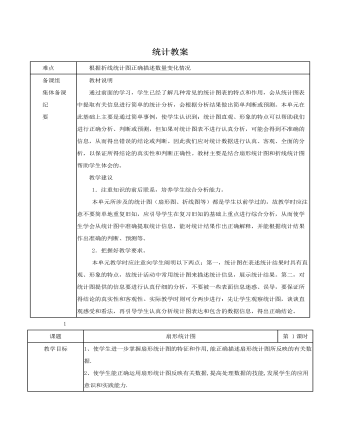
人教版新课标小学数学六年级下册统计教案
分别算出2008年比2007年各季度增产的百分数和合计数,再制成统计表.分析:根据题目要求,要算出各季度增产的百分数,我们只要根据2008年与2007年各个季度的原始数据,运用“求一个数是另一个数的百分之几”的方法就可以算出.算出了各个季度增产的百分数,根据题意制统计表时,既要按照季度分类,又要反映出年份的类别,所以在确定表头时可分为3部分:年份、台数、季度,年份又分为2007年产量、2008年产量、2008年比2007年增产的百分数.2、田力化肥厂今年第一季度生产情况如下:元月份计划生产1500吨,实际生产1620吨;二月计划生产1600吨,实际生产1680吨;三月份计划生产1640吨,实际生产1720吨,根据上面的数据,算出各月完成计划的百分数,并制成统计表.(1)制作含有百分数的统计表时,百分数这一栏一定要写清楚是谁占谁的百分之几,并按“求一个数是另一个数的百分之几”的解题方法正确算出对应百分数”
人教版高中政治必修3聚焦文化竞争力说课稿
(1)文化与经济、政治在经济基础上相互影响。①经济、政治和文化是社会生活的三个基本领域。其中,经济是基础,政治是经济的集中表现,文化是经济和政治的反映。一定的文化由一定的经济、政治所决定,又反作用于一定的政治、经济,给予政治、经济以重大影响。②经济发展是文化发展的基础。但这并不意味着文化的发展始终与经济的发展亦步亦趋。如同不能简单地把精神文明看作是物质文明的派生物和附属品一样,也不能简单地认为文化是经济、政治的派生物和附属品。文化有其自身的传承性和相对的独立性。那种认为只要物质条件好了,精神文化自然而然地就会好起来,物质条件差一点,精神文化就不可能搞好的观点,不符合历史发展的事实,是不正确的。③掀开历史的画卷,文化既有古今和地域之别,又有先进与落后、腐朽之分。不同的文化,对经济、政治的影响不同,对社会发展的作用也不同。不同民族的文化,影响不同民族和国家各具特色的发展道路。
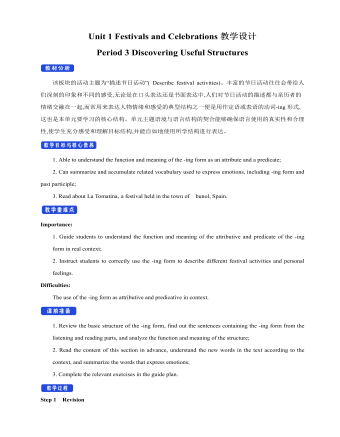
新人教版高中英语必修3Unit 1 Festivals and Celebrations教学设计二
1. Ss look at the picture and scan the passage to understand the main idea while teacher is giving the following questions to inspire Ss to think.*Where are those people?*What are they doing?*Why are they so excited?2. Ss complete the passage with the appropriate -ing form. Then discuss and check the answers with class.Answers: boring, interesting, taking, exciting, amazing3. The teacher raises questions for the students to discuss and encourages them to express their opinions.*Do you like La Tomatina? Why or why not?4. Each group representative reports the discussion result, the teacher gives feedback and the evaluation.Step 6 PracticeActivity 41. Ss complete the Ex 2 in Using structures.2. Check the answers after finishing the exercises.①The dragon boat races are the most exciting part of the Dragon Boat Festival.② The children were excited to go Easter egg hunting.③What an amazing performance! This is the best music festival I have ever been to.④We were amazed by her funny-looking hat.⑤His inspiring speech at the conference won the admiration/ favour of the audience.⑥This is a challenging game to test your memory and observation capabilities. 3. T asks Ss to finish Ex 3 and 4 in Using structures by themselves, then check the answers with class.Step 6 Homework1. Understand and master the functions and usage of the -ing form;2. Finish the other exercises in Using structures.1、通过本节内容学习,学生是否理解和掌握动词-ing形式作定语和表语的功能和意义;2、通过本节内容学习,学生能否在理解文段内容的基础上,根据上下文语境和表达逻辑,能正确运用动词-ing形式描述节日庆典。3、通过本节内容学习,学生是否归纳和积累用于表达情绪的相关词汇。
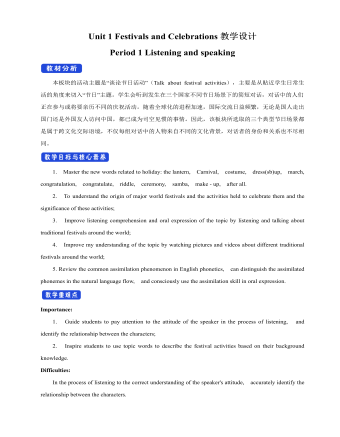
新人教版高中英语必修3Unit 1 Festivals and Celebrations教学设计一
本板块的活动主题是“谈论节日活动”(Talk about festival activities),主要是从贴近学生日常生活的角度来切入“节日”主题。学生会听到发生在三个国家不同节日场景下的简短对话,对话中的人们正在参与或将要亲历不同的庆祝活动。随着全球化的进程加速,国际交流日益频繁,无论是国人走出国门还是外国友人访问中国,都已成为司空见惯的事情。因此,该板块所选取的三个典型节日场景都是属于跨文化交际语境,不仅每组对话中的人物来自不同的文化背景,对话者的身份和关系也不尽相同。1. Master the new words related to holiday: the lantern, Carnival, costume, dress(sb)up, march, congratulation, congratulate, riddle, ceremony, samba, make - up, after all. 2. To understand the origin of major world festivals and the activities held to celebrate them and the significance of these activities;3. Improve listening comprehension and oral expression of the topic by listening and talking about traditional festivals around the world;4. Improve my understanding of the topic by watching pictures and videos about different traditional festivals around the world;5. Review the common assimilation phenomenon in English phonetics, can distinguish the assimilated phonemes in the natural language flow, and consciously use the assimilation skill in oral expression. Importance:1. Guide students to pay attention to the attitude of the speaker in the process of listening, and identify the relationship between the characters;2. Inspire students to use topic words to describe the festival activities based on their background knowledge. Difficulties:In the process of listening to the correct understanding of the speaker's attitude, accurately identify the relationship between the characters.
新人教版高中英语必修3Unit 1 Festivals and Celebrations教学设计三
*wide range of origins(= a great number of different origins, many kinds of origins)*It featured a parade and a great feast with music, dancing, and sports. (=A parade and a great feast with music, dancing, and sports were included as important parts of the Egyptian harvest festival.)*.. some traditions may fade away and others may be established.(= Some traditions may disappear gradually, while other new traditions may come into being.)Step 6 Practice(1) Listen and follow the tape.The teacher may remind the students to pay attention to the meaning and usage of the black words in the context, so as to prepare for the completion of the blanks in activity 5 and vocabulary exercises in the exercise book.(2) Students complete the text of activity 5 by themselves.The teacher needs to remind the students to fill in the blanks with the correct form of the vocabulary they have learned in the text.Students exchange their answers with their partners, and then teachers and students check their answers.(3)Finish the Ex in Activity 5 of students’ book.Step 7 Homework1. Read the text again, in-depth understanding of the text;2. Discuss the origin of festivals, the historical changes of related customs, the influence of commercial society on festivals and the connotation and essential meaning of festivals.3. Complete relevant exercises in the guide plan.1、通过本节内容学习,学生是否理解和掌握阅读文本中的新词汇的意义与用法;2、通过本节内容学习,学生能否结合文本特点快速而准确地找到主题句;3、通过本节内容学习,学生能否理清论说文的语篇结构和文本逻辑,了解节日风俗发展与变迁,感悟节日的内涵与意义。
新人教版高中英语必修3Unit 2 Morals and Virtues教学设计二
Activity 41. Students complete the task of activity 4, then teachers and students check the answers. 2. The teacher organized the students to work together and asked them to use the tables and mind maps sorted out before to retold the important choices in Lin Qiaozhi's life and their resultsStep 5 Language points1. The teacher asks the students to read the text carefully, find out the core words and long and difficult sentences in the text and draw lines, understand the use of vocabulary, and analyze the structure of long and difficult sentences. 2. The teacher explains and summarizes the usage of core vocabulary and asks the students to take notes. 3. The teacher analyzes and explains the long and difficult sentences that the students don't understand, so that the students can understand them better. Step 6 Homework1. Read the text again, in-depth understanding of the text; 2. Master the use of core vocabulary and understand the long and difficult sentences. 3. Complete relevant exercises in the guide plan. 1、通过本节内容学习,学生是否理解和掌握阅读文本中的新词汇的意义与用法;2、通过本节内容学习,学生能否结合文本特点总结林巧稚的人生原则和人格品质特征;3、通过本节内容学习,学生能否针对人生抉择发表自己的看法;能否全面地、客观地、理性地看待问题,进而对道德和人性有更加深入的思考和理解。
新人教版高中英语必修3Unit 2 Morals and Virtues教学设计四
3.Teachers ask different groups to report the answers to the questions and ask them to try different sentence patterns.The teacher added some sentence patterns for students to refer to when writing.Step 4 Writing taskActivity 51.Write the first draft.Students first review the evaluation criteria in activity 5, and then independently complete the draft according to the outline of activity 4, the answers to the questions listed in the group discussion and report, and the reference sentence pattern.2.Change partners.The teacher guides the students to evaluate their partner's composition according to the checklist of activity 5 and proposes Suggestions for modification.3.Finalize the draft.Based on the peer evaluation, students revise their own compositions and determine the final draft.Finally, through group recommendation, the teacher selects excellent compositions for projection display or reading aloud in class, and gives comments and Suggestions.Step 5 Showing writingActivity 5T call some Ss to share their writing.Step 6 Homework1. Read the passage in this section to better understand the passage.2. Carefully understand the hierarchical structure of the article, and deeply understand the plot of the story according to the causes, process and results;3. Independently complete the relevant exercises in the guide plan.1、通过本节内容学习,学生是否理解和掌握阅读文本中的新词汇的意义与用法;2、通过本节内容学习,学生能否通过人物言行的对比分析道德故事的深层内涵;3、通过本节内容学习,学生能否根据故事的起因、经过和结果来深入理解故事的情节,从而了解文章的层次结构;4、结合现实生活案例发表自己的见解和看法,写一篇观点明确、层次分明的故事评论。
新人教版高中英语必修3Unit 2 Morals and virtues教学设计一
(2) students are divided into groups according to the requirements of activity 3. Each student shares a story of personal experience or hearing-witnessing kindness, and then selects the most touching story in the group and shares it with the whole class. Before the students share the story, the teacher can instruct them to use the words and sentence patterns in the box to express. For example, the words in the box can be classified:Time order: first of all, then, after that, later, finally logical relationship :so, however, although, butTeachers can also appropriately add some transitional language to enrich students' expression:Afterwards, afterwards, at last, in the end, eventuallySpatial order: next to, far from, on the left, in front ofOtherwise, nevertheless, as a result, therefore, furthermore, in addition, as well asSummary: in a word, in short, on the whole, to sum up, in briefStep 8 Homework1. Understand the definition of "moral dilemma" and establish a correct moral view;2. Accumulate vocabulary about attitudes and emotions in listening texts and use them to express your own views;3. Complete relevant exercises in the guide plan.1、通过本节内容学习,学生能否理解理解“道德困境”的定义;2、通过本节内容学习,学生能否通过说话人所表达的内容、说话的语气、语调等来判断其态度和情绪;3、通过本节内容学习,学生能否针对具体的道德困境发表自己的看法和见解,能否掌握听力理训练中的听力策略。
新人教版高中英语必修3Unit 2 Morals and Virtues教学设计三
The joke set her crying.这个玩笑使她哭起来。Step 5 ReadingActivity 31. Students read the small text in activity 3. The teacher provides several small questions to check whether students understand the content of the text and the ideographic function of the -ing form in the text.*Where are those people?*Why did Dr Bethune come to China?*How did he help the Chinese people during the war?*What did Chairman Mao Zedong say about him?2. Ss try to rewrite some sentences using the -ing form. Then check the answers. When checking the answers, the teacher can ask different students to read the rewritten sentences and give comments.Answers:1. he became very interested in medicine, deciding to become a doctor.2. …after hearing that many people were dying in the war.3. Helping to organise hospitals, he taught doctors and nurses, and showed people how to give first aid./ He helped to organise hospitals, teaching doctors and nurses, and showing people how to give first aid.4. …praising Dr Bethune as a hero to be remembered in China.Step 6 PracticeActivity 4Students complete grammar activities 2 and 3 on page 69 of the workbook.Step 6 Homework1. Understand and master the functions and usage of the -ing form;2. Finish the other exercises in Using structures.1、通过本节内容学习,学生是否理解和掌握动词-ing形式作宾语补足语语和状语语的功能和意义;2、通过本节内容学习,学生能否正确使用动词-ing形式描述人物的行为、动作及其经历;3、通过本节内容学习,学生能否独立完成练习册和导学案中的相关练习。

人教版高中政治必修4意识的本质说课稿
师:分析得非常到位。大家来看看薛宝钗是怎么说的?薛宝钗的评论:“不像吟月了,月字底下放一个‘色’字倒还使得,你看句句倒是月色。这也罢了,原来诗从胡说来,再迟几天就好了。”生:(读第三首诗)“精华欲掩料应难,影自娟娟魄自寒。一片砧敲千里白,半轮鸡唱五更残。绿蓑江上秋闻笛,红袖楼头夜倚栏。博得嫦娥应借问,缘何不使永团圆!”这首诗语言很朴实,但意境很深远。我虽然读过《红楼梦》这本书,也看过电视剧,但我阅历太浅,说不出诗中所包含的深刻内涵。师:贾宝玉的评论:“这首不但好,而且新巧有意趣,可知俗语说的‘天下无难事,只怕有心人。2.意识的形式是主观的意识是人脑对客观存在的反映,意识是不是仅仅是人脑对客观存在原原本本的反映呢?“龙、凤”是中华民族的象征,是炎黄子孙的两大主要图腾,但地球上从来就没有出现过“龙、凤”,那么“龙、凤”的观念又是从何而来的呢?原来,“龙、凤”的观念最早产生于原始社会的图腾崇拜。、
人教版高中语文必修1《论语》说课稿
三、文本中的句子解决完毕,大家对文本内容的理解更加深入了。请速度文本,思考:《论语》具体涉及了哪些方面的内容,体现了孔子什么观点?明确:主要有治学、从政、修身养性和交友治道等方面,体现了孔子“克己复礼”的思想。四、 教师引导学生讨论: 如何评价孔子的言行和观点?从古至今人们对孔子有哪些评价?明确:1、春秋战国时代, 孔子门人及其后学者均推尊孔子。门人中以子贡为代表,他对孔子赞美备至,奉如天人,把孔子比拟为高天、日月、木铎,凡人是永远不可企及的,认为孔子是天生的圣人,“仰之弥高,钻之弥坚”。亚圣孟子认为孔子所行的“圣人之道”是遍及自然界和社会的至高准则。然而当时民间一般看法认为孔子是博学成名的大学者。
人教版高中语文必修1《优美的汉字》说课稿
明确:(1)结绳记事说。原始记事的一种方法。人类在没有发明文字或文字使用尚不普遍时,常用在绳索或类似物件上打结的方法记录数字,表达某种意思,用以传达信息,处理事件。 (2)书画说。(3)仓颉造字说。中国自古就有仓颉造字之说。文字的发明是人类发展史上一件石破天惊的大事,它将人们的思维、语言、经验以及复杂的社会现象记录下来,使文化得以传播交流、世代传承。2、汉字的形体:中华民族五千年的历史中,汉字的演变,从甲骨文--金文--大篆--小篆--隶书--草书--楷书--行书,字形由象形到点横竖撇捺的方块字,经历了漫长的岁月。其中凝聚着民族的智慧,也体现出汉字逐步完善的过程,凸显其方方正正、四平八稳的特点。汉字又是一种文化的体现,那些经过艺术处理的汉字或跳起了拉丁舞、有的如同酒醉的成龙打起了醉拳,更是让我们感到的是在欣赏汉字在纸张上跳舞,所以:书法是“纸上的舞蹈”。请大家看到书上的相关内容,注意每一种形体的汉字的载体是什么,其功能又有什么不一样。
人教版高中语文必修1《小狗包弟》说课稿
探究、讨论、交流:1、包弟讨人喜欢,作者却不得不将它送走,为什么?2、送走包弟后,作者为什么先是感觉轻松,随后觉得沉重?3、“您的小狗怎样?”这句话反复出现,有什么用意?4、“整整十三年零五个月过去了”“整整”一词有什么作用?5、“满园的创伤使我的心仿佛又给放在油锅里熬煎”这句话如何理解?6、“我怀念包弟,我想向它表示歉意。”如何理解?学生各抒己见后教师结合材料发表看法明确总结特别是最后一个问题得出作者这发之心底的语言,不仅仅是歉意,更是发自灵魂深处的忏悔!是对生命的尊重,是一个有良知的作家对反省历史的呼号。第三环节“认识你自己”——忏悔意识与我引导学生正视和反省成长过程中曾犯下过错。并布置课后作业:要求学生课后在本周随笔中谈反省忏悔后的感受。