-
新人教版高中英语必修2Unit 2 Wildlife Protection-Reading and Thinking教案一
The listening and speaking part aims at how to protect and help endangered animals by listening, speaking and talking about the facts and reasons. This lesson analyzes the decreasing clause of Tibetan antelope population and the measures of protecting Tibetan antelopes. So students can be guided to learn to analyse the title and use different reading skills or strategies, like scanning, skimming and careful reading.1. Read quickly to get the main ideas and the purpose of going to Tibetan; read carefully to understand what the author see and think.2. Understand the sentences of the present continuous passive voice such as “Much is being done to protect wildlife.” and the inverted sentence “Only when we learn to exist in harmony with nature can we stop being a threat to wildlife and to our planet.”3. Enhance the awareness of protecting wildlife.4. Cultivate the reading methods according to different materials.1. Read quickly to get the main ideas and the purpose of going to Tibetan; read carefully to understand what the author see and think.2. Understand the sentences of the present continuous passive voice such as “Much is being done to protect wildlife.” and the inverted sentence “Only when we learn to exist in harmony with nature can we stop being a threat to wildlife and to our planet.”3. Cultivate the reading methods according to different materials.Step 1 Leading-inWatch a video about elephants and whales and then ask:Why are they endangered ? They are killed/hunted
新人教版高中英语必修2Unit 3 The Internet-Discovering Useful Structure教案二
This teaching period mainly deals with grammar “The Present Perfect Passive Voice.” To begin with, teachers should lead students to revise what they have learned about the Present Perfect Passive Voice. And then, teachers move on to stress more special cases concerning this grammar。This period carries considerable significance to the cultivation of students’ writing competence and lays a solid foundation for the basic appreciation of language beauty. The teacher is expected to enable students to master this period thoroughly and consolidate the knowledge by doing some exercises. 1. Guide students to review the basic usages of the Present Perfect Passive Voice2. Lead students to learn to use some special cases concerning the Present Perfect Passive Voice flexibly.2. Enable students to use the basic phrases structures flexibly.3. Strengthen students’ great interest in grammar learning.1. Help students to appreciate the function of the Present Perfect Passive Voice in a sentence2. Instruct students to write essays using the proper the Present Perfect Passive Voice.观察下列句子特点,总结共同点。1.(教材P28)Much has been written about the wonders of the World Wide Web.2.(教材P28)But the Internet has done much more for people than simply make life more convenient.3.(教材P28)Many people have been helped by the club.4.(教材P28)She no longer feels lonely, and her company has become quite successful.5.(教材P32)Today I thought I’d blog about a question that has been asked many times—how do you stay safe online and avoid bad experiences on the Internet?
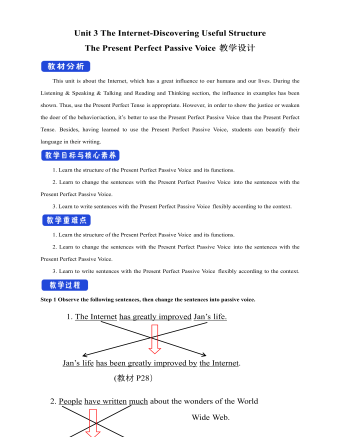
新人教版高中英语必修2Unit 3 The Internet-Discovering Useful Structure教案一
This unit is about the Internet, which has a great influence to our humans and our lives. During the Listening & Speaking & Talking and Reading and Thinking section, the influence in examples has been shown. Thus, use the Present Perfect Tense is appropriate. However, in order to show the justice or weaken the doer of the behavior/action, it’s better to use the Present Perfect Passive Voice than the Present Perfect Tense. Besides, having learned to use the Present Perfect Passive Voice, students can beautify their language in their writing. 1. Learn the structure of the Present Perfect Passive Voice and its functions. 2. Learn to change the sentences with the Present Perfect Passive Voice into the sentences with the Present Perfect Passive Voice. 3. Learn to write sentences with the Present Perfect Passive Voice flexibly according to the context. 1. Learn the structure of the Present Perfect Passive Voice and its functions. 2. Learn to change the sentences with the Present Perfect Passive Voice into the sentences with the Present Perfect Passive Voice. 3. Learn to write sentences with the Present Perfect Passive Voice flexibly according to the context. Step 1 Observe the following sentences, then change the sentences into passive voice.He has been selected to take part in the sports meeting.(肯定句)他已被挑选出来参加运动会。The ink has not been removed from his overcoat.(否定句)墨迹还没有从他外套上去掉。
新人教版高中英语必修2Unit 3 The Internet-Reading and Thinking教案一
Paragraph 3. Jan decided to start an IT club to teach old people how to use computers and the Internet. Paragraph 4. Jan has started taking online classes to learn more about how to use the Internet to make society better. Paragraph 5. Jan’s life has been greatly improved by the Internet. Step 5: Critical thinking:(1)How do you arrange your time spent on study and the Internet? Is it reasonable? I usually surf the Internet using my mobile phone for only an hour after class, and it is reasonable for me.(2)What are your online activities? Are they safe? I chat with my friends, read news and play games. I never give away my private information so I think they are safe.Step 4: summary Much has been written about the wonders of the World Wide Web. There are countless articles (1)______(tell) us how the Internet has made our lives more convenient. But the Internet has done a lot (2)_____(much) for people than simply make life more convenient. People’s lives (3) _________________(change) by online communities and social networks so far. Take Jan for example, who developed a serious illness that made her (4)_____(stick) at home with only her computer to keep (5)___(she) company. She joined an online group (6)______ she could share problems, support and advice with others. She considered the ability to remove the distance between people as one of the greatest (7)_______(benefit). She was so inspired (8)____ she started an IT club in which many people have been helped. She has started to learn more about how to use the Internet to make society better. Her next goal is to start a charity website to raise money (9)___ children in poor countries. Jan’s life has been (10)______(great) improved by the Internet. Step 5 Homework:Review what we have learned and find out the key language points in the text.
新人教版高中英语必修2Unit 4 History and Traditions-Listening&Speaking&Talking教案一
This unit is about history and traditions. From the opening page, we can know that this unit will introduce the history and traditions around the world. As Marcus Garvey says “A people without the knowledge of their past history, origin and culture is like a tree without roots”, it is important for students to realize the importance and value of knowing the history and traditions and their further meanings. And this part ( listening and speaking ) is divided into two parts: Part A---share views on historic sites, Part B ---talk about a visit to a historic tourist destination. By talking with a foreigner, the speakers introduce the historic attractions and their cultures. Part A is that William, a British student, who was going to visit the Confucius Temple and a Chinese student, Xiao Kong, who was going to the Confucius Temple to meet with the members of the research group, went together and exchanged their views on the Confucius Temple, Confucius, Confucius' descendants and Confucius' educational thoughts. Part B is a conversation between Xiao Yan, a youth hostel receptionist and Paul, a backpacker about the feelings and experience after visiting the Chinese famous tourist attraction Pingyao.1. Guide students to understand the content of listening texts in terms of the whole and key details; 2. Cultivate students' ability to guess the meaning of words in listening; discuss with their peers how to talk about historic spots and great person.3. Instruct students to use functional sentences of showing one’s excitement, surprise and disappointment.1. Guide students to understand the content of listening texts in terms of the whole and key details; 2. Cultivate students' ability to discuss with their peers the related topics.3. Enable students to use the functional items of showing one’s excitement, surprise and disappointment.
新人教版高中英语必修2Unit 4 History and Traditions-Listening&Speaking&Talking教案二
Listening and Speaking introduces the topic of “Take part in a youth project”. The listening text is an interview about "sharing views on historical sites". Through listening to a dialogue between Chinese and foreign students on the way to the Confucius Temple, students can understand their views on the Confucius Temple, Confucius, Confucius' descendants and Confucius' educational thoughts, so as to realize and think about the profound influence of Confucius and his thoughts on Chinese historical tradition. At the same time, the dialogue naturally integrates English idioms and mentions Shakespeare, the British playwright, so as to provide language materials and context for students to understand English idioms and related cultural allusions, as well as to compare Chinese and foreign cultures, which is helpful for students to understand and express the language such as history, tradition, culture and custom significant impact.Text analysis: listening text is a dialogue between a British student and a Chinese student when he goes to the Confucius Temple. When William, a British student, visited the Confucius Temple, he asked Xiao Kong, a Chinese student, for directions. Xiao Kong was just going to the Confucius Temple to meet with the members of the research group, so they went together and exchanged their views on the Confucius Temple, Confucius, Confucius' descendants and Confucius' educational thoughts. From the perspective of foreign tourists, this paper describes their thoughts on Confucius, the great son of Confucius, who had a profound impact on Chinese history and cultural tradition, and his education.Listening and Talking introduces a visit to a historic tourist destination. Tourism is a common way to understand a country's history, culture, and customs and so on. Students listen to the dialogue between Xiao Yan, a youth hostel Usher, and Paul, a backpacker, to learn about Pingyao's famous historical and cultural attractions and Paul's travel experience and experience as a foreign tourist.
新人教版高中英语必修2Unit 4 History and Traditions-Reading and Thinking教案一
Features of languages1.Finally, in the 20th century, the southern part of Ireland broke away from the UK, which resulted in the full name we have today: the United Kingdom of Great Britain and Northern Ireland.该句是一个复合句。该句主句为:the southern part of Ireland broke away from the UK;which resulted in the full name we have today为which引导的定语从句代指前面整句话的内容,we have today为定语从句修饰先行词name。译文:最后,在20世纪,爱尔兰南部脱离英国,这导致了我们今天有的英国的全名:大不列颠及北爱尔兰联合王国。2.Almost everywhere you go in the UK, you will be surrounded by evidence of four different groups of people who took over at different times throughout history.该句是一个复合句。该句主句为:you will be surrounded by evidence of four different groups of people;其中Almost everywhere you go in the UK为让步状语从句; who took over at different times throughout history为定语从句修饰先行词people。译文:几乎无论你走到英国的任何地方,你都会发现历史上有四种不同的人在不同的时期统治过英国。3.The capital city London is a great place to start, as it is an ancient port city that has a history dating all the way back to Roman times.该句是一个复合句。该句主句为:The capital city London is a great place to start; as it is an ancient port city that has a history dating all the way back to Roman times.为原因状语从句;dating all the way back to Roman times为现在分词短语作定语修饰history。
新人教版高中英语必修2Unit 5 Music-Discovering Useful Structures教案一
Step1:自主探究。1.(教材P52)Born(bear) in the USA on 2 January 1970, Whitacre began studying music at the University of Nevada in 1988.2.(教材P52) Moved(move) by this music, he said, “It was like seeing color for the first time.”3.(教材P56)I was very afraid and I felt so alone and discouraged(discourage).4.(教材P58)Encouraged(encourage) by this first performance and the positive reaction of the audience, I have continued to play the piano and enjoy it more every day.Step2:语法要点精析。用法1:过去分词作表语1).过去分词可放在连系动词be, get, feel, remain, seem, look, become等之后作表语,表示主语所处的状态Tom was astonished to see a snake moving across the floor.汤姆很惊讶地看到一条蛇正爬过地板。Finally the baby felt tired of playing with those toys.终于婴儿厌倦了玩那些玩具。注意:1).过去分词作表语时与被动语态的区别过去分词作表语时,强调主语所处的状态;而动词的被动语态表示主语是动作的承受者,强调动作。The library is now closed.(状态)图书馆现在关闭了。The cup was broken by my little sister yesterday.(动作)昨天我妹妹把杯子打碎了。2)感觉类及物动词的现在分词与过去分词作表语的区别过去分词作表语多表示人自身的感受或事物自身的状态,常译作“感到……的”;现在分词多表示事物具有的特性,常译作“令人……的”。
新人教版高中英语必修2Unit 5 Music-Listening and Speaking教案
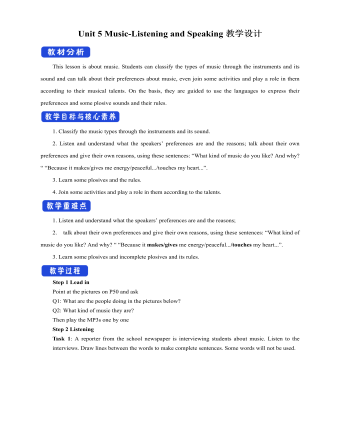
This lesson is about music. Students can classify the types of music through the instruments and its sound and can talk about their preferences about music, even join some activities and play a role in them according to their musical talents. On the basis, they are guided to use the languages to express their preferences and some plosive sounds and their rules.1. Classify the music types through the instruments and its sound.2. Listen and understand what the speakers’ preferences are and the reasons; talk about their own preferences and give their own reasons, using these sentences: “What kind of music do you like? And why? “ “Because it makes/gives me energy/peaceful.../touches my heart...”.3. Learn some plosives and the rules.4. Join some activities and play a role in them according to the talents. 1. Listen and understand what the speakers’ preferences are and the reasons;2. talk about their own preferences and give their own reasons, using these sentences: “What kind of music do you like? And why? “ “Because it makes/gives me energy/peaceful.../touches my heart...”.3. Learn some plosives and incomplete plosives and its rules.Step 1 Lead inPoint at the pictures on P50 and ask Q1: What are the people doing in the pictures below?Q2: What kind of music they are?Then play the MP3s one by oneStep 2 ListeningTask 1: A reporter from the school newspaper is interviewing students about music. Listen to the interviews. Draw lines between the words to make complete sentences. Some words will not be used.
新人教版高中英语选修1Unit 4 Body Language教案
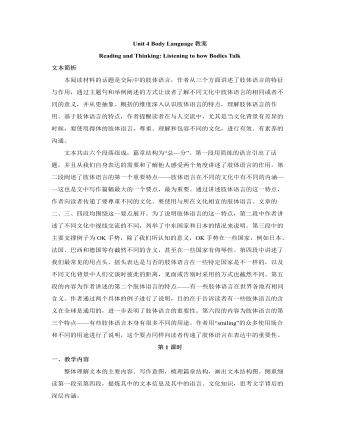
本阅读材料的话题是交际中的肢体语言,作者从三个方面讲述了肢体语言的特征与作用,通过主题句和举例阐述的方式让读者了解不同文化中肢体语言的相同或者不同的意义,并从更抽象、概括的维度深入认识肢体语言的特点,理解肢体语言的作用。基于肢体语言的特点,作者提醒读者在与人交流中,尤其是当文化背景有差异的时候,要使用得体的肢体语言,尊重、理解和包容不同的文化,进行有效、有素养的沟通。文本共由六个段落组成,篇章结构为“总—分”。第一段用简练的语言引出了话题,并且从我们自身表达的需要和了解他人感受两个角度讲述了肢体语言的作用。第二段阐述了肢体语言的第一个重要特点——肢体语言在不同的文化中有不同的内涵——这也是文中写作篇幅最大的一个要点,最为重要。通过讲述肢体语言的这一特点,作者向读者传递了要尊重不同的文化、要使用与所在文化相宜的肢体语言。
新人教版高中英语选修3Unit 2 Healthy Lifestyle教案
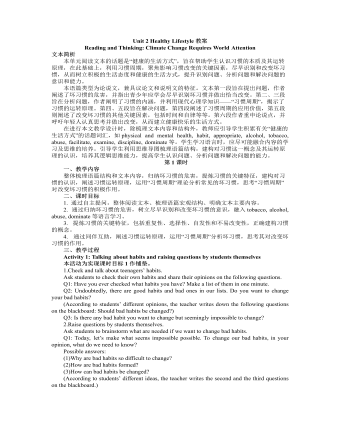
Activity 4: Figuring out the structure and the writing purpose 本活动为实现课时目标2。 1.Read Paragraph 6 and think about its main idea and the writer’s writing purpose. Q1: If you were the author, how would you end your article? “For young people, there is plenty of time to change bad habits. However, there is no “magic pill” or delete button that will help you; you have to think about your bad habits and decide on some changes. You have the power to build a happy and healthy life full of good habits!” Q2: What is Paragraph 6 mainly about? (Possible answer: to appeal to young people including teenagers to change bad habits and live a happy and healthy life.) 2.Think about the writer’s writing purpose and share opinions. Q1: What is the writing purpose? Work in pairs and figure it out. (Possible answer: On the one hand, the passage is written to help teenagers change their bad habits and live a healthy lifestyle. On the other hand, it provides us with a scientific way to identify and analyse our problems objectively, thus strengthening our resolve to tackle the seemingly common yet tough problems in our lives.) 【设计意图】 步骤1旨在预测和验证文章最后一段主要内容,梳理完整的语篇结构,步骤2旨在思考和讨论作者的写作目的。教师也可根据学生课堂反应情况融入对语篇人称多次转换的思考。
新人教版高中英语选修3Unit 5 Poems教案
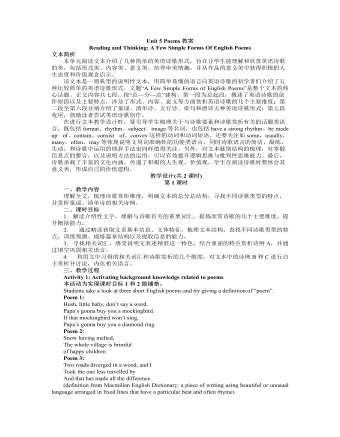
本单元阅读文本介绍了几种简单的英语诗歌形式,旨在让学生能理解和欣赏英语诗歌的美,包括形式美、内容美、意义美,培养审美情趣,并从作品的意义美中获得积极的人生态度和价值观念启示。 该文本是一则典型的说明性文本,用简单易懂的语言向英语诗歌的初学者们介绍了五种比较简单的英语诗歌形式。文题“A Few Simple Forms of English Poems”是整个文本的核心话题。正文内容共七段,按“总—分—总”建构。第一段为总起段,概述了英语诗歌的创作原因以及主要特点,涉及了形式、内容、意义等方面赏析英语诗歌的几个主要维度;第二段至第六段分别介绍了童谣、清单诗、五行诗、俳句和唐诗五种英语诗歌形式;第七段收尾,鼓励读者尝试英语诗歌创作。 在进行文本教学设计时,要引导学生梳理关于与诗歌要素和诗歌赏析有关的话题类语言,既包括format、rhythm、subject、image等名词,也包括have a strong rhythm、be made up of、contain、consist of、convey这样的动词和动词短语。
新人教版高中英语选修4Unit 5 Language Your Career教案
本单元阅读文本向中学生推荐职业能力测试(Career Aptitude Test),旨在建议学生利用职业倾向测试来发现自己更感兴趣、更有潜力的学习或职业方向,并规划自己的未来职业。 本文采用了建议性文本,全篇从职业生涯的重要意义讲起,针对中学生对职业规划比较迷茫的现状,提出了职业倾向测试这一建议。全文共七段,其中第一段和第二段为第一部分,其余五段为第二部分。第一部分论述职业的重要性和职业生涯规划的最佳时间是在校期间,第二部分提出解决职业选择困惑可以通过完成职业能力测试,介绍了不同种类的职业倾向测试,结合图表详细说明其中一种操作步骤,并提醒职业建议也基于学历和经验,最后一段概括论述,建议学生通过职业能力测试这一有效的工具,找到自己真正热爱的事物。 在文本教学设计时,要帮助学生梳理有关职业的话题语言。阅读策略层面,指导学生通过学习图表和图形,在有限的空间内获取广泛信息,如阅读图表标题,图表上的标签,X轴Y轴上的数据所指。
《姑苏行》教案
教学过程:【欣赏:《姑苏行》】教师活动:(1)《姑苏行》的曲作者江先谓,这首乐曲是用什么乐器演奏的,它属于八音分类的哪一类? (2)请学生分析《姑苏行》的风格特点是怎样的? 完整的聆听乐曲在你心中展现怎样的画面?(3)请学生试唱并吹奏《姑苏行》的主旋律。学生活动:(1)回答《姑苏行》的演奏乐器笛子是属于八音分类:竹类。(2)《姑苏行》的风格婉转悠扬,犹如一幅江南的水墨画。(3)试唱《姑苏行》的旋律。(4)竖笛吹奏《姑苏行》的旋律。
《姑苏行》教案
一、组织教学:师生问好。(同学们今天的状态真精神,希望你们表现的也会同样精彩。)二、导入:师:同学们,你们知道什么叫昆曲吗?今天老师给大家带来了一首关于根据昆曲和江南民歌为素材创作的歌曲。师:你们听出了这是什么乐器演奏的吗? 师:这是一首笛子独奏的歌曲。三、新课教学:1、聆听歌曲: 师:同学们,我们一同来听,这首歌曲描绘了什么样的印象? 生:在我们眼前描绘了一幅美丽的江南风光画卷。师:在这首乐曲结构上大家有什么发现呢?生:乐曲好像有3段组成。 师:小结,进行评价。 师:让我们再次聆听,同学们可以仔细聆听这首歌曲的表演特色?
《姑苏行》教案
教学过程:1、图片导课(寒山寺)——诗《枫桥夜泊》——欣赏歌曲《涛声依旧》。2、导出《姑苏行》,聆听音乐,图片诱导情感。3、给出问题再次聆听,然后解决问题。《姑苏行》采用昆曲音调,具有江南风味。乐曲典雅,表现了古城苏州(古称姑苏)的秀丽风光和人们游览时的愉悦心情。宁静的引子,是一幅晨雾依稀、楼台亭阁、小桥流水诱人画面。抒情的行板,使游人尽情的观赏精巧秀丽的姑苏园林。中段是热情的小快板,游人嬉戏,情溢于外。接着再现主题,在压缩的音调中,更感旋律婉转动听,使人久久沉浸在美景中,流连忘返,令人寻味。此曲韵味深长,发挥了曲笛音色柔美,宽厚而圆润的特征,再结合南方笛子演奏常使用叠音、打音、颤音等技巧,使乐曲表现更加动人完美。
《千人糕》教案
一、谈话导入师:同学们,中国有句俗话叫“民以食为天”,你们喜欢美食吗?(喜欢)老师也喜欢吃,不过我们可别光顾着吃,我们要认识它,还要记住他们的名字。(课件出示米糕图片)。1、师:看,老师给你们带来了什么?(米糕)生活中,你们除了吃过米糕,还吃过什么糕呢?(课件出示词语:蛋糕、雪糕、糕点。)领读词语。2、师:不论是蛋糕、雪糕,还是糕点,味道上都有一个共同点是()?甜,是因为在里面加入了糖,(出示糖的卡片认读生字“糖”)课件出示生活中常见的糖的图片,齐读词语。3、引导观察生字“糕、糖”,发现共同点,引出“粉”。交流“粉”的识字方法,引出“芬、份、纷、扮”,出示词语:粉丝、粉笔、面粉。齐读。
天地人教案
一、谈话导入从这节课开始,我们就要在拼音朋友的帮助下,到识字王国去认识更多的汉字朋友啦!老师真为你们高兴!现在,让我们一起快乐地向识字王国出发吧!二、观察图画,揭示课题1、看图说话,出示书本封面,你看到了什么?引出天、地、人。(PPT1)2、指名读:谁能读读?你是怎么认识这几个字的?3、请小老师带领大家轻声跟读(两遍)。4、出示课题。(PPT2)
人教部编版七年级语文上册狼教案
(学生交流,教师引导,总结方法)(1)方法1:主谓之间要停顿。【示例】一狼/得骨/止;其一/犬坐于前。(2)方法2 :谓语与宾语之间要停顿。【示例】顾/野有麦场;乃悟/前狼/假寐 。(3)方法3:连词前面可以停顿。【示例】后狼止/而前狼又至;意将/隧入/以攻其后也。(4)方法4 :发语词后面要停顿。【示例】盖/以诱敌。(全班齐读课文,读顺文章)师小结:理解文意,固然可以运用停顿技巧,但最重要的方法是弄懂字词大意、文句意思。理解了文意,才能读准句读,有利于我们读顺文章。【设计意图】本环节旨在通过学习互助的方式,调动学生的学习热情,充分发挥学生的学习积极性和主动性,进而理解文意,读顺文章。教师及时点拨,适时归纳文言释词方法、句式和停顿划分小技巧,实现知识学习与技能掌握的统一。四、细读课文,读懂内容1.概括文章情节文章讲述了屠户杀狼的故事。按照事件的发展,情节一般可以分为开端(发生)、发展、高潮和结局。请同学们细读课文后,用词语概括这个故事的发展经过。(生交流后,师明确)
人教部编版七年级语文上册春教案
本文具有很强的画面感,凸显出绘画美,虽是散文,却满贮诗意,正是文中有画,画中有诗。作者从色泽、层次和动态上向人们展示了一幅栩栩如生的春景图。作者笔下的春景图色泽鲜艳,不仅有象征希望的“嫩嫩的,绿绿的”小草,还有“红的像火,粉的像霞,白的像雪”的繁花,也有温暖的“红红的”太阳的脸和“黄晕的”灯光,这些色彩描绘出了一个生机勃勃而又安静祥和的春天。在描写春景的时候,作者还通过有层次感的描写使景物意蕴悠长,例如对春雨的描写是从“人家屋顶上”到“小路上”“石桥边”再到“地里”,从远至近,层次分明。另外,朱自清使用精妙的语言向读者展示了动态(生机)美,在他笔下,花是“赶趟儿”的,蜜蜂是“闹着”的,气味儿是“酝酿”的,一切都是“生长着”的,洋溢着盎然的生机。作者从总体上描绘春景,大地回春、万物复苏的景象就活生生地展现在了读者眼前。