-
人教版高中语文必修1《再别康桥》教案2篇
教学过程:一、交流诵读课文技巧。——节奏、韵脚、感情……(5分钟)二、再读确定自己的学习主题(15分)1、主题提示:音乐美、绘画美、建筑美简介诗歌“三美”追求闻一多先生是我国现代文学史上集诗人、学者和斗士于一身的重要诗人。他不但致力于新诗艺术美的探索,提出了音乐美、绘画美、建筑美的诗歌\"三美\"的新格律诗理论主张,还努力进行创作实践,写出了许多精美诗篇。他的新格律诗理论被后人称为现代诗学的奠基石,影响深远。《诗的格律》是闻一多先生系列诗论中最重要的一篇。在这篇论文中,他系统的提出\"诗的实力不独包括音乐的美(音节)、绘画的美(词藻),并且还有建筑的美(节的匀称和句的均齐)。\"这一关于新诗\"三美\"主张遂成为新格律诗派的理论纲领。
人教版高中语文必修2《演讲》教案2篇
一个世纪前,一位了不起的美国人签署了奴隶解放宣言,而我们今天就站在他的塑像下面。对于千千万万身受不公正待遇之苦的黑奴来说,这份划时代的文件,是一座光芒万丈的希望灯塔,是结束他们被束缚之漫漫长夜的快乐黎明。我有一个梦,有朝一日在乔治亚州的丘陵地带,奴隶的后代与奴隶主的后代,将能够兄弟般地相处。我有一个梦,有朝一日甚至密西西比州,这个充满不平与压迫的州,将转化成一片自由与公正的绿洲。我有一个梦,我的四个孩子,有朝一日将可以生活在这样一个国度里:在此人们不是根据他们的肤色,而是根据他们的品行来衡量他们。我今天有一个梦!我有一个梦,有朝一日在阿拉巴马州,尽管目前有许多恶毒的种族主义者,尽管州长叫嚷着要与联邦政府对抗,有朝一日在阿拉巴马州,黑人孩子与白人孩子将会像兄弟姊妹那样亲密无间。
人教版高中语文必修4《李贺小传》教案
一、明确目标1.注意小传的写作特色,如小传的“小”以及是怎样小中见大的。2.引导学生进行综合把握和比较阅读以更好地理解课文内容,看看在写法上各自有什么不同。3.一词多义的准确知识运用二、整体感知1.解题李商隐的《李贺小传》有别于一般传记文的客观直叙,是一篇性情之文;同时也和作者的诗歌风格相异,写得朴实自然而又不乏意趣。2.本文所体现的“小传”的特点本文最大的特点在于:小传虽小,但小中有大、以小见大。其“小”在于:作者并没有全面勾勒诗人李贺的一生,对他的生平经历也记叙不多,而是选取了他生活中的若干小片段进行插叙,以小片段撑起传记的主干。此外,在篇幅上,全文寥寥数百字,语言极为精练。而其“大”又体现在:极小极短的篇幅却具有很大的容量,集叙事、议论和曲折的抒情于一体。内容浑厚,意味深长。
人教版高中语文必修4《廉颇蔺相如列传》教案
(2)个性化的对话描写。在三个事件的描述中,大段对话占了很大篇幅,有的情节干脆由对话来表达,许多对话形象地表现了人物的思想和性格,使我们如闻其声,如见其人。先说蔺相如,他在秦廷上的慷慨陈词,有时语气平和,谦恭有礼,使对方放松警惕;有时直言斥责,有理有据,雄辩折人;有时坚决表态,分析利害,暗示对方;有时怒不可遏,咄咄逼人。总之,词锋犀利,刚柔兼施,而又轻重恰当,充分表现了他是一个热爱祖国、不畏强暴、有智有勇,长于辞令的外交家。再说廉颇,在将相交欢事件中,他先前说的这一番话,表现了他的自高自大和心胸狭窄,非常符合武将廉颇的性格特点,后来写他知过改过,负荆请罪时说:“鄙贱之人,不知将军宽之至此也!”语言不多,坦诚直率,可敬可爱。(解说:对话描写的分析,宜以学生为主,教师必要时适当点拨。)
人教版高中语文必修5《陈情表》教案
【教学目标】1.熟读全文,掌握文中出现的重要的实词、虚词、古汉语句式;2.鉴赏本文融情于事的表达和形象精粹的语言;3.深入体会文章凄切婉转的陈情技巧。【教学重点】重要的古汉语语词知识【教学难点】理解作者当时的处境和李密祖孙间真挚深厚的感情【教学方法】作为教读课,选择串讲的方式,突出朗读,以期能做到既落实知识,又能体会文章之美。课时安排为两课时。要重点做好预习工作。【教学步骤】一、以苏轼的评论导入读《出师表》不下泪者,其人必不忠;读《陈情表》不下泪者,其人必不孝;读《祭十二郎文》不下泪者,其人必不友二、预习检测1、下列红色字注音完全正确的一项()A、臣以险衅(xìn)夙遭闵(mǐn)凶终鲜(xiǎn)兄弟常在床蓐(rù)B、猥(wěi)以微贱责臣逋(bǔ)慢犹蒙衿(jīn)育宠命优渥(wò)C、岂敢盘桓(huán)有所希冀(yì)日薄(bó)西山除臣洗(xiǎn)马D、逮(dǎi)奉圣朝过蒙拔擢(zhuó)门衰祚(zuò)薄更(gēng)相为命分析:B责臣逋(bū)慢,C有所希冀(jì),D逮(dài)奉圣朝。
人教版高中语文必修4《张衡传》教案
采用明段意分段法:先逐段概括段意,然后用合并同类项法把相关联紧缩密的自然段合在一起。全文五个自然段中,二、三、四自然段讲的都是张衡取得的科学成就,自然应合为一大段。这样,就理清了文章的结构。全文可分为三个部分:(1)写张衡的品格和文才①(2)写张衡在科学技术上取得的成就(②③④)(3)写张衡的政治才干(⑤)第二部分是文章的重点,又可分为两层:一是仕途情况,以及制作浑天仪和著《灵宪》、《算图论》的情况;一是专门介绍候风地支仪。显然,后者又是第二部分的重点。作者这样处理文章的详略安排。无疑是非常正确的,因为张衡一生有多方面的才能和成就,而他在科技方面的才能和创造发明最为突出,理应成为本文记叙的重点。四、小结1.了解全文的内容和结构,掌握明段意分段法。2.了解文章的详略安排。五、作业
人教版高中语文必修4《长亭送别》教案
三.分析第三部分:1.夫妻赠诗表现了二人怎样的心情?提示:崔莺莺告诫张生切勿忘记她;张生则发誓永无别恋。这充分展示了二人深厚的情谊。2.怎样理解[耍孩儿]中的典故?提示:“红泪”借王嘉《拾遗记》的典故,司马青衫借白居易《琵琶行》的典故,表现主人公因离别而生的伤心之情。“伯劳飞去燕西归”则用牛郎织女的典故表现两人缠绵难舍的心情。3.[五煞]表明了主人公怎样的心情?提示:对张生的生活的关心,千叮万嘱,真情自现。4.[二煞]中所用是几个典故?这些典故的作用是什么?提示:三个典故,见课本。其作用是表明崔莺莺对张生的担心。四.分析第四部分:1.[一煞]中再写环境,其作用是否与先前所写相同?提示:稍有不同,这里是表现崔莺莺目送张生远去时那种凄怆悲苦的眷恋之情。以所见之物,写内心深藏之情。2.[收尾]中写‘残照’其含义是什么?提示:以“残照”表现内心的怅惘失意之情。
人教版高中语文必修5《逍遥游》教案
六、到此为止,我们了解到,作者对“笑”鲲鹏和别人的蜩与学鸠、斥鴳、宋荣子都一一作了否定。那么请大家讨论一下,1、作者对鲲鹏和“知效一官,行比一乡,德合一君,而征一国者”是不是肯定呢?明确:也都作了否定。否定后者好理解,关键是否定前者不好理解,因为“鲲鹏展翅”早已作为积极的意象被人们广泛引用。但在本文中,作者在讲述这一寓言故事时,突出的不是鲲鹏本身,而是风力,“故九万里,风斯在下矣,而后乃今培风;背负青天,而莫之夭阏者,而后乃今将图南”。对风力作用的突出,实际上就是对鲲鹏的否定。作者写了“笑”的双方,对“笑”的一方蜩与学鸠、斥鴳、宋荣子都作了否定,对被“笑”的一方鲲鹏和“知效一官,行比一乡,德合一君,而征一国者”也都作了否定,并且对顺便提及的野马、尘埃、芥、大舟、朝菌、蟪蛄、冥灵、大椿、彭祖、列子等事物或者人物也都作了否定。这种全盘否定的态度,如果我们借用本文中的一个形象的词语,可以说是:笑!是的,本文也可以说是:庄子“笑”万物!
人教版高中语文必修4《短文三篇》教案
③于是,大自然出现了惊人的奇迹,不毛的石缝间丛生出倔强的生命。④或者就只是一簇一簇无名的野草,春绿秋黄。岁岁枯荣。它们只有三两片长长的细瘦的薄叶,那细微的叶脉,告知你生存该是多么艰难;更有的。它们就在一簇一簇瘦叶下自己生长出根须,只为了少向母体吮吸一点乳汁,便自去寻找那不易被觉察到的石缝。这就是生命,如果这是一种本能,那么它正说明生命的本能是多么尊贵,生命有权自认为辉煌壮丽,生机竟是这样地不可扼制。⑤或者就是一团一团小小的山花,大多又都是那苦苦的蒲公英。它们不似田野上的同宗长得那样茁壮,它们的茎显得坚韧而苍老。它们的叶因枯萎而失却光泽。它们已经不能再去为人们作佐餐的鲜嫩的野菜,却默默地为攀登山路的人准备了一个可靠的抓手。生命就这样地被环境规定着,又被环境改变着,适者生存的规律尽管无情。但一切适者就是战胜环境的强者。生命现象告诉你,生命就是拼搏。
新人教版高中英语必修1Unit 2 Travelling Around-Discovering Useful Structure教案
(5)be to do (可以和具体的时间状语连用)①表示按计划、安排即将发生的动作。②用于时间、条件状语从句中,表示“如果要……,想要……”。The students are to meet at the school gate tomorrow. 明天学生们将在学校大门口集会。 If you are to succeed, you must work as hard as possible. 如果你想要成功,比必须努力工作。(6)be about to do (不与具体的时间状语连用) 表示即将要发生的动作。We are about to start. 我们就要出发了。The new school year is about to begin. 新学年开学在即。(7)一般现在时表将来①表示按时间表规定将要发生的动作。常限于表示位置移动的短暂性动词。②在时间、条件或让步状语从句中,用一般现在时表将来。Look at the timetable. Hurry up! Flight 4026 takes off at 18:20. 你看看时刻表,快点!4026次航班的起飞时间是下午6点20分。Jane is in a hurry because the train to the airport leaves in half an hour. 简很匆忙,因为去机场的火车半小时后出发。
新人教版高中英语必修1Unit 2 Travelling Around-Reading for Writing教案
Is there a clear purpose for the trip? :Does each paragraph have a clear main idea? Does the writer use the present continuous tense for future plans?Does the writer use commas, stops, and question marks correctly? Are all the words spelt correctly?Are all the proper nouns capitalized?Revise your draft according to your partner's comments.Step 5:The summary of how to write a travel plan.旅游计划是一种常见的应用文写作。旅游可分为观光游、文化游、美食游及探险游等不同类型,因此旅游计划也要根据不同的旅游目的进行设计。常规的旅游计划需要明确以下几个方面的问题:Travel planWhen will you leave for? Where is your the destination?How will you get there?What will you do there?How long will you there?Is there a clear purpose for the trip? 为了提升旅行计划的层级,还需注意以下几个方面的问题:1.每段是否有明确清晰的主题;2.用一般现在时代替一般将来时;3.用更高级的形容词词汇。例如:表达“好”时,不要总用“nice”,我们还可以用“smart, clean, excellent, exciting, beautiful, wonderful, clever, famous, grand”等表达更具有指向性的词汇;4.用更高级的动词词汇。比如:我们可以用“seem stand, lie .get stay, remain, look . sound, become . keep, grow”等代替"be";
新人教版高中英语必修1Unit 4 Natural Disasters-Reading & Thinking教案
5. Read to get detailed information about Paragraph 5.Q1. What shows the revival of Tangshan?Q2. How can Tangshan revive itself and get up on its feet again?Q3. In times of disasters, how can we go through it?T: In times of disasters, we should unify, show the wisdom and stay positive.Step 4 Activity 4 Highlighting the theme and reflecting1. Make a summary of the text.2. Further understand the titleQ: After our learning, why do you think the earth didn’t sleep on that night?T: An earthquake happened. The people in the earthquake suffered a lot, and the people outside Tangshan were concerned about the people there a lot.3. Reflect through discussion on what can be learnt after reading.T: Disasters are powerful. Unpreparedness can be deadly. Life is weak, but if people work together to help each other, disasters can be defeated.There is no love from disaster, but we have love in the human heart.Step 5 Assignment How does the writer convey that the earthquake was deadly, and that people were helpless during the earthquake? Try to find some attractive and impressive expressions and note them down.
新人教版高中英语必修1Welcome Unit-Discovering Useful Structures & Listening and Talking教案
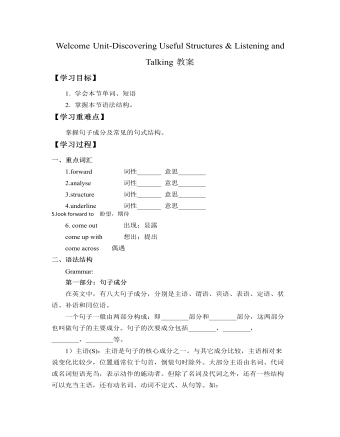
常跟双宾语的动词有:(需借助to的)bring, ask, hand, offer, give, lend, send, show, teach, tell, write, pass, pay, promise, return等;基本句型 五S +V + O + OC(主+谓+宾+宾补)特点:动词虽然是及物动词,但是只跟一个宾语还不能表达完整的意思,必须加上一个补充成分来补足宾语,才能使意思完整。 判断原则:能表达成—宾语 是…/做…注:此结构由“主语+及物的谓语动词+宾语+宾语补足语”构成。宾语与宾语补足语之间有逻辑上的主谓关系或主表关系,若无宾语补足语,则句意不够完整。可以用做宾补的有:名词,形容词,副词,介词短语,动词不定式,分词等。如:He considers himself an expert on the subject.他认为自己是这门学科的专家。We must keep our classroom clean.我们必须保持教室清洁。I had my bike stolen.我的自行车被偷了。We invited him to come to our school.我们邀请他来我们学校。I beg you to keep secret what we talked here.我求你对这里所谈的话保密。用it做形式宾语,而将真正的宾语放到宾语补足语的后面,以使句子结构平衡,是英语常用的句型结构方式。即:主语+谓语+it+宾补+真正宾语。如:We think it a good idea to go climb the mountain this Sunday.
新人教版高中英语必修2Unit 1 Cultural Heritage-Discovering Useful Structure教案二
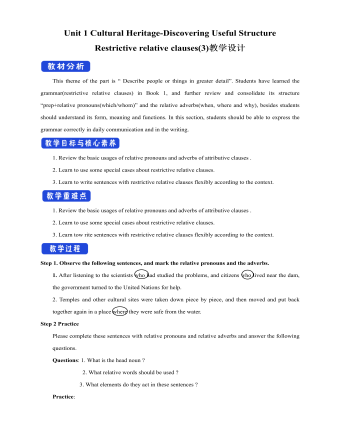
This theme of the part is “ Describe people or things in greater detail”. Students have learned the grammar(restrictive relative clauses) in Book 1, and further review and consolidate its structure “prep+relative pronouns(which/whom)” and the relative adverbs(when, where and why), besides students should understand its form, meaning and functions. In this section, students should be able to express the grammar correctly in daily communication and in the writing. 1. Review the basic usages of relative pronouns and adverbs of attributive clauses . 2. Learn to use some special cases about restrictive relative clauses.3. Learn to write sentences with restrictive relative clauses flexibly according to the context.1. Review the basic usages of relative pronouns and adverbs of attributive clauses .2. Learn to use some special cases about restrictive relative clauses.3. Learn tow rite sentences with restrictive relative clauses flexibly according to the context.Step 1. Observe the following sentences, and mark the relative pronouns and the adverbs. 1. After listening to the scientists who had studied the problems, and citizens who lived near the dam, the government turned to the United Nations for help.2. Temples and other cultural sites were taken down piece by piece, and then moved and put back together again in a place where they were safe from the water.Step 2 PracticePlease complete these sentences with relative pronouns and relative adverbs and answer the following questions.Questions: 1. What is the head noun ?2. What relative words should be used ?3. What elements do they act in these sentences ?
新人教版高中英语必修2Unit 1 Cultural Heritage-Discovering Useful Structure教案一
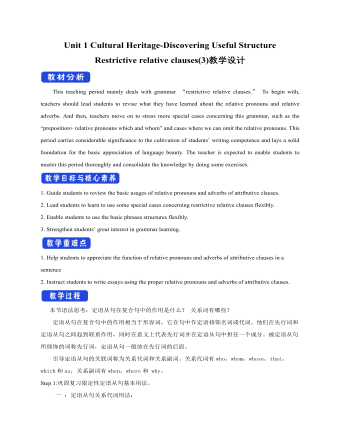
This teaching period mainly deals with grammar “restrictive relative clauses.” To begin with, teachers should lead students to revise what they have learned about the relative pronouns and relative adverbs. And then, teachers move on to stress more special cases concerning this grammar, such as the “preposition+ relative pronouns which and whom” and cases where we can omit the relative pronouns. This period carries considerable significance to the cultivation of students’ writing competence and lays a solid foundation for the basic appreciation of language beauty. The teacher is expected to enable students to master this period thoroughly and consolidate the knowledge by doing some exercises. 1. Guide students to review the basic usages of relative pronouns and adverbs of attributive clauses.2. Lead students to learn to use some special cases concerning restrictive relative clauses flexibly.2. Enable students to use the basic phrases structures flexibly.3. Strengthen students’ great interest in grammar learning.1. Help students to appreciate the function of relative pronouns and adverbs of attributive clauses in a sentence2. Instruct students to write essays using the proper relative pronouns and adverbs of attributive clauses.本节语法思考:定语从句在复合句中的作用是什么? 关系词有哪些?定语从句在复合句中的作用相当于形容词,它在句中作定语修饰名词或代词。他们在先行词和定语从句之间起到联系作用,同时在意义上代表先行词并在定语从句中担任一个成分。被定语从句所修饰的词称先行词,定语从句一般放在先行词的后面。
新人教版高中英语必修2Unit 1 Cultural Heritage-Reading and Thinking教案二
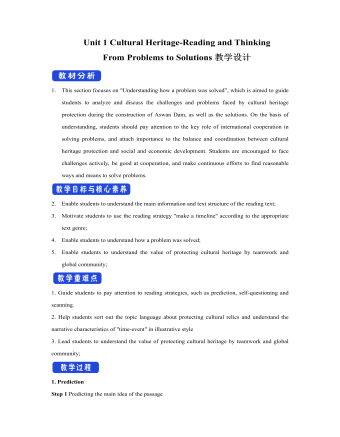
1. This section focuses on "Understanding how a problem was solved”, which is aimed to guide students to analyze and discuss the challenges and problems faced by cultural heritage protection during the construction of Aswan Dam, as well as the solutions. On the basis of understanding, students should pay attention to the key role of international cooperation in solving problems, and attach importance to the balance and coordination between cultural heritage protection and social and economic development. Students are encouraged to face challenges actively, be good at cooperation, and make continuous efforts to find reasonable ways and means to solve problems.2. Enable students to understand the main information and text structure of the reading text;3. Motivate students to use the reading strategy "make a timeline" according to the appropriate text genre;4. Enable students to understand how a problem was solved;5. Enable students to understand the value of protecting cultural heritage by teamwork and global community;1. Guide students to pay attention to reading strategies, such as prediction, self-questioning and scanning.2. Help students sort out the topic language about protecting cultural relics and understand the narrative characteristics of "time-event" in illustrative style3. Lead students to understand the value of protecting cultural heritage by teamwork and global community;
新人教版高中英语必修2Unit 1 Cultural Heritage-Reading and Thinking教案一
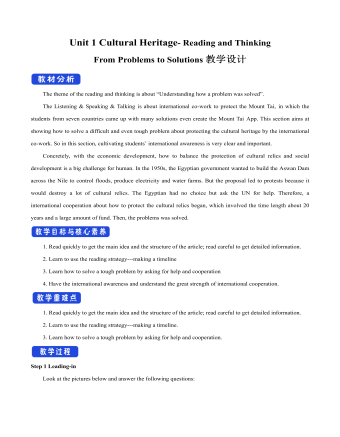
The theme of the reading and thinking is about “Understanding how a problem was solved”.The Listening & Speaking & Talking is about international co-work to protect the Mount Tai, in which the students from seven countries came up with many solutions even create the Mount Tai App. This section aims at showing how to solve a difficult and even tough problem about protecting the cultural heritage by the international co-work. So in this section, cultivating students’ international awareness is very clear and important. Concretely, with the economic development, how to balance the protection of cultural relics and social development is a big challenge for human. In the 1950s, the Egyptian government wanted to build the Aswan Dam across the Nile to control floods, produce electricity and water farms. But the proposal led to protests because it would destroy a lot of cultural relics. The Egyptian had no choice but ask the UN for help. Therefore, a international cooperation about how to protect the cultural relics began, which involved the time length about 20 years and a large amount of fund. Then, the problems was solved. 1. Read quickly to get the main idea and the structure of the article; read careful to get detailed information.2. Learn to use the reading strategy---making a timeline3. Learn how to solve a tough problem by asking for help and cooperation4. Have the international awareness and understand the great strength of international cooperation.1. Read quickly to get the main idea and the structure of the article; read careful to get detailed information.2. Learn to use the reading strategy---making a timeline.3. Learn how to solve a tough problem by asking for help and cooperation.
新人教版高中英语必修2Unit 1 Cultural Heritage-Reading For Writing教案
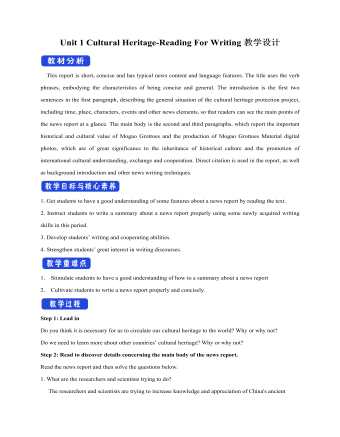
This report is short, concise and has typical news content and language features. The title uses the verb phrases, embodying the characteristics of being concise and general. The introduction is the first two sentences in the first paragraph, describing the general situation of the cultural heritage protection project, including time, place, characters, events and other news elements, so that readers can see the main points of the news report at a glance. The main body is the second and third paragraphs, which report the important historical and cultural value of Mogao Grottoes and the production of Mogao Grottoes Material digital photos, which are of great significance to the inheritance of historical culture and the promotion of international cultural understanding, exchange and cooperation. Direct citation is used in the report, as well as background introduction and other news writing techniques.1. Get students to have a good understanding of some features about a news report by reading the text.2. Instruct students to write a summary about a news report properly using some newly acquired writing skills in this period.3. Develop students’ writing and cooperating abilities.4. Strengthen students’ great interest in writing discourses.1. Stimulate students to have a good understanding of how to a summary about a news report 2. Cultivate students to write a news report properly and concisely.Step 1: Lead in Do you think it is necessary for us to circulate our cultural heritage to the world? Why or why not?Do we need to learn more about other countries’ cultural heritage? Why or why not?Step 2: Read to discover details concerning the main body of the news report.
新人教版高中英语必修2Unit 2 Wildlife Protection-Listening &Speaking&Talking教案
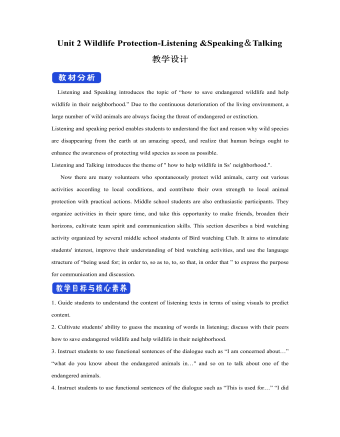
Listening and Speaking introduces the topic of “how to save endangered wildlife and help wildlife in their neighborhood.” Due to the continuous deterioration of the living environment, a large number of wild animals are always facing the threat of endangered or extinction. Listening and speaking period enables students to understand the fact and reason why wild species are disappearing from the earth at an amazing speed, and realize that human beings ought to enhance the awareness of protecting wild species as soon as possible.Listening and Talking introduces the theme of " how to help wildlife in Ss’ neighborhood.". Now there are many volunteers who spontaneously protect wild animals, carry out various activities according to local conditions, and contribute their own strength to local animal protection with practical actions. Middle school students are also enthusiastic participants. They organize activities in their spare time, and take this opportunity to make friends, broaden their horizons, cultivate team spirit and communication skills. This section describes a bird watching activity organized by several middle school students of Bird watching Club. It aims to stimulate students' interest, improve their understanding of bird watching activities, and use the language structure of “being used for; in order to, so as to, to, so that, in order that ” to express the purpose for communication and discussion.1. Guide students to understand the content of listening texts in terms of using visuals to predict content.2. Cultivate students' ability to guess the meaning of words in listening; discuss with their peers how to save endangered wildlife and help wildlife in their neighborhood.3. Instruct students to use functional sentences of the dialogue such as “I am concerned about…” “what do you know about the endangered animals in…" and so on to talk about one of the endangered animals.
新人教版高中英语必修2Unit 4 History and Traditions-Discovering Useful Structure教案一
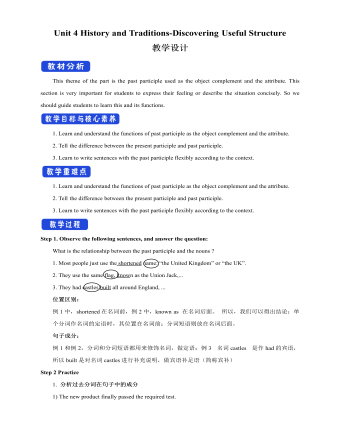
Step 5 Practice一、完成下列句子。1. Judy and I _______________(把车停下来(park))in an underground car Park near Trafalgar Square, where we could ______________________(让我们的车充电(charge)).2. When we finally reached the service desk to ask for audio guides, we heard it ___________ that there were no audio guides____________(留下,剩下).3. We__________________________(发现自己对...很惊讶)the large number of visitors and the amount of noise at the entrance of the National Gallery.4. Judy ____________________(眼神专注于) Van Gogh’s Sunflowers. It was hard to approach the painting as there were so many people around.5. She ____________________(把这幅画的复制品装箱(box)) to ensure that it was delivered safely.答案:1.had our car parked get our car battery charged 2. announced left 3. found ourselves very surprised 4. had her eyes fixed on 5. had a copy of the painting boxed二、用过去分词对下列句子进行改写。1. Loch Ness was surrounded by beautiful natural landscape, which made it look amazing.2. Carl and his friend stayed with a generous family who offered them bread with butter and honey that was homemade.3. The family’s ancestors once attended to soldiers who were wounded in the First World War.4. The young people were attracted by the legend of Loch Ness. They watched over the lake with their cameras and binoculars, which were positioned on the hill.答案:1. Loch Ness surrounded by beautiful natural landscape looks amazing.2. Carl and his friends stayed with a generous family who offered them homemade bread with butter and honey.3. The family’s ancestors once attended to wounded soldiers in the First World War.4. The young people attracted by the legend of Loch Ness watched over the lake with their cameras and binoculars positioned on the hill.