-
新人教版高中英语选修2Unit 5 Reading and thinking教学设计
The theme of this activity is to learn the first aid knowledge of burns. Burns is common in life, but there are some misunderstandings in manual treatment. This activity provides students with correct first aid methods, so as not to take them for granted in an emergency. This section guides students to analyze the causes of scald and help students avoid such things. From the perspective of text structure and collaborative features, the text is expository. Expository, with explanation as the main way of expression, transmits knowledge and information to readers by analyzing concepts and elaborating examples. This text arranges the information in logical order, clearly presents three parts of the content through the subtitle, accurately describes the causes, types, characteristics and first aid measures of burns, and some paragraphs use topic sentences to summarize the main idea, and the level is very clear.1. Guide students to understand the causes, types, characteristics and first aid methods of burns, through reading2. Enhance students’ ability to deal withburnss and their awareness of burns prevention3. Enable students to improve the ability to judge the types of texts accurately and to master the characteristics and writing techniques of expository texts.Guide students to understand the causes, types, characteristics and first aid methods of burns, through readingStep1: Lead in by discussing the related topic:1. What first-aid techniques do you know of ?CPR; mouth to mouth artificial respiration; the Heimlich Manoeuvre
新人教版高中英语必修3Unit 2 Morals and Virtues教学设计二
Activity 41. Students complete the task of activity 4, then teachers and students check the answers. 2. The teacher organized the students to work together and asked them to use the tables and mind maps sorted out before to retold the important choices in Lin Qiaozhi's life and their resultsStep 5 Language points1. The teacher asks the students to read the text carefully, find out the core words and long and difficult sentences in the text and draw lines, understand the use of vocabulary, and analyze the structure of long and difficult sentences. 2. The teacher explains and summarizes the usage of core vocabulary and asks the students to take notes. 3. The teacher analyzes and explains the long and difficult sentences that the students don't understand, so that the students can understand them better. Step 6 Homework1. Read the text again, in-depth understanding of the text; 2. Master the use of core vocabulary and understand the long and difficult sentences. 3. Complete relevant exercises in the guide plan. 1、通过本节内容学习,学生是否理解和掌握阅读文本中的新词汇的意义与用法;2、通过本节内容学习,学生能否结合文本特点总结林巧稚的人生原则和人格品质特征;3、通过本节内容学习,学生能否针对人生抉择发表自己的看法;能否全面地、客观地、理性地看待问题,进而对道德和人性有更加深入的思考和理解。
新人教版高中英语必修3Unit 2 Morals and virtues教学设计一
(2) students are divided into groups according to the requirements of activity 3. Each student shares a story of personal experience or hearing-witnessing kindness, and then selects the most touching story in the group and shares it with the whole class. Before the students share the story, the teacher can instruct them to use the words and sentence patterns in the box to express. For example, the words in the box can be classified:Time order: first of all, then, after that, later, finally logical relationship :so, however, although, butTeachers can also appropriately add some transitional language to enrich students' expression:Afterwards, afterwards, at last, in the end, eventuallySpatial order: next to, far from, on the left, in front ofOtherwise, nevertheless, as a result, therefore, furthermore, in addition, as well asSummary: in a word, in short, on the whole, to sum up, in briefStep 8 Homework1. Understand the definition of "moral dilemma" and establish a correct moral view;2. Accumulate vocabulary about attitudes and emotions in listening texts and use them to express your own views;3. Complete relevant exercises in the guide plan.1、通过本节内容学习,学生能否理解理解“道德困境”的定义;2、通过本节内容学习,学生能否通过说话人所表达的内容、说话的语气、语调等来判断其态度和情绪;3、通过本节内容学习,学生能否针对具体的道德困境发表自己的看法和见解,能否掌握听力理训练中的听力策略。
新人教版高中英语必修3Unit 3 Diverse Cultures教学设计三
The price is the same as(the price was)before the war.价格与战前相同。(4)定语从句中的“关系代词+助动词be”可以省略。The ticket(that/which was)booked by his sister has been sent to him.他妹妹订的那张票已送到了他那里。Step 5 PracticeActivity 3(1) Guide students to complete the four activities in the Using Structures part of exercise book, in which activities 1 and 2 focus on ellipsis in dialogue answers, activity 3 focus on signs and headlines, two typical situations where ellipsis is used, and activity 4 focus on ellipsis in diary, an informal style.(2) Combine the examples in the above activities, ask students to summarize the omitted situations in groups, and make their own summary into a poster, and post it on the class wall after class to share with the class.(This step should give full play to the subjectivity of students, and teachers should encourage students to conclude different ellipsis phenomena according to their own understanding, they can conclude according to the different parts omitted in the sentence.)Step 6 Homework1. Understand and master the usages of ellipsis;2. Finish the other exercises in Using structures of Workbook.1、通过本节内容学习,学生是否理解和掌握省略的用法;2、通过本节内容学习,学生能否根据上下文语境或情景恢复句子中省略的成分,体会使用省略的效果;3、通过本节内容学习,学生能否独立完成练习册和导学案中的相关练习。
新人教版高中英语必修3Unit 3 Diverse Cultures教学设计四
该板块的活动主题是“介绍一个有显著文化特征的地方”( Describe a place with distinctive cultural identity)。该板块通过介绍中国城继续聚焦中国文化。本单元主题图呈现的是旧金山中国城的典型景象, Reading and Thinking部分也提到中国城,为该板块作铺垫。介绍中国城的目的主要是体现中国文化与美国多元文化的关系,它是美国多元文化的重要组成部分。中国城也是海外华人的精神家园和传播中国文化的重要窗口,外国人在中国城能近距离体验中国文化。1. Read the text to understand the cultural characteristics of Chinatown in San Francisco and the relationship between Chinese culture and American multiculturalism;2. Through reading, learn to comb the main information of the article, understand the author's writing purpose and writing characteristics;3. Learn to give a comprehensive, accurate, and organized description of the city or town you live in;Learn to revise and evaluate your writing.Importance:1. Guide the students to read the introduction of Chinatown in San Francisco and grasp its writing characteristics;2. Guide students to introduce their city or town in a comprehensive, accurate and organized way;3. Learn to comb the main information of the article, understand the author's writing purpose, and master the core vocabulary.
新人教版高中英语选修2Unit 3 Learning about Language教学设计
1. We'll need ten months at least to have the restaurant decorated.2.Some traditional Chinese dishes from before the Ming Dynasty are still popular today.3.My grandpa's breakfast mainly includes whole grain biscuits and a glass of milk.4.People in this area would eat nearly a kilo of cheese per week.5. We enjoyed a special dinner in a fancy restaurant where the waiters all wore attractive suits.6. He prefers this brand of coffee which, as he said, has an unusually good flavor.Key:1. at a minimum 2. prior to3. consist of4. consume5. elegant6. exceptionalStep 5:Familiarize yourself with some food idioms by matching the meaning on the right with the colored words on the left.1.Public concern for the health of farm animals has mushroomed in the UK2.Anderson may be young but he's certainly rolling to doing dough!3.George is a popular lecturer. He often peppers his speech with jokes.4.As the person to bring home the bacon, he needs to find a stable job.5 He is often regarded as a ham actor for his over emphasized facial expressions. The media reported that these companies had treated pollution as a hot potato. 6.The media reported that these companies had treated pollution as a hot potato.7.Don't worry about the test tomorrow. It's going to be a piece of cake!8. It's best to fold the swimming ring when it is as flat as a pancake.A. completely flatB. something that is very easy to do C.an issue that is hard to deal withD.to include large numbers of somethingE.to earn on e's living to support a familyF. wealthyG.to rapidly increase in numberH. an actor who performs badly, especially by over emphasizing emotions
新人教版高中英语选修2Unit 2 Learning about Language教学设计
The activity theme of this section is to design various activities around the key words in the first text. Therefore, the activities require students to pay attention to the spelling of words. On the other hand, let students grasp the meaning of words more accurately through sentences and short texts. This kind of teaching design also helps to improve the ability of using English thinking.1. Cultivating students' ability to use word formation to induce and memorize vocabulary, and the ability to use lexical chunks to express meaning.2. Guide the students to think independently and use the correct form of words to complete sentences3. Cultivate students' habit of using lexical chunks to express language completely, guide students to draw words in sentences quickly, pay attention to word collocation, so as to accumulate more authentic expressions4. Instruct students to create sentences with the chunks.1. Enable students to use the language points in the real situation or specific contexts flexibly and appropriately.2. Guiding the Ss to use unit topic words and the sentence patterns in a richer context.Step1: Think of a word that best fits each definition.1. to remember sth2.to accept, admit, or recognize sth or the truth/existence of sth3. the process of changing sth or yourself to suit a new situation4 .to make sb feel less worried or unhappy5. a strong desire to achieve sth
新人教版高中英语选修2Unit 3 Reading for writing教学设计
The theme of this part is to write an article about healthy diet. Through reading and writing activities, students can accumulate knowledge about healthy diet, deepen their understanding of the theme of healthy diet, and reflect on their own eating habits. This text describes the basic principles of healthy diet. The author uses data analysis, definition, comparison, examples and other methods. It also provides a demonstration of the use of conjunctions, which provides important information reference for students to complete the next collaborative task, writing skills, vivid language materials and expressions.1. Teach Ss to learn and skillfully use the new words learned from the text.2. Develop students’ ability to understand, extract and summarize information.3. Guide students to understand the theme of healthy diet and reflect on their own eating habits.4. To guide students to analyze and understand the reading discourse from the aspects of theme content, writing structure, language expression, etc., 5. Enable Ss to write in combination with relevant topics and opinions, and to talk about their eating habits.1. Guide students to analyze and understand the reading discourse from the aspects of theme content, writing structure, language expression, etc.2. Enable them to write in combination with relevant topics and opinions, and to talk about their eating habits.3. Guide the students to use the cohesive words correctly, strengthen the textual cohesion, and make the expression fluent and the thinking clear.Step1: Warming upbrainstorm some healthy eating habits.1.Eat slowly.2.Don’t eat too much fat or sugar.3.Eat healthy food.4.Have a balanced diet.Step2: Read the passage and then sum up the main idea of each paragraph.
新人教版高中英语选修2Unit 4 Learning about Language教学设计
This section guides students to pay attention to the typical context of vocabulary use, helps students accumulate vocabulary around the key vocabulary of this unit, and uses the learned words and word chunks in different contexts to deeply understand their meaning and usage, so as to achieve the purpose of review and consolidation.The teaching design activities aim to guide students to pay attention to the typical context in which the target vocabulary is used, as well as the common vocabulary used in collocation, so that students can complete the sentence with correct words. In terms of vocabulary learning strategies, this unit focuses on cultivating students' ability to pay attention to collocation of words and to use word blocks to express meaning.For vocabulary learning, it is not enough just to know the meaning of a single word, but the most important thing is to master the common collocations of words, namely word blocks.Teachers should timely guide students to summarize common vocabulary collocation, such as verb and noun collocation, verb and preposition collocation, preposition and noun collocation, and so on.1. Guide students to understand and consolidate the meaning and usage of the vocabulary in the context, 2. Guide the students to use the unit topic vocabulary in a richer context3. Let the students sort out and accumulate the accumulated vocabulary, establishes the semantic connection between the vocabulary,4. Enable students to understand and master the vocabulary more effectivelyGuiding the Ss to use unit topic words and the sentence patterns in a richer context.
新人教版高中英语选修2Unit 5 Using langauge-Listening教学设计
The theme of this section is to learn how to make emergency calls. Students should learn how to make emergency calls not only in China, but also in foreign countries in English, so that they can be prepared for future situations outside the home.The emergency telephone number is a vital hotline, which should be the most clear, rapid and effective communication with the acute operator.This section helps students to understand the emergency calls in some countries and the precautions for making emergency calls. Through the study of this section, students can accumulate common expressions and sentence patterns in this context. 1.Help students accumulate emergency telephone numbers in different countries and learn more about first aid2.Guide the students to understand the contents and instructions of the telephone, grasp the characteristics of the emergency telephone and the requirements of the emergency telephone.3.Guide students to understand the first aid instructions of the operators.4.Enable Ss to make simulated emergency calls with their partners in the language they have learned1. Instruct students to grasp the key information and important details of the dialogue.2. Instruct students to conduct a similar talk on the relevant topic.Step1:Look and discuss:Match the pictures below to the medical emergencies, and then discuss the questions in groups.
角平分线的性质教案教学设计
这是本节课的重点。让同学们将∠aob对折,再折出一个直角三角形(使第一条折痕为斜边),然后展开,请同学们观察并思考:后折叠的二条折痕的交点在什么地方?这两条折痕与角的两边有什么位置关系?这两条折痕在数量上有什么关系?这时有的同学会说:“角的平分线上的点到角的两边的距离相等”.即得到了角平分线的性质定理的猜想。接着我会让同学们理论证明,并转化为符号语言,注意分清题设和结论。有的同学会用全等三角形的判定定理aas证明,从而证明了猜想得到了角平分线的性质定理。
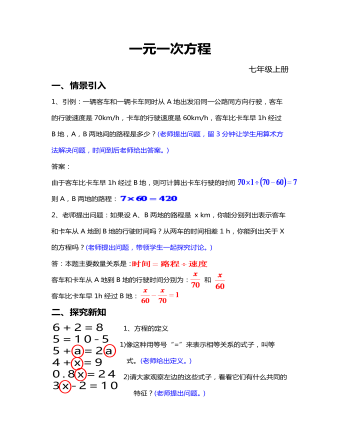
一元一次方程教案教学设计
1、方程的定义1)像这种用等号“=”来表示相等关系的式子,叫等式。(老师给出定义。)2)请大家观察左边的这些式子,看看它们有什么共同的特征?(老师提出问题。)3)列方程时,要先设字母表示未知数,然后根据问题中的相等关系,写出含有未知数的等式叫做方程。(学生思考后,老师给出新学内容方程的定义。)4)判断方程的两个关键要素: ①有未知数 ②是等式(老师提问,并给出。)
大班语言教案:《m, f》教学设计
2.学会声母“b”和单韵母“a”拼读音节的方法。 3.学会拼读“b p m f”与“u、o”组成的音节。 教学难点 掌握拼读声母和韵母组成的音节。 教学过程 一、谈话导入 我们已经认识了韵母家族的6个朋友(出示a o e i u ü)一起读读,你们读得真准,能不能按字母顺序摆一摆,再按顺序读一读。你们记得真清楚。这节课我们一起到拼音王国里再认识四个声母家族的朋友,你们愿意吗? 二、学习“b p m f ”的音形 (一)学习“b”的音形 1.出示“b”的图 (1)引导学生提问:图上的小朋友在干什么? (2)问:这个字母念什么?学生试读“b”。 (3)讲:听广播的“播”读得轻短些,发音时,把两片嘴闭合,把气 憋住,然后突然放开,让气流冲出双唇就是“b”的音。 (4)教师范读。 (5)学生学读,体会发音方法。 (6)开火车读。 2.学习“b”的形 (1)引导学生提问:怎样记住“b”的形?或“b”与图中的哪一部分很像? (2)你们能编一个记忆“b”的小儿歌吗? 拉开天线听广播“b b b”。 右下半圆“b b b”。 6字“b”。…… 3.指导书写b(1)讲:我们先认识一个字母基本笔画:“丨”上竖。 (2)请同学们观察书中字母“b”先写哪笔,再写哪笔,几笔写成?占什么格?同桌同学互相说说。(3)学生说笔顺、位置,教师范写,强调“b”的第一笔在上格的三分之一处起笔到第三条线停笔。 (4)学生书空笔顺。 (5)学生在拼音本上抄字头。教师行间巡视,进行个别辅导。纠正学生的写姿和执笔方法。对姿势正确的学生及时表扬鼓励。
频率的稳定性教案教学设计
活动内容:教师首先让学生回顾学过的三类事件,接着让学生抛掷一枚均匀的硬币,硬币落下后,会出现正面朝上、正面朝下两种情况,你认为正面朝上和正面朝下的可能性相同吗?(让学生体验数学来源于生活)。活动目的:使学生回顾学过的三类事件,并由掷硬币游戏培养学生猜测游戏结果的能力,并从中初步体会猜测事件可能性。让学生体会猜测结果,这是很重要的一步,我们所学到的很多知识,都是先猜测,再经过多次的试验得出来的。而且由此引出猜测是需通过大量的实验来验证。这就是我们本节课要来研究的问题(自然引出课题)。
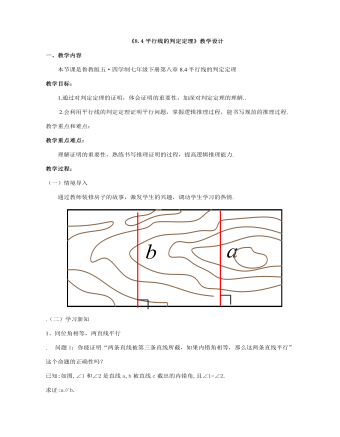
平行线的判定定理教案教学设计
问题1:你能证明“两条直线被第三条直线所截,如果内错角相等,那么这两条直线平行”这个命题的正确性吗?已知:如图,∠1和∠2是直线a,b被直线c截出的内错角,且∠1=∠2.求证:a∥b. 问题2:你能证明“两条直线被第三条直线所截,如果同旁内角互补,那么这两条直线平行”这个命题的正确性吗?已知:如图,∠1和∠2是直线a、b被直线c截出的同旁内角,且∠1与∠2互补.求证:a∥b
简单随机抽样教案教学设计
1、交流与发现为了了解本校学生暑假期间参加体育活动的情况,学校准备抽取一部分学生进行调查,你认为按下面的调查方法取得的结果能反映全校学生的一般情况吗?如果不能反映,应当如何改进调查方法?方法1:调查学校田径队的30名同学;方法2:调查每个班的男同学;方法3:从每班抽取1名同学进行调查;方法4:选取每个班级中的一半学生进行调查.通过前面的活动,学生亲身经历了一次数据的调查过程,并通过对所得数据的计算和分析,了解了自己在家干家务活的时间所处的位置和水平,在调查过程中体会到调查方便有效的重要性.接下来,就能很好地解决交流与发现中的问题.师生共同讨论完成交流与发现.
几何证明举例教案教学设计
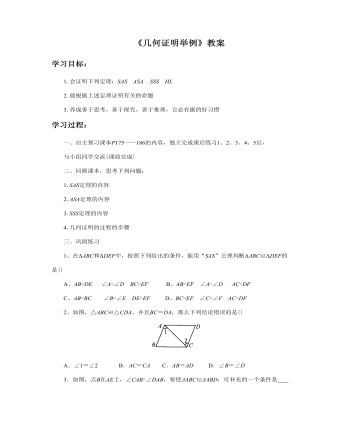
学习过程:一、自主预习课本P175——186的内容,独立完成课后练习1、2、3、4、5后,与小组同学交流(课前完成)二、回顾课本,思考下列问题:1.SAS定理的内容2.ASA定理的内容3.SSS定理的内容4.几何证明的过程的步骤
二元一次方程组教案教学设计
1、问题1的设计基于学生已有的一元一次方程的知识,学生独立思考问题,同学会考虑到题中涉及到等量关系,从中抽象出一元一次方程模型;同学可能想不到用方程的方法解决,可以由组长带领进行讨论探究.2、问题2的设计为了引出二元一次方程,但由于同学的知识有限,可能有个别同学会设两个未知数,列出二元一次方程;如果没有生列二元一次方程,教师可引导学生分析题目中有两个未知量,我们可设两个未知数列方程,再次从中抽象出方程模型.根据方程特点让生给方程起名,提高学生学习兴趣.3、定义的归纳,先请同学们观察所列的方程,找出它们的共同点,并用自己的语言描述,组内交流看法;如果学生概括的不完善,请其他同学补充. 交流完善给出定义,教师规范定义.
三角形内角和定理教案教学设计
活动内容:① 已知,如图,在三角形ABC中,AD平分外角∠EAC,∠B=∠C.求证:AD∥BC分析:要证明AD∥BC,只需证明“同位角相等”,即需证明∠DAE=∠B.证明:∵∠EAC=∠B+∠C(三角形的一个外角等于和它不相邻的两个内角的和)∠B=∠C(已知)∴∠B=∠EAC(等式的性质)∵AD平分∠EAC(已知)∴∠DAE=∠EAC(角平分线的定义)∴∠DAE=∠B(等量代换)∴AD∥BC(同位角相等,两直线平行)想一想,还有没有其他的证明方法呢?这个题还可以用“内错角相等,两直线平行”来证.
大班语言教案:《i,u,ü》教学设计
2、学会正确认读i、u、ü的带调韵母。知道ü上标声调时,上面的小圆点不写。3、会在四线格里抄写i、u、ü三个单韵母。课时安排:2课时第一课时 教学目标:教学单韵母i、u并抄写。 教学过程: 一、 复习检查。 1、猜谜语。 (1)白鹅倒影是什么韵母? (2)圆脸小姑娘,小辫右边扎。这是什么韵母? (3)像个圆圈是什么韵母? 2、抽读字母卡片。 二、 教学单韵母i。 1、看图说话引出i。 图上画着什么?图上画着一件衣服。i的发音与“衣”的音相同。 2、教学i的发音,认清字形。 (1)发音要领:发音时嘴比发e时开得更小,只留一条小缝,舌前部升高,接近上腭,舌尖抵住下齿背,让气从舌尖和上腭中间自然流出。 (2)教师范读、领读。 (3)记忆字形。 i像什么?顺口溜:“像支蜡烛i、i、i。” 3、书写指导:先写竖,再写点,两笔写成。 三、 教学单韵母u。 1、看图说话引出u。 图上画着什么?“树上有一只乌鸦。”乌鸦的“乌”就是u。 2、教学u的发音,认清字形。 (1)发音要领:发音时把嘴唇收拢,嘴唇比发o时更圆更小,舌尖后缩,舌根抬高,让气从小洞中出来。 (2)教师范读,领读。 (3)记忆字形。 可用顺口溜:“像只茶杯u、u、u。” 3、书写指导:u一笔写成。 四、 巩固复习。