-
人教版高中语文必修4《李清照词两首》教案
2.【提问】《醉花阴》反映的是早年丈夫赵明诚游宦在外,作者一个人留在家中的生活状况和内心感受。对于这样的“闺怨”题材,应当怎样评价呢?【明确】作者作为一个封建时代的妇女,能够坦率地表达出自己对于丈夫深深的思恋之情,描写了闺中生活的孤独寂寞,这在当时乃是一种很大胆的行为。所以,有人批评说:李清照作词是“无顾忌”地“肆意落笔”。其实,感情的充沛、真挚,敢于正面地展露自己的行为和内心世界,正是她创作成功的重要原因之一,也正是她的词最值得珍视的地方。3.【提问】古人常常爱用花比喻人之美貌,如“芙蓉如面柳如眉”,“人面桃花相映红”等,而李清照却说“人比黄花瘦”,这样的比喻有什么丰富的内涵?【明确】黄色的菊花不止外形上雅淡、清秀,与作者因相思而消瘦的体态相近,而且在菊花品格的传统象征意义上,也酷似作者清高、淡泊的精神,这样的比喻正比较恰切地反映了当时作者由于离开丈夫而孤独、愁闷的生活状态和内心情感。
人教版高中语文必修4《哈姆莱特》教案
一、作者简介:威廉·莎士比亚(1564~1616),英国文艺复兴时期伟大的戏剧家和诗人。(人文主义:欧洲文艺复兴时期新兴资产阶级反封建的社会思潮。资产阶级人道主义的最初形式。它肯定人性和人的价值,要求享受人世的欢乐,要求人的个性解放和自由平等,推崇人的感性经验和理性思维。)一生共写有37部戏剧,154首14行诗,两首长诗和许多其他诗歌。主要代表作有早期的历史剧、喜剧———《亨利四世》、《仲夏夜之梦》、《威尼斯商人》和《罗密欧与朱丽叶》等;中期的悲剧———《哈姆莱特》、《奥瑟罗》、《李尔王》和《麦克白》等;后期的传奇剧———《暴风雨》等。二、莎士比亚创作《哈姆莱特》的社会背景:莎士比亚是欧洲文艺复兴时期英国伟大的戏剧家和诗人。他生活在欧洲历史上封建制度日趋没落、资本主义兴起的交替时代。哈姆莱特是丹麦古代的王子。莎士比亚故意以超越时代的误差将哈姆莱特搬到伊丽莎白统治未年的英国现实中来。
人教版高中政治必修1经营公司教案
最后,公司要城信经营,树立良好的信誉与企业形象。教师活动:引导学生阅读教材P44“金华火腿”的事例;多媒体播放电视系列片3:“小天鹅”重视产品质量的例子,国家对洗衣机的质量标准是4000次运行无故障,而国际标准是5000次,为此,厂里组织近百名科技人员,花了两年时间进行全厂性技术攻关,终于实现了无故障运行5000次。“小天鹅”以它的信誉和质量给企业带来了巨大效益,1000多人的厂子,年销售收入10.03亿元,实现利润1.72亿元,公司跻身于全国500家大型企业的行列,企业综合经济效益居全国18位。设问:两个企业不同命运的原因何在?学生活动:思考讨论,发表见解。教师点评:企业的信誉和形象对企业的生存竞争至关重要,是企业的无形资产,是公司经营成败的重要因素。企业的信誉和形象集中体现在产品和服务的质量上。创立名牌产品,实行优质服务,是企业信誉和形象的表现,也是企业开展正当竞争的主要手段。
人教版高中政治必修1税收及其种类教案
教师总结:近二十多年来,我国个人所得税的征收发展迅速,这也反映了我国经济水平、人民生活收入有了较大提高。与增值税的计税方法不同,个人所得税采用累进税率的计税办法,就是个人所得越高,税率越高,纳税人个人收入越多,缴纳个人所得税越多。这一特点从教材83页个人所得税税率表上可以看出。教师点拨:个人所得税的计算办法是分段计算的,个人收入800元以内不计税,多余800元以上部分,按不同税率分段计税。请同学们计算教材所列题目。学生活动:计算。应税所得额:4000元;不超过500元部分:25元;500――2000元部分:150元;2000――4000元部分:300元;累计所得税:475元教师活动:同学们想一想,这样计算个人所得税有什么意义呢?学生活动:认真思考,回答问题教师点拨:有利于增加财政收入,有利于调节个人收入分配,实现社会公平。(三)课堂总结、点评
人教版高中政治必修1信用工具和外汇教案
(3)人民币外汇牌价:我国通常采用100单位外币作为标准,折算为一定数量的人民币。如果用100单位外币可以兑换更多的人民币,说明外汇汇率升高;反之,则说明外汇汇率跌落。教师活动:大家知道汇率是经常变动的,为什么汇率经常变动?我国在美国、日本等国再三施加压力的情况下,为什么保持汇率稳定,人民币不升值?学生活动:学生就老师提出的问题去阅读教材;然后展开讨论,并回答(4)保持人民币币值稳定的意义教师点评:影响汇率变动的因素主要有:外汇的供求关系、通货膨胀(或紧缩)率的差异、经济增长率、利率水平、国家货币当局的干预与管制、市场预期、外汇投机活动等。外汇在国家经济发展和国际贸易中具有重要的作用:通过汇率的升降调节进出口贸易;可以影响国际资本的流动方向和数量;可以影响国内物价水平;影响外汇储备的实际价值等。
人教版高中政治必修1依法纳税教案
(3)骗税 骗税是指纳税人用欺骗手段获得国家税收优惠的行为。教师活动:请同学们看教材87页“相关链接”,了解骗税行为的特点和法律处罚规定。学生活动:认真阅读,积极思考。(4)抗税 抗税是指纳税人以暴力、威胁等手段,拒不缴纳税款的行为。教师活动:请同学们看教材87页“相关链接”,了解骗税行为的特点和法律处罚规定。学生活动:认真阅读,积极思考。3、公民要增强税收监督意识教师活动:请同学们看教材88页“相关链接”,思考公民如何维护国家税收工作?学生活动:认真阅读,积极思考。教师总结:公民是国家税收的最终负税人,应自觉增强税收监督意识,以主人翁的态度积极监督国家公职人员及公共权力的行为,关注税收的征收和使用情况,对他们的违法行为进行批评、检举,维护国家利益和自身利益。
人教版高中政治必修3建设学习型社会教案
三、第三阶段。课后感悟与收获1、让学生以“走向学习型社会”为题,将在收集与整理、展示与交流两个环节中获得的体验和感悟,以心得体会的形式写一篇小论文。2、办一期专栏或黑板报,将优秀小论文作集中展示与交流。(进行理论总结,将实践与理论相结合,让科学理论更好地指导实践。充分挖掘学生潜力,增强学生的自信)[评析]新课程理念之一就是政治课不应只局限于课堂上的教与学。把综合探究课与研究性学习相结合,不失为一种有益的尝试。传统的学习方式把学习建立在客观性、受动性、依赖性的基础上,把学生看成一个没有感情的接受容器,这种学习会窒息学生的思维和智力,成为学生发展的障碍。单元探究活动的开展就是要转变学生的学习方式,关注学生的学习过程,使得探究过程成为学生发现问题、提出问题、分析问题、解决问题的过程,培养学生的创新精神和实践能力。本教案的第一阶段充分发挥了学生的主动性。
新人教版高中英语必修1Unit 1 Teenage Life-Reading for Writing教案
【教材分析】This teaching period mainly deals with reading for writing a letter of advice. Students are expected to learn the knowledge about how to write a suggestion letter. The teacher is expected to enable students to master some writing skills concerning suggestion letters and learn to write one.【教学目标与核心素养】1. Get students to have a good understanding of how to write a suggestion letter properly.2. Enable students to use some writing skills flexibly.3. Develop students’ writing and cooperating abilities.4. Strengthen students’ great interest in writing discourses.【教学重难点】1. How to enable students to have a good understanding of the skills of writing a suggestion letter2.How to enable students to write a good recommendation letter using some writing skills properly.【教学过程】Step 1: Lead in Begin the class with the lead-in questions: how to write a letter for advice? What kinds of aspects should be included? It is strongly recommended that the teacher should ask students to discuss the topic freely with their partners and brainstorm some ideas concerning the topic. In this way, students can come up with more ideas and avoid being nervous at the beginning of the class.Step 2: Read to discover details concerning advice letters’ writing style.The teacher is expected to ask students to read a letter offering some advice on page 18 silently and then request students to discuss the questions below.
新人教版高中英语必修1Unit 3 Sports and Fitness-Reading and Thinking教案
2. Sort out detailed information about Michael Jordan.(1) Understand the transitional sentence.Q: Which part is about Michael Jordan as a master? Which part is about the example he set?(2) Have the Ss Focus on why Michael Jordan is a master and what good examples Michael Jordan set when they’re reading. And think about these questions as below:Q1: How does the author describe his impressive skills?Q2: How do you understand “time seemed to stand still”?Q3: What does “graceful” mean?Q4. Which sentence do you think best describes his mental strength?Q5. Which words is important in the sentence in describing his mental strength? Why?Q6: How do you understand “unique”?Q7: What can we learn from Michael Jordan?Step 5 Discussing and recommendingRecommend their own living legends of sports.Work in groups to choose your own living legend of sports and give the reasons of your choice. Step 6 HomeworkReview the stories of Lang Ping and Michael Jordan, and try to retell them.
新人教版高中英语必修1Unit 3 Sports and Fitness-Reading for Writing教案
Then have them write a short paragraph to describe and explain their changes. After that, get the Ss to exchange their drafts with their partners and use the checklist to give feedback on their drafts, and finally revise it.Step 5 Summary of how to write a wellness book1.健康书的审题步骤:第一步:明确要求该写作属于经验分享,故要用第一人称来写;时态以一股现在时为主。第二步:确定段落该类文章可以从以下三个方面人手:Para.1首先表明写作的目的Para.2自己的做法及心得体会Para.3表示期望及感谢第三步:提炼要点2.健康书常见句式:1) It is an honor for me to share my favorite sport with you,2) It makes me feel relaxed playing with my friends.3) It makes me rid myself of stress while playing with my friends.4) Moreover, it provides me a valuable chance to communicate with others.5) I we eat too little or too much, or if we choose the wrong food, we may become sick.6) We can do something to change the poor situation.Step 6Homework假如你的老师让你在班级Wellness Bok上分享自己的亲身经历及心得,请根据以下要点写一篇80字左右的文章1. 你喜欢的运动是什么?2. 你最喜欢的原因是什么?3. 你参加锻炼的体会。
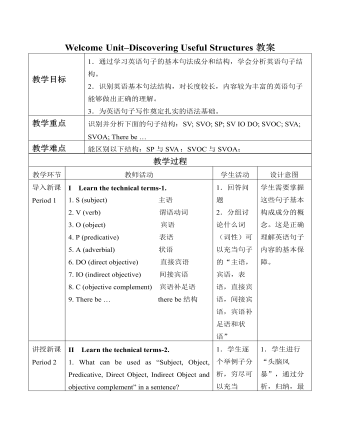
新人教版高中英语必修1Welcome Unit-Discovering Useful Structures教案
II Learn the technical terms-2.1. What can be used as “Subject, Object, Predicative, Direct Object, Indirect Object and objective complement” in a sentence?2. What can be used as “adverbial” in a sentence?3. What can be used as “verb” in a sentence?Answers to questions 1-3:1. Nouns, pronouns and appellations can be used as “Subject, Object, Predicative, Direct Object, Indirect Object and Objective Complement”. Besides, adjectives can be used as “Predicative and Objective Complement” in a sentence.2. Adverbs and prepositional phrases can be used as “Adverbial”.3. Verbs with actual meaning can be used as “Verb” in a sentence. Auxiliary verbs alone cannot be used as “Verb” in a sentence.III Learn to recognize the sentence structures.1. SV structure. For Example:(1) A bird flies.S V(2) A monkey jumps.S V(3) A fish swims.S V√ In SV structures, verbs are “intransitive verbs”.2. SVO structure. For Example:(1) A sheep eats grass.S V O(2) They like bananas.S V O(3) He wants candy.S V O√ In SVO structures, verbs are “transitive verbs”.3. SP structure. For Example:(1) This is great.S P (2) He looks well.S P (3) She became a teacher.S P √ In SP structures, Predicatives are formed by “link verbs” and “adjectives or nouns”.√ link verbs: be, become, grow, look, feel, taste, etc.4. SV IO DO structure. For Example:(1) He asked me a question.S V IO DO(2) Danny wrote me a letter.S V IO DO(3) Billy brought Sam a kite.S V IO DO√ In SV IO DO structures, the verbs are transitive and are followed by two objectives – pronouns or nouns as Indirect Objective, and nouns as Direct Objectives.
新人教版高中英语必修1Unit 4 Natural Disasters-Reading & Thinking教案
5. Read to get detailed information about Paragraph 5.Q1. What shows the revival of Tangshan?Q2. How can Tangshan revive itself and get up on its feet again?Q3. In times of disasters, how can we go through it?T: In times of disasters, we should unify, show the wisdom and stay positive.Step 4 Activity 4 Highlighting the theme and reflecting1. Make a summary of the text.2. Further understand the titleQ: After our learning, why do you think the earth didn’t sleep on that night?T: An earthquake happened. The people in the earthquake suffered a lot, and the people outside Tangshan were concerned about the people there a lot.3. Reflect through discussion on what can be learnt after reading.T: Disasters are powerful. Unpreparedness can be deadly. Life is weak, but if people work together to help each other, disasters can be defeated.There is no love from disaster, but we have love in the human heart.Step 5 Assignment How does the writer convey that the earthquake was deadly, and that people were helpless during the earthquake? Try to find some attractive and impressive expressions and note them down.
新人教版高中英语必修1Welcome Unit-Discovering Useful Structures & Listening and Talking教案
常跟双宾语的动词有:(需借助to的)bring, ask, hand, offer, give, lend, send, show, teach, tell, write, pass, pay, promise, return等;基本句型 五S +V + O + OC(主+谓+宾+宾补)特点:动词虽然是及物动词,但是只跟一个宾语还不能表达完整的意思,必须加上一个补充成分来补足宾语,才能使意思完整。 判断原则:能表达成—宾语 是…/做…注:此结构由“主语+及物的谓语动词+宾语+宾语补足语”构成。宾语与宾语补足语之间有逻辑上的主谓关系或主表关系,若无宾语补足语,则句意不够完整。可以用做宾补的有:名词,形容词,副词,介词短语,动词不定式,分词等。如:He considers himself an expert on the subject.他认为自己是这门学科的专家。We must keep our classroom clean.我们必须保持教室清洁。I had my bike stolen.我的自行车被偷了。We invited him to come to our school.我们邀请他来我们学校。I beg you to keep secret what we talked here.我求你对这里所谈的话保密。用it做形式宾语,而将真正的宾语放到宾语补足语的后面,以使句子结构平衡,是英语常用的句型结构方式。即:主语+谓语+it+宾补+真正宾语。如:We think it a good idea to go climb the mountain this Sunday.
新人教版高中英语必修1Unit 5 Languages Around the World-Reading and Thinking教案
【教材分析】本节课是高中英语第一册的最后一个单元的阅读和思考部分,文章难度明显增加,体现在以下几个方面:文章题材是说明文,比较难理解;话题生疏,涉及到历史等知识;生词量增大,而且在语境中理解词汇的要求提高。面对这些,教师的难度和高度也要有所提升,通过探讨说明顺序,了解背景知识等帮助他们找到说明文阅读的方法。【教学目标与核心素养】1. 文化意识目标新课程中指出,文化意识是对中外文化的理解和对优秀文化的认同。文化意识的的培养有助于学生增加国家认同和家国情怀,成为有文明素养和社会责任感的人。我们这个单元很好体现了这一点,通过了解汉字书写的体系和发展,学生可以有一种文化自豪感,同时也能够帮助学生深入挖掘这篇文章,从而想到更多和中国文化相关的方面。2. 学习能力目标
新人教版高中英语必修3Unit 1 Festivals and Celebrations教学设计一
本板块的活动主题是“谈论节日活动”(Talk about festival activities),主要是从贴近学生日常生活的角度来切入“节日”主题。学生会听到发生在三个国家不同节日场景下的简短对话,对话中的人们正在参与或将要亲历不同的庆祝活动。随着全球化的进程加速,国际交流日益频繁,无论是国人走出国门还是外国友人访问中国,都已成为司空见惯的事情。因此,该板块所选取的三个典型节日场景都是属于跨文化交际语境,不仅每组对话中的人物来自不同的文化背景,对话者的身份和关系也不尽相同。1. Master the new words related to holiday: the lantern, Carnival, costume, dress(sb)up, march, congratulation, congratulate, riddle, ceremony, samba, make - up, after all. 2. To understand the origin of major world festivals and the activities held to celebrate them and the significance of these activities;3. Improve listening comprehension and oral expression of the topic by listening and talking about traditional festivals around the world;4. Improve my understanding of the topic by watching pictures and videos about different traditional festivals around the world;5. Review the common assimilation phenomenon in English phonetics, can distinguish the assimilated phonemes in the natural language flow, and consciously use the assimilation skill in oral expression. Importance:1. Guide students to pay attention to the attitude of the speaker in the process of listening, and identify the relationship between the characters;2. Inspire students to use topic words to describe the festival activities based on their background knowledge. Difficulties:In the process of listening to the correct understanding of the speaker's attitude, accurately identify the relationship between the characters.
新人教版高中英语必修3Unit 1 Festivals and Celebrations教学设计三
*wide range of origins(= a great number of different origins, many kinds of origins)*It featured a parade and a great feast with music, dancing, and sports. (=A parade and a great feast with music, dancing, and sports were included as important parts of the Egyptian harvest festival.)*.. some traditions may fade away and others may be established.(= Some traditions may disappear gradually, while other new traditions may come into being.)Step 6 Practice(1) Listen and follow the tape.The teacher may remind the students to pay attention to the meaning and usage of the black words in the context, so as to prepare for the completion of the blanks in activity 5 and vocabulary exercises in the exercise book.(2) Students complete the text of activity 5 by themselves.The teacher needs to remind the students to fill in the blanks with the correct form of the vocabulary they have learned in the text.Students exchange their answers with their partners, and then teachers and students check their answers.(3)Finish the Ex in Activity 5 of students’ book.Step 7 Homework1. Read the text again, in-depth understanding of the text;2. Discuss the origin of festivals, the historical changes of related customs, the influence of commercial society on festivals and the connotation and essential meaning of festivals.3. Complete relevant exercises in the guide plan.1、通过本节内容学习,学生是否理解和掌握阅读文本中的新词汇的意义与用法;2、通过本节内容学习,学生能否结合文本特点快速而准确地找到主题句;3、通过本节内容学习,学生能否理清论说文的语篇结构和文本逻辑,了解节日风俗发展与变迁,感悟节日的内涵与意义。
新人教版高中英语必修3Unit 3 Diverse Cultures教学设计三
The price is the same as(the price was)before the war.价格与战前相同。(4)定语从句中的“关系代词+助动词be”可以省略。The ticket(that/which was)booked by his sister has been sent to him.他妹妹订的那张票已送到了他那里。Step 5 PracticeActivity 3(1) Guide students to complete the four activities in the Using Structures part of exercise book, in which activities 1 and 2 focus on ellipsis in dialogue answers, activity 3 focus on signs and headlines, two typical situations where ellipsis is used, and activity 4 focus on ellipsis in diary, an informal style.(2) Combine the examples in the above activities, ask students to summarize the omitted situations in groups, and make their own summary into a poster, and post it on the class wall after class to share with the class.(This step should give full play to the subjectivity of students, and teachers should encourage students to conclude different ellipsis phenomena according to their own understanding, they can conclude according to the different parts omitted in the sentence.)Step 6 Homework1. Understand and master the usages of ellipsis;2. Finish the other exercises in Using structures of Workbook.1、通过本节内容学习,学生是否理解和掌握省略的用法;2、通过本节内容学习,学生能否根据上下文语境或情景恢复句子中省略的成分,体会使用省略的效果;3、通过本节内容学习,学生能否独立完成练习册和导学案中的相关练习。
新人教版高中英语必修3Unit 3 Diverse Cultures教学设计二
(2)Consolidate key vocabulary.Ask the students to complete the exercises of activity 6 by themselves. Then ask them to check the answers with their partners.(The first language:Damage of the 1906 San Francisco earthquake and fire.A second language: Yunnan - one of the most diverse provinces in China).Step 5 Language points1. The teacher asks the students to read the text carefully, find out the more words and long and difficult sentences in the text and draw lines, understand the use of vocabulary, and analyze the structure of long and difficult sentences.2. The teacher explains and summarizes the usage of core vocabulary and asks the students to take notes.3. The teacher analyzes and explains the long and difficult sentences that the students don't understand, so that the students can understand them better.Step 6 Homework1. Read the text again, in-depth understanding of the text;2. Master the use of core vocabulary and understand the long and difficult sentences.3. Complete relevant exercises in the guide plan.1、通过本节内容学习,学生是否理解和掌握阅读文本中的新词汇的意义与用法;2、通过本节内容学习,学生能否结合文本特点了解文章的结构和作者的写作逻辑;3、通过本节内容学习,学生能否了解旧金山的城市风貌、文化特色,以及加利福尼亚州的历史,体会多元文化对美国的影响。
新人教版高中英语必修3Unit 3 Diverse Cultures教学设计一
Activity 81.Grasp the main idea of the listening.Listen to the tape and answer the following questions:Who are the two speakers in the listening? What is their relationship?What is the main idea of the first part of the listening? How about the second part?2.Complete the passage.Ask the students to quickly review the summaries of the two listening materials in activity 2. Then play the recording for the second time.Ask them to complete the passage and fill in the blanks.3.Play the recording again and ask the students to use the structure diagram to comb the information structure in the listening.(While listening, take notes. Capture key information quickly and accurately.)Step 8 Talking Activity 91.Focus on the listening text.Listen to the students and listen to the tape. Let them understand the attitudes of Wu Yue and Justin in the conversation.How does Wu Yue feel about Chinese minority cultures?What does Justin think of the Miao and Dong cultures?How do you know that?2.learn functional items that express concerns.Ask students to focus on the expressions listed in activity. 3.And try to analyze the meaning they convey, including praise (Super!).Agree (Exactly!)"(You're kidding.!)Tell me more about it. Tell me more about it.For example, "Yeah Sure." "Definitely!" "Certainly!" "No kidding!" "No wonder!" and so on.4.Ask the students to have conversations in small groups, acting as Jsim and his friends.Justin shares his travels in Guizhou with friends and his thoughts;Justin's friends should give appropriate feedback, express their interest in relevant information, and ask for information when necessary.In order to enrich the dialogue, teachers can expand and supplement the introduction of Miao, dong, Lusheng and Dong Dage.After the group practice, the teacher can choose several groups of students to show, and let the rest of the students listen carefully, after listening to the best performance of the group, and give at least two reasons.
人教版高中地理必修1常见天气系统教案
知识和技能 ⑴从图片和简易图中,了解气团(冷气团、暖气团)的概念;锋的概念与分类;低压(气旋)、高压(反气旋)、高压脊、低压槽的概念。⑵从气温、气压、湿度、降水、风等几方面分析各种天气系统的形成及其气流特点,并综合出各种天气系统控制下的天气状况过程与方法 ⑴让学生能阅读和简单分析天气图,解释天气变化现象;⑵用案例说明气象灾害发生的原因和危害;⑶结合我国常见的天气系统说明其对人们生产和生活的影响情感、态度与价值观激发学生探究天气的形成和变化的兴趣和动机,培养学生求真、求实的科学态度,提高地理审美情趣教学重点1.锋面系统。(锋面系统:一是要区别冷暖锋的成因,二是要掌握锋面两侧的气压、温度、湿度、风和天气差异)2.低压、高压系统。(要掌握其成因、气压特征、气流特征及其天气特点四个方面。)