-
新人教版高中英语必修2Unit 2 Wildlife Protection-Reading and Thinking教案二
The theme of this unit is human and nature, focusing on the theme of wildlife protection. Nature is a complex ecosystem, in which there are delicate balance between animals and plants. Because of the role of the food chain, the extinction of one species will produce influence, causing a series of chain reaction. Large scale extinction of species will have a serious and even irreversible impact on the ecosystem, resulting in immeasurable losses. Therefore, it is of great significance to protect wild species. To protect wild species is to protect human beings themselves. The motto of this unit is "when the buying stops, the killing can too,” which is a public service advertising slogan to protect wildlife. It tells people that every rhinoceros horn, every fur, every bowl of shark fin soup, every Ivory product, and every tiger bone product, etc. consumed by human beings, are innocent wild animals slaughtered behind them. The mission of wild aid is to ban illegal trade in endangered wildlife and mitigate climate change. It aims to educate the public to reduce the consumption demand for endangered wildlife products through public publicity and improve the awareness of environmental protection.1. Improve the awareness of wildlife protection by acquiring the knowledge of wildlife protection.2. Focus on environmental protection and protection of all lives.3. Analysis of the living environment of wild animals with appropriate thinking mode.4. Skillfully use the vocabulary and grammar knowledge of this unit to cultivate self-study ability according to the unit content5. Develop cooperative learning ability through discussion and other ways1. Enable the Ss to talk about the current situation of wild animals.2. Guide the Ss to summarize the main idea of each paragraph as well as the main idea of the text.
新人教版高中英语必修2Unit 2 Wildlife Protection-Reading For Writing教案一
1. 标题首先根据海报的特点、格式写明标题。海报中往往把内容作为大标题。例如: Save the earth, Save the birds。2. 正文部分不同的海报其正文部分的侧重点不同。对于介绍性的海报, 首先要引出话题, 其次列出原因, 最后是总结。对于宣传类的海报, 要写明具体内容, 如: 活动内容, 地点以及参加活动的注意事项, 主持或举办单位等。1. 图片: 要选择引人注目的图片, 与主题要相关, 色彩明亮。话题句式 1. It is a treasure of our country. 它是我国的国宝。2. Believe it or not, at present only several thousand pandas exist in the world. 信不信由你, 目前世界上仅现存几千只熊猫。 3.It’s because of human activities that tigers are endangered. 正是因为人类的活动, 老虎处于濒危的状态。4. Many wild animals are in danger of dying out. 很多野生动物面临着灭绝的危险。 5. The government has taken effective measures to protect them. 政府已采取有效的措施来保护它们。6. People should raise the awareness of the protection of wild animals. 人们应该提高保护野生动物的意识。 7. It’s amazing that there are merely less than 1, 000 finless porpoises living in China. 非常令人吃惊, 目前中国仅有不足1 000只江豚。
新人教版高中英语必修2Unit 3 The Internet-Discovering Useful Structure教案一
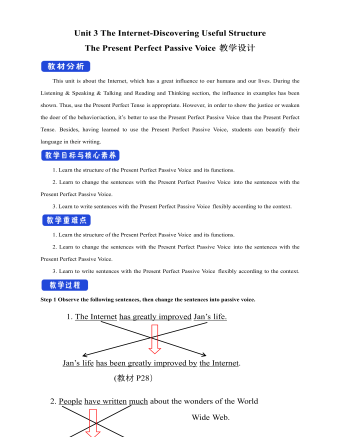
This unit is about the Internet, which has a great influence to our humans and our lives. During the Listening & Speaking & Talking and Reading and Thinking section, the influence in examples has been shown. Thus, use the Present Perfect Tense is appropriate. However, in order to show the justice or weaken the doer of the behavior/action, it’s better to use the Present Perfect Passive Voice than the Present Perfect Tense. Besides, having learned to use the Present Perfect Passive Voice, students can beautify their language in their writing. 1. Learn the structure of the Present Perfect Passive Voice and its functions. 2. Learn to change the sentences with the Present Perfect Passive Voice into the sentences with the Present Perfect Passive Voice. 3. Learn to write sentences with the Present Perfect Passive Voice flexibly according to the context. 1. Learn the structure of the Present Perfect Passive Voice and its functions. 2. Learn to change the sentences with the Present Perfect Passive Voice into the sentences with the Present Perfect Passive Voice. 3. Learn to write sentences with the Present Perfect Passive Voice flexibly according to the context. Step 1 Observe the following sentences, then change the sentences into passive voice.He has been selected to take part in the sports meeting.(肯定句)他已被挑选出来参加运动会。The ink has not been removed from his overcoat.(否定句)墨迹还没有从他外套上去掉。
新人教版高中英语必修2Unit 3 The Internet-Listening &Speaking&Talking教案一
Listening and Speaking introduces the topic of “ask about online habits”. Many middle school students have been surfing the Internet for many years, but what they do with the Internet and how much time they spend every day may not be very clear to themselves, nor to other students. This section allows students to investigate their peers' Internet use, which is conducive to their mutual understanding and understanding of the Internet. It can also help them reflect on their own online behavior, learn from other people's good online habits, and get rid of their bad online behavior.The listening text of this section is an investigation interview. The investigators interview specific groups with the same questions to obtain information, so as to understand their views, practices or attitudes on this issue. There are two specific questions: “how much time do you spend online every day? What do you usually do online?”. The answers of the three respondents provide rich and different information, and achieve the purpose of the investigators. The oral discourse structure of survey interviews generally includes greeting and explaining the purpose of the interview, presenting the interview questions and the respondents' answers. Listening and Talking introduces the theme of “choosing the right application ". Listening text is a conversation between Laura and Xiao Bo. In this part of listening, “oink”; “piggy bank” may cause the students' hearing comprehension limitation. Oink refers to sound word and pig's sound. So, add some oink to my piggy bank is often used to describe "making a little money".1. Guide students to understand the content of listening texts in terms of listening for definitions.2. Cultivate students' ability to define words and understand an investigation interview.
新人教版高中英语必修2Unit 3 The Internet-Reading and Thinking教案一
Paragraph 3. Jan decided to start an IT club to teach old people how to use computers and the Internet. Paragraph 4. Jan has started taking online classes to learn more about how to use the Internet to make society better. Paragraph 5. Jan’s life has been greatly improved by the Internet. Step 5: Critical thinking:(1)How do you arrange your time spent on study and the Internet? Is it reasonable? I usually surf the Internet using my mobile phone for only an hour after class, and it is reasonable for me.(2)What are your online activities? Are they safe? I chat with my friends, read news and play games. I never give away my private information so I think they are safe.Step 4: summary Much has been written about the wonders of the World Wide Web. There are countless articles (1)______(tell) us how the Internet has made our lives more convenient. But the Internet has done a lot (2)_____(much) for people than simply make life more convenient. People’s lives (3) _________________(change) by online communities and social networks so far. Take Jan for example, who developed a serious illness that made her (4)_____(stick) at home with only her computer to keep (5)___(she) company. She joined an online group (6)______ she could share problems, support and advice with others. She considered the ability to remove the distance between people as one of the greatest (7)_______(benefit). She was so inspired (8)____ she started an IT club in which many people have been helped. She has started to learn more about how to use the Internet to make society better. Her next goal is to start a charity website to raise money (9)___ children in poor countries. Jan’s life has been (10)______(great) improved by the Internet. Step 5 Homework:Review what we have learned and find out the key language points in the text.
新人教版高中英语必修2Unit 3 The Internet-Reading for Writing教案二
8. However, the more polite you are, the less likely it is you will be attacked. 然而, 你越有礼貌, 你被攻击的可能性就越小。 Step 8 Writing---the articleHow to stay safe in the online chat roomToday I thought I’d blog about a question that has been asked many times--- how do you stay safe online and avoid bad experiences in the online chat room ? I’m not an expert, but many years as a blogger have taught me a thing or two.First of all, there’s the golden rule of the Internet: keep out of what makes you uneasy. Don’t post comments or click on anything. Second, protect your privacy. Don’t give out too much private information like your address, phone numbers, the ID numbers, etc. Third, be polite. If you are polite to others on the Internet, you won’t be attacked in normal situation. Finally, don’t believe in others easily and never meet someone you met online alone. It is very dangerous.Have you had any bad experiences online, or do you have some good advice for staying safe? Post your comments below!Step 9 Pair workExchange drafts with a partner. Use this checklist to help your partner revise his/her draft.1. Does the writer tell the reader what he/she know about the topic ?2. Are the tips and suggestions well organised ?3. Has the writer defined the new words ?4. Does the author include examples, comparison, or explanations ?5. Does the writer end by asking readers to leave comments and/or suggestions ?6. Can you find any grammar or spelling mistakes.Step 6 HomeworkPut up your revised draft in the classroom or read it to your class.
新人教版高中英语必修2Unit 5 Music-Listening and Speaking教案
This lesson is about music. Students can classify the types of music through the instruments and its sound and can talk about their preferences about music, even join some activities and play a role in them according to their musical talents. On the basis, they are guided to use the languages to express their preferences and some plosive sounds and their rules.1. Classify the music types through the instruments and its sound.2. Listen and understand what the speakers’ preferences are and the reasons; talk about their own preferences and give their own reasons, using these sentences: “What kind of music do you like? And why? “ “Because it makes/gives me energy/peaceful.../touches my heart...”.3. Learn some plosives and the rules.4. Join some activities and play a role in them according to the talents. 1. Listen and understand what the speakers’ preferences are and the reasons;2. talk about their own preferences and give their own reasons, using these sentences: “What kind of music do you like? And why? “ “Because it makes/gives me energy/peaceful.../touches my heart...”.3. Learn some plosives and incomplete plosives and its rules.Step 1 Lead inPoint at the pictures on P50 and ask Q1: What are the people doing in the pictures below?Q2: What kind of music they are?Then play the MP3s one by oneStep 2 ListeningTask 1: A reporter from the school newspaper is interviewing students about music. Listen to the interviews. Draw lines between the words to make complete sentences. Some words will not be used.
新人教版高中英语必修2Unit 5 Music-Reading and Thinking教案一
This section focuses on "learning about experiencing music Online". This virtual choir is a new form of music performance. Members from all over the world don't need to love to come to a place. Instead, they use the new technology to model the various parts and wonderful virtual harmony group of music in the family. Students need to understand the main meaning of each paragraph. Finding topic sentences is an important way to understand the general idea of a paragraph. After the topic sentence, it is usually the detail sentence that supports and explains the topic sentence. Some paragraphs have obvious subject sentences, for example, the first sentence of the second paragraph is the subject sentence of the paragraph, and the following sentenceStudents need to pay attention to the topic sentences and key sentences, and then pay attention to how the sentences after the meaning explain, explain and support the topic sentences or key sentences before.1.Guide students to learn about experiencing music online2.Guide students to scan and circle the information in the text.3.Guide students to find the numbers and dates to fill in the timeline.4.Guide students to learn more about music by completing the sentences with the correct forms of the words and phrases. And then make a mind map about the outline of the passage.1. Guide students to pay attention to reading strategies, such as prediction, self-questioning and scanning.2. Help students sort out the main meaning of each paragraph and understand the narrative characteristics of "timeline” in illustrative style.3. Lead students to understand the changes that have been caused by the Internet.
人教版高中地理必修3区域农业发展教案
1.归纳珠江三角洲发展基塘生产有利的地理条件。珠江三角洲地势低平,河网密布,降水充沛。北回归线从珠江三角洲的北部穿过。珠江三角洲地区发展基塘农业生产有利条件可以结合材料,归纳为三个方面:地形、气候、市场(当地和海外)。2.基塘生产将哪些产业联系起来?哪些副产品(或废弃物)被充分利用起来?这种联系对农村经济发展有什么作用?基塘生产环节将种植业(桑、蔗等)、养殖业(养蚕、养鱼)、工业(丝厂、糖厂)等几种产业紧密的联系在一起。在此环节中,塘泥、蚕沙(蚕屎)、蚕蛹、缫丝、滤泥、蔗叶等副产品被充分的回收利用。养蚕业、蔗糖加工业同塘鱼养殖业紧密结合,作为一种综合的经营,几者之间相互依存、相互促进、扬长补短,有机地循环联系起来。基本上解决了桑、蔗的肥料和蚕、鱼的饲料问题。不仅养蚕、蔗糖加工和养鱼生产稳定,而且成本也大大降低。
人教版高中地理必修3区域工业化与城市化教案
知识和技能 1、 了解区域工业化和城市化之间的关系,以及它们对区域社会经济发展所起的作用 。2、分析导致珠江三角洲工业化和城市化快速推进的诸多思想束缚,并通过比较,认识到对外开放政策是其中的关键因素。3、 比较珠江三角 洲的 区工业化进程的两个主要阶段,归纳出不同时期的主要发展特点,并能够结合具体案例分析工业化进程对城市化的巨大推动。 4、分析珠江三角洲地区工业化和城市化进程中的问题,并尝试评价目前的一些调整措施和发展方向。5、通过分析我国珠江三角 洲地区工 业化、城市化的发展阶段、问题与对策,了解区域工业化和城市化的推进动力和发展规律。过程与方法 利用扮演不同的社会角色来谈对珠江三角洲地区未来经济和城镇发展的设想和建议,反馈学生知识、能力、价值观发展情况和效果, 培养学生对所学所得的运用能力,并为学生的创新精神的发 展营造有利氛围。情感、态度与价值观1、通过鼓励学生主动获 取资料的做法,关注学生实践能力、综合思维能力及终身学习能力的训练。
人教版新课标高中物理必修1摩擦力教案2篇
l.知识与技能:(1)知道摩擦力产生的条件。(2)能在简单问题中,根据物体的运动状态,判断静摩擦力的有无、大小和方向;知道存在着最大静摩擦力。(3)掌握动磨擦因数,会在具体问题中计算滑动磨擦力,掌握判定摩擦力方向的方法。(4)知道影响到摩擦因数的因素。2.过程与方法:通过观察演示实验,概括出摩擦力产生的条件及摩擦力的特点,培养学生的观察、概括能力。通过静摩擦力与滑动摩擦力的区别对比,培养学生分析综合能力。3.情感态度价值观:在分析物体所受摩擦力时,突出主要矛盾,忽略次要因素及无关因素,总结出摩擦力产生的条件和规律。二、重点、难点分析1.本节课的内容分滑动摩擦力和静摩擦力两部分。重点是摩擦力产生的条件、特性和规律,通过演示实验得出关系f=μN。2.难点是学生有初中的知识,往往误认为压力N的大小总是跟滑动物体所受的重力相等,因此必须指出只有当两物体的接触面垂直,物体在水平拉力作用下,沿水平面滑动时,压力N的大小才跟物体所受的重力相等。
人教版新课标高中物理必修2功率教案2篇
1.用CAI课件模拟汽车的启动过程。师生共同讨论:①如果作用在物体上的力为恒力,且物体以匀速运动,则力对物体做功的功率保持不变。此情况下,任意一段时间内的平均功率与任一瞬时的瞬时功率都是相同的。②很多动力机器通常有一个额定功率,且通常使其在额定功率状态工作(如汽车),根据P=FV可知:当路面阻力较小时,牵引力也小,速度大,即汽车可以跑得快些;当路面阻力较大,或爬坡时,需要比较大的牵引力,速度必须小。这就是爬坡时汽车换低速挡的道理。③如果动力机器在实际功率小于额定功率的条件下工作,例如汽车刚刚起动后的一段时间内,速度逐渐增大过程中,牵引力仍可增大,即F和v可以同时增大,但是这一情况应以二者乘积等于额定功率为限度,即当实际功率大于额定功率以后,这种情况不可能实现。
人教版新课标高中物理必修2平抛运动教案2篇
(五)平抛运动规律的应用例1:一架老式飞机在高出海面45m的高处,以80m/s的速度水平飞行,为了使飞机上投下的炸弹落在停在海面上的敌船,应该在与轰炸目标的水平距离为多远的地方投弹?不计空气阻力。分析:对于这道题我们可以从以下几个方面来考虑:(1)从水平飞行的飞机上投下的炸弹,做什么运动?为什么?(2)炸弹的这种运动可分解为哪两个什么样的分运动?3)要想使炸弹投到指定的目标处,你认为炸弹落地前在水平方向通过的距离与投弹时飞机离目标的水平距离之间有什么关系?拓展:1、式飞机在高出海面45m的高处,以80m/s的速度水平飞行,尾追一艘以15m/s逃逸的敌船,为了使飞机上投下的炸弹正好击中敌船,应该在与轰炸目标的水平距离为多远的地方投弹?不计空气阻力。2、在一次摩托车跨越壕沟的表演中,摩托车从壕沟的一侧以速度v=40m/s沿水平方向向另一侧,壕沟两侧的高度及宽度如图所示,摩托车可看做质点,不计空气阻力。(1)判断摩托车能否跨越壕沟?请计算说明(2)若能跨过,求落地速度?
人教版高中语文必修1《小狗包弟》教案2篇
巴金在十年浩劫中的大致经历:放弃包弟并没有换得保全一家人,1968年8月,巴金被关进牛棚改造,随后经受了大字报、挂牌游街等形式的批斗。1970年,到农村改造,掏大粪、喂猪、背稻草、种地……1972年,妻子萧珊在饱受精神折磨后患上癌症,病逝。巴金的儿子在劳动改造的过程中也饱受精神和肉体上的折磨,性格变得内向抑郁,疾病缠身。此时,巴金69岁。巴金曾在《病中》一文写道:“当姚文元拿着棒子的时候,我给关在牛棚里除了唯唯诺诺之外,敢于做过什么事情?十年间我不过是一条含着眼泪等人宰割的牛。”小结:(幻灯片12)社会是病态的社会,政治是高压的政治,人性是扭曲的人性。十年文革,十年浩劫,给多少人留下了累累不可弥合的精神创伤。即使一条小狗,也可能摆脱不了“文革”无情的迫害,比如包弟,比如艺术家邻居的小狗。
人教版高中语文必修1《荆轲刺秦王》教案
教学目标:1、知识与能力:①了解荆轲刺秦王的历史背景和过程,整体感知课文。②掌握文言文中重要的字、词、句解释,提高翻译能力。③学会从人物的对话、动作、神态描写入手,分析主要人物形象。2、情感与态度:正确看待荆轲刺秦王这一事件,学会历史而辩证地评价人物。重点难点:评价历史事件,分析人物形象。教学方法:朗读法、提问法、讨论法课时安排:三课时教学过程:第一课时一、导入:(课前展示雕塑照片)来到正定讲课,我感到非常高兴,一进县城,就被这里浓郁的历史文化气息所感染。我们住在华阳假日酒店,外面正在兴建文化广场,刚才的照片就是在那里拍摄的。在此,我进一步了解到正定这座文化古城悠久的历史渊源,这里有南越王赵佗,常胜将军赵云,一代名家颜真卿等等,可谓物华天宝、人杰地灵。因此我相信我们正定中学的同学们一定都非常优秀。这也让我更深刻地体会到一个道理:语文的外延就是生活的外延。
人教版高中语文必修2《涉江采芙蓉》教案2篇
三、想象画面,把握意境1.指导想象学习陶渊明的《归园田居》我们脑海中自然会出现一幅幅的画面,比如他归家后的生活场景,我们会想象“榆柳”是如何遮蔽房屋的,而“桃李”又是如何摘种在房前的。我们会想象村落是如何在薄雾中若隐若现的,想象炊烟是如何袅袅升起的。《涉江采芙蓉》一诗只有8句话,更需要我们展开想象,去构画场景,这样才能深入诗歌,体会到诗歌的味道。2.学生想象要求学生闭目想象1分钟。3.学生展示想象结果(抽三四个学生回答即可)4.老师指导纠正学生想象不合理之处。要注意的地方:“江”可能学生会想象成小溪流、小池塘。“兰泽”可能学生理解成“湖泊”。注意字词“还顾”“漫浩浩”中隐含的情感,注意“离居”中流露的愁怨。5.时间允许的话,老师读自己的下水作文。
人教版高中语文必修2《孔雀东南飞并序》教案2篇
让学生仔细聆听美妙的音乐,合作讨论,加深理解。(1)本诗文中的“兰芝被遣”和“兰芝抗婚”的情节,可与乐曲展开部第一阶段“逼嫁抗婚”对比阅读。文中的刘兰芝是在封建礼教的压迫下被遣归及被迫“改嫁”,刘兰芝与祝英台一样都进行了抗争。乐曲中的乐器奏出了具有威胁力的封建势力的主题,代表着封建势力的凶暴残酷,同时叙述了祝英台的悲痛和不安心情,表现了控诉、抗争的感情。(2)本诗文中的“夫妻誓别”的情节,可与乐曲呈示部中的结束部“长亭惜别”对比阅读。文中刘兰芝与焦仲卿的誓别。二人分手之际,依依不舍,“举手长劳劳,二情同依依”。乐曲中梁祝分别时依依不舍又充满悲伤,音调抒情徐缓。让学生在徐缓的音乐中去感受刘兰芝与焦仲卿生离死别的痛苦。
人教版高中语文必修2《我有一个梦想》教案2篇
全班齐读第五段内容。请一位同学分析,接着让这位同学按他分析的读一遍。3、4两自然段的平缓之后,第5段作者的情感再次抬升。为了满足这种情感的张扬,作一口气连用了四个排比句式“现在是……时候”,一方面这是情感发泄的需要,另一方面这种排山倒海的语势也加强了内容的表达,极强地突出了现实为自由、平等而战的重要性。四、学会演讲我们刚才细读了课文,但读和讲是有区别的。所谓演讲,是一门语言艺术,它的主要形式是“讲”,即运用有声语言并追求言辞的表现力和声音的感染力;同时还要辅之以“演”,即运用面部表情、手势动作、身体姿态乃至一切可以理解的态势语言,使讲话“艺术化”起来,从而产生一种非凡的艺术魅力。那么,接下来就假设一下假如你是马丁·路德·金,你会怎样去讲这篇演讲辞。
人教版高中语文必修2《离骚》教案2篇
四、品味诗歌艺术1、诗人是如何表现其品质的?运用了什么修辞手法?产生了怎样的表达效果?明确:诗句“扈江离与辟芷兮,纫秋兰以为佩”很好地体现了诗人光辉俊洁的人格。用“江离”“辟芷”“秋兰”三种香草来装饰自己,比喻自己,极其生动形象地表现了诗人自己美好的精神世界,使诗歌充满了浪漫主义气息。2、《离骚》中作者常以“香草”、“美物”来比喻自己、贤士和君王,并表达政治理想,这是《离骚》的一大艺术特色,这种方法叫做“移情法”,即不直接说出自己想说的话,而是把它寄寓于某一物上,也就是“移情于物”,这种方法在古典诗词中广泛运用,在政治不清明的时代,借用“移情”,可言难言之语,抒难抒之情。请找出相关的诗句,说说诗人是怎样运用这些比喻来表达政治理想的。
人教版高中语文必修2《囚绿记》教案2篇
教学设想:本节课的主题是“生命之绿,璞玉心灵”,用圈点批注法解读爱绿的感情,让学生在批注中明确“绿”的象征意义,而不只是结论的传递。同时借助于阅读、感受和理解把握作者对绿的认识是不断升华的,由一般对生命希望之绿的喜爱,到与绿交往后被它的不畏强暴,永远向阳的精神所折服,最后在特定的时代背景下绿在作者的心目中已经成了我们民族不屈精神的象征。让学生评中求解,评中悟情,评中明理,评中品味。教学进程:一、导语上节课我们学习了朱自清的《绿》,初步了解了读书动笔的基本方法,这节课我们继续用圈点批注的方法来学习陆蠡的散文《囚绿记》。二、释题师:看标题,囚绿之“绿”在文中具体指什么?(一株常春藤)“囚”就是囚禁的意思,那题目就是记述囚禁绿色常春藤的经过。三、圈点、把握情节作者为什么要囚绿呢?文中除了写“囚绿”之外,还写了哪些有关绿的意念和行动?带着这样的质疑用自己喜欢的方式朗读课文,请同学们圈点出疑难字词,或结合书下注释,或同学合作解决,解决不了的,可提出来我们共同解决。标注段落节次。勾画出表现作者对绿意念和行动的句子。