-
人教版高中历史必修1甲午中日战争说课稿
3.甲午中日战争中国战败的原因 对于“中国战败的原因”这一难点的突破,主要通过设置问题“中国之败败在实力逊于日本吗?”通过幻灯片全方位分析其实中国的综合国力当时是强于日本的。并且在战前,日本毫无取胜的把握。让学生结合刚学习过的战争原因和经过进行讨论,从多方面分析中国战败的原因。经过讨论,学生可以得出以下结论:避战自保方针,没有积极备战,将领临阵脱逃,教师肯定并总结答案进行补充。中日对比:中国士兵出身农民,军事训练落后,散兵游勇;日本士兵出身武士,训练有素;中国将领大多临阵脱逃,并相互猜忌,受当时恶劣的官风影响;李鸿章深知北洋海军实情,缺乏军费,军备废弛。为政治资本奉行避战自保政策,慈禧太后挪用海军军费过寿,支持李鸿章。使中方处于被动的局面,一再贻误战机。而日本在天皇的带动下,全民备战,做了充分的战争准备。
人教版新课标小学数学三年级下册一位数除三位数(商是两位数且有余数)教案2篇
二、互动交流,理解算法1.出示教科书第22页的情境图,提问:他们在干什么?你获得了什么信息?能提出什么问题?怎样列式?2.师:今天我们就学习一位数除三位数的计算方法。(板书课题:一位数除三位数)3.师:怎样计算238÷6呢?你能用估算的方法估计出大致结果吗?4.学生尝试独立完成例3的竖式计算。师:在这道题中被除数最高位上是2个百,2个百除以6,商不够1个百怎么办?师:谁能说一说商3个十的3写在商的什么位置上?为什么?教师边板演边说明:用除数6去乘3个十,积是18个十,表示被除数中已经分掉的数,写在23的下面。23减18得5,表示十位上还剩5个十。师:接下来该怎么办?(把被除数个位上的8落下来,与十位上的5合起来继续除。)师:最后结果是多少?5.启发学生想一想:如果一本相册有24页,一本相册能插得下这些照片吗?2本呢?
人教版高中政治必修2中国发展进步的政治制度保障说课稿
环节四 课堂总结 巩固知识本节课我采用线索性的板书,整个知识结构一目了然,为了充分发挥学生在课堂的主体地位,我将课堂小结交由学生完成,请学生根据课堂学习的内容,结合我的板书设计来进行小结,以此来帮助教师在第一时间掌握学生学习信息的反馈,同时培养学生归纳分析能力、概括能力。环节五 情景回归,情感升华我的实习指导老师告诉过我们,政治这一门学科要从生活中来到生活去,所以在课堂的最后布置课外作业,以此培养学生对理论的实际运用能力,同时检验他们对知识的真正掌握情况,以此达到情感的升华,本节课,我根据建构主义理论,强调学生是学习的中心,学生是知识意义的主动建构者,是信息加工的主体,要强调学生在课堂中的参与性、以及探究性,不仅让他们懂得知识,更让他们相信知识,并且将知识融入到实践当中去,最终达到知、情、意、行的统一。
人教版高中政治必修2中国走和平发展道路说课稿
教师点评:根据小论文的写作情况对小论文给予肯定,同时指出其有待修改的地方。学生在写小论文的时候是根据教材中的提示来写的,所以对于教材中的这些提示,可以作一个说明。如“在发展的过程中,我们面对怎样的挑战和困难”,对于这点,学生可能会出现片面看问题的不足,一旦这种情况出现,我们就要及时进行说明:我们面临的挑战和困难既有来自国内的,也有来自国际的,引导学生学会用全面的观点分析问题。教师引导学生明确作为中学生可以从以下方面去作准备:第一,要有国家观念、民族意识,不断增强民族自豪感、自尊心和自信心;第二,关注国家大事;第三,自自觉履行维护国家统一和民族团结的义务,维护国家安全、荣誉和利益;第四,努力学好科学文化知识,提高自己的科学文化素质和思想道德素质,增强各个方面的能力,掌握振兴中华民族的本领,这也是中学生最需要做到的。通过探究活动,培养学生获取信息的能力,自主学习的能力以及全面看问题的能力,再结合教师的讲授,给学生一种茅塞顿开的感觉。
人教版新课标小学数学四年级上册整万数的改写与省略说课教案
1、课本第14页的”做一做”。通过练习,一方面是让学生用刚学到的知识进行改写,进一步巩固了新知;一方面回忆过去提供的有关地理知识素材,使学生了解我国的地理知识,扩大视野。2、课本练习二的第3题。第3题的素材介绍了我国主要的农产品,可以扩大学生的知识面。在改写之后还要求学生进行大数的比较,对两部分知识进行混合练习。3、课文练习二的第4~5题。第4题是关于近似数的联系,通过准确数与近似数的对比,区分联系,题会在什么情况下使用准确数,在什么情况下使用近似数,使学生进一步理解近似数的含义和在实际生活中的作用。第5题是关于我国第五次人口普查中6个省份的人口数。让学生求出这些数的近似诉,并提示学生在可能的情况下通过互连网等媒体了解其他地区的人口数。同时还介绍了我国每十年进行一次人口普查的知识。
高中语文人教版必修三《动物游戏之谜》说课稿
科学是人类认识世界的重要工具,阅读科普说明文不仅可以启迪心智,了解更多知识。而且更够激发学生对科学的兴趣。学习这些文章要注重学生科学精神的培养,关注科学探索的过程,感受科学家在科学探索中表现的人格魅力。我们知道一些科学家就是因为阅读了相关的科普文章才对某一学科产生兴趣,从而走上成功之路的。我们在讲解的时候可以跟学生列举一些例子,让学生认识到一篇好的科普文章的重大意义。
新人教版高中英语必修3Unit 1 Festivals and Celebrations教学设计一
本板块的活动主题是“谈论节日活动”(Talk about festival activities),主要是从贴近学生日常生活的角度来切入“节日”主题。学生会听到发生在三个国家不同节日场景下的简短对话,对话中的人们正在参与或将要亲历不同的庆祝活动。随着全球化的进程加速,国际交流日益频繁,无论是国人走出国门还是外国友人访问中国,都已成为司空见惯的事情。因此,该板块所选取的三个典型节日场景都是属于跨文化交际语境,不仅每组对话中的人物来自不同的文化背景,对话者的身份和关系也不尽相同。1. Master the new words related to holiday: the lantern, Carnival, costume, dress(sb)up, march, congratulation, congratulate, riddle, ceremony, samba, make - up, after all. 2. To understand the origin of major world festivals and the activities held to celebrate them and the significance of these activities;3. Improve listening comprehension and oral expression of the topic by listening and talking about traditional festivals around the world;4. Improve my understanding of the topic by watching pictures and videos about different traditional festivals around the world;5. Review the common assimilation phenomenon in English phonetics, can distinguish the assimilated phonemes in the natural language flow, and consciously use the assimilation skill in oral expression. Importance:1. Guide students to pay attention to the attitude of the speaker in the process of listening, and identify the relationship between the characters;2. Inspire students to use topic words to describe the festival activities based on their background knowledge. Difficulties:In the process of listening to the correct understanding of the speaker's attitude, accurately identify the relationship between the characters.
新人教版高中英语必修3Unit 3 Diverse Cultures教学设计四
该板块的活动主题是“介绍一个有显著文化特征的地方”( Describe a place with distinctive cultural identity)。该板块通过介绍中国城继续聚焦中国文化。本单元主题图呈现的是旧金山中国城的典型景象, Reading and Thinking部分也提到中国城,为该板块作铺垫。介绍中国城的目的主要是体现中国文化与美国多元文化的关系,它是美国多元文化的重要组成部分。中国城也是海外华人的精神家园和传播中国文化的重要窗口,外国人在中国城能近距离体验中国文化。1. Read the text to understand the cultural characteristics of Chinatown in San Francisco and the relationship between Chinese culture and American multiculturalism;2. Through reading, learn to comb the main information of the article, understand the author's writing purpose and writing characteristics;3. Learn to give a comprehensive, accurate, and organized description of the city or town you live in;Learn to revise and evaluate your writing.Importance:1. Guide the students to read the introduction of Chinatown in San Francisco and grasp its writing characteristics;2. Guide students to introduce their city or town in a comprehensive, accurate and organized way;3. Learn to comb the main information of the article, understand the author's writing purpose, and master the core vocabulary.
新人教版高中英语必修3Unit 3 Diverse Cultures教学设计一
Activity 81.Grasp the main idea of the listening.Listen to the tape and answer the following questions:Who are the two speakers in the listening? What is their relationship?What is the main idea of the first part of the listening? How about the second part?2.Complete the passage.Ask the students to quickly review the summaries of the two listening materials in activity 2. Then play the recording for the second time.Ask them to complete the passage and fill in the blanks.3.Play the recording again and ask the students to use the structure diagram to comb the information structure in the listening.(While listening, take notes. Capture key information quickly and accurately.)Step 8 Talking Activity 91.Focus on the listening text.Listen to the students and listen to the tape. Let them understand the attitudes of Wu Yue and Justin in the conversation.How does Wu Yue feel about Chinese minority cultures?What does Justin think of the Miao and Dong cultures?How do you know that?2.learn functional items that express concerns.Ask students to focus on the expressions listed in activity. 3.And try to analyze the meaning they convey, including praise (Super!).Agree (Exactly!)"(You're kidding.!)Tell me more about it. Tell me more about it.For example, "Yeah Sure." "Definitely!" "Certainly!" "No kidding!" "No wonder!" and so on.4.Ask the students to have conversations in small groups, acting as Jsim and his friends.Justin shares his travels in Guizhou with friends and his thoughts;Justin's friends should give appropriate feedback, express their interest in relevant information, and ask for information when necessary.In order to enrich the dialogue, teachers can expand and supplement the introduction of Miao, dong, Lusheng and Dong Dage.After the group practice, the teacher can choose several groups of students to show, and let the rest of the students listen carefully, after listening to the best performance of the group, and give at least two reasons.
新人教版高中英语必修3Unit 1 Festivals and Celebrations教学设计二
1. Ss look at the picture and scan the passage to understand the main idea while teacher is giving the following questions to inspire Ss to think.*Where are those people?*What are they doing?*Why are they so excited?2. Ss complete the passage with the appropriate -ing form. Then discuss and check the answers with class.Answers: boring, interesting, taking, exciting, amazing3. The teacher raises questions for the students to discuss and encourages them to express their opinions.*Do you like La Tomatina? Why or why not?4. Each group representative reports the discussion result, the teacher gives feedback and the evaluation.Step 6 PracticeActivity 41. Ss complete the Ex 2 in Using structures.2. Check the answers after finishing the exercises.①The dragon boat races are the most exciting part of the Dragon Boat Festival.② The children were excited to go Easter egg hunting.③What an amazing performance! This is the best music festival I have ever been to.④We were amazed by her funny-looking hat.⑤His inspiring speech at the conference won the admiration/ favour of the audience.⑥This is a challenging game to test your memory and observation capabilities. 3. T asks Ss to finish Ex 3 and 4 in Using structures by themselves, then check the answers with class.Step 6 Homework1. Understand and master the functions and usage of the -ing form;2. Finish the other exercises in Using structures.1、通过本节内容学习,学生是否理解和掌握动词-ing形式作定语和表语的功能和意义;2、通过本节内容学习,学生能否在理解文段内容的基础上,根据上下文语境和表达逻辑,能正确运用动词-ing形式描述节日庆典。3、通过本节内容学习,学生是否归纳和积累用于表达情绪的相关词汇。
新人教版高中英语必修3Unit 1 Festivals and Celebrations教学设计三
*wide range of origins(= a great number of different origins, many kinds of origins)*It featured a parade and a great feast with music, dancing, and sports. (=A parade and a great feast with music, dancing, and sports were included as important parts of the Egyptian harvest festival.)*.. some traditions may fade away and others may be established.(= Some traditions may disappear gradually, while other new traditions may come into being.)Step 6 Practice(1) Listen and follow the tape.The teacher may remind the students to pay attention to the meaning and usage of the black words in the context, so as to prepare for the completion of the blanks in activity 5 and vocabulary exercises in the exercise book.(2) Students complete the text of activity 5 by themselves.The teacher needs to remind the students to fill in the blanks with the correct form of the vocabulary they have learned in the text.Students exchange their answers with their partners, and then teachers and students check their answers.(3)Finish the Ex in Activity 5 of students’ book.Step 7 Homework1. Read the text again, in-depth understanding of the text;2. Discuss the origin of festivals, the historical changes of related customs, the influence of commercial society on festivals and the connotation and essential meaning of festivals.3. Complete relevant exercises in the guide plan.1、通过本节内容学习,学生是否理解和掌握阅读文本中的新词汇的意义与用法;2、通过本节内容学习,学生能否结合文本特点快速而准确地找到主题句;3、通过本节内容学习,学生能否理清论说文的语篇结构和文本逻辑,了解节日风俗发展与变迁,感悟节日的内涵与意义。
新人教版高中英语必修3Unit 3 Diverse Cultures教学设计三
The price is the same as(the price was)before the war.价格与战前相同。(4)定语从句中的“关系代词+助动词be”可以省略。The ticket(that/which was)booked by his sister has been sent to him.他妹妹订的那张票已送到了他那里。Step 5 PracticeActivity 3(1) Guide students to complete the four activities in the Using Structures part of exercise book, in which activities 1 and 2 focus on ellipsis in dialogue answers, activity 3 focus on signs and headlines, two typical situations where ellipsis is used, and activity 4 focus on ellipsis in diary, an informal style.(2) Combine the examples in the above activities, ask students to summarize the omitted situations in groups, and make their own summary into a poster, and post it on the class wall after class to share with the class.(This step should give full play to the subjectivity of students, and teachers should encourage students to conclude different ellipsis phenomena according to their own understanding, they can conclude according to the different parts omitted in the sentence.)Step 6 Homework1. Understand and master the usages of ellipsis;2. Finish the other exercises in Using structures of Workbook.1、通过本节内容学习,学生是否理解和掌握省略的用法;2、通过本节内容学习,学生能否根据上下文语境或情景恢复句子中省略的成分,体会使用省略的效果;3、通过本节内容学习,学生能否独立完成练习册和导学案中的相关练习。
新人教版高中英语必修3Unit 3 Diverse Cultures教学设计二
(2)Consolidate key vocabulary.Ask the students to complete the exercises of activity 6 by themselves. Then ask them to check the answers with their partners.(The first language:Damage of the 1906 San Francisco earthquake and fire.A second language: Yunnan - one of the most diverse provinces in China).Step 5 Language points1. The teacher asks the students to read the text carefully, find out the more words and long and difficult sentences in the text and draw lines, understand the use of vocabulary, and analyze the structure of long and difficult sentences.2. The teacher explains and summarizes the usage of core vocabulary and asks the students to take notes.3. The teacher analyzes and explains the long and difficult sentences that the students don't understand, so that the students can understand them better.Step 6 Homework1. Read the text again, in-depth understanding of the text;2. Master the use of core vocabulary and understand the long and difficult sentences.3. Complete relevant exercises in the guide plan.1、通过本节内容学习,学生是否理解和掌握阅读文本中的新词汇的意义与用法;2、通过本节内容学习,学生能否结合文本特点了解文章的结构和作者的写作逻辑;3、通过本节内容学习,学生能否了解旧金山的城市风貌、文化特色,以及加利福尼亚州的历史,体会多元文化对美国的影响。
人教版新课标小学数学一年级上册认识物体和图形教案
1.让学生拿出长方体摸一摸,问:你有什么感觉?摸的的面是什么形状?师:谁来摸一摸,老师手上长方体的长方形在哪?(学生找出长方形)2.让学生在自己的学具(长方体、正方体、圆柱体)上找图形,并和小组里的同学说一说。3、指名说,教师把学生找到的图形从立体图形上分离出来,贴于黑板上,师:这些图形是物体上的一个面,这就是我们今天要认识的图形。(板书课题——认识平面图形)4.让学生说说:从什么物体上找到了什么图形?5.师:你能想办法把这些形状画到一张纸上吗?请学生演示各自不同的方法,然后教师在黑板上沿长方体的一个面画出长方形。师:你会画吗?请小朋友们用自己喜欢的办法画出并剪出长方形、正方形、圆和三角形各2个。
人教版新课标小学数学五年级上册观察物体教案
第一课时:从不同角度观察一个物体教学内容:教科书38页例1、从不同角度观察一个物体教学目标:1、知识目标:让学生经历观察的过程,认识到从不同的位置观察物体,所看到的形状是不同的。能辨认从正面、左面、上面观察到的简单物体的形状。2、能力目标:培养学生从不同角度观察,分析事物的能力。培养学生构建简单的空间想象力。教学重难点:帮助学生构建初步的空间想象力。学情分析:学生在日常生活中已经积累了丰富的观察物体的感性经验,已经能辨认从不同位置观察到的简单物体的形状,因此可以放手让学生自己去探究,让学生真正地、实实在在地进行观察和操作。教具学具:长方体、正方体、盒子等。教学设计:一、,谜语导入请同学们猜谜语:“左一片、右一片,摸得着,看不见,是什么呢?”(耳朵)为什么能看见别人的耳朵,却看不见自己的耳朵呢?因为我们观察的角度不一样,那么今天我们就一起来进一步研究观察物体(板书)
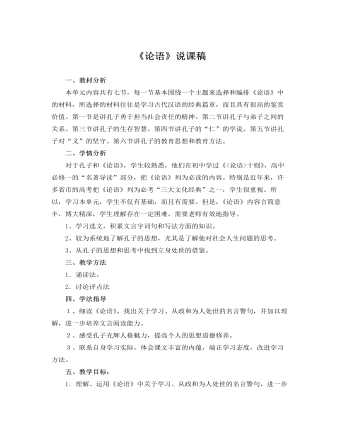
人教版高中语文必修1《论语》说课稿
三、文本中的句子解决完毕,大家对文本内容的理解更加深入了。请速度文本,思考:《论语》具体涉及了哪些方面的内容,体现了孔子什么观点?明确:主要有治学、从政、修身养性和交友治道等方面,体现了孔子“克己复礼”的思想。四、 教师引导学生讨论: 如何评价孔子的言行和观点?从古至今人们对孔子有哪些评价?明确:1、春秋战国时代, 孔子门人及其后学者均推尊孔子。门人中以子贡为代表,他对孔子赞美备至,奉如天人,把孔子比拟为高天、日月、木铎,凡人是永远不可企及的,认为孔子是天生的圣人,“仰之弥高,钻之弥坚”。亚圣孟子认为孔子所行的“圣人之道”是遍及自然界和社会的至高准则。然而当时民间一般看法认为孔子是博学成名的大学者。
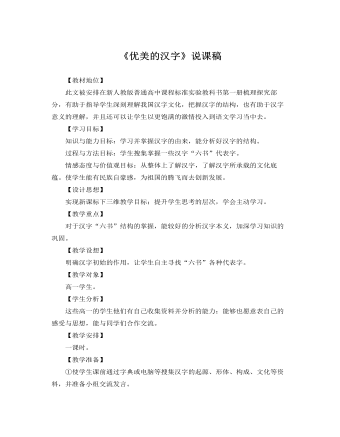
人教版高中语文必修1《优美的汉字》说课稿
明确:(1)结绳记事说。原始记事的一种方法。人类在没有发明文字或文字使用尚不普遍时,常用在绳索或类似物件上打结的方法记录数字,表达某种意思,用以传达信息,处理事件。 (2)书画说。(3)仓颉造字说。中国自古就有仓颉造字之说。文字的发明是人类发展史上一件石破天惊的大事,它将人们的思维、语言、经验以及复杂的社会现象记录下来,使文化得以传播交流、世代传承。2、汉字的形体:中华民族五千年的历史中,汉字的演变,从甲骨文--金文--大篆--小篆--隶书--草书--楷书--行书,字形由象形到点横竖撇捺的方块字,经历了漫长的岁月。其中凝聚着民族的智慧,也体现出汉字逐步完善的过程,凸显其方方正正、四平八稳的特点。汉字又是一种文化的体现,那些经过艺术处理的汉字或跳起了拉丁舞、有的如同酒醉的成龙打起了醉拳,更是让我们感到的是在欣赏汉字在纸张上跳舞,所以:书法是“纸上的舞蹈”。请大家看到书上的相关内容,注意每一种形体的汉字的载体是什么,其功能又有什么不一样。
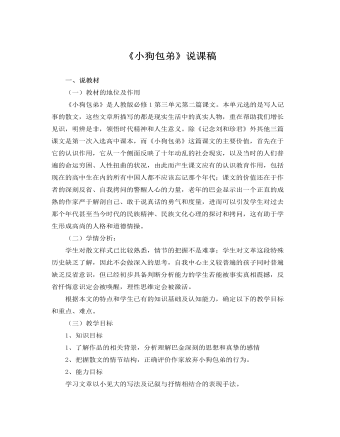
人教版高中语文必修1《小狗包弟》说课稿
探究、讨论、交流:1、包弟讨人喜欢,作者却不得不将它送走,为什么?2、送走包弟后,作者为什么先是感觉轻松,随后觉得沉重?3、“您的小狗怎样?”这句话反复出现,有什么用意?4、“整整十三年零五个月过去了”“整整”一词有什么作用?5、“满园的创伤使我的心仿佛又给放在油锅里熬煎”这句话如何理解?6、“我怀念包弟,我想向它表示歉意。”如何理解?学生各抒己见后教师结合材料发表看法明确总结特别是最后一个问题得出作者这发之心底的语言,不仅仅是歉意,更是发自灵魂深处的忏悔!是对生命的尊重,是一个有良知的作家对反省历史的呼号。第三环节“认识你自己”——忏悔意识与我引导学生正视和反省成长过程中曾犯下过错。并布置课后作业:要求学生课后在本周随笔中谈反省忏悔后的感受。
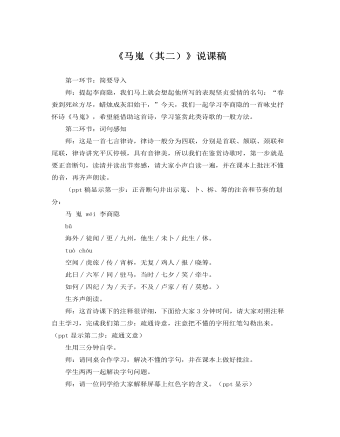
人教版高中语文必修3《马嵬(其二)》说课稿
生2:颔联的意思是只听到禁卫军中传来夜间巡逻的梆子声,不再向宫中那样安逸地听到有鸡人打鸣报时的声音了。生3:颈联的意思是说事变发生那天军队发生哗变停留不前,但当年唐玄宗以为自己可以和贵妃天天在一起,对天上的牵牛和织女一年一度的会见还加以嘲笑呢。生4:尾联的含义是为什么唐玄宗当了四十五年的皇帝,还不如普通百姓夫妻恩爱,长相厮守。师:好的。请大家再齐读一遍诗文,做到人人都能疏通诗的含义。学生再次齐读。第三环节:专项探究师:白居易曾说:“文章合为时而著,歌诗合为事而作。”这首诗就是作者途经马嵬驿,咏马嵬之变这一历史事件而作,所以我们鉴赏的第三步,就是通过标题和诗文,弄清诗中的历史事件。请同学们找出诗中哪些诗句描述了这一事件?
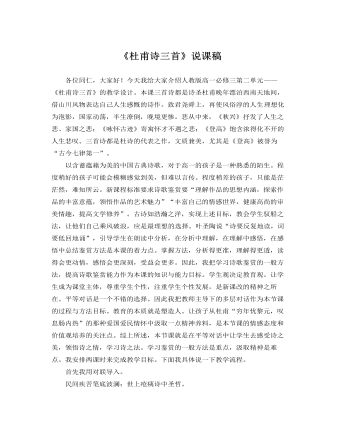
人教版高中语文必修3《杜甫诗三首》说课稿
我以以《登高》为例,引导学生进行意象分析,感悟意境美。古人云“立象以尽意”“古诗之妙,专求意象”意象是诗人情感的载体,是诗歌的灵魂。引导学生张开联想和想象的翅膀去感受,去体验是意象,诗歌鉴赏的关键。科林伍德说“真正艺术的作品,不是看见的,也不是听到的,而是想象中的某种东西。”诗人通过想象创造出诗的形象,我们读者通过想象丰富地再现诗人创造的形象。而感受体验则是以全部身心投入作品,心灵与心灵相沟通,感情与感情相交流,对诗人的想象活动进行再经历和再体验。因此,在引导意象解读中,我先让学生点击这一个,就是通过抓修饰词、依据感情基调、展开想象具体分析本诗中每个意象的情感意蕴和审美意蕴,使学生明白意象在每首诗中的独特性。