-
人教版高中语文必修2《兰亭集序》教案3篇
三、指导第一段的背诵,点拨理解句意,强调关键词语,注重文言基础知识教学。过程中要让学生反复读背。背诵线索:时间——地点——事件——人物——环境——活动——天气——感觉。时间:永和九年,岁在癸丑,暮春之初。地点:会于会稽山阴之兰亭。事件:修稧事也。人物:群贤毕至,少长咸集。环境:此地有崇山峻岭,茂林修竹;又有清流激湍,映带左右。活动:引以为流觞曲水,列坐其次。虽无丝竹管弦之盛,一觞一咏,亦足以畅叙幽情。天气:是日也,天朗气清,惠风和畅。感觉:仰观宇宙之大,俯察品类之盛,所以极视听之娱,信可乐也。四、学生自读背诵5分钟。五、抽一至二名学生试背课文,教师可作必要的线索提示。第二课时一、听名家示范朗诵,学生小声跟读。二、复习巩固第一自然段的阅读背诵。三、朗读、解析第二自然段,理解文章“由叙入感”的写作结构。
人教版高中语文必修3《劝学》教案2篇
五.研习第一段:1.诵读指导要处理好句中停顿2.请学生对照注释翻译本段重点词句:学不可以已已:停止。青,取之于蓝而青于蓝于:从;比。木直中绳中:zhàng符合,合于。虽有槁暴,不复挺者,揉使之然也有通又,揉通煣,以火烘木,使其弯曲。然:这样。翻译:故木受绳则直,金就砺则利,君子博学而日参省乎己,则知明而行无过矣。所以木材经墨线画过(再用斧锯加工)就直了,金属刀剑拿到磨刀石上(磨过)就锋利了,君子广博地学习并且每天对自己检验反省,就能智慧明达,行为没有过错了。3.本段是从哪个角度论述中心论点的?明确:本段是从学习的意义这个角度论述中心论点的。荀子认为人的知识、道德、才能都不是天生成的,而是后天不断学习获得的,学习的意义十分重大,所以学习不能停止。4.本段中几个比喻句是为了说明什么道理?学生讨论发言,教师明确:
人教版高中语文必修3《蜀道难》教案2篇
【明确】“一夫当关,万夫莫开”言剑阁有易守难攻的险要形势,暗示中央朝廷的部队很不容易打进来,因而野心家可以据险发动叛乱,“化为狼与豺”,搞地方割据。如果割据势力之间出现矛盾冲突,难免要发生混战,结果必定是“杀人如麻”。诗人这番预言在十多年后就得到了证实:从上元二年到大历初即有段子璋、徐知道、崔旰等人相继发动叛乱。诗人的意图是要严防野心家发难。诗人从剑阁的险要引出对政治形势的描写。他化用西晋张载《剑阁铭》中形胜之地,匪亲勿居的语句,目的在于劝人引以为鉴戒,警惕战乱的发生,并联系当时的社会背景,揭露了蜀中豺狼的磨牙吮血,杀人如麻,这既是描写蜀道猛兽,又是影射政治黑暗的双关语句,表达了对国事的忧虑与关切,为诗篇增加了现实的内涵、深厚的意蕴。唐天宝初年,太平景象背后正潜伏着危机,后来发生的安史之乱,证明诗人的忧虑是有现实意义的。
人教版高中政治必修3体味文化教案2篇
3、文化是人们的一种素养(1)人的文化素养是在社会生活、实践中形成的。每个人所具有的文化素养,不是天生的,而是通过对社会生活的体验,特别是通过参与文化生活、接受知识文化教育而逐步培养出来的。文化素养的形成,离不开生活、实践和教育。人们在社会实践中创造和发展文化,也在社会生活中获得和享用文化。(2)人的文化素养表现在日常言行中。教师活动:引导学生阅读教材7页“公交车漫画”材料,并思考所反映的问题学生活动:积极思考并讨论问题教师点评:人们的精神活动离不开物质活动,人们的文化素养总是要通过他在日常生活中的言行、在社会实践活动中的表现等表现出来。我们通过观察人们的社会行为,就可以从中透视人们的精神世界和精神生活。4、文化的传承和发展离不开物质载体。社会文化和精神产品离不开物质载体,一个时代的文化和精神产品,往往是这一时代社会发展轨迹的反映。
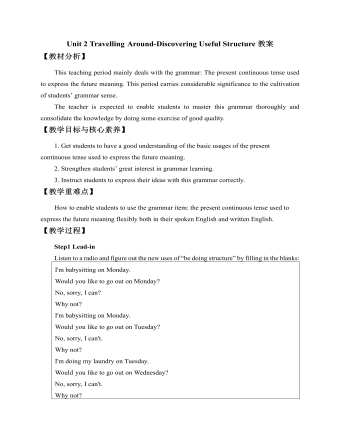
新人教版高中英语必修1Unit 2 Travelling Around-Discovering Useful Structure教案
(5)be to do (可以和具体的时间状语连用)①表示按计划、安排即将发生的动作。②用于时间、条件状语从句中,表示“如果要……,想要……”。The students are to meet at the school gate tomorrow. 明天学生们将在学校大门口集会。 If you are to succeed, you must work as hard as possible. 如果你想要成功,比必须努力工作。(6)be about to do (不与具体的时间状语连用) 表示即将要发生的动作。We are about to start. 我们就要出发了。The new school year is about to begin. 新学年开学在即。(7)一般现在时表将来①表示按时间表规定将要发生的动作。常限于表示位置移动的短暂性动词。②在时间、条件或让步状语从句中,用一般现在时表将来。Look at the timetable. Hurry up! Flight 4026 takes off at 18:20. 你看看时刻表,快点!4026次航班的起飞时间是下午6点20分。Jane is in a hurry because the train to the airport leaves in half an hour. 简很匆忙,因为去机场的火车半小时后出发。
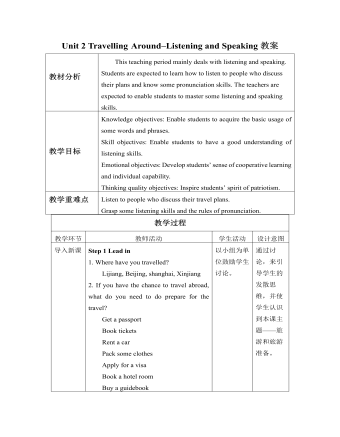
新人教版高中英语必修1Unit 2 Travelling Around–Listening and Speaking教案
无论她说什么都不会对我们的安排有影响。Answers: for, arrangement3) Parents arrange everything for their children and spare no effort to pave the way for their success.父母为孩子安排好一切,不遗余力地为他们的成功铺路。4. extremely adv 极其,非常extreme adj 非常的1) Mary found it extremely difficult to get a job.2) I’m extremely sorry to have troubled you.Answers:玛丽发现找工作极其困难。给你添了麻烦,我十分抱歉。3) It had white-painted tunnels and bright red carriages, and proved _________ (extreme) popular with the public.它有白色的隧道和明亮的红色车厢,结果证明它非常受大众的欢迎。Answers: extremelyExercises1. I am continuing to apply_______ jobs though I have failed several times.2. All this had an _______ (extremely) bad effect on the criminal justice system.3. The invention would have wide ______ (apply) in industry.4. She’s happy with her unusual living _________ (arrange).5. I was banging so loudly that I’m ___________ (amaze) that they didn’t hear me.6. You haven’t changed at all you still look ___________ (exact) the same.7. “Was it what you expected?” “Yes, _________ (definite).”8. He was looking forward to______ (work) with the newPrime Minister. Answers: for extreme application arrangement amazed exactly definitely looking单句写作:1. _______________ (你要说些什么) when you get on the platform to accept the reward?2. Since_____________________(我们为这些事情做好了准备), we have nothing to worry about.
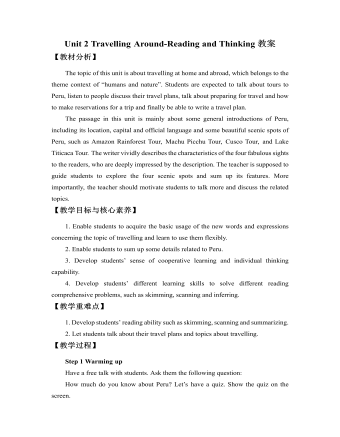
新人教版高中英语必修1Unit 2 Travelling Around-Reading and Thinking教案
Good expressions that students can choose to use: help the travelers choose which tour to take1. In my opinion, you could/might choose…, because you prefer to…2. …could be a perfect choice for you, for…3. As far as I am concerned, you would enjoy…, for…4. …would probably suit you, because you enjoy/love/hate doing…Step 5 Passage ConsolidationLanguage appreciation:1. You can then spend three days exploring the rainforest with a local guide and enjoying the plants and animals unique to the rainforest. 在接下来的三天里,您可以在当地导游的陪同下,深入雨林进行探索,欣赏雨林特有的动植物。本句主体结构为spend some time doing sth. 2. Inca builders cut stones to exact sizes so that nothing was needed to hold walls together other than the perfect fit of the stones. 印加的建筑工人将石头切割成精确的尺寸,仅仅凭着石头间的完美契合,即可稳固墙体。本句为so that引导的结果状语从句。nothing与the perfect fit为并列成分; other than在句中意为“除了”。Step 6 HomeworkSuppose you will travel to Peru, write a short essay about your three-day tour plan.
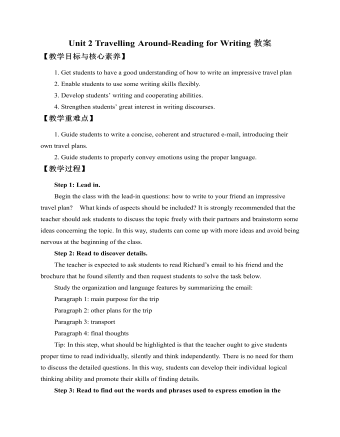
新人教版高中英语必修1Unit 2 Travelling Around-Reading for Writing教案
Is there a clear purpose for the trip? :Does each paragraph have a clear main idea? Does the writer use the present continuous tense for future plans?Does the writer use commas, stops, and question marks correctly? Are all the words spelt correctly?Are all the proper nouns capitalized?Revise your draft according to your partner's comments.Step 5:The summary of how to write a travel plan.旅游计划是一种常见的应用文写作。旅游可分为观光游、文化游、美食游及探险游等不同类型,因此旅游计划也要根据不同的旅游目的进行设计。常规的旅游计划需要明确以下几个方面的问题:Travel planWhen will you leave for? Where is your the destination?How will you get there?What will you do there?How long will you there?Is there a clear purpose for the trip? 为了提升旅行计划的层级,还需注意以下几个方面的问题:1.每段是否有明确清晰的主题;2.用一般现在时代替一般将来时;3.用更高级的形容词词汇。例如:表达“好”时,不要总用“nice”,我们还可以用“smart, clean, excellent, exciting, beautiful, wonderful, clever, famous, grand”等表达更具有指向性的词汇;4.用更高级的动词词汇。比如:我们可以用“seem stand, lie .get stay, remain, look . sound, become . keep, grow”等代替"be";
新人教版高中英语必修2Unit 1 Cultural Heritage-Discovering Useful Structure教案一
This teaching period mainly deals with grammar “restrictive relative clauses.” To begin with, teachers should lead students to revise what they have learned about the relative pronouns and relative adverbs. And then, teachers move on to stress more special cases concerning this grammar, such as the “preposition+ relative pronouns which and whom” and cases where we can omit the relative pronouns. This period carries considerable significance to the cultivation of students’ writing competence and lays a solid foundation for the basic appreciation of language beauty. The teacher is expected to enable students to master this period thoroughly and consolidate the knowledge by doing some exercises. 1. Guide students to review the basic usages of relative pronouns and adverbs of attributive clauses.2. Lead students to learn to use some special cases concerning restrictive relative clauses flexibly.2. Enable students to use the basic phrases structures flexibly.3. Strengthen students’ great interest in grammar learning.1. Help students to appreciate the function of relative pronouns and adverbs of attributive clauses in a sentence2. Instruct students to write essays using the proper relative pronouns and adverbs of attributive clauses.本节语法思考:定语从句在复合句中的作用是什么? 关系词有哪些?定语从句在复合句中的作用相当于形容词,它在句中作定语修饰名词或代词。他们在先行词和定语从句之间起到联系作用,同时在意义上代表先行词并在定语从句中担任一个成分。被定语从句所修饰的词称先行词,定语从句一般放在先行词的后面。
新人教版高中英语必修2Unit 1 Cultural Heritage-Listening&Speaking&Talking教案
Listening and Speaking introduces the topic of “Take part in a youth project”. The listening text is an interview about an international youth cultural heritage protection project. More than 20 high school students from seven countries participated in the project. The reporter interviewed two participants Stephanie and Liu Bin. By listening to the text, students can understand the significance of cultural heritage protection, and teenagers can use their knowledge, combine their own interests and advantages, etc. to participate in the action of cultural heritage protection. Listening and Talking introduces the theme of "Talk about history and culture". The listening text is a dialogue between two tourists and tour guides when they visit the Kremlin, red square and surrounding buildings. The dialogue focuses on the functional items of "starting a conversation", which is used to politely and appropriately attract the attention of the others, so as to smoothly start a conversation or start a new topic. The purpose of this section is to guide students to understand the history and current situation of Chinese and foreign cultural heritage in their own tourism experiences or from other people's tourism experiences, explore the historical and cultural values, and be able to express accurately and appropriately in oral communication.1. Guide students to understand the content of listening texts in terms of the whole and key details; 2. Cultivate students' ability to guess the meaning of words in listening; discuss with their peers how to participate in cultural heritage protection activities.3. Instruct students to use functional sentences of the dialogue such as “I beg your pardon, but…” “Forgive me for asking, but…" and so on to start the conversation more politely and appropriately.
新人教版高中英语必修2Unit 1 Cultural Heritage-Reading and Thinking教案二
1. This section focuses on "Understanding how a problem was solved”, which is aimed to guide students to analyze and discuss the challenges and problems faced by cultural heritage protection during the construction of Aswan Dam, as well as the solutions. On the basis of understanding, students should pay attention to the key role of international cooperation in solving problems, and attach importance to the balance and coordination between cultural heritage protection and social and economic development. Students are encouraged to face challenges actively, be good at cooperation, and make continuous efforts to find reasonable ways and means to solve problems.2. Enable students to understand the main information and text structure of the reading text;3. Motivate students to use the reading strategy "make a timeline" according to the appropriate text genre;4. Enable students to understand how a problem was solved;5. Enable students to understand the value of protecting cultural heritage by teamwork and global community;1. Guide students to pay attention to reading strategies, such as prediction, self-questioning and scanning.2. Help students sort out the topic language about protecting cultural relics and understand the narrative characteristics of "time-event" in illustrative style3. Lead students to understand the value of protecting cultural heritage by teamwork and global community;
新人教版高中英语必修2Unit 1 Cultural Heritage-Reading and Thinking教案一
The theme of the reading and thinking is about “Understanding how a problem was solved”.The Listening & Speaking & Talking is about international co-work to protect the Mount Tai, in which the students from seven countries came up with many solutions even create the Mount Tai App. This section aims at showing how to solve a difficult and even tough problem about protecting the cultural heritage by the international co-work. So in this section, cultivating students’ international awareness is very clear and important. Concretely, with the economic development, how to balance the protection of cultural relics and social development is a big challenge for human. In the 1950s, the Egyptian government wanted to build the Aswan Dam across the Nile to control floods, produce electricity and water farms. But the proposal led to protests because it would destroy a lot of cultural relics. The Egyptian had no choice but ask the UN for help. Therefore, a international cooperation about how to protect the cultural relics began, which involved the time length about 20 years and a large amount of fund. Then, the problems was solved. 1. Read quickly to get the main idea and the structure of the article; read careful to get detailed information.2. Learn to use the reading strategy---making a timeline3. Learn how to solve a tough problem by asking for help and cooperation4. Have the international awareness and understand the great strength of international cooperation.1. Read quickly to get the main idea and the structure of the article; read careful to get detailed information.2. Learn to use the reading strategy---making a timeline.3. Learn how to solve a tough problem by asking for help and cooperation.
新人教版高中英语必修2Unit 3 The Internet-Discovering Useful Structure教案二
This teaching period mainly deals with grammar “The Present Perfect Passive Voice.” To begin with, teachers should lead students to revise what they have learned about the Present Perfect Passive Voice. And then, teachers move on to stress more special cases concerning this grammar。This period carries considerable significance to the cultivation of students’ writing competence and lays a solid foundation for the basic appreciation of language beauty. The teacher is expected to enable students to master this period thoroughly and consolidate the knowledge by doing some exercises. 1. Guide students to review the basic usages of the Present Perfect Passive Voice2. Lead students to learn to use some special cases concerning the Present Perfect Passive Voice flexibly.2. Enable students to use the basic phrases structures flexibly.3. Strengthen students’ great interest in grammar learning.1. Help students to appreciate the function of the Present Perfect Passive Voice in a sentence2. Instruct students to write essays using the proper the Present Perfect Passive Voice.观察下列句子特点,总结共同点。1.(教材P28)Much has been written about the wonders of the World Wide Web.2.(教材P28)But the Internet has done much more for people than simply make life more convenient.3.(教材P28)Many people have been helped by the club.4.(教材P28)She no longer feels lonely, and her company has become quite successful.5.(教材P32)Today I thought I’d blog about a question that has been asked many times—how do you stay safe online and avoid bad experiences on the Internet?
新人教版高中英语必修2Unit 3 The Internet-Discovering Useful Structure教案一
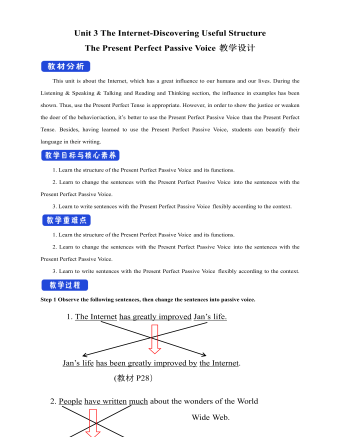
This unit is about the Internet, which has a great influence to our humans and our lives. During the Listening & Speaking & Talking and Reading and Thinking section, the influence in examples has been shown. Thus, use the Present Perfect Tense is appropriate. However, in order to show the justice or weaken the doer of the behavior/action, it’s better to use the Present Perfect Passive Voice than the Present Perfect Tense. Besides, having learned to use the Present Perfect Passive Voice, students can beautify their language in their writing. 1. Learn the structure of the Present Perfect Passive Voice and its functions. 2. Learn to change the sentences with the Present Perfect Passive Voice into the sentences with the Present Perfect Passive Voice. 3. Learn to write sentences with the Present Perfect Passive Voice flexibly according to the context. 1. Learn the structure of the Present Perfect Passive Voice and its functions. 2. Learn to change the sentences with the Present Perfect Passive Voice into the sentences with the Present Perfect Passive Voice. 3. Learn to write sentences with the Present Perfect Passive Voice flexibly according to the context. Step 1 Observe the following sentences, then change the sentences into passive voice.He has been selected to take part in the sports meeting.(肯定句)他已被挑选出来参加运动会。The ink has not been removed from his overcoat.(否定句)墨迹还没有从他外套上去掉。
新人教版高中英语必修2Unit 3 The Internet-Listening &Speaking&Talking教案二
From the pictures in the text and the title--- choose the best app, we can know that this part is about how to save money by using apps.Step 2 While-listening1. Laura and Xiao Bo are talking about apps. Listen to their conversation and find out what apps they want.Xiao Bo is looking for a(n) exercise app to help him get in shape.Laura would like an app for getting rich and another that will make her grades better.2. Listen again. Are the sentences true T or false F?1). Both of Xiao Bo's apps keep track of the steps he takes._____2). Xiao Bo's second app can help him make a fitness plan._____3). Laura needs an app that will help her get discounts.______4). Laura needs an app that will add money to her bank account._______F T F T3. Listen once more and tick the sentence you hear. Underline the words used to express predictions, guesses, and beliefs.Predictions, Guesses, and Beliefs________It might help me walk more.________My guess is that it wouldn't work.________I imagine this app would help me get fit faster________I suppose that would be good.________I guess you could save a little with this app.________I suppose there would be some problems, too.________I believe this app could help me get thinner.
新人教版高中英语必修2Unit 3 The Internet-Listening &Speaking&Talking教案一
Listening and Speaking introduces the topic of “ask about online habits”. Many middle school students have been surfing the Internet for many years, but what they do with the Internet and how much time they spend every day may not be very clear to themselves, nor to other students. This section allows students to investigate their peers' Internet use, which is conducive to their mutual understanding and understanding of the Internet. It can also help them reflect on their own online behavior, learn from other people's good online habits, and get rid of their bad online behavior.The listening text of this section is an investigation interview. The investigators interview specific groups with the same questions to obtain information, so as to understand their views, practices or attitudes on this issue. There are two specific questions: “how much time do you spend online every day? What do you usually do online?”. The answers of the three respondents provide rich and different information, and achieve the purpose of the investigators. The oral discourse structure of survey interviews generally includes greeting and explaining the purpose of the interview, presenting the interview questions and the respondents' answers. Listening and Talking introduces the theme of “choosing the right application ". Listening text is a conversation between Laura and Xiao Bo. In this part of listening, “oink”; “piggy bank” may cause the students' hearing comprehension limitation. Oink refers to sound word and pig's sound. So, add some oink to my piggy bank is often used to describe "making a little money".1. Guide students to understand the content of listening texts in terms of listening for definitions.2. Cultivate students' ability to define words and understand an investigation interview.
新人教版高中英语必修2Unit 3 The Internet-Reading and Thinking教案一
Paragraph 3. Jan decided to start an IT club to teach old people how to use computers and the Internet. Paragraph 4. Jan has started taking online classes to learn more about how to use the Internet to make society better. Paragraph 5. Jan’s life has been greatly improved by the Internet. Step 5: Critical thinking:(1)How do you arrange your time spent on study and the Internet? Is it reasonable? I usually surf the Internet using my mobile phone for only an hour after class, and it is reasonable for me.(2)What are your online activities? Are they safe? I chat with my friends, read news and play games. I never give away my private information so I think they are safe.Step 4: summary Much has been written about the wonders of the World Wide Web. There are countless articles (1)______(tell) us how the Internet has made our lives more convenient. But the Internet has done a lot (2)_____(much) for people than simply make life more convenient. People’s lives (3) _________________(change) by online communities and social networks so far. Take Jan for example, who developed a serious illness that made her (4)_____(stick) at home with only her computer to keep (5)___(she) company. She joined an online group (6)______ she could share problems, support and advice with others. She considered the ability to remove the distance between people as one of the greatest (7)_______(benefit). She was so inspired (8)____ she started an IT club in which many people have been helped. She has started to learn more about how to use the Internet to make society better. Her next goal is to start a charity website to raise money (9)___ children in poor countries. Jan’s life has been (10)______(great) improved by the Internet. Step 5 Homework:Review what we have learned and find out the key language points in the text.
新人教版高中英语必修2Unit 4 History and Traditions-Listening&Speaking&Talking教案一
This unit is about history and traditions. From the opening page, we can know that this unit will introduce the history and traditions around the world. As Marcus Garvey says “A people without the knowledge of their past history, origin and culture is like a tree without roots”, it is important for students to realize the importance and value of knowing the history and traditions and their further meanings. And this part ( listening and speaking ) is divided into two parts: Part A---share views on historic sites, Part B ---talk about a visit to a historic tourist destination. By talking with a foreigner, the speakers introduce the historic attractions and their cultures. Part A is that William, a British student, who was going to visit the Confucius Temple and a Chinese student, Xiao Kong, who was going to the Confucius Temple to meet with the members of the research group, went together and exchanged their views on the Confucius Temple, Confucius, Confucius' descendants and Confucius' educational thoughts. Part B is a conversation between Xiao Yan, a youth hostel receptionist and Paul, a backpacker about the feelings and experience after visiting the Chinese famous tourist attraction Pingyao.1. Guide students to understand the content of listening texts in terms of the whole and key details; 2. Cultivate students' ability to guess the meaning of words in listening; discuss with their peers how to talk about historic spots and great person.3. Instruct students to use functional sentences of showing one’s excitement, surprise and disappointment.1. Guide students to understand the content of listening texts in terms of the whole and key details; 2. Cultivate students' ability to discuss with their peers the related topics.3. Enable students to use the functional items of showing one’s excitement, surprise and disappointment.
新人教版高中英语必修2Unit 3 The Internet-Reading For Writing教案一
⑦identity theft 身份盗窃⑧chat room 聊天室⑨draft your blog post 起草博客帖子⑩post embarrassing photos 张贴尴尬照片 【话题句式】 1. How do you stay safe online and avoid bad experiences on the Internet? 你如何在网上保持安全, 避免在网上的不良经历? 2. I’m not an expert, but many years as a blogger have taught me a thing or two. 我不是专家, 但作为一个博主, 我已经学了好几年了。 3. If you see or read something that makes you feel uncomfortable, leave the site immediately. 如果你看到或读到一些让你觉得不舒服的东西, 立即离开这个网站。4. Don’t give out your address or phone number. 别告诉别人你的地址或电话号码。 5. Identity theft is a common and serious problem. 身份盗窃是一个常见而严重的问题。6. Being online is no excuse for being rude, and you don’t want to become a target for a troll or cyberbully. 上网并不是无礼的借口, 你也不想成为发挑衅帖子的人或网络恶霸的目标。 7. Trolls often use several false names so that they can stay on a site. 发挑衅帖子的人经常使用几个假名, 这样他们就可以留在一个网站上。8. However, the more polite you are, the less likely it is you will be attacked. 然而, 你越有礼貌, 你被攻击的可能性就越小。
新人教版高中英语必修2Unit 4 History and Traditions-Discovering Useful Structure教案二
This teaching period mainly deals with grammar: The past participle is used as attributive and objective complement.1. Guide students to review the basic usages of the past participle used as attributive and objective complement.2. Lead students to learn to use some special cases concerning the past participle used as attributive and objective complement flexibly.3. Strengthen students’ great interest in grammar learning.1. Help students to appreciate the function of the past participle used as attributive and objective complement.2. Instruct students to write essays using the past participle used as attributive and objective complement.Step1:温故而知新。Analyze the underlined phrases and then sum up the common usages of the past participles.1.(教材P41)They had castles built(build) all around England, and made changes to the legal system.2.(教材P42)They use the same flag, known(know) as the Union Jack,...3.(教材P42)Judy and I had our car parked(park) in an underground car park near Trafalgar Square, where we could get our car battery charged(charge).Common points: f the past participle used as attributive and objective complement.Step 2:过去分词作定语时的意义1.及物动词的过去分词作定语,在语态上表示被动;在时间上,常表示动作已经发生或完成,有时也不表示时间性。Our teacher watched us doing the experiment and gave us a satisfied smile at last.我们的老师看着我们做实验,最后给了我们一个满意的微笑。The plan put forward at the meeting will be carried out soon.会上提出的计划将很快被执行。2.不及物动词的过去分词作定语,它不表示被动意义,只强调动作完成。Many little kids like gathering fallen leaves in the yard.